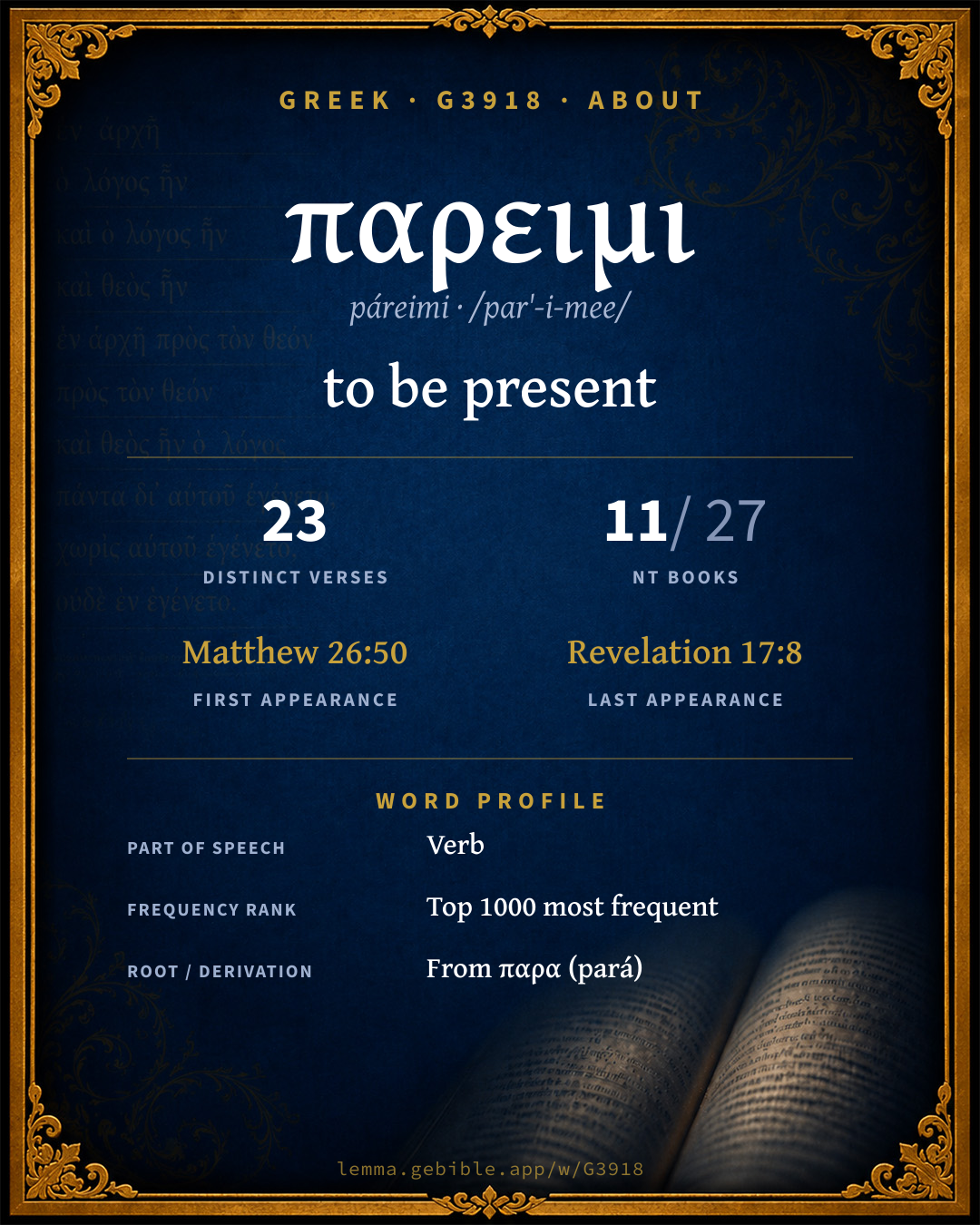
πάρειμι
to be present
also: to be by, be at hand, to have arrived fuller range ↓
Full lexicon entry — Thayer's Greek Lexicon
From Thayer's Greek Lexicon
Where this word appears
See every Present-tense verb in the Greek New Testament →
Grammar key — what these labels mean
Part of speech
- Verb
- An action or state-of-being word.
Tense
- Present
- Ongoing or general action in present time (imperfective aspect).
- Imperfect
- Continuous or repeated action in past time (“was writing”).
- Future
- Action expected in future time.
Voice
- Active
- The subject performs the action.
- Middle deponent
- Middle in form but active in meaning.
Mood
- Participle
- A verbal adjective (“writing,” “having written”).
- Indicative
- States a fact or asks a factual question (the mood of reality).
- Infinitive
- A verbal noun (“to write”), unmarked for person or number.
Case
- Nominative
- The case of the subject (and the predicate nominative).
- Accusative
- The case of the direct object and of extent.
- Dative
- The case of the indirect object, means, or location — “to / for / with / in.”
- Genitive
- The case of source, possession, or “of” — answers “whose / from what.”
Person
- 3rd person
- The one spoken about (“he / she / it / they”).
- 1st person
- The speaker (“I / we”).
- 2nd person
- The one addressed (“you”).
Gender
- Masculine
- Grammatically masculine.
- Neuter
- Grammatically neuter.
- Feminine
- Grammatically feminine.
Number
- Singular
- One.
- Plural
- More than one.
Grammatical forms 14 distinct
- Verb, Present, Active, Participle, Nominative, Singular, Masculine 6 times (25%)
- Verb, Present, Active, Indicative, 3rd person, Singular 3 times (13%)
- Verb, Present, Active, Infinitive 3 times (13%)
- Verb, Imperfect, Active, Indicative, 3rd person, Plural 2 times (8%)
- Verb, Future, Middle deponent, Indicative, 3rd person, Singular 1 time (4%)
- Verb, Present, Active, Indicative, 1st person, Plural 1 time (4%)
- Verb, Present, Active, Indicative, 2nd person, Plural 1 time (4%)
- Verb, Present, Active, Indicative, 2nd person, Singular 1 time (4%)
+6 more forms (6 occurrences)
Parsed forms decoded from the imported morphology (Robinson–Tischendorf, public domain), counted across 24 parsed occurrences — not distinct verses.
Every verse where G3918 appears — 23 distinct verses across 11 books. Click any verse to open its interlinear word-by-word view. Verse text shown in the World English Bible for context — . Each verse’s Greek form is shown with its reference; the English is not keyword-highlighted, since the data carries no word-level English alignment. Use “Compare translations” on any verse to read it across multiple English versions. This concordance covers the Greek New Testament; Septuagint (Greek Old Testament) occurrences of this word are not indexed here.
Matthew 1 verse
Luke 1 verse
John 2 verses
Acts 5 verses
- Acts 10:21 πάρεστε pres act ind 2pl Peter went down to the men, and said, "Behold, I am he whom you seek. Why have you come?"
- Acts 10:33 πάρεσμεν pres act ind 1pl Therefore I sent to you at once, and it was good of you to come. Now therefore we are all here present in the sight of God to hear all things that have been commanded you by God."
- Acts 12:20 παρῆσαν impf act ind 3pl Now Herod was very angry with the people of Tyre and Sidon. They came with one accord to him, and, having made Blastus, the king's chamberlain, their friend, they asked for peace, because their country depended on the king's country for food.
- Acts 17:6 πάρεισιν pres act ind 3pl When they didn't find them, they dragged Jason and certain brothers before the rulers of the city, crying, "These who have turned the world upside down have come here also,
- Acts 24:19 παρεῖναι pres act inf They ought to have been here before you, and to make accusation, if they had anything against me.
1 Corinthians 1 verse
2 Corinthians 5 verses
- 2 Corinthians 10:2 παρὼν pres act ptcp nom sg masc Yes, I beg you that I may not, when present, show courage with the confidence with which I intend to be bold against some, who consider us to be walking according to the flesh.
- 2 Corinthians 10:11 παρόντες pres act ptcp nom pl masc Let such a person consider this, that what we are in word by letters when we are absent, such are we also in deed when we are present.
- 2 Corinthians 11:8 παρὼν pres act ptcp nom sg masc I robbed other assemblies, taking wages from them that I might serve you.
- 2 Corinthians 13:2 παρὼν pres act ptcp nom sg masc I have said beforehand, and I do say beforehand, as when I was present the second time, so now, being absent, I write to those who have sinned before now, and to all the rest, that, if I come again, I will not spare;
- 2 Corinthians 13:10 παρὼν pres act ptcp nom sg masc For this cause I write these things while absent, that I may not deal sharply when present, according to the authority which the Lord gave me for building up, and not for tearing down.
Galatians 2 verses
Colossians 1 verse
Hebrews 2 verses
- Hebrews 12:11 παρὸν pres act ptcp acc sg neut All chastening seems for the present to be not joyous but grievous; yet afterward it yields the peaceful fruit of righteousness to those who have been exercised thereby.
- Hebrews 13:5 παροῦσιν pres act ptcp dat pl neut Be free from the love of money, content with such things as you have, for he has said, "I will in no way leave you, neither will I in any way forsake you."
2 Peter 2 verses
- 2 Peter 1:9 πάρεστιν pres act ind 3sg For he who lacks these things is blind, seeing only what is near, having forgotten the cleansing from his old sins.
- 2 Peter 1:12 παρούσῃ pres act ptcp dat sg fem Therefore I will not be negligent to remind you of these things, though you know them, and are established in the present truth.
Revelation 1 verse
About this entry
At a glance — auto-summarized from this page’s data, not written by a person. Every figure links to its source below. This summary describes the numbers; it doesn’t interpret them.
παρειμι (páreimi) is a Greek verb most often rendered “to be present.” It first appears in Matthew 26:50. With 23 verses in 11 books, it is an uncommon word in the Greek New Testament. Ranging over 2 senses, its meaning includes “to be by”, “be at hand”, and “to have arrived”. It clusters with παρα, παραβαινω and παραβαλλω under a shared root. For the data behind this summary, explore the sense tree and the renderings breakdown below.
Gloss history
Strong's 1890 vs modern scholarship

About this word
Strong's G3918 catalogs a Greek word from the Greek New Testament.
These counts are not copied from any lexicon or concordance. They are computed here, from the morphology-tagged Greek New Testament. What Lemma adds →
- 23
- distinct verses
- The word appears in 23 distinct verses.
- 11 / 27
- NT books
- The word appears in 11 of 27 New Testament books.
- #548
- by frequency
- Top 1000 most frequent Greek words (rank 548 of 5,347 Greek words by occurrence).
View all 23 occurrences in the concordance →
Most concentrated in
- Acts 5 verses 22%
- 2 Corinthians 5 verses 22%
- John 2 verses 9%
By section of the New Testament
By traditional corpus
Conventional, traditional groupings — biblical authorship is debated, so this is a traditional corpus grouping, not an authorship claim. Some books belong to more than one corpus (Luke is in both the Gospels and the Lukan corpus, and so on), so these shares overlap and need not total 100%. Each figure is a share of the word’s 23 distinct verses.
- Pauline corpus 9 verses · 39%
- Lukan (Luke–Acts) 6 verses · 26%
- Gospels 4 verses · 17%
- Johannine 3 verses · 13%
- Hebrews 2 verses · 9%
- General (Catholic) Epistles 2 verses · 9%
- Revelation 1 verse · 4%
How translations render this word
Counts come from each version’s own published word-to-Strong’s tagging or interlinear alignment — an approximate guide to how each version renders this word, not a word-level alignment the data otherwise carries. Because each total is that version’s own tagged count, the per-version totals vary from one another and need not match the appearance or distinct-verse counts above. These counts may also differ from a printed concordance because Lemma counts each distinctly tagged rendering and does not collapse phrase taggings into a single head-word total. This is a fixed set of word-tagged versions (KJV, ASV, BSB, ULT) and does not change with the reading translation you choose elsewhere. Each version’s license is shown beside its name below (and on Sources).
- King James Version: Present 4×, I were present 2×, Is come 2×
- American Standard Version: Present 5×, Are come 2×, I was present 2×
- Berean Standard Bible: I am present 2×, I was 2×, Present 2×
- unfoldingWord Literal Text: Being present 9×, Present 4×, Are 3×
King James Version Public Domain
Renders G3918 across 24 tagged occurrences — most commonly:
Plus 16 renderings that appear only once — usually multi-word phrases or single function words the recovered tagging swept in, not distinct renderings. Not rendered by a distinct English word in 1 further occurrence.
American Standard Version Public Domain
Renders G3918 across 24 tagged occurrences — most commonly:
Plus 15 renderings that appear only once — usually multi-word phrases or single function words the recovered tagging swept in, not distinct renderings.
Berean Standard Bible Public Domain
Renders G3918 across 22 tagged occurrences — most commonly:
Plus 16 renderings that appear only once — usually multi-word phrases or single function words the recovered tagging swept in, not distinct renderings. Not rendered by a distinct English word in 1 further occurrence.
unfoldingWord Literal Text CC BY-SA 4.0
Renders G3918 across 29 tagged occurrences — most commonly:
Plus 11 renderings that appear only once — usually multi-word phrases or single function words the recovered tagging swept in, not distinct renderings.
Senses in Thayer's
The 2 senses Thayer's distinguishes for this word, in lexicon order (not ranked by frequency or importance). The full entry — with sub-senses — is in the Lexicon Entry tab.
- to be by, be at hand, to have arrived, to be present
- to be ready, in store, at command
Word origin
Derived from παρα (pará) (G3844) — from.
Forms in the corpus
The 16 distinct written forms G3918 takes in the Greek New Testament, most frequent first — each parse links to that tense’s occurrences in the concordance.
Same root — word family
Other Thayer's entries built from the same root as G3918, grouped by Strong’s listed origin. These share a root / origin per the lexicon — not necessarily a shared meaning. Each links to that word’s own entry.
Derives from
Shares the same root
- παραβαινω parabaínō G3845 to neglect
- παραβαλλω parabállō G3846 to place beside
- παραβιαζομαι parabiázomai G3849 to compel
- παραβουλευομαι parabouleúomai G3851 to consult wrongly
- παραγγελλω parangéllō G3853 to announce
- παραγινομαι paragínomai G3854 to appear
- παραγω parágō G3855 to pass by
- παραδειγματιζω paradeigmatízō G3856 to make example
- παραδεχομαι paradéchomai G3858 to receive
- παραδιατριβη paradiatribḗ G3859 empty business
- παραδιδωμι paradídōmi G3860 to deliver
- παραδοξος parádoxos G3861 strange
- παραζηλοω parazēlóō G3863 to provoke
- παραθαλασσιος parathalássios G3864 by the sea
- παραθεωρεω paratheōréō G3865 to compare
- παραινεω parainéō G3867 to exhort
- παραιτεομαι paraitéomai G3868 to beg pardon
- παρακαθιζω parakathízō G3869 to sit beside
- παρακαλεω parakaléō G3870 to call beside
- παρακαλυπτω parakalýptō G3871 to cover up
- παρακαταθηκη parakatathḗkē G3872 deposit
- παρακειμαι parákeimai G3873 to lie beside
- παρακολουθεω parakolouthéō G3877 to follow after
- παρακουω parakoúō G3878 to disobey
+51 more words share this root (not shown).
Derived from this word
Proper names from this root
People and places named from this root — a name, not an additional meaning of the word.
Compare all same-root words → Showing 4 of 79 — not the complete family. 1 of the same-root words is a proper name (a person or place). They share a root, not necessarily a meaning.
Septuagint usage
The same Greek word παρειμι appears 25 times in the Greek Old Testament (Septuagint), across 24 verses in 14 books.
- 25
- LXX occurrences
- Tagged occurrences of this Greek word in the Septuagint.
- 24
- verses
- Distinct Septuagint verses containing this word.
- 14 / 39
- OT books
- The word appears in 14 of the 39 Old Testament books.
Sample Septuagint occurrences
- Numbers 22:20 παραεἰμί
- Deuteronomy 32:35 παραεἰμί
- 1 Samuel 9:6 παραεἰμί
- 2 Samuel 13:35 παραεἰμί
- 1 Chronicles 14:14 παραεἰμί
- Esther 9:1 παραεἰμί
- Job 1:7 παραεἰμί
- Psalms 137:8 παραεἰμί
- Proverbs 1:27 παραεἰμί
- Isaiah 8:1 παραεἰμί
- Lamentations 4:18 παραεἰμί
- Daniel 7:13 παραεἰμί
Septuagint occurrences (same lexeme)
Every verse where the same Strong’s number (G3918) appears in the Greek Septuagint. Verse text shown in the World English Bible for context; the Greek form is the matched word — the English is not keyword-highlighted.
- Numbers 22:20 παραεἰμί God came to Balaam at night, and said to him, If the men are come to call you, rise up, go with them; but only the word which I speak to you, that shall you do.
- Deuteronomy 32:35 παραεἰμί Vengeance is mine, and recompense, At the time when their foot shall slide: For the day of their calamity is at hand, The things that are to come on them shall make haste.
- 1 Samuel 9:6 παραεἰμί He said to him, See now, there is in this city a man of God, and he is a man who is held in honor; all that he says comes surely to pass: now let us go there; peradventure he can tell us concerning our journey whereon we go.
- 2 Samuel 13:35 παραεἰμί Jonadab said to the king, Behold, the king's sons are come: as your servant said, so it is.
- 2 Samuel 15:18 παραεἰμί All his servants passed on beside him; and all the Cherethites, and all the Pelethites, and all the Gittites, six hundred men who came after him from Gath, passed on before the king.
- 1 Chronicles 14:14 παραεἰμί David inquired again of God; and God said to him, You shall not go up after them: turn away from them, and come on them over against the mulberry trees.
- Esther 9:1 παραεἰμί Now in the twelfth month, which is the month Adar, on the thirteenth day of the same, when the king's commandment and his decree drew near to be put in execution, on the day that the enemies of the Jews hoped to have rule over them, (whereas it was turned to the contrary, that the Jews had rule over those who hated them),
- Job 1:7 παραεἰμί Yahweh said to Satan, "Where have you come from?" Then Satan answered Yahweh, and said, "From going back and forth in the earth, and from walking up and down in it."
- Job 2:2 παραεἰμί Yahweh said to Satan, "Where have you come from?" Satan answered Yahweh, and said, "From going back and forth in the earth, and from walking up and down in it."
- Psalms 137:8 παραεἰμί Daughter of Babylon, doomed to destruction, He will be happy who rewards you, As you have served us.
- Psalms 138:8 παραεἰμί Yahweh will fulfill that which concerns me; Your loving kindness, Yahweh, endures forever. Don't forsake the works of your own hands.
- Proverbs 1:27 παραεἰμί When calamity overtakes you like a storm, When your disaster comes on like a whirlwind; When distress and anguish come on you.
- Proverbs 7:19 παραεἰμί For my husband isn't at home. He has gone on a long journey.
- Proverbs 8:27 παραεἰμί When he established the heavens, I was there; When he set a circle on the surface of the deep,
- Proverbs 9:15 παραεἶμι To call to those who pass by, Who go straight on their ways,
- Isaiah 8:1 παραεἰμί Yahweh said to me, "Take a large tablet, and write on it with a man's pen, 'For Maher Shalal Hash Baz;'
- Isaiah 30:13 παραεἰμί therefore this iniquity shall be to you as a breach ready to fall, swelling out in a high wall, whose breaking comes suddenly in an instant.
- Isaiah 52:6 παραεἰμί Therefore my people shall know my name: therefore [they shall know] in that day that I am he who does speak; behold, it is I.
- Isaiah 58:9 παραεἰμί Then shall you call, and Yahweh will answer; you shall cry, and he will say, Here I am. If you take away from the midst of you the yoke, the putting forth of the finger, and speaking wickedly;
- Isaiah 63:4 παραεἰμί For the day of vengeance was in my heart, and the year of my redeemed is come.
- Lamentations 4:18 παραεἰμί They hunt our steps, so that we can't go in our streets: Our end is near, our days are fulfilled; for our end is come.
- Daniel 7:13 παραεἰμί I saw in the night-visions, and, behold, there came with the clouds of the sky one like a son of man, and he came even to the ancient of days, and they brought him near before him.
- Joel 2:1 παραεἰμί Blow you the trumpet in Zion, And sound an alarm in my holy mountain! Let all the inhabitants of the land tremble, For the day of Yahweh comes, For it is close at hand:
- Habakkuk 3:2 παραεἰμί Yahweh, I have heard of your fame. I stand in awe of your deeds, Yahweh. Renew your work in the midst of the years. In the midst of the years make it known. In wrath, you remember mercy.
These are occurrences of the same Greek lexeme (G3918) in the Septuagint — not a translation of any one Hebrew word. The store carries no word-level Hebrew↔Greek alignment, so no Hebrew original is asserted here. Counts come from the recovered LXX Strong's tagging — high-frequency vocabulary is well covered, while rare or late forms may be untagged — so they reflect tagged occurrences and may slightly undercount.