
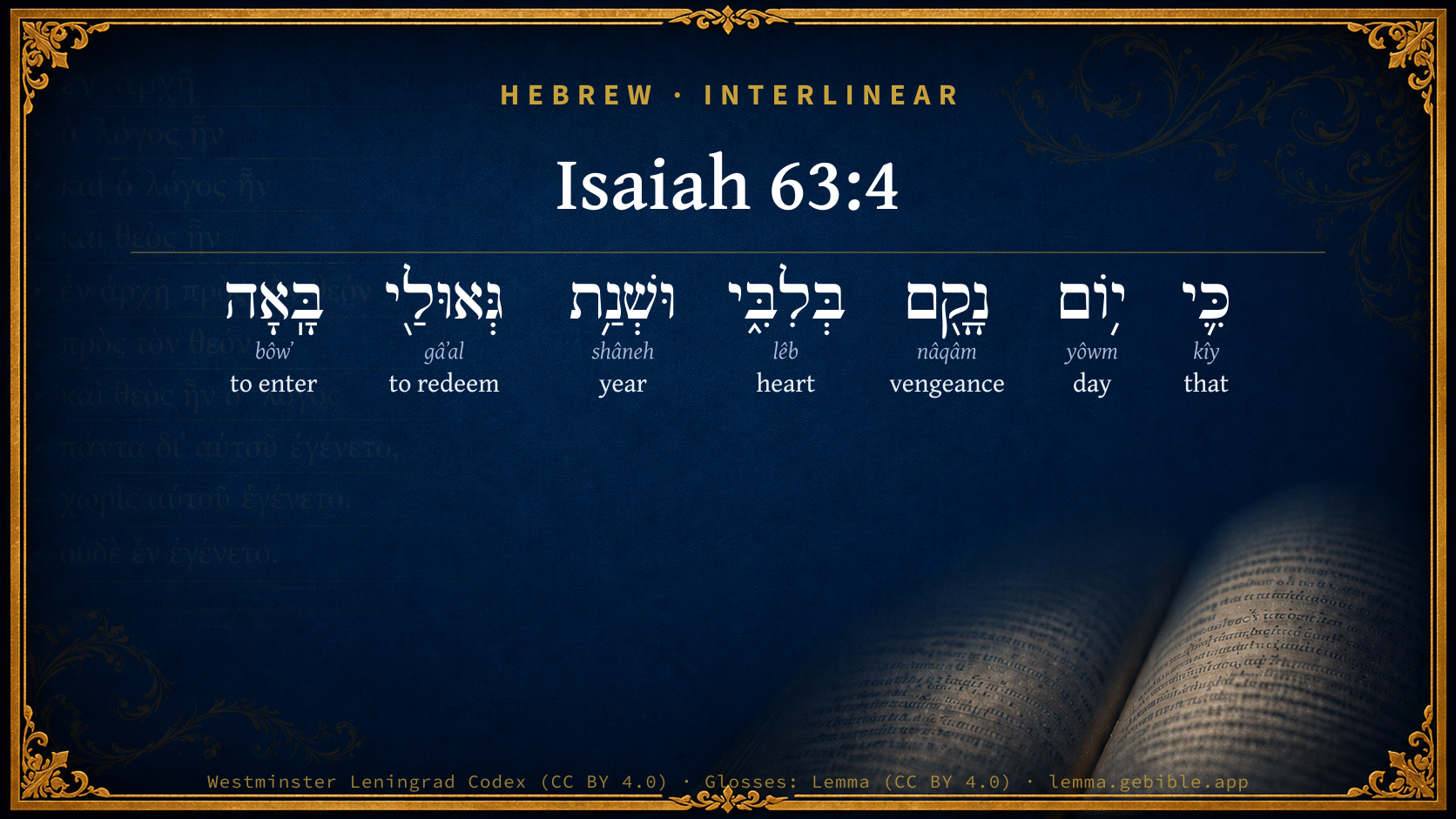
Isaiah 63:4

Hebrew (Westminster Leningrad Codex) Isaiah 63:4 appears in the Hebrew Old Testament. The text above is from the Westminster Leningrad Codex. Each word links to its Strong’s number, a concise gloss, and parsing drawn from the Open Scriptures Hebrew Bible morphology. Click any word for its full Brown-Driver-Briggs (BDB) entry.
Download image
Cite this verse

Isaiah 63:4 (World English Bible). Public Domain. Lemma interlinear Bible study tool, https://lemma.gebible.app/v/isaiah/63/4.

Show BibTeX & RIS
BibTeX
RIS
English Translation
For the day of vengeance was in my heart, and the year of my redeemed is come.
World English Bible · Public Domain
Download a study sheet

One document with this verse’s original text, its word-by-word gloss line, the meaning frame, cross-references with their text, attributed commentary, and full source and license credits — printable, and it pastes into notes with its structure intact.

This verse Autodidact and up

Study sheet (.html) Plain text (.txt)

A passage Seminary Student

Up to 50 verses in one chapter. A passage sheet keeps up to 6 commentary sources and 12 cross-references per verse, in the order this page ranks them, and says so on the sheet whenever that leaves anything out. Ask for a single verse and you get the Autodidact verse sheet above.

Everything on this page stays free to read, with no account — the sheet is a download of what is already on screen, not access to it.

Want to remove ads? Support Godless Engineer
Compare translations 3

The same verse in 3 English versions, stacked beneath the original-language interlinear above. Click any original word for its lexicon entry.

Each is an independent rendering of the whole verse — the interlinear is not word-aligned to these translations.

Highlighted words mark where these versions differ — a whole-verse word diff, not a word-by-word alignment.

  • World English Bible Public Domain
    For the day of vengeance was in my heart, and the year of my redeemed is come.
  • King James Version Public Domain
    For the day of vengeance is in mine heart, and the year of my redeemed is come.
  • unfoldingWord Literal Text CC BY-SA 4.0
    For the day of vengeance in my heart, and the year of my redeemed ones came.

unfoldingWord Literal Text — © unfoldingWord, licensed CC BY-SA 4.0. Word-aligned USFM3 via Door43 (git.door43.org/unfoldingWord/en_ult).

Versions to compare (up to 4)

3 of 4 selected

Show all 18 translations

Every available English version of this verse, each an independent rendering of the whole verse.

  • World English Bible Public Domain
    For the day of vengeance was in my heart, and the year of my redeemed is come.
  • Berean Standard Bible Public Domain
    For the day of vengeance was in My heart, and the year of My redemption had come.
  • Majority Standard Bible Public Domain
    For the day of vengeance was in My heart, and the year of My redemption had come.
  • King James Version Public Domain
    For the day of vengeance is in mine heart, and the year of my redeemed is come.
  • American Standard Version (1901) Public Domain
    For the day of vengeance was in my heart, and the year of my redeemed is come.
  • Revised Version (1885) Public Domain
    For the day of vengeance was in mine heart, and the year of my redeemed is come.
  • Geneva Bible (1599) Public Domain
    For the day of vengeance is in mine heart, and the yeere of my redeemed is come.
  • Douay-Rheims (1899) Public Domain
    For the day of vengeance is in my heart, the year of my redemption is come.
  • Young's Literal Translation Public Domain
    For the day of vengeance `is' in my heart, And the year of my redeemed hath come.
  • Literal Standard Version CC BY-SA 4.0
    For the day of vengeance [is] in My heart, || And the year of My redeemed has come.
  • Unlocked Literal Bible CC BY-SA 4.0
    For I looked forward to the day of vengeance, and the year for my redemption had arrived.
  • unfoldingWord Literal Text CC BY-SA 4.0
    For the day of vengeance in my heart, and the year of my redeemed ones came.
  • Darby Bible Public Domain
    For the day of vengeance was in my heart, and the year of my redeemed had come.
  • World Messianic Bible Public Domain
    For the day of vengeance was in my heart, and the year of my redeemed has come.
  • Webster's Bible Public Domain
    For the day of vengeance is in my heart, and the year of my redeemed is come.
  • Free Bible Version CC BY-SA 4.0
    For I decided this was the day of my vengeance; the year of my redemption has come.
  • Bible in Basic English Public Domain
    For the day of punishment is in my heart, and the year for the payment of the price for my people has come.
  • JPS Tanakh (1917) Public Domain
    For the day of vengeance that was in My heart, and My year of redemption are come.

Literal Standard Version (2020), Covenant Press — licensed CC BY-SA 4.0. Text via the HelloAO Bible API (eBible.org). Unlocked Literal Bible (unfoldingWord) — licensed CC BY-SA 4.0. Text via the HelloAO Bible API (eBible.org). unfoldingWord Literal Text — © unfoldingWord, licensed CC BY-SA 4.0. Word-aligned USFM3 via Door43 (git.door43.org/unfoldingWord/en_ult). Free Bible Version, Dr. Jonathan Gallagher — licensed CC BY-SA 4.0. Text via the HelloAO Bible API (eBible.org).

Word by word

More ways to search: Search by grammar → Find every occurrence → Compare this word →

Practice this passage: Drill this verse → Learn its vocabulary →

About this verse

These counts appear in no published source. They are computed here, from the morphology-tagged text and Lemma’s own curated glosses. What Lemma adds →

7
words
7
distinct lemmas
Prophets
section

Notable vocabulary

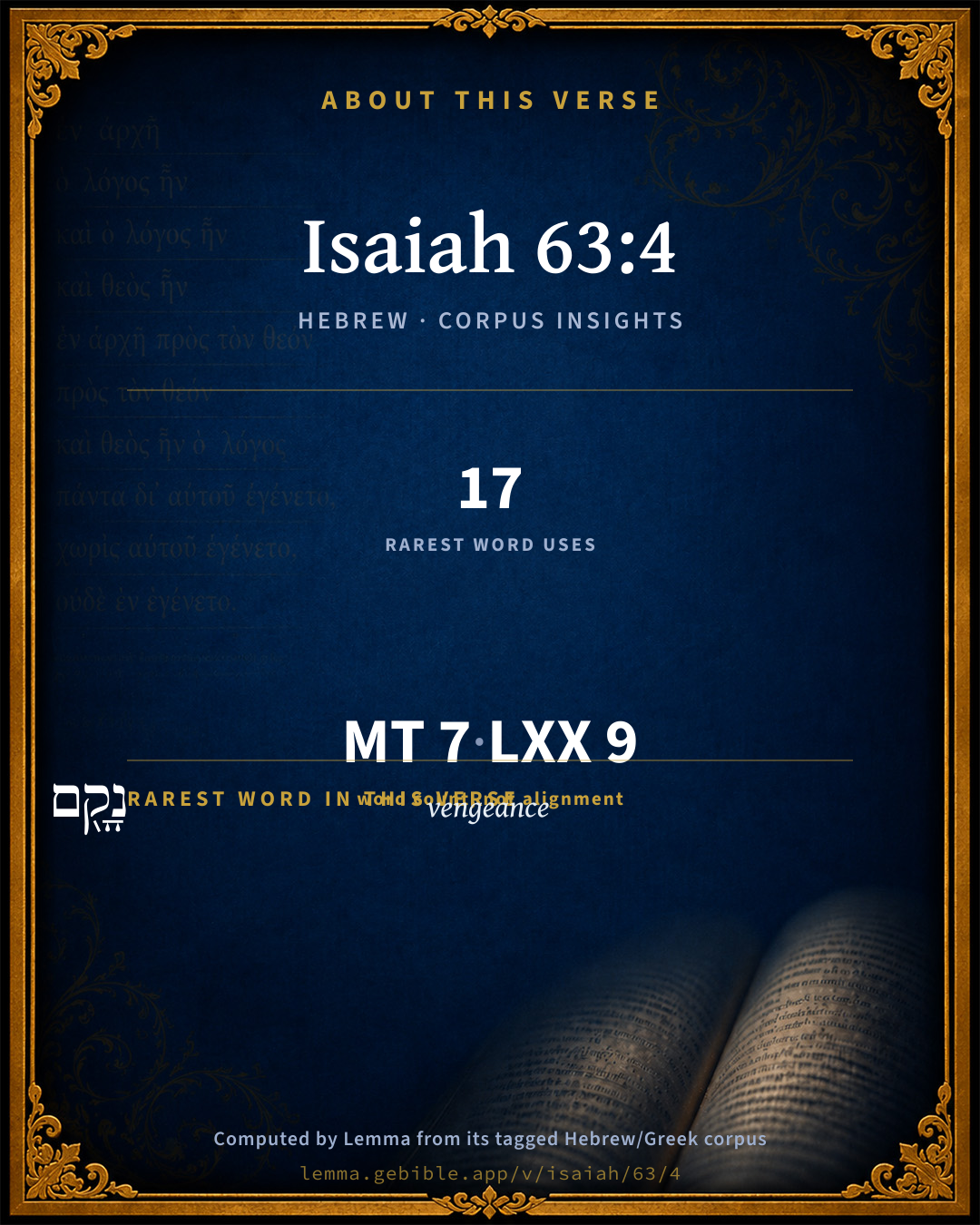
The rarest word here is נָקָ֖ם vengeance H5359 — appearing just 17 times in the whole Hebrew Bible.

Shared distinctive vocabulary

נָקָ֖ם vengeance H5359 occurs in 17 verses of the Hebrew Bible. Also found in:

Grammatical profile

  • 1 verb
  • 5 nouns
  • 1 conjunction

Verb forms

  • בָּֽאָה Qal · Perfect

Hebrew & Septuagint length

In English translation the verse runs 17 words from the Hebrew and 17 from the Septuagint (LXX English) — the same length.

A rough comparison of the two English renderings, which tokenize alike — not a word-level alignment.

Word counts can differ between the Hebrew and the Greek without any difference in meaning — e.g. the Hebrew direct-object marker אֵת has no separate Greek word, and Greek often adds the article ὁ.

In the original languages it is 7 Hebrew tokens and 9 Greek tokens — but the two are counted differently (Hebrew bundles its prefixes and suffixes into one token; the Greek is in lemma form), so that isn’t a like-for-like length.

Cross-references

9

Topical passages linked to Isaiah 63:4 in the Treasury of Scripture Knowledge — connected by theme and wording, ordered by reader-vote popularity; previews shown in the World English Bible.

  • Isaiah 34:8 For Yahweh has a day of vengeance, a year of recompense for the cause of Zion.
  • Isaiah 35:4 Tell those who are of a fearful heart, Be strong, don't be afraid: behold, your God will come [with] vengeance, [with] the recompense of God; he will come and save you.
  • Isaiah 61:2 to proclaim the year of Yahweh's favor, and the day of vengeance of our God; to comfort all who mourn;
  • Jeremiah 51:6 Flee out of the midst of Babylon, and save every man his life; don't be cut off in her iniquity: for it is the time of Yahweh's vengeance; he will render to her a recompense.
  • Revelation 18:20 Rejoice over her, O heaven, you saints, apostles, and prophets; for God has judged your judgment on her."
  • Luke 21:22 For these are days of vengeance, that all things which are written may be fulfilled.
  • Revelation 6:9–17 When he opened the fifth seal, I saw underneath the altar the souls of those who had been killed for the Word of God, and for the testimony of the Lamb which they had.
  • Revelation 11:13 In that day there was a great earthquake, and a tenth of the city fell. Seven thousand people were killed in the earthquake, and the rest were terrified, and gave glory to the God of heaven.
  • Zechariah 3:8 Hear now, Joshua the high priest, you and your fellows who sit before you; for they are men who are a sign: for, behold, I will bring forth my servant, the Branch.

Cross-references courtesy of OpenBible.info (CC BY 4.0).

Hebrew and Greek witnesses Masoretic Hebrew ↔ Greek Septuagint

The same verse in the two great witnesses to the Old Testament, shown verse-for-verse.

These are two independent witnesses, not word-aligned to each other, and the Septuagint is shown in lemma (dictionary) form.

Hebrew Isaiah 63:4 Masoretic · Westminster Leningrad Codex

כִּ֛י י֥וֹם נָקָ֖ם בְּלִבִּ֑י וּשְׁנַ֥ת גְּאוּלַ֖י בָּֽאָה

For the day of vengeance was in my heart, and the year of my redeemed is come.

World English Bible · Public Domain

Greek LXX Isaiah 63:4 Septuagint · lemma form

ἡμέρα γάρ ἀνταπόδοσις ἐπιἔρχομαι αὐτός καί ἐνιαυτός λύτρωσις παραεἰμί

For the day of recompence has come upon them, and the year of redemption is at hand.

LXX2012 (modern English Septuagint) · Public Domain

Hebrew: Westminster Leningrad Codex (CC BY 4.0). Greek: Septuagint (public domain); English from LXX2012 (modern English Septuagint) (Public Domain). How the Septuagint differs from the Hebrew →

Targum (Aramaic paraphrase)

1

The Targum is the ancient Jewish Aramaic paraphrase of the Hebrew Scriptures — an interpretive translation, not the Hebrew text itself. Onkelos (literal) and Pseudo-Jonathan (expansive) render the Torah, and Jonathan the Prophets. Coverage is partial: where no permissively-licensed English translation exists for a verse, only the Aramaic is shown. This is verse-level text, not a word-by-word alignment to the Hebrew.

  1. Targum Jonathan Prophets (Joshua–Malachi)
    אֲרֵי יוֹם פּוּרְעֲנוּתָא קֳדָמַי וּשְׁנַת פּוּרְקַן עַמִי מְטָת:

    For the day of vengeance is before me, and the year of the salvation of my people hath come.

    Targum Jonathan — Aramaic: “Mikraot Gedolot” (public domain). English: “Sefaria Community Translation” (CC0 1.0 (public-domain dedication)); “London "Chaldee Paraphrase," 1871” (public domain). Text via Sefaria.

Commentary

Notes on Isaiah 63:4 from classic Christian and Jewish commentators (each source and its license shown beneath its notes). The classic Christian expositions comment on the surrounding passage and are grouped to its opening verse, so a note may address several verses; the Jewish commentaries on the Tanakh (Rashi and others) are per-verse, so they appear only where the commentator wrote on this verse.

Lemma curates 59 commentaries, every one of them public domain or Creative Commons licensed, each selected and text-cleaned for this edition rather than reprinted as found. About our sources →

Trapp's Complete Commentary

John Trapp

Isa 63:4 For the day of vengeance [is] in mine heart, and the year of my redeemed is come.

Ver. 4. For the day of vengeance is in mine heart.] Or, Was in mine heart. Hence I made such havoc. Christ is the "Lord God of recompenses," {Jer 51:56} and the "Lord God of revenges"; {Psa 94:1} he is "jealous and furious," {Nah 1:2; see the note there} his feet, wherewith he treadeth down his enemies, are "like unto fine brass, as if they burned in a furnace." {Rev 1:15} Oh, "it is a fearful thing to fall into the punishing hands of this living God." {Heb 10:31}

And the year of my redeemed is come.] Their joyful jubilee. It is hail with the saints when ill with the wicked. The deliverance of those is oft the destruction of these.

John Trapp, A Commentary or Exposition upon All the Books of the Old and New Testament (1647–1656) — public domain. Text from a community e-Sword module.

The Biblical Illustrator

Joseph S. Exell

Isa_63:4

For the day of vengeance is in Mine heart

The day of vengeance"

The day of vengeance," announced in Isa_61:2.

Is in Mine heart, i.e in My purpose. (Prof. J. Skinner, D. D.)

The Redeemers vengeance upon the grand enemy of the redeemed

These words are a material repetition of the first promise (Gen_3:15). We have here--

1. The designation of Gods remnant of mankind--sinners. My redeemed. They are Mine by election, Mine by My Fathers donation, Mine by the purchase of My blood, and they are to be Mine by conquest.

2. The deep resentment that the glorious Redeemer has of the quarrel of the redeemed. The day of vengeance is mine heart.

3. The stated time for the deliverance of the redeemed. The day. The year.

4. The Redeemers satisfaction with the view of all this. He speaks of it with a particular air of joy and triumph. (E. Erskine.)

The annals of redeeming love

I. THE GREAT AND GLORIOUS REDEEMER. He is--

1. A chosen Redeemer. Mine elect.

2. A mighty Redeemer. Mighty to save.

3. A Redeemer of great authority. The government shall be upon His shoulder. His kingdom is an everlasting kingdom.

4. A wealthy Redeemer.

5. An incomparable Redeemer.

6. A resolute and courageous Redeemer.

II. THE REDEEMED.

III. THE YEAR OF THE REDEEMED. There is--

1. The year of purposed redemption. With respect to this year Christ is called a Lamb slain from the foundation of the world.

2. The year of purchased redemption. This year the great God was incarnate; the great Lawgiver voluntarily subjected Himself to His own law; God blessed for ever was made a curse; everlasting righteousness was brought in; God actually laid the foundation of a throne of grace, in justice and judgment, etc.

3. The year of exhibited redemption. The year of a Gospel-dispensation among a people.

4. The year of applied redemption; under which may be comprehended the whole period of time from the souls conversion unto the day of death.

5. The year of consummate redemption. This is a year which never, never ends.

IV. THE YEAR OF THE REDEEMED, THE JOY OF THE REDEEMERS HEART.

V. APPLICATION. (E. Erskine.)

The Redeemers vengeance

I. WHO IS THE GRAND ENEMY THAT THE GLORIOUS REDEEMER HAS IN HIS VIEW? Satan.

II. THE GROUND OF THE QUARREL THAT OUR REDEEMER HATH AGAINST THIS ENEMY. What injury hath Satan done to the redeemed? He hath deceived them; he defaced the image of God; he made them liable to the curse of the law; he made them his own slaves.

III. WHAT VENGEANCE IS IT THAT OUR REDEEMER TAKES UPON THIS ENEMY OF THE REDEEMED? A bruising of his head (Gen_3:15). A judging of the devil (Jon_16:11). A destroying of the devil (Heb_2:14). A spoiling of principalities and powers (Col_2:15). Our glorious Redeemer--

1. Invades Satans usurped kingdom and government, which he had established in this world. Satan is called the god of this world.

2. Out-shoots the devil in his own bow--takes this wise spirit in his own craftiness.

3. Condemns sin, the first-born of the devil.

4. Wrests the keys of death and hell out of the devils hand.

5. Lays a heavy chain upon the roaring enemy.

6. Takes those who were his slaves from under his power, and arms them with His truth, whereby they make war against him, under Christ as their Leader and Commander.

7. Makes a spectacle of him and all his legions (Col_2:15).

8. Makes a road between heaven and earth, by His ascension, through the very territories of the devil, who is called the prince of the power of the air.

9. Will, at the last day, make the poor believer, who was once under his power, and whom he many times harassed with his fiery darts, to judge and condemn him. Know ye not that the saints shall judge angels?

10. Burns his galleries, where he has walked up and down. The earth . . . shall be burned up.

IV. THE STATED TIME OF VENGEANCE, here called a day.

1. There are some seasons of His taking vengeance upon him in his own person.

(1) Upon the back of his first sin, when that proud spirit, swelled with ambition, attempted the throne of heaven, the Son of God, armed with His Fathers power, turned Him and His apostate legions down from heaven to hell (2Pe_2:4).

(2) The day of Christs incarnation.

(3) Of Christs death.

(4) The last judgment.

2. When Christ is avenged upon this enemy in the redeemed.

(1) The day of conversion.

(2) The day of believing.

(3) The renewed actings of faith under strong temptation.

(4) The day of special nearness to God in His ordinances.

(5) When the Redeemer brings multitudes of souls to yield themselves unto His obedience.

(6) When an honourable testimony is given for Christ in a Church against errors and blasphemies that the devil and his emissaries have vented, to the darkening of the Redeemers glory.

(7) The day of death, when the poor believer is guarded to glory through his principality.

V. WHY THIS DAY OF VENGEANCE IS SAID TO BE IN THE REDEEMERS HEART.

1. He had firmly purposed it.

2. The thoughts of it were a delight to Him.

3. He had not forgotten the quarrel he had with Satan and his works.

4. The stated time of final vengeance lay as a secret in His own breast.

V. APPLICATION. (E. Erskine.)

The year of my redeemed is come

The year of redemption

A rendering preferred by many authorities is, the year of My redemption: the plural being taken as expressing the abstract idea, in accordance with a common Hebrew usage. The year of redemption, is the same as the year of Jehovahs favour in Isa_61:2; it is the time of Israels victory and salvation, a year that has no end. (Prof. J. Skinner, D. D.)

The year of the redeemed

I. THE PERIOD FORETOLD. The word year, in such connections as this, is to be interpreted in a general sense as applying to a lengthened period of time. The year of the redeemed may not mean so much the year when Christ died, in order to redeem them, as the period when He should begin to win the victories of His grace among them; the period when He should be lifted up by the preaching of the Gospel, and draw all men unto Him; the period when the sign of the Son of Man, in the preaching of Christ and of Him crucified, should be visible in the ecclesiastical world, represented in the everlasting prophecy as heaven, and when by the preaching of a crucified Saviour, sinners, numerous as on the day of Pentecost and in succeeding times, should be won from darkness to light, and translated from the kingdom of Satan to the kingdom of Gods dear Son.

II. THE CERTAINTY OF ITS ARRIVAL. God has decreed it, and all its glories must be realized. It may be said to be come in the distinct and positive revelations of prophecy. In the prophecies of God, the decrees of God are unfolded. (W. H. Cooper.)

The Biblical Illustrator, edited by Joseph S. Exell (c. 1880s–1900s) — public domain. Text from a community e-Sword module.

Tyndale Open Study Notes

Tyndale Open Resources

63:4 the time . . . to avenge my people: See study note on 34:8. • to ransom: See study note on 43:1.

Tyndale Open Study Notes — © Tyndale Open Resources, licensed CC BY-SA 4.0. Text via the HelloAO Bible API.

Geneva Bible (1599)

Geneva Bible translators

Showing that when God punisheth his enemies, it is for the profit and deliverance of his Church.

Geneva Bible (1599) marginal notes — public domain. Text via Bolls.life.

Jamieson, Fausset & Brown

Robert Jamieson, A. R. Fausset & David Brown

is--rather, "was." This assigns the reason why He has thus destroyed the foe (Zep 3:8).

my redeemed--My people to be redeemed.

day . . . year--here, as in Isa 34:8; Isa 61:2, the time of "vengeance" is described as a "day"; that of grace and of "recompense" to the "redeemed," as a "year."

Jamieson, Fausset & Brown — Commentary Critical and Explanatory on the Whole Bible (1871) — public domain (CC PDM 1.0). Text via the HelloAO Bible API.

Ellicott's Commentary for English Readers

(4) The day of vengeance is.—Better, in both clauses, was, as pointing to the motive of the action, of which the blood-stained garments were the result.

The year of my redeemed . . .—Better, the year of my redemption, scil., the work of redeeming my people.

A Bible Commentary for English Readers, edited by Charles John Ellicott (1878–1897) — public domain. Text from a community e-Sword module.

The Cambridge Bible for Schools and Colleges

gen. ed. J. J. S. Perowne

4. the day of vengeance] announced in ch. Isa_61:2.

is in mine heart] i.e. in my purpose.

the year of my redeemed] Another rendering, preferred by many authorities, is the year of my redemption: the plural being taken as expressing the abstract idea, in accordance with a common Hebr. usage. The year of redemption is the same as the year of Jehovah’s favour in ch. Isa_61:2; it is the time of Israel’s victory and salvation, a year that has no end.

The Cambridge Bible for Schools and Colleges (gen. ed. J. J. S. Perowne; Cambridge University Press, 1878–1918) — public domain. Text from a community e-Sword module.

John Gill's Exposition

For the day of vengeance is in my heart,.... Resolved on with him, fixed by him, and which is desirable to him; he has it at heart, and longs as it were till the time is come to avenge the blood of his saints on the Romish antichrist, whom he will destroy with the breath of his mouth, and the brightness of his coming; see Th2 2:8 and when he shall pour out all his vials on the antichristian states, and revenge the cause and quarrel of his people, Rev 16:1,

and the year of my redeemed is come; the time when those who are already redeemed by the blood of Christ, and so are his property, whom he claims as his own, being the purchase of his blood, shall be redeemed again from antichristian bondage and slavery, shall be called and brought out of Babylon; and when those, who have led them captive, shall go into captivity themselves: this will be a jubilee year to the saints; a time of refreshing from the presence of the Lord; when, being rid of all their persecuting enemies, they will enjoy the utmost peace, prosperity, and safety; see Rev 13:10.

John Gill's Exposition of the Whole Bible (1746–1763) — public domain (CC PDM 1.0). Text via the HelloAO Bible API.

Albert Barnes' Notes on the Bible

For the day of vengeance - (See the notes at Isa 34:8).

And the year of my redeemed is come - The year when my people are to be redeemed. It is a year when their foes are all to be destroyed, and when their entire liberty is to be effected.

Albert Barnes' Notes on the Bible (1834–1885) — public domain. Text from a community e-Sword/MySword module.

Matthew Poole's English Annotations

The day of vengeance, designed and purposed by me to take vengeance on the enemies of my church; or particularly the posterity of Esau.

Day and

year is all one, save the latter may have some respect to the length of their captivity.

Is in mine heart; or, was in my heart; a desire of execution, Psa 40:8. I have meditated or studied revenge; being long forborne, hath wrought in me resolutions of revenge; therefore wonder not that I am so bloody: noting the severity of his proceedings against his enemies.

My redeemed: the Jews have this title, because he redeemed them out of Egypt, and would also out of Babylon.

Is come; is at hand: see Psa 102:13; Isa 34:8. The former part of the verse shows that Christ is still about his work, though he defer the execution till the fit time come; he may allude to the year of jubilee.

Matthew Poole's English Annotations on the Holy Bible (1683–1685) — public domain. Text from a community e-Sword/MySword module.

The Pulpit Commentary

For the day of vengeance is in my heart. Translate, for a day of vengeance was in my heart. (comp Isa_34:8 Isa_61:2) "A day" is time enough for God to take vengeance, to kill, and to destroy. He hastens over work that is necessary, but uncongenial. But he lengthens out the time of release and redemption for his loved ones. The "day of vengeance" ushers in the "year of redemption." Is come; rather, was come. The Divine speaker goes back to the time preceding the actual punishment of the nations.

The Pulpit Commentary (1880–1919), ed. H.D.M. Spence-Jones & Joseph S. Exell — public domain. Text from a community e-Sword module.

John Wesley's Explanatory Notes

Of vengeance - To take vengeance on the enemies of my church.

John Wesley, Explanatory Notes Upon the Whole Bible (1754–1765) — public domain. Text via the GEBible commentary corpus.

J. A. Alexander on Isaiah

Joseph Addison Alexander

“For the day of vengeance (is) in my heart, and the year of my redeemed is come.” For the sense of day and year in this connection, see above, on Isa 61:2. ‘In my heart’ (i.e., my mind or purpose). It is not necessary to explain the participle in a future sense (to be redeemed), since their redemption was as firmly settled in the divine purpose as the day of vengeance.

Joseph Addison Alexander, The Prophecies of Isaiah (1846–1847; New York: Scribner, 1870–1878) — public domain. Text from a community e-Sword module.

Scofield Reference Notes

C. I. Scofield

Day of the Lord (Day of Jehovah) Isa 2:10-22; Isa 4:1-6; Isa 11:10-13; Isa 13:9-16; Isa 24:21-23; Isa 26:20; Isa 26:21; Isa 63:1-6; Isa 66:15-24; Rev 19:11-21

The Scofield Reference Bible (1917 edition), notes by C. I. Scofield — public domain. Text from a community e-Sword module.

Ibn Ezra

Rabbi Abraham ibn Ezra

For the day of vengeance, etc. For I will wreak vengeance against my enemies, and I will redeem my friends. גאולי My redeemed. It is participle passive plural with the suffix, first person, referring to God.

Ibn Ezra on the Tanakh — English translations: “Sefaria Community Translation” (CC0 1.0 (public-domain dedication)); “Yalkut, Sifsei Chachomim Chumash, Metsudah Publications, 2009” (CC BY 4.0); and “Commentary of Ibn Ezra on Isaiah - trans. by M. Friedlander, 1873” (public domain). Text via Sefaria.

Lesson kit

Teaching starters — assembled from the data on this page, not authored interpretation. Every prompt links to the verse data it draws on. Edit before teaching.

Isaiah, in the Prophets, opens this verse with 7 words (7 distinct Hebrew lemmas). Its most distinctive word is nâqâm (“vengeance”). A historical commentator’s framing appears above. Read the whole chapter for the surrounding context.

Discussion questions

  1. The word nâqâm carries the sense “vengeance.” How does it shape the verse?
  2. Leviticus 26:25 shares the word «vengeance» with this verse. How do the two illuminate each other?
  3. The translations on this page render this verse differently — a whole-verse word diff, not a word-by-word alignment. What might account for the different wordings?
  4. The verb «בָּֽאָה» is Qal Perfect. How does its form color the action?
  5. Reading how Trapp's Complete Commentary and The Biblical Illustrator read this verse, where do the two commentators agree and where do they part?

Things to notice

Reading settings

Reading text

Shown beneath each verse's original-language words.

Old Testament
Old Testament edition

Read the OT as the Masoretic Hebrew (MT) or the Greek Septuagint (LXX).

English shown for the Greek Septuagint (in the Hebrew ↔ Greek comparison).

Comparing translations? Open the Compare panel on any verse page to stack up to four side by side.