
Proverbs 9:15

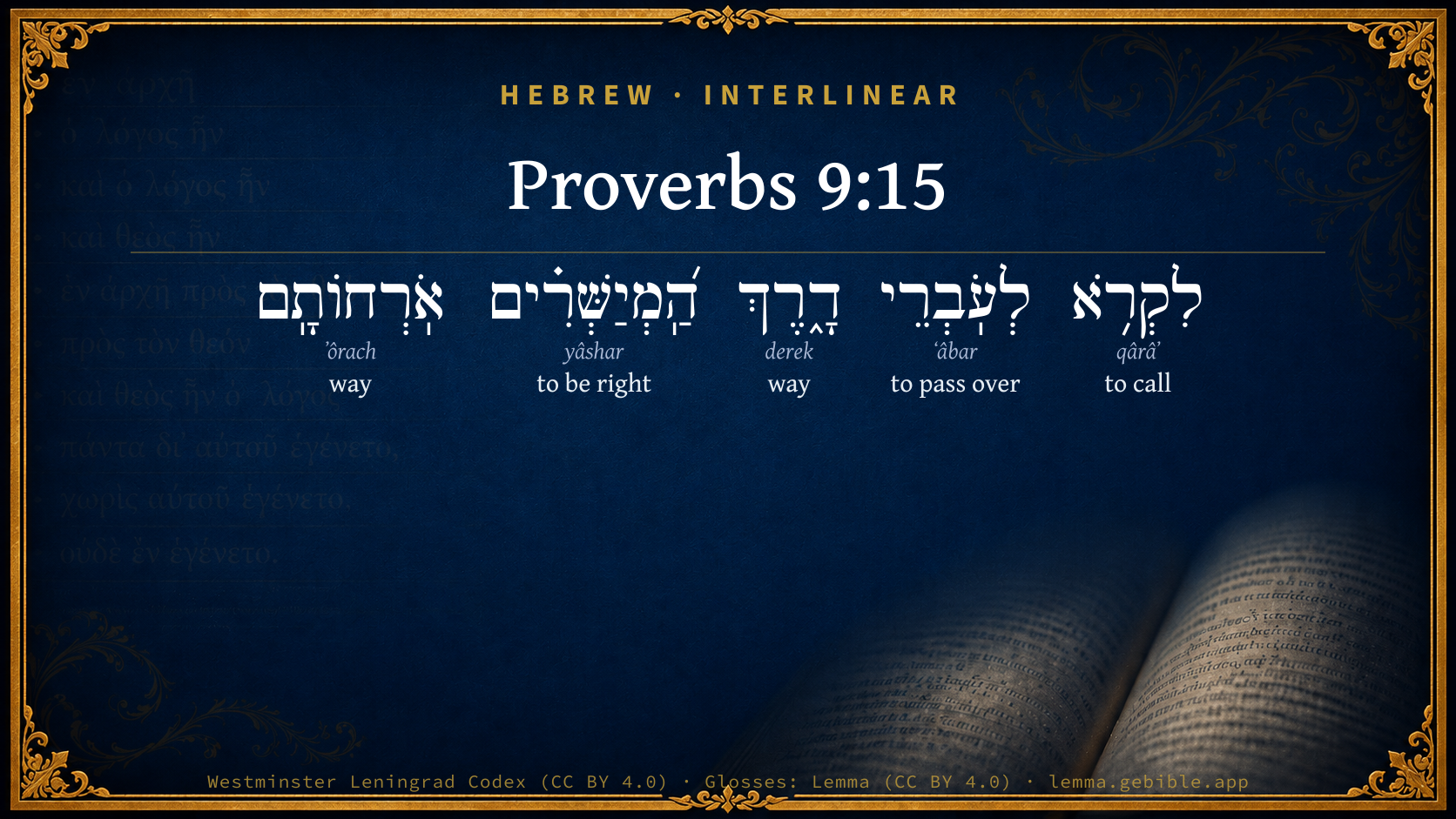
Hebrew (Westminster Leningrad Codex) Proverbs 9:15 appears in the Hebrew Old Testament. The text above is from the Westminster Leningrad Codex. Each word links to its Strong’s number, a concise gloss, and parsing drawn from the Open Scriptures Hebrew Bible morphology. Click any word for its full Brown-Driver-Briggs (BDB) entry.
Download image
Cite this verse

Proverbs 9:15 (World English Bible). Public Domain. Lemma interlinear Bible study tool, https://lemma.gebible.app/v/proverbs/9/15.

Show BibTeX & RIS
BibTeX
RIS
English Translation
To call to those who pass by, Who go straight on their ways,
World English Bible · Public Domain
Download a study sheet

One document with this verse’s original text, its word-by-word gloss line, the meaning frame, cross-references with their text, attributed commentary, and full source and license credits — printable, and it pastes into notes with its structure intact.

This verse Autodidact and up

Study sheet (.html) Plain text (.txt)

A passage Seminary Student

Up to 50 verses in one chapter. A passage sheet keeps up to 6 commentary sources and 12 cross-references per verse, in the order this page ranks them, and says so on the sheet whenever that leaves anything out. Ask for a single verse and you get the Autodidact verse sheet above.

Everything on this page stays free to read, with no account — the sheet is a download of what is already on screen, not access to it.

Want to remove ads? Support Godless Engineer
Compare translations 3

The same verse in 3 English versions, stacked beneath the original-language interlinear above. Click any original word for its lexicon entry.

Each is an independent rendering of the whole verse — the interlinear is not word-aligned to these translations.

Highlighted words mark where these versions differ — a whole-verse word diff, not a word-by-word alignment.

  • World English Bible Public Domain
    To call to those who pass by, Who go straight on their ways,
  • King James Version Public Domain
    To call passengers who go right on their ways:
  • unfoldingWord Literal Text CC BY-SA 4.0
    to call to those who pass over the way, the ones going straight their paths.

unfoldingWord Literal Text — © unfoldingWord, licensed CC BY-SA 4.0. Word-aligned USFM3 via Door43 (git.door43.org/unfoldingWord/en_ult).

Versions to compare (up to 4)

3 of 4 selected

Show all 18 translations

Every available English version of this verse, each an independent rendering of the whole verse.

  • World English Bible Public Domain
    To call to those who pass by, Who go straight on their ways,
  • Berean Standard Bible Public Domain
    calling out to those who pass by, who make their paths straight.
  • Majority Standard Bible Public Domain
    calling out to those who pass by, who make their paths straight.
  • King James Version Public Domain
    To call passengers who go right on their ways:
  • American Standard Version (1901) Public Domain
    To call to them that pass by, Who go right on their ways:
  • Revised Version (1885) Public Domain
    To call to them that pass by, who go right on their ways,
  • Geneva Bible (1599) Public Domain
    To call them that passe by the way, that go right on their way, saying,
  • Douay-Rheims (1899) Public Domain
    To call them that pass by the way, and go on their journey:
  • Young's Literal Translation Public Domain
    To call to those passing by the way, Who are going straight `on' their paths.
  • Literal Standard Version CC BY-SA 4.0
    To call to those passing by the way, || Who are going straight [on] their paths.
  • Unlocked Literal Bible CC BY-SA 4.0
    She is calling out to those who pass by in the streets, to people walking straight on their way.
  • unfoldingWord Literal Text CC BY-SA 4.0
    to call to those who pass over the way, the ones going straight their paths.
  • Darby Bible Public Domain
    to call passers-by who go right on their ways:
  • World Messianic Bible Public Domain
    to call to those who pass by, who go straight on their ways,
  • Webster's Bible Public Domain
    To call passengers who go right on their ways:
  • Free Bible Version CC BY-SA 4.0
    calling out to those passing by, going about their business,
  • Bible in Basic English Public Domain
    Crying out to those who go by, going straight on their way, she says:
  • JPS Tanakh (1917) Public Domain
    To call to them that pass by, who go right on their ways:

Literal Standard Version (2020), Covenant Press — licensed CC BY-SA 4.0. Text via the HelloAO Bible API (eBible.org). Unlocked Literal Bible (unfoldingWord) — licensed CC BY-SA 4.0. Text via the HelloAO Bible API (eBible.org). unfoldingWord Literal Text — © unfoldingWord, licensed CC BY-SA 4.0. Word-aligned USFM3 via Door43 (git.door43.org/unfoldingWord/en_ult). Free Bible Version, Dr. Jonathan Gallagher — licensed CC BY-SA 4.0. Text via the HelloAO Bible API (eBible.org).

Word by word

More ways to search: Search by grammar → Find every occurrence → Compare this word →

Practice this passage: Drill this verse → Learn its vocabulary →

הַֽ֝מְיַשְּׁרִ֗ים
yâshar
H3474
“the · being right”
Particle, Definite Article + Verb, Piel, Participle Active, Masculine, Plural, Absolute
Part of Speech
Particle + Verb
Stem
Piel
Form
Participle Active
Gender
Masculine
Number
Plural
State
Absolute
Full BDB Definition

Origin: a primitive root

TWOT: 930

to be right, be straight, be level, be upright, be just, be lawful, be smooth - (Qal) - to go straight - to be pleasing, be agreeable, be right (figuratively) - to be straightforward, be upright - (Piel) - to make right, make smooth, make straight - to lead, direct, lead straight along - to esteem right, approve - (Pual) to be made level, be laid smoothly out - (Hiphil) to make straight, look straight
  1. לִקְרֹ֥א qârâʼ H7121 “to call” Preposition + Verb, Qal, Infinitive Construct
  2. לְעֹֽבְרֵי ʻâbar H5674 “to/for · passing over” Preposition + Verb, Qal, Participle Active, Masculine, Plural, Construct
  3. דָ֑רֶךְ derek H1870 “way” Noun, Common, Both, Singular, Absolute
  4. אֹֽרְחוֹתָֽם ʼôrach H734 “ways · their” Noun, Common, Both, Plural, Construct + Suffix, Personal, 3rd Person, Masculine, Plural

About this verse

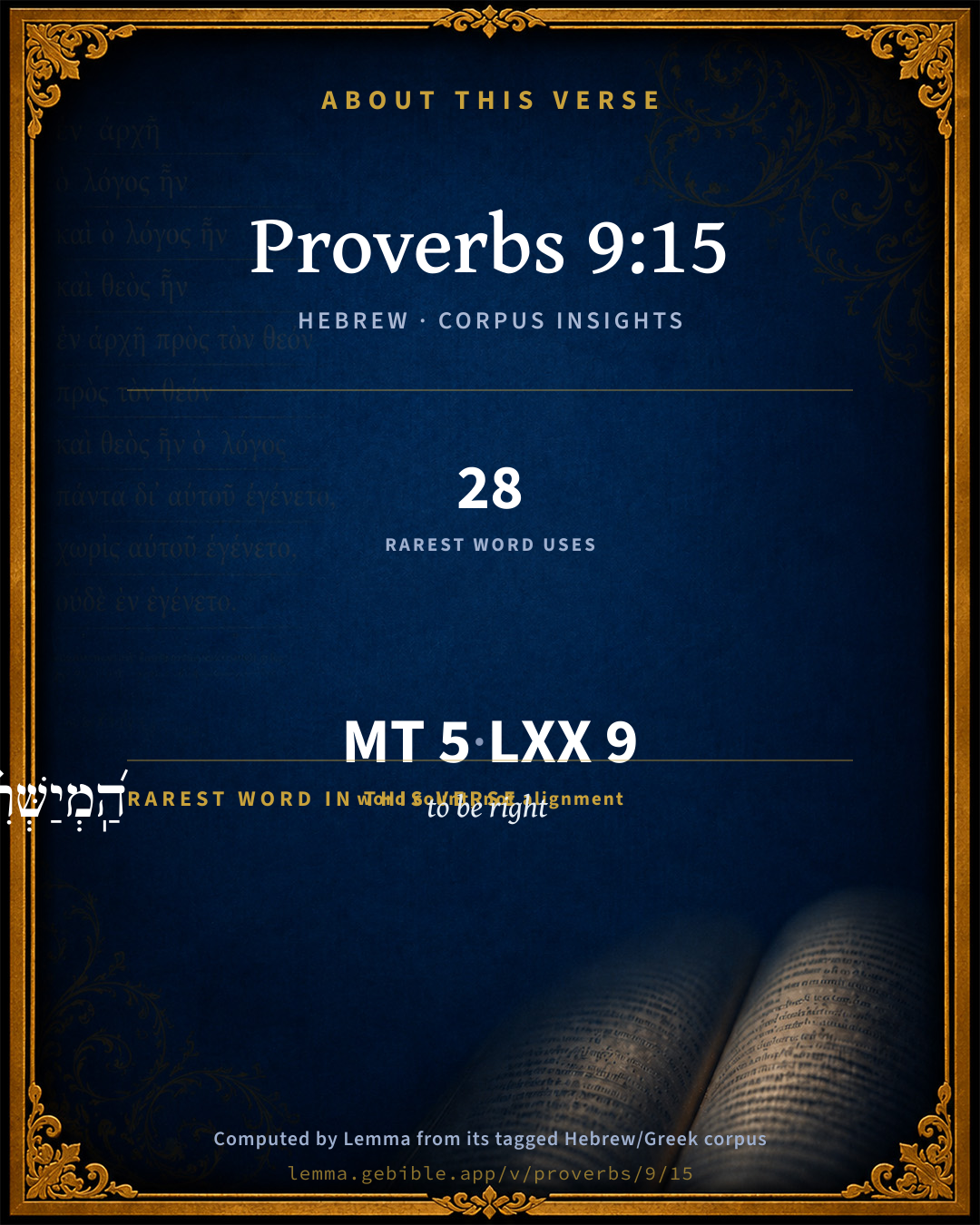
These counts appear in no published source. They are computed here, from the morphology-tagged text and Lemma’s own curated glosses. What Lemma adds →

5
words
5
distinct lemmas
Wisdom
section

Shared distinctive vocabulary

הַֽ֝מְיַשְּׁרִ֗ים to be right H3474 occurs in 26 verses of the Hebrew Bible. Also found in:

Grammatical profile

  • 3 verbs
  • 2 nouns

Verb forms

  • לִקְרֹ֥א Qal · Infinitive Construct
  • לְעֹֽבְרֵי Qal · Participle Active
  • הַֽ֝מְיַשְּׁרִ֗ים Piel · Participle Active

Hebrew & Septuagint length

In English translation the verse runs 13 words from the Hebrew and 14 from the Septuagint (LXX English) — closely comparable.

A rough comparison of the two English renderings, which tokenize alike — not a word-level alignment.

Word counts can differ between the Hebrew and the Greek without any difference in meaning — e.g. the Hebrew direct-object marker אֵת has no separate Greek word, and Greek often adds the article ὁ.

In the original languages it is 5 Hebrew tokens and 9 Greek tokens — but the two are counted differently (Hebrew bundles its prefixes and suffixes into one token; the Greek is in lemma form), so that isn’t a like-for-like length.

Cross-references

3

Topical passages linked to Proverbs 9:15 in the Treasury of Scripture Knowledge — connected by theme and wording, ordered by reader-vote popularity; previews shown in the World English Bible.

Cross-references courtesy of OpenBible.info (CC BY 4.0).

Hebrew and Greek witnesses Masoretic Hebrew ↔ Greek Septuagint

The same verse in the two great witnesses to the Old Testament, shown verse-for-verse.

These are two independent witnesses, not word-aligned to each other, and the Septuagint is shown in lemma (dictionary) form.

Hebrew Proverbs 9:15 Masoretic · Westminster Leningrad Codex

לִקְרֹ֥א לְעֹֽבְרֵי דָ֑רֶךְ הַֽ֝מְיַשְּׁרִ֗ים אֹֽרְחוֹתָֽם

To call to those who pass by, Who go straight on their ways,

World English Bible · Public Domain

Greek LXX Proverbs 9:15 Septuagint · lemma form

προςκαλέω ὁ παραεἶμι καί καταεὐθύνω ἐν ὁ ὁδός αὐτός

calling to passers by, and to those that are going right on their ways;

LXX2012 (modern English Septuagint) · Public Domain

On this verse, The Pulpit Commentary discusses the Septuagint’s reading. Read the note in Commentary ↓

Hebrew: Westminster Leningrad Codex (CC BY 4.0). Greek: Septuagint (public domain); English from LXX2012 (modern English Septuagint) (Public Domain). How the Septuagint differs from the Hebrew →

Commentary

Notes on Proverbs 9:15 from classic Christian and Jewish commentators (each source and its license shown beneath its notes). The classic Christian expositions comment on the surrounding passage and are grouped to its opening verse, so a note may address several verses; the Jewish commentaries on the Tanakh (Rashi and others) are per-verse, so they appear only where the commentator wrote on this verse.

Lemma curates 59 commentaries, every one of them public domain or Creative Commons licensed, each selected and text-cleaned for this edition rather than reprinted as found. About our sources →

Trapp's Complete Commentary

John Trapp

Pro 9:15 To call passengers who go right on their ways:

Ver. 15. That go right on their way.] She fights at the fairest, seeks to seduce the forwardest. "They shall deceive, if it were possible, the very elect." {Mat 24:24} Flies settle upon the sweetest perfumes when they are cold, and corrupt them.

John Trapp, A Commentary or Exposition upon All the Books of the Old and New Testament (1647–1656) — public domain. Text from a community e-Sword module.

The Biblical Illustrator

Joseph S. Exell

Pro_9:15

To call passengers who go right on their ways.

The tempted ones

Who are the tempted? Young people who have been well-educated; these she will triumph most in being the ruin of.

I. What their real character is. Passengers that go right on their ways; that have been trained up in the paths of religion and virtue, and set out very hopefully and well; that seemed determined and designed for good, and are not (as that young man in Pro_7:8) going the way to her house. Such as these she has a design upon, and lays snares for, and uses all her arts, all her charms, to pervert them; if they go right on, and will not look toward her, she will call after them, so urgent are these temptations.

II. How the foolish woman represents them. She calls them simple and wanting understanding, and therefore courts them to her school, that they may be cured of the restraints and formalities of their religion. This is the method of the stage, where the sober young man that has been virtuously educated is the fool in the play, and the plot is to make him seven times more a child of hell than his profane companions, under colour of polishing and refining him, and setting him up for a wit and a beau. What is justly charged upon sin and impiety (Pro_9:4) that it is folly, is here very unjustly retorted upon the ways of virtue; but the day will declare who are the fools. (Matthew Henry.)

The Biblical Illustrator, edited by Joseph S. Exell (c. 1880s–1900s) — public domain. Text from a community e-Sword module.

Jamieson, Fausset & Brown

Robert Jamieson, A. R. Fausset & David Brown

to allure those who are right-minded, and who are addressed as in Pro 9:4, as

simple--that is, easily led (Pro 1:4) and unsettled, though willing to do right.

Jamieson, Fausset & Brown — Commentary Critical and Explanatory on the Whole Bible (1871) — public domain (CC PDM 1.0). Text via the HelloAO Bible API.

The Cambridge Bible for Schools and Colleges

gen. ed. J. J. S. Perowne

15. who go right on their ways] who are not putting themselves in the way of temptation by loitering or straying into by-ways, but who, though in the path of duty, are unwary and unsuspecting, and so need warning.

The Cambridge Bible for Schools and Colleges (gen. ed. J. J. S. Perowne; Cambridge University Press, 1878–1918) — public domain. Text from a community e-Sword module.

John Gill's Exposition

To call passengers who go right on their ways. Who have been religiously educated, and trained up in the principles of true Christianity; and who walk outwardly according to the rule of the divine word, and are in a fair way for heaven and eternal happiness. These she has her eye upon as they pass along, and calls unto them, and endeavours to turn them aside out of the way they are going, to make them proselytes to her antichristian religion; which, when she succeeds in, she glories and boasts of; just as harlots are very desirous of seducing and debauching chaste, innocent, and virtuous persons; see Rev 2:20. Saying as follows:

. Saying as follows:

Proverbs 9:16

pro 9:16

pro 9:16

pro 9:16Whoso is simple, let him turn in hither,.... The harlot's house, Popish chapels and churches. She uses the same form of words that Wisdom does, Pro 9:4; having a form of godliness, a show of religion, but without the power of it; her priests are wolves in sheep's clothing, and speak lies in hypocrisy: and such that she fixes upon as proper persons to work on are the simple, the credulous and unwary; who are not on their guard, and are easily persuaded and imposed on;

and as for him that wanteth understanding; is not well grounded in the principles of Christianity he professes; has not a spiritual and experimental understanding of them:

she saith to him; addresses him in such language as follows:

John Gill's Exposition of the Whole Bible (1746–1763) — public domain (CC PDM 1.0). Text via the HelloAO Bible API.

Matthew Poole's English Annotations

Who were going innocently and directly about their business without any unchaste design; for others needed none of those invitations or offers, but went to her of their own accord. And besides, such lewd persons take a greater pleasure in corrupting the innocent.

Matthew Poole's English Annotations on the Holy Bible (1683–1685) — public domain. Text from a community e-Sword/MySword module.

Whedon's Commentary on the Bible

Daniel D. Whedon

15. To call passengers — This is her object, to draw even those aside into her haunts of folly and impurity who are going straight forward to the school of wisdom and virtue. She is, in this respect, a fair representative of the modern “saloon keeper.”

Daniel D. Whedon (gen. ed.), Commentary on the Old and New Testaments (1874–1909) — public domain. Text from a community e-Sword module.

The Pulpit Commentary

To call passengers who go right on their ways. With shameless effrontery she cries to all that pass by, she addresses her solicitations to persons who are going straight on their way, thinking nothing of her, having no idea of deviating from their pursued object. As they walk in the path of right and duty, she tries to turn them aside. Septuagint, "Calling to herself (proskaloumenh ) those that pass by and are keeping straight in their ways." The Fathers find here a picture of the seductions of heretical teaching, which puts on the mask of orthodoxy and deceives the unwary. Wordsworth notes that, in the Apocalypse, the false teacher bears some emblems of the Lamb. (Rev_13:11) All false doctrine retains some element of truth, and it is because of this admixture that it procures adherents and thrives for a time.

The Pulpit Commentary (1880–1919), ed. H.D.M. Spence-Jones & Joseph S. Exell — public domain. Text from a community e-Sword module.

John Wesley's Explanatory Notes

Go right - Who are going innocently about their business.

John Wesley, Explanatory Notes Upon the Whole Bible (1754–1765) — public domain. Text via the GEBible commentary corpus.

Lesson kit

Teaching starters — assembled from the data on this page, not authored interpretation. Every prompt links to the verse data it draws on. Edit before teaching.

Proverbs, in the Wisdom, opens this verse with 5 words (5 distinct Hebrew lemmas). Its most distinctive word is yâshar (“to be right”). A historical commentator’s framing appears above. Read the whole chapter for the surrounding context.

Discussion questions

  1. What does “to be right” (yâshar) contribute to the verse as a whole?
  2. Numbers 23:27 shares the word «to be right» with this verse. How do the two illuminate each other?
  3. These translations render this verse differently. What is at stake in choosing one wording over another?
  4. The verb «לִקְרֹ֥א» is Qal Infinitive Construct. How does its form color the action?
  5. Reading how Trapp's Complete Commentary and The Biblical Illustrator read this verse, where do the two commentators agree and where do they part?

Things to notice

Reading settings

Reading text

Shown beneath each verse's original-language words.

Old Testament
Old Testament edition

Read the OT as the Masoretic Hebrew (MT) or the Greek Septuagint (LXX).

English shown for the Greek Septuagint (in the Hebrew ↔ Greek comparison).

Comparing translations? Open the Compare panel on any verse page to stack up to four side by side.