Lamentations 4:18

Hebrew (Westminster Leningrad Codex) Lamentations 4:18 appears in the Hebrew Old Testament. The text above is from the Westminster Leningrad Codex. Each word links to its Strong’s number, a concise gloss, and parsing drawn from the Open Scriptures Hebrew Bible morphology. Click any word for its full Brown-Driver-Briggs (BDB) entry.
Download image
Cite this verse

Lamentations 4:18 (World English Bible). Public Domain. Lemma interlinear Bible study tool, https://lemma.gebible.app/v/lamentations/4/18.

Show BibTeX & RIS
BibTeX
RIS
English Translation
They hunt our steps, so that we can't go in our streets: Our end is near, our days are fulfilled; for our end is come.
World English Bible · Public Domain
Download a study sheet

One document with this verse’s original text, its word-by-word gloss line, the meaning frame, cross-references with their text, attributed commentary, and full source and license credits — printable, and it pastes into notes with its structure intact.

This verse Autodidact and up

Study sheet (.html) Plain text (.txt)

A passage Seminary Student

Up to 50 verses in one chapter. A passage sheet keeps up to 6 commentary sources and 12 cross-references per verse, in the order this page ranks them, and says so on the sheet whenever that leaves anything out. Ask for a single verse and you get the Autodidact verse sheet above.

Everything on this page stays free to read, with no account — the sheet is a download of what is already on screen, not access to it.

Want to remove ads? Support Godless Engineer
Compare translations 3

The same verse in 3 English versions, stacked beneath the original-language interlinear above. Click any original word for its lexicon entry.

Each is an independent rendering of the whole verse — the interlinear is not word-aligned to these translations.

Highlighted words mark where these versions differ — a whole-verse word diff, not a word-by-word alignment.

  • World English Bible Public Domain
    They hunt our steps, so that we can't go in our streets: Our end is near, our days are fulfilled; for our end is come.
  • King James Version Public Domain
    They hunt our steps, that we cannot go in our streets: our end is near, our days are fulfilled; for our end is come.
  • unfoldingWord Literal Text CC BY-SA 4.0
    They hunted our steps from walking in our open places. Our end drew near; our days are full, for our end had come. QOPH

unfoldingWord Literal Text — © unfoldingWord, licensed CC BY-SA 4.0. Word-aligned USFM3 via Door43 (git.door43.org/unfoldingWord/en_ult).

Versions to compare (up to 4)

3 of 4 selected

Show all 18 translations

Every available English version of this verse, each an independent rendering of the whole verse.

  • World English Bible Public Domain
    They hunt our steps, so that we can't go in our streets: Our end is near, our days are fulfilled; for our end is come.
  • Berean Standard Bible Public Domain
    They stalked our every step, so that we could not walk in our streets. Our end drew near, our time ran out, for our end had come!
  • Majority Standard Bible Public Domain
    They stalked our every step, so that we could not walk in our streets. Our end drew near, our time ran out, for our end had come!
  • King James Version Public Domain
    They hunt our steps, that we cannot go in our streets: our end is near, our days are fulfilled; for our end is come.
  • American Standard Version (1901) Public Domain
    They hunt our steps, so that we cannot go in our streets: Our end is near, our days are fulfilled; for our end is come.
  • Revised Version (1885) Public Domain
    They hunt our steps, that we cannot go in our streets: our end is near, our days are fulfilled; for our end is come.
  • Geneva Bible (1599) Public Domain
    They hunt our steppes that we cannot goe in our streetes: our ende is neere, our dayes are fulfilled, for our ende is come.
  • Douay-Rheims (1899) Public Domain
    Sade. Our steps have slipped in the way of our streets, our end draweth near: our days are fulfilled, for our end is come.
  • Young's Literal Translation Public Domain
    They have hunted our steps from going in our broad-places, Near hath been our end, fulfilled our days, For come hath our end.
  • Literal Standard Version CC BY-SA 4.0
    They have hunted our steps from going in our broad-places, || Near has been our end, fulfilled our days, || For our end has come.
  • Unlocked Literal Bible CC BY-SA 4.0
    They followed our steps, we could not walk in our streets. Our end was near and our days were numbered, our end had come.
  • unfoldingWord Literal Text CC BY-SA 4.0
    They hunted our steps from walking in our open places. Our end drew near; our days are full, for our end had come. QOPH
  • Darby Bible Public Domain
    They hunted our steps, that we could not go in our streets: our end is near, our days are fulfilled; for our end is come.
  • World Messianic Bible Public Domain
    They hunt our steps, so that we can’t go in our streets. Our end is near. Our days are fulfilled, for our end has come.
  • Webster's Bible Public Domain
    They hunt our steps, that we cannot go in our streets: our end is near, our days are fulfilled; for our end is come.
  • Free Bible Version CC BY-SA 4.0
    The enemy tracked our every movement so we couldn't walk through our streets. Our end approached. Our time was up because our end had come.
  • Bible in Basic English Public Domain
    They go after our steps so that we may not go in our streets: our end is near, our days are numbered; for our end has come.
  • JPS Tanakh (1917) Public Domain
    They hunt our steps, that we cannot go in our broad places; our end is near, our days are fulfilled; for our end is come.

Literal Standard Version (2020), Covenant Press — licensed CC BY-SA 4.0. Text via the HelloAO Bible API (eBible.org). Unlocked Literal Bible (unfoldingWord) — licensed CC BY-SA 4.0. Text via the HelloAO Bible API (eBible.org). unfoldingWord Literal Text — © unfoldingWord, licensed CC BY-SA 4.0. Word-aligned USFM3 via Door43 (git.door43.org/unfoldingWord/en_ult). Free Bible Version, Dr. Jonathan Gallagher — licensed CC BY-SA 4.0. Text via the HelloAO Bible API (eBible.org).

Word by word

More ways to search: Search by grammar → Find every occurrence → Compare this word →

Practice this passage: Drill this verse → Learn its vocabulary →

צְעָדֵ֔ינוּ
tsaʻad
H6806
“steps · our”
Noun, Common, Masculine, Plural, Construct + Suffix, Personal, 1st Person, Common, Plural
Part of Speech
Noun
Type
Common
Gender
Masculine
Number
Plural
State
Construct
Full BDB Definition

Origin: from H6804

TWOT: 1943a

step, pace, stride - step, pace - step, steps (of course of life) (figuratively)
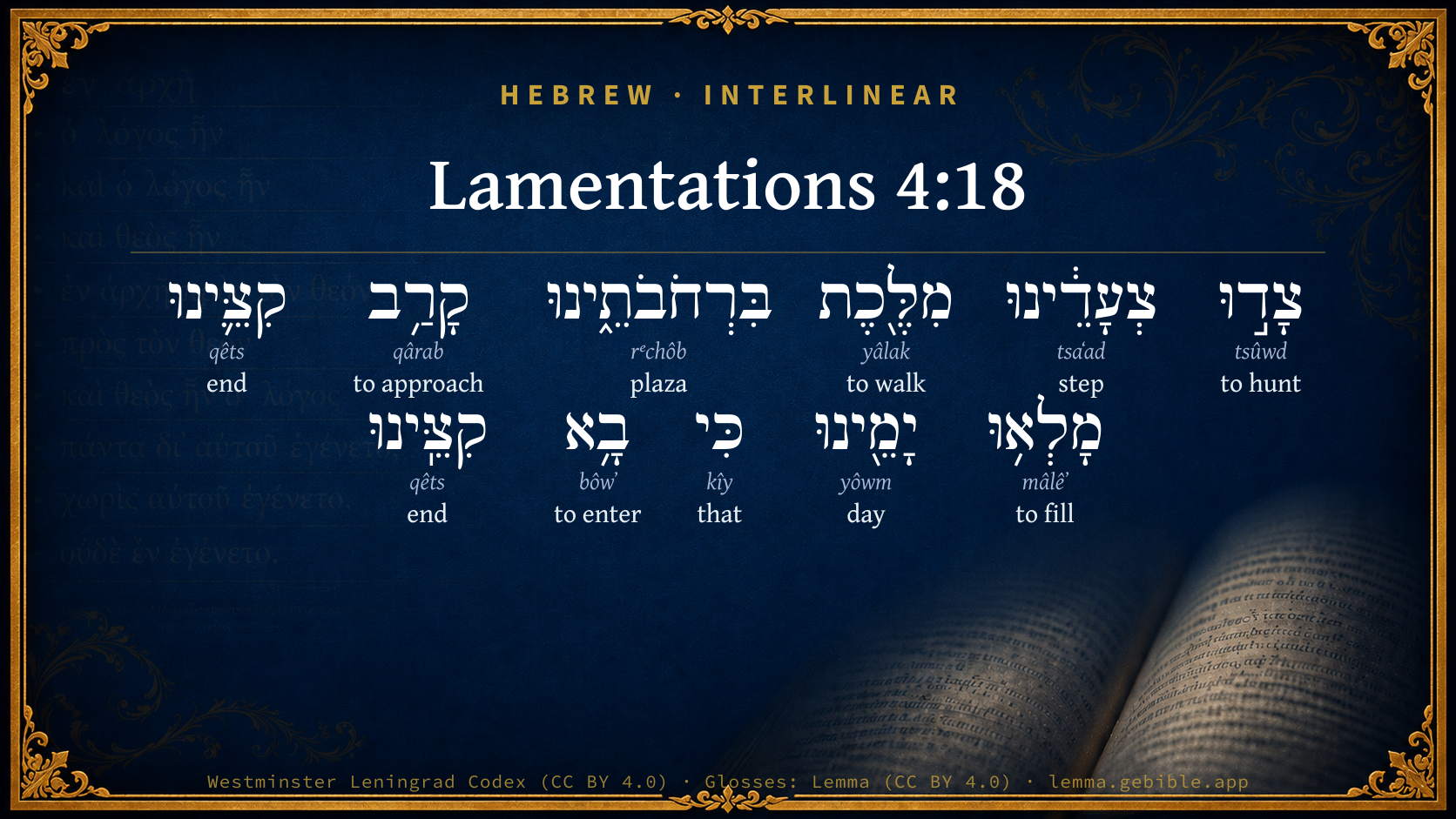
  1. צָד֣וּ tsûwd H6679 “to hunt” Verb, Qal, Perfect, 3rd Person, Common, Plural
  2. מִלֶּ֖כֶת yâlak H3212 “from · to walk” Preposition + Verb, Qal, Infinitive Construct
  3. בִּרְחֹבֹתֵ֑ינוּ rᵉchôb H7339 “in/at · plazas · our” Preposition + Noun, Common, Feminine, Plural, Construct + Suffix, Personal, 1st Person, Common, Plural
  4. קָרַ֥ב qârab H7126 “to approach” Verb, Qal, Perfect, 3rd Person, Masculine, Singular
  5. קִצֵּ֛ינוּ qêts H7093 “end · our” Noun, Common, Masculine, Singular, Construct + Suffix, Personal, 1st Person, Common, Plural
  6. מָלְא֥וּ mâlêʼ H4390 “to fill” Verb, Qal, Perfect, 3rd Person, Common, Plural
  7. יָמֵ֖ינוּ yôwm H3117 “days · our” Noun, Common, Masculine, Plural, Construct + Suffix, Personal, 1st Person, Common, Plural
  8. כִּי kîy H3588 “that” Conjunction
  9. בָ֥א bôwʼ H935 “to enter” Verb, Qal, Perfect, 3rd Person, Masculine, Singular
  10. קִצֵּֽינוּ qêts H7093 “end · our” Noun, Common, Masculine, Singular, Construct + Suffix, Personal, 1st Person, Common, Plural

About this verse

These counts appear in no published source. They are computed here, from the morphology-tagged text and Lemma’s own curated glosses. What Lemma adds →

11
words
10
distinct lemmas
Prophets
section

Notable vocabulary

The rarest word here is צְעָדֵ֔ינוּ step H6806 — appearing just 14 times in the whole Hebrew Bible.

Shared distinctive vocabulary

צְעָדֵ֔ינוּ step H6806 occurs in 14 verses of the Hebrew Bible. Also found in:

Grammatical profile

  • 5 verbs
  • 5 nouns
  • 1 conjunction

Verb forms

  • צָד֣וּ Qal · Perfect
  • מִלֶּ֖כֶת Qal · Infinitive Construct
  • קָרַ֥ב Qal · Perfect
  • מָלְא֥וּ Qal · Perfect
  • בָ֥א Qal · Perfect

Repetition

A word recurs within this verse — often emphatic in Hebrew:

  • קִצֵּ֛ינוּ end H7093 ×2

Hebrew & Septuagint length

In English translation the verse runs 25 words from the Hebrew and 29 from the Septuagint (LXX English) — closely comparable.

A rough comparison of the two English renderings, which tokenize alike — not a word-level alignment.

Word counts can differ between the Hebrew and the Greek without any difference in meaning — e.g. the Hebrew direct-object marker אֵת has no separate Greek word, and Greek often adds the article ὁ.

Cross-references

14

Topical passages linked to Lamentations 4:18 in the Treasury of Scripture Knowledge — connected by theme and wording, ordered by reader-vote popularity; previews shown in the World English Bible.

  • Amos 8:2 He said, "Amos, what do you see?" I said, "A basket of summer fruit." Then Yahweh said to me, "The end has come on my people Israel. I will not again pass by them any more.
  • Psalms 140:11 An evil speaker won't be established in the earth. Evil will hunt the violent man to overthrow him.
  • Ezekiel 7:2–12 You, son of man, thus says the Lord Yahweh to the land of Israel, An end: the end is come on the four corners of the land.
  • Jeremiah 16:16 Behold, I will send for many fishermen, says Yahweh, and they shall fish them up; and afterward I will send for many hunters, and they shall hunt them from every mountain, and from every hill, and out of the clefts of the rocks.
  • Lamentations 3:52 They have chased me sore like a bird, those who are my enemies without cause.
  • 1 Samuel 24:14 After whom is the king of Israel come out? after whom do you pursue? after a dead dog, after a flea.
  • 2 Kings 25:4–5 Then a breach was made in the city, and all the men of war [fled] by night by the way of the gate between the two walls, which was by the king's garden (now the Chaldeans were against the city round about); and [the king] went by the way of the Arabah.
  • Job 10:16 If my head is held high, you hunt me like a lion. Again you show yourself powerful to me.
  • Jeremiah 1:12 Then said Yahweh to me, You have well seen: for I watch over my word to perform it.
  • Jeremiah 39:4–5 It happened that, when Zedekiah the king of Judah and all the men of war saw them, then they fled, and went forth out of the city by night, by the way of the king's garden, through the gate between the two walls; and he went out toward the Arabah.
  • Jeremiah 51:33 For thus says Yahweh of hosts, the God of Israel: The daughter of Babylon is like a threshing floor at the time when it is trodden; yet a little while, and the time of harvest shall come for her.
  • Jeremiah 52:7–9 Then a breach was made in the city, and all the men of war fled, and went forth out of the city by night by the way of the gate between the two walls, which was by the king's garden; (now the Chaldeans were against the city round about;) and they went toward the Arabah.
  • Ezekiel 12:22–23 Son of man, what is this proverb that you have in the land of Israel, saying, The days are prolonged, and every vision fails?
  • Ezekiel 12:27 Son of man, behold, they of the house of Israel say, The vision that he sees is for many day to come, and he prophesies of times that are far off.

Cross-references courtesy of OpenBible.info (CC BY 4.0).

Hebrew and Greek witnesses Masoretic Hebrew ↔ Greek Septuagint

The same verse in the two great witnesses to the Old Testament, shown verse-for-verse.

These are two independent witnesses, not word-aligned to each other, and the Septuagint is shown in lemma (dictionary) form.

Hebrew Lamentations 4:18 Masoretic · Westminster Leningrad Codex

צָד֣וּ צְעָדֵ֔ינוּ מִלֶּ֖כֶת בִּרְחֹבֹתֵ֑ינוּ קָרַ֥ב קִצֵּ֛ינוּ מָלְא֥וּ יָמֵ֖ינוּ כִּי בָ֥א קִצֵּֽינוּ

They hunt our steps, so that we can't go in our streets: Our end is near, our days are fulfilled; for our end is come.

World English Bible · Public Domain

Greek LXX Lamentations 4:18 Septuagint · lemma form

θηρεύω μικρός ἐγώ ὁ μή πορεύομαι ἐν ὁ πλατύς ἐγώ ἄγω ὁ καιρός ἐγώ πληρόω ὁ ἡμέρα ἐγώ παραεἰμί ὁ καιρός ἐγώ

We have hunted for our little ones, that they should not walk in our streets. KOPH. Our time has drawn near, our days are fulfilled, our time is come.

LXX2012 (modern English Septuagint) · Public Domain

Hebrew: Westminster Leningrad Codex (CC BY 4.0). Greek: Septuagint (public domain); English from LXX2012 (modern English Septuagint) (Public Domain). How the Septuagint differs from the Hebrew →

Commentary

Notes on Lamentations 4:18 from classic Christian and Jewish commentators (each source and its license shown beneath its notes). The classic Christian expositions comment on the surrounding passage and are grouped to its opening verse, so a note may address several verses; the Jewish commentaries on the Tanakh (Rashi and others) are per-verse, so they appear only where the commentator wrote on this verse.

Lemma curates 59 commentaries, every one of them public domain or Creative Commons licensed, each selected and text-cleaned for this edition rather than reprinted as found. About our sources →

Trapp's Complete Commentary

John Trapp

Lam 4:18 They hunt our steps, that we cannot go in our streets: our end is near, our days are fulfilled; for our end is come.

Ver. 18. They hunt our steps.] There is an elegance in the original, as if we should say, They hunt our haunts.

That we cannot go in our streets.] Because of their forts, from whence they shoot at us. Satan doth so much more -

“ Cui nomina mille,

Mille nocendi artes. ”

Our end is come.] We are an undone people.

John Trapp, A Commentary or Exposition upon All the Books of the Old and New Testament (1647–1656) — public domain. Text from a community e-Sword module.

Joseph Benson's Commentary

Lam 4:18-20. They hunt our steps that we cannot go in our streets — The Chaldeans, employed in the siege, are so close upon us, that we cannot stir a foot, nor look out at our doors, nor walk safely in the streets. Our end is near — The end of our church and state; we are just at the brink of the ruin of both. Nay, our days are fulfilled, our end is come — We are utterly undone; a fatal, final period is put to all our comforts; the days of our prosperity are fulfilled, they are numbered and finished. Our persecutors are swifter than the eagles — God has brought upon us that judgment which he threatened by Moses, of bringing a nation against us as swift as the eagle flieth, Deu 28:49. Such were the horsemen of the Chaldean army. We could nowhere escape them, neither by fleeing to the mountains, nor by hiding ourselves in the valleys. The wilderness is in other places put for the lower, or pasture grounds. The breath of our nostrils, the anointed of the Lord, &c. — Our king, who was the very life of us; was taken in their pits — In those toils his enemies had laid for him. Some have supposed that the prophet speaks this of Josiah, but it seems more probable that Zedekiah is meant, and his being taken prisoner and led into captivity is here alluded to. Of whom we said, Under his shadow we shall live among the heathen — As long as he was safe, we had some hopes of being protected, and of preserving some face of government, although we were carried away into a foreign country. The protection a king affords his subjects is often, in Scripture, compared to the shelter of a great tree, which is a covert against storms and tempests: see Eze 17:23; Eze 31:6; Dan 4:12.

Joseph Benson's Commentary on the Old and New Testaments (1811–1818) — public domain. Text from a community e-Sword module.

Jamieson, Fausset & Brown

Robert Jamieson, A. R. Fausset & David Brown

They--the Chaldeans.

cannot go--without danger.

Jamieson, Fausset & Brown — Commentary Critical and Explanatory on the Whole Bible (1871) — public domain (CC PDM 1.0). Text via the HelloAO Bible API.

Adam Clarke's Commentary

Verse 18. We cannot go in our streets] Supposed to refer to the darts and other missiles cast from the mounds which they had raised on the outside of the walls, by which those who walked in the streets were grievously annoyed, and could not shield themselves.

Adam Clarke's Commentary on the Bible (1810–1826) — public domain. Text from a community e-Sword/MySword module.

John Calvin's Commentaries

Many apply this verse to the Egyptians, that they insidiously enticed the Jews to flee to them in their difficulties. It is indeed, true, that the Jews had been deceived by their false promises; and, as a harlot draws to herself young men by wicked arts, so also the Jews had been captivated by the enticements of the Egyptians. But the meaning of the Prophet seems to be different, even this, — that the Chaldeans followed the Jews as hunters, so that they observed their footsteps; and I connect together the two verses, for it immediately follows, —

John Calvin's Commentaries (1540-1563) — public domain. Text from the Calvin Translation Society English edition (1840s-50s) via the Christian Classics Ethereal Library (ccel.org). Calvin's coverage is partial (roughly two-thirds of the Bible); uncommented books and verses are honest gaps, never fabricated. The 19th-century editor's footnotes and remarks are omitted so the notes are faithfully Calvin's own voice.

Ellicott's Commentary for English Readers

(18) They hunt our steps.—Better, They lie in wait. The words probably point to the posts occupied here and there near the wide places of the city, which led people to avoid them through fear of being attacked. The only cry possible at such a time was that “all was over.”

A Bible Commentary for English Readers, edited by Charles John Ellicott (1878–1897) — public domain. Text from a community e-Sword module.

The Cambridge Bible for Schools and Colleges

gen. ed. J. J. S. Perowne

18. They hunt our steps] This expresses the danger which existed in the “streets” (lit. broad places, and therefore exposed) from the towers which were gradually advanced nearer to the walls by the besiegers. Eastern streets are too narrow to expose their occupants to the weapons of a besieging force.

The Cambridge Bible for Schools and Colleges (gen. ed. J. J. S. Perowne; Cambridge University Press, 1878–1918) — public domain. Text from a community e-Sword module.

John Gill's Exposition

They hunt our steps, that we cannot go in our streets,.... The Chaldeans, from their forts and batteries, as they could see, they watched the people as they came out of their houses, and walked about the streets, and shot their arrows at them; so that they were obliged to keep within doors, and not stir out, which they could not do without great danger:

our end is near, for our days are fulfilled; for our end is come; either the end of their lives, the days, months, and years appointed for them being fulfilled; or the end of their commonwealth, the end of their civil and church state, at least as they thought; the time appointed for their destruction was not only near at hand, but was actually come; it was all over with them.

John Gill's Exposition of the Whole Bible (1746–1763) — public domain (CC PDM 1.0). Text via the HelloAO Bible API.

Haydock's Catholic Bible Commentary

Streets. There were enemies within as well as without. (Calmet)

George Leo Haydock (1774–1849), Haydock's Catholic Family Bible and Commentary, 1859 edition — public domain. Excludes Psalms (Douay-Rheims chapter numbering differs from Protestant) and Deuterocanonical books (Catholic canon only).

Matthew Poole's English Annotations

The Chaldeans employed in the siege are so close upon us, that we cannot stir a foot about our businesses, nor look out at our doors, nor walk safely in the streets; we are ruined, there is an end of our civil state; our period is come, and the time of our prosperity is elapsed.

Matthew Poole's English Annotations on the Holy Bible (1683–1685) — public domain. Text from a community e-Sword/MySword module.

Whedon's Commentary on the Bible

Daniel D. Whedon

18. They hunt our steps — The word for “hunt” does not mean to pursue game so much as to watch for, to ensnare, to wait in ambush. The reference is to the time of the capture and sack of the city. The inhabitants could not escape, for whenever they appeared in the streets they were at once captured.

Daniel D. Whedon (gen. ed.), Commentary on the Old and New Testaments (1874–1909) — public domain. Text from a community e-Sword module.

The Pulpit Commentary

They hunt our steps, etc. Realistic attempts to explain this line have not been wanting, but seem unsuccessful. The Chaldeans were either within the city or without. If within, they would not need literally to "hunt the steps" of the Jews; if without, they had not war engines adequate to shooting the inhabitants at some distance. Probably the expressions are metaphorical; they are similar to those used in Lam_3:52, immediately after which we meet with such a purely poetical phrase as, "They have cut off my life in the pit Authorized Version, "dungeon, and cast a stone upon me". (see note on Lam_3:52-56)

The end is come!

The progress of the enemy"s works, the approach of the enemy"s forces, the frequency of the enemy"s assaults, all tended to dishearten the citizens of the besieged Jerusalem. The prophet represents the discouraged and dismayed citizens as gazing with terror upon the assailants and their strategy, and exclaiming in despair, "Our end is come!" The dealing and the discipline of God with the souls of the disobedient and rebellious may well awaken the same conviction and elicit the same cry.

I THE END OF OUR OWN RESOURCES. It is sometimes only when men have tried what is in their power, have done their best to solve their spiritual difficulties and to make their way secure, that, convinced of their own insufficiency, they admit themselves to be altogether in the wrong.

II THE END OF OUR RESISTANCE TO OUR FOES. Men strive to carry on the conflict in their own strength, and they strive in vain. "Wearied in the greatness of their way," convinced that they are no match for the spiritual enemy, they may confess that, left to themselves, they cannot conquer, they cannot withstand.

III THE END OF ALL OUR HOPES OF DELIVERANCE. Those hopes may have buoyed up for days and years; but when they have issued only in disappointment how can the discouraged do other than at last forever abandon them?

IV THE END OF OUR REBELLION AGAINST GOD. If this be the effect produced by long experience of the wretchedness and the futility of such hostility, there will be reason for gratitude. They who lay down the weapons of rebellion shall receive mercy and experience deliverance. T.

The Pulpit Commentary (1880–1919), ed. H.D.M. Spence-Jones & Joseph S. Exell — public domain. Text from a community e-Sword module.

John Wesley's Explanatory Notes

They - The Chaldeans.

John Wesley, Explanatory Notes Upon the Whole Bible (1754–1765) — public domain. Text via the GEBible commentary corpus.

Rashi

Rabbi Shlomo Yitzchaki (Rashi)

They dogged our steps Heb. צָדוּ. Our enemies stalked our steps and prevented us from walking in our streets, like (Exod. 21:13): “but if he did not lurk (צָדָה)”;(I Sam. 24:12): “but you are stalking (צֹדֶה) my soul.”

Rashi on the Tanakh — English translations: “The Judaica Press complete Tanach with Rashi, translated by A. J. Rosenberg” (CC BY 4.0); “Pentateuch with Rashi's commentary by M. Rosenbaum and A.M. Silbermann, 1929-1934” (public domain); “The Metsudah Tanach series, Lakewood, N.J” (CC BY 4.0); and “The Book of Joshua, Metsudah Publications, 1997” (CC BY 4.0). Text via Sefaria.

Lesson kit

Teaching starters — assembled from the data on this page, not authored interpretation. Every prompt links to the verse data it draws on. Edit before teaching.

Lamentations, in the Prophets, opens this verse with 11 words (10 distinct Hebrew lemmas). Its most distinctive word is tsaʻad (“step”). A historical commentator’s framing appears above. Read the whole chapter for the surrounding context.

Discussion questions

  1. How does “step” (tsaʻad) shape what this verse is saying?
  2. 2 Samuel 6:13 shares the word «step» with this verse. How do the two illuminate each other?
  3. “end” occurs 2× in this one verse. What is the effect of the repetition?
  4. These translations render this verse differently. What is at stake in choosing one wording over another?
  5. The verb «צָד֣וּ» is Qal Perfect. How does its form color the action?
  6. Reading how Trapp's Complete Commentary and Joseph Benson's Commentary read this verse, where do the two commentators agree and where do they part?

Things to notice

Reading settings

Reading text

Shown beneath each verse's original-language words.

Old Testament
Old Testament edition

Read the OT as the Masoretic Hebrew (MT) or the Greek Septuagint (LXX).

English shown for the Greek Septuagint (in the Hebrew ↔ Greek comparison).

Comparing translations? Open the Compare panel on any verse page to stack up to four side by side.