
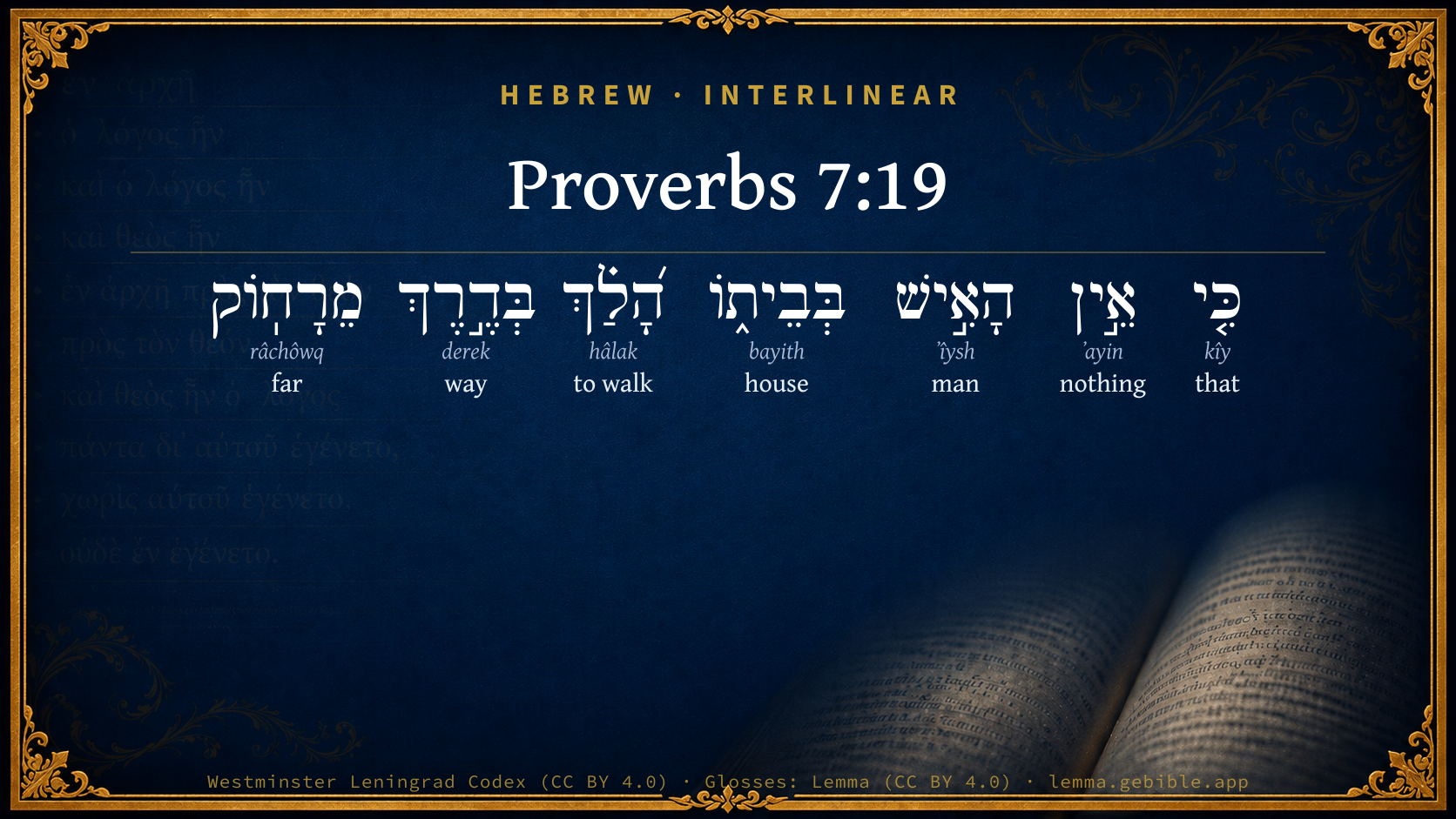
Proverbs 7:19

Hebrew (Westminster Leningrad Codex) Proverbs 7:19 appears in the Hebrew Old Testament. The text above is from the Westminster Leningrad Codex. Each word links to its Strong’s number, a concise gloss, and parsing drawn from the Open Scriptures Hebrew Bible morphology. Click any word for its full Brown-Driver-Briggs (BDB) entry.
Download image
Cite this verse

Proverbs 7:19 (World English Bible). Public Domain. Lemma interlinear Bible study tool, https://lemma.gebible.app/v/proverbs/7/19.

Show BibTeX & RIS
BibTeX
RIS
English Translation
For my husband isn't at home. He has gone on a long journey.
World English Bible · Public Domain
Download a study sheet

One document with this verse’s original text, its word-by-word gloss line, the meaning frame, cross-references with their text, attributed commentary, and full source and license credits — printable, and it pastes into notes with its structure intact.

This verse Autodidact and up

Study sheet (.html) Plain text (.txt)

A passage Seminary Student

Up to 50 verses in one chapter. A passage sheet keeps up to 6 commentary sources and 12 cross-references per verse, in the order this page ranks them, and says so on the sheet whenever that leaves anything out. Ask for a single verse and you get the Autodidact verse sheet above.

Everything on this page stays free to read, with no account — the sheet is a download of what is already on screen, not access to it.

Want to remove ads? Support Godless Engineer
Compare translations 3

The same verse in 3 English versions, stacked beneath the original-language interlinear above. Click any original word for its lexicon entry.

Each is an independent rendering of the whole verse — the interlinear is not word-aligned to these translations.

Highlighted words mark where these versions differ — a whole-verse word diff, not a word-by-word alignment.

  • World English Bible Public Domain
    For my husband isn't at home. He has gone on a long journey.
  • King James Version Public Domain
    For the goodman is not at home, he is gone a long journey:
  • unfoldingWord Literal Text CC BY-SA 4.0
    For the man is not in his house; he went on a road far away.

unfoldingWord Literal Text — © unfoldingWord, licensed CC BY-SA 4.0. Word-aligned USFM3 via Door43 (git.door43.org/unfoldingWord/en_ult).

Versions to compare (up to 4)

3 of 4 selected

Show all 18 translations

Every available English version of this verse, each an independent rendering of the whole verse.

  • World English Bible Public Domain
    For my husband isn't at home. He has gone on a long journey.
  • Berean Standard Bible Public Domain
    For my husband is not at home; he has gone on a long journey.
  • Majority Standard Bible Public Domain
    For my husband is not at home; he has gone on a long journey.
  • King James Version Public Domain
    For the goodman is not at home, he is gone a long journey:
  • American Standard Version (1901) Public Domain
    For the man is not at home; He is gone a long journey:
  • Revised Version (1885) Public Domain
    For the goodman is not at home, he is gone a long journey:
  • Geneva Bible (1599) Public Domain
    For mine husband is not at home: he is gone a iourney farre off.
  • Douay-Rheims (1899) Public Domain
    For my husband is not at home, he is gone a very long journey.
  • Young's Literal Translation Public Domain
    For the man is not in his house, He hath gone on a long journey.
  • Literal Standard Version CC BY-SA 4.0
    For the man is not in his house, || He has gone on a long journey.
  • Unlocked Literal Bible CC BY-SA 4.0
    For my husband is not at his house; he has gone on a long journey.
  • unfoldingWord Literal Text CC BY-SA 4.0
    For the man is not in his house; he went on a road far away.
  • Darby Bible Public Domain
    For the husband is not at home, he is gone a long journey;
  • World Messianic Bible Public Domain
    For my husband isn’t at home. He has gone on a long journey.
  • Webster's Bible Public Domain
    For the good-man is not at home, he is gone a long journey:
  • Free Bible Version CC BY-SA 4.0
    My husband isn't home; he's gone on a long trip.
  • Bible in Basic English Public Domain
    For the master of the house is away on a long journey:
  • JPS Tanakh (1917) Public Domain
    For my husband is not at home, he is gone a long journey;

Literal Standard Version (2020), Covenant Press — licensed CC BY-SA 4.0. Text via the HelloAO Bible API (eBible.org). Unlocked Literal Bible (unfoldingWord) — licensed CC BY-SA 4.0. Text via the HelloAO Bible API (eBible.org). unfoldingWord Literal Text — © unfoldingWord, licensed CC BY-SA 4.0. Word-aligned USFM3 via Door43 (git.door43.org/unfoldingWord/en_ult). Free Bible Version, Dr. Jonathan Gallagher — licensed CC BY-SA 4.0. Text via the HelloAO Bible API (eBible.org).

Word by word

More ways to search: Search by grammar → Find every occurrence → Compare this word →

Practice this passage: Drill this verse → Learn its vocabulary →

About this verse

These counts appear in no published source. They are computed here, from the morphology-tagged text and Lemma’s own curated glosses. What Lemma adds →

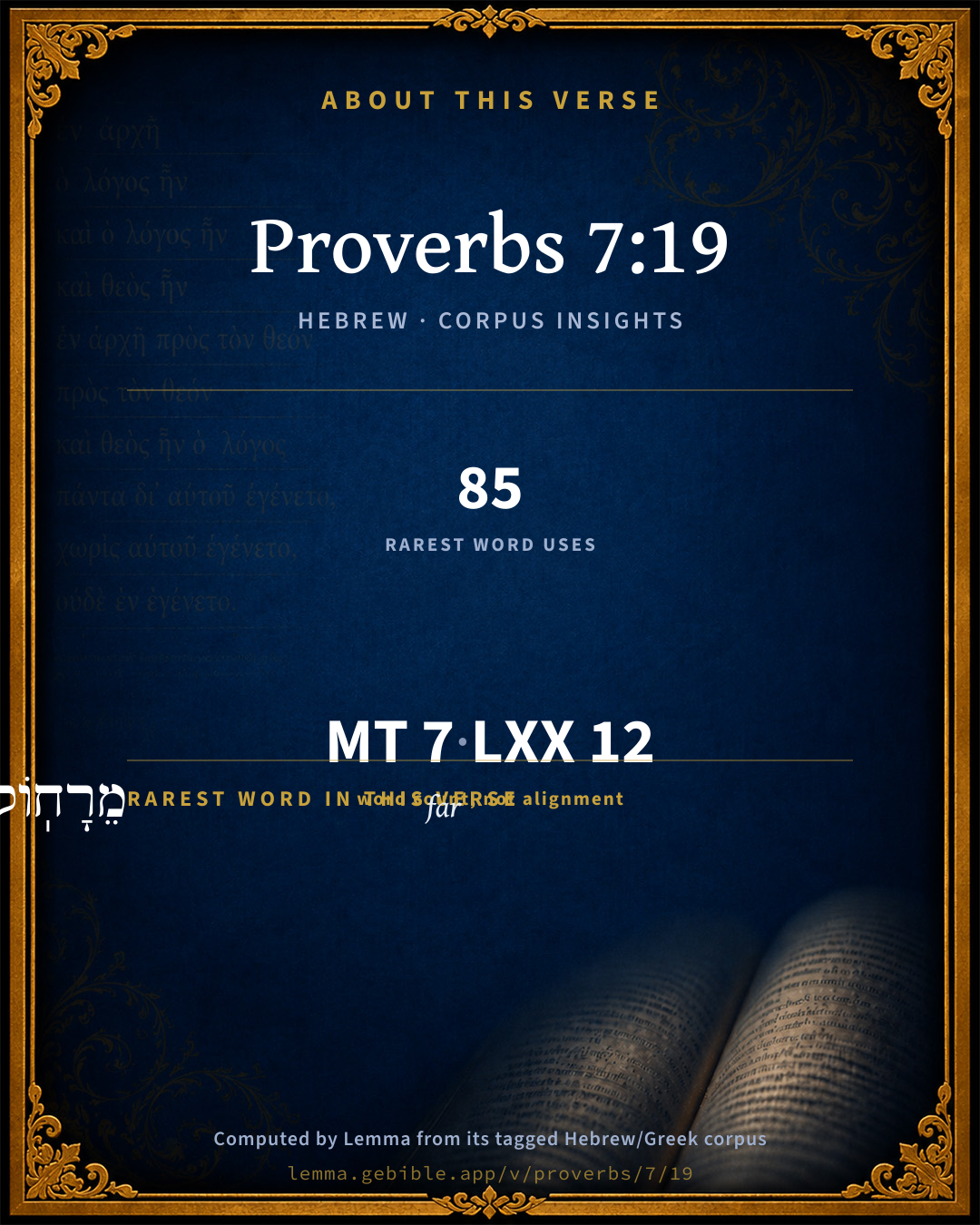
7
words
7
distinct lemmas
Wisdom
section

Grammatical profile

  • 1 verb
  • 3 nouns
  • 1 adjective
  • 1 conjunction
  • 1 particle

Verb forms

  • הָ֝לַ֗ךְ Qal · Perfect

Hebrew & Septuagint length

In English translation the verse runs 13 words from the Hebrew and 14 from the Septuagint (LXX English) — closely comparable.

A rough comparison of the two English renderings, which tokenize alike — not a word-level alignment.

Word counts can differ between the Hebrew and the Greek without any difference in meaning — e.g. the Hebrew direct-object marker אֵת has no separate Greek word, and Greek often adds the article ὁ.

In the original languages it is 7 Hebrew tokens and 12 Greek tokens — but the two are counted differently (Hebrew bundles its prefixes and suffixes into one token; the Greek is in lemma form), so that isn’t a like-for-like length.

Cross-references

6

Topical passages linked to Proverbs 7:19 in the Treasury of Scripture Knowledge — connected by theme and wording, ordered by reader-vote popularity; previews shown in the World English Bible.

  • Matthew 20:11 When they received it, they murmured against the master of the household,
  • Luke 12:45–46 But if that servant says in his heart, 'My lord delays his coming,' and begins to beat the menservants and the maidservants, and to eat and drink, and to be drunken,
  • Matthew 24:43 But know this, that if the master of the house had known in what watch of the night the thief was coming, he would have watched, and would not have allowed his house to be broken into.
  • Matthew 24:48 But if that evil servant should say in his heart, 'My lord is delaying his coming,'
  • Mark 13:34–36 "It is like a man, traveling to another country, having left his house, and given authority to his servants, and to each one his work, and also commanded the doorkeeper to keep watch.
  • Luke 12:39 But know this, that if the master of the house had known in what hour the thief was coming, he would have watched, and not allowed his house to be broken into.

Cross-references courtesy of OpenBible.info (CC BY 4.0).

Hebrew and Greek witnesses Masoretic Hebrew ↔ Greek Septuagint

The same verse in the two great witnesses to the Old Testament, shown verse-for-verse.

These are two independent witnesses, not word-aligned to each other, and the Septuagint is shown in lemma (dictionary) form.

Hebrew Proverbs 7:19 Masoretic · Westminster Leningrad Codex

כִּ֤י אֵ֣ין הָאִ֣ישׁ בְּבֵית֑וֹ הָ֝לַ֗ךְ בְּדֶ֣רֶךְ מֵרָחֽוֹק

For my husband isn't at home. He has gone on a long journey.

World English Bible · Public Domain

Greek LXX Proverbs 7:19 Septuagint · lemma form

οὐ γάρ παραεἰμί ὁ ἀνήρ ἐγώ ἐν οἶκος πορεύομαι δέ ὁδός μακρός

For my husband is not at home, but is gone on a long journey,

LXX2012 (modern English Septuagint) · Public Domain

Hebrew: Westminster Leningrad Codex (CC BY 4.0). Greek: Septuagint (public domain); English from LXX2012 (modern English Septuagint) (Public Domain). How the Septuagint differs from the Hebrew →

Commentary

Notes on Proverbs 7:19 from classic Christian and Jewish commentators (each source and its license shown beneath its notes). The classic Christian expositions comment on the surrounding passage and are grouped to its opening verse, so a note may address several verses; the Jewish commentaries on the Tanakh (Rashi and others) are per-verse, so they appear only where the commentator wrote on this verse.

Lemma curates 59 commentaries, every one of them public domain or Creative Commons licensed, each selected and text-cleaned for this edition rather than reprinted as found. About our sources →

Trapp's Complete Commentary

John Trapp

Pro 7:19 For the goodman [is] not at home, he is gone a long journey:

Ver. 19. For the goodman is not at home.] Heb., The man, - not my man, or my husband, &c. The very mention (how much more the presence!) of such a man might have marred the mirth.

John Trapp, A Commentary or Exposition upon All the Books of the Old and New Testament (1647–1656) — public domain. Text from a community e-Sword module.

Adam Clarke's Commentary

Verse 19. For the good man] Literally, "For the man is not in his house."

Adam Clarke's Commentary on the Bible (1810–1826) — public domain. Text from a community e-Sword/MySword module.

Ellicott's Commentary for English Readers

(19) The goodman.—Literally, the man; she does not even call him “my husband.”

At the day appointed.—Rather, at the full moon, a fortnight later, as now it would seem to have been new moon, when the nights are dark.

A Bible Commentary for English Readers, edited by Charles John Ellicott (1878–1897) — public domain. Text from a community e-Sword module.

The Cambridge Bible for Schools and Colleges

gen. ed. J. J. S. Perowne

19. the goodman] Heb. the man, i.e. her husband. There is no fear of detection. See for the reason why this is urged, Pro_6:34-35.

The Cambridge Bible for Schools and Colleges (gen. ed. J. J. S. Perowne; Cambridge University Press, 1878–1918) — public domain. Text from a community e-Sword module.

John Gill's Exposition

He hath taken a bag of money with him,.... Or, "in his hand" (a); either for merchandise, as Gersom; or for defraying: the charges of his journey; and both suppose length of time: if for merchandise, it required time to purchase goods, and see them packed up and sent away; or if for his journey, since it was not a few pieces of money he put in his pocket to defray expenses, but a bag of it he carried in his hand, it shows that he should be out a considerable time;

and will come home at the day appointed; and not before: Aben Ezra interprets it, at the beginning of the month, at the new moon, when the moon is covered (b), which Horace (c) calls "tricessima sabbata": but rather it is to be understood of the full moon, as Aquila and the Vulgate Latin version render it; when it is light all night, and so a proper time for travelling home again. Gersom takes it to mean the beginning of the year, when the holy blessed God, parabolically speaking, sits upon a throne to judge the world in righteousness: the Targum calls it the day of the congregation; some fixed festival day, when the congregation meets together; and at such a festival, or appointed time, this good man had fixed for his return, and when, and not before, he would. This she says to remove all fears from the young man of being surprised and caught by her husband. There is an appointed time for Christ's second coming, when he will certainly come, and not before; and which is supposed to be at a great distance of time: and therefore wicked men and seducers, and such as the apostate church of Rome make use of to encourage themselves in their wickedness, in hopes of impunity, put the evil day far away from them; but in the appointed time Christ will come, and call his servants to an account, good and bad.

(a) "in manu sua", Pagninus, Montanus, Mercerus, Gejerus, Michaelis. (b) "in die plenae lunae", V. L. Michaelis; "novilunii", so some in Vatablus, Piscator; "ad diem interlunii", Cocceius, Schultens. (c) Satirar. l. 1. Sat. 9. v. 69.

John Gill's Exposition of the Whole Bible (1746–1763) — public domain (CC PDM 1.0). Text via the HelloAO Bible API.

Albert Barnes' Notes on the Bible

The reference to the husband is probably a blind. The use of the word “goodman” is due to the wish of the English translators to give a colloquial character to this part of their Version. The Hebrew is merely “the man.” A touch of scorn may be noticed in the form of speech: not “my husband,” but simply “the man.”

Albert Barnes' Notes on the Bible (1834–1885) — public domain. Text from a community e-Sword/MySword module.

Haydock's Catholic Bible Commentary

My. Literally, "the man." (Haydock) --- She speaks thus out of contempt. (Calmet)

George Leo Haydock (1774–1849), Haydock's Catholic Family Bible and Commentary, 1859 edition — public domain. Excludes Psalms (Douay-Rheims chapter numbering differs from Protestant) and Deuterocanonical books (Catholic canon only).

Matthew Poole's English Annotations

The goodman; whom she doth not call her husband, lest the mention of that name should awaken his conscience or discretion.

Matthew Poole's English Annotations on the Holy Bible (1683–1685) — public domain. Text from a community e-Sword/MySword module.

Whedon's Commentary on the Bible

Daniel D. Whedon

19, 20. The goodman — האישׁ, (haish,) the man, that is, of the house. Geneva Bible, “housband.” She pretends that she has a husband, or father, but that he is out of the way. This is said to assure her paramour of safe and uninterrupted enjoyment.

Gone a long journey — Literally, gone in the way, afar off.

The bag of money — quite a bundle — is mentioned, to correspond with the long journey.

At the day appointed — Many of the best critics prefer, at the full moon. Comp. Psa_81:3.

Daniel D. Whedon (gen. ed.), Commentary on the Old and New Testaments (1874–1909) — public domain. Text from a community e-Sword module.

The Pulpit Commentary

The temptress proceeds to encourage the youth by showing that there is no fear of interruption or detection. The goodman is not at home. "Goodman" is an old word meaning "master of the house," or husband; (Mat_20:11, etc.) but the Hebrew is simply "the man," which is probably a contemptuous way of speaking of the husband whom she was outraging. He is gone a long journey; he has gone to a place at a great distance hence. This fact might assure her lover that he was safe from her husband"s jealousy; (Pro_6:34) but she has further encouragement to offer.

The Pulpit Commentary (1880–1919), ed. H.D.M. Spence-Jones & Joseph S. Exell — public domain. Text from a community e-Sword module.

Keil & Delitzsch

C. F. Keil & F. Delitzsch

The adulteress now deprives the youth of all fear; the circumstances under which her invitation is given are as favourable as possible.

19 "For the man is not at home,

He has gone on a long journey.

20 He has taken the purse with him:

He will not return home till the day of the full moon."

It is true that the article stands in האישׁ, Arab. alm'ar-fat, i.e., serves to define the word: the man, to whom here κατ ̓ ̓ξοχήν and alone reference can be made, viz., the husband of the adulteress (Fl.); but on the other side it is characteristic that she does not say אישׁי (as e.g., Gen 29:32), but ignores the relation of love and duty in which she is placed to him, and speaks of him as one standing at a distance from her (Aben-Ezra). Erroneously Vogel reads בּבּית after the Targ. instead of בּביתו. We say in Hebr. אינו בביתו, il n'est pas chez soi, as we say לקח בּידו, il a pris avec soi (cf. Jer 38:10). מרחוק Hitzig seeks to connect with the verb, which, after Isa 17:13; Isa 22:3, is possible; for the Hebr. מרחוק (ממּרחק), far off, has frequently the meaning from afar, for the measure of length is determined not from the point of departure outward, but from the end, as e.g., Homer, Il. ii. 456; ἕκαθεν δέ τε φαίνεται αὐγή, from afar the gleam is seen, i.e., shines hither from the distance. Similarly we say in French, il vient du cot du nord, he comes from the north, as well as il va du cot du nord, he goes northwards. But as we do not say: he has gone on a journey far off, but: on a distant journey, so here מרחוק is virtually an adj. (vid., under Isa 5:26) equivalent to רחוקה (Num 9:10): a journey which is distant = such as from it he has a long way back. Michaelis has well remarked here: ut timorem ei penitus adimat, veluti per gradus incedit. He has undertaken a journey to a remote point, but yet more: he has taken money with him, has thus business to detain him; and still further: he has even determined the distant time of his return. צרור־הכּסף .nruter (thus to be written after Ben-Asher, vid., Baer's Torath Emeth, p. 41) is the purse (from צרר, to bind together), not one of many, but that which is his own. The terminus precedes 20b to emphasize the lateness; vid., on כּסא under Psa 81:4. Graec. Venet. τῇ ἡμέρᾳ τοῦ καιροῦ, after Kimchi and others, who derive כסא (כסה) from the root כס, to reckon, and regard it as denoting only a definite time. But the two passages require a special idea; and the Syr. ḳêso, which in Kg1 12:32; Ch2 7:10, designates the time from the 15th day of the month, shows that the word denotes not, according to the Talmud, the new moon (or the new year's day), when the moon's disk begins to cover itself, i.e., to fill (יתכסה), but the full moon, when it is covered, i.e., filled; so that thus the time of the night-scene here described is not that of the last quarter of the moon (Ewald), in which it rises at midnight, but that of the new moon (Hitzig), when the night is without moonlight. Since the derivation of the word from כסא (כסה), to cover, gives the satisfactory idea of the covering or filling of the moon's disk, we do not seek after any other; Dietrich fixes on the root-idea of roundness, and Hitzig of vision (כסא = סכה, שׂכה, vid., on the contrary, under Psa 143:9). The ל is that of time at which, in which, about which, anything is done; it is more indefinite than בּ would be. He will not return for some fourteen days.

Keil & Delitzsch — Biblical Commentary on the Old Testament (1861–1891) — public domain (CC PDM 1.0). Text via the HelloAO Bible API. (Old Testament only.)

unfoldingWord translationNotes

Door43 World Missions Community

is not at his house

"is not at home"

full moon

The moon is said to be full when it is a perfectly round disk, shining at its brightest.

she turned him

To persuade someone to act in a certain way is spoken of as if it were changing the direction that person was walking. AT: "she persuaded him" (See: Metaphor)

her ... she ... him

The female is the married woman who wants to sleep with "him," the young man.

smooth lips

Here "lips" represents what a person says. When a person flatters someone else by saying things that are not sincere, these words are spoken of as if they were a smooth object. AT: "flattering, deceiving words" (See: Metonymy and Metaphor)

she misled him

"she persuaded him to do something evil" AT: "she convinced him to sin with her"

unfoldingWord translationNotes — © Distant Shores Media and the Door43 World Missions Community, licensed CC BY-SA 4.0. Source: git.door43.org/Door43/en_tn.

Rashi

Rabbi Shlomo Yitzchaki (Rashi)

For the man is not at home You have seen that the Holy One, blessed be He, has removed His Shechinah and has given all good to the pagans.

Rashi on the Tanakh — English translations: “The Judaica Press complete Tanach with Rashi, translated by A. J. Rosenberg” (CC BY 4.0); “Pentateuch with Rashi's commentary by M. Rosenbaum and A.M. Silbermann, 1929-1934” (public domain); “The Metsudah Tanach series, Lakewood, N.J” (CC BY 4.0); and “The Book of Joshua, Metsudah Publications, 1997” (CC BY 4.0). Text via Sefaria.

Lesson kit

Teaching starters — assembled from the data on this page, not authored interpretation. Every prompt links to the verse data it draws on. Edit before teaching.

Proverbs, in the Wisdom, opens this verse with 7 words (7 distinct Hebrew lemmas). Its most distinctive word is râchôwq (“far”). A historical commentator’s framing appears above. Read the whole chapter for the surrounding context.

Discussion questions

  1. What does “far” (râchôwq) contribute to the verse as a whole?
  2. Matthew 20:11 shares this passage’s theme. How do the two illuminate each other?
  3. These translations render this verse differently. What is at stake in choosing one wording over another?
  4. The verb «הָ֝לַ֗ךְ» is Qal Perfect. How does its form color the action?
  5. Reading how Trapp's Complete Commentary and Adam Clarke's Commentary read this verse, where do the two commentators agree and where do they part?

Things to notice

Reading settings

Reading text

Shown beneath each verse's original-language words.

Old Testament
Old Testament edition

Read the OT as the Masoretic Hebrew (MT) or the Greek Septuagint (LXX).

English shown for the Greek Septuagint (in the Hebrew ↔ Greek comparison).

Comparing translations? Open the Compare panel on any verse page to stack up to four side by side.