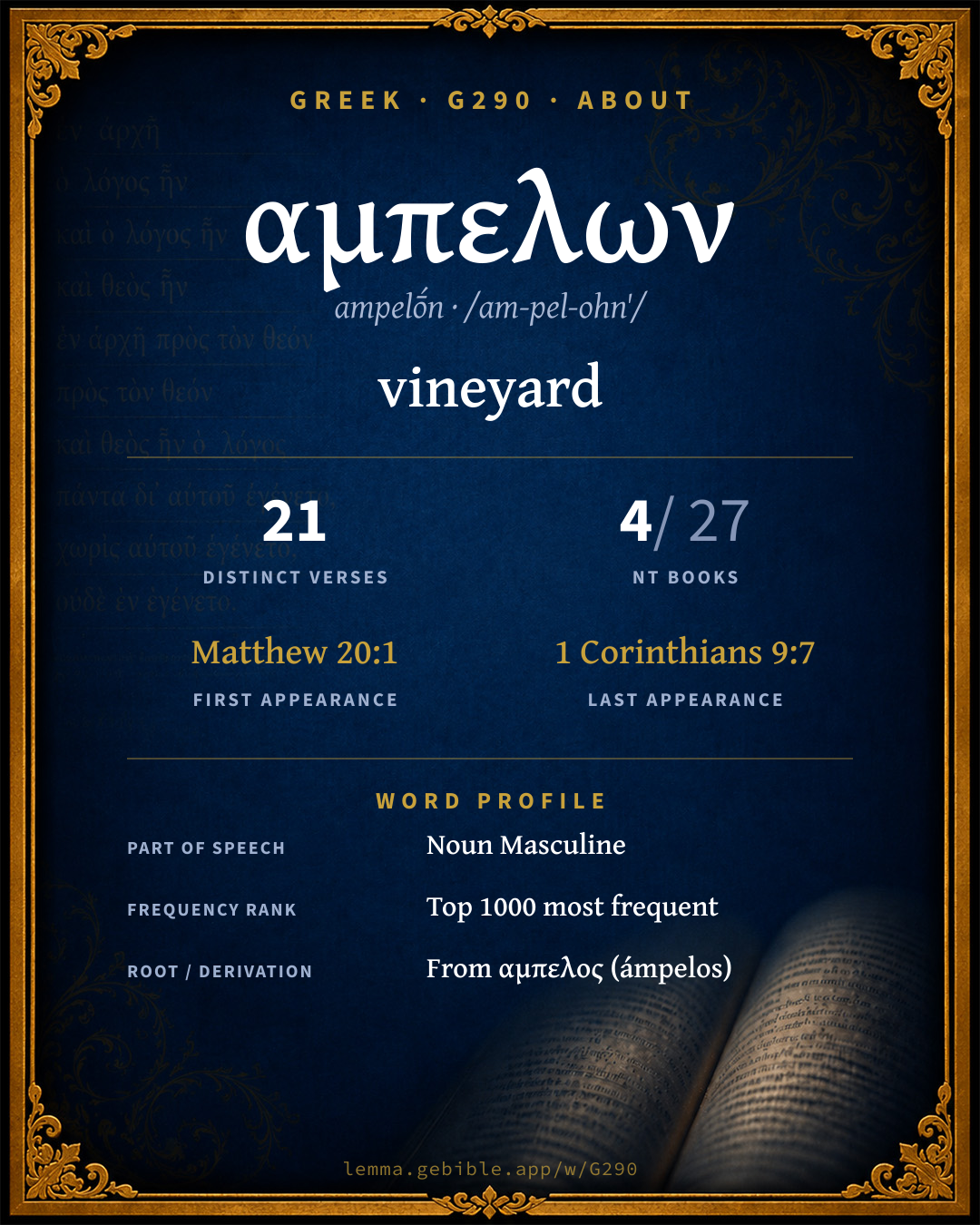
ἀμπελών
vineyard
Full lexicon entry — Thayer's Greek Lexicon
From Thayer's Greek Lexicon
Where this word appears
See every Accusative-case word in the Greek New Testament →
Grammar key — what these labels mean
Part of speech
- Noun
- A naming word — a person, place, thing, or idea.
Case
- Accusative
- The case of the direct object and of extent.
- Genitive
- The case of source, possession, or “of” — answers “whose / from what.”
- Dative
- The case of the indirect object, means, or location — “to / for / with / in.”
Gender
- Masculine
- Grammatically masculine.
Number
- Singular
- One.
Grammatical forms
- Noun, Accusative, Singular, Masculine 11 times (48%)
- Noun, Genitive, Singular, Masculine 10 times (43%)
- Noun, Dative, Singular, Masculine 2 times (9%)
Parsed forms decoded from the imported morphology (Robinson–Tischendorf, public domain), counted across 23 parsed occurrences — not distinct verses.
Every verse where G290 appears — 21 distinct verses across 4 books. Click any verse to open its interlinear word-by-word view. Verse text shown in the World English Bible for context — . Each verse’s Greek form is shown with its reference; the English is not keyword-highlighted, since the data carries no word-level English alignment. Use “Compare translations” on any verse to read it across multiple English versions. This concordance covers the Greek New Testament; Septuagint (Greek Old Testament) occurrences of this word are not indexed here.
Matthew 10 verses
- Matthew 20:1 ἀμπελῶνα n acc sg masc "For the Kingdom of Heaven is like a man who was the master of a household, who went out early in the morning to hire laborers for his vineyard.
- Matthew 20:2 ἀμπελῶνα n acc sg masc When he had agreed with the laborers for a denarius a day, he sent them into his vineyard.
- Matthew 20:4 ἀμπελῶνα n acc sg masc To them he said, 'You also go into the vineyard, and whatever is right I will give you.' So they went their way.
- Matthew 20:7 ἀμπελῶνα n acc sg masc "They said to him, 'Because no one has hired us.' "He said to them, 'You also go into the vineyard, and you will receive whatever is right.'
- Matthew 20:8 ἀμπελῶνος n gen sg masc When evening had come, the lord of the vineyard said to his steward, 'Call the laborers and pay them their wages, beginning from the last to the first.'
- Matthew 21:28 ἀμπελῶνι n dat sg masc But what do you think? A man had two sons, and he came to the first, and said, 'Son, go work today in my vineyard.'
- Matthew 21:33 ἀμπελῶνα n acc sg masc "Hear another parable. There was a man who was a master of a household, who planted a vineyard, set a hedge about it, dug a winepress in it, built a tower, leased it out to farmers, and went into another country.
- Matthew 21:39 ἀμπελῶνος n gen sg masc So they took him, and threw him out of the vineyard, and killed him.
- Matthew 21:40 ἀμπελῶνος n gen sg masc When therefore the lord of the vineyard comes, what will he do to those farmers?"
- Matthew 21:41 ἀμπελῶνα n acc sg masc They told him, "He will miserably destroy those miserable men, and will lease out the vineyard to other farmers, who will give him the fruit in its season."
Mark 4 verses
- Mark 12:1 ἀμπελῶνα n acc sg masc He began to speak to them in parables. "A man planted a vineyard, put a hedge around it, dug a pit for the winepress, built a tower, rented it out to a farmer, and went into another country.
- Mark 12:2 ἀμπελῶνος n gen sg masc When it was time, he sent a servant to the farmer to get from the farmer his share of the fruit of the vineyard.
- Mark 12:8 ἀμπελῶνος n gen sg masc They took him, killed him, and cast him out of the vineyard.
- Mark 12:9 ἀμπελῶνος ἀμπελῶνα n gen sg masc n acc sg masc What therefore will the lord of the vineyard do? He will come and destroy the farmers, and will give the vineyard to others.
Luke 6 verses
- Luke 13:6 ἀμπελῶνι n dat sg masc He spoke this parable. "A certain man had a fig tree planted in his vineyard, and he came seeking fruit on it, and found none.
- Luke 20:9 ἀμπελῶνα n acc sg masc He began to tell the people this parable. "A man planted a vineyard, and rented it out to some farmers, and went into another country for a long time.
- Luke 20:10 ἀμπελῶνος n gen sg masc At the proper season, he sent a servant to the farmers to collect his share of the fruit of the vineyard. But the farmers beat him, and sent him away empty.
- Luke 20:13 ἀμπελῶνος n gen sg masc The lord of the vineyard said, 'What shall I do? I will send my beloved son. It may be that seeing him, they will respect him.'
- Luke 20:15 ἀμπελῶνος ἀμπελῶνος n gen sg masc n gen sg masc They threw him out of the vineyard, and killed him. What therefore will the lord of the vineyard do to them?
- Luke 20:16 ἀμπελῶνα n acc sg masc He will come and destroy these farmers, and will give the vineyard to others." When they heard it, they said, "May it never be!"
1 Corinthians 1 verse
About this entry
At a glance — auto-summarized from this page’s data, not written by a person. Every figure links to its source below. This summary describes the numbers; it doesn’t interpret them.
“vineyard” is the headline sense of the Greek noun αμπελων (ampelṓn). Scripture first uses it in Matthew 20:1. With 21 verses in 4 books, it is an uncommon word in the Greek New Testament. It concentrates in Matthew, which alone accounts for 48% of its uses. From the same root come αμπελος and αμπελουργος. See the sense tree, 21-verse concordance, and the renderings breakdown below.
Gloss history
Strong's 1890 vs modern scholarship
About this word
Strong's G290 catalogs a Greek word from the Greek New Testament.
These counts are not copied from any lexicon or concordance. They are computed here, from the morphology-tagged Greek New Testament. What Lemma adds →
- 21
- distinct verses
- The word appears in 21 distinct verses.
- 4 / 27
- NT books
- The word appears in 4 of 27 New Testament books.
- #563
- by frequency
- Top 1000 most frequent Greek words (rank 563 of 5,347 Greek words by occurrence).
View all 21 occurrences in the concordance →
By section of the New Testament
By traditional corpus
Conventional, traditional groupings — biblical authorship is debated, so this is a traditional corpus grouping, not an authorship claim. Some books belong to more than one corpus (Luke is in both the Gospels and the Lukan corpus, and so on), so these shares overlap and need not total 100%. Each figure is a share of the word’s 21 distinct verses.
- Gospels 20 verses · 95%
- Lukan (Luke–Acts) 6 verses · 29%
- Pauline corpus 1 verse · 5%
How translations render this word
Counts come from each version’s own published word-to-Strong’s tagging or interlinear alignment — an approximate guide to how each version renders this word, not a word-level alignment the data otherwise carries. Because each total is that version’s own tagged count, the per-version totals vary from one another and need not match the appearance or distinct-verse counts above. These counts may also differ from a printed concordance because Lemma counts each distinctly tagged rendering and does not collapse phrase taggings into a single head-word total. This is a fixed set of word-tagged versions (KJV, ASV, BSB, ULT) and does not change with the reading translation you choose elsewhere. Each version’s license is shown beside its name below (and on Sources).
- King James Version: Vineyard 23×
- American Standard Version: Vineyard 23×
- Berean Standard Bible: Vineyard 23×
- unfoldingWord Literal Text: Vineyard 23×
King James Version Public Domain
Renders G290 across 23 tagged occurrences — most commonly:
American Standard Version Public Domain
Renders G290 across 23 tagged occurrences — most commonly:
Berean Standard Bible Public Domain
Renders G290 across 23 tagged occurrences — most commonly:
unfoldingWord Literal Text CC BY-SA 4.0
Renders G290 across 24 tagged occurrences — most commonly:
Plus 1 rendering that appears only once — usually multi-word phrases or single function words the recovered tagging swept in, not distinct renderings.
Senses in Thayer's
The 1 sense Thayer's distinguishes for this word, in lexicon order (not ranked by frequency or importance). The full entry — with sub-senses — is in the Lexicon Entry tab.
- a vineyard
Word origin
Derived from αμπελος (ámpelos) (G288) — vine.
From G288 ; a vineyard : - vineyard.
— Strong’s Exhaustive Concordance (1890), public domain.
Forms in the corpus
The 3 distinct written forms G290 takes in the Greek New Testament, most frequent first — each parse links to that case’s occurrences in the concordance.
| Form | Parsing | Example | Uses |
|---|---|---|---|
| ἀμπελῶνα ampelō̂na | Noun, Accusative, Singular, Masculine | Matthew 20:1 | 11 |
| ἀμπελῶνος ampelō̂nos | Noun, Genitive, Singular, Masculine | Matthew 20:8 | 10 |
| ἀμπελῶνι ampelō̂ni | Noun, Dative, Singular, Masculine | Matthew 21:28 | 2 |
Same root — word family
Other Thayer's entries built from the same root as G290, grouped by Strong’s listed origin. These share a root / origin per the lexicon — not necessarily a shared meaning. Each links to that word’s own entry.
Derives from
Shares the same root
Compare all same-root words → They share a root, not necessarily a meaning.
Septuagint usage
The same Greek word αμπελων appears 84 times in the Greek Old Testament (Septuagint), across 75 verses in 22 books.
- 84
- LXX occurrences
- Tagged occurrences of this Greek word in the Septuagint.
- 75
- verses
- Distinct Septuagint verses containing this word.
- 22 / 39
- OT books
- The word appears in 22 of the 39 Old Testament books.
Sample Septuagint occurrences
- Genesis 9:20 ἀμπελών
- Exodus 22:4 ἀμπελών
- Leviticus 19:10 ἀμπελών
- Numbers 16:14 ἀμπελών
- Deuteronomy 6:11 ἀμπελών
- Joshua 24:13 ἀμπελών
- Judges 9:27 ἀμπελών
- 1 Samuel 8:14 ἀμπελών
- 1 Kings 20:1 ἀμπελών
- 2 Kings 5:26 ἀμπελών
- Ezra 15:3 ἀμπελών
- Job 24:6 ἀμπελών
Septuagint occurrences (same lexeme)
Every verse where the same Strong’s number (G290) appears in the Greek Septuagint — showing the first 50 of 75. Verse text shown in the World English Bible for context; the Greek form is the matched word — the English is not keyword-highlighted.
- Genesis 9:20 ἀμπελών Noah began to be a farmer, and planted a vineyard.
- Exodus 22:4 ἀμπελών If the stolen property is found in his hand alive, whether it is ox, donkey, or sheep, he shall pay double.
- Exodus 23:11 ἀμπελών but the seventh year you shall let it rest and lie fallow, that the poor of your people may eat; and what they leave the animal of the field shall eat. In like manner you shall deal with your vineyard and with your olive grove.
- Leviticus 19:10 ἀμπελών You shall not glean your vineyard, neither shall you gather the fallen grapes of your vineyard; you shall leave them for the poor and for the foreigner. I am Yahweh your God.
- Leviticus 19:19 ἀμπελών "'You shall keep my statutes. "'You shall not crossbreed different kinds of animals. "'you shall not sow your field with two kinds of seed; "'neither shall there come upon on you a garment made of two kinds of material.
- Numbers 16:14 ἀμπελών Moreover you haven't brought us into a land flowing with milk and honey, nor given us inheritance of fields and vineyards: will you put out the eyes of these men? we won't come up.
- Numbers 20:17 ἀμπελών Please let us pass through your land: we will not pass through field or through vineyard, neither will we drink of the water of the wells: we will go along the king's highway; we will not turn aside to the right hand nor to the left, until we have passed your border.
- Numbers 21:22 ἀμπελών Let me pass through your land: we will not turn aside into field, or into vineyard; we will not drink of the water of the wells: we will go by the king's highway, until we have passed your border.
- Deuteronomy 6:11 ἀμπελών and houses full of all good things, which you didn't fill, and cisterns dug out, which you didn't dig, vineyards and olive trees, which you didn't plant, and you shall eat and be full;
- Deuteronomy 20:6 ἀμπελών What man is there who has planted a vineyard, and has not used the fruit of it? let him go and return to his house, lest he die in the battle, and another man use the fruit of it.
- Deuteronomy 22:9 ἀμπελών You shall not sow your vineyard with two kinds of seed, lest the whole fruit be forfeited, the seed which you have sown, and the increase of the vineyard.
- Deuteronomy 23:26 ἀμπελών
- Deuteronomy 24:21 ἀμπελών When you gather [the grapes of] your vineyard, you shall not glean it after you: it shall be for the foreigner, for the fatherless, and for the widow.
- Deuteronomy 28:30 ἀμπελών You shall betroth a wife, and another man shall lie with her: you shall build a house, and you shall not dwell therein: you shall plant a vineyard, and shall not use the fruit of it.
- Deuteronomy 28:39 ἀμπελών You shall plant vineyards and dress them, but you shall neither drink of the wine, nor gather [the grapes]; for the worm shall eat them.
- Joshua 24:13 ἀμπελών I gave you a land whereon you had not labored, and cities which you didn't build, and you dwell therein; of vineyards and olive groves which you didn't plant do you eat.
- Judges 9:27 ἀμπελών They went out into the field, and gathered their vineyards, and trod [the grapes], and held festival, and went into the house of their god, and did eat and drink, and cursed Abimelech.
- Judges 14:5 ἀμπελών Then went Samson down, and his father and his mother, to Timnah, and came to the vineyards of Timnah: and, behold, a young lion roared against him.
- Judges 15:5 ἀμπελών When he had set the brands on fire, he let them go into the standing grain of the Philistines, and burnt up both the shocks and the standing grain, and also the olive groves.
- Judges 21:20 ἀμπελών They commanded the children of Benjamin, saying, Go and lie in wait in the vineyards,
- Judges 21:21 ἀμπελών and see, and, behold, if the daughters of Shiloh come out to dance in the dances, then come you out of the vineyards, and catch you every man his wife of the daughters of Shiloh, and go to the land of Benjamin.
- 1 Samuel 8:14 ἀμπελών He will take your fields, and your vineyards, and your olive groves, even the best of them, and give them to his servants.
- 1 Samuel 8:15 ἀμπελών He will take the tenth of your seed, and of your vineyards, and give to his officers, and to his servants.
- 1 Samuel 15:9 ἀμπελών But Saul and the people spared Agag, and the best of the sheep, and of the oxen, and of the fatlings, and the lambs, and all that was good, and wouldn't utterly destroy them: but everything that was vile and refuse, that they destroyed utterly.
- 1 Samuel 22:7 ἀμπελών Saul said to his servants who stood about him, Hear now, you Benjamites; will the son of Jesse give everyone of you fields and vineyards, will he make you all captains of thousands and captains of hundreds,
- 1 Kings 20:1 ἀμπελών Ben Hadad the king of Syria gathered all his host together; and there were thirty-two kings with him, and horses and chariots: and he went up and besieged Samaria, and fought against it.
- 1 Kings 20:2 ἀμπελών He sent messengers to Ahab king of Israel, into the city, and said to him, Thus says Ben Hadad,
- 1 Kings 20:6 ἀμπελών but I will send my servants to you tomorrow about this time, and they shall search your house, and the houses of your servants; and it shall be, that whatever is pleasant in your eyes, they shall put it in their hand, and take it away.
- 1 Kings 20:7 ἀμπελών Then the king of Israel called all the elders of the land, and said, Please notice how this man seeks mischief: for he sent to me for my wives, and for my children, and for my silver, and for my gold; and I didn't deny him.
- 1 Kings 20:15 ἀμπελών Then he mustered the young men of the princes of the provinces, and they were two hundred and thirty-two: and after them he mustered all the people, even all the children of Israel, being seven thousand.
- 1 Kings 20:16 ἀμπελών They went out at noon. But Ben Hadad was drinking himself drunk in the pavilions, he and the kings, the thirty-two kings who helped him.
- 1 Kings 20:18 ἀμπελών He said, Whether they are come out for peace, take them alive, or whether they are come out for war, taken them alive.
- 2 Kings 5:26 ἀμπελών He said to him, Didn't my heart go with you, when the man turned from his chariot to meet you? Is it a time to receive money, and to receive garments, and olive groves and vineyards, and sheep and oxen, and men-servants and maid-servants?
- 2 Kings 18:32 ἀμπελών Until I come and take you away to a land like your own land, a land of grain and new wine, a land of bread and vineyards, a land of olive trees and of honey, that you may live, and not die: and don't listen to Hezekiah, when he persuades you, saying, Yahweh will deliver us.
- 2 Kings 19:29 ἀμπελών This shall be the sign to you: You shall eat this year that which grows of itself, and in the second year that which springs of the same; and in the third year sow you, and reap, and plant vineyards, and eat the fruit of it.
- Ezra 15:3 ἀμπελών
- Ezra 15:4 ἀμπελών
- Ezra 15:5 ἀμπελών
- Ezra 15:11 ἀμπελών
- Ezra 19:25 ἀμπελών
- Job 24:6 ἀμπελών They cut their provender in the field. They glean the vineyard of the wicked.
- Psalms 106:37 ἀμπελών Yes, they sacrificed their sons and their daughters to demons.
- Proverbs 9:12 ἀμπελών If you are wise, you are wise for yourself. If you mock, you alone will bear it.
- Proverbs 24:30 ἀμπελών I went by the field of the sluggard, By the vineyard of the man void of understanding;
- Ecclesiastes 2:4 ἀμπελών I made myself great works. I built myself houses. I planted myself vineyards.
- Song of Solomon 1:6 ἀμπελών Don't stare at me because I am dark, Because the sun has scorched me. My mother's sons were angry with me. They made me keeper of the vineyards. I haven't kept my own vineyard.
- Song of Solomon 1:14 ἀμπελών My beloved is to me a cluster of henna blossoms From the vineyards of En Gedi. Lover
- Song of Solomon 2:15 ἀμπελών Catch for us the foxes, The little foxes that spoil the vineyards; For our vineyards are in blossom. Beloved
- Song of Solomon 7:13 ἀμπελών The mandrakes give forth fragrance. At our doors are all kinds of precious fruits, new and old, Which I have stored up for you, my beloved.
- Song of Solomon 8:11 ἀμπελών Solomon had a vineyard at Baal Hamon. He leased out the vineyard to keepers. Each was to bring a thousand shekels of silver for its fruit.
These are occurrences of the same Greek lexeme (G290) in the Septuagint — not a translation of any one Hebrew word. The store carries no word-level Hebrew↔Greek alignment, so no Hebrew original is asserted here. Counts come from the recovered LXX Strong's tagging — high-frequency vocabulary is well covered, while rare or late forms may be untagged — so they reflect tagged occurrences and may slightly undercount.