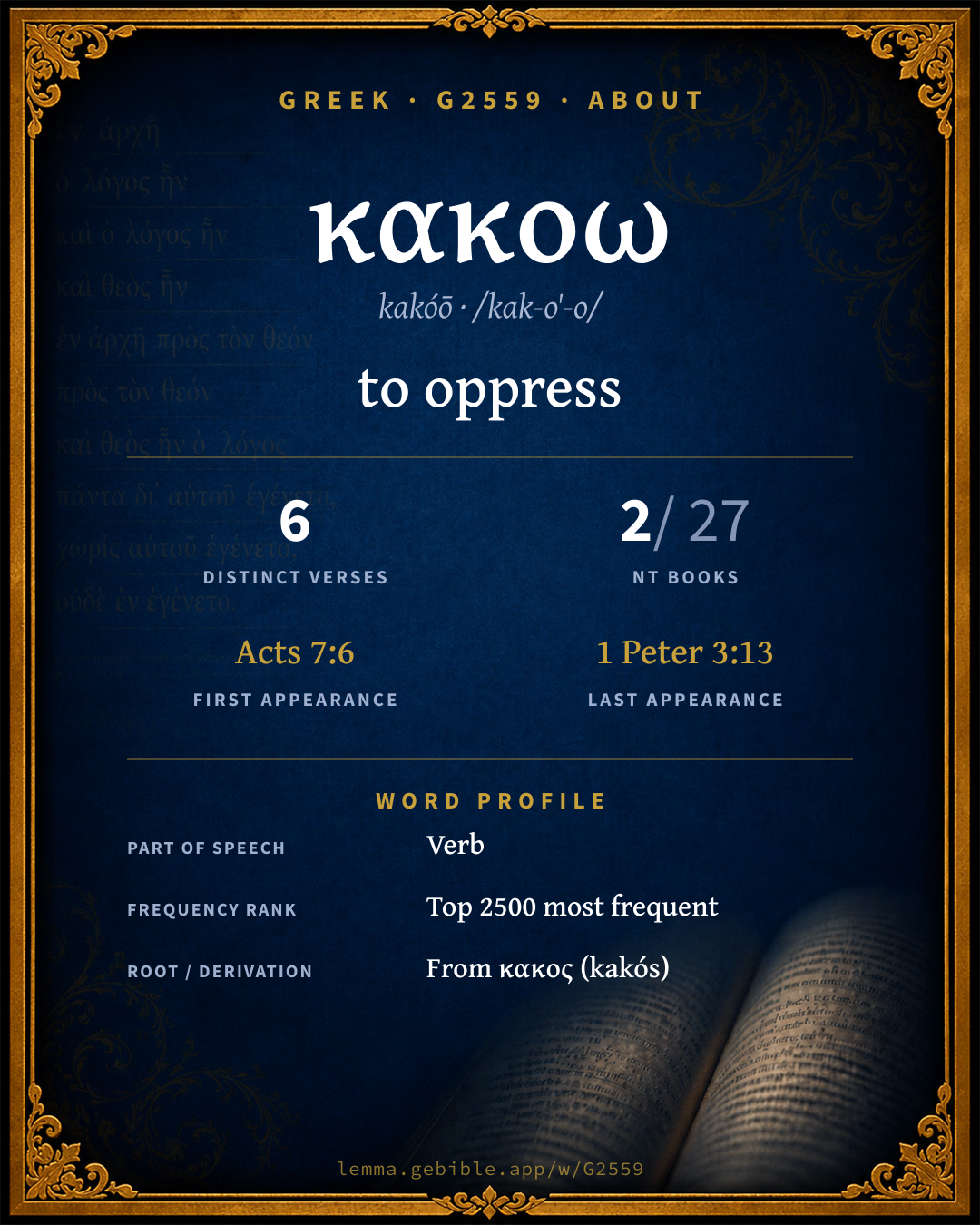
κακόω
to oppress
also: afflict, harm, maltreat fuller range ↓
Full lexicon entry — Thayer's Greek Lexicon
From Thayer's Greek Lexicon
Where this word appears
See every Aorist-tense verb in the Greek New Testament →
Grammar key — what these labels mean
Part of speech
- Verb
- An action or state-of-being word.
Tense
- Aorist
- Action viewed as a simple whole, without regard to duration — often past (perfective aspect).
- Future
- Action expected in future time.
Voice
- Active
- The subject performs the action.
Mood
- Infinitive
- A verbal noun (“to write”), unmarked for person or number.
- Indicative
- States a fact or asks a factual question (the mood of reality).
- Participle
- A verbal adjective (“writing,” “having written”).
Case
- Nominative
- The case of the subject (and the predicate nominative).
Person
- 3rd person
- The one spoken about (“he / she / it / they”).
Gender
- Masculine
- Grammatically masculine.
Number
- Plural
- More than one.
- Singular
- One.
4 distinct verses where G2559 appears in the Aorist tense, across 1 book. Filtered view — show all forms. Click any verse to open its interlinear word-by-word view. Verse text shown in the World English Bible for context — . Each verse’s Greek form is shown with its reference; the English is not keyword-highlighted, since the data carries no word-level English alignment. Use “Compare translations” on any verse to read it across multiple English versions. This concordance covers the Greek New Testament; Septuagint (Greek Old Testament) occurrences of this word are not indexed here.
Acts 4 verses
- Acts 7:19 ἐκάκωσεν aor act ind 3sg The same took advantage of our race, and mistreated our fathers, and forced them to throw out their babies, so that they wouldn't stay alive.
- Acts 12:1 κακῶσαί aor act inf Now about that time, Herod the king stretched out his hands to oppress some of the assembly.
- Acts 14:2 ἐκάκωσαν aor act ind 3pl But the disbelieving Jews stirred up and embittered the souls of the Gentiles against the brothers.
- Acts 18:10 κακῶσαί aor act inf for I am with you, and no one will attack you to harm you, for I have many people in this city."
About this entry
At a glance — auto-summarized from this page’s data, not written by a person. Every figure links to its source below. This summary describes the numbers; it doesn’t interpret them.
κακοω (kakóō) is a Greek verb most often rendered “to oppress.” Acts dominates its distribution — 5 of 6 verses. The Greek New Testament uses it across 6 verses — uncommon. It first appears in Acts 7:6. Ranging over 2 senses, its meaning includes “afflict”, “harm”, and “maltreat”. For the data behind this summary, explore the sense tree and the renderings breakdown below.
Gloss history
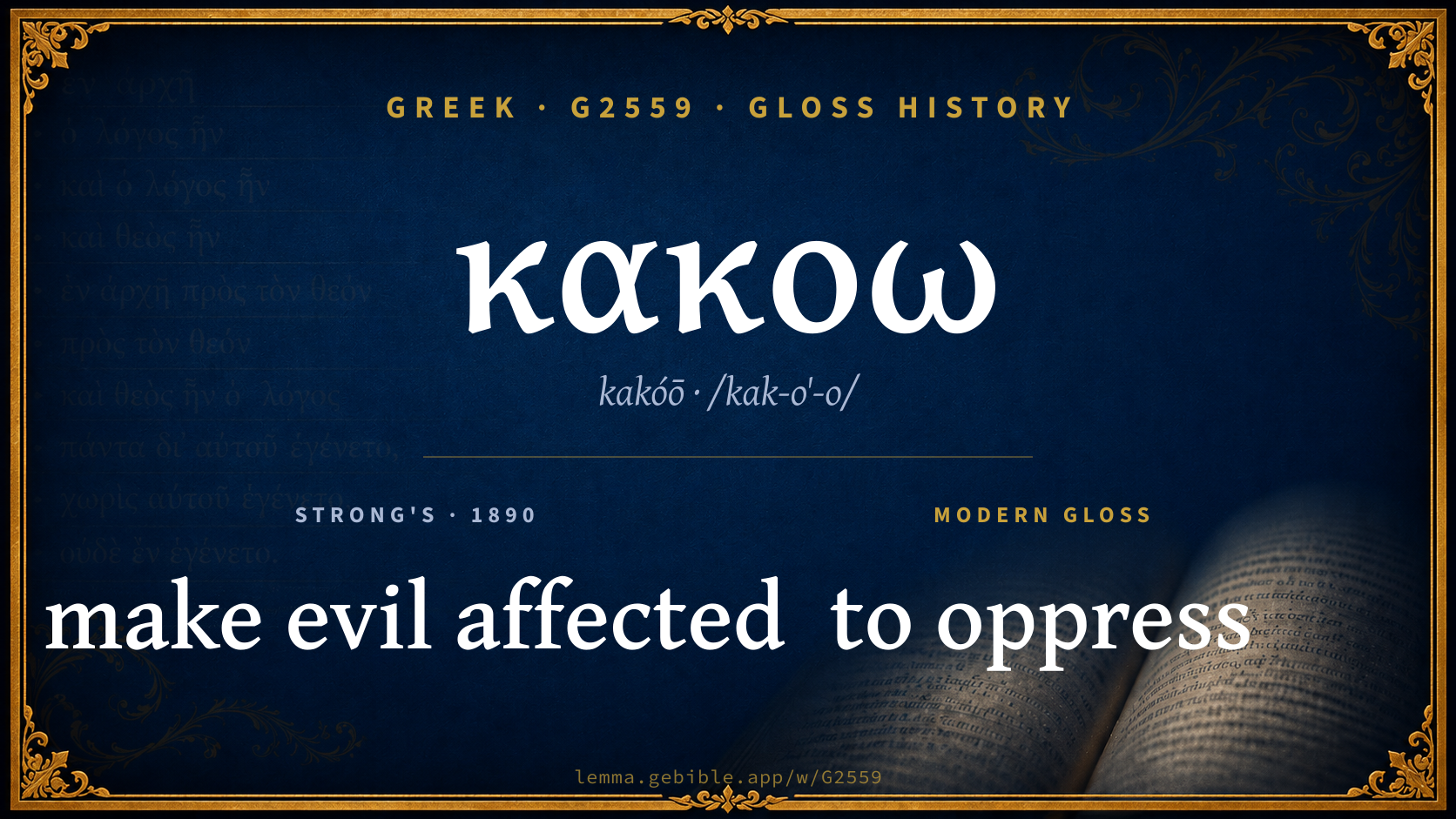
Strong's 1890 vs modern scholarship
About this word
Strong's G2559 catalogs a Greek word from the Greek New Testament.
These counts are not copied from any lexicon or concordance. They are computed here, from the morphology-tagged Greek New Testament. What Lemma adds →
- 6
- distinct verses
- The word appears in 6 distinct verses.
- 2 / 27
- NT books
- The word appears in 2 of 27 New Testament books.
- #1,476
- by frequency
- Top 2500 most frequent Greek words (rank 1,476 of 5,347 Greek words by occurrence).
View all 6 occurrences in the concordance →
By traditional corpus
Conventional, traditional groupings — biblical authorship is debated, so this is a traditional corpus grouping, not an authorship claim. Some books belong to more than one corpus (Luke is in both the Gospels and the Lukan corpus, and so on), so these shares overlap and need not total 100%. Each figure is a share of the word’s 6 distinct verses.
- Lukan (Luke–Acts) 5 verses · 83%
- General (Catholic) Epistles 1 verse · 17%
How translations render this word
Counts come from each version’s own published word-to-Strong’s tagging or interlinear alignment — an approximate guide to how each version renders this word, not a word-level alignment the data otherwise carries. Because each total is that version’s own tagged count, the per-version totals vary from one another and need not match the appearance or distinct-verse counts above. These counts may also differ from a printed concordance because Lemma counts each distinctly tagged rendering and does not collapse phrase taggings into a single head-word total. This is a fixed set of word-tagged versions (KJV, ASV, BSB, ULT) and does not change with the reading translation you choose elsewhere. Each version’s license is shown beside its name below (and on Sources).
- King James Version: Entreat them evil 1×, Evil affected 1×, Evil entreated 1×
- American Standard Version: Afflict 1×, Evil affected 1×, Harm 1×
- Berean Standard Bible: Can harm 1×, Harm 1×, Mistreated 1×
- unfoldingWord Literal Text: Harm 2×
King James Version Public Domain
Renders G2559 across 7 tagged occurrences — most commonly:
American Standard Version Public Domain
Renders G2559 across 7 tagged occurrences — most commonly:
Berean Standard Bible Public Domain
Renders G2559 across 5 tagged occurrences — most commonly:
Not rendered by a distinct English word in 1 further occurrence.
unfoldingWord Literal Text CC BY-SA 4.0
Renders G2559 across 6 tagged occurrences — most commonly:
Plus 4 renderings that appear only once — usually multi-word phrases or single function words the recovered tagging swept in, not distinct renderings.
Senses in Thayer's
The 2 senses Thayer's distinguishes for this word, in lexicon order (not ranked by frequency or importance). The full entry — with sub-senses — is in the Lexicon Entry tab.
- to oppress, afflict, harm, maltreat
- to embitter, render evil affected
Word origin
Derived from κακος (kakós) (G2556) — evil.
From G2556 ; to injure ; figuratively to exasperate : - make evil affected entreat evil harm hurt vex.
— Strong’s Exhaustive Concordance (1890), public domain.
Forms in the corpus
The 5 distinct written forms G2559 takes in the Greek New Testament, most frequent first — each parse links to that tense’s occurrences in the concordance.
| Form | Parsing | Example | Uses |
|---|---|---|---|
| κακῶσαί kakō̂saí | Verb, Aorist, Active, Infinitive | Acts 12:1 | 2 |
| κακώσουσιν kakṓsousin | Verb, Future, Active, Indicative, 3rd person, Plural | Acts 7:6 | 1 |
| κακώσων kakṓsōn | Verb, Future, Active, Participle, Nominative, Singular, Masculine | 1 Peter 3:13 | 1 |
| ἐκάκωσαν ekákōsan | Verb, Aorist, Active, Indicative, 3rd person, Plural | Acts 14:2 | 1 |
| ἐκάκωσεν ekákōsen | Verb, Aorist, Active, Indicative, 3rd person, Singular | Acts 7:19 | 1 |
Same root — word family
Other Thayer's entries built from the same root as G2559, grouped by Strong’s listed origin. These share a root / origin per the lexicon — not necessarily a shared meaning. Each links to that word’s own entry.
Derives from
Shares the same root
- ηττον hḗtton G2276 less
- κακια kakía G2549 malice
- κακοηθεια kakoḗtheia G2550 maliciousness
- κακολογεω kakologéō G2551 to revile
- κακοπαθεια kakopátheia G2552 suffering
- κακοποιος kakopoiós G2555 evildoer
- κακουργος kakoûrgos G2557 malefactor
- κακουχεω kakouchéō G2558 to treat ill
- κακως kakōs G2560 miserable
- χειρων cheírōn G5501 worse
Derived from this word
Compare all same-root words → Showing 4 of 13 — not the complete family. They share a root, not necessarily a meaning.
Septuagint usage
The same Greek word κακοω appears 51 times in the Greek Old Testament (Septuagint), across 49 verses in 16 books.
- 51
- LXX occurrences
- Tagged occurrences of this Greek word in the Septuagint.
- 49
- verses
- Distinct Septuagint verses containing this word.
- 16 / 39
- OT books
- The word appears in 16 of the 39 Old Testament books.
Sample Septuagint occurrences
- Genesis 15:13 κακόω
- Exodus 1:11 κακόω
- Numbers 11:11 κακόω
- Deuteronomy 8:2 κακόω
- Joshua 24:5 κακόω
- Ruth 1:21 κακόω
- 1 Kings 2:26 κακόω
- Job 20:26 κακόω
- Psalms 26:2 κακόω
- Ecclesiastes 7:22 κακόω
- Isaiah 41:23 κακόω
- Jeremiah 25:6 κακόω
Septuagint occurrences (same lexeme)
Every verse where the same Strong’s number (G2559) appears in the Greek Septuagint. Verse text shown in the World English Bible for context; the Greek form is the matched word — the English is not keyword-highlighted.
- Genesis 15:13 κακόω He said to Abram, "Know for sure that your seed will live as foreigners in a land that is not theirs, and will serve them. They will afflict them four hundred years.
- Genesis 16:6 κακόω But Abram said to Sarai, "Behold, your maid is in your hand. Do to her whatever is good in your eyes." Sarai dealt harshly with her, and she fled from her face.
- Genesis 19:9 κακόω They said, "Stand back!" They said, "This one fellow came in to live as a foreigner, and he appoints himself a judge. Now will we deal worse with you, than with them!" They pressed hard on the man, even Lot, and drew near to break the door.
- Exodus 1:11 κακόω Therefore they set taskmasters over them to afflict them with their burdens. They built storage cities for Pharaoh: Pithom and Raamses.
- Exodus 5:22 κακόω Moses returned to Yahweh, and said, "Lord, why have you brought trouble on this people? Why is it that you have sent me?
- Exodus 5:23 κακόω For since I came to Pharaoh to speak in your name, he has brought trouble on this people; neither have you delivered your people at all."
- Exodus 22:20 κακόω "He who sacrifices to any god, except to Yahweh only, shall be utterly destroyed.
- Exodus 22:21 κακόω "You shall not wrong an alien, neither shall you oppress him, for you were aliens in the land of Egypt.
- Exodus 22:22 κακόω "You shall not take advantage of any widow or fatherless child.
- Numbers 11:11 κακόω Moses said to Yahweh, Why have you dealt ill with your servant? and why haven't I found favor in your sight, that you lay the burden of all this people on me?
- Numbers 16:15 κακόω Moses was very angry, and said to Yahweh, "Don't respect their offering: I have not taken one donkey from them, neither have I hurt one of them."
- Numbers 20:15 κακόω how our fathers went down into Egypt, and we lived in Egypt a long time; and the Egyptians dealt ill with us, and our fathers:
- Numbers 24:24 κακόω But ships [shall come] from the coast of Kittim, They shall afflict Asshur, and shall afflict Eber; He also shall come to destruction.
- Numbers 29:7 κακόω On the tenth day of this seventh month you shall have a holy convocation; and you shall afflict your souls: you shall do no manner of work;
- Numbers 30:14 κακόω But if her husband altogether hold his peace at her from day to day, then he establishes all her vows, or all her bonds, which are on her: he has established them, because he held his peace at her in the day that he heard them.
- Deuteronomy 8:2 κακόω You shall remember all the way which Yahweh your God has led you these forty years in the wilderness, that he might humble you, to prove you, to know what was in your heart, whether you would keep his commandments, or not.
- Deuteronomy 8:3 κακόω He humbled you, and allowed you to hunger, and fed you with manna, which you didn't know, neither did your fathers know; that he might make you know that man does not live by bread only, but by everything that proceeds out of the mouth of Yahweh does man live.
- Deuteronomy 8:16 κακόω who fed you in the wilderness with manna, which your fathers didn't know; that he might humble you, and that he might prove you, to do you good at your latter end:
- Deuteronomy 26:6 κακόω The Egyptians dealt ill with us, and afflicted us, and laid on us hard bondage:
- Joshua 24:5 κακόω I sent Moses and Aaron, and I plagued Egypt, according to that which I did in the midst of it: and afterward I brought you out.
- Joshua 24:20 κακόω If you forsake Yahweh, and serve foreign gods, then he will turn and do you evil, and consume you, after that he has done you good.
- Ruth 1:21 κακόω I went out full, and Yahweh has brought me home again empty; why do you call me Naomi, seeing Yahweh has testified against me, and the Almighty has afflicted me?"
- 1 Kings 2:26 κακόω To Abiathar the priest said the king, Get you to Anathoth, to your own fields; for you are worthy of death: but I will not at this time put you to death, because you bear the ark of the Lord Yahweh before David my father, and because you were afflicted in all in which my father was afflicted.
- 1 Kings 17:20 κακόω He cried to Yahweh, and said, Yahweh my God, have you also brought evil on the widow with whom I sojourn, by killing her son?
- Job 20:26 κακόω All darkness is laid up for his treasures. An unfanned fire shall devour him. It shall consume that which is left in his tent.
- Job 22:9 κακόω You have sent widows away empty, And the arms of the fatherless have been broken.
- Job 24:24 κακόω They are exalted; yet a little while, and they are gone. Yes, they are brought low, they are taken out of the way as all others, And are cut off as the tops of the ears of grain.
- Job 30:11 κακόω For he has untied his cord, and afflicted me; And they have thrown off restraint before me.
- Job 31:30 κακόω (Yes, I have not allowed my mouth to sin By asking his life with a curse);
- Psalms 26:2 κακόω Examine me, Yahweh, and prove me. Try my heart and my mind.
- Psalms 37:9 κακόω For evildoers shall be cut off, But those who wait for Yahweh shall inherit the land.
- Psalms 43:3 κακόω Oh, send out your light and your truth. Let them lead me. Let them bring me to your holy hill, To your tents.
- Psalms 88:23 κακόω
- Psalms 93:5 κακόω Your statutes stand firm. Holiness adorns your house, Yahweh, forevermore.
- Psalms 105:32 κακόω He gave them hail for rain, With lightning in their land.
- Psalms 106:39 κακόω Thus were they defiled with their works, And prostituted themselves in their deeds.
- Ecclesiastes 7:22 κακόω for often your own heart knows that you yourself have likewise cursed others.
- Ecclesiastes 8:9 κακόω All this have I seen, and applied my mind to every work that is done under the sun. There is a time in which one man has power over another to his hurt.
- Isaiah 41:23 κακόω Declare the things that are to come hereafter, that we may know that you are gods: yes, do good, or do evil, that we may be dismayed, and see it together.
- Isaiah 50:9 κακόω Behold, the Lord Yahweh will help me; who is he who shall condemn me? Behold, all they shall wax old as a garment, the moth shall eat them up.
- Isaiah 53:7 κακόω He was oppressed, yet when he was afflicted he didn't open his mouth; as a lamb that is led to the slaughter, and as a sheep that before its shearers is mute, so he didn't open his mouth.
- Jeremiah 25:6 κακόω and don't go after other gods to serve them or worship them, and don't provoke me to anger with the work of your hands; and I will do you no harm.
- Jeremiah 32:16 κακόω Now after I had delivered the deed of the purchase to Baruch the son of Neriah, I prayed to Yahweh, saying,
- Jeremiah 38:28 κακόω So Jeremiah abode in the court of the guard until the day that Jerusalem was taken.
- Jeremiah 51:27 κακόω Set up a standard in the land, blow the trumpet among the nations, prepare the nations against her, call together against her the kingdoms of Ararat, Minni, and Ashkenaz: appoint a marshal against her; cause the horses to come up as the rough canker-worm.
- Ezekiel 33:12 κακόω You, son of man, tell the children of your people, The righteousness of the righteous shall not deliver him in the day of his disobedience; and as for the wickedness of the wicked, he shall not fall thereby in the day that he turns from his wickedness; neither shall he who is righteous be able to live thereby in the day that he sins.
- Hosea 9:7 κακόω The days of visitation have come. The days of reckoning have come. Israel will consider the prophet to be a fool, And the man who is inspired to be insane, Because of the abundance of your sins, And because your hostility is great.
- Zephaniah 1:12 κακόω It will happen at that time, that I will search Jerusalem with lamps, and I will punish the men who are settled on their dregs, who say in their heart, "Yahweh will not do good, neither will he do evil."
- Zechariah 8:14 κακόω For thus says Yahweh of hosts: "As I thought to do evil to you, when your fathers provoked me to wrath," says Yahweh of Hosts, "and I didn't repent;
These are occurrences of the same Greek lexeme (G2559) in the Septuagint — not a translation of any one Hebrew word. The store carries no word-level Hebrew↔Greek alignment, so no Hebrew original is asserted here. Counts come from the recovered LXX Strong's tagging — high-frequency vocabulary is well covered, while rare or late forms may be untagged — so they reflect tagged occurrences and may slightly undercount.