Jeremiah 46:18

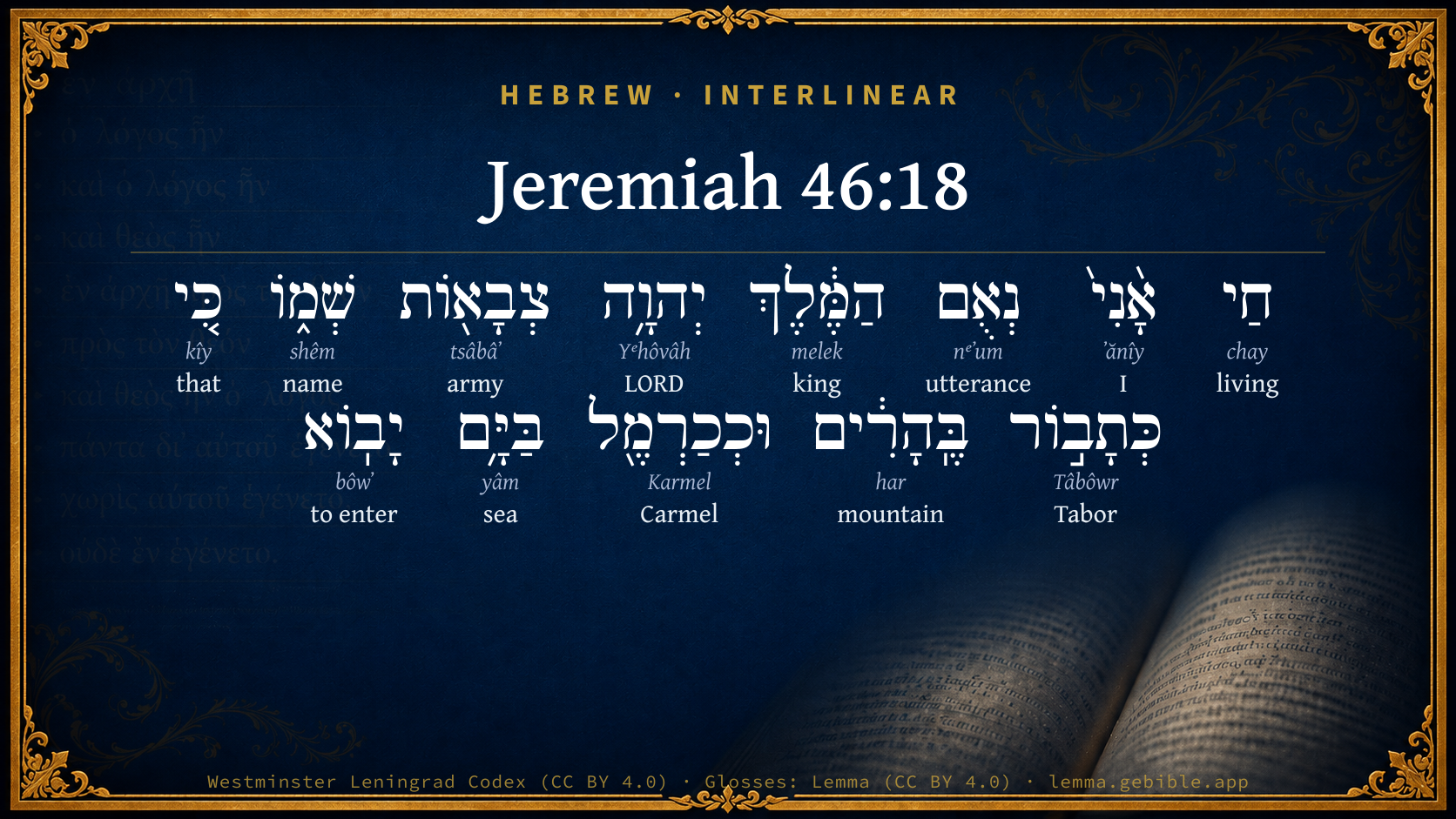
Hebrew (Westminster Leningrad Codex) Jeremiah 46:18 appears in the Hebrew Old Testament. The text above is from the Westminster Leningrad Codex. Each word links to its Strong’s number, a concise gloss, and parsing drawn from the Open Scriptures Hebrew Bible morphology. Click any word for its full Brown-Driver-Briggs (BDB) entry.
Download image
Cite this verse

Jeremiah 46:18 (World English Bible). Public Domain. Lemma interlinear Bible study tool, https://lemma.gebible.app/v/jeremiah/46/18.

Show BibTeX & RIS
BibTeX
RIS
English Translation
As I live, says the King, whose name is Yahweh of Hosts, surely like Tabor among the mountains, and like Carmel by the sea, so shall he come.
World English Bible · Public Domain
Download a study sheet

One document with this verse’s original text, its word-by-word gloss line, the meaning frame, cross-references with their text, attributed commentary, and full source and license credits — printable, and it pastes into notes with its structure intact.

This verse Autodidact and up

Study sheet (.html) Plain text (.txt)

A passage Seminary Student

Up to 50 verses in one chapter. A passage sheet keeps up to 6 commentary sources and 12 cross-references per verse, in the order this page ranks them, and says so on the sheet whenever that leaves anything out. Ask for a single verse and you get the Autodidact verse sheet above.

Everything on this page stays free to read, with no account — the sheet is a download of what is already on screen, not access to it.

Want to remove ads? Support Godless Engineer
Compare translations 3

The same verse in 3 English versions, stacked beneath the original-language interlinear above. Click any original word for its lexicon entry.

Each is an independent rendering of the whole verse — the interlinear is not word-aligned to these translations.

Highlighted words mark where these versions differ — a whole-verse word diff, not a word-by-word alignment.

  • World English Bible Public Domain
    As I live, says the King, whose name is Yahweh of Hosts, surely like Tabor among the mountains, and like Carmel by the sea, so shall he come.
  • King James Version Public Domain
    As I live, saith the King, whose name is the LORD of hosts, Surely as Tabor is among the mountains, and as Carmel by the sea, so shall he come.
  • unfoldingWord Literal Text CC BY-SA 4.0
    As I live—declares the King, whose name is Yahweh of hosts— someone will come like Mount Tabor and Mount Carmel by the sea.

unfoldingWord Literal Text — © unfoldingWord, licensed CC BY-SA 4.0. Word-aligned USFM3 via Door43 (git.door43.org/unfoldingWord/en_ult).

Versions to compare (up to 4)

3 of 4 selected

Show all 18 translations

Every available English version of this verse, each an independent rendering of the whole verse.

  • World English Bible Public Domain
    As I live, says the King, whose name is Yahweh of Hosts, surely like Tabor among the mountains, and like Carmel by the sea, so shall he come.
  • Berean Standard Bible Public Domain
    As surely as I live, declares the King, whose name is the LORD of Hosts, there will come one who is like Tabor among the mountains and like Carmel by the sea.
  • Majority Standard Bible Public Domain
    As surely as I live, declares the King, whose name is the LORD of Hosts, there will come one who is like Tabor among the mountains and like Carmel by the sea.
  • King James Version Public Domain
    As I live, saith the King, whose name is the LORD of hosts, Surely as Tabor is among the mountains, and as Carmel by the sea, so shall he come.
  • American Standard Version (1901) Public Domain
    As I live, saith the King, whose name is Jehovah of hosts, surely like Tabor among the mountains, and like Carmel by the sea, so shall he come.
  • Revised Version (1885) Public Domain
    As I live, saith the King, whose name is the LORD of hosts, surely like Tabor among the mountains, and like Carmel by the sea, so shall he come.
  • Geneva Bible (1599) Public Domain
    As I liue, saith the King, whose Name is the Lord of hostes, surely as Tabor is in the mountaines, and as Carmel is in the sea: so shall it come.
  • Douay-Rheims (1899) Public Domain
    As I live, (saith the King, whose name is the Lord of hosts,) as Thabor is among the mountains, and as Carmel by the sea, so shall he come.
  • Young's Literal Translation Public Domain
    I live -- an affirmation of the King, Jehovah of Hosts `is' His name, Surely as Tabor `is' among mountains, And as Carmel by the sea -- he cometh in,
  • Literal Standard Version CC BY-SA 4.0
    [As] I live—an affirmation of the King, || YHWH of Hosts [is] His Name, || Surely as Tabor [is] among mountains, || And as Carmel by the sea—he comes in,
  • Unlocked Literal Bible CC BY-SA 4.0
    As I live—declares the King, whose name is Yahweh of hosts— someone will come like Mount Tabor and Mount Carmel by the sea.
  • unfoldingWord Literal Text CC BY-SA 4.0
    As I live—declares the King, whose name is Yahweh of hosts— someone will come like Mount Tabor and Mount Carmel by the sea.
  • Darby Bible Public Domain
    [As] I live, saith the King, whose name is Jehovah of hosts, surely as Tabor among the mountains, and as Carmel by the sea, so shall he come.
  • World Messianic Bible Public Domain
    “As I live,” says the King, whose name is the LORD of Hosts, “surely like Tabor among the mountains, and like Carmel by the sea, so he will come.
  • Webster's Bible Public Domain
    As I live, saith the king, whose name is the LORD of hosts, Surely as Tabor is among the mountains, and as Carmel by the sea, so shall he come.
  • Free Bible Version CC BY-SA 4.0
    As I live, declares the King who has the name “the Lord Almighty,” the king of Babylon will come. He is like Mount Tabor that stands out from the other mountains, like Mount Carmel high above the sea.
  • Bible in Basic English Public Domain
    By my life, says the King, whose name is the Lord of armies, truly, like Tabor among the mountains and like Carmel by the sea, so will he come.
  • JPS Tanakh (1917) Public Domain
    As I live, saith the King, whose name is the LORD of hosts, surely like Tabor among the mountains, and like Carmel by the sea, so shall he come.

Literal Standard Version (2020), Covenant Press — licensed CC BY-SA 4.0. Text via the HelloAO Bible API (eBible.org). Unlocked Literal Bible (unfoldingWord) — licensed CC BY-SA 4.0. Text via the HelloAO Bible API (eBible.org). unfoldingWord Literal Text — © unfoldingWord, licensed CC BY-SA 4.0. Word-aligned USFM3 via Door43 (git.door43.org/unfoldingWord/en_ult). Free Bible Version, Dr. Jonathan Gallagher — licensed CC BY-SA 4.0. Text via the HelloAO Bible API (eBible.org).

Word by word

More ways to search: Search by grammar → Find every occurrence → Compare this word →

Practice this passage: Drill this verse → Learn its vocabulary →

כְּתָב֣וֹר
Tâbôwr
H8396
“like/as · Tabor”
Preposition + Noun, Proper
Part of Speech
Preposition + Noun
Type
Proper
Full BDB Definition

Origin: from a root corresponding to H8406

TWOT: None

Tabor = "mound" - a mountain in the plain of Esdraelon rising abruptly and insulated except for a narrow ridge on the west connecting it to the hills of Nazareth (noun proper mountain) - a town around the summit of Mount Tabor (1) (noun proper locative) - a city of the Merarite Levites located in the territory of Zebulun (noun proper locative) - the place of an oak tree which was on the homeward journey of Saul after he had been anointed by Samuel (noun proper arbour)
  1. חַי chay H2416 “living” Adjective, Adjective, Masculine, Singular, Absolute
  2. אָ֨נִי֙ ʼănîy H589 “I” Pronoun, Personal, 1st Person, Common, Singular
  3. נְאֻם nᵉʼum H5002 “utterance of” Noun, Common, Masculine, Singular, Construct
  4. הַמֶּ֔לֶךְ melek H4428 “the · king” Particle, Definite Article + Noun, Common, Masculine, Singular, Absolute
  5. יְהוָ֥ה Yᵉhôvâh H3068 “LORD” Noun, Proper
  6. צְבָא֖וֹת tsâbâʼ H6635 “armies” Noun, Common, Both, Plural, Absolute
  7. שְׁמ֑וֹ shêm H8034 “name · his” Noun, Common, Masculine, Singular, Construct + Suffix, Personal, 3rd Person, Masculine, Singular
  8. כִּ֚י kîy H3588 “that” Conjunction
  9. בֶּֽהָרִ֔ים har H2022 “in/at the · mountains” Preposition, Determined + Noun, Common, Masculine, Plural, Absolute
  10. וּכְכַרְמֶ֖ל Karmel H3760 “and · like/as · Carmel” Conjunction + Preposition + Noun, Proper
  11. בַּיָּ֥ם yâm H3220 “in/at the · sea” Preposition, Determined + Noun, Common, Masculine, Singular, Absolute
  12. יָבֽוֹא bôwʼ H935 “to enter” Verb, Qal, Imperfect, 3rd Person, Masculine, Singular

About this verse

These counts appear in no published source. They are computed here, from the morphology-tagged text and Lemma’s own curated glosses. What Lemma adds →

13
words
13
distinct lemmas
Prophets
section

Notable vocabulary

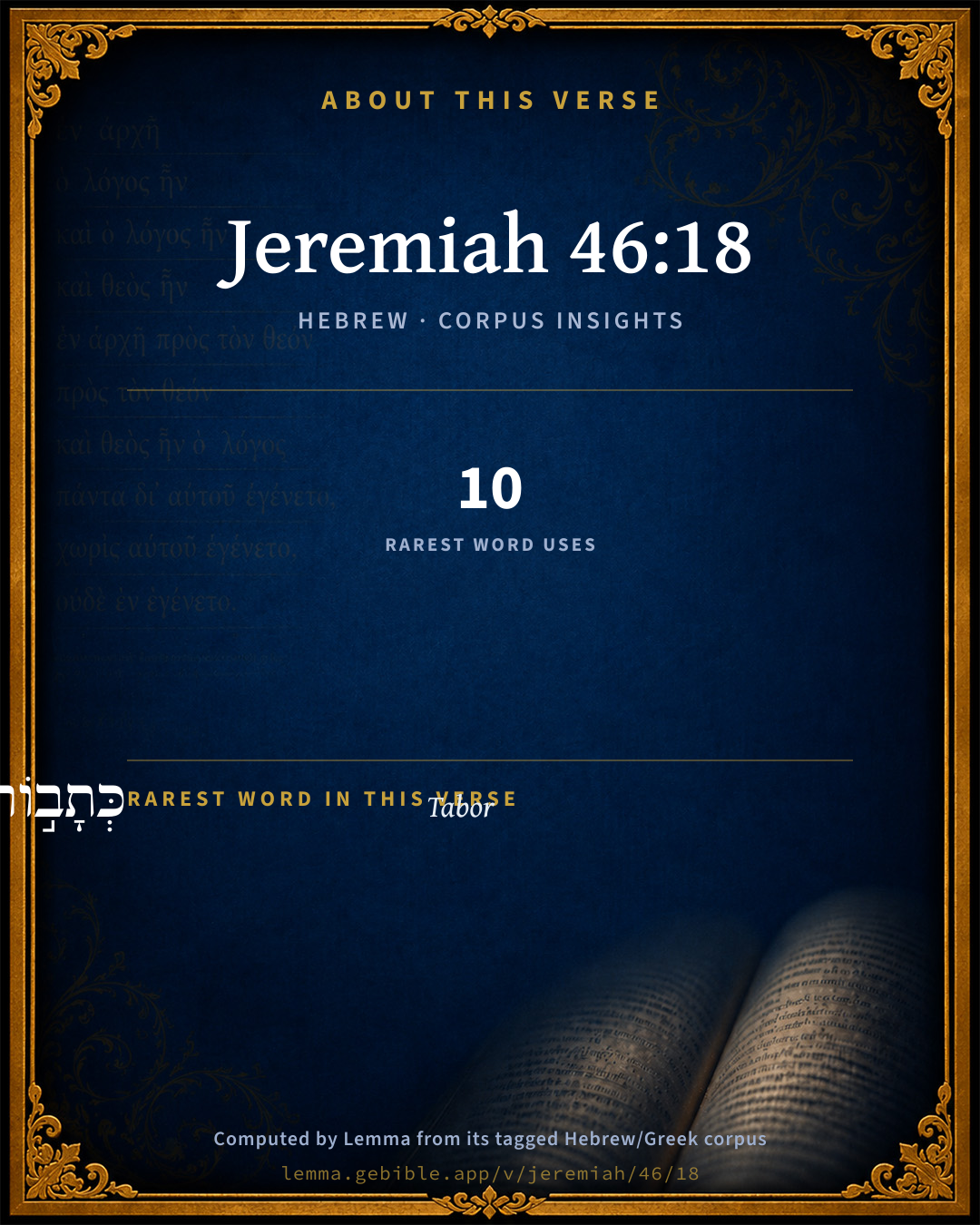
The rarest word here is כְּתָב֣וֹר Tabor H8396 — appearing just 10 times in the whole Hebrew Bible.

Shared distinctive vocabulary

כְּתָב֣וֹר Tabor H8396 occurs in 10 verses of the Hebrew Bible. Also found in:

Grammatical profile

  • 1 verb
  • 9 nouns
  • 1 adjective
  • 1 pronoun
  • 1 conjunction

Verb forms

  • יָבֽוֹא Qal · Imperfect

Cross-references

13

Topical passages linked to Jeremiah 46:18 in the Treasury of Scripture Knowledge — connected by theme and wording, ordered by reader-vote popularity; previews shown in the World English Bible.

  • Jeremiah 48:15 Moab is laid waste, and they are gone up into his cities, and his chosen young men are gone down to the slaughter, says the King, whose name is Yahweh of Hosts.
  • Joshua 19:22 and the border reached to Tabor, and Shahazumah, and Beth-shemesh; and the goings out of their border were at the Jordan: sixteen cities with their villages.
  • Judges 4:6 She sent and called Barak the son of Abinoam out of Kedesh-naphtali, and said to him, Hasn't Yahweh, the God of Israel, commanded, [saying], Go and draw to Mount Tabor, and take with you ten thousand men of the children of Naphtali and of the children of Zebulun?
  • Psalms 89:12 The north and the south, you have created them. Tabor and Hermon rejoice in your name.
  • Isaiah 47:4 Our Redeemer, Yahweh of hosts is his name, the Holy One of Israel.
  • Isaiah 48:2 (for they call themselves of the holy city, and stay themselves on the God of Israel; Yahweh of Hosts is his name):
  • Malachi 1:14 "But the deceiver is cursed, who has in his flock a male, and vows, and sacrifices to the Lord a blemished thing; for I am a great King," says Yahweh of hosts, "and my name is awesome among the nations."
  • 1 Kings 18:42–43 So Ahab went up to eat and to drink. Elijah went up to the top of Carmel; and he bowed himself down on the earth, and put his face between his knees.
  • Jeremiah 10:10 But Yahweh is the true God; he is the living God, and an everlasting King: at his wrath the earth trembles, and the nations are not able to abide his indignation.
  • Jeremiah 44:26 Therefore hear the word of Yahweh, all Judah who dwell in the land of Egypt: Behold, I have sworn by my great name, says Yahweh, that my name shall no more be named in the mouth of any man of Judah in all the land of Egypt, saying, As the Lord Yahweh lives.
  • Jeremiah 51:17 Every man is become brutish [and is] without knowledge; every goldsmith is disappointed by his image; for his molten image is falsehood, and there is no breath in them.
  • Matthew 5:35 nor by the earth, for it is the footstool of his feet; nor by Jerusalem, for it is the city of the great King.
  • 1 Timothy 1:17 Now to the King eternal, immortal, invisible, to God who alone is wise, be honor and glory forever and ever. Amen.

Cross-references courtesy of OpenBible.info (CC BY 4.0).

Hebrew and Greek witnesses Masoretic Hebrew ↔ Greek Septuagint

The same verse in the two great witnesses to the Old Testament, shown verse-for-verse.

These are two independent witnesses, not word-aligned to each other, and the Septuagint is shown in lemma (dictionary) form.

Hebrew Jeremiah 46:18 Masoretic · Westminster Leningrad Codex

חַי אָ֨נִי֙ נְאֻם הַמֶּ֔לֶךְ יְהוָ֥ה צְבָא֖וֹת שְׁמ֑וֹ כִּ֚י כְּתָב֣וֹר בֶּֽהָרִ֔ים וּכְכַרְמֶ֖ל בַּיָּ֥ם יָבֽוֹא

As I live, says the King, whose name is Yahweh of Hosts, surely like Tabor among the mountains, and like Carmel by the sea, so shall he come.

World English Bible · Public Domain

Greek LXX Structure differs

In the Septuagint, Jeremiah is about an eighth shorter than the Hebrew and arranges its material differently — the Oracles Against the Nations (Hebrew chapters 46–51) appear in the middle of the Greek book, after 25:13. Because the chapter and verse boundaries do not line up, a verse-for-verse comparison with the Hebrew is not shown.

A verse-for-verse comparison isn’t shown here because the chapters and verses don’t line up. Switch to the LXX edition with the MT / LXX toggle above to read the Greek directly.

On this verse, John Gill's Exposition discusses the Septuagint’s reading. Read the note in Commentary ↓

Hebrew: Westminster Leningrad Codex (CC BY 4.0). Greek: Septuagint (public domain); English from a public-domain English Septuagint. How the Septuagint differs from the Hebrew →

Targum (Aramaic paraphrase)

1

The Targum is the ancient Jewish Aramaic paraphrase of the Hebrew Scriptures — an interpretive translation, not the Hebrew text itself. Onkelos (literal) and Pseudo-Jonathan (expansive) render the Torah, and Jonathan the Prophets. Coverage is partial: where no permissively-licensed English translation exists for a verse, only the Aramaic is shown. This is verse-level text, not a word-by-word alignment to the Hebrew.

  1. Targum Jonathan Prophets (Joshua–Malachi)
    קְיַם אֲנָא אֲמַר מַלְכָּא יְיָ צְבָאוֹת שְׁמֵיהּ אֲרֵי כְּמָא דְיַצִיב פִּתְגָמָא דְתָבוֹר בְּטוּרַיָא וּכְכַרְמְלָא בְּיַמָא כֵּן יֵיתֵי תְבִירֵיהּ:

    (no public-domain English translation for this verse)

    Targum Jonathan — Aramaic: “Mikraot Gedolot” (public domain). English: “Sefaria Community Translation” (CC0 1.0 (public-domain dedication)); “London "Chaldee Paraphrase," 1871” (public domain). Text via Sefaria.

Commentary

Notes on Jeremiah 46:18 from classic Christian and Jewish commentators (each source and its license shown beneath its notes). The classic Christian expositions comment on the surrounding passage and are grouped to its opening verse, so a note may address several verses; the Jewish commentaries on the Tanakh (Rashi and others) are per-verse, so they appear only where the commentator wrote on this verse.

Lemma curates 59 commentaries, every one of them public domain or Creative Commons licensed, each selected and text-cleaned for this edition rather than reprinted as found. About our sources →

Trapp's Complete Commentary

John Trapp

Jer 46:18 [As] I live, saith the King, whose name [is] the LORD of hosts, Surely as Tabor [is] among the mountains, and as Carmel by the sea, [so] shall he come.

Ver. 18. As I live.] Formula iurandi elliptica, et Deo propria. Let none presume to swear in that sort.

Surely as Tabor is among the mountains.] As Tabor surmounts and commandeth the little hills round about it, and Carmel the adjoining sea, over which it hangeth a promontory, so shall Nebuchadnezzar come into Egypt and subdue the whole country.

John Trapp, A Commentary or Exposition upon All the Books of the Old and New Testament (1647–1656) — public domain. Text from a community e-Sword module.

The Biblical Illustrator

Joseph S. Exell

Jer_46:18

As I live, saith the King, whose name is the Lord of hosts.

The oaths of Jehovah

I. The Divine oaths recorded in Scripture exhibit and declare the glory of the Divine character.

1. As they show forth the infinite condescension of God. He has addressed us not only in the language of authority and goodness, but also actually condescended to confirm His own true sayings by the most solemn oaths, and this He has done, not only upon some one particular occasion, but in numerous instances, and in every variety of form. Sometimes, Jehovah swears by one or the other of His natural perfections. The Lord hath sworn by His right hand, and by the arm of His strength. At other times He swears by one or the other of His moral perfections, as, Once have I sworn by My holiness. At other times by His great name, but the most expressive, as well as the most usual form is that in the text, As I live, saith the Lord God.

2. The Divine oaths furnish a sublime and awful manifestation of the sincere earnestness of the Divine mind in what He declares unto us in His Word, with such an attestation.

3. The Divine oaths exhibit also the benevolent solicitude of God for the welfare of the unworthy creatures whom He thus addresses; or as the apostle expresses it, the kindness and love of God our Saviour towards man.

4. The Divine oaths intimate the unchangeableness of the Divine mind in relation to those arrangements in His natural and moral government which were in that manner established and confirmed.

II. The Divine oaths also serve to illustrate the moral character of man, and to exercise a powerful influence on his moral and spiritual interests.

1. They strongly corroborate the fact that the human heart is corrupt and alienated from God. In speaking to His holy angels, who excel in strength, and are swift to do His will, an oath in confirmation of His Word is altogether unnecessary. They know His character too well ever to entertain the slightest suspicion of His truthfulness; but in dealing with fallen and apostate man, He knew it was necessary to confirm His own faithful words by most solemn oaths, pledging His own eternal existence on their truth.

2. They serve also as fearful warnings of the perilous condition of the impenitent and unbelieving soul. Could not an angel have reasonably supposed that in the face of all the declarations and oaths of Jehovah, recorded in the Bible, unbelief on the part of man would have been a moral impossibility? After all, unbelief is the most common sin in the world, and the sin on account of which men generally feel the least compunction; the sin on account of which the Son of God marvelled and was grieved,--men neither marvel nor grieve. Just as if it was a thing of no moment to treat the eternal God as a liar and a perjurer! Be not deceived, God is not mocked.

3. They afford the strongest encouragement to believers in their onward progress to heaven. Christians, during their earthly pilgrimage, have to contend against many things in themselves and in the world, which are calculated to exert a most depressing influence upon their hearts. But they are, nevertheless, favoured with abundant sources of consolation in the abiding presence of the Holy Spirit, and in the great and precious truths and promises of the Gospel God, willing more abundantly to show unto the heirs of the promises the immutability of His counsel, confirmed it by an oath: that by two immutable things, in which it was impossible for God to lie, we might have a strong consolation, who have fled for refuge to lay hold upon the hope set before us. The firm stability of the ordinances of the covenant made with Noah, is employed to illustrate the stability and unchangeableness of the covenant of redemption. The mountains and the hills are referred to as fit emblems of its eternal immutability. (W. Rees, D. D.)

The Biblical Illustrator, edited by Joseph S. Exell (c. 1880s–1900s) — public domain. Text from a community e-Sword module.

Joseph Benson's Commentary

Jer 46:18. As I live saith the king, whose name is the Lord of hosts — He, before whom the mightiest kings on earth, though gods to us, are but as grasshoppers; he hath said and sworn what follows; Surely as Tabor, &c. — As surely as Tabor is among the mountains and Carmel by the sea, so surely shall the conqueror of Egypt come. Or, though Egypt were as inaccessible as the top of Tabor, and begirt with the sea like Carmel, yet the enemy should come upon her, and make an entire conquest of her. Houbigant paraphrases the clause thus, “As much as Tabor overtops all other mountains, so much shall the Chaldeans be superior to the Egyptians; and as the waves of the sea roar in vain at the foot of mount Carmel, so shall the Egyptians waves rage in vain.” Blaney understands the clause in nearly the same sense, observing, “Tabor and Carmel were two of the most considerable mountains in the land of Israel. Carmel formed the principal headland all along the sea-coast. Nebuchadnezzar is compared to these on account of his superiority over all others.”

Joseph Benson's Commentary on the Old and New Testaments (1811–1818) — public domain. Text from a community e-Sword module.

Tyndale Open Study Notes

Tyndale Open Resources

46:18 Mount Tabor towers over the eastern part of the Jezreel Valley. Mount Carmel rises above the coastline of the Mediterranean Sea.

Tyndale Open Study Notes — © Tyndale Open Resources, licensed CC BY-SA 4.0. Text via the HelloAO Bible API.

Geneva Bible (1599)

Geneva Bible translators

To wit, that the Egyptians shall be destroyed.

Geneva Bible (1599) marginal notes — public domain. Text via Bolls.life.

Jamieson, Fausset & Brown

Robert Jamieson, A. R. Fausset & David Brown

As the mountains Tabor and Carmel tower high above the other hills of Palestine, so Nebuchadnezzar (Jer 46:26) when he comes shall prove himself superior to all his foes. Carmel forms a bold promontory jutting out into the Mediterranean. Tabor is the higher of the two; therefore it is said to be "among the mountains"; and Carmel "by the sea."

the King . . . Lord of hosts-- (Jer 48:15); in contrast to "Pharaoh king of Egypt . . . but a noise" (Jer 46:17). God the true "King . . . the Lord of hosts," shall cause Nebuchadnezzar to come. Whereas Pharaoh shall not come to battle at the time appointed, notwithstanding his boasts, Nebuchadnezzar shall come according to the prediction of the King, who has all hosts in His power, however ye Egyptians may despise the prediction.

Jamieson, Fausset & Brown — Commentary Critical and Explanatory on the Whole Bible (1871) — public domain (CC PDM 1.0). Text via the HelloAO Bible API.

Adam Clarke's Commentary

Verse 18. As Tabor is among the mountains] This mountain is situated in the plain of Esdraelon in Galilee, on the confines of the tribes of Zebulun and Issachar, Jos 19:22. It stood by itself, separated from all the other mountains by deep valleys, and is the highest of the whole.

And as Carmel by the sea] Carmel is a mountain on the coast of the Mediterranean Sea, on the southern frontier of the tribe of Asher. Were the Egyptians as distinguished for valour and strength as the mountains Tabor and Carmel are for height among the other mountains in their vicinity, they should not be able to stand the shock of the Chaldean army.

Adam Clarke's Commentary on the Bible (1810–1826) — public domain. Text from a community e-Sword/MySword module.

John Calvin's Commentaries

Why did the Prophet say this, except that the Egyptians thought they had escaped, because the time had been delayed? As, then, the length of time had deceived them, thinking, as they did, that God had told what was false, or that he had forgotten what he had predicted by his Prophets, he says, I live, saith Jehovah, that is, by my life; for God here swears by his life, that what he now declares would come. This seems to be the true meaning. Igor did the Prophet speak thus only for the sake of the Egyptians, but also for the sake of the Jews; for we know that it was usual and common with them proudly to assert that what the Prophets had spoken from God’s mouth was all vain: hence that proverbial saying,

“To-morrow we shall die, let us eat and drink.” (Isaiah 22:13)

They also called the prophecies burdens, by way of reproach and contempt. As the ungodly promised themselves impunity through God’s forbearance, it was necessary to testify to them what we here read, even that whatever God had threatened would come to pass, though he delayed it for a time. For he suspends his punishment, but his vengeance at length breaks out, when the unbelieving think that all things will turn out prosperously; yea, when they say,

“Peace and security, then sudden destruction overtakes them.” (1 Thessalonians 5:3)

By the word מועד, muod, then, the Prophets mean a fixed time, not that they had pointed out a certain day, but that they had spoken of the destruction of Egypt, as though God had already gone forth as the judge.

As, then, they said that the time had passed by, God here swears by his life; and hence he says, whose name is King, Jehovah of hosts God here sets forth his own greatness in opposition to the power of Pharaoh and of all other kings; for prosperity commonly brings pride with it, and those who excel in dignity and power become self-willed and insolent. Hence to repress this haughty insolence, he says, that the name of King, the God of hosts, belongs not properly to any but to himself alone.

It shall come, he says, as Tabor is in the mountains, and Carmel in the sea Their exposition is not suitable who say, “As wild beasts fleeing from hunters, pass over from neighboring mountains to Mount Tabor, and as trees cut on Carmel are carried to the sea.” This is an extremely forced explanation, and cannot be adapted to the present passage. For what is the design of the Prophet? even to shew that what he had just declared would be immutable, and so fixed that it could not be reversed, that though the whole world attempted to frustrate what God had decreed, yet nothing could be done. Then he says, As Tabor is in the mountains, that is, As Mount Tabor is surrounded by other mountains, and has there its deep roots, so that it cannot be torn up; and as Carmel is in the sea Now this Carmel was not understood by the Jews to have been that mount where Nabal dwelt, but a mountain not far from Ptolemais, and it was girded and washed by the sea: hence he says, As Carmel is a mountain in the sea. Tabor as well as Carmel remain fixed, and cannot be transferred to another place; so he says, shall this prophecy come to pass; it is valid and shall be accomplished; as though he had said, “This immutable decree cannot be refixed, as Carmel cannot be moved, nor Tabor, so as to be transplanted elsewhere.” It now follows, —

John Calvin's Commentaries (1540-1563) — public domain. Text from the Calvin Translation Society English edition (1840s-50s) via the Christian Classics Ethereal Library (ccel.org). Calvin's coverage is partial (roughly two-thirds of the Bible); uncommented books and verses are honest gaps, never fabricated. The 19th-century editor's footnotes and remarks are omitted so the notes are faithfully Calvin's own voice.

Ellicott's Commentary for English Readers

(18) Surely as Tabor is among the mountains . . .—Nebuchadnezzar in his high-towering greatness is compared to two of the most conspicuous mountains of Palestine, Tabor rising in solitary greatness 1,350 feet above the plain, Carmel 1,805 feet above the sea. So, in Jer_22:6, the king of Judah is compared to “Gilead and the head of Lebanon.”

A Bible Commentary for English Readers, edited by Charles John Ellicott (1878–1897) — public domain. Text from a community e-Sword module.

The Cambridge Bible for Schools and Colleges

gen. ed. J. J. S. Perowne

18. The foe (unnamed, but meaning Nebuchadnezzar, unless the passage is late, and Alexander the Great is intended; so Schmidt) shall resemble these mountains as standing out conspicuous. Tabor, as rising in the midst of an extensive plain, is more striking than even loftier hills, which have not its advantages in the way of position. Carmel (about 600 feet above the sea) stretches as a long bold promontory into the Mediterranean.

The Cambridge Bible for Schools and Colleges (gen. ed. J. J. S. Perowne; Cambridge University Press, 1878–1918) — public domain. Text from a community e-Sword module.

John Gill's Exposition

As I live, saith the King, whose name is the Lord of hosts,.... A greater King than either Nebuchadnezzar or Pharaoh; the Lord of the armies of heaven and earth; and who has them all at his command and service; swears by his life, by himself, because he can swear by no greater, to the truth of what follows; for this is the form of an oath:

surely, as Tabor is among the mountains, and as Carmel by the sea,

so shall he come. Tabor is commonly said to be the mountain on which our Lord was transfigured; but that there is any just foundation for it is not certain. It was a mountain in Galilee, situated on the borders of the tribes of Issachar and Zebulun, Jos 19:12; it was two leagues from Nazareth eastward (n); three miles from the lake of Gennesaret; ten miles from Diocaesarea to the east; and two days' journey from Jerusalem (o). Adrichomius (p) says it was a most beautiful mountain, situated in the midst of the plain of Galilee, remarkable for its roundness, and was about four miles or thirty furlongs high, abounding with vines, olives, and fruit trees, with which it was set all over; and gave to those at sea a most delightful sight at a considerable distance. Our countryman, Mr. Maundrell (q), who travelled up it, gives this account of it; that it

"stands by itself in the plain of Esdraelon (the same the Scripture calls the valley of Jezreel); after a very laborious ascent (says he), which took up near an hour, we reached the highest part of the mountain: it has a plain area at top, most fertile and delicious; of an oval figure, extended about one furlong in breadth, and two in length: this area is enclosed with trees on all parts, except towards the south.''

It is called by the Septuagint, Josephus, and other writers, Itabyrium. Carmel is with great propriety called "Carmel by the sea"; it was situated on the border of the tribe of Asher; and near to it was the river Kishon, Jos 19:26. So Mr. Maundrell (r) says,

"we arrived in two hours at that ancient river, the river Kishon, which cuts his way down the middle of the plain of Esdraelon; and then, continuing his course close by the side of Mount Carmel, falls into the sea at a place called Caypha;''

by which it appears that the mount was near the sea; and Pliny (s) calls it a promontory, and places it on the Phoenician shore; on which he says were the promontory Carmel, and a town upon the mountain of the same name, formerly called Ecbatana. Adrichomius (t) gives it the name of "Carmel of the sea"; and says it was a very high mountain, and woody, abounding with most noble vines, olives, fruit trees, and odoriferous herbs. So Josephus (u) makes mention of Carmel and the sea together; he says, the Zebulonites obtained land as far as the lake of Genezareth, contiguous to Carmel and the sea; and their being near to each other appears from a passage in the Jerusalem Talmud (w); says

"R. Samuel Bar Chain Bar Judah, in the name of R. Chanina, when the orb of the sun begins to set, a man standing on Mount Carmel, and goes down and dips in the great sea (the Mediterranean sea), and goes up again, and eats his "teruma" (or offering), it is a presumption that he dipped in the daytime;''

and which is also evident from the passage in Kg1 18:42; where Elijah and his servant are said to be on the top of Mount Carmel, and from thence he bid his servant look towards the sea: now these mountains so situated are taken notice of, either to show the manner of the king of Babylon's coming against Egypt; that as Tabor and Carmel were high mountains in the land of Israel, so should Nebuchadnezzar lift up his head on high, and come with great pride and haughtiness of spirit against the Egyptians; or rather the certainty of his coming, that he should come as sure as those mountains were in the places they were; or, best of all, the certainty of the destruction of the Egyptians, and the truth of this prophecy concerning it; though the Egyptians were as firm, and might think themselves as secure and as immovable, as the above mountains, yet should certainly come to ruin, and the word of God concerning it should stand as firm as they. To this sense agrees the Targum,

"as this word stands firm, that Tabor is among the mountains, and Carmel in the sea, so shall his destruction come.''

The words, according to the accents, may be better rendered, "as Tabor among the mountains, and Carmel also, he shall come into the sea" (x); that is, Pharaoh, though he lift up his head as high as Tabor and Carmel, he shall be brought low into the depths of the sea; into a most forlorn and deplorable condition, into a very low estate; and perhaps there may be an allusion to the ancient Pharaoh being drowned in the sea; and with this agrees the Syriac version, "Pharaoh shall fall as the fragment of a mountain, and as Carmel, into the midst of the sea"; compare with this Mat 11:23.

(n) Borchard, Breidenbach, &c. in Lightfoot, Chorograph. on John, vol. 2. p. 495. (o) Vid. Reland. Palestina Illustrata, l. 1, c, 51, 331, 383. (p) Theatrum Terrae Sanctae, Zabulon, No. 95. p. 143. (q) Journey from Aleppo to Jerusalem, p. 113, 114. Ed. 7. (r) Ib. p. 57. (s) Nat. Hist. l. 5. c. 19. (t) Ut supra (Theatrum Terrae Sanctae), Issachar, No. 19. p. 35. (u) Antiqu. l. 5. c. 1. sect. 22. (w) T. Bab. Hieros. Beracot, fol. 2. 2. (x) "quia sicut Tabor in montibus, et sicut Carmel (scil. in montibus est) ita in mare veniet", Schmidt.

John Gill's Exposition of the Whole Bible (1746–1763) — public domain (CC PDM 1.0). Text via the HelloAO Bible API.

Albert Barnes' Notes on the Bible

As Tabor is - Omit “is.” “He shall come like a Tabor among the mountains, and like a Carmel by the sea.” Tabor rises in the form of a truncated cone to the height of about 1,350 feet above the plain of Esdraelon, its total height above the sea level being 1,805 feet. Its shape and the wide extent of the plain around it make it a far more conspicuous object than other mountains in sight of equal elevation. Similarly, Carmel is a most commanding mountain, because it rises from the edge of the wide expanse of the Mediterranean.

Albert Barnes' Notes on the Bible (1834–1885) — public domain. Text from a community e-Sword/MySword module.

Haydock's Catholic Bible Commentary

He, the destroyer; (ver. 16.) or "it," my word (Haydock) shall surely stand as long as the mountains, (Calmet) yea, longer than heaven and earth. (Haydock) --- My decrees shall be put in execution in spite of the efforts of man. (Calmet)

George Leo Haydock (1774–1849), Haydock's Catholic Family Bible and Commentary, 1859 edition — public domain. Excludes Psalms (Douay-Rheims chapter numbering differs from Protestant) and Deuterocanonical books (Catholic canon only).

Matthew Poole's English Annotations

That is, he shall as certainly come and encompass you with his armies as Tabor is encompassed with mountains, and as Carmel is by the sea, or as Barak going down from Mount Tabor destroyed Sisera’s army, or as surely as the rain came which Elijah first discovered from Mount Carmel, 1Ki 18:41,42. There are other guesses at the sense of this comparison, but the sense is undoubtedly no more than that Nebuchadnezzar should certainly come against Egypt, how vainly soever the Egyptians flattered themselves to the contrary, supposing the time past which the prophet spake of.

Matthew Poole's English Annotations on the Holy Bible (1683–1685) — public domain. Text from a community e-Sword/MySword module.

Whedon's Commentary on the Bible

Daniel D. Whedon

18. As Tabor is among the mountains — The overshadowing power of Nebuchadrezzar is the point of the comparison. Tabor, though by no means a high mountain, yet stands out from the surface of the plain below with unusual boldness, and so is conspicuous in all directions. Carmel is a bold, lofty promontory, standing out above the Mediterranean in a most imposing manner. Both are fit types of that formidable Babylonian who had come to stand forth so loftily above the common level of the world.

Daniel D. Whedon (gen. ed.), Commentary on the Old and New Testaments (1874–1909) — public domain. Text from a community e-Sword module.

The Pulpit Commentary

The threat implied in ver. 17 is set forth more fully; he who speaks is a very different "king" from the fallen Pharaoh. As Tabor is among the mountains. The sense is deformed by the insertion of "is." The King of Babylon is compared to "Tabor among the mountains and Carmel by the sea." Mount Tabor is a most prominent object, owing to the wide extent of the plain of Esdraelon, in which it is situated; and a similar remark applies to Mount Carmel. The view of Tabor differs considerably according to the point from which it is taken; but "its true figure is an elongated oval" (Thomson). Carmel, so called from the rich orchards and vineyards with which it was anciently adorned, is not lofty (being only about six hundred feet above the sea), but the form in which it breaks off towards the sea has a beauty of its own. It is now deprived of its rich forest and garden culture, but is still described as "a glorious mountain."

The Pulpit Commentary (1880–1919), ed. H.D.M. Spence-Jones & Joseph S. Exell — public domain. Text from a community e-Sword module.

John Wesley's Explanatory Notes

Surely - He shall as certainly come and encompass you with his armies, as Tabor is encompassed with mountains, and as Carmel is by the sea.

John Wesley, Explanatory Notes Upon the Whole Bible (1754–1765) — public domain. Text via the GEBible commentary corpus.

unfoldingWord translationNotes

Door43 World Missions Community

As I live

"As surely as I am alive." Yahweh uses this expression to show that what he says next is certainly true. This is a way of making a solemn promise. AT: "I solemnly swear" (See: Idiom)

declares the King

Here "King" refers to Yahweh. This can be stated in first person. AT: "this is what I, the King, declare" (See: First, Second, or Third Person)

someone will come like Mount Tabor and Mount Carmel by the sea

This refers to the nation of Babylon who will be as overwhelming to the nation of Egypt as the these two mountains are to the plains that surround them. (See: Simile)

Mount Tabor

This is the name of a mountain in the northern part of Israel. (See: How to Translate Names)

Pack for yourselves baggage to carry into exile

"Prepare to go into exile"

translationWords

life

declare

king

name

Yahweh of hosts

Carmel

exile

ruin

unfoldingWord translationNotes — © Distant Shores Media and the Door43 World Missions Community, licensed CC BY-SA 4.0. Source: git.door43.org/Door43/en_tn.

Rashi

Rabbi Shlomo Yitzchaki (Rashi)

that as sure as Tabor is among the mountains Just as it is a true fact that Tabor is fast among the mountains and Mount Carmel is by the sea, so is it true that this thing shall come upon Egypt.

Rashi on the Tanakh — English translations: “The Judaica Press complete Tanach with Rashi, translated by A. J. Rosenberg” (CC BY 4.0); “Pentateuch with Rashi's commentary by M. Rosenbaum and A.M. Silbermann, 1929-1934” (public domain); “The Metsudah Tanach series, Lakewood, N.J” (CC BY 4.0); and “The Book of Joshua, Metsudah Publications, 1997” (CC BY 4.0). Text via Sefaria.

Lesson kit

Teaching starters — assembled from the data on this page, not authored interpretation. Every prompt links to the verse data it draws on. Edit before teaching.

Jeremiah, in the Prophets, opens this verse with 13 words (13 distinct Hebrew lemmas). Its most distinctive word is Tâbôwr (“Tabor”). A historical commentator’s framing appears above. Read the whole chapter for the surrounding context.

Discussion questions

  1. How does “Tabor” (Tâbôwr) shape what this verse is saying?
  2. Joshua 19:22 shares the word «Tabor» with this verse. How do the two illuminate each other?
  3. The translations on this page render this verse differently — a whole-verse word diff, not a word-by-word alignment. What might account for the different wordings?
  4. The verb «יָבֽוֹא» is Qal Imperfect. How does its form color the action?
  5. Reading how Trapp's Complete Commentary and The Biblical Illustrator read this verse, where do the two commentators agree and where do they part?

Things to notice

Reading settings

Reading text

Shown beneath each verse's original-language words.

Old Testament
Old Testament edition

Read the OT as the Masoretic Hebrew (MT) or the Greek Septuagint (LXX).

English shown for the Greek Septuagint (in the Hebrew ↔ Greek comparison).

Comparing translations? Open the Compare panel on any verse page to stack up to four side by side.