
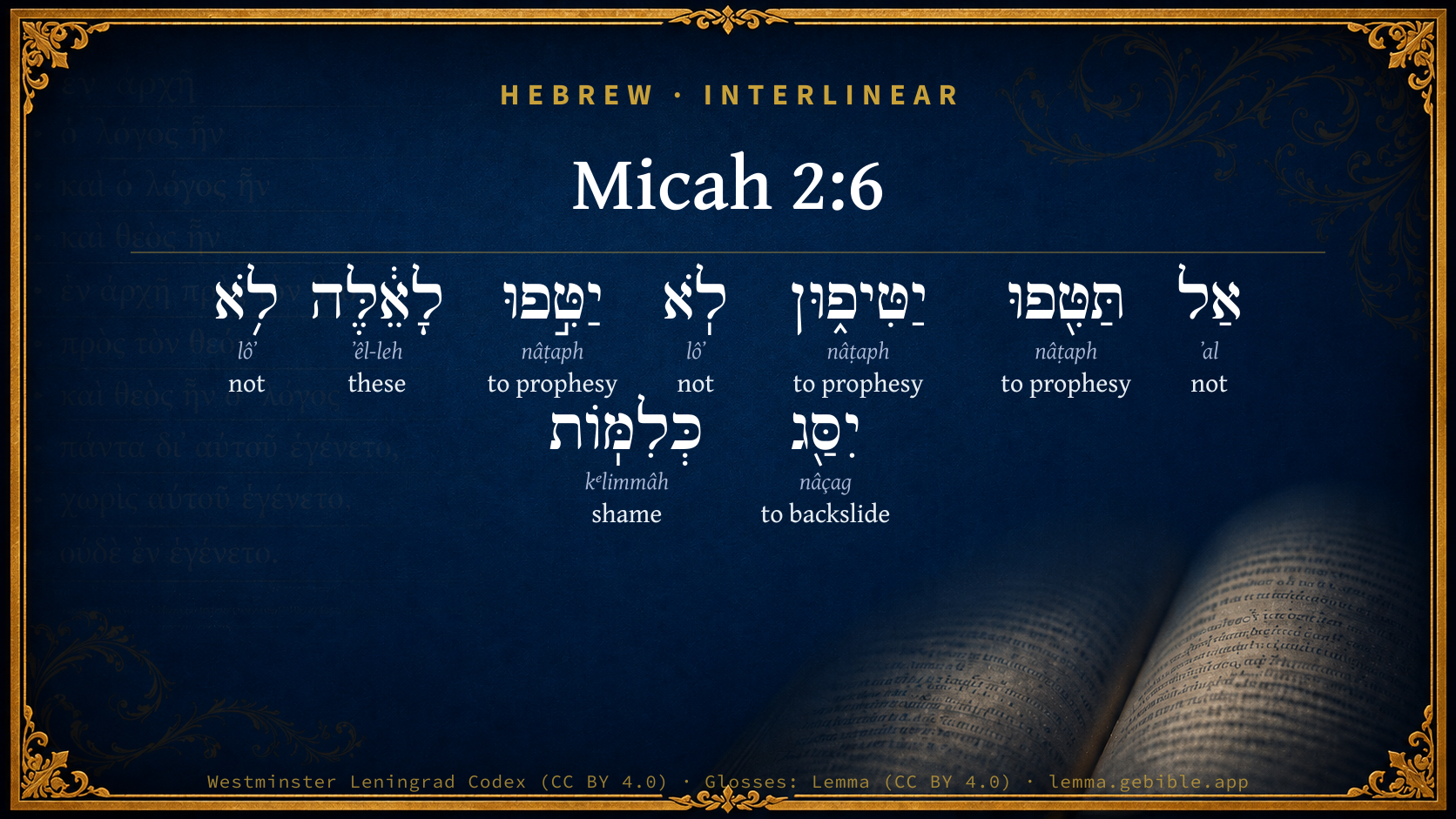
Micah 2:6

Hebrew (Westminster Leningrad Codex) Micah 2:6 appears in the Hebrew Old Testament. The text above is from the Westminster Leningrad Codex. Each word links to its Strong’s number, a concise gloss, and parsing drawn from the Open Scriptures Hebrew Bible morphology. Click any word for its full Brown-Driver-Briggs (BDB) entry.
Download image
Cite this verse

Micah 2:6 (World English Bible). Public Domain. Lemma interlinear Bible study tool, https://lemma.gebible.app/v/micah/2/6.

Show BibTeX & RIS
BibTeX
RIS
English Translation
"Don't you prophesy!" They prophesy. "Don't prophesy about these things. Disgrace won't overtake us."
World English Bible · Public Domain
Download a study sheet

One document with this verse’s original text, its word-by-word gloss line, the meaning frame, cross-references with their text, attributed commentary, and full source and license credits — printable, and it pastes into notes with its structure intact.

This verse Autodidact and up

Study sheet (.html) Plain text (.txt)

A passage Seminary Student

Up to 50 verses in one chapter. A passage sheet keeps up to 6 commentary sources and 12 cross-references per verse, in the order this page ranks them, and says so on the sheet whenever that leaves anything out. Ask for a single verse and you get the Autodidact verse sheet above.

Everything on this page stays free to read, with no account — the sheet is a download of what is already on screen, not access to it.

Want to remove ads? Support Godless Engineer
Compare translations 3

The same verse in 3 English versions, stacked beneath the original-language interlinear above. Click any original word for its lexicon entry.

Each is an independent rendering of the whole verse — the interlinear is not word-aligned to these translations.

Highlighted words mark where these versions differ — a whole-verse word diff, not a word-by-word alignment.

  • World English Bible Public Domain
    "Don't you prophesy!" They prophesy. "Don't prophesy about these things. Disgrace won't overtake us."
  • King James Version Public Domain
    Prophesy ye not, say they to them that prophesy: they shall not prophesy to them, that they shall not take shame.
  • unfoldingWord Literal Text CC BY-SA 4.0
    "Do not drip," they drip. They do not drip about these; disgraces will not depart.

unfoldingWord Literal Text — © unfoldingWord, licensed CC BY-SA 4.0. Word-aligned USFM3 via Door43 (git.door43.org/unfoldingWord/en_ult).

Versions to compare (up to 4)

3 of 4 selected

Show all 18 translations

Every available English version of this verse, each an independent rendering of the whole verse.

  • World English Bible Public Domain
    "Don't you prophesy!" They prophesy. "Don't prophesy about these things. Disgrace won't overtake us."
  • Berean Standard Bible Public Domain
    “Do not preach,” they preach. “Do not preach these things; disgrace will not overtake us.”
  • Majority Standard Bible Public Domain
    “Do not preach,” they preach. “Do not preach these things; disgrace will not overtake us.”
  • King James Version Public Domain
    Prophesy ye not, say they to them that prophesy: they shall not prophesy to them, that they shall not take shame.
  • American Standard Version (1901) Public Domain
    Prophesy ye not, `thus' they prophesy. They shall not prophesy to these: reproaches shall not depart.
  • Revised Version (1885) Public Domain
    Prophesy ye not, thus they prophesy. They shall not prophesy to these: reproaches shall not depart.
  • Geneva Bible (1599) Public Domain
    They that prophecied, Prophecie ye not. They shall not prophecie to them, neither shall they take shame.
  • Douay-Rheims (1899) Public Domain
    Speak ye not, saying: It shall not drop upon these, confusion shall not take them.
  • Young's Literal Translation Public Domain
    Ye do not prophesy -- they do prophesy, They do not prophesy to these, It doth not remove shame.
  • Literal Standard Version CC BY-SA 4.0
    You do not prophesy—they prophesy, || They do not prophesy to these, || It does not remove shame.
  • Unlocked Literal Bible CC BY-SA 4.0
    “Do not prophesy,” they say. “They must not prophesy these things; reproaches must not come.”
  • unfoldingWord Literal Text CC BY-SA 4.0
    "Do not drip," they drip. They do not drip about these; disgraces will not depart.
  • Darby Bible Public Domain
    Prophesy ye not, they prophesy. If they do not prophesy to these, the ignominy will not depart.
  • World Messianic Bible Public Domain
    “Don’t prophesy!”—they prophesy— “Don’t prophesy about these things. Disgrace won’t overtake us.”
  • Webster's Bible Public Domain
    Prophesy ye not, say they to them that prophesy: they shall not prophesy to them, that they shall not take shame.
  • Free Bible Version CC BY-SA 4.0
    But you preach at me, saying, “Don't preach such things. Don't prophesy like this. Such a humiliation won't happen to us!”
  • Bible in Basic English Public Domain
    Let not words like these be dropped, they say: Shame and the curse will not come to the family of Jacob!
  • JPS Tanakh (1917) Public Domain
    'Preach ye not', they preach; 'They shall not preach of these things, that they shall not take shame.'

Literal Standard Version (2020), Covenant Press — licensed CC BY-SA 4.0. Text via the HelloAO Bible API (eBible.org). Unlocked Literal Bible (unfoldingWord) — licensed CC BY-SA 4.0. Text via the HelloAO Bible API (eBible.org). unfoldingWord Literal Text — © unfoldingWord, licensed CC BY-SA 4.0. Word-aligned USFM3 via Door43 (git.door43.org/unfoldingWord/en_ult). Free Bible Version, Dr. Jonathan Gallagher — licensed CC BY-SA 4.0. Text via the HelloAO Bible API (eBible.org).

Word by word

More ways to search: Search by grammar → Find every occurrence → Compare this word →

Practice this passage: Drill this verse → Learn its vocabulary →

About this verse

These counts appear in no published source. They are computed here, from the morphology-tagged text and Lemma’s own curated glosses. What Lemma adds →

9
words
6
distinct lemmas
Prophets
section

Notable vocabulary

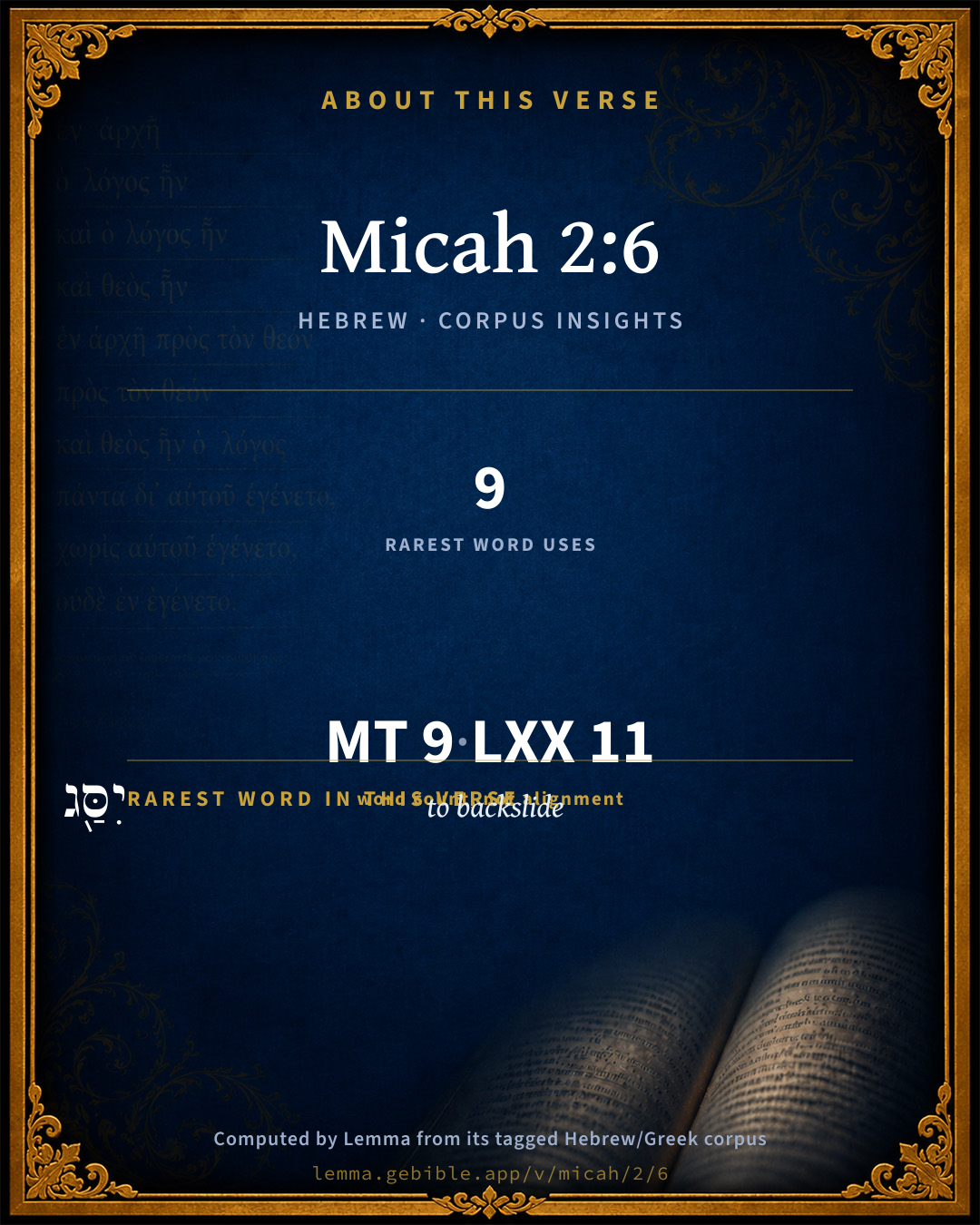
The rarest word here is יִסַּ֖ג to backslide H5253 — appearing just 9 times in the whole Hebrew Bible.

Shared distinctive vocabulary

יִסַּ֖ג to backslide H5253 occurs in 9 verses of the Hebrew Bible. Also found in:

Grammatical profile

  • 4 verbs
  • 1 noun
  • 1 pronoun
  • 3 particles

Verb forms

  • תַּטִּ֖פוּ Hiphil · Jussive
  • יַטִּיפ֑וּן Hiphil · Imperfect
  • יַטִּ֣פוּ Hiphil · Imperfect
  • יִסַּ֖ג Niphal · Imperfect

Repetition

Words recur within this verse — often emphatic in Hebrew:

  • תַּטִּ֖פוּ to prophesy H5197 ×3
  • לֹֽא not H3808 ×2

Hebrew & Septuagint length

In English translation the verse runs 14 words from the Hebrew and 24 from the Septuagint (LXX English) — the Septuagint runs noticeably longer here. See the side-by-side →

A rough comparison of the two English renderings, which tokenize alike — not a word-level alignment.

Word counts can differ between the Hebrew and the Greek without any difference in meaning — e.g. the Hebrew direct-object marker אֵת has no separate Greek word, and Greek often adds the article ὁ.

In the original languages it is 9 Hebrew tokens and 11 Greek tokens — but the two are counted differently (Hebrew bundles its prefixes and suffixes into one token; the Greek is in lemma form), so that isn’t a like-for-like length.

Cross-references

18

Topical passages linked to Micah 2:6 in the Treasury of Scripture Knowledge — connected by theme and wording, ordered by reader-vote popularity; previews shown in the World English Bible.

  • Amos 2:12 "But you gave the Nazirites wine to drink, And commanded the prophets, saying, 'Don't prophesy!'
  • Isaiah 30:10 who tell the seers, "Don't see;" and to the prophets, "Don't prophesy to us right things, speak to us smooth things, prophesy deceits,
  • Ezekiel 3:26 and I will make your tongue cleave to the roof of your mouth, that you shall be mute, and shall not be to them a reprover; for they are a rebellious house.
  • Acts 5:40 They agreed with him. Summoning the apostles, they beat them and charged them not to speak in the name of Jesus, and let them go.
  • Psalms 74:9 We see no miraculous signs. There is no longer any prophet, Neither is there among us anyone who knows how long.
  • Jeremiah 6:14–15 They have healed also the hurt of my people slightly, saying, Peace, peace; when there is no peace.
  • Jeremiah 8:11–12 They have healed the hurt of the daughter of my people slightly, saying, Peace, peace; when there is no peace.
  • Jeremiah 26:8–9 It happened, when Jeremiah had made an end of speaking all that Yahweh had commanded him to speak to all the people, that the priests and the prophets and all the people laid hold on him, saying, You shall surely die.
  • Jeremiah 26:20–23 There was also a man who prophesied in the name of Yahweh, Uriah the son of Shemaiah of Kiriath Jearim; and he prophesied against this city and against this land according to all the words of Jeremiah:
  • Ezekiel 20:46 Son of man, set your face toward the south, and drop [your word] toward the south, and prophesy against the forest of the field in the South;
  • Ezekiel 21:2 Son of man, set your face toward Jerusalem, and drop [your word] toward the sanctuaries, and prophesy against the land of Israel;
  • Amos 7:13 but don't prophesy again any more at Bethel; for it is the king's sanctuary, and it is a royal house!"
  • Amos 8:11–13 Behold, the days come," says the Lord Yahweh, "That I will send a famine in the land, Not a famine of bread, Nor a thirst for water, But of hearing the words of Yahweh.
  • Micah 6:16 For the statutes of Omri are kept, And all the works of the house of Ahab. You walk in their counsels, That I may make you a ruin, And her inhabitants a hissing; And you will bear the reproach of my people."
  • Acts 4:17 But so that this spreads no further among the people, let's threaten them, that from now on they don't speak to anyone in this name."
  • Acts 5:28 saying, "Didn't we strictly charge you not to teach in this name? Behold, you have filled Jerusalem with your teaching, and intend to bring this man's blood on us."
  • Acts 7:51 "You stiff-necked and uncircumcised in heart and ears, you always resist the Holy Spirit! As your fathers did, so you do.
  • 1 Thessalonians 2:15–16 who killed both the Lord Jesus and their own prophets, and drove us out, and didn't please God, and are contrary to all men;

Cross-references courtesy of OpenBible.info (CC BY 4.0).

Hebrew and Greek witnesses Masoretic Hebrew ↔ Greek Septuagint

The same verse in the two great witnesses to the Old Testament, shown verse-for-verse.

Here the Septuagint runs noticeably longer than the Hebrew — LXX2012 (modern English Septuagint) 24 words vs World English Bible 14. A rough length comparison of the two English translations, not a word-level alignment — read both below.

These are two independent witnesses, not word-aligned to each other, and the Septuagint is shown in lemma (dictionary) form.

Hebrew Micah 2:6 Masoretic · Westminster Leningrad Codex

אַל תַּטִּ֖פוּ יַטִּיפ֑וּן לֹֽא יַטִּ֣פוּ לָאֵ֔לֶּה לֹ֥א יִסַּ֖ג כְּלִמּֽוֹת

"Don't you prophesy!" They prophesy. "Don't prophesy about these things. Disgrace won't overtake us."

World English Bible · Public Domain

Greek LXX Micah 2:6 Septuagint · lemma form

μή κλαίω δάκρυ μηδέ δακρύω ἐπί οὗτος οὐ γάρ ἀποὠθέω ὄνειδος

Weep not with tears in the assembly of the Lord, neither let any weep for these things; for he shall not remove the reproaches,

LXX2012 (modern English Septuagint) · Public Domain

On this verse, Haydock's Catholic Bible Commentary discusses the Septuagint’s reading. Read the note in Commentary ↓

Hebrew: Westminster Leningrad Codex (CC BY 4.0). Greek: Septuagint (public domain); English from LXX2012 (modern English Septuagint) (Public Domain). How the Septuagint differs from the Hebrew →

Targum (Aramaic paraphrase)

1

The Targum is the ancient Jewish Aramaic paraphrase of the Hebrew Scriptures — an interpretive translation, not the Hebrew text itself. Onkelos (literal) and Pseudo-Jonathan (expansive) render the Torah, and Jonathan the Prophets. Coverage is partial: where no permissively-licensed English translation exists for a verse, only the Aramaic is shown. This is verse-level text, not a word-by-word alignment to the Hebrew.

  1. Targum Jonathan Prophets (Joshua–Malachi)
    לָא תִתְנַבּוּן נְבוּאָה לָא תֵילְפוּן לְעַמָא הָדֵין אֲרֵי לָא מְקַבְּלִין אִתְכְּנָעוּ:

    (no public-domain English translation for this verse)

    Targum Jonathan — Aramaic: “Mikraot Gedolot” (public domain). English: “Sefaria Community Translation” (CC0 1.0 (public-domain dedication)); “London "Chaldee Paraphrase," 1871” (public domain). Text via Sefaria.

Commentary

Notes on Micah 2:6 from classic Christian and Jewish commentators (each source and its license shown beneath its notes). The classic Christian expositions comment on the surrounding passage and are grouped to its opening verse, so a note may address several verses; the Jewish commentaries on the Tanakh (Rashi and others) are per-verse, so they appear only where the commentator wrote on this verse.

Lemma curates 59 commentaries, every one of them public domain or Creative Commons licensed, each selected and text-cleaned for this edition rather than reprinted as found. About our sources →

Trapp's Complete Commentary

John Trapp

Mic 2:6 Prophesy ye not, [say they to them that] prophesy: they shall not prophesy to them, [that] they shall not take shame.

Ver. 6. Prophesy ye not, say they to them that prophesy] Prodigious impudence thus to silence the prophets, or else to prescribe to them, according to the other reading of the text. Prophesy not, as they prophesy, for they are too tart; therefore drop not ye, who thus drop vinegar and nitre, who vex our galled consciences no less then the cruel Spaniards do the poor Indians’ naked bodies, which, for a sport, they do day by day drop with burning bacon. But let these drop that can smooth us up, that can utter toothless truths, that will drop oil into our ears, and give us silken words ( byssina verba), these be prophets for our turns, &c. God cannot please some hearers unless he speak tinkling and tickling words. Now, these must get their ears healed (as Demosthenes advised his countrymen of Greece) ere they can be in case to hear with profit. They must learn of bees, to pass by roses and violets and sit upon thyme; to heed, I mean, sound rebukes rather than smooth supparasitations. There are those who note a jeer in the term drop. It is well known that the word preached is often compared to rain, Deu 32:2 Isa 55:10-11. The prophets therefore are here in derision called droppers or distillers, and forbidden to do their office, or at least, to drop in that sort. Thus their successors in evil, the Pharisees, who were likewise covetous, derided Christ, Luk 16:14. And thus their predecessors also, in Isaiah’s time, put a scoff upon him and his preaching, Isa 28:10, where the sound of the words in the original carries a taunt, as scornful people, by the tone of their voice and rhyming words, gibe and jeer at those whom they vilify.

They shall not prophesy to them] q.d. You shall have your wish; my droppers shall give over dropping, and be no further troublesome, nor take shame any more by prophesying to such a perverse people, so shamefully, so lawlessly wicked.

That they shall not take shame] Or, shall they not take shame? q.d. though they will not hear of it, that shame shall be their promotion and confusion their portion; yea, they shall surely feel and find it so.

John Trapp, A Commentary or Exposition upon All the Books of the Old and New Testament (1647–1656) — public domain. Text from a community e-Sword module.

Whedon's Commentary on the Bible

Daniel D. Whedon

6. Attempts to silence the prophets were not infrequent; undoubtedly Micah’s patience was tried many times by those who resented his teaching. But he cannot be silenced; he flings back the prohibition and makes it the starting point for new denunciations. If Mic_2:5 contains the utterance of a bystander, “Prophesy not,” in Mic_2:6 may be understood as a summary of the prohibition implied in the threat there. The new condemnation falls chiefly upon the faithless religious teachers.

The text of 6ff. is in many places obscure; frequently the translation is doubtful, and there is much uncertainty as to where the objections which Micah takes up end, and where his own condemnations begin. G.A. Smith includes Mic_2:6-7 in the objection, and he renders the two verses as follows: —

Prate not, they prate, let none prate of such things!

Revilings will never cease!

O thou that speakest thus to the house of Jacob,

Is the spirit of Jehovah cut short?

Or are such his doings?

Shall not his words mean well with him that walketh uprightly?

This differs considerably from the translations found in A.V. and R.V., but it requires only very slight alterations in the present Hebrew text. Of the two English translations that of R.V. is certainly superior to that of A.V. That even the Revisers found it difficult to understand the present text is shown by the numerous marginal readings.

If Smith’s reproduction of the original is accepted as correct, the meaning of the two verses becomes clear. The people or the false prophets insist that Micah discontinue his foolish talk, his eternal revilings. Everyone can see that his statements are absurd. Does he mean to say that Jehovah will cast off his people? Has he ceased to be long-suffering? Is this the method of God’s dealings with his chosen people? This last question forms the basis of the prophet’s reply. He admits the truth implied in the question, but he points out in 8ff. that they are mistaken in their estimate of themselves. They are not upright; on the contrary, in every possible manner have they set aside the will of Jehovah; hence, according to their own reasoning, they can expect no favor from him.

Prophesy — Literally, drop, that is, words (see on Amo_7:16). Here the word is used in an unfavorable sense, equivalent to “grumble,” “find fault.” In the following clause “the prophet flings the same word back at them sarcastically.” In this case the verb is in the frequentative tense, “they prophesy (or, prate) continually.”

To them — If the above interpretation is correct a better rendering would be “of these things” (so R.V. margin). The prophet is told to let alone politics and social conditions — the politicians will look after these things; he is to confine himself to the preaching of the “simple gospel.” In the last clause of Mic_2:6 the above translation reproduces the Hebrew more accurately; the words are those of the prophet’s opponents, who are weary of listening to his grumbling. The opening words of Mic_2:7 have proved a puzzle to all commentators, and practically all favor emendations. Smith alters the words so that they may be understood as an address to Micah, introducing several questions which are intended to show the absurdity of his attitude.

Straitened — Or, impatient; literally, shortened. Has Jehovah ceased to be long-suffering?

These — The things described in Mic_2:3-4.

Mean well — God can send no message of judgment to those who serve him faithfully.

A second interpretation divides the sentences of Mic_2:6-7 between the prophet and his opponents. “Prophesy ye not” is assigned to the opposition, “thus they prophesy” are thought to be the words of Micah, introducing the preceding quotation. To this attempt to silence him the prophet replies with two rhetorical questions: (1) “Shall one not preach to these?” — that is, to such as are described in Mic_2:1-2; they certainly deserve the condemnation. (2) “Shall not reproaches depart?” Is it not time for the reproaches heaped upon the prophet to come to an end? In Mic_2:7 the prophet is thought to introduce an additional objection raised to his preaching: “Shall it be said, O house of Jacob,” or “by the house of Jacob.” These are understood to be the words of the prophet, introducing the objection itself, which is expressed in two questions: (1) “Is the spirit of Jehovah shortened?” The prophet’s words seemed to imply that Jehovah has ceased to be long-suffering; this accusation against Jehovah the objectors indignantly deny. (2) “Are these his doings?” The forsaking of his people, as announced in Mic_2:3-4. This also they are unwilling to believe. To these objections the prophet replies, introducing Jehovah himself as the speaker, by asking a question which points out, by implication, that he is not blaspheming Jehovah, but that they, by their own conduct, have made it impossible for Jehovah to show them any favor. The objections raised by the people indicated that they had failed completely to understand the ethical character of Jehovah and of his government. Like Amos, Micah is compelled to show that Jehovah cannot save Israel simply because they are his chosen people; they must maintain the proper attitude of heart and life if they would enjoy his goodness (Mic_6:8). Their shortcomings and failures are further described in Mic_2:8-9. In view of this condition of things there is left no doubt that the denunciation of Mic_2:3-4 is perfectly justified, hence the sentence is repeated in Mic_2:10.

These are the two most important interpretations of Mic_2:6-7; others need not be mentioned. The force of the verses remains essentially the same with either. The second follows more closely the present Hebrew text, but it is by no means certain that the latter has come down to us in its original purity; it may have suffered in the course of transmission.

Daniel D. Whedon (gen. ed.), Commentary on the Old and New Testaments (1874–1909) — public domain. Text from a community e-Sword module.

The Preacher's Complete Homiletical Commentary

Joseph S. Exell (gen. ed.)

CRITICAL NOTES.]

Mic_2:6. Prophesy] Lit. to drip, to cause words to flow, prophesying (Amo_7:16). “The people, the false prophets, the politicians, forbade God and Micah to prophesy. Prophesy not] God, by Micah, recites their prohibition to themselves, and forewarns them of the consequences” [Pusey]. Shame] Lit. shames, manifold shame (cf. Amo_7:16).

Mic_2:7. Straitened] i.e. shortened, impatient. These] i.e. the punishments threatened; a speech which claims for itself the promises regardless of moral condition. God not less merciful than formerly (Exo_34:6); but their sins have changed his proceedings towards them.

HOMILETICS

OPPOSITION TO GOD’S WORD AND ITS CONSEQUENCES.—Mic_2:6-7

A second accusation is brought against them, for contempt of God’s Word and opposition to his servants. The wicked could not endure the threatening of judgment, sought to silence the Prophet (Amo_7:10-12), or make him preach to please only, as their false prophets did. This conduct adds to their sins, leaves them without true teachers, and throws them into deeper shame.

I. Man’s opposition to God’s Word. “Prophesy ye not, say they to them that prophesy.” Opposition to God’s Word is an insult to his character, and a denial of his authority.

1. Men are offended with the faithful preaching of the Word. The truth is unwelcome to those who live in sin. Judgment terrifies them and conscience accuses them in guilt. The cross is an offence, and the gospel a stumbling-block to many. They want the preacher to please them, withhold the truth, and speak peace when there is no peace. “Prophesy not unto us right things, speak unto us smooth things, prophesy deceits.”

2. Men are offended with the constant preaching of the Word. “Drop not,” distil not; indicating habitual and unceasing warning and lamentation. Occasional appeals may be overlooked; but to be constantly threatened is disagreeable and offensive. It is vinegar and nitre dropped in the conscience instead of dew and refreshment to the heart. It argues an ungodly life and a degenerate age to resist the warnings of the gospel. “Did we not straitly command you, that ye should not teach in this name?”

II. God’s purpose to fulfil His Word. When the wicked said prophesy not, the Lord answered, they shall prophesy. The Word must be published. Men must be warned whether they hear or forbear.

1. God’s servants must obey their commission. Persecuted and opposed, they must be faithful to their trust and to their God. “Of a truth the Lord hath sent me unto you to speak all these words in your ears” (Jer_26:10-15).

2. God’s Spirit cannot be restrained. “Is the Spirit of the Lord straitened?” Can you overcome God by opposing his servants? Can you restrain the Spirit from uttering the truth, or resolve its purpose to what you please? Can you quench the sun or imprison the light? Then you may limit the Holy Spirit in its operations. If God thunders in judgment, it is not because he cannot give mercy. His power is not diminished, and his mercy is from everlasting to everlasting (Cf. Isa_1:2; Psa_103:17). But sins and iniquities hide his face from you, hinder his word, and procure your punishment.

III. The awful consequences of opposing God’s Word. God takes them at their word. They shall not prophesy, and their shame shall not be removed.

1. This will deprive them of the faithful ministry. If men silence God’s ministers and hinder God’s word, God will leave them without light and reproof. They will have their wish and be righteously punished for their choice. Ephraim is joined to his idols, let him alone.

2. This will offend the Spirit of God. In silencing the prophets they did what they could to silence and limit the Spirit. “Is the Lord’s Spirit straitened?” But impenitence cannot shut out conviction from the heart. Human sinfulness cannot frustrate Divine purposes.

3. This will rob them of religious privileges. “Thou art named the house of Jacob,” but this conduct is most unreasonable for such dignity. Men study to keep up a name, but it is only a name, without anything to answer to it in life. God discerns between show and substance, fair titles and truth. Men may boast of descent, rely on false security, and flatter themselves that they are Abraham’s children; but God will reject them, call them a sinful nation, a people laden with iniquity. Their privileges will be taken away, and their profession will bring a curse and not a blessing. “Thou hast a name that thou livest, and art dead.”

THE ADVANTAGES OF REVELATION.—Mic_2:7

The Word of God must operate according to the principles and dispositions within us. If it be food, it is nothing to the dead, but to the living only. The benefit is only to. them that walk by it. We are not to expect that his words will do us good mechanically, that is, without our consciousness or activity; or that they will act in us as physical causes operate in the body, where the concoction of the food and the circulation of the fluids go on when we are asleep as well as when we are awake, being independent of our volitions and thoughts. The Scriptures can only affect us morally, in a way of motive, in the exercises of the mind, and in the use of the means which God has appointed. This is the only way in which we are authorized to look for it to work We must read, hear, and understand them; we must pray over them, speak of them, and reflect upon them. It is endless to describe the benefit they will then do for us. They will do us good in a way of information. For the soul to be without knowledge it is not good. There is no knowledge like that of the Scriptures. It is clear, full, and blessed. It gives life to them that have it. It is an advantage in duty and perplexity to hear the voice: This is the way, walk ye in it. They will do us good in a way of excitement. We get dull and formal, have a name to live, but are dead. God quickens us according to his Word, endears it to us, and enables us to remember it. “I will never forget thy precepts; for with them thou hast quickened me.” They will do us good in a way of rebuke. They never flatter, but deal truly with us, and frequently reprove us. If we are concerned for our welfare we shall not esteem them our enemy because they tell us the truth. It is improper to limit the benefit of the Word to encouragement, to suppose that we have never a good opportunity, unless it comforts us. It is a blessing to be humbled and emptied of self, to see our vileness, and cry “God be merciful to me a sinner.” We talk of benefactors! What good has the Bible done! What millions has it blessed! How much do we owe it! Thanks be unto God for his unspeakable gift [Jay].

GOD’S APPEAL TO EXPERIENCE.—Mic_2:7

God’s Word does good and not harm. It is folly, therefore, to oppose it. You are then acting not merely in opposition to God, but against your own benefit and the best interests of your country.

I. The words of God design to do good. Words express mind. God’s Word reveals God’s will and design, and this design is merciful. There are mysteries, but no proofs of malevolent feelings, in the world. Benevolence predominates in nature, notwithstanding sin. Providence wears a benign aspect. The sun shines and the rain falls on the just and the unjust. But in the gospel we have the purpose of God to save, the words of God to bless. “God having raised up his Son Jesus, sent him to bless you, in turning away every one of you from his iniquities.”

II. The words of God have done good in human experience. Their truth has been confirmed within us. The greatest sinners have received good. Saul of Tarsus, Bunyan, and Newton have been forgiven and saved. We can point to trophies of its power in characters most sinful and profligate. “Such were some of you; but ye are washed, but ye are sanctified, but ye are justified,” &c.

III. But the good which the words of God effect depends upon our moral condition. To him that walketh uprightly. They operate not on outward but moral nature, and influence us according to our relation to them. The sun that melts the wax will harden the clay. Good must be within us before good can come to us. An evil disposition will bring a curse and not a blessing. “To the one we are the savour of death unto death; and to the other the savour of life unto life.”

HOMILETIC HINTS AND OUTLINES

Mic_2:6. The words are very emphatic in Hebrew, from their briefness: Prophesy not; they shall indeed prophesy; they shall not prophesy to these; shame shall not depart [Pusey]. I. Opposition to God.

1. In his servants.

2. In his Word. II. Consequences of opposition.

1. Shame shall rest upon them.

2. The Word shall be proclaimed to others. “God would have turned away the shame from them; but they, despising his warnings, drew it to themselves. It was the natural fruit of their doings; it was in its natural home with them. The sinner hath but to remain as he is; the shame encompasseth him already, and only departeth not. The wrath of God is already upon him and abideth on him [Pusey].

Mic_2:7. Named. The name is belied,

1. By conduct which contradicts profession.

2. By claiming the promises of God regardless of moral condition before God. Jacob was not copied in spirit and example by those who boasted of his name, a name which reminded of favours, which they abused, and of which they were deprived.

Is the Spirit of the Lord straitened? No, for that would—

1. Contradict his Word.

2. Be at variance with the facts of human experience. It is free and unfettered, gracious and abundant in its operations (Cf. Mal_2:15; 2Ti_2:9; 2Th_2:9). “Turn you at my reproof: behold, I will pour out my Spirit unto you, I will make known my words unto you.”

My words.

1. The benevolent nature of God’s words, “do good.”

2. The power of God’s words, “do good.”

3. The persons who enjoy the benefits, “the upright.” Those who return to the way of righteousness and do not forsake it (Pro_4:26-27).

That is the old and still practised way of avoiding God’s threatenings, namely, that men so readily form conceptions of God, and imagine that he cannot be angry because he is merciful. Let one learn, first of all, to understand God from his own sayings. He who hates the light may for a while resort to imaginary comfort, but it cannot help him [Lange].

ILLUSTRATIONS TO CHAPTER 2

Mic_2:7. My words. They do evil and injury to many. Thousands will curse for ever the hour they became acquainted with the Scriptures, for they derive from them only an increase of guilt and condemnation. But this is not the effect of design or of natural tendency in them, for the Bible is intended and adapted to do us good only, but is the accidental result of depravity; and therefore it is confined to those who pervert it, abuse it, neglect it, and thus turn the blessing into a curse [Jay].

The Preacher's Complete Homiletical Commentary (gen. ed. Joseph S. Exell; Funk & Wagnalls, c. 1892) — public domain (pre-1929). A full-Bible homiletical/sermon-outline anthology covering 65 of 66 books (2 John is absent from the source module). Text from a community e-Sword module.

Keil & Delitzsch

C. F. Keil & F. Delitzsch

As such a prophecy as this met with violent contradiction, not only from the corrupt great men, but also from the false prophets who flattered the people, Micah indicates it by showing that the people are abusing the long-suffering and mercy of the Lord; and that, by robbing the peaceable poor, the widows, and the orphans, they are bringing about the punishment of banishment out of the land. Mic 2:6. "Drip not (prophesy not), they drip: if they drip not this, the shame will not depart. Mic 2:7. Thou, called house of Jacob, is the patience of Jehovah short, then? or is this His doing? Are not my words good to him that walketh uprightly?" הטּיף, to drip, to cause words to flow, used of prophesying, as in Amo 7:16. The speakers in Mic 2:6 are not the Jews generally, or the rich oppressors who have just been punished and threatened. The word yattı̄phū does not agree with this, since it does not mean to chatter, but to prophesy, as Mic 2:11 and also the primary passage Deu 32:2 show. But Micah could not call the rich men's speaking prophesying. It is rather false prophets who are speaking, - namely, those who in the word 'al-tattı̄phū (prophesy not) would prohibit the true prophets from predicting the judgments of the Lord. The second hemistich is rendered by most of the modern commentators, "they are not to chatter (preach) of such things; the reproaches cease not," or "there is no end to reproaching" (Ewald, Hitzig, Maurer, and Caspari). But this is open to the following objections: (1) That הטּיף ל in Mic 2:11 means to prophesy to a person (not concerning or of anything); (2) that sūg or nâsag means to depart, not to cease; (3) that even the thought, "the reproaches to not cease," is apparently unsuitable, since Micah could not well call a prohibition against prophesying an incessant reproach; and to this we may add, (4) the grammatical harshness of taking לא יטּיפוּ as an imperative, and the following לא יסּג as an indicative (a simple declaration). Still less can the rendering, "they (the true prophets) will not chatter about this, yet the reproach will not depart" (Ros., Rckert), be vindicated, as such an antithesis as this would necessarily be indicated by a particle. The only course that remains, therefore, is that adopted by C. B. Michaelis and Hengstenberg, viz., to take the words as conditional: if they (the true prophets) do not prophesy to these (the unrighteous rich in Mic 2:1, Mic 2:2 : Hengstenberg), or on account of these things (Michaelis), the shame will not depart, i.e., shameful destruction will burst incessantly upon them. On the absence of the conditional אם, see Ewald, p. 357, b. Such addresses as these do not please the corrupt great men; but they imagine that such threats are irreconcilable with the goodness of Jehovah. This is the connection of Mic 2:7, in which the prophet meets the reproach cast upon his threatening words with the remark, that God is not wrathful, and has no love for punishing, but that He is stirred up to wrath by the sins of the nation, and obliged to punish. האמוּר is not an exclamation, "O, what is said! = O for such talk as this!" (Ewald, Umbreit, Caspari); for it cannot be shown that the participle is ever used in this way, and it cannot be supported from הפכּכם in Isa 29:16, especially as here a second vocative would follow. Nor is it a question: Num dicendum? Dare one say this?" (Hitzig). For although he might be an interrogative particle (cf. Eze 28:9), the passive participle cannot express the idea of daring, in support of which Hitzig is quite wrong in appealing to Lev 11:47 and Psalm 22:32. האמוּר is not doubt a vocative, but it is to be taken in connection with bēth-Ya‛aqōb: thou who art called house of Jacob. There is very little force in the objection, that this would have required האמוּר לך ב י, since אמר, when used in the sense of being called or being named, is always construed with ל of the person bearing the name. The part. pal of 'âmar only occurs here; and although the niphal, when used in this sense, is generally construed with ל, the same rule may apply to אמר as to קרא in the sense of naming, - namely, that in the passive construction the ל may either be inserted or omitted (cf. Isa 56:7; Isa 54:5; Deu 3:13), and האמוּר may just as well be used in the sense of dicta (domus) as הנּקראים in Isa 48:1 in the sense of vocati = qui appellantur. The whole nation is addressed, although the address points especially to the unrighteous great men. Is Jehovah indeed wrathful? i.e., has He not patience, does He not exercise long-suffering? Qātsar rūăch must not be explained according to Exo 6:9, but according to Pro 14:27. Or are these ('ēlleh, the punishments threatened) His deeds? i.e., is He accustomed, or does He only like to punish? The answer to these questions, or speaking more correctly, their refutation, follows in the next question, which is introduced with the assuring הלוא, and in which Jehovah speaks: My words deal kindly with him that walks uprightly. The Lord not only makes promises to the upright, but He also grants His blessing. The words of the Lord contain their fulfilment within themselves. In היּשׁר הולך, it is for the sake of emphasis that yâshâr stands first, and the article properly belongs to hōlēkh; but it is placed before yshr to bind together the two words into one idea. The reason why the Lord threatens by His prophets is therefore to be found in the unrighteousness of the people.

Keil & Delitzsch — Biblical Commentary on the Old Testament (1861–1891) — public domain (CC PDM 1.0). Text via the HelloAO Bible API. (Old Testament only.)

Tyndale Open Study Notes

Tyndale Open Resources

2:6 There was a pathetic attempt to stifle the words of a true prophet. • the people respond: They thought that exile and other such disasters could not happen to them, but they were wrong.

Tyndale Open Study Notes — © Tyndale Open Resources, licensed CC BY-SA 4.0. Text via the HelloAO Bible API.

Geneva Bible (1599)

Geneva Bible translators

Thus the people warn the prophets that they speak to them no more, for they cannot abide their threatenings.

God saith that they shall not prophesy, nor receive no more of their rebukes nor taunts.

Geneva Bible (1599) marginal notes — public domain. Text via Bolls.life.

Matthew Henry's Commentary

Here are two sins charged upon the people of Israel, and judgments denounced against them for each, such judgments as exactly answer the sin - persecuting God's prophets and oppressing God's poor.

I. Persecuting God's prophets, suppressing and silencing them, is a sin that provokes God as much as anything, for it not only spits in the face of his authority over us, but spurns at the bowels of his mercy to us; for his sending prophets to us is a sure and valuable token of his goodwill. Now observe here,

1. What the obstruction and opposition were which this people gave to God's prophets: They said to those that prophesy, Prophesy ye not, as Isa 30:10. They said to the seers, "See not; do not trouble us with accounts of what you have seen, nor bring us any such frightful messages." They must either not prophesy at all or prophesy only what is pleasing. The word for prophesying here signifies dropping, for the words of the prophets dropped from heaven as the dew. Note, Those that hate to be reformed hate to be reproved, and do all they can to silence faithful ministers. Amos was forbidden to prophesy, Amo 7:10, etc. Therefore persecutors stop their breath, because they have no other way to stop their mouths; for, if they live, they will preach and torment those that dwell on the earth, as the two witnesses did, Rev 11:10. Some read it, Prophesy not; let these prophesy. Let not those prophesy that tell us of our faults, and threaten us, but let those prophesy that will flatter us in our sins, and cry peace to us. They will not say that they will have no ministers at all, but they will have such as will say just what they would have them and go their way. This they are charged with (Mic 2:11), that when they silenced and frowned upon the true prophets they countenanced and encouraged pretenders, and set them up, and made an interest for them, to confront God's faithful prophets: If a man walk in the spirit of falsehood, pretend to have the Spirit of God, while really it is a spirit of error, a spirit of delusion, and he himself knows that he has no commission, no instruction, from God, yet, if he says, I will prophesy unto thee of wine and strong drink, if he will but assure them that they shall have wine and strong drink enough, that they need not fear the judgments of war and famine which the other prophets threatened them with, that they shall always have plenty of the delights of sense and never know the want of them, and if he will but tell them that it is lawful for them to drink as much as they please of their wine and strong drink, and they need not scruple being drunk, that they shall have peace though they go on and add drunkenness to thirst, such a prophet as this is a man after their own heart, who will tell them that there is neither sin nor danger in the wicked course of life they lead: He shall even be the prophet of this people; such a man they would have to be their prophet, that will not only associate with them in their rioting and revellings, but will pretend to consecrate their sensualities by his prophecies and so harden them in their security and sensuality. Note, It is not strange if people that are vicious and debauched covet to have ministers that are altogether such as themselves, for they are willing to believe God is so too, Psa 50:21. But how are sacred things profaned when they are prostituted to such base purposes, when prophecy itself shall be pressed into the services of a lewd and profane crew! But thus that servant who said, My Lord delays his coming, by the spirit of falsehood, smote his fellow servants and ate and drank with the drunken.

2. How they are here expostulated with upon this matter (Mic 2:7): "O thou that art named the house of Jacob, does it become thee to say and do thus? Wilt thou silence those that prophesy, and forbid them to speak in God's name?" Note, It is an honour and privilege to be named of the house of Jacob. Thou art called a Jew, Rom 2:17. But, when those who are called by that worthy name degenerate, they commonly prove the worst of men themselves and the worst enemies to God's prophets. The Jews who were named of the house of Jacob were the most violent persecutors of the first preachers of the gospel. Upon this the prophet here argues with these oppressors of the word of God, and shows them, (1.) What an affront they hereby put upon God, the God of the holy prophets: "Is the Lord's Spirit straitened? In silencing the Lord's prophets you do what you can to silence his Spirit too; but do you think you can do it? Can you make the Spirit of God your prisoner and your servant? Will you prescribe to him what he shall say, and forbid him to say what is displeasing to you? If you silence the prophets, yet cannot the Spirit of the Lord find out other ways to reach your consciences? Can your unbelief frustrate the divine counsels?" (2.) What a scandal it was to their profession as Jews: "You are named the house of Jacob, and this is your honour; but are these his doings? Are these the doings of your father Jacob? Do you herein tread in his steps? No; if you were indeed his children you would do his works; but now you seek to kill and silence a man that tells you the truth, in God's name; this did not Abraham (Joh 8:39, Joh 8:40); this did not Jacob." Or, "Are these God's doings? Are these the doings that will please him? Are these the doings of his people? No, you know they are not, however some may be so strangely blinded and bigoted as to kill God's ministers and think that therein they do him service," Joh 16:2. (3.) Let them consider how unreasonable and absurd the thing was in itself: Do not my words do good to those that walk uprightly? Yes; certainly they do; it is an appeal to the experiences of the generation of the upright: "Call now if there be any of them that will answer you, and to which of the saints will you turn? Turn to which you will, and you will find they all agree in this, that the word of God does good to those that walk uprightly; and will you then oppose that which does good, so much good as good preaching does? Herein you wrong God, who owns the words of the prophets to be his words (they are my words) and who by them aims and designs to do good to mankind (Psa 119:68); and will you hinder the great benefactor from doing good? Will you put the light of the world under a bushel: You might as well say to the sun, Shine not, as say to the seers, See not. Herein you wrong the souls of men, and deprive them of the benefit designed them by the word of God." Note, Those are enemies not only to God, but to the world, they are enemies to their country, that silence good ministers, and obstruct the means of knowledge and grace; for it is certainly for the public common good of states and kingdoms that religion should be encouraged. God's words do good to those that walk uprightly. It is the character of good people that they walk uprightly (Psa 15:2); and it is their comfort that the words of God are good and do good to them; they find comfort in them. God's words are good words to good people, and speak comfortably to them. But those that opposed the words of God, and silenced the prophets, pleaded, in justification of themselves, that God's words were unprofitable and unpleasant to them, and did them no good, nor prophesied any good concerning them, but evil, as Ahab complained of Micaiah, in answer to which the prophet here tells them that it was their own fault; they might thank themselves. They might find it of good use to them if they were but disposed to make a good use of it; if they would but walk uprightly, as they should, and so qualify themselves for comfort, the word of God would speak comfortably to them. Do that which is good, and thou shalt have praise for the same.

3. What they are threatened with for this sin; God also will choose their delusions, and, (1.) They shall be deprived of the benefit of a faithful ministry. Since they say, Prophesy not, God will take them at their word, and they shall not prophesy to them; their sin shall be their punishment. If men will silence God's ministers, it is just with God to silence them, as he did Ezekiel, and to say, They shall no more be reprovers and monitors to them. Let the physician no longer attend the patient that will not be healed, for he will not be ruled. They shall not prophesy to them, and then they will not take shame. As it is the work of magistrates, so it is also of ministers, to put men to shame when they do amiss (Jdg 18:7), that, being made ashamed of their folly, they may not return again to it; but, when God gives men up to be impudent and shameless in sin, he says to his prophets, They are joined to idols; let them alone. (2.) They shall be given up to the blind guidance of an unfaithful ministry. We may understand Mic 2:11 as a threatening: If a man be found walking in the spirit of falsehood, having such a lying spirit as was in the mouth of Ahab's prophets, that will strengthen their hands in their wicked ways, he shall be the prophet of this people, that is, God will leave them to themselves to hearken to such; since they will be deceived, let them be deceived; since they will not admit the truth in the love of it, God will send them strong delusions to believe a lie, Th2 2:10, Th2 2:11. They shall have prophets that will prophesy to them for wine and strong drink (so some read it), that will give you a cast of their office to your mind for a bottle of wine of a flagon of ale, will soothe sinners in their sins if they will but feed them with the gratifications of their lusts; to have such prophets, and to be ridden by them, is as sad a judgment as any people can be under and as bad a preface of ruin approaching as it is to a particular person to be under the influence of a debauched conscience.

II. Oppressing God's poor is another sin they are charged with, as before (Mic 2:1, Mic 2:2), for it is a sin doubly hateful and provoking to God. Observe,

1. How the sin is described, Mic 2:8, Mic 2:9. When they contemned God's prophets and opposed them they broke out into all other wickedness; what bonds will hold those that have no reverence for God's word? Those who formerly rose up against the enemies of the nation, in defence of their country and therein behaved themselves bravely, now of late rose up as enemies of the nation, and, instead of defending it, destroyed it, and did it more mischief (as usually such vipers in the bowels of a state do) than a foreign enemy could do. They made a prey of men, women, and children, (1.) Of men, that were travelling on the way, that pass by securely as men averse from war, that were far from any bad designs, but went peaceably about their lawful occasions; those they set upon, as if they had been dangerous obnoxious people, and pulled off the robe with the garment from them, that is, they stripped them both of the upper and the inner garment, took away their cloak, and would have their coat also; thus barbarously did they use those that were quiet in the land, who, being harmless, were fearless, and so the more easily make a prey of. (2.) Of women, whose sex should have been their protection (Mic 2:9): The women of my people have you cast out from their pleasant houses. They devoured widows' houses (Mat 23:14), and so turned them out of the possession of them, because they were pleasant houses, and such as they had a mind for. It was inhuman to deal thus barbarously with women; but that which especially aggravated it was that they were the women of God's people, whom they knew to be under his protection. (3.) Of children, whose age entitles them to a tender usage: From their children have you taken away my glory for ever. It was the glory of the Israelites' children that they were free, but they enslaved them - that they were born in God's house, and had a right to the privileges of it, but they sold them to strangers, sent them into idolatrous countries, where they were deprived for ever of that glory; at least the oppressors designed their captivity should be perpetual. Note, The righteous God will certainly reckon for injuries done to the widows and fatherless, who, being helpless and friendless, cannot otherwise expect to be righted.

2. What the sentence is that is passed upon them for it (Mic 2:10): "Arise ye, and depart; prepare to quit this land, for you shall be forced out of it, as you have forced the women and children of my people out of their possessions; it is not, it shall not, be your rest, as it was intended that Canaan should be, Psa 95:11. You shall have neither contentment nor continuance in it, because it is polluted by your wickedness." Sin is defiling to a land, and sinners cannot expect to rest in a land which they have polluted, but is will spew them out, as this land spewed out the Canaanites of old when they had polluted it with their abominations, Lev 18:27, Lev 18:28. "Nay, you shall not only be obliged to depart out of this land, but it shall destroy you even with a sore destruction; you shall either be turned out of it or (which is all one) you shall be ruined in it." We may apply this to our state in this present world; it is polluted; there is a great deal of corruption in the world, through lust, and therefore we should arise, and depart out of it, keep at a distance from the corruption that is in it, and keep ourselves unspotted from it. It is not our rest; it was never intended to be so; it was designed for our passage, but not for our portion - our inn, but not our home. Here we have no continuing city; let us therefore arise and depart; let us sit loose to it and live above it, and think of leaving it and seek a continuing city above.

Matthew Henry's Commentary on the Whole Bible (1708–1710) — public domain (CC PDM 1.0). Text via the HelloAO Bible API.

Jamieson, Fausset & Brown

Robert Jamieson, A. R. Fausset & David Brown

Prophesy ye not, say they--namely, the Israelites say to the true prophets, when announcing unwelcome truths. Therefore God judicially abandons them to their own ways: "The prophets, by whose ministry they might have been saved from shame (ignominious captivity), shall not (that is, no longer) prophesy to them" (Isa 30:10; Amo 2:12; Amo 7:16). MAURER translates the latter clause, "they shall not prophesy of such things" (as in Mic 2:3-5, these being rebellious Israel's words); "let them not prophesy"; "they never cease from insult" (from prophesying insults to us). English Version is supported by the parallelism: wherein the similarity of sound and word implies how exactly God makes their punishment answer to their sin, and takes them at their own word. "Prophesy," literally, "drop" (Deu 32:2; Eze 21:2).

Jamieson, Fausset & Brown — Commentary Critical and Explanatory on the Whole Bible (1871) — public domain (CC PDM 1.0). Text via the HelloAO Bible API.

Adam Clarke's Commentary

Verse 6. Prophesy ye not] Do not predict any more evils-we have as many as we can bear. We are utterly ruined-shame and confusion cover our faces. The original is singular, and expressive of sorrow and sobbing. Literally, "Do not cause it to rain; they will cause it to rain; they cannot make it rain sooner than this; confusion shall not depart from us." To rain, often means to preach, to prophesy; Eze 20:46; Eze 21:2; Am 7:16; De 32:2; Job 29:22; Pr 5:3, c.

The last line Bp. Newcome translates, "For he shall not remove from himself reproaches" and paraphrases, "The true prophet will subject himself to public disgrace by exercising his office."

Adam Clarke's Commentary on the Bible (1810–1826) — public domain. Text from a community e-Sword/MySword module.

John Calvin's Commentaries

Here the conciseness of the expressions has made interpreters to differ in their views. Some read thus, Distill ye not, — they will distill; that is, the Jews speak against the prophets, and with threats forbid them, as with authority, to address them. The Hebrew word, distill, means the same as to speak; though at the same time it is applied more commonly to weighty addresses than to such as are common and ordinary. If any understands, they will distill, or speak, of the Jews, then the Prophet points out their arrogance in daring to contend with God’s prophets, and in trying to silence and force them to submission. We indeed find that ungodly men act thus, when they wish to take away the liberty of teaching from God’s prophets; for they resist as though they themselves were doubly and treble prophets. So also in this place, Distill ye not, that is, the Jews say, Let not the servants of God prophesy. But some think that a relative is understood, Distill ye not for them who distill; as though he had said, that ungodly men would not bear God’s prophets and thus would prevent and restrain them, as much as they could, from speaking. Others make this distinction, Distill ye not, — they shall distill; as though the Jews said the first, and God the second. Distill ye not, — this was the voice of the ungodly and rebellious people, who would cast away from them and reject every instruction: but God on the other side opposed them and said, Nay, they shall distill; ye forbid, but it is not in your power; I have sent them: though ye may rage and glamour a hundred times, it is my will that they should proceed in their course.

We hence see how various are the explanations: and even in the other part of the verse there is no more agreement between interpreters: They shall not distill; respecting this clause, it is sufficiently evident, that God here intimates that there would be now an end to all prophecies. How so? Because he would not render his servants a sport, and subject them to reproach. This is the true meaning: and yet some take another view, as though the Prophet continued his sentence, They shall not distill, lest the people should receive reproaches; for the ungodly think, that if they close the mouths of the prophets, all things would be lawful to them, and that their crimes would be hid, in short, that their vices would not be called to an account; as though their wickedness was not in itself sufficiently reproachful, were God to send no prophets, and no reproof given. No doubt, profane men are so stupid as to think themselves free from every reproach, when God is silent, and when they put away from themselves every instruction. Hence some think, that this passage is to be understood in this sense. But I consider the meaning to be that which I have stated; for he had before said, Distill ye not who distill; that is, Ye prophets, be no longer troublesome to us; why do you stem our ears? We can no longer bear your boldness; be then silent. Thus he expressly introduced the Jews as speaking with authority, as though it was in their power to restrain the prophets from doing their duty. Now follows, as I think, the answer of God, They shall not distill, that he may not get reproaches: Since I see that my doctrine is intolerable to you, since I find a loathing so great and so shameful, I will take away my prophets from you: I will therefore rest, and be hereafter silent. — Why? “Because I effect nothing; nay, I subject my prophets to reproaches; for they lose their labor in speaking, they pour forth words which produce no fruit; for ye are altogether irreclaimable. Nay, as they are reproachfully treated by you, their condition is worse than if they were covered with all the disgrace of having been criminal. Since then I subject my prophets to reproach I will not allow them to be thus mocked by you. They shall therefore give over, they shall prophesy no longer. ”

But the Lord could not have threatened the Jews with any thing worse or more dreadful than with this immunity, — that they should no more hear anything which might disturb them: for it is an extreme curse, when God gives us loose reins, and suffers us, with unbridled liberty, to rush as it were headlong into evils, as though he had delivered us up to Satan to be his slaves. Since it is so, let us be assured that it is an awful threatening, when he says, They shall not distill, lest they should hereafter become objects of reproach.

John Calvin's Commentaries (1540-1563) — public domain. Text from the Calvin Translation Society English edition (1840s-50s) via the Christian Classics Ethereal Library (ccel.org). Calvin's coverage is partial (roughly two-thirds of the Bible); uncommented books and verses are honest gaps, never fabricated. The 19th-century editor's footnotes and remarks are omitted so the notes are faithfully Calvin's own voice.

Ellicott's Commentary for English Readers

(6) Prophesy ye not.—The construction of this verse is very confused, but the intention of it is fairly clear. It contains the address of the oppressors to the true prophets, and their reply. The oppressors desire the prophets to cease prophesying; nevertheless, the prophecies shall be continued, but without benefit to those who will not put away their shame.

A Bible Commentary for English Readers, edited by Charles John Ellicott (1878–1897) — public domain. Text from a community e-Sword module.

The Cambridge Bible for Schools and Colleges

gen. ed. J. J. S. Perowne

6, 7. Hostility of the two classes of Prophets

6. Prophesy ye not] Micah and the prophets like-minded with him (e. g. Isaiah) are angrily bidden by the flattering, popular prophets to hold their peace. Comp. Isa_30:9-10, ‘For it is a rebellious people … Who say to the seers, See not; and to the prophets, Prophesy not unto us right things; speak unto us smooth things, prophesy deceits (or, illusions); also Amo_2:12; Amo_5:10. Thus, in the times of Isaiah, Amos, and Micah, we can already detect the germs of the persecution which broke out with such severity under Manasseh. The faithful prophets of Jehovah were sometimes obliged to hide themselves (Isa_30:20), and it seemed as if ‘the godly man had perished out of the land’ (Mic_7:2). From the context in which these words ‘Prophesy ye not,’ occur, we should suppose that the speakers were the ‘rebellious people’ (see Isa_30:9; Isa_30:20), represented by the grandees, though most commentators think that they are rather the unfaithful, smooth-speaking prophets, sometimes called ‘false prophets.’ Obs., the word used, here and in Mic_2:11 (also in Amo_7:16, Eze_21:2) for ‘prophesy’ is literally ‘drop;’ it was perhaps originally a figurative expression for the constant flow and persuasive eloquence of prophecy. It is however probably used by Micah’s hostile critics in an unfavourable sense (‘dropping’ = constantly finding fault, comp. ‘here a little, there a little,’ Isa_28:10), so that we may venture to render here, Prattle ye not. Speech in general is said to ‘drop as the dew,’ Deu_32:2; comp. Job_29:22.

say they to them that prophesy] Rather, (thus) they prattle. The prophet takes up their word, and flings it back to them sarcastically. This view makes the grandees the speakers, in accordance with the context. Most recent commentators, however, suppose a sudden introduction of the false prophets (see last note).

they shall not prophesy to them] Rather, they should not prattle of these things. Micah and his companions are exceeding the limits of their commission. It is for the grandees to decide political matters; and to chatter about the ruin of the state is simply high treason.

that they shall not take shame] Rather, reproaches are unceasing. By ‘reproaches’ the hostile speakers mean denunciations such as that in Mic_2:1-2, Isaiah 5. Comp. again Isa_28:10 (where however A. V. needs to be corrected).

The Cambridge Bible for Schools and Colleges (gen. ed. J. J. S. Perowne; Cambridge University Press, 1878–1918) — public domain. Text from a community e-Sword module.

John Gill's Exposition

Prophesy ye not, say they to them that prophesy,.... Or "drop not" (h); such terrible words, such menacing things; let them not flow from your lips with such profusion and abundance; cease from speaking in the name of the Lord, if we can hear nothing else but sharp reproofs, and severe judgments: or the first word respects the true prophets of the Lord, and forbids their prophesying; and, according to others, the next should be rendered, "let them prophesy", or "drop" (i); that is, the false prophets, that prophesy smooth things; and so the sense is, let the one prophesy, but not the other:

they shall not prophesy to them; these are the words of the Lord, in answer to the other, that since they did not like his prophets, their should no more be sent to, them, nor should drop or distil the rain of doctrine upon them; but, as a judgment upon them, should be deprived of them: or, "they shall not prophesy according to these" (k); as the false prophets do, not such things as they; or the whole may be rendered thus, "prophesy not", or, "if they prophesy, let them not prophesy as these" (l); such things as these; namely,

that shame shall not overtake them; that is, as the false prophets, who said that shame and confusion should not come upon the people of Israel, or the wrath denounced against them, but they should enjoy great peace and prosperity: but the first sense seems best, and the meaning of this clause to be, that the true prophets of the Lord should not prophesy any more to this people, since they did not choose they should: "that shame might not come upon them"; that the prophets might not be treated by them in a shameful and ignominious manner: or, as others, "shame shall not depart from them" (m); though they think to escape it by forbidding the prophets prophesying terrible things to come, yet confusion will be their portion at last.

(h) "ne stilletis", Pagninus, Montanus, Cocceius, Burkius, Junius & Tremellius; "ne stillatote", Piscator. (i) "stallent isti", Junius & Tremellius, Cocceius; "stillanto", Piscator. (k) "secundum istos", Junius & Tremellius, Piscator. (l) "Ne vaticinemini, aut si vaticinentur ne talia vaticinentur", Castalio. (m) "non recedent ignominiae", De Dieu; "non retroageretur summa ignominia", Cocceius; "non recederet ignominia magna", Burkius.

John Gill's Exposition of the Whole Bible (1746–1763) — public domain (CC PDM 1.0). Text via the HelloAO Bible API.

Albert Barnes' Notes on the Bible

Prophesy ye not, say they to them that prophesy; they shall not prophesy to them, that they shall not take shame - The words are very emphatic in Hebrew, from their briefness, “Prophesy not; they shall indeed prophesy; they shall not prophesy to these; shame shall not depart.” The people, the false prophets, the politicians, forbade God and Micah to prophesy; “Prophesy not.” God, by Micah recites their prohibition to themselves, and forewarns them of the consequences.

Prophesy ye not - , literally drop not. Amaziah and the God-opposing party had already given an ungodly meaning to the word . “Drop not,” “distill not,” thus unceasingly, these same words, ever warning, ever telling of “lamentation and mourning and woe Eze 2:10; prophesying not good concerning us, but evil” 1Ki 22:18. So their descendants commanded the Apostles Act 4:18; Act 5:40 not to speak at all or to teach in the Name of Jesus Act 5:28. Did we not straitly command you, that ye should not teach in this Name? Act 6:13. This man ceaseth not to speak blasphemous words against this holy place and the law. God answers; They shall certainly prophesy. The Hebrew word is emphatic. The prophets had their commission from God, and Him they must obey, whether Israel Eze 2:5, Eze 2:7 would hear or whether they would forbear. So must Micah and Isaiah Isa 28:9-14, Isa 28:22 now, or Jeremiah Jer 1:7, Jer 1:17; Jer 26:10-15, Ezekiel, and the rest afterward. “They shall not prophesy to these.”

He does not say only, “They shall not prophesy to them,” but, to these; that is, they shall prophesy to others who would receive their words: God’s word would not be stayed; they who would hearken shall never be deprived of their portion; but to these who despise, “they shall not prophesy.” It shall be all one, as though they did not prophesy; the soft rain shall not bedew them. The barn-floor shall be dry, while the fleece is moist Jdg 6:37. So God says by Isaiah; “I will also command the clouds that they rain no rain upon it” Isa 5:6. The dew of God’s word shall be transferred to others. But so shame (literally shames manifold shame,) shall not depart, but shall rest upon them forever. God would have turned away the shame from them; but they, despising His warnings, drew it to themselves. It was the natural fruit of their doings; it was in its natural home with them. God spoke to them, that they might be freed from it. They silenced His prophets; deafened themselves to His words; so it departed not. So our Lord says Joh 9:41, Now ye say, we see; therefore your sin remaineth; and John the Immerser Joh 3:36, The wrath of God abideth on him. It hath not now first to come. It is not some new thing to be avoided, turned aside. The sinner has but to remain as he is; the shame encompasseth him already; and only departeth not. The wrath of God is already upon him, and abideth on him.

Albert Barnes' Notes on the Bible (1834–1885) — public domain. Text from a community e-Sword/MySword module.

Haydock's Catholic Bible Commentary

Drop. That is, the prophecy shall not come upon these. Such were the sentiments of the people that were unwilling to believe the threats of the prophets. (Challoner) --- The princes order the prophets not to inculcate so many miseries. (Worthington) --- Hebrew, "Make it not rain: they will make it rain: they will cause no rain like this: confusion shall not cease." The people beg that the prophets would not announce such judgments: but, (Calmet) correcting themselves, they bid them to say what they please, (Haydock) as nothing can befall them more terrible. Here the canticle ends. (Calmet) --- Septuagint, "shed no tears, nor let them weep for these things, for she will not cast away reproaches, who says the house of Jacob has provoked the spirit," &c. (Haydock)

George Leo Haydock (1774–1849), Haydock's Catholic Family Bible and Commentary, 1859 edition — public domain. Excludes Psalms (Douay-Rheims chapter numbering differs from Protestant) and Deuterocanonical books (Catholic canon only).

Matthew Poole's English Annotations

Prophesy ye not; it is manifest that our version here intends this as an interdict, or prohibition, laid upon the true prophets, whose hearers were so far from amending and turning unto God in compliance with his counsel, and obedience to his commands given out by his prophets, that rulers and people agree to silence the prophets, and expressly forbid them to distil or drop their severe predictions against the kingdom.

That prophesy faithfully, as Isaiah, Hoses, Joel, and Micah now did.

They, or my true prophets, saith God,

shall not prophesy to them; shall cease from further troubling and terrifying these people, who fear not my judgments, and will not by repentance prevent their miserable captivity and shame. So God doth in his displeasure grant their desire, and gratify the interdict in judgment against them.

That they shall not take shame; that they may, as they seem resolved to put off all blushing and shame, go on without checks or rebuke, till they be utterly ruined: they are impatient of that shame they should take to themselves for their sins, and therefore would not hear the truth; so it shall be, and they shall not be shamed to repentance, but they shall be ashamed in their ruin. This seems the meaning of the words in our version, and I will not add any other, though there are several versions which somewhat vary from ours.

Matthew Poole's English Annotations on the Holy Bible (1683–1685) — public domain. Text from a community e-Sword/MySword module.

The Pulpit Commentary

Vers. 6-11. The threat announced in ver. 3 is further vindicated and applied to individual sinners, with a glance at the false prophets who taught the people to love lies.

Prophesy ye not; literally, drop ye not, as Amo_7:16 (where see note). The speakers are generally supposed to be the false prophets who wish to stop the mouths of Micah and those who are like minded with him. This is probably correct; but these are not the only speakers; the people themselves, the oppressing grandees, who side with the popularity hunting seers, are also included (see note on ver. 12). Say they to them that prophesy; rather, thus they prophesy (drop). Micah uses their own word sarcastically, "Do not be always rebuking; Thus they rebuke." The rest of the verse belongs to the same speakers, and should be rendered, "They shall not prophesy of these things; reproaches never cease." The great men and the false prophets complain of the true prophets that they are always proclaiming misfortune and rebuking the people, and they bid them leave such denunciations alone for the future. The passage is very difficult, and its interpretation has greatly exercised commentators; the above is virtually the explanation of Ewald, Hitzig, Caspari, and Cheyne. Orelli makes the two last clauses Micah"s answer to the interdict of the adversaries, "Should one not prophesy of these things? Should reproaches (against the true prophets) never cease?" We prefer the interpretations given above, and consider the prophet"s reply to be given in the next verse.

An impious veto; a fatal withdrawal.

We adopt as our rendering of this difficult verse, "Prophesy not; they shall indeed prophesy; they shall not prophesy to these; shame shall not depart." We see hers

I AN IMPIOUS VETO. Men may seek to put their veto on a faithful messenger in various ways.

1. By seeking to persuade him to utter smooth words. Thus Micaiah"s integrity was first assailed. (1Ki_22:13) So, too, in the later days of (Amo_2:12, where the corruption of prophets as well as of Nazarites is suggested) and of Isaiah. (Isa_30:9-11)

2. My direct veto, supported by threats, uttered or implied, as in the ease of Amos. (Amo_7:10-13)

3. By direct persecution. Micaiah was imprisoned; Jezebel "cut off the prophets of the Lord," and sought to slay Elijah. Conspiracies were formed against the liberty and the life of Jeremiah. (Jer_20:1, 2 26:8, 9) God"s faithful witnesses are always odious to "the beast" and those who bear his mark. (Rev_11:7-10) Successive steps in this impious veto are seen in the experience of Christ"s apostles. (Act_4:1-3, 18-21 5:17, 18, 26 40)

4. By stubborn neglect or haughty contempt. These are virtually a veto on faithful preachers. (cf. Isa_28:9-12 Isa_53:1) It is as though their hearers said, "Spare your breath," etc., or in still ruder phrase, "Shut up!" For they actually prefer such teachers as those alluded to in ver. 11, who encourage them in sin and delusion. (Deu_29:19, Deu_29:20) The contempt with which preachers and their messages are often regarded are a temptation to abandon the work. They say, "Drop not" (Hebrew), which seems almost equivalent to "Drivel not," We hear of "the decay of preaching," and know by how many it is neglected. To say, "We do not care to hear your message," is much the same as to say, "Prophesy not," And the neglect of God"s truth by courteous and even complimentary hearers is a sore temptation to an earnest preacher who watches for souls not for smiles. (Eze_33:30-32) To this impious veto a reply comes in the form of

II A FATAL WITHDRAWAL. We hear three sharp, decisive messages.

1. They shall prophesy. " God"s servants shall continue to do so under the constraint of both a Divine command and an irresistible impulse. Both these are illustrated in the history of Jeremiah, who shrank from his mission, (Jer_1:5-19 Jer_15:10 Jer_20:7, Jer_20:8) yet undertook it, (Jer_2:1) and returned to it again and again. (Jer_15:15, 16 20:9) St. Paul is another example. (Act_26:16-20 Gal_1:15, Gal_1:16; see too Act_20:24 1Co_9:16) Men"s impiety shall not frustrate God"s purposes.

2. They shall not prophesy to these. " The ministry shall be withdrawn; (Psa_74:9 Amo_8:11-13; and see RAPC 1Ma 4:46 9:27 14:41) or, if continued, it will be of no avail because of the hardness of heart of the hearers. (Eze_3:24, Eze_3:27) Both these threats are illustrated by the treatment of the gospel by the Jews, and of the Jews by the apostles. (Act_13:46, 47 28:23-28) Many now are subject to a similar sentence. They nominally attend some pastor"s ministry, but practically are without it, because deaf to the message it brings to them. Then the threat against God"s ancient vineyard is fulfilled, "I will also command the clouds that they rain no rain upon it". (Isa_5:6) Showers of blessing are dropping on others, but their hearts are dry, like Gideon"s fleece when the floor around was soaked with dew.

3. Shame shall not depart. " By silencing God"s messengers they hoped to silence the reproaches of conscience and the shame they felt at the prophet"s rebukes. But in vain. The fact of the withdrawal of the messengers was itself a shame to the people; like. (illust.: 2Sa_10:1-4; Roman ambassador insulted at Tarentum; and cf. Luk_10:16) This shame was the fruit of their own doings, and was thus bound up with their future history. It became more and more aggravated, owing to the degrading influence of sin. The wrath of God abode on them, whereas, by repentance and faith, it might have been removed. (cf. Joh_3:36 with Joh_9:41) The final issue of shameful sin must be a resurrection "to shame" and "condemnation". E.S.P. (Dan 12:2Jo Dan_5:29)

The Pulpit Commentary (1880–1919), ed. H.D.M. Spence-Jones & Joseph S. Exell — public domain. Text from a community e-Sword module.

John Wesley's Explanatory Notes

They shall not prophesy - So God doth in his displeasure grant their desire. Take shame - That will not take shame to themselves.

John Wesley, Explanatory Notes Upon the Whole Bible (1754–1765) — public domain. Text via the GEBible commentary corpus.

unfoldingWord translationNotes

Door43 World Missions Community

General Information:

Micah speaks to false prophets, as well as to the rich who have abused their power.

Do not prophesy

The speakers are speaking to Micah and to others, so this is plural. (See: Forms of You)

they say

"the people of Israel say"

They must not prophesy

"The prophets must not prophesy"

reproaches must not come

Reproach is spoken of as if it were a robber chasing a person. It can be translated as a verb. AT: "we will not allow you to reproach us" (See: Metaphor and Abstract Nouns)

Should it really be said ... "Is the Spirit ... his deeds?"

Micah is scolding the Israelites by using this question. This can be translated as a statement. AT: "You know that you do not need to ask ... 'Is the Spirit ... his deeds?'" (See: Rhetorical Question)

house of Jacob

The word "house" is a metonym for the family that lives in the house. In this case it refers to Jacob's descendants. AT: "descendants of Jacob" (See: Metonymy)

said ... "Is the Spirit of Yahweh angry? Are these really his deeds?"

Possible meanings are 1) the people really do not know if they are seeing Yahweh act. AT: "asked ... 'Is the Spirit of Yahweh angry? Are these really his deeds?'" or 2) the people do not believe that Yahweh is really punishing them. These rhetorical questions can be translated as statements. AT: "said ... 'The Spirit of Yahweh is not really angry. These are not really his deeds.'" (See: Rhetorical Question)

Do not my words do good to anyone who walks uprightly?

Micah uses a question to teach the people. It can bee translated as a statement. AT: "My message does good to those who walk uprightly." (See: Rhetorical Question)

my people

This refers to either 1) Micah's people or 2) Yahweh's people.

You strip the robe, the garment, from those who pass by unsuspectingly

Possible meanings are 1) the wicked rich people are literally stealing robes from the poor or 2) creditors are keeping the outer garments of the poor who come to borrow money and give the garment as assurance they will repay. (See: Metaphor)

translationWords

prophet

reproach

house

Jacob

Holy Spirit

Yahweh

anger

works

word

good

walk

adversary

robe

unfoldingWord translationNotes — © Distant Shores Media and the Door43 World Missions Community, licensed CC BY-SA 4.0. Source: git.door43.org/Door43/en_tn.

Rashi

Rabbi Shlomo Yitzchaki (Rashi)

“Preach not, those who preach”—Do not prophesy to reprove them. To you, the prophets who constantly preach, I say this.

they shall not take shame—Lest disgraces from them overtake them, as the matter is stated (Prov. 9:8): “Reprove not a scorner.” Every instance of טִיף is an expression of prophecy, as in (Amos 7:16) “And do not prophesy (תַטִיף) concerning the house of Isaac” and (Ezek. 21:2) “And prophesy (וְהַטֵף) to the south.”

Rashi on the Tanakh — English translations: “The Judaica Press complete Tanach with Rashi, translated by A. J. Rosenberg” (CC BY 4.0); “Pentateuch with Rashi's commentary by M. Rosenbaum and A.M. Silbermann, 1929-1934” (public domain); “The Metsudah Tanach series, Lakewood, N.J” (CC BY 4.0); and “The Book of Joshua, Metsudah Publications, 1997” (CC BY 4.0). Text via Sefaria.

Lesson kit

Teaching starters — assembled from the data on this page, not authored interpretation. Every prompt links to the verse data it draws on. Edit before teaching.

Micah, in the Prophets, opens this verse with 9 words (6 distinct Hebrew lemmas). Its most distinctive word is nâçag (“to backslide”). The Greek Septuagint runs longer here. A historical commentator’s framing appears above. Read the whole chapter for the surrounding context.

Discussion questions

  1. How does “to backslide” (nâçag) shape what this verse is saying?
  2. Deuteronomy 19:14 shares the word «to backslide» with this verse. How do the two illuminate each other?
  3. “to prophesy” occurs 3× in this one verse. What is the effect of the repetition?
  4. Compared with the Hebrew, the Septuagint runs longer here. What questions does that raise?
  5. These translations render this verse differently. What is at stake in choosing one wording over another?
  6. The verb «תַּטִּ֖פוּ» is Hiphil Jussive. How does its form color the action?
  7. Reading how Trapp's Complete Commentary and Whedon's Commentary on the Bible read this verse, where do the two commentators agree and where do they part?

Things to notice

Reading settings

Reading text

Shown beneath each verse's original-language words.

Old Testament
Old Testament edition

Read the OT as the Masoretic Hebrew (MT) or the Greek Septuagint (LXX).

English shown for the Greek Septuagint (in the Hebrew ↔ Greek comparison).

Comparing translations? Open the Compare panel on any verse page to stack up to four side by side.