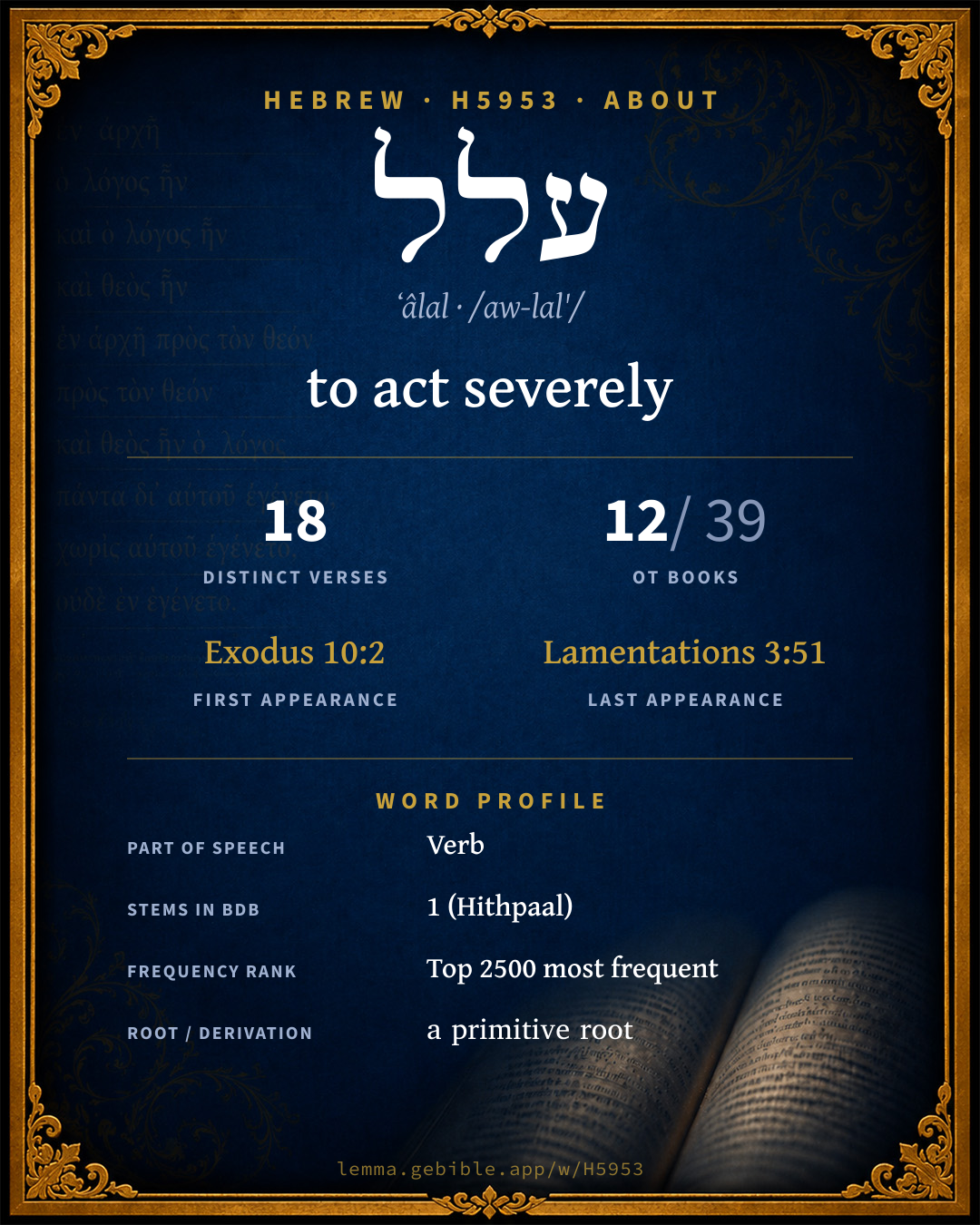
עָלַל
to act severely
‘to act severely’ is one of 4 main senses fuller range ↓
Full lexicon entry — Brown-Driver-Briggs (BDB)
From Brown-Driver-Briggs (BDB)
Where this word appears
See every Poel verb in the Hebrew Bible →
Grammar key — what these labels mean
Part of speech
- Verb
- An action or state-of-being word.
Stem
- Hithpael
- The reflexive or reciprocal stem (the subject acts on itself).
- Hithpolel
- The reflexive counterpart of the Polel.
Form
- Sequential Perfect
- A perfect with prefixed waw continuing a preceding imperfect or command (waw-consecutive perfect).
- Imperfect
- An incomplete, ongoing, or future action (“he will / would write”).
- Perfect
- A completed action or state — Hebrew marks aspect (completeness) more than strict tense (“he wrote”).
- Imperative
- A direct command (“write!”).
- Sequential Imperfect
- An imperfect with prefixed waw — the standard past-narrative form (waw-consecutive imperfect).
- Infinitive Construct
- A bound verbal noun, frequently with prepositions (“to write / in writing”).
- Infinitive Absolute
- An unbound verbal noun, often intensifying or standing in for a finite verb.
- Participle Active
- A verbal adjective expressing ongoing or characteristic action (“writing / one who writes”).
State
- Absolute
- The independent form of a noun, not bound to a following word.
Person
- 3rd Person
- The one spoken about (“he / she / it / they”).
- 2nd Person
- The one addressed (“you”).
- 1st Person
- The speaker (“I / we”).
Gender
- Common
- Either gender — not distinguished for this form.
- Masculine
- Grammatically masculine.
- Feminine
- Grammatically feminine.
Number
- Plural
- More than one (in Hebrew, generally three or more).
- Singular
- One.
Grammatical forms 17 distinct
- Verb, Hithpael, Sequential Perfect, 3rd Person, Common, Plural 2 times (10%)
- Verb, Poel, Imperfect, 2nd Person, Masculine, Singular 2 times (10%)
- Verb, Poel, Perfect, 2nd Person, Masculine, Singular 2 times (10%)
- Verb, Poel, Perfect, 1st Person, Common, Singular 1 time (5%)
- Verb, Poel, Imperative, 2nd Person, Masculine, Singular 1 time (5%)
- Verb, Poel, Sequential Imperfect, 3rd Person, Masculine, Plural 1 time (5%)
- Verb, Hithpael, Perfect, 3rd Person, Common, Plural 1 time (5%)
- Verb, Hithpael, Sequential Imperfect, 3rd Person, Masculine, Plural 1 time (5%)
+9 more forms (9 occurrences)
Parsed forms decoded from the imported morphology (morphhb / Westminster Leningrad Codex — WLC text public domain, morphhb tagging CC BY 4.0), counted across 20 parsed occurrences — not distinct verses.
Every verse where H5953 appears — 18 distinct verses across 12 books. Click any verse to open its interlinear word-by-word view. Verse text shown in the World English Bible for context — . Each verse’s Hebrew form is shown with its reference; the English is not keyword-highlighted, since the data carries no word-level English alignment. Use “Compare translations” on any verse to read it across multiple English versions. This concordance covers the Hebrew Bible; Septuagint (Greek Old Testament) occurrences are not indexed here.
Exodus 1 verse
Leviticus 1 verse
Numbers 1 verse
Deuteronomy 1 verse
Judges 2 verses
- Judges 19:25 וַ/יִּֽתְעַלְּלוּ conj + Hithpael wimpf 3mp But the men wouldn't listen to him: so the man laid hold on his concubine, and brought her forth to them; and they knew her, and abused her all the night until the morning: and when the day began to spring, they let her go.
- Judges 20:45 וַ/יְעֹֽלְלֻ֨/הוּ֙ conj + Poel wimpf 3mp + sfx pers 3ms They turned and fled toward the wilderness to the rock of Rimmon: and they gleaned of them in the highways five thousand men, and followed hard after them to Gidom, and struck of them two thousand men.
1 Samuel 2 verses
- 1 Samuel 6:6 הִתְעַלֵּ֣ל Hithpael pf 3ms Why then do you harden your hearts, as the Egyptians and Pharaoh hardened their hearts? When he had worked wonderfully among them, didn't they let the people go, and they departed?
- 1 Samuel 31:4 וְ/הִתְעַלְּלוּ conj + Hithpael pf 3cp Then said Saul to his armor bearer, Draw your sword, and thrust me through therewith, lest these uncircumcised come and thrust me through, and abuse me. But his armor bearer would not; for he was sore afraid. Therefore Saul took his sword, and fell on it.
1 Chronicles 1 verse
Job 1 verse
Psalms 1 verse
Isaiah 1 verse
Jeremiah 2 verses
- Jeremiah 6:9 עוֹלֵ֛ל יְעוֹלְל֥וּ Poel inf.abs Poel impf 3mp Thus says Yahweh of Hosts, They shall thoroughly glean the remnant of Israel as a vine: turn again your hand as a grape-gatherer into the baskets.
- Jeremiah 38:19 וְ/הִתְעַלְּלוּ conj + Hithpael wpf 3cp Zedekiah the king said to Jeremiah, I am afraid of the Jews who are fallen away to the Chaldeans, lest they deliver me into their hand, and they mock me.
Lamentations 4 verses
- Lamentations 1:12 עוֹלַ֖ל Poal pf 3ms Is it nothing to you, all you who pass by? Look, and see if there be any sorrow like my sorrow, which is brought on me, With which Yahweh has afflicted [me] in the day of his fierce anger.
- Lamentations 1:22 וְ/עוֹלֵ֣ל עוֹלַ֛לְתָּ conj + Poel impv 2ms Poel pf 2ms Let all their wickedness come before you; Do to them, as you have done to me for all my transgressions: For my sighs are many, and my heart is faint.
- Lamentations 2:20 עוֹלַ֣לְתָּ Poel pf 2ms Look, Yahweh, and see to whom you have done thus! Shall the women eat their fruit, the children that are dandled in the hands? Shall the priest and the prophet be killed in the sanctuary of the Lord?
- Lamentations 3:51 עֽוֹלְלָ֣ה Poel pf 3fs My eye affects my soul, because of all the daughters of my city.
About this entry
At a glance — auto-summarized from this page’s data, not written by a person. Every figure links to its source below. This summary describes the numbers; it doesn’t interpret them.
At its core, עלל (ʻâlal) means “to act severely.” Carrying more than one sense, it rewards its full sense range. Spanning 18 verses in 12 books, it ranks among the uncommon words of the Hebrew Bible. Scripture first uses it in Exodus 10:2. From the same root come מעלל, על and עליל. Dig into 18-verse concordance and the renderings breakdown below.
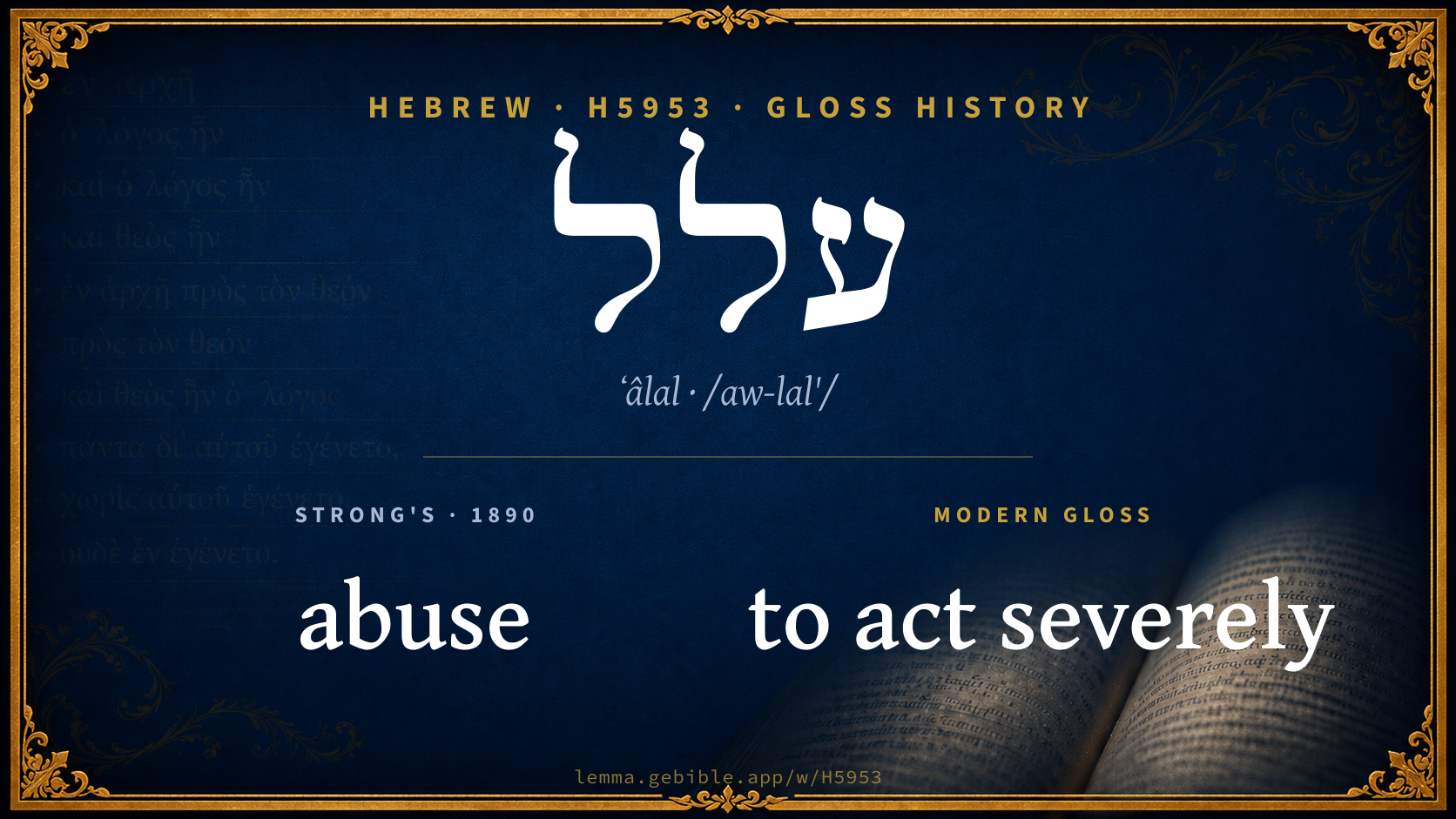
Gloss history
Strong's 1890 vs modern scholarship
About this word
Strong's H5953 catalogs a Hebrew word from the Hebrew Old Testament.
These counts are not copied from any lexicon or concordance. They are computed here, from the morphology-tagged Hebrew Old Testament. What Lemma adds →
- 18
- distinct verses
- The word appears in 18 distinct verses.
- 12 / 39
- OT books
- The word appears in 12 of 39 Old Testament books.
- #1,513
- by frequency
- Top 2500 most frequent Hebrew words (rank 1,513 of 8,640 Hebrew words by occurrence).
View all 18 occurrences in the concordance →
Most concentrated in
- Lamentations 4 verses 22%
- Judges 2 verses 11%
- 1 Samuel 2 verses 11%
By section of the Old Testament
By traditional corpus
Conventional, traditional groupings — biblical authorship is debated, so this is a traditional corpus grouping, not an authorship claim. Each share is this word’s portion of its verses in that division of the Hebrew canon. Each figure is a share of the word’s 18 distinct verses.
- Prophets (Nevi'im) 7 verses · 39%
- Writings (Ketuvim) 7 verses · 39%
- Torah (Pentateuch) 4 verses · 22%
How translations render this word
Counts come from each version’s own published word-to-Strong’s tagging or interlinear alignment — an approximate guide to how each version renders this word, not a word-level alignment the data otherwise carries. Because each total is that version’s own tagged count, the per-version totals vary from one another and need not match the appearance or distinct-verse counts above. These counts may also differ from a printed concordance because Lemma counts each distinctly tagged rendering and does not collapse phrase taggings into a single head-word total. This is a fixed set of word-tagged versions (KJV, ASV, BSB, ULT) and does not change with the reading translation you choose elsewhere. Each version’s license is shown beside its name below (and on Sources).
BDB lists this Strong’s number as 4 distinct words (homographs). Each count above pools all of them and is not split by sense — see the Senses section below. A low-frequency rendering may belong to a different one of those words, not the primary meaning.
- King James Version†: Abuse 2×, Thou hast done 2×, Thou shalt not glean 2×
- American Standard Version†: Abuse 2×, Thou shalt not glean 2×
- Berean Standard Bible†: Torture 2×
- unfoldingWord Literal Text†: Abuse 2×, You shall 2×
King James Version Public Domain
Renders H5953 across 20† tagged occurrences — most commonly:
Plus 14 renderings that appear only once — usually multi-word phrases or single function words the recovered tagging swept in, not distinct renderings.
American Standard Version Public Domain
Renders H5953 across 20† tagged occurrences — most commonly:
Plus 16 renderings that appear only once — usually multi-word phrases or single function words the recovered tagging swept in, not distinct renderings.
Berean Standard Bible Public Domain
Renders H5953 across 19† tagged occurrences — most commonly:
Plus 17 renderings that appear only once — usually multi-word phrases or single function words the recovered tagging swept in, not distinct renderings. Not rendered by a distinct English word in 1 further occurrence.
unfoldingWord Literal Text CC BY-SA 4.0
Renders H5953 across 21† tagged occurrences — most commonly:
Plus 17 renderings that appear only once — usually multi-word phrases or single function words the recovered tagging swept in, not distinct renderings.
Senses in the full BDB
What do BDB’s symbols mean?
BDB uses these scholarly abbreviations:
| Symbol | Meaning |
|---|---|
| 𝔊 | the Septuagint (the ancient Greek translation, LXX) |
| 𝔙 | the Vulgate (the Latin translation) |
| 𝔖 | the Syriac version (the Peshitta) |
| 𝔗 | the Targum (the Aramaic translation) |
| ψ | the Psalms |
| √ | root (the underlying root or stem) |
| ‖ | parallel passage (a synonymous or contrasted parallel) |
| † | the dagger: every passage where the word occurs is cited |
The 1 sense the full Brown-Driver-Briggs lexicon distinguishes for this word, in lexicon order (not ranked by frequency), with BDB’s own verbatim wording and sub-sense lettering. Shown in Hebrew script with BDB’s own scholarly abbreviations. The condensed entry is in the Lexicon Entry tab. See also the Forms in the corpus table below.
עלל I Poʿēl, act arbitrarily (toward) (NH id., deal with (rare), and deriv.
Hithpaal
- Pf. 1. busy, divert oneself with (cf. Arabic v.), always c. ב pers.: 1 s. אֶת־אֲשֶׁר הִתְעַלַּלְתִּי בְּ׳ Ex 10:2 (J) how I [י׳] have made a toy of Egypt; especially deal wantonly, ruthlessly with (ב pers.): 3 ms. הִתְעַלֵּל 1 S 6:6; 2 fs. הִתְעַלַּלְתְּ Nu 22:29 (JE; Balaam’s ass); 3 pl. וְהִתְעַלְּלוּ consec. 1 S 31:4 = 1 Ch 10:4; Je 38:19; Impf. 3 mpl. וַיִּתְעַלְּלוּ־בָהּ Ju 19:25 (of abusing a woman; ‖ וַיֵּדְעוּ אֹתָהּ). Hithpōʿ. Inf. cstr. לְהִתְעוֹלֵל עֲלִלוֹת ψ 141:4 to practise practice in wickedness (perhaps denom.). e.g. Exodus 10:2
עלל II denom. Pōʿ. glean (grapes or olives
עלל III denom. act or play the child
עלל IV insert, thrust in (Arabic غَلَّ whence غُلٌّ yoke
Senses from the full Brown-Driver-Briggs lexicon (Brown, Driver, Briggs; Oxford 1906 — public domain), digitized via Sefaria, supplemented by the OpenScriptures HebrewLexicon (CC BY 4.0). Full attribution on Sources.
Word origin
I. vb. Poʿēl, act arbitrarily (toward) (NH id., deal with (rare), and deriv.; Arabic عَلَّ do a thing (drink, beat, give) a second time, ii. divert, occupy, v. divert, occupy oneself with (food, a woman, etc.); Syriac ܥܶܠܬܳܐ cause, occasion, affair);—act severely, always c. ל pers.: Pf. 2 ms. עוֹלַלְתָּ לִי La 1:22 as thou hast acted severely to me (in punishment, subj. י׳); לְמִי ע׳ 2:20 to whom hast thou acted thus severely? 3 fs. עֵינִי עוֹלְלָה לְנַפְשִׁי 3:51 my eye deals severely with me, i.e. gives me pain (?; text dub.; cf. PerlesAnal. 18 Bu). Imv. ms. עוֹלֵל לָמוֹ La 1:22 deal severely with them.—Vid. also ע׳ denom. infr. Pōʿal Pf. 3 ms. מַכְאֹבִי אֲשֶׁר עוֹלַל לִי La 1:12 my pain which is severely dealt out to me.
II. vb. denom. Pōʿ. glean (grapes or olives; לִקֵּט of grain);—Impf. 2 ms. תְּעוֹלֵל Lv 19:10 (obj. כֶּרֶם; ‖ תְּלַקֵּט), Dt 24:21 (abs., + אַחֲרֶיךָ); 3 mpl. fig. (+ Inf. abs.) עוֹלֵל יְעוֹלְלוּ כַגֶּפֶן שְׁאֵרִית יִשְׂרָאֵל Je 6:9; וַיְעֹלְלֻהוּ Ju 20:45 they made a gleaning of them (i.e. smote the fugitives).
III. vb. denom. act or play the child;—only Pōʿ. Pt. עַמִּי נֹגְשָׂיו מְעוֹלֵל Is 3:12 my people—its ruler is acting the child.
IV. vb. insert, thrust in (Arabic غَلَّ whence غُلٌّ yoke; cf. Old Aramaic עלל, 𝔗 עֲלַל, Syriac ܥܰܠ, all enter);—only Pōʿ. Pf. 1 s. וְעֹלַלְתִּי בֶעָפָר קַרְנִי Jb 16:15 fig. of humiliation.
— Brown-Driver-Briggs (Oxford 1906, public domain), digitized via Sefaria, supplemented by the OpenScriptures HebrewLexicon (CC BY 4.0). See Sources.
Origin: a primitive root
Jastrow Dictionary
A second Hebrew/Aramaic lexicon for comparison, covering Aramaic and post-biblical (Talmudic, Targumic, Midrashic) usage that the biblical-Hebrew BDB does not. Matched by lemma rather than by Strong’s number, so a lemma may carry more than one Jastrow headword (shown separately below), and the entries cover usage well beyond the Bible.
עָלַל
- עוֹלֵל Pol. to bring about) to go about,
- 1. (cmp. סוּר I ch.) to superintend, be busy. Koh. R. to VI, 10 … מלך ומסרו לאריס לַעֲלוֹל בו a King that had a vineyard and gave it in charge of a tenant to attend to it (ed. Wil. לעֹמול).—Part. pass. עָלוּל; f. עֲלוּלָה; pl. עֲלוּלִים, עֲלוּלִין; עֲלוּלוֹת [brought about,] liable, likely (cmp. רָגִיל). Nidd. 7ᵇ ע׳ לקבל טומאה likely to catch uncleanness; Tosef. Makhsh. II, 11.
- 2. (with ל־; cmp. סוּר I) to ascend, land, enter. Koh. R. to VI, 5 למה לא עָלַלְתָּה למדינה why didst thou not visit the city?; ואת שירדת ועָלַלְתָּ and thou who didst go down (leave the ship) and visit; (Yalk. ib. 972 עאל, עלת, עיילת, v. עוּל, a. next w.). Ab. Zar. 71ᵃ עוֹל תחתי לעוצר go for me to the collector (settle with him).
- (b. h.), Nithpa. נִתְעַלֵּל [to busy one’s self,] to sport, abuse. Gitt. 58ᵃ; Yalk. Jer. 276; a. e.
עֲלַל I
- , esp. (corresp. to h. בּוֹא) to enter a town, a house &c.; to come in (interch. with עוּל). Targ. Prov. XI, 2; a. fr.—Y. Taan. I, 64ᵇ bot. מי ע׳ when he was going home. Ib.ᶜ top כד דאנא עָלֵיל וכ׳ when I was coming home from the hill. Ib. כד דאתית למֵיעוֹל when thou wert about to go home. Y. Sabb. VI, 8ᶜ bot. בר קפרא אִיעֲלַל … מי ע׳ וכ׳ B. K. was trying to enter a town; when he entered it &c. Y. Erub. V, beg. 22ᵇ תלת … עבר עָלֵיל קומי וכ׳ thirteen years he spent going in and out before his teacher without need (of his instruction). Koh. R. to I, 3 עָלְלִין ונפקין are brought in and taken out again; a. e.—2) (with שמשא) to set. Targ. O. Gen. XV, 12; a. fr.—3) to be busy, have to do with, (euphem.) to sport. Esth. R. to II, 16 אנא יהיב … ועליל עמה I would give one hundred denars to sport with her; Yalk. Gen. 67; (Gen. R. s. 40 ואִיעֲלַל Ithpa.).
- to go around searching; to glean. Targ. O. Lev. XIX, 10 (ed. Berl. תְעַלִיל; ed. Amst. תְעָליל); Deut. XXIV, 21 תְעַלֵּיל ed. Berl. (ed. Amst. a. Y. תְעָלֵיל). e.g. Deuteronomy 24:21
- (fr. עוּל), אָעוֹל, אֵ׳ to cause to go in; to carry in, bring in. Targ. Gen. VI, 19 (Y. ed. Vien. תֵעוֹל). Targ. Ps. LXVI, 11. Targ. O. Gen. XLVII, 24 אָעוֹלֵי ed. Berl. (oth. ed. אַעוּלֵי, verbal noun). Targ. Hag. I, 9; a. fr.
- to be carried in. Targ. Job X, 19 אֶתְּעָל. Ib. XXI, 32 יִתָּעֵל ed. Wil. (oth. ed. יִתְּעָל). Ib. 30 יִתָּעֲלוּן (some ed. יִתְעֲלוּן Ithpe.). Targ. O. Gen. XLIII, 18 (Y. מִתְעֲל׳, ed. Vien. מִתְעָ׳); a. fr.
- 1. same, v. supra.—2)
- to attempt entrance. Y. Sabb. l. c., v. supra.—3) to busy one’s self, to sport. Gen. R. l. c., v. supra.
עֲלַל II
- (preced.) [that which is brought in; cmp. תְּבוּאָה,] harvest, provision; income. Targ. Job XL, 20 (h. text בול). Targ. Is. XXX, 23. Targ. Lev. XXV, 21; a. fr.—Ḥag. 5ᵃ, v. זוּזָא I. Ned. 55ᵃ פקיד … מן ע׳ דנהר פניא left in his will that they should give Raba thirteen thousand Zuz out of the ʿălalta (income) of N’har Pania; היכי מיקריא ע׳ what is understood by ʿălalta? Ib. תבואה … ע׳ כל מילי משמע by t’buah (= תבואת שדה) we understand only the five kinds of grain, by ʿălalta, anything (income). Ib. שכר בתים … כיון דפחתן לאו ע׳ היא וכ׳ how about the rent from houses or ships? Shall we say, because their value is diminishing by wear and tear, it cannot be called ʿălalta (income), or is it to be called ʿălalta, because the diminution is not noticeable?; a. e.—Pl. עֲלָלָן, עֲלָלָתָא. Targ. Y. II, Deut. XIV, 22. Targ. O. Gen. XLVII, 24 עָלְלָתָא ed. Lsb. (ed. Berl. עָלַלְתָּא; oth. ed. עֲלַלְתָּא, sing.); a. e.
A Dictionary of the Targumim, the Talmud Babli and Yerushalmi, and the Midrashic Literature (Marcus Jastrow; London, Luzac, 1903) — Public Domain. Digitized via Sefaria. Digitized via Sefaria. Full attribution on Sources.
Forms in the corpus
The 18 distinct written forms H5953 takes in the Hebrew Bible, most frequent first — each parse links to that stem’s occurrences in the concordance. Hebrew forms include their vowel points and cantillation, so a single lemma takes many written forms.
Same root — word family
Other BDB entries built from the same root as H5953, grouped by Strong’s listed origin. These share a root / origin per the lexicon — not necessarily a shared meaning. Each links to that word’s own entry.
Derived from this word
- מעלל maʻălâl H4611 deed
- על ʻôl H5923 yoke
- עליל ʻălîyl H5948 furnace
- עלילה ʻălîylâh H5949 wantonness
- עלל ʻălal H5954 to go in
- עללה ʻôlêlâh H5955 gleaning
- תעלול taʻălûwl H8586 vexation
Compare all same-root words → Showing 4 of 8 — not the complete family. They share a root, not necessarily a meaning.
Septuagint verse parallels
This word appears in 18 verses that also exist in the Greek Old Testament (Septuagint), out of the 18 Hebrew verses it occurs in. You can read those verses in Greek by switching the Old Testament edition to the Septuagint.
Read these verses in the Septuagint
- Exodus 10:2
- Leviticus 19:10
- Numbers 22:29
- Deuteronomy 24:21
- Judges 19:25
- 1 Samuel 6:6
- 1 Chronicles 10:4
- Job 16:15
- Psalms 141:4
- Isaiah 3:12
- Jeremiah 6:9
- Lamentations 1:12
This is a verse-level parallel only — the same verses exist in both the Hebrew and Greek Old Testaments. No word-level Hebrew↔Greek correspondence is claimed: the data carries no such alignment, so no Greek word is shown as this Hebrew word’s translation. Coverage is not total — the Septuagint omits the deuterocanon and renumbers the Psalms, so some Hebrew verses have no direct Greek parallel.