
1 John 5:9

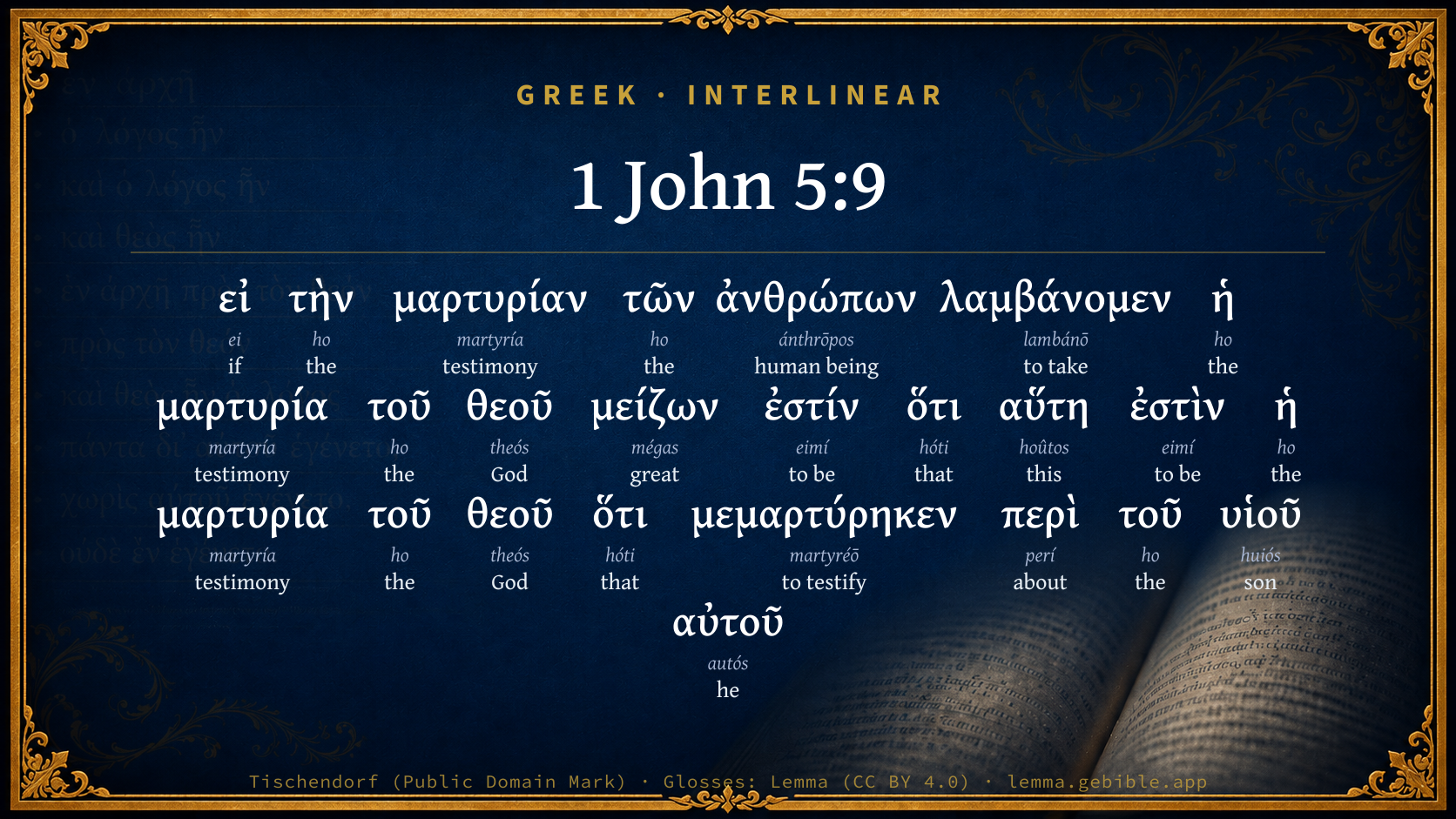
Greek (Tischendorf 8th ed.) 1 John 5:9 appears in the Greek New Testament. The text above is from the Tischendorf 8th edition. Each word links to its Strong’s number and a concise gloss. Click any word for its full Thayer’s Greek Lexicon entry.
Download image
Cite this verse

1 John 5:9 (World English Bible). Public Domain. Lemma interlinear Bible study tool, https://lemma.gebible.app/v/1-john/5/9.

Show BibTeX & RIS
BibTeX
RIS
English Translation
If we receive the witness of men, the witness of God is greater; for this is God's testimony which he has testified concerning his Son.
World English Bible · Public Domain
Download a study sheet

One document with this verse’s original text, its word-by-word gloss line, the meaning frame, cross-references with their text, attributed commentary, and full source and license credits — printable, and it pastes into notes with its structure intact.

This verse Autodidact and up

Study sheet (.html) Plain text (.txt)

A passage Seminary Student

Up to 50 verses in one chapter. A passage sheet keeps up to 6 commentary sources and 12 cross-references per verse, in the order this page ranks them, and says so on the sheet whenever that leaves anything out. Ask for a single verse and you get the Autodidact verse sheet above.

Everything on this page stays free to read, with no account — the sheet is a download of what is already on screen, not access to it.

Want to remove ads? Support Godless Engineer
Compare translations 3

The same verse in 3 English versions, stacked beneath the original-language interlinear above. Click any original word for its lexicon entry.

Each is an independent rendering of the whole verse — the interlinear is not word-aligned to these translations.

Highlighted words mark where these versions differ — a whole-verse word diff, not a word-by-word alignment.

  • World English Bible Public Domain
    If we receive the witness of men, the witness of God is greater; for this is God's testimony which he has testified concerning his Son.
  • King James Version Public Domain
    If we receive the witness of men, the witness of God is greater: for this is the witness of God which he hath testified of his Son.
  • unfoldingWord Literal Text CC BY-SA 4.0
    If we receive the testimony of men, the testimony of God is greater. For this is the testimony of God, that he has testified about his Son.

unfoldingWord Literal Text — © unfoldingWord, licensed CC BY-SA 4.0. Word-aligned USFM3 via Door43 (git.door43.org/unfoldingWord/en_ult).

Versions to compare (up to 4)

3 of 4 selected

Show all 19 translations

Every available English version of this verse, each an independent rendering of the whole verse.

  • World English Bible Public Domain
    If we receive the witness of men, the witness of God is greater; for this is God's testimony which he has testified concerning his Son.
  • Berean Standard Bible Public Domain
    Even if we accept human testimony, the testimony of God is greater. For this is the testimony that God has given about His Son.
  • Majority Standard Bible Public Domain
    Even if we accept human testimony, the testimony of God is greater. For this is the testimony that God has given about His Son.
  • King James Version Public Domain
    If we receive the witness of men, the witness of God is greater: for this is the witness of God which he hath testified of his Son.
  • American Standard Version (1901) Public Domain
    If we receive the witness of men, the witness of God is greater: for the witness of God is this, that he hath borne witness concerning his Son.
  • Revised Version (1885) Public Domain
    If we receive the witness of men, the witness of God is greater: for the witness of God is this, that he hath borne witness concerning his Son.
  • Geneva Bible (1599) Public Domain
    If we receiue the witnesse of men, the witnesse of God is greater: for this is the witnesse of God, which he testified of his Sonne.
  • Douay-Rheims (1899) Public Domain
    If we receive the testimony of men, the testimony of God is greater. For this is the testimony of God, which is greater, because he hath testified of his Son.
  • Young's Literal Translation Public Domain
    If the testimony of men we receive, the testimony of God is greater, because this is the testimony of God that He hath testified concerning His Son.
  • Literal Standard Version CC BY-SA 4.0
    If we receive the testimony of men, the testimony of God is greater, because this is the testimony of God that He has testified concerning His Son.
  • Unlocked Literal Bible CC BY-SA 4.0
    If we receive the witness of men, the witness of God is greater. For the testimony of God is this, that he has borne witness concerning his Son.
  • unfoldingWord Literal Text CC BY-SA 4.0
    If we receive the testimony of men, the testimony of God is greater. For this is the testimony of God, that he has testified about his Son.
  • Darby Bible Public Domain
    If we receive the witness of men, the witness of God is greater. For this is the witness of God [which] he has witnessed concerning his Son.
  • World Messianic Bible Public Domain
    If we receive the witness of men, the witness of God is greater; for this is God’s testimony which he has testified concerning his Son.
  • Webster's Bible Public Domain
    If we receive the testimony of men, the testimony of God is greater: for this is the testimony of God which he hath testified of his Son.
  • Free Bible Version CC BY-SA 4.0
    If we accept the evidence that human witnesses provide, then the evidence that God provides is much more important. The evidence that God provides is his testimony about his Son.
  • Bible in Basic English Public Domain
    If we take the witness of men to be true, the witness of God is greater: because this is the witness which God has given about his Son.
  • Text-Critical English NT CC BY 4.0
    If we receive the testimony of men, we should know that the testimony of God is greater, because it is the testimony that God has given about his Son.
  • Tyndale New Testament (1534) Public Domain
    Yf we receave the witnes of men the witnes of god is greater. For this is the witnes of god which he testifyed of his sonne.

Literal Standard Version (2020), Covenant Press — licensed CC BY-SA 4.0. Text via the HelloAO Bible API (eBible.org). Unlocked Literal Bible (unfoldingWord) — licensed CC BY-SA 4.0. Text via the HelloAO Bible API (eBible.org). unfoldingWord Literal Text — © unfoldingWord, licensed CC BY-SA 4.0. Word-aligned USFM3 via Door43 (git.door43.org/unfoldingWord/en_ult). Free Bible Version, Dr. Jonathan Gallagher — licensed CC BY-SA 4.0. Text via the HelloAO Bible API (eBible.org).

Word by word

More ways to search: Search by grammar → Find every occurrence → Compare this word →

Practice this passage: Drill this verse → Learn its vocabulary →

μαρτυρίαν
martyría
G3141
“testimony”
Noun, Accusative, Singular, Feminine
Part of Speech
Noun
Case
Accusative
Number
Singular
Gender
Feminine
Full Thayer's Definition

Origin: from G3144

TDNT: 11:54,6

1. a testifying a. the office committed to the prophets of testifying concerning future events 2. what one testifies, testimony, i.e. before a judge
  1. εἰ ei G1487 “if” Conditional
  2. τὴν ho G3588 “the” Article, Accusative, Singular, Feminine
  3. τῶν ho G3588 “the” Article, Genitive, Plural, Masculine
  4. ἀνθρώπων ánthrōpos G444 “human being” Noun, Genitive, Plural, Masculine
  5. λαμβάνομεν lambánō G2983 “to take” Verb, Present, Active, Indicative, 1st person, Plural
  6. ἡ ho G3588 “the” Article, Nominative, Singular, Feminine
  7. μαρτυρία martyría G3141 “testimony” Noun, Nominative, Singular, Feminine
  8. τοῦ ho G3588 “the” Article, Genitive, Singular, Masculine
  9. θεοῦ theós G2316 “God” Noun, Genitive, Singular, Masculine
  10. μείζων mégas G3173 “great” Adjective, Nominative, Singular, Feminine, Comparative
  11. ἐστίν eimí G1510 “to be” Verb, Present, Active, Indicative, 3rd person, Singular
  12. ὅτι hóti G3754 “that” Conjunction
  13. αὕτη hoûtos G3778 “this” Demonstrative pronoun, Nominative, Singular, Feminine
  14. ἐστὶν eimí G1510 “to be” Verb, Present, Active, Indicative, 3rd person, Singular
  15. ἡ ho G3588 “the” Article, Nominative, Singular, Feminine
  16. μαρτυρία martyría G3141 “testimony” Noun, Nominative, Singular, Feminine
  17. τοῦ ho G3588 “the” Article, Genitive, Singular, Masculine
  18. θεοῦ theós G2316 “God” Noun, Genitive, Singular, Masculine
  19. ὅτι hóti G3754 “that” Conjunction
  20. μεμαρτύρηκεν martyréō G3140 “to testify” Verb, Perfect, Active, Indicative, 3rd person, Singular
  21. περὶ perí G4012 “about” Preposition
  22. τοῦ ho G3588 “the” Article, Genitive, Singular, Masculine
  23. υἱοῦ huiós G5207 “son” Noun, Genitive, Singular, Masculine
  24. αὐτοῦ autós G846 “he” Personal pronoun, Genitive, Singular, Masculine

About this verse

These counts appear in no published source. They are computed here, from the morphology-tagged text and Lemma’s own curated glosses. What Lemma adds →

25
words
14
distinct lemmas
General Epistles
section

Shared distinctive vocabulary

μαρτυρίαν testimony G3141 occurs in 33 verses of the Greek New Testament. Also found in:
Repetition

Words recur within this verse:

  • μαρτυρίαν testimony G3141 ×3
  • θεοῦ God G2316 ×2
  • ἐστίν to be G1510 ×2
  • τὴν the G3588 ×7
  • ὅτι that G3754 ×2

Cross-references

12

Topical passages linked to 1 John 5:9 in the Treasury of Scripture Knowledge — connected by theme and wording, ordered by reader-vote popularity; previews shown in the World English Bible.

  • Matthew 3:16–17 Jesus, when he was baptized, went up directly from the water: and behold, the heavens were opened to him. He saw the Spirit of God descending as a dove, and coming on him.
  • Matthew 17:5 While he was still speaking, behold, a bright cloud overshadowed them. Behold, a voice came out of the cloud, saying, "This is my beloved Son, in whom I am well pleased. Listen to him."
  • John 8:17–19 It's also written in your law that the testimony of two people is valid.
  • Acts 17:31 because he has appointed a day in which he will judge the world in righteousness by the man whom he has ordained; of which he has given assurance to all men, in that he has raised him from the dead."
  • Acts 5:32 We are His witnesses of these things; and so also is the Holy Spirit, whom God has given to those who obey him."
  • 1 John 5:10 He who believes in the Son of God has the testimony in himself. He who doesn't believe God has made him a liar, because he has not believed in the testimony that God has given concerning his Son.
  • Hebrews 2:4 God also bearing witness with them, both by signs and wonders, and by various works of power, and by gifts of the Holy Spirit, according to his own will?
  • John 3:32–33 What he has seen and heard, of that he testifies; and no one receives his witness.
  • John 5:39 "You search the Scriptures, because you think that in them you have eternal life; and these are they which testify about me.
  • John 10:38 But if I do them, though you don't believe me, believe the works; that you may know and believe that the Father is in me, and I in the Father."
  • John 5:31–37 "If I testify about myself, my witness is not valid.
  • Hebrews 6:18 that by two immutable things, in which it is impossible for God to lie, we may have a strong encouragement, who have fled for refuge to take hold of the hope set before us.

Cross-references courtesy of OpenBible.info (CC BY 4.0).

Commentary

Notes on 1 John 5:9 from classic Christian and Jewish commentators (each source and its license shown beneath its notes). The classic Christian expositions comment on the surrounding passage and are grouped to its opening verse, so a note may address several verses; the Jewish commentaries on the Tanakh (Rashi and others) are per-verse, so they appear only where the commentator wrote on this verse.

Lemma curates 59 commentaries, every one of them public domain or Creative Commons licensed, each selected and text-cleaned for this edition rather than reprinted as found. About our sources →

The Cambridge Bible for Schools and Colleges

gen. ed. J. J. S. Perowne

9. If we receive the witness of men] And it is notorious that we do so: comp. ‘if God so loved us’ (1Jn_4:11), and see on 2Jn_1:10. The argument reads like an echo of that of Christ to the Pharisees, ‘In your law it is written that the witness of two men is true’ (Joh_8:17); how much more therefore the witness of the Father and the Son? For ‘receive’ in the sense of ‘accept as valid’ comp. Joh_3:11; Joh_3:32-33.

for] Or, because. Something is evidently to be understood; e.g. ‘I say, the witness of God, because …’, or ‘I use this argument, because …’.

this is the witness of God] Better, as R.V., the witness of God is this: ‘this’ is the predicate and refers to what follows (see on 1Jn_1:5). His witness consists in His having borne witness about His Son.

which he hath testified] According to the better reading and rendering, that He hath borne witness. ‘I appeal to the witness of God, because the witness of God is this, even the fact that He hath borne witness concerning His Son’. The perfect tense indicates the permanence of the testimony. Comp. ‘He that hath seen hath borne witness’ (Joh_19:35).

9–11. S. John’s characteristic repetition of the word ‘witness’ is greatly weakened in A. V. by the substitution of ‘testify’ in 1Jn_5:9 and ‘record’ in 1Jn_5:10-11 : see on 1Jn_1:2, 1Jn_2:15; 1Jn_2:24, 1Jn_4:5.

The Cambridge Bible for Schools and Colleges (gen. ed. J. J. S. Perowne; Cambridge University Press, 1878–1918) — public domain. Text from a community e-Sword module.

The Biblical Illustrator

Joseph S. Exell

1Jn_5:9-10

This is the witness of God, which He hath testified of His Son

Faith, and the witness upon which it is founded

Faith stands, under the covenant of grace, in a leading position amongst the works of the regenerate man and the gifts of the Spirit of God.

The promise no longer stands to the man who doeth these things that he shall live in them, else we were shut out of it, but the just shall live by faith. God now biddeth us live by believing in Him.

I. First, then, since our great business is that we believe God, let us see what reason we have for believing Him.

I. The external evidence given is stated in the first verse of the text, as the evidence of God to us, and it is prefaced by the remark that we receive the witness of men. We do and must believe the testimony of men as a general rule; and it is only right that we should account witnesses honest till they have proved themselves false. Now, God has been pleased to give us a measure of the witness of men with regard to His Son, Jesus Christ. We have the witness of such men as the four evangelists and the twelve apostles. We have the witness of men as to the facts that Jesus Christ, the Son of God, lived and died, and rose again, and ascended into heaven. Further, we have the testimony of men as to the present power of that same Jesus to forgive men their trespasses, and to save them from the power of sin. From the first day when our Lord was taken up till now men and women have come forward, and have said, We were once lovers of sin; whatever our neighbours are, such were we, but we are washed, but we are sanctified; and all this by faith in Jesus. Some years ago there went into a Methodist class meeting a lawyer who was a doubter, but at the same time a man of candid spirit. Sitting down on one of the benches, he listened to a certain number of poor people, his neighbours, whom he knew to be honest people. He heard some thirteen or fourteen of these persons speak about the power of Divine grace in their souls, and about their conversion, and so on. He jotted down the particulars, and went home, and sat down, and said to himself, Now, these people all bear witness, I will weigh their evidence. It struck him that if he could get those twelve or thirteen people into the witness box, to testify on his side in any question before a court, he could carry anything. They were persons of different degrees of intellect and education, but they were all of the sort of persons whom he would like to have for witnesses, persons who could bear cross examination, and by their very tone and manner would win the confidence of the jury. Very well, he said to himself, I am as much bound to believe these people about their religious experience as about anything else. He did so, and that led to his believing on the Lord Jesus Christ with all his heart. Thus, you see, the testimony of God to us does in a measure come through men, and we are bound to receive it. But now comes the text: If we receive the witness of men, the witness of God is greater. God is to be believed if all men contradict Him. Let God be true, and every man a liar. Now, what is the witness of God with regard to Christ? How does He prove to us that Jesus Christ did really come into the world to save us? Gods witnesses are three: the Spirit, the water, and the blood. God says, My Son did come into the world: He is My gift to sinful men; He has redeemed you, and He is able to save to the uttermost them that come unto Me by Him: and in proof that He is so the Holy Spirit has been given. Then the water, that is to say, the purifying power of the gospel, is also Gods witness to the truth of the gospel. If it does not change mens characters when they receive it, it is not true. But as God everywhere, among the most savage tribes, or amongst the most refined of mankind, makes the gospel to be sacred bath of cleansing to the hearts and lives of men, He gives another witness that His Son is really Divine, and that His gospel is true. The blood also witnesses. Does believing in Jesus Christ do what the blood was said to do, namely, give peace with God through the pardon of sin? Hundreds and thousands all over the world affirm that they had no peace of conscience till they looked into the streaming veins of Jesus, and then they saw how God can be just and yet forgive sin.

II. I come now to the internal evidence, or the witness in us. He that believeth on the Son of God hath the witness in himself. When a man is led by the Spirit of God to believe that God cannot lie, he inquires what it is that God says; and he hears that atonement has been made, and that whosoever believeth in Jesus shall have eternal life. He sees the witness to be good, and he believes it. That man is saved. What happens next? Why, this man becomes a new creature. He is radically changed. Now, says he to himself, I am sure of the truth of the gospel, for this wonderful change in me, in my heart, my speech, and my life, must be of Divine origin. I was told that if I believed I should be saved from my former self, and I era. Now, I know, not only by the external witness, nor even because of the witness of God, but I have an inner consciousness of a most marvellous birth, and this is a witness in myself. The man then goes on to enjoy great peace. Looking alone to Jesus Christ for pardon, he finds his sins taken from him, and his heart is unburdened of a load of fear, and this rest of heart becomes to him another inward witness. As the Christian thus goes on from strength to strength he meets with answers to prayer. He goes to God in trouble. In great perplexity he hastens to the Lord, light comes, and he sees his way. He wants many favours, he asks for them, and they are bestowed. He that believeth hath the witness in himself; and there is no witness like it. Except the witness of God, which stands first, and which we are to receive, or perish, there is nothing equal to the witness within yourself. Many a poor man and woman could illuminate their Bibles after the fashion of the tried saint who placed a T. and P. in the margin. She was asked what it meant, and she replied, That means Tried and proved, sir. Yes, we have tried and proved the Word of God, and are sure of its truth.

III. How are we treating the witness of God? For it is written in our text, He that believeth not God hath made Him a liar; because he believeth not the witness that God witnessed of His Son. Now, are we believing the witness of God? Do you unconverted people believe that the wrath of God abideth on you? Then you must be insane if you do not seek to escape from that wrath. If you believe that Jesus Christ saves from sin, and gives to the soul a treasure far beyond all price, you will make all speed to obtain the precious boon. Is it not so? He who believes in the value of a gift will hasten to accept it, unless he be out of his mind. Methinks I hear one say, I would believe if I felt something in my heart. You will never feel that something. You are required to believe on the witness of God, and will you dare to say that His evidence is not sufficient? If you will believe on the Divine testimony you shall have the witness within by and by, but you cannot have that first. The demand of the gospel is, Believe on the Lord Jesus Christ, and believe upon Gods testimony. What testimony do you want more? God has given it you in many forms. By His inspired book; by the various works of His Spirit, and by the water and the blood in the Church all around you. Above all, Jesus Himself is the best of witnesses. Believe Him. (C. H. Spurgeon.)

He that believeth on the Son of God hath the witness in himself--

The inward witness of faith

Testimony and experience constitute two separate and independent grounds of faith. That we may have full confidence in the skill of a physician, it is not necessary that we should have seen him, or have personally witnessed any of the cures ejected by him. Our faith may rest simply on the testimony of competent witnesses. But there is also a faith that grounds itself on our own personal experience. The physician whom we first employed, because he was recommended to us by others, may now receive our confidence from what we have ourselves seen and felt of his skill. Our faith in him began with testimony, but now it has become independent of it. The general order of Gods moral government is, first belief, afterwards experience. We must begin by using testimony, not by rejecting it; by cherishing not a proud and sceptical, but a childlike and confiding spirit. The gospel of Christ comes to us in the form of Divine testimony. We may have witnessed its effects upon others. We may have heard them telling with joyful accents what it has done for their souls. But this, too, is testimony; very weighty and valuable when accompanied by such a life as convinces us of its sincerity, but still only human testimony, with its usual alloy of error and imperfection. It cannot convey to us an adequate apprehension of the blessedness and power of faith in Christ, any more than a description of light can be a substitute for seeing the sun shining in his strength. To understand fully how worthy the gospel is of our acceptance, we must feel its efficacy. But this we cannot till we have received it. Our reception of it, then, must rest on Gods testimony. After that, we shall have both the outward and the inward witness of its truth. It is reasonable, therefore, when God calls upon men to repent and believe the gospel, that He should furnish them with clear evidence that it is His gospel, and no invention of man. This He has done from the beginning. Our Saviour did not ask His hearers to receive Him as the Son of God, without first furnishing them with many infallible proofs of His Divine mission (Joh_5:31; Joh_10:37; Joh_5:36). This outward evidence which Jesus furnished of His Messiahship left all who rejected Him without excuse. But to those who received Him in faith and love there was a higher testimony (Mat_16:17). The man who has received the gospel in faith and love knows, from his own experience, that it satisfies all the wants of his spiritual nature, and must therefore be true; since it is inconceivable that the soul should be nurtured by error, and kept by it in a vigorous and healthful condition, as that the body should thrive on poison.

I. The gospel quiets the conscience, and that on reasonable grounds. The moment the soul apprehends the mighty truth that God has manifested Himself in the flesh; that in the person of our Lord Jesus Christ the true God has taken into union with Himself a true human nature, and in this nature has borne the curse of the law in our stead, it cries out with joy--This it what I need; a propitiation of infinite worth to meet the immeasurable guilt of my sin.

II. The gospel gives the victory over the inward power of sin. Of the greatness and difficulty of this work the careless and light minded have no conception. But let one who has gained some true knowledge of the Divine law as a spiritual rule for the regulation of the inner man set himself in earnest to the work of obeying it inwardly as well as outwardly, and he will soon make distressing discoveries of his moral impotence; an impotence which lies not in the absence or defect of any of those faculties which are necessary to qualify him to render to Gods law perfect obedience, but only in his free guilty preference of earthly above spiritual good. To emancipate him from this bondage to indwelling sin, and raise him to holiness and communion with God, he needs help from above. Here the gospel, in the fulness of its grace, comes to his relief. It offers him the all-sufficient help of the Holy Spirit to illumine his dark mind, cleanse his polluted soul from the defilement of sin, strengthen his weakness, and give him a victory over the world.

III. The gospel restores the soul to communion with God.

Lessons:

1. Only they who receive the gospel can fully apprehend the evidence Of its truth.

2. It is possible for a man to put himself in such an attitude that he cannot judge rightly of the evidence by which the gospel is supported.

3. Our assurance of the truth of Christianity is intimately connected with the growth of our piety. (E. P. Barrows, D. D.)

The inward witness

I. How come we to be believers? You know how faith arises in the heart from the human point of view. We hear the gospel, we accept it as the message of God, and we trust our selves to it. So far it is our own work; and be it remembered that in every case faith is and must be the act of man. But, having said that, let us remember that the Godward history of our believing is quite another thing, for true faith is always the gift of God and the work of the Holy Spirit. The Holy Spirit brings us to perform the act of faith by which we are saved; and the process is after this manner, though varying in different individuals:

1. We are brought attentively to listen to the old, old story of the Cross.

2. Further, the Holy Spirit is also pleased to make us conscious of our sinfulness, our danger, and our inability, and this is a great way towards faith in Christ.

3. Moreover, while attentively hearing, we perceive the suitability of the gospel to our case. We feel ourselves sinful, and rejoice that our great Substitute bore our sin, and suffered on its account, and we say, That substitution is fall of hope to me; salvation by an atonement is precisely what I desire; here can my conscience rest.

4. There is but one more step, and that is, we accept Jesus as set forth in the gospel, and place all our trust in Him.

5. When the soul accepts the Lord Jesus as Saviour, she believes in Him as God: for she saith, How can He have offered so glorious an atonement had He not been Divine? This is why we believe, then, and the process is a simple and logical one. The mysterious Spirit works us to faith, but the states of mind through which He brings us follow each other in a beautifully simple manner.

II. How know we that believers are saved? for that seems to be a grave question with some. God declares in His Word, even in that sure Word of testimony, whereunto ye do well to take heed as unto a light that shineth in a dark place, that every believer in Jesus Christ is saved. Again, we know on the authority of Scripture that believers are saved, because the privileges which are ascribed to them prove that they are in a saved condition. John goes to the very root of every matter, and in Joh_1:12 he tells us, As many as received Him, to them gave He power to become the sons of God, even to them that believe on His name. Once again, the whole tone of Scripture regards the believer as a saved man. Believers is a common synonym for saints, for sanctified persons; and truth to say the Epistles are written to believers, for they are written to the Churches, and Churches are but assemblages of believers.

III. How do we know that we are believers? It is clear that if we are believers we are saved, but how do we know that we are believers? First of all, as a general rule, it is a matter of consciousness. How do I know that I breathe? How do I know that I think? I know I do, and that is enough. Faith is to a large extent a matter of consciousness. I believe, and if you ask me how I know it I reply, I am sure I do. Still there is other evidence. How do I know that I am a believer? Why, by the very remarkable change which I underwent when I believed; for when a man believes in Jesus Christ there is such a change wrought in him that he must be aware of it. Things we never dreamed of before we have realised now. I remember one who when he was converted said, Well, either the world is new or else I am. This change is to us strong evidence that faith is in us, and has exercised its power. We have further evidence that we believe, for our affections are so altered. The believer can say that the things he once loved he now hates, and the things he hated he now loves; that which gave him pleasure now causes him pain, and things which were irksome and unpleasant have now become delightful to him. Especially is there a great change in us with respect to God. We know, also, that we believe because though very far from perfect we love holiness and strive after purity. And we know that we have believed in Jesus Christ because now we have communion with God; we are in the habit of speaking with God in prayer, and hearing the Lord speak with us when we read His Word. We know that we have believed in the Lord Jesus because we have over and above all this a secret something, indescribable to others, but well known by ourselves, which is called in Scripture the witness of the Holy Spirit: for it is written, The Spirit Himself also beareth witness with our spirit that we are born of God. There comes stealing over the soul sometimes a peace, a joy, a perfect rest, a heavenly deliciousness, a supreme content, in which, though no voice is heard, yet are we conscious that there is rushing through our souls, like a strain of heavens own music, the witness of the Spirit of God. In closing, let me ask, Do you believe in Jesus Christ or no? If thou believest thou art saved; if thou believest not thou art condemned already. Let me next ask, are any of you seeking after any witness beyond the witness of God? If you are, do you not know that virtually you are making God a liar? (C. H. Spurgeon.)

The internal witness

I. It includes a consciousness of the existence of faith in our own minds. What is faith? The substance of things hoped for, the evidence of things not seen. It draws aside the curtain which hides the eternal world from view. It gives reality, in our apprehensions, to the future condition of rational and immortal beings. It causes us to live under the influence of things unseen by the eye of sense and that are eternal. It is a grace, because it is the gift of God, produced in the soul by the operation of His Spirit. It is a saving grace, because wherever it is produced salvation is its concomitant result. Can it be said that these are exercises which elude our observation? Surely, if we can be conscious of any thing that passes within us, we may and ought to be conscious of the existence and operation of faith.

II. By the exercise of faith the experience of the believer is made to harmonise with the testimony of the divine word, so that the internal witness is confirmed and strengthened. Our Lord has said, If any man will do His will, he shall know of the doctrine whether it be of God. As we act upon it we find it to be true. This statement admits of a very extensive illustration. Every doctrine of the Divine Word may be included in it.

III. The effects and concomitants of faith are a constant and growing testimony to its reality. It is not too much to say that faith produces a complete revolution in the soul. Our views undergo an entire change. God, and self, and sin, and holiness, and salvation, and time, and eternity, are seen in a new light. Now, is a work such as this to be maintained in the soul without the consciousness of the subject of it? It must be most strange if it be so. Of all mysteries and miracles that is certainly one of the greatest. Surely if it be unobserved we should fear it does not exist. If the sun shines we behold his light. He that believeth in God hath the witness in himself. (J. Morgan, D. D.)

The witness in oneself

A Christian minister should often press upon his hearers the difference between historical and saving faith, and entreat them to take heed lest, to the ruin of the soul, they confound things which are so essentially distinct. The historical faith requires nothing but what are popularly called the evidences of Christianity; and a volume from Paley or Chalmers gathering to a point the scattered testimonies to the Divine origin of our religion, suffices, with every inquiring mind, to produce a conviction that the Bible is no cunningly devised fable. But saving faith, whilst it does not discard the evidences which serve as outworks to Christianity, possesses others which are peculiar to itself; and just as historical faith being seated in the head, the proofs on which it rests address themselves to the head, so saving faith being seated in the heart, in the heart dwell the evidences to which it makes its appeal. The character to which the apostle refers here is unquestionably that of a true believer in Christ, one who believes to the saving of the soul, and not merely with the assent of the understanding. The Messiahship of Jesus is a kind of centre whence emanate those various truths through belief in which we become raised from the ruins of the Fall; and no man can have faith in Jesus as the Christ, the Anointed of God, except so far as he has faith in the life-giving doctrines which He was anointed to proclaim. No correct estimate can be formed of sin unless we measure its enormity by the greatness of the satisfaction which was required for its pardon. And only so far as the heinousness of sin is discovered can the fearfulness be felt of our condition by nature; and therefore we may justly maintain that he alone understands rightly the fall of man who understands rightly the evil of transgression. But external testimony will never satisfy us of this evil; whereas he who believes on the Son of God hath the witness in himself to the immensity of sin, for he has in himself a vigorous perception of the mysterious and awful things of the atonement. Sin is beheld through the wounds of the Saviour; and, thus beheld, its lightest acting is discerned to be infinitely dishonouring to God and infinitely destructive to man. But it is in himself that the believer finds the witness. Faith brings Christ into his heart; and then the mysteries of Calvary are developed; and the man feels his own share in the crucifixion; feels, as we have already described, that his own sins alone were of guilt enough to make his salvation impossible with out that crucifixion. And if such internal feeling be the necessary accompaniment, or rather a constituent part, of saving faith in the Lord Jesus Christ, is it not undeniable that he who believeth on the Son of God hath the witness in himself to the heinousness of sin; in other words, hath the witness in himself to the ruin consequent on transgression? We hasten to the second and perhaps more obvious truth--namely, that he that believeth on the Son of God hath the witness in him self to the rescue perfected by redemption. We enter not now on any proof of this indissoluble connection between simple faith and active zeal. We refer to believing experience; we appeal to its records. Has it not always been found that the strongest faith is accompanied by the warmest love; and that in the very proportion in which the notion has been discarded of works availing to justification, have works been wrought as evidences and effects of justification? The believer feels and finds the truth of this in himself. His whole soul is drawn out towards God. (H. Melvill, B. D.)

Christian consciousness as a witness

We acquire knowledge by different witnesses. There is--

1. The witness of the senses.

2. The witness of testimony. All history is but a collection of human testimony regarding past events.

3. The witness of logic. There is a class of truths, a species of knowledge which we reach by conclusions drawn from known facts.

4. The witness of consciousness. Consciousness assures us of the reality of all our mental impulses and states. The text brings under our notice the witness of Christian consciousness. I offer three remarks concerning this witness.

I. It is the most important of all witnesses. Why is it the most important? Because it bears witness to the most momentous realities.

1. The truth of the gospel. Fully acknowledging the value of other evidences in favour of Christianity, such as that of history, prophecy, miracle, and success, none are to be compared in value to that of consciousness. The gospel commends itself to every mans conscience. This is the witness that gives to the majority of believers in Christianity their faith.

2. The souls interest in the gospel.

II. It is the most incontrovertible of all witnesses. The evidence of the senses, which often deceive; of human testimony, which is fallible; of logic, which often errs, is all controvertible. Doubts may be raised at all the statements of these witnesses. But what consciousness attests is at once placed beyond argument, beyond debate, beyond doubt. It never lies, it never mistakes. What consciousness attests, lives, despite the antagonism of all philosophy and logic. The verities attested by consciousness burn as imperishable stars in the mental hemisphere of the mind. One thing I know, that whereas I was blind, now I see.

III. It is the most available of all witnesses. In some cases, logic, through the natural feebleness of the understanding, and in other cases, through the lack of data, without which, however naturally strong, it cannot speak, is not always available even with its feeble testimony. But the witness of consciousness is always in the court. The availableness of the witness, it must be remembered, depends upon the possession of personal Christianity. If we have it not, consciousness cannot attest it. Have we this witness? It is no transient phenomenon. It is a Paraclete that comes to abide with him forever. (Homilist.)

Evidences of personal piety

I. Conversion. Here we must begin in all our inquiries after religion.

II. Humility.

III. Faith.

IV. Prayer. Without prayer a man cannot have the witness in himself that he is the subject of true piety.

V. Love. The man that would know whether he be a true Christian must search for evidences of supreme love to God and Christ, and love to the people of God for His sake.

VI. Hatred of sin.

VII. Holiness of life. Essential as the evidences of the heart are to prove a man a Christian, none of them can be considered as genuine unless they are corroborated by the outward conduct. (Essex Remembrancer.)

The believers witness in himself

I. The declaration--he that believeth on the Son of God, hath the witness in himself. The witness of what? I do not understand it to be the same as that which we meet with in the eighth of the Romans, The Spirit itself beareth witness with our spirit, that we are the children of God. I think the witness here is to the truth connected with the former verse--If we receive the witness of men, the witness of God is greater; for this is the witness of God, which He hath testified of His Son. The declaration of the text, then, amounts to this: that he that truly believes on the Son of God hath internal proof that Gods Word is true. If we take it in its most general view, it is so. He reads in that book declarations concerning man, as a guilty, lost, ruined, weak, helpless creature; and he that believeth hath inward witness that it is so. But especially does it refer to the Lord Jesus, as the great sum and substance of the gospel. The believer in Him has internal witness that Jesus is the Christ.

II. How is it that he has it? it is a thing altogether spiritual. It is the work of the Holy Spirit. If you ask by what it is that He conveys it, I answer, by faith. Faith is the substance of things hoped for, the evidence of things not seen. A man does not really know a truth till he believes it; a man does not really know Christ, till he believes in Him. It is faith that gives body to the truth; it is faith that reveals Christ to the soul of man. But do you ask what it is that confirms it? A man sees what effects it produces, a man observes the consequences of it. He has been working hard for righteousness, and he has the revelation of Christ and His righteousness to pacify his conscience. And if you ask in what school it is that the Lord the Spirit teaches a man and instructs him, I answer, in the school of experience. In His Word I read it; in the experience of my soul I know it.

III. The qualifies that mark this inward witness. Beloved, it is a Scriptural witness. The Spirit of God uses His Word as the great medium of all consolation and all sanctification. Not that He is to be limited by us; who shall say what direct communication He may have with us? I dare not deny it. But it must be tested by the Word of God. Bring it to the Word of truth; if it be of God, it will stand the test of truth; for all truth is to be tried by its own test, and whatever comes from God must be that which leads to God. (J. H. Evans, M. A.)

The true position of the witness within

Here then--

I. Believing on the son of God comes before the inner witness. He that believeth on the Son of God hath the witness in himself; he believes before he has that witness, and it is only as a believer that he obtains it.

1. The basis of faith is the testimony of God concerning His Son--the testimony of God as we find it in Holy Scripture. Dare we ask more? We must not go about to buttress the solid pillar of Divine testimony.

2. Note that the words which follow our text assure us very solemnly that the rejection of this basis, namely, Gods own testimony, involves the utmost possible guilt. He that believeth not God, hath made Him a liar; because he believeth not the record which God gave of His Son.

3. Now, this basis of faith is abundantly sufficient. If we were not alienated from God, we should feel this at once.

4. Now, though this basis is sufficient, the Lord, knowing our unbelief, has been pleased not to add to it, but to set it before us in a graciously amplified manner. He says, There are three which bear witness in earth, the Spirit, the water, and the blood, and these three agree in one. There is the witness of the Spirit. Instead of miracles we have the presence of the Holy Ghost: men quickened from death in sin, hearts renewed, eyes enlightened, souls regenerated--these are the standing witnesses of God in the Church to the truth of the gospel. Then, there is the witness of the water. By the water I understand the spiritual life which abides in the Church--the life and the cleansing which God gives to believers. Then there is the blood--a third witness--that blood of atonement which brings peace to the guilty conscience, and ends the strife within. There is no voice like it to believing ears. Beyond this evidence, the hearer of the gospel may expect nothing. What more can he need? What more can he desire? If you refuse Christ upon the witness of God, you must refuse Him outright, for other witness shall never be given unto those who believe not upon the solemn testimony of God.

5. And let me say that this basis which has been so graciously amplified in the triple witness of the Spirit, the water, and the blood, has this to commend it, that it is everlasting and immutable.

6. Now, the faith which will not and cannot rest on this basis is evidently no faith in God at all, but a proud resolve to demand other evidence than His word. Well, saith one, but suppose I were to see a vision, I should then believe. That is to say, you would believe your vision, but that vision would, in all probability, be the result of a fevered brain, and you would be deceived. Oh, but if I could hear a voice, then I could believe. That is to say, you refuse the sure word of testimony in the Bible, and will only believe God if He will condescend to indulge your whims. Voices which you might think you heard are not to be depended upon, for imagination easily creates them.

7. Let me tell those of you who will not believe in God till you get a certain experience, or sign, or wonder to be added to Gods word, that those of His people who have been longest walking by faith have to come back full often to the first foundation of faith in the outer witness of God in His Word. Whether I am saint or sinner, there standeth the word, He that believeth in Him is not condemned. I do believe in Him and I am not condemned, nor shall all the devils in hell make me think I am, since God has said I am not. On that rock my faith shall stand unshaken, come what may.

II. The inner witness naturally follows upon faith. He that believeth on the Son of God hath the witness in himself.

1. It is quite impossible that the inner witness should precede faith. If you refuse to believe Gods word how can you think that the Spirit will bear witness of anything in you except it be to your condemnation? There must be faith going before, and then the witness will follow after.

2. But be it remembered especially that a man may have the witness within him and sometimes he may not perceive it. Now, what is this witness within? Jesus Christ is the Son of God, and the Saviour of sinners--that is the main point to be witnessed. First the Spirit, after we have believed, bears witness in our soul that it is so, because we perceive that the Spirit has led us to believe in Jesus, and has given us repentance; the Spirit has renewed us, the Spirit has made us different from what we were. Then the water bears witness within us--that is to say, we feel a new life. Thirdly, the precious blood within our souls bears further witness, for then we rejoice before God as cleansed by the blood from all sin. Now we have confirmatory witness within our spirits, given not because we demanded it, but as a sweet reward and gracious privilege. We should never have received it if we had not believed first on the naked word of God, but after that the witness flows naturally into the heart. And what if I were to speak of growing holiness of character, of increased conformity to Christs image? Do not these form a good inner witness? What if I were to speak of growing strength, so that the things we dare not once attempt we now accomplish with ease, or of growing patience under tribulation. Either of these would be noble proofs.

III. This inner witness is exceedingly excellent.

1. Because it is very plain and easy to be understood. Numbers of you have never read Butlers Analogy, and if you were set to study it you would go to sleep over it. Never mind, you may have an unanswerable analogy in your own souls.

2. That is another point of its excellence--that it is unanswerable. A man is told that a certain medicine is mere quackery, See here, says he, it healed me. What do you say to such an argument? You had better let the man alone. So when a Christian is told that the gospel is all nonsense he replies, It saved me. I was a man of strong passions, and it tamed me, and more. What can you say to such facts? Why, nothing.

3. Such argument as this is very abiding in its results. A man who has been transformed by the gospel cannot be baffled, because every day his argument is renewed, and he finds fresh reasons within himself for knowing that what he believed is true. Such argument is always ready to hand. Sometimes if you are challenged to a controversy you have to reply, Wait till I run upstairs and consult a few books, but when the evidence is personal--I have felt it, I know it, I have tasted it, handled it--why you have your argument at your fingers ends at all times.

4. Such witness as this gives a man great boldness. He does not begin to conceal his opinions, or converse with his neighbour with an apologetic air, but he is positive and certain.

IV. Excellent as this inner witness is, it must never be put in the place of the divine witness in the word. Why not? Because it would insult the Lord, and be contrary to His rule of salvation by faith. Because, moreover, it is not always with us in equal clearness, or rather, we cannot equally discern it. If the brightest Christian begins to base his faith upon his experience and his attainments, he will be in bondage before long. Build on what God hath said, and not upon your inward joys. Accept these precious things not as foundation stones, but as pinnacles of your spiritual temple. Let the main thing be--I believe because God hath spoken. (C. H. Spurgeon.)

The evidential importance of the inner witness

All the objective witness is crowned and perfected when it passes inwardly into the soul, into the heart and life--when the believer on the Son of God hath the witness in himself. The evidential importance of the inner witness is well stated by Baxter. I am now much mare apprehensive than heretofore of the necessity of well grounding men in their religion, and especially of the witness of the indwelling Spirit; for I more sensibly perceive that the Spirit is the great witness of Christ and Christianity to the world. And though the folly of fanatics tempted me long to overlook the strength of the testimony of the Spirit, whilst they placed it in certain internal affection or enthusiastic inspiration, yet now I see that the Holy Ghost in another manner is the witness of Christ and His agent in the world. The Spirit in the prophets was His first witness; and the Spirit by miracles was the second; and the Spirit by renovation and sanctification, illumination and consolation, assimilating the soul to Christ and heaven, is the continued witness to all true believers. And therefore ungodly persons have a great disadvantage in their resisting temptations to unbelief. (Abp. W. Alexander.)

Believing and knowing

Two and two make four--that is mathematics; hydrogen and oxygen in certain proportions make water--that is science; Christ and Him crucified is the power and wisdom of God for salvation--that is revelation. But how do you know? Put two and two together and you have four; count and see. Put hydrogen and oxygen together and you have water; taste and prove. Believe on the Lord Jesus Christ and thou shalt be saved; believe and thou shalt know. The last is as clear a demonstration as the others. (G. F. Pentecost, D. D.)

He that believeth not God hath made Him a liar; because he believeth not the record that God gave of His Son--

Rejecting the Divine testimony

I. The sin of rejecting Christ is very aggravated, seeing it is an offence against God. He that believeth not God hath made Him a liar; because he believeth not the record that God gave of His Son. The language is fearfully strong. He hath made Him a liar. Strong, however, as it is, it is only calling the sin by its right name. God has borne witness to His Son in every way that ought to satisfy the most scrupulous mind. It is the testimony of God Himself which they withstand. Therefore are they charged with virtually pronouncing His testimony false. Our Lord presents the subject in the very same light, denouncing the sin of unbelief with equal severity, and exposing its enormity by tracing it up to the deep seated love of sin in the heart (Joh_3:18-19). Because their deeds are evil. There lies the secret of opposition to Christ and His gospel. It is the love of sin. Everyone that doeth evil hateth the light, neither cometh to the light, lest his deeds should be reproved.

II. Such conduct is distinguished as much by folly as by sin, considering the nature and value of that which is rejected. And this is the record, that God hath given to us eternal life, and this life is in His Son.

1. Eternal life. How are we to describe it? It comprehends all the blessedness which man is capable of enjoying in this life, and in that which is to come. The lowest idea we can attach to it is the remission of all our sins. The sentence of death which on their account has been passed upon us is removed. What an unspeakable blessing! Great, however, as such a blessing is, it is accompanied by another, greater and better. This is acceptance in the beloved. Not merely is there deliverance from condemnation, but admission to favour. The two blessings arise out of the same source, and that is union with Christ. On the ground of His atonement we are at once freed from death and crowned with life. Nor is this all. The same prolific source yields another blessing, which is never separated from pardon and acceptance. The dead soul is at the same time quickened and made alive unto God. The eyes are opened to see the vileness of sin and the beauty of holiness. The ears are unstopped to hear the voice of God in His Word and works. The tongue is unloosed to speak with Him in prayer, and for Him to man. The hands are emancipated to engage in His service. And the feet are turned into His ways, and run in the paths of His commandments. The blessings of life are now enjoyed. There is activity with all its healthful exercises. There is purity, with all its peace and prosperity. There is enjoyment, with all its precious treasures. In the measure in which spiritual life is restored, we are made like unto God. To consummate this blessedness, the stamp of eternity is put upon it.

2. The source from which this blessing is represented to proceed is calculated greatly to enhance and recommend it. It is the gift of God.

3. Farther, not only has the apostle described the blessedness, and the source from which it comes, but the very channel through which it is conveyed to us. This life is in His Son. The design of this announcement is at once to instruct and encourage us. It seems to contemplate the mind awakened by such a blessedness as was proposed to it, and inquiring where shall I find it? To such a one it is said, go unto Jesus.

III. It is inexcusable, seeing it may be so simply and effectually secured. He that hath the Son hath life; and he that hath not the Son of God hath not life. To have the Son is identified, in the text itself, with believing on Him. We may have Christ and eternal life in Him simply by believing. This is the constant testimony of the Divine Word. He that hath the Son hath life. So soon as we are united to Christ by faith, we are put in possession of life. This is true of all the blessings contained in it. But how solemn is the alternative! He that hath not the Son of God hath not life. He cannot have pardon, for without the shedding of blood is no remission. He cannot have favour, for, if a man shall keep the whole law, and offend in one point, he is guilty of all. He cannot have holiness, for, If any man have not the Spirit of Christ, he is none of His. And he cannot be an heir of glory, for Jesus hath said, I am the way, and the truth, and the life; no man cometh unto the Father but by Me. (J. Morgan, D. D.)

A solemn impeachment of unbelievers

It is always well for every man to know exactly what he is at. On the sea of life the oftener we take observations as to our longitude and latitude the better. I believe there is such a thing as pitying sinners and comforting them till they consider themselves to be no longer blameworthy, and even regard themselves as unhappy people who deserve sympathy.

I. The sinners inability to believe dissected. He pleads that he cannot believe. He often says this, and quiets his conscience with it. Let me take your unbelief to pieces and show why it is that you cannot believe.

1. The inability of many of you lies in the fact that you do not care to think about the matter at all. You give your mind to your business, your pleasure, or your sin: you dream that there is time enough yet to think of heavenly things, and you think them to be of secondary importance. Many, however, say, Oh, yes, I believe the Bible, I believe it is Gods book, I believe the gospel to be Gods gospel. Why, then, do you not believe in Jesus? It must be because you do not think the gospel message important enough to be obeyed; and in so doing you are giving God the lie practically, for you tell Him that your soul is not so precious as He says it is, neither is your state so perilous as He declares it to be.

2. A second reason of the sinners inability to believe lies in the fact that the gospel is true. No, you reply, that is precisely why we would believe it. Yes, but what does Jesus say in Joh_8:45? When religious impostures have arisen, the very men who have heard the gospel from their youth up, and have not received it because it is true, have become dupes of imposition at once. The truth did not suit their nature, which was under the dominion of the father of lies, but no sooner was a transparent lie brought under their notice than they leaped at it at once like a fish at a fly. The monstrous credulity of unbelief amazes me!

3. There are persons who do not receive the gospel because it is despised among men. Sinner, this is no small offence, to be ready to accept the verdict of your fellow men, but not ready to accept the declaration of your God.

4. Many, however, do not receive the gospel because they are much too proud to believe it. The gospel is a very humbling thing.

5. Another reason why men cannot believe Gods testimony concerning Jesus lies in the holiness of the gospel. The gospel proclaims Jesus, who saves men from their sins, but you do not want that.

II. The nature of the sin of unbelief, in that it makes God a liar. Those are guilty of this sin who deny that Jesus is the Messiah, the promised Saviour, the Son of God. When a man says that Jesus is not God, and the Father says He is, the lie direct is given; but, as I believe there are very few of that kind of unbelievers, I will leave such persons and pass on. A poor trembling, weeping sinner comes to me, and amongst other things he says, My sins are so great that I do not believe they can be pardoned. I meet him thus. God says, Though your sins be as scarlet, etc. But, sir, my sin is very great indeed. The blood of Jesus Christ, His Son, cleanseth us from all sin. But my transgressions have been exceedingly aggravated. Let the wicked forsake his way, etc. Sir, I cannot believe it. Stand up, then, and tell the Lord so in the plainest manner. Another will say, Oh, but my heart is so hard I cannot believe in the power of God to make a new man of me and deliver me from the love of sin. Yet God declares in His Word, A new heart also will I give them, etc. In many there exists a doubt about the willingness of God to save. They say, I believe that the blood of Jesus Christ does blot out sin, but is He willing to pardon me? Now, listen to what Jehovah says: As I live, saith the Lord, I have no pleasure in the death of him that dieth, but had rather that He turn unto Me and live. Alas, cries one, my ground for doubt is deeper; I hear that God can pardon, regenerate, and all that, and I believe it, but then I cannot see that any of this is for me. I do not see that these things are meant for me. Listen, then, to what God says, Ho everyone that thirsteth, etc. You adroitly reply, But I do not thirst. More shame for you, then! Listen again, Come unto Me all ye that labour and are heavy laden, and I will give, you rest. But I do not labour. Do not labour? How do you get your living? I am sorry for you if you are such a lazy man that you have no labour. That text includes every labouring man and every heavy laden man under heaven. Listen yet again, Whosoever will, let him come. Does not that invite every living man who is willing to come? If you say, I am not willing, then I leave you, for you confess that you are unwilling to be saved, and that is exactly what I am trying to prove--you cannot believe because you are unwilling to do so. Yet hear me once again. Jesus has said to His disciples, Go ye into all the world and preach the gospel to every creature; he that believeth and is baptized shall be saved. Are you a creature? Yes, I am a creature. Well, man, God has put it as plain as it can be put that the gospel is to be preached to you, and, therefore, it has a relation to you. Would God send it to you to tantalise you? When you say, It is not for me, you give God the lie. Well, says one, but I cannot see how simply trusting in Christ, and believing Gods witness of Him, would save my soul. Are you never to believe anything but what you can see, and how are you to see this thing till you have tried it? The faith which is commanded in the gospel is faith in the record which God has given concerning His Son, a faith which takes God at His word. Believe, then, on the Lord Jesus Christ, and you have believed God to be true: refuse to trust in Jesus Christ, unless you get some other evidence beyond the witness of God, and you have practically said that Gods testimony is not enough, that is to say, you have made God a liar.

III. The execration of his sin. To disbelieve God is a sin indeed! It was the mother sin of all, the door by which all other evil came into the world. Oh, accursed unbelief! How can the absolutely true submit to be charged with falsehood? This sin of making God a liar I do pray you look at it very solemnly, for it is a stab at God Himself. Then, remember, this unbelief insults God on a very tender point. He comes to the guilty sinner and says, I am ready to forgive. The sinner says, I do not believe Thee. Hear Me, says the Lord. What proof do you ask? See, I have given My only-begotten Son--He has died upon the tree to save sinners. Still I do not believe Thee, says the unbeliever. Now, what further evidence can be given? Infinite mercy has gone its utmost length in giving the Saviour to bleed and die: God has laid bare His inmost heart in the wounds of His dying Son, and still He is not believed. Surely man has reached the climax of enmity to God in this: nothing proves the utter baseness of man so much as this refusal to believe his God, and nothing proves so much the greatness of almighty grace as that God should after all this condescend to work faith in a heart so depraved.

IV. The fate of the unbeliever. If this man continues to say he cannot believe God, and that Christ is not to be trusted, what will happen to him? I wonder what the angels think must befall a being who calls God a liar? They see His glory, and as they see it they veil their faces, and cry, Holy, holy, holy; what horror would they feel at the idea of making God untrue! The saints in heaven when they see the glory of God fall down on their faces and adore Him. Ask them what they think must happen to those who persist in calling God a liar, and a liar in the matter of His mercy to rebels through Jesus Christ. As for me, I cannot conceive any punishment too severe for final unbelief. Nothing on earth or in heaven can save you except you believe in Jesus. Not only will the unbeliever be lost, but he will be lost by his unbelief. Thus saith the Lord, He that believeth not is condemned already. Why? Because he hath not believed on the Sod of God. Has he not committed a great deal else that will condemn him? Oh, yes, a thousand other sins are upon him, but justice looks for the most flagrant offence, that it may be written as a superscription over his condemned head, and it selects this monster sin and writes condemned, because he hath not believed on the Son of God. (C. H. Spurgeon.)

The immorality of unbelief

The sources of our knowledge are various. I know that the sun shines because I see it shine. The man who has travelled most widely has seen but a small fragment of Gods illimitable empire. The bulk of my knowledge has been derived from other sources than the observation of my senses. All that I know of other countries or regions than the little spot I call my home I have learned from others. I know that in Kentucky there is a mammoth cave, extending ten miles or more under ground, not because I have actually seen it, but because I have been told of it by those who have seen it. And this knowledge is just as certain as knowledge derived in any other way. I am just as certain that Queen Victoria rules over the British Empire, though I have never seen her, as that I am occupying this pulpit today and that you are seated before me. Now, this principle which holds society together, which is the key to all progress in knowledge, to all achievements in science, which is the spring of all useful activity in the world, and which, in a religious sense, is the source of all piety in the soul, is faith. For faith is but dependence upon the word of another. Now, just as in relation to those countries which lie outside of the limits of our daily experience and observation, we are indebted for our knowledge to the evidence of others, so in relation to those worlds which lie beyond the range of this material universe, and those spiritual truths which transcend the bounds of human experience and reason, we must depend for our knowledge upon the testimony of another. What can we know of heaven or the state beyond the grave from our own observation? For this knowledge we must depend upon the testimony of none other than the Almighty Himself. He alone can disclose to us His purposes and plans. To accept the testimony of God is to exercise true faith.

I. The text teaches, in the first place, that God hath borne witness concerning His Son--that is, concerning the character and mission of the Lord Jesus Christ. To the mere facts connected with the life of Jesus at Nazareth human testimony is a sufficient ground of evidence. But to the fact that He was the Son of God, the Saviour of the world, Divine testimony is necessary to compel our assent. His mission must be authenticated by Him from whom He came and in whose name He professed to act. And Christs work was authenticated. God the Father hath set His seal to the fact that Jesus is His Son. None but an Almighty Mind could have conceived a plan of redemption such as is made known in this Book. None but God could have accomplished it. None but God could have made it known. The human imagination has brought forth some grand conceptions, but no human imagination evolved the grand and glorious scheme of salvation contained in the Word of God. The true revelation of Gods will may have many counterfeits.

II. The text implies that some men do not credit the testimony of God. Very many, indeed, reject the evidence which God gives of His Son. It was so when Christ yet dwelt upon the earth.

III. But, finally, the text teaches the rejection of the witness of God with respect to His Son is not simply an error of judgment, a mistake of the intellect, but an insult of the deepest dye offered to the greatest of all beings in the universe. Unbelief says: There is no coming wrath that we need dread. No hell that we need shun. No heaven to which we need hope to attain. No fellowship with God and Christ and redeemed spirits beyond the grave. Unbelief declares: There is no sin that needs an expiation; no justifying righteousness required by man; that he can save himself from all the dangers to which he is exposed. See what unbelief does. It justifies the greatest of all crimes, the murder of the Lord Jesus Christ. It enters the chamber of sickness, and ridicules the prayers that go up from pallid lips, and derides the faith and confidence of those who fall asleep in Jesus. It enters the sanctuary of God, mocks at the worship of the Most High, and sneers at the preaching of His Word. Unbelief says: God is untrue. He is endeavouring to deceive His creatures. He is imposing upon the world a false system of doctrines, an untrustworthy scheme of salvation through a crucified Redeemer. This is the hideous character of unbelief as painted by the inspired apostle. (S. W. Reigart.)

The Biblical Illustrator, edited by Joseph S. Exell (c. 1880s–1900s) — public domain. Text from a community e-Sword module.

Joseph Benson's Commentary

1Jn 5:9. If we receive the testimony of men — As we do continually, and must do, in a thousand instances, if we would not give over all business, and even refuse taking necessary nourishment. The testimony of two or three credible witnesses, according to the law of Moses, was deemed sufficient to prove any matter of fact; and indeed human affairs in general, even the most important, are conducted and determined by depending on the testimony of men. Nay, and we not only receive the testimony of men, when they bear their testimony in a solemn manner, upon oath, before magistrates, but we rely on one another’s word from time to time, and sometimes concerning things of great moment: the testimony of God is greater — More valid, of higher authority, and much more worthy to be received than the witness of men, be they ever so numerous, or ever so respectable for their understanding and their integrity; so that we may rely on it with the greatest assurance. For this is the testimony of God — Namely, this six-fold testimony, and especially that of the last three mentioned witnesses, of the Father, the Word, and the Holy Ghost: which he hath testified of his Son — As the true Messiah, the Saviour of the world, able to save, even to the uttermost, all that come unto God by him; and actually saving all that believe in him with their heart unto righteousness.

Joseph Benson's Commentary on the Old and New Testaments (1811–1818) — public domain. Text from a community e-Sword module.

Whedon's Commentary on the Bible

Daniel D. Whedon

9, 10. The surety of this august witness or testimony, 1Jn_5:9-10. It is far above all human testimony, as God is above man.

Witness of men—On the testimony of two or three unimpeached oaths of men we take the life of a fellow-being by the courts. Deu_17:6; Deu_19:15.

For—The clause and I say this for, or because, is here to be mentally supplied, and the emphasis is to be laid on God. The testimony from Christ is from God, and therefore comes under the law that God’s witness is greater than man’s. Man may swear falsely, but God cannot be a liar or perjurer.

Daniel D. Whedon (gen. ed.), Commentary on the Old and New Testaments (1874–1909) — public domain. Text from a community e-Sword module.

The Preacher's Complete Homiletical Commentary

Joseph S. Exell (gen. ed.)

CRITICAL AND EXEGETICAL NOTES

1Jn_5:9. Receive.—λαμβάνομεν; admit as valid. The testimony of two human witnesses is admitted; here is the threefold testimony of God—the voice at baptism, the acceptance in resurrection, the Spirit in our hearts.

1Jn_5:10. Witness in himself.—In two ways—in having the permanently abiding Spirit, and in having a personal experience. Made Him a liar.—Because to fail to trust a person is really to declare him untrustworthy.

1Jn_5:11. Record.—Statement or declaration which we are required to believe. “The Christian creed is here reduced to a very small compass—the gift of eternal life, and the dependence of that life upon His Son.” Eternal life.—Not merely continuing life, but that new life we have by spiritual birth. Eternal life is that which we now understand by spiritual life. That is in its nature continuous. On it the “second death” can have no power. It depends on our relation to Jesus Christ. To have Christ by faith is to breathe the first breath of the eternal life. The life is in Christ for impartation to us, and the receptivity in us is our faith.

MAIN HOMILETICS OF THE PARAGRAPH.—1Jn_5:9-12

God’s Gift in a Person.—All the mystery of redemption will not go into a sentence. And yet very helpful sentences are graciously given. If we would know, as briefly as possible, what are the essentials of salvation, this paragraph answers, “Having the Son.” How limited this is! It confines human hope to one absolute condition. How comprehensive it is! It concerns man as man, recognising no merely intellectual, or social, or sectarian distinctions. Anywhere, everywhere, the man who has the Son has life. There is full, free, present salvation for all in Christ the Son.

I. God’s gift to us—“eternal life.”—The young rich ruler asked, “What good thing can I do that I may inherit eternal life?” He had the Pharisaic notion, that it was the reward of doing some extraordinary thing. It is often regarded as only continuous, never-ending life. But the Scriptures put other and larger meanings into the term. The word is applied to God: “the eternal God is thy refuge.” To the power of God: “His eternal power and Godhead.” To Israel: “an eternal excellency.” Unseen things are eternal. We read of “an eternal weight of glory”; “an eternal purpose”; “eternal salvation”; “eternal judgment”; “eternal redemption”; “the eternal Spirit”; “eternal inheritance”; “eternal fire.” And the Revised Version has “an eternal sin.” Evidently the word chiefly means what we mean by “spiritual,” “divine,” or perhaps “the highest, intensest, conceivable.” Quality is indicated by the term, and not mere size or length. There is a time-figure in the word, as there is a material figure in all words, e.g. Spirit, God. The length of time that a thing will last is a well-recognised note of value. So the term “eternal life” makes us think of the highest form of life that is possible to man. Our thought of life is a gradual ascent—vegetable, animal, human, mental, social, political, then spiritual, which is the life of God so far as it can be man’s. We vainly try to conceive of Divine life, the life of God, which is the top of the ascent. What thoughts may we have concerning the gift God bestows?

1. If He arranges to give it, we must supremely need it. As men we cannot be content to stop short of the best that is possible to us. What is within the limit of human attainment? Culture of body; culture of mind; culture of character. Nothing more. Something more is attainable as the gift of God. He seals our faith with the gift of Divine, spiritual life.

2. If He arranges to give it, we cannot otherwise get it. The young rich ruler a type. What could he get by means of works? Life is only quickened by the contact of life. Regeneration. The best possible—the Divine in man—is a gift of God as truly as was the first life for Adam.

II. God’s gift in a person.—“This life is in His Son.” Not merely entrusted to Him, but actually in Him. If so, we can see it in Him. We can know it by watching Him. Can we then know what the Divine, eternal life in the soul of man is? There it is, in Christ. That life is in the Son. If so, there is a mystery in Christ. The life in Him is for us. It is a life that imparts life, a life that quickens life. Illustrate how we change into the spirit of those with whom we live. What, then, is that soul-contact that brings to us Christ’s eternal life? Illustrate by grafting or budding trees.

III. That person imparting the gift.—“He that hath the Son hath life.” Having Christ—what can that mean?

1. In what senses are we said to have things?

(1) We have material things, by the personal use of them.

(2) We have persons, by the pleasure of their affection and intercourse.

(3) We have knowledge, when our mind for itself grasps truth.

(4) We have principles, when they act within us as motives. So the idea of “having Christ” is appropriation, personal relation.

2. In what sense did the disciples “have Christ”? Daily and hourly He was in the circle of their life and thought, the shaper of their life and thought. Illustrate from Bethany. Martha had Christ to serve. Mary had Christ to love and listen to. Lazarus had Christ to receive life from. See the test presented to the young rich ruler. “You have much wealth. Give it up, and have Me.”

3. How is “having” related to “believing”? “Having” fixes thought on one part of believing—the last part. Believing includes:

(1) intellectual apprehension of a statement;

(2) heart-feeling of the importance of the statement;

(3) active effort to realise personal interest in it. Take the statement, “Christ died for sinners.” “Having” sets out prominently the third element—the effort to appropriate. “Having” says “He died for me.” See then that no faith in a creed will do; no works will do; only trust in, and love to, a person brings us life. The life we supremely need is just that life of sonship that was in Christ. The life of sonship to God is the eternal life. To have Christ is to have life, i.e. to have Divine acceptance, with Him—to have the spirit of sonship with Him. Not to have Christ is death. Dead in trespasses and sins. Dead in self-will. Dead as in the wrath of God.

The Life in God.—“The Christian creed is here reduced to a very small compass: the gift of eternal life, and the dependence of that life upon His Son. Eternal life does not here mean the mere continuance of life after death, whether for good or evil: it is the expression used throughout St. John’s writings for that life in God, thought of without reference to time, which can have no end, which implies heaven, and every possible variety of blessedness, and which consists in believing in God the Father, and in His Son. Its opposite is not annihilation, Out the second death, existence in exclusion from God.” “Having the Son is His dwelling in the heart by faith—a conscious difference to human life which transforms its whole character. “Having life” is the birth of the new man within, which can never die.”

SUGGESTIVE NOTES AND SERMON SKETCHES

1Jn_5:10. The Dishonouring Character of Unbelief.—It makes God to seem a liar, a deceiver, one who makes statements for which there is no ground, and promises which can but disappoint. We can do no greater dishonour to a brother-man than fail to trust him, to believe his word, to rely upon his promise. Human unbelief is sometimes presented as the source of moral mischief in a man’s character and life, and as the cause of his deprivation of privilege. There are a thousand things that man “cannot enter into” “because of his unbelief.” But here quite another side of the evil influence of unbelief is presented. It dishonours God. It prevents men from putting that trust in Him which He seeks, which is the invitation and persuasion of His love, and which is so firmly based on His goodness and faithfulness. Unbelief proclaims God to be untrustworthy. But this brings up the question, whether the evidences of God’s truth, and righteousness, and goodness, are sufficiently abundant, and clear, and impressive, to make absolutely unreasonable all human unbelief. And this ground may reasonably be taken. The appeals for God may be made—

(1) to every part of man’s nature;

(2) to every matter of man’s concern;

(3) to every page of man’s history. Take the best men who have appeared in all the ages; they have believed in God. Take the most perplexing and involved circumstances of God’s people; He has always fulfilled His promise, and led them safely through. Take the promises which lie thick on the page of the word, like stars in the midnight sky; there cannot one be found which stands unfulfilled in the history of God’s people. He always “remembers His word.”

The Method of Faith.—Court of justice, judge, jury, counsels, reporters, listeners. The culprit—his trial will come on. His fate depends on the evidence which will be adduced—not on public opinion or feeling. There is a tribunal in every breast. “For when the Gentiles, which have not the law, do by nature the things contained in the law, these, having not the law, are a law unto themselves: which show the works of the law written in their hearts, their consciences also bearing witness, and their thoughts the meanwhile accusing or else excusing one another.”

I. The process which transfers the gospel and all its living, saving power into the soul.—“He that believeth.”

1. Our attention must be thoroughly arrested. This is done by two distinct methods—by striking and forcible means, by gradual influence and development. A mirage—a whole scene pictured in the heavens. Gradual influence—father’s prayers, Saul of Tarsus and Timothy.

2. We must realise in ourselves and for ourselves the gospel and its influence. Every man is intensely individual, and the things which affect us so are the most real. Reading of the dangers of others will produce an impression, but when in danger ourselves the feeling is most intense. The father whose five little children were in the railway carriages which broke loose was most anxious for their safety. “I am crucified with Christ to the world.” “Fellowship with His sufferings.” Look into that great soul, and you will see Golgotha, the cross, the suffering Saviour. Again, “Christ in you the hope of glory.” Resurrection, ascension, intercession, benediction.

3. There must be felt an abiding presence and influence. There are momentous things engraved on our minds, but they only come up occasionally. “Abide in Me, and I in you, so that ye be My disciples.” “Let that therefore abide in you which ye have heard from the beginning.” Not a passing breath, but the functions of breathing; not the drop of blood which passes through the veins, but the heart which circulates it. “I in them, and Thou in Me, that they may be made perfect in one.”

II. The inward testimony to our salvation.—

1. The accord of truth with the moral demands of our nature. Let us not treat our souls as if they were blank or empty, but as morally sentient. Our whole nature, physical and mental, is based on the same principle. “It is the spirit that quickeneth; the flesh profiteth nothing: the words that I speak unto you, they are spirit, they are life.” Repent, believe, pray, obey, love; the soul says “Amen” to all these.

2. The presence of the Spirit and the attestation. “The Spirit itself beareth witness with our spirit that we are the children of God.” The appeal of the loving, confiding child to the witnessing of the father. “And because ye are sons, God has sent forth the Spirit of His Son into your hearts, crying, Abba, Father.” The Spirit gives the assurance of faith.

III. The accord of the verdict with the soul.—We shall stand soon before the judgment-seat of Christ. “For God is my witness, whom I serve with my spirit in the gospel.” “Also now behold my witness is in heaven, my record is on high.”—Anon.

The Preacher's Complete Homiletical Commentary (gen. ed. Joseph S. Exell; Funk & Wagnalls, c. 1892) — public domain (pre-1929). A full-Bible homiletical/sermon-outline anthology covering 65 of 66 books (2 John is absent from the source module). Text from a community e-Sword module.

The Expositor's Bible

Chapter 17

THE WITNESS OF MEN (APPLIED TO THE RESURRECTION)

1Jn_5:9

AT an early period in the Christian Church the passage in which these words occur was selected as a fitting Epistle for the First Sunday after Easter, when believers may be supposed to review the whole body of witness to the risen Lord and to triumph in the victory of faith. It will afford one of the best illustrations of that which is covered by the comprehensive canon-"if we receive the witness of men"-if we consider the unity of essential principles in the narratives of the Resurrection, and draw the natural conclusions from them.

I Let us note the unity of essential principles in the narratives of the Resurrection.

St. Matthew hastens on from Jerusalem to the appearance in Galilee. "Behold! He goeth before you into Galilee," is, in some sense, the key of the twenty-eighth chapter. St. Luke, on the other hand, speaks only of manifestations in Jerusalem or its neighbourhood.

Now St. Johns Resurrection history falls in the twentieth chapter into four pieces, with three manifestations in Jerusalem. The twenty-first chapter (the appendix chapter) also falls into four pieces, with one manifestation to the seven disciples in Galilee.

St. John makes no profession of telling us all the appearances which were known to the Church, or even all of which he was personally cognisant. In the treasures of the old mans memory there were many more which, for whatever reason, he did not write. But these distinct continuous specimens of a permitted communing with the eternal glorified life (supplemented on subsequent thought by another in the last chapter) are as good as three or four hundred for the great purpose of the Apostle. "These are written that ye might believe that Jesus is the Christ, the Son of God."

Throughout St. Johns narrative every impartial reader will find delicacy of thought, abundance of matter, minuteness of detail. He will find something more. While he feels that he is not in cloudland or dreamland, he will yet recognise that he walks in a land which is wonderful, because the central figure in it is One whose name is Wonderful. The fact is fact, and yet it is something more. For a short time poetry and history are absolutely coincident. Here, if anywhere, is Herders saying true, that the fourth Gospel seems to be written with a feather which has dropped from an angels wing.

The unity in essential principles which has been claimed for these narratives taken together is not a lifeless identity in details. It is scarcely to be worked out by the dissecting maps of elaborate harmonies. It is not the imaginative unity, which is poetry; nor the mechanical unity, which is fabrication; nor the passionless unity, which is commended in a police report. It is not the thin unity of plain song; it is the rich unity of dissimilar tones blended into a figure.

This unity may be considered in two essential agreements of the four Resurrection histories.

1. All the Evangelists agree in reticence on one point-in abstinence from one claim.

If any of us were framing for himself a body of such evidence for the Resurrection as should almost extort acquiescence, he would assuredly insist that the Lord should have been seen and recognised after the Resurrection by miscellaneous crowds-or, at the very least, by hostile individuals. Not only by a tender Mary Magdalene, an impulsive Peter, a rapt John, a Thomas through all his unbelief nervously anxious to be convinced. Let Him be seen by Pilate, by Caiaphas, by some of the Roman soldiers, of the priests, of the Jewish populace. Certainly, if the Evangelists had simply aimed at effective presentation of evidence, they would have put forward statements of this kind.

But the apostolic principle-the apostolic canon of Resurrection evidence-was very different. St. Luke has preserved it for us, as it is given by St. Peter. "Him God raised up the third day, and gave Him to be made manifest after He rose again from the dead, not to all the people, but unto witnesses chosen before of God, even to us." He shall, indeed, appear again to all the people, to every eye; but that shall be at the great Advent. St. John, with his ideal tenderness, has preserved a word of Jesus, which gives us St. Peters canon of Resurrection evidence, in a lovelier and more spiritual form. Christ as He rose at Easter should be visible, but only to the eye of love, only to the eye which life fills with tears and heaven with light-"Yet a little while, and the world seeth Me no more; but ye see Me He that loveth Me shall be loved of My Father, and I will manifest Myself to Him." Round that ideal canon St. Johns Resurrection history is twined with undying tendrils. Those words may be written by us with our softest pencils over the twentieth and twenty-first chapters of the fourth Gospel. There is-very possibly there can be-under our present human conditions, no manifestation of Him who was dead and now liveth, except to belief, or to that kind of doubt which springs from love.

That which is true of St. John is true of all the Evangelists.

They take that Gospel, which is the life of their life. They bare its bosom to the stab of Celsus, to the bitter sneer plagiarised by Renan-"why did He not appear to all, to His judges and enemies? Why only to one excitable woman, and a circle of His initiated? The hallucination of a hysterical woman endowed Christendom. with a risen God." An apocryphal Gospel unconsciously violates this apostolic, or rather divine canon, by stating that Jesus gave His grave clothes to one of the High Priests servants. There was every reason but one why St. John and the other Evangelists should have narrated such stories. There was only one reason why they should not, but that was all-sufficient. Their Master was the Truth as well as the Life. They dared not lie.

Here, then, is one essential accordance in the narratives of the Resurrection. They record no appearances of Jesus to enemies or to unbelievers.

2. A second unity of essential principle will be found in the impression produced upon the witnesses.

There was, indeed, a moment of terror at the sepulchre, when they had seen the angel clothed in the long white garment. "They trembled, and were amazed; neither said they anything to any man; for they were afraid." So writes St. Mark. And no such word ever formed the close of a Gospel! On the Easter Sunday evening there was another moment when they were "terrified and affrighted, and supposed that they had seen a spirit." But this passes away like a shadow. For man, the Risen Jesus turns doubt into faith, faith into joy. For woman, He turns sorrow into joy. From the sacred wounds joy rains over into their souls. "He showed them His hands and His feet while they yet believed not for joy and wondered." "He showed unto them His hands and His side. Then were the disciples glad when they saw the Lord." {Luk_24:41 Joh_20:20} Each face of those who beheld Him wore after that a smile through all tears and forms of death. "Come," cried the great Swedish singer, gazing upon the dead face of a holy friend, "come and see this great sight. Here is a woman who has seen Christ." Many of us know what she meant, for we too have looked upon those dear to us who have seen Christ. Over all the awful stillness-under all the cold whiteness as of snow or marble-that strange soft light, that subdued radiance, what shall we call it? wonder, love, sweetness, pardon, purity, rest, worship, discovery. The poor face often dimmed with tears, tears of penitence, of pain, of sorrow, some perhaps which we caused to flow, is looking upon a great sight. Of such the beautiful text is true, written by a sacred poet in a language of which, to many, verbs are pictures. "They looked unto Him, and were lightened." {Psa_34:5} That meeting of lights without a flame it is which makes up what angels call joy. There remained some of that light on all who had seen the Risen Lord. Each might say-"have I not seen Jesus Christ our Lord?"

This effect, like every effect, had a cause.

Scripture implies in the Risen Jesus a form with, all heaviness and suffering lifted off it with the glory, freshness, elasticity, of the new life, overflowing with beauty and power. He had a voice with some of the pathos of affection, making its sweet concession to human sensibility: saying, "Mary," "Thomas," "Simon, son of Jonas." He had a presence at once so majestic that they durst not question Him, yet so full of magnetic attraction that Magdalene clings to His feet, and Peter flings Himself into the waters when he is sure that it is the Lord. (Joh_21:12; Joh_21:7.)

Now let it be remarked that this consideration entirely disposes of that afterthought of critical ingenuity which has taken the place of the base old Jewish theory-"His disciples came by night, and stole Him away." {Mat_28:13} That theory, indeed, has been blown into space by Christian apologetics. And now not a few are turning to the solution that He did not really die upon the cross, but was taken down alive. There are other, and more than sufficient refutations. One from the character of the august Sufferer, who would not have deigned to receive adoration upon false pretences. One from the minute observation by St. John of the physiological effect of the thrust of the soldiers lance, to which he also reverts in the context.

But here, we only ask what effect the appearance of the Saviour among His disciples, supposing that He had not died, must unquestionably have had. He would only have been taken down from the cross something more than thirty hours. His brow punctured with the crown of thorns; the wounds in hands, feet, and side, yet unhealed; the back raw and torn with scourges; the frame cramped by the frightful tension of six long hours-a lacerated and shattered man, awakened to agony by the coolness of the sepulchre and by the pungency of the spices; a spectral, trembling, fevered, lamed, skulking thing-could that have seemed the Prince of Life, the Lord of Glory, the Bright and Morning Star? Those who had seen Him in Gethsemane and on the cross, and then on Easter, and during the forty days, can scarcely speak of His Resurrection without using language which attains to more than lyrical elevation. Think of St. Peters anthem like burst. "Blessed be the God and Father of our Lord Jesus Christ, who hath begotten us again to a lively hope, by the Resurrection of Jesus Christ from the dead." Think of the words which St. John heard Him utter. "I am the First and the Living, and behold! I became dead, and I am, living unto the ages of ages."

Let us, then, fix our attention upon the unity of all the Resurrection narratives in these two essential principles.

(1) The appearances of the Risen Lord to belief and love only.

(2) The impression common to all the narrators of glory on His part, of joy on theirs.

We shall be ready to believe that this was part of the great body of proof which was in the Apostles mind, when pointing to the Gospel with which this Epistle was associated, he wrote of this human but most convincing testimony "if we receive," as assuredly we do, "the witness of men"-of evangelists among the number.

II Too often such discussions as these end unpractically enough. Too often

"When the critic has done his best,

The pearl of price at reasons test

On the Professors lecture table

Lies, dust and ashes levigable."

But, after all, we may well ask: can we afford to dispense with this well-balanced probability? Is it well for us to face life and death without taking it, in some form, into the account? Now at the present moment, it may safely be said that, for the best and noblest intellects imbued with the modern philosophy, as for the best and noblest of old who were imbued with the ancient philosophy, external to Christian revelation, immortality is still, as before, a fair chance, a beautiful "perhaps," a splendid possibility. Evolutionism is growing and maturing somewhere another Butler, who will write in another, and possibly more satisfying chapter, than that least convincing of any in the "Analogy"-"of a Future State."

What has Darwinism to say on the matter?

Much. Natural selection seems to be a pitiless worker; its instrument is death. But, when we broaden our survey, the sum total of the result is everywhere advance- what is mainly worthy of notice, in man the advance of goodness and virtue. For of goodness, as of freedom,

"The battle once begun, Though baffled oft, is always won."

Humanity has had to travel, thousands of miles, inch by inch, towards the light. We have made such progress that we can see that in time, relatively short, we shall be in noonday. After long ages of strife, of victory for hard hearts and strong sinews, Goodness begins to wipe away the sweat of agony from her brow; and will stand, sweet, smiling, triumphant in the world. A gracious life is free for man; generation after generation a softer ideal stands before us, and we can conceive a day when "the meek shall inherit the earth." Do not say that evolution, if proved an outrance, brutalises man. Far from it. It lifts him from below out of the brute creation. What theology calls original sin, modern philosophy the brute inheritance-the ape, and the goat, and the tiger-is dying out of man. The perfecting of human nature and of human society stands out as the goal of creation. In a sense, all creation waits for the manifestation of the sons of God. Nor need the true Darwinian necessarily fear materialism. "Livers secrete bile-brains secrete thought," is smart and plausible, but it is shallow. Brain and thought are, no doubt, connected-but the connection is of simultaneousness, of two things in concordance indeed, but not related as cause and effect. If cerebral physiology speaks of annihilation when the brain is destroyed, she speaks ignorantly and without a brief.

The greatest thinkers in the Natural Religion department of the new philosophy seem then to be very much in the same position as those in the same department of the old. For immortality there is a sublime probability. With man, and mans advance in goodness and virtue as the goal of creation, who shall say that the thing so long provided for, the goal of creation, is likely to perish? Annihilation is a hypothesis; immortality is a hypothesis. But immortality is the more likely as well as the more beautiful of the two. We may believe in it, not as a thing demonstrated, but as an act of faith that "God will not put us to permanent intellectual confusion."

But we may well ask whether it is wise and well to refuse to intrench this probability behind another. Is it likely that He who has so much care for us as to make us the goal of a drama a million times more complex than our fathers dreamed of, who lets us see that He has not removed us out of his sight, will leave Himself, and with Himself our hopes, without witness in history? History is especially human; human evidence the branch of moral science of which man is master-for man is the best interpreter of man. The primary axiom of family, of social, of legal, of moral life, is that there is a kind and degree of human evidence which we ought not to refuse; that if credulity is voracious in belief, incredulity is no less voracious in negation; that if there is a credulity which is simple, there is an incredulity which is. unreasonable and perilous. Is it then well to grope for the keys of death in darkness, and turn from the hand that holds them out; to face the ugly realities of the pit with less consolation than is the portion of our inheritance in the faith of Christ?

"The disciples," John tells us, "went away again unto their own home. But Mary was standing without at the sepulchre weeping." Weeping! What else is possible while we are outside, while we stand-what else until we stoop down from our proud grief to the sepulchre, humble our speculative pride, and condescend to gaze at the death of Jesus face to face? When we do so, we forget the hundred voices that tell us that the Resurrection is partly invented, partly imagined, partly ideally true. We may not see angels in white, nor hear their "why weepest thou?" But assuredly we shall hear a sweeter voice, and a stronger than theirs; and our name will be on it, and His name wilt rush to our lips in the language most expressive to us-as Mary said unto Him in Hebrew, " Rabboni." Then we shall find that the grey of morning is passing; that the thin thread of scarlet upon the distant hills is deepening into dawn; that in that world where Christ is the dominant law the ruling principle is not natural selection which works through death, but supernatural selection which works through life; that "because He lives, we shall live also." {Joh_14:19}

With the reception of the witness of men then, and among them of such men as the writer of the fourth Gospel, all follows. For Christ,

"Earth breaks up-time drops away; -

In flows Heaven with its new day

Of endless life, when He who trod,

Very Man and very God,

This earth in weakness, shame, and pain,

Dying the death whose signs remain

Up yonder on the accursed tree;

Shall come again, no more to be

Of captivity the thrall

-But the true God all in all,

King of kings, and Lord of lords,

As His servant John received the words-

I died, and live for evermore."

For us there comes the hope in Paradise-the connection with the living dead-the pulsation through the isthmus of the Church, from sea to sea, from us to them-the tears not without smiles as we think of the long summer day when Christ who is our life shall appear-the manifestation of the sons of God, when "them that sleep in Jesus will God bring with Him." Our resurrection shall be a fact of history, because His is a fact of history; and we receive it as such-partly from the reasonable motive of reasonable human belief on sufficient evidence for practical conviction.

All the long chain of manifold witness to Christ is consummated and crowned when it passes into the inner world of the individual life. "He that believeth on the Son of God, hath the witness in him," i.e., in himself! Correlative to this stands a terrible truth. He of whom we must conceive that he believes not God, has made Him a liar -nothing less; for his time for receiving Christ came, and went, and with this crisis his unbelief stands a completed present act as the result of his past; unbelief stretching over to the completed witness of God concerning His Son; human unbelief coextensive with divine witness.

But that sweet witness in a mans self is not merely in books or syllogisms. It is the creed of a living soul. It lies folded within a mans heart, and never dies-part of the great principle of victory fought and won over again, in each true life-until the man dies, and ceasing then only because he sees that which is the object of its witness.

William Robertson Nicoll, ed., The Expositor's Bible (London: Hodder & Stoughton, 1887–1910) — public domain. 65 of 66 books (1 Corinthians is not separately keyed, as that volume carries no machine-parseable verse references); section-level commentary keyed to the opening verse. Introductory and overview sections not keyed to a specific passage are excluded.

Bengel's Gnomon

Johann Albrecht Bengel

1Jn 5:9. Εἰ, if) From that which is undeniable, and yet of smaller consequence, he draws an inference to that which is greater.—τῶν ἀνθρώπων, of men) in the case of any business whatever, Joh 8:17; and in administering the very testimony of the spirit, and the water, and the blood. For although they do that by the Divine institution and command, yet they themselves continue men Joh 5:34; Joh 3:31.—ἡ μαρτυρία τοῦ Θεοῦ, the witness of God) the Father: whose Son is Jesus. See the end of this ver. But, together with the testimony of the Father, that of the Son and of the Spirit is pointed out as divine and heavenly, because it is opposed to the testimony of men, in the plural. The testimony of the Father is, as it were, the basis of the testimony of the Word and the Holy Spirit, just as the testimony of the Spirit is, as it were, the basis of the testimony of the water and the blood.—μείζων ἐστὶν, is greater) [and therefore much more worthy of acceptation.—V. g.] Joh 5:36.

The sum of the things which we have spoken is this: The Greek copies which contain the Epistles, including those of St John, are neither of such number, nor of such antiquity, that they ought to prevent the reception of the verse respecting the Three which bear witness in heaven, since it stands altogether upon a peculiar footing. This verse rests upon the authority of the Latin translator, and that almost alone; but he is an authority of the greatest antiquity and genuineness: and he is followed from the first by many fathers, through a continued series of ages, in Africa, Spain, Gaul, and Italy, accompanied with an appeal to the reading of the Arians, which concurs with it. In fine, the context itself confirms this verse as the centre and sum of the whole Epistle.—αὓτη ἐστὶν, this is) Is altogether engaged in [altogether turns upon] this.

Bengel's Gnomon of the New Testament — English translation (T&T Clark, Edinburgh, 1860) — public domain. Text from a community e-Sword module.

Meyer's Critical & Exegetical Commentary

Heinrich August Wilhelm Meyer

1Jn_5:9 brings out the greatness of the witness of God, and our obligation to accept it. The two clauses which are here connected with one another do not perfectly correspond in form; for in the antecedent clause the idea that corresponds to the μείζων of the consequent clause is not expressed, nor in the consequent clause the idea that corresponds to the λαμβάνομεν of the antecedent. The sentence, if completed, would run: If we receive the witness of men because it is of some value, much more must we receive the witness of God, as it has a much greater value (comp. A. Buttm. p. 338). The sentence contains a conclusion ex minore ad majus. The conjunction εἰ, as frequently, is not dubitative.

Brückner justly says, in opposition to Baur: The witness of men is only alluded to on the side of its judicial value; there is not assumed to be in it an import which would be equal to that of the witness of God by water and blood and spirit.[315]

Ἡ ΜΑΡΤΥΡΊΑ ΤΟῦ ΘΕΟῦ is here used quite generally; the more particular definition is only given by the sequel (so also Düsterdieck).

ὍΤΙ ΑὝΤΗ ἘΣΤῚΝ Ἡ ΜΑΡΤΥΡΊΑ ΤΟῦ ΘΕΟῦ] With ὍΤΙ it seems necessary to supply a thought to which it refers; Lücke supplies the thought: if we accept the witness of God, we must believe that Jesus is the Christ, the Son of God; Düsterdieck, with whom Braune agrees: a witness of God now really exists, namely this …; but such a supplement is not necessary if we suppose that the clause beginning with ὍΤΙ is intended to give the reason of the contrast of the human and of the divine witness which here appears, in this sense: I say, ἡ μαρτυρία τοῦ θεοῦ, for …

In the reading: ὍΤΙ (instead of ἭΝ) ΜΕΜΑΡΤΎΡΗΚΕ ΠΕΡῚ ΤΟῦ ΥἹΟῦ ΑὐΤΟῦ, which is attested by the best manuscripts, this second ὍΤΙ may be taken as causal particle, in which case ΑὝΤΗ would be referred to the witness spoken of in 1Jn_5:6-7, in this sense: for this is the witness of God, since He has testified (it) of His Son; but the want of an ΑὐΤΌς before ΜΕΜΑΡΤΎΡΗΚΕ is an obstacle to this view; it is therefore better to interpret ὍΤΙ by that, and to refer αὕτη to this sentence which begins with ὍΤΙ (Lücke, Erdmann, Düsterdieck, Myrberg, Ebrard, Ewald, Brückner, Braune), so that the sense is: for this is (therein consists) the witness of God, that He has testified of His Son. By this witness we are to understand no other than that which was spoken of in the preceding, namely, the objective witness of the Spirit, not the internal witness, of which the apostle does not speak until afterwards (contrary to Düsterdieck), but still less, as Ebrard interprets, the witness in Joh_1:33.

With the reading ἭΝ, ΑὝΤΗ must be referred back to the preceding; the sense then is: for that (1Jn_5:6-7) is the witness of God which He has testified of His Son.[316]

The perfect ΜΕΜΑΡΤΎΡΗΚΕ is here to be taken in the same way as John frequently uses the perfect, namely, in this way, that the witness which God has given is to be regarded as permanently remaining.

[315] It is quite erroneous for Storr to understand by the witness of men specially the witness of John the Baptist.

[316] Lücke erroneously thinks that with the reading ἥν there results only an imperfect sense, when he says: the witness of God, which He has testified, consistsin what? This appearance of incompleteness disappears, however, as soon as αὕτη is referred to the preceding.

Meyer — Critical and Exegetical Commentary on the New Testament — English translation by Peter Christie, edited by Frederick Crombie (T&T Clark, 1880) — public domain. Text from a community e-Sword module.

Expositor's Greek Testament

ed. W. Robertson Nicoll

1Jn 5:9-12 . Our attitude to the Threefold Testimony. “If we receive the testimony of men, the testimony of God is greater, because this is the testimony of God what He hath testified concerning His Son. He that believeth in the Son of God hath the testimony in himself. He that believeth not God hath made Him a liar, because he hath not believed in the testimony which God hath testified concerning His Son. And this is the testimony, that God gave us life eternal; and this life is in His Son. He that hath the Son hath the life; he that hath not the Son of God the life hath not.”

1Jn 5:9 . According to the Jewish law threefold testimony was valid (Deu 19:15 ; cf. Mat 18:16 ; Joh 8:17-18 ). Read (as in 1Jn 3:20 ) ὅ , τι μεμαρτύηκεν , “what He hath testified concerning His Son,” i.e. the testimony of His miracles and especially His Resurrection (Rom 1:4 ). The variant ἥν is a marginal gloss indicating the relative ( ὄ , τι ), not the conjunction ( ὄτι ). The latter is incapable of satisfactory explanation. The alternatives are: (1) “Because the testimony of God is this the fact that He hath testified,” which is meaningless and involves an abrupt variation in the use of ὄτι . (2) “Because this is the testimony of God, because, I say, He hath testified,” which is intolerable. The Apostle appeals here to his readers to be as reasonable with God as with their fellow men. Cf. Pascal: “Would the heir to an estate on finding the title-deeds say, ‘Perhaps they are false’? and would he neglect to examine them?”

The Expositor's Greek Testament, edited by W. Robertson Nicoll (1897–1910) — public domain. Text from a community e-Sword module.

Cambridge Greek Testament for Schools and Colleges

9–11. S. John’s characteristic repetition of the word ‘witness’ is greatly weakened in A.V. by the substitution of ‘testify’ in 1Jn 5:9, and ‘record’ in 1Jn 5:10-11: see on 1Jn 1:2; 1Jn 2:15; 1Jn 2:24; 1Jn 4:5.

9. For ἥν ([778][779]) read ὅτι with [780][781][782] and most Versions.

[778] 9th century. All three Epistles.

[779] 9th century. All three Epistles.

[780] 4th century. Discovered by Tischendorf in 1859 at the monastery of S. Catherine on Mount Sinai, and now at Petersburg. All three Epistles.

[781] 5th century. Brought by Cyril Lucar, Patriarch of Constantinople, from Alexandria, and afterwards presented by him to Charles I. in 1628. In the British Museum. All three Epistles.

[782] 4th century. Brought to Rome about 1460. It is entered in the earliest catalogue of the Vatican Library, 1475. All three Epistles.

9. εἰ τ. μαρτ. τ. ἀνθρ. λαμβάνομεν. ‘If we receive such testimony—and it is quite notorious that we do so’. Comp. εἰ οὕτως ὁ Θεὸς ἠγάπησεν ἡμᾶς (1Jn 4:11). In neither case does εἰ imply any doubt about the fact. See on 2Jn 1:10. The argument is a fortiori and reads like an echo of that of Christ to the Pharisees ‘In your law it is written that the witness of two men is true’ (Joh 8:17); how much more therefore the witness of the Father and the Son? For λαμβάνειν in the sense of ‘accept as valid’, comp. Joh 3:11; Joh 3:32-33.

ὅτι αὕτη ἐστὶν ἡ μαρτ. Because the witness of God is this (see on 1Jn 1:5). This first ὅτι is elliptical. ‘I say the witness of God, because …’, or, ‘I use this argument, because …’, Winer, 774. The second ὅτι ([842][843][844] and most Versions) is less easy, and hence the corruption to the simple ἥν. This ὅτι may be epexegetic of αὕτη, or epexegetic of μαρτυρία, or parallel to the first ὅτι. The first of these possibilities seems best: that He hath borne witness. ‘I appeal to the witness of God, because (ὅτι) the witness of God is this, that (ὅτι) He hath borne witness concerning His Son’. Μαρτυρεῖν περὶ is frequent in the Gospel (Joh 1:8; Joh 1:15; Joh 2:25; Joh 5:31-32; Joh 5:36-37; Joh 5:39, &c.). The perfect, as so constantly in S. John, gives the permanent result of a past act: the testimony still abides. Comp. ὁ ἑωρακὼς μεμαρτύρηκεν … ἵνα καὶ ὑμεῖς πιστεύσητε (Joh 19:35).

[842] 4th century. Discovered by Tischendorf in 1859 at the monastery of S. Catherine on Mount Sinai, and now at Petersburg. All three Epistles.

[843] 5th century. Brought by Cyril Lucar, Patriarch of Constantinople, from Alexandria, and afterwards presented by him to Charles I. in 1628. In the British Museum. All three Epistles.

[844] 4th century. Brought to Rome about 1460. It is entered in the earliest catalogue of the Vatican Library, 1475. All three Epistles.

Cambridge Greek Testament for Schools and Colleges (Cambridge University Press, 1896; 21 vols, various authors incl. Carr, Maclear, Plummer, Farrar, Lumby, Moule, M. R. James, Simcox) — public domain. Text from a community e-Sword module.

Geneva Bible (1599)

Geneva Bible translators

I conclude this aright: for that testimony which I said is given in heaven, cometh from God, who so setteth forth his Son.

He showeth by an Argument of comparison, of what great weight the heavenly testimony is, that the Father hath given of the Son, unto whom agreeth both the Son himself and the holy Ghost.

Geneva Bible (1599) marginal notes — public domain. Text via Bolls.life.

Jamieson, Fausset & Brown

Robert Jamieson, A. R. Fausset & David Brown

If, &c.--We do accept (and rightly so) the witness of veracious men, fallible though they be; much more ought we to accept the infallible witness of God (the Father). "The testimony of the Father is, as it were, the basis of the testimony of the Word and of the Holy Spirit; just as the testimony of the Spirit is, as it were, the basis of the testimony of the water and the blood" [BENGEL].

for--This principle applies in the present case, FOR, &c.

which--in the oldest manuscripts, "because He hath given testimony concerning His Son." What that testimony is we find above in Jo1 5:1, Jo1 5:5, "Jesus is the Christ, the Son of God"; and below in Jo1 5:10-11.

Jamieson, Fausset & Brown — Commentary Critical and Explanatory on the Whole Bible (1871) — public domain (CC PDM 1.0). Text via the HelloAO Bible API.

Adam Clarke's Commentary

Verse 9. If we receive the witness of men] Which all are obliged to do, and which is deemed a sufficient testimony to truth in numberless cases; the witness of God is greater-he can neither be deceived nor deceive, but man may deceive and be deceived.

Adam Clarke's Commentary on the Bible (1810–1826) — public domain. Text from a community e-Sword/MySword module.

John Calvin's Commentaries

9 If we receive the witness, or testimony, of men He proves, reasoning from the less to the greater, how ungrateful men are when they reject Christ, who has been approved, as he has related, by God; for if in worldly affairs we stand to the words of men, who may lie and deceive, how unreasonable it is that God should have less credit given to him, when sitting as it were on his own throne, where he is the supreme judge. Then our own corruption alone prevents us to receive Christ,, since he gives us full proof for believing in his power. Besides, he calls not only that the testimony of God which the Spirit imprints on our hearts, but also that which we derive from the water and the blood. For that power of cleansing and expiating was not earthly, but heavenly. Hence the blood of Christ is not to be estimated according to the common manner of men; but we must rather look to the design of God, who ordained it for blotting out sins, and also to that divine efficacy which flows from it.

John Calvin's Commentaries (1540-1563) — public domain. Text from the Calvin Translation Society English edition (1840s-50s) via the Christian Classics Ethereal Library (ccel.org). Calvin's coverage is partial (roughly two-thirds of the Bible); uncommented books and verses are honest gaps, never fabricated. The 19th-century editor's footnotes and remarks are omitted so the notes are faithfully Calvin's own voice.

John Gill's Exposition

If we receive the witness of men,.... The witness of a sufficient number of credible men, of men of good character and report, is always admitted in any case, and in any court of judicature; it was allowed of in the law of Moses; everything was proved and established hereby; upon this men were justified or condemned, cognizance was taken of men's sins, and punishment inflicted, yea, death itself, Deu 17:6; and even in this case concerning the Son of God, his coming into the world, and the dignity of his person, the testimony of men is credited; as that of the wise men, who declared that the King of the Jews was born, and his star had been seen in the east, which Herod himself gave credit to, and upon it summoned the chief priests, and inquired of them where he should be born; and also of the shepherds, who testified to the appearance of angels, who told them that there was then born a Saviour, which is Christ the Lord, and who also related that they themselves saw the infant at Bethlehem; and especially of John the Baptist, whose testimony was true, and could not be objected to by the Jews themselves, who sent to him, before whom he bore a plain and faithful witness. Now if an human testimony may be, and is received,

the testimony of God is greater; more valuable, surer, and to be more firmly depended on, since it must be infallible; for God can neither deceive, nor be deceived:

for this is the witness of God, which he hath testified of his Son; even the witness of the Spirit, the water, and the blood, is the testimony, not of men, but of God; the Gospel, attended with the Spirit of God, is the testimony of God; and so the ordinances of baptism and the Lord's supper, which bear witness of Christ, are not of men, but of God; and especially the witness of the Father, the Word, and the Spirit, must be the testimony of God, since, though three persons, they are one God; particularly the witness which God the Father testified of his Son Jesus Christ at his baptism and transfiguration, must be allowed to be the testimony of God, and far greater than any human testimony, and therefore to be received.

John Gill's Exposition of the Whole Bible (1746–1763) — public domain (CC PDM 1.0). Text via the HelloAO Bible API.

Trapp's Complete Commentary

John Trapp

9 If we receive the witness of men, the witness of God is greater: for this is the witness of God which he hath testified of his Son.

Ver. 9. If we receive, &c.] If two or three witnesses establish a truth with men, shall we deny that honour to God’s testimony?

John Trapp, A Commentary or Exposition upon All the Books of the Old and New Testament (1647–1656) — public domain. Text from a community e-Sword module.

Albert Barnes' Notes on the Bible

If we receive the witness of men - As we are accustomed to do, and as we must do in courts of justice, and in the ordinary daily transactions of life. We are constantly acting on the belief that what others say is true; that what the members of our families, and our neighbors say, is true; that what is reported by travelers is true; that what we read in books, and what is sworn to in courts of justice, is true. We could not get along a single day if we did not act on this belief; nor are we accustomed to call it in question, unless we have reason to suspect that it is false. The mind is so made that it must credit the testimony borne by others; and if this should cease even for a single day, the affairs of the world would come to a pause.

The witness of God is greater - Is more worthy of belief; as God is more true, and wise, and good than people. People may be deceived, and may undesignedly bear witness to that which is not true - God never can be; men may, for sinister and base purposes, intend to deceive - God never can; people may act from partial observation, from rumors unworthy of credence - God never can; people may desire to excite admiration by the marvelous - God never can; people have deceived - God never has; and though, from these causes, there are many instances where we are not certain that the testimony borne by people is true, yet we are always certain that that which is borne by God is not false. The only question on which the mind ever hesitates is, whether we actually have his testimony, or certainly know what he bears witness to; when that is ascertained, the human mind is so made that it cannot believe that God would deliberately deceive a world. See the notes at Heb 6:18. Compare Tit 1:2.

For this is the witness of God ... - The testimony above referred to - that borne by the Spirit, and the water, and the blood. Who that saw his baptism, and heard the voice from heaven, Mat 3:16-17, could doubt that he was the Son of God? Who that saw his death on the cross, and that witnessed the amazing scenes which occurred there, could fail to join with the Roman centurion in saying that this was the Son of God? Who that has felt the influences of the Eternal Spirit on his heart, ever doubted that Jesus was the Son of God? Compare the notes at 1Co 12:3. Any one of these is sufficient to convince the soul of this; all combined bear on the same point, and confirm it from age to age.

Albert Barnes' Notes on the Bible (1834–1885) — public domain. Text from a community e-Sword/MySword module.

Matthew Poole's English Annotations

A testimony above exception, being wholly Divine, as he himself argued, Joh 5:36,37; 8:13,14,17,18.

Matthew Poole's English Annotations on the Holy Bible (1683–1685) — public domain. Text from a community e-Sword/MySword module.

The Pulpit Commentary

An argument a fortiori. If we receive expresses no doubt, but states an admitted fact gently (see 1Jn_4:11; and comp. Joh_7:23 Joh 10:35 Joh_13:14) "If we accept human witness and, of course, we do, we must accept Divine witness and, therefore, must believe that the Son of God is Jesus Christ; for the witness of God consists in this, that he has borne witness concerning his Son." Note the pertinacious repetition of the word "witness," thoroughly in St John"s style. The perfect memarturhke indicates that the witness still continues.

Vers. 9-12.

The Divine witness subjectively verified.

Connecting link: The main topic is now the witness of God. In the preceding sketch we dwelt upon the witness of God objectively given. Now we have for our topicThe witness of God verified in the individual experience. The apostle gives us this in two forms the positive and the negative.

(1) Negative: "He that hath not the Son of God hath not the life.

(2) Positive: "He that hath the Son hath the life." We deal now only with the positive statement (save as in the footnote). In so doing, we join with it the corresponding one: "He that believeth on the Son of God hath the witness in himself" (verse 10). There are two well-known laws concerning testimony.

(1) That it is appropriate and even obligatory to receive adequate testimony objectively given.

(2) That it is impossible to question such testimony when it is subjectively verified. It is the latter of these two laws the operation of which we are now to consider.

I LET US INQUIRE WHAT THIS INWARD WITNESS IS. "The witness in himself." So far as the expression is concerned, apart front the context, the apostle"s words might bear either of two meanings:

(1) "He that believeth on the Son of God hath the witness in himself that he believes;" or

(2) "He that believeth on the Son of God hath the witness in himself that God"s testimony concerning his Son is true." The context decides for the latter, and it is set by the apostle in form most exactly logical First step: "This is the witness that God hath given to us eternal life, and that this life is in his Son." Second step: "He that hath the Son hath the life." Conclusion: "He has the witness in himself of the truth of God"s testimony." Had we time to elaborate this part of our theme, we would do so in four distinct stages.

1. God gives man life through Christ, and premises it to all that believe.

2. Man believes unfeignedly in the testimony God has given of his Son.

3. Believing in Jesus, he already enjoys the life which God has promised tobestow.

4. Therefore he has within him an actual verification of God"s own faithfulWord. He believed the testimony was true, and no he knows it to be so.

II WHAT IS THE SPECIAL VALUE OF THIS INWARD EVIDENCE? It has a sevenfold value.

1. It is a distinctively personal verification of the truth of God"s Word concerning his Son. It is emphatically the believer"s own, which may be paralleled in the experience of others, but cannot be shared by them. There is first of all a firm and unwavering certitude that he has a life above and beyond that of nature. Then there is the knowledge gained by continuous experience that only by and through Christ has such a life been initiated, nourished, and sustained.

2. It is an evidence that attends him everywhere. It is always with him. He affirms, "The life I now live in the flesh, I live by the faith of the Son of God." This is what Dr. Chalmers used to call "the portable evidence of Christianity." It can be carried about with a man, go where he will. It takes up no space on the shelves in his library, but ever fills a snug corner of his heart.

1. It is an evidence which is independent of what man may say. At one time, when the only evidence he knew of was that which is external to the man, he was dependent on what this or that one might say, and his belief would be stronger or weaker according to the speaker"s success or failure in argument. But his faith is no longer a traditional one. It is the result of the Spirit"s work within him; and if no other advocate for the Saviour

2. should appear, what Christ has done for him and in him would lead him to say from his own experience, "I know that this is indeed the Christ, the Saviour of the world.

3. It is an evidence which brings a joy along with it, with which a strangerintermeddleth not. Evidence which merely shows a man the glory of what he ought to believe, and that it is binding on him to believe, may but irritate, and will, if there, be a dislike to the truth. But when a man has God"s witness within himself, then he knows whom he has believed, and the knowledge brings a joy unspeakable and full of glory. His may be yea, is a life of calm resting in the promise, "Where I am there shall also my servant be.

1. Such an evidence gives him power as a pleader for God. With what zest can he tell to sinners round what a dear Saviour he has found! He can speak, not from hearsay, not merely out of a book, but of "what he has tasted and handled and felt of the Word of life.

2. This evidence accumulates in strength with advancing years. The longer his experience of the power and grace of Christ to sustain in him the eternal life, the more he has received from the fullness of the Saviour, and the severer and the more frequent the trials which have thrown him on his Redeemer for sympathy and for strength, the stronger will this inward evidence become. The value of the testimony, "Not one thing hath failed of all that the Lord hath spoken," must needs increase with the number of the years that such testimony includes.

3. This is an evidence of which its possessor cannot be deprived. All evidences that are without a man historical, philosophical, moral may lose their hold on him, "when mind and memory flee." And besides, of any evidence for which he is dependent on man, by man he can be deprived. An evidence of which man cannot rob us must be an evidence man cannot give us. And here it is: "The witness in himself the life within, which, when nature sinks, will rise the higher, and which will enable the believer even in death to shout, "Thanks be to God, which giveth us the victory!

Note:

1. When we summon up before our imagination the thousands and millionsof this and of past ages who have known and declared that life in Christ is their certain experience, we see how great the problem which the destructive skeptic has to solve ere he can demolish the evidences of and for Christianity! He might as well try to put out the sun"s light! If it were

2. possible (which it is not) for an unbeliever to know all the evidence of Christianity, objective and subjective, he would give up his puny attempts at disproof thereof.

3. Let those who do not possess this inward witness look at the fact that,unless they arc to disbelieve in, or to regard as fools, the holiest of their friends who speak of the life in Christ as theirs, this evidence, though inward to their friends, is outward to themselves, and as such must be taken into account by them as pertaining to human experience. For it is by no means allowable to claim experience as a basis of evidence, and at the same time to decide a priori what that experience ought to be.

1. If a man knows that some have an experimental and living faith which hehimself lacks, if he feels painfully that religion is as yet something entirely outside him, how great should be his desire to pass from a dead faith which is dependent on man, to a living one imparted and sustained by God!

2. Let us use the doctrine of the text as the basis of an earnest and lovingappeal; and say, "We know what Christ is, for he is our Saviour; we know how freely he forgives, for he has forgiven us; we "speak that we do know, and testify that we have seen," we have tried his own words, and have found them true, "He that believeth on me hath the everlasting life.

Vers. 9, 10.

Human and Divine testimony compared.

Connecting link: There is a topic suggested in these verses closely bearing on the themes of the two preceding homilies. The Lord Jesus Christ, the Son of God, has come into the world, bearing a message from the eternal throne. Of the contents and value of the message there are three witnesses the Spirit, the water, and the blood. The message is that God has givento us eternal life, and that this life is in his Son. Where the Son of God has been received by faith, there is the life actually existing; and this inward life is a distinctive personal seal of the truth of God"s words, whereby they are verified by every one who shares the life. But, granting that this verification is lacking (as it is) in those who have not the life, and that in consequence the only testimony to the truth of God"s words is that which comes to them from without, how, then, does the case stand as to the sufficiency of that outer testimony? Thus there are certain well-understood laws which govern belief in human testimony; there are circumstances under which no one would think of rejecting such testimony under which, if he were to reject it, be would be doing a manifold wrong. Much more is this the case with regard to the testimony of God concerning Jesus Christ. It is in every respect greater, fuller, clearer, than the testimony of man. "If we receive," etc., Faith in God"s testimony concerning his Son is required by the laws which ordinarily govern human belief.

I THERE ARE CERTAIN CIRCUMSTANCES UNDER WHICH THE TESTIMONY OF MAN WOULD BE UNHESITATINGLY ACCEPTED. "If we receive the testimony of man," etc. If, not as expressing a doubt whether we do or no. The "if" is nearly equivalent to "since" or "inasmuch as." The fact is taken for granted, as one well known, that receiving testimony from man is a commonly accepted way of gaining knowledge. We can but offer in our limited space the very barest outline of how this matter stands.

1. More than three-fourths of every man"s knowledge comes to him from the testimony of others. Even those who demand "verification" are content to accept the verification of another in every department save their own. If it were not so, the progress of man would be slow indeed.

1. What is required in a witness is

1. truthfulness;

2. competent knowledge.

Let these conditions be fulfilled, and few would gainsay his testimony.

1. If for a particular fact, call it x, there were not only one, two, or three,but twelve witnesses.

2. If the twelve witnesses were all men of unimpeachable character, andteachers and examples of the loftiest morality the world has ever known.

3. If they one and all gave up all that the world holds dear, and risked, oreven forfeited, life itself in giving their testimony.

4. If it was well-known that the testimony was directly opposed to the verystrongest prepossessions in which they had been nursed and nurtured; and if:

5. The effect of their testimony was to impart soundness, joy, life, love,where only disease, sorrow, death, and selfishness reigned before; in such a case, we venture to say, such testimony would be regarded as warranting, and even demanding, belief. It could not and would not be rejected. Be it so: then observe

II THE TESTIMONY OF GOD IS STILL WEIGHTIER THAN EVEN SUCH HUMAN TESTIMONY WOULD BE. Evidently the apostle"s meaning is that, if we feel it incumbent on us not to reject human testimony when clear and adequate, much more ought we to feel it binding on us to receive the testimony of God. For this (and specially this concerning Christ) is greater than any human testimony could possibly be. In what sense? In many.

1. It is greater in its origin. "God." It may, and probably would, be urged by an unbeliever here, "I grant that at once, that God"s testimony is greater than man"s; but the difficulty with me is, is it God"s testimony?" That is just the thing to be shown. The following hints may serve.

(1) It is admitted by the philosopher that at the back of all things there is an infinite energy. We can take this pagan text for a starting-point, and we affirm, if the energy is infinite, it can let us know something about itself.

(2) If the infinite energy deigns to tell us something about itself, it must be through such channels of life, thought, and words as we can apprehend.

(3) The fact that the channel of communication may be human is entirely consistent with the origin of communication being Divine.

(4) When this is the case, then such human communication has to be interrogated and tested as to its whence and how.

(5) If it stands this test, i.e., if

(a) it claims to be from God, if

(b) it justifies that claim, and if

(c) there is nothing inconsistent with the claim, then the proof of the validity of its testimony is complete.

The carrying out of this argument will Trove that the Christian testimony is from God. We have a heavenly treasure, though put into earthen vessels.

1. It is greater in its contents. It is a grand proclamation that "the gift of God is eternal life, through Jesus Christ our Lord.

2. It is greater in the manifoldness and strength of the evidence. Let all the tests suggested under the first division be applied, e.g., to the testimony for the resurrection of Christ, and it will stand them all, while the evidence from the perfection of the moral character of the Christ is absolutely unique and sufficient.

3. It is greater, consequently, in its binding force. Well we know, alas! that, inevitable as this conclusion is, it is precisely the one many would evade and avoid; and, in fact, it may even be that, because they see this to be the issue of the inquiry, some decline to enter upon it. They do not like to be bound. Their spirit is Psa_2:3. And the clearer the evidence, the greater their wrath. But Joh_7:17 (Greek) shows us what theconclusion will be with a man who is "of God". (Joh_8:47)

III IF GOD"S TESTIMONY CONCERNING HIS SON BE SO GREAT AND SO CLEAR, WHAT THEN?

1. The believer is abundantly justified in his faith; so that he is doubly happy, for the outer evidence justifies his faith when he believes, and the inner evidence verifies the faith after he believes.

2. The unbeliever is condemned. The apostle makes a terrible charge against him he maketh God a liar. How? Thus: he declares the greatest work which God has ever done in the world to have its basis in a delusion and a lie. The noblest life that the world has received has been grounded on the belief that Jesus is the Son of God. The man denies that. In doing so he consequently declares that God builds up his noblest lives on an untruth. What is this but making God a liar?

3. The sinner has abundant warrant for saying

Hence and for ever from my heart I bid my doubts and fears depart, And to those hands my soul resign That bear credentials so Divine.

The Pulpit Commentary (1880–1919), ed. H.D.M. Spence-Jones & Joseph S. Exell — public domain. Text from a community e-Sword module.

John Wesley's Explanatory Notes

If we receive the testimony of men - As we do continually, and must do in a thousand instances. The testimony of God is greater - Of higher authority, and much more worthy to be received; namely, this very testimony which God the Father, together with the Word and the Spirit, hath testified of the Son, as the saviour of the world.

John Wesley, Explanatory Notes Upon the Whole Bible (1754–1765) — public domain. Text via the GEBible commentary corpus.

Kretzmann's Popular Commentary

Paul E. Kretzmann

The essence of faith:

v. 9. If we receive the witness of men, the witness of God is greater; for this is the witness of God which He hath testified of His Son.

v. 10. He that believeth on the Son of God hath the witness in himself; he that believeth not God hath made Him a liar, because he believeth not the record that God gave of His Son.

v. 11. And this is the record, that God hath given to us eternal life, and this life is in His Son.

v. 12. He that hath the Son hath life; and he that hath not the Son of God hath not life.

Here the apostle shows with what confidence we should accept the testimony of the Gospel: If the witness of men we receive, the witness of God is greater, for this is the witness of God which He has witnessed concerning His Son. Here we again have an argument from the smaller to the greater. It is the custom among men to accept the witness of other men, unless there is good reason for suspecting trickery. The witness of God, therefore, must be infinitely more certain and credible, by as much as God is higher than any mere man. The Gospel is the testimony of God Himself concerning the salvation which was earned by His Son Jesus Christ. In holding before our eyes the fact of Christ’s baptism and of the shedding of His blood in His great Passion, the Holy Ghost, being Himself true God, gives us evidence that cannot be gainsaid that Christ redeemed the world, all men, from sin, death, and the power of the devil

Faith is essentially the acceptance and application of this fact: He that believes on the Son of God has this witness in himself; he that does not believe God has made Him a liar, because he has not believed in the witness which God has witnessed concerning His Son. Every one that believes in the Son of God has the trust, the conviction, the confidence that Jesus of Nazareth is the eternal Son of God and the Savior of the world, and that this salvation applies to the believer himself. The Holy Spirit, who lives in the heart of the believer, assures him of this fact, seals this fact in his heart through the Word of the Gospel. Just as sure as the Holy Spirit is the Truth and cannot lie, just that surely we may accept the message of our redemption through Christ. The unbelievers, on the other hand, are not only foolish, but also blasphemous, for in refusing to believe the testimony of God in the Gospel concerning His Son and the redemption through His blood, they declare God to be a liar by treating His historic testimony as unworthy of belief.

John gives a summary of God’s witness: And this is the witness, that God has given us eternal life, and this life is in His Son. That is the testimony of the Gospel; that is the wonderful news which we find on every page of the apostle’s letter; that is the message which all the apostles proclaimed, that God has given us eternal life, that this life is a free gift of His grace and mercy. For there is nothing in us that should merit such a reward; the only reason why God has given it, why He is holding it out to all men, is His divine love in Christ Jesus; for it is in His Son that we have this eternal life, if we place our entire trust in Him, if we rely on His perfect atonement in life and in death.

Therefore the apostle adds: He that has the Son has life; he that has not the Son of God does not have life. We Christians, having received the message of salvation, having had it imparted to us through the Word and the Sacraments, place our trust in Jesus, the Son of God, the Savior of the world, our Redeemer. By this token we have eternal life as a definite possession. Its actual enjoyment, the bliss of seeing God face to face, is still a matter of the future, but there can be no question as to our being the possessors of the gift of eternal life. The testimony of the Gospel is too certain, too definite to admit of doubt. He who foolishly rejects the Son of God, who is also his Savior, thereby rejects eternal life and deliberately chooses everlasting death and damnation. The unbeliever has only himself to blame if he is given over to that lot which he himself preferred.

Paul E. Kretzmann, Popular Commentary of the Bible (1921–1924) — public domain. Text from a community e-Sword module.

Burkitt's Expository Notes on the New Testament

William Burkitt

Our apostles’s argument in these words is taken from the less to the greater, thus: "If, says he, for the believing of any thing it be ordinarily thought sufficient to have the testimony of two or three credible men, then surely the testimony of the faithful and infallible God, given from heaven, is much more worthy of belief; but the testimony given concerning Christ, that he is verily the Son of God, is evidently the testimony of the faithful God that cannot lie: therefore he that, after all the assurance which God has given of his Son’s being a true and real Saviour, shall yet reject and disown him as such, does in effect accuse God of falsehood, and make him a liar, because he believes not the record which God has given of his Son: whereas the person that believes on Christ as the Son of God, and the true Messiah, is safe, having the testimony of God the Father without him, and the testimony of the Holy Spirit within him as the Spirit of holiness, wisdom, and power: He that believeth on the Son hath the witness in himself: he that believeth not the Son, has made God a liar."

Learn hence, 1. That every testimony which God gives us is infallibly true.

2. That the testimony which God has given us concerning his Son Jesus Christ being the true and promised Messiah, has had its confirmation abundantly above and beyond other testimonies.

3. Therefore such as do not believe on our Lord Jesus Christ as the Saviour of the world, they disbelieve the most undoubted and infallible testimony of God, and in his account make him a liar.

Lord! what a bold, presumptuous, and daring sin is unbelief? It gives God the lye, and makes the God of truth a liar.

William Burkitt's Expository Notes on the New Testament (1700–1703) — public domain. Text from a community e-Sword module.

The People's New Testament

B. W. Johnson

9. If we receive the witness of men. We do receive human testimony. We have human testimony of many and unimpeachable witnesses to the facts of the life of Christ, but we have also the greater witness of God. We have the Father's testimony on record, and we have it constantly repeated in his transforming grace. Every one born again to a new life is a new demonstration.

B. W. Johnson's The People's New Testament with Notes (1889–1891) — public domain. Electronic text from the Christian Classics Ethereal Library (CCEL) ThML edition.

unfoldingWord translationNotes

Door43 World Missions Community

If we receive the witness of men, the witness of God is greater

The translator can state more clearly the implied reason about why we should believe what God says: AT: "If we believe what people say, then we should believe what God says because he always tells the truth" (See: Assumed Knowledge and Implicit Information)

receive the witness of men

The idiom to "receive the witness" means to believe what another person testifies concerning something that he has seen. The abstract noun "witness" can be translated with a verbal phrase. AT: "believe what men testify" or "believe what men say about what they have seen" (See: Idiom and Abstract Nouns)

the witness of God is greater

the witness of God is more important and more reliable

Son

This is an important title for Jesus, the Son of God. (See: Translating Son and Father)

Anyone who believes in the Son of God has the testimony in himself

"Whoever believes in Jesus knows for sure Jesus is the Son of God"

has made him out to be a liar

"has called God a liar"

because he has not believed the witness that God has given concerning his Son

"because he has not believed that God has told the truth about his Son"

translationWords

receive

testimony

testimony

Son of God

believe

unfoldingWord translationNotes — © Distant Shores Media and the Door43 World Missions Community, licensed CC BY-SA 4.0. Source: git.door43.org/Door43/en_tn.

Alford’s Greek Testament

Henry Alford

9.] An argument a minori ad majus, grounded on the practice of mankind, by which it is shewn that God’s testimony must be by all means believed by us. If we (mankind in general: all reasonable men) receive (as we do: εἰ with an indic.: cf. Joh 7:23, Joh 10:35, Joh 13:14. On the expression μαρτ. λαμβάνειν, see reff. It is, to receive with approval, to accept) the testimony of men (τῶν ἀνθρ., generic; τὴν μαρτ. in any given case. No special testimony need be thought of, as touching this present case: the proposition is general), the testimony of God is greater (supply in the argument, “and therefore much more ought we to receive that.” The testimony of God here spoken of is not any particular testimony, as the prophecies concerning Christ (Bede), or the testimony of the Baptist and other eyewitnesses to Him (Wetstein, Storr), or the Prophets, the Baptist, Martyrs, and Apostles (Bengel, Episcopius, al.): it is general, as is the testimony of men with which it is compared. The particular testimony pointed at by the general proposition is introduced in the following words): for (see above at the beginning of ver. 7. Here, there is an ellipsis: “and this maxim applies in the case before us, because”), the testimony of God is this, that He hath borne testimony concerning His Son (i. e. the testimony of God to which the argument applies is this, the fact that He hath borne testimony to His Son: αὕτη ἐστὶν ἡ μαρτυρία, ὅτι …, as in ver. 11. The correction to the easier ἥν, as in ver. 10, gives a wrong reference for αὕτη, making it refer back to that mentioned in vv. 6-8, and throws back also a wrong shade of meaning over ver. 9, making “the testimony of God” there particular instead of general. The absolute sense of μεμαρτύρηκεν is found in the Gospel, 1:32, 13:21, 19:35: see also vv. 6, 7 above).

Henry Alford, The Greek Testament (1849–1861) — public domain. Text from a community e-Sword module.

International Critical Commentary

9. quoniam quia

International Critical Commentary — older volumes (1896–1929), various authors — public domain. Text from a community e-Sword module.

Vincent's Word Studies in the New Testament

Marvin R. Vincent

If we receive [ει λαμβανομεν] . The indicative mood, assuming such reception as a fact. If we receive, as we do. On the verb receive, see on Joh 3:32.

The witness of God is greater. Supply mentally, and therefore we should receive that.

For [οτι] . Not explaining why it is greater, but why the principle of the superior greatness of divine testimony should apply and be appealed to in this case. Supply mentally, and this applies in the case before us, for, etc. This is the witness of God which [ην] . The best texts read oti that or because. Render that. This is the witness of God, even the fact that, etc.

Marvin R. Vincent, Word Studies in the New Testament (1887–1900) — public domain. Text from a community e-Sword/MySword module.

Westcott on Hebrews & the Epistles of John

Brooke Foss Westcott

9. El τὴν μ. τ. ἀνθρ. λαμβ.] Si... accipimus V., If we receive... This is assumed as unquestioned: 6. iii. 13. The threefold witness of which St John has spoken, simply as being threefold, satisfies the conditions of human testimony. Much more then, he argues, does a threefold divine witness meet all claims; and such a witness, it is implied, we have in the witness of the Spirit, the water and the blood. This witness therefore is ‘greater’ than the witness of men in regard to its authority: John v. 36. Comp. c. iii. 20; iv. 4.

The form of the argument is irregular. Instead of completing the sentence on the same type as he began, ‘much more shall we receive the witness of God,’ St John states that which is the ground of this conclusion, ‘the witness of God is greater.’

ὅτι αὕτη é....6rt...] guoniam hoc est .. guia... V., because this 18...that... The words look backward and forward. This triple witness which has been described, and which is now defined further to be a witness of God concerning His Son: this is the final form of the witness of God.

The witness was open and visible

τοῦ υἱοῦ αὐτοῦ.

ew εἰς is used with an object not directly personal, John xii. 36 πιστεύειν eis τὸ φῶς, but here φώς is used with immediate reference to John viii. 12; ix. 5. So it stands out that the ultimate object of faith is not a fact or a dogma but a Person.

ἣν pepapr....| It might have seemed simpler to say ‘the witness of God’ (ce. 9); but St John repeats at length what he has shewn that witness to be, 8 witness concerning His Son.

11, 12, The witness, which has been shewn to be divine and internal, points also to the presence of a divine life, which, given once for all, is enjoyed by fellowship with the Son.

Brooke Foss Westcott (1825–1901), The Epistle to the Hebrews (1889) and The Epistles of St John (1883) — public domain (pre-1929). Text recovered from Internet Archive / Google Books OCR scans. Westcott’s Gospel of John commentary is not included (its OCR lost the chapter running-heads required for reliable verse-keying). Some Greek quoted in the Hebrews volume is imperfectly rendered by the OCR.

Lesson kit

Teaching starters — assembled from the data on this page, not authored interpretation. Every prompt links to the verse data it draws on. Edit before teaching.

1 John, in the General Epistles, opens this verse with 25 words (14 distinct Greek lemmas). Its most distinctive word is martyría (“testimony”). A historical commentator’s framing appears above. Read the whole chapter for the surrounding context.

Discussion questions

  1. What does “testimony” (martyría) contribute to the verse as a whole?
  2. Mark 14:55 shares the word «testimony» with this verse. How do the two illuminate each other?
  3. “testimony” occurs 3× in this one verse. What is the effect of the repetition?
  4. These translations render this verse differently; the difference is in the English rendering, not the original. What questions does that raise?
  5. Reading how The Cambridge Bible for Schools and Colleges and The Biblical Illustrator read this verse, where do the two commentators agree and where do they part?

Things to notice

  • These translations choose different wording for 7 words in this verse.
  • “testimony” occurs 3× in this single verse.
  • 14 distinct Greek lemmas span 25 words in this verse.

Reading settings

Reading text

Shown beneath each verse's original-language words.

Old Testament
Old Testament edition

Read the OT as the Masoretic Hebrew (MT) or the Greek Septuagint (LXX).

English shown for the Greek Septuagint (in the Hebrew ↔ Greek comparison).

Comparing translations? Open the Compare panel on any verse page to stack up to four side by side.