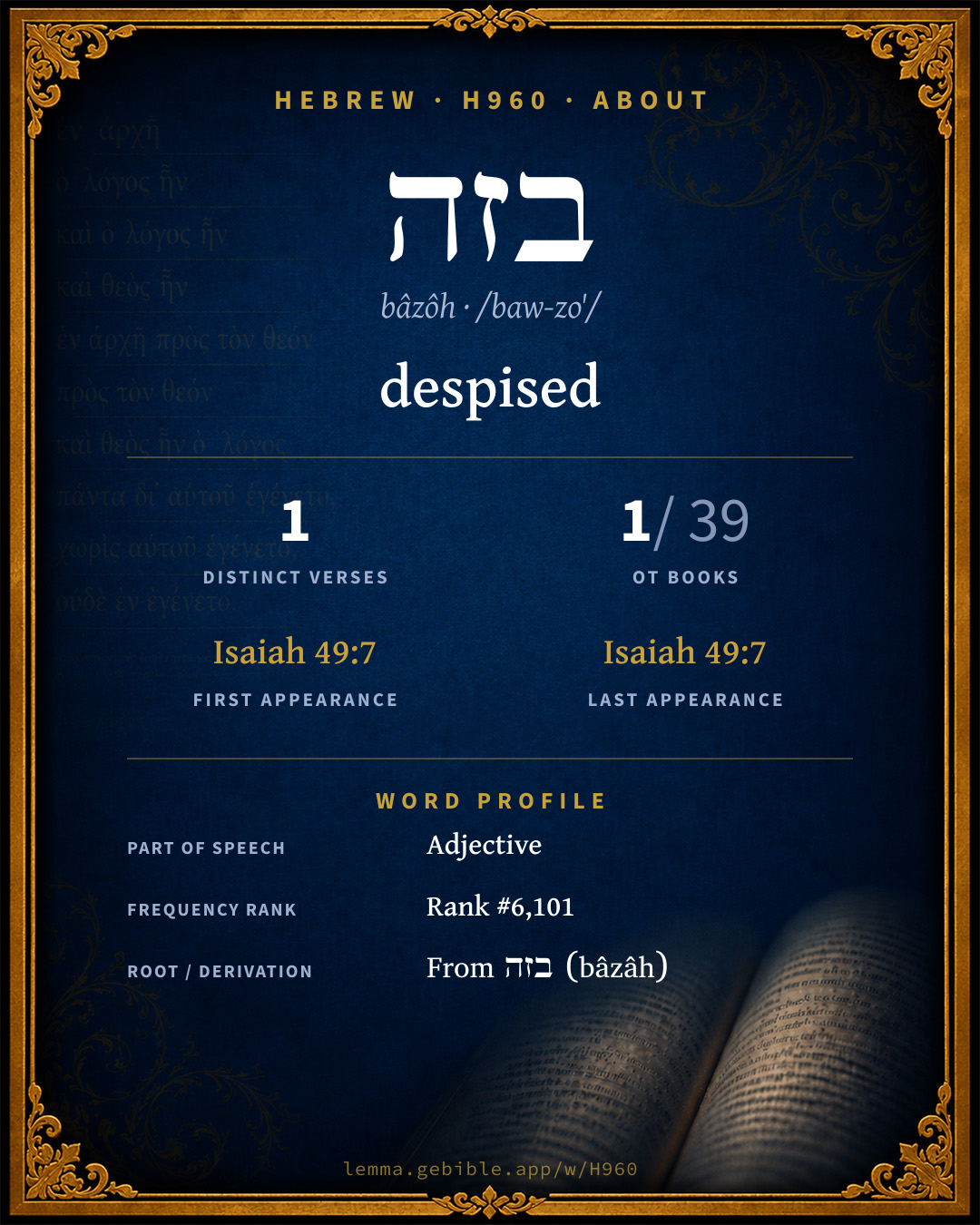
בָּזֹה
despised
Full lexicon entry — Brown-Driver-Briggs (BDB)
From Brown-Driver-Briggs (BDB)
Where this word appears
Grammar key — what these labels mean
Stem
- Qal
- The basic, simple active stem — the plain form of the verb (“he wrote”).
Form
- Infinitive Construct
- A bound verbal noun, frequently with prepositions (“to write / in writing”).
Every verse where H960 appears — 1 distinct verse across 1 book. Click any verse to open its interlinear word-by-word view. Verse text shown in the World English Bible for context — . Each verse’s Hebrew form is shown with its reference; the English is not keyword-highlighted, since the data carries no word-level English alignment. Use “Compare translations” on any verse to read it across multiple English versions. This concordance covers the Hebrew Bible; Septuagint (Greek Old Testament) occurrences are not indexed here.
Isaiah 1 verse
About this entry
At a glance — auto-summarized from this page’s data, not written by a person. Every figure links to its source below. This summary describes the numbers; it doesn’t interpret them.
בזה — transliterated bâzôh — is a Hebrew adjective carrying the sense “despised.” The Hebrew Bible uses it only 1 verse. Its uses cluster heavily in Isaiah (100% of all occurrences). Its lone occurrence is Isaiah 49:7. From the same root come בזה, בזיון and נמבזה. Each statement above links to its evidence; the full detail follows below.
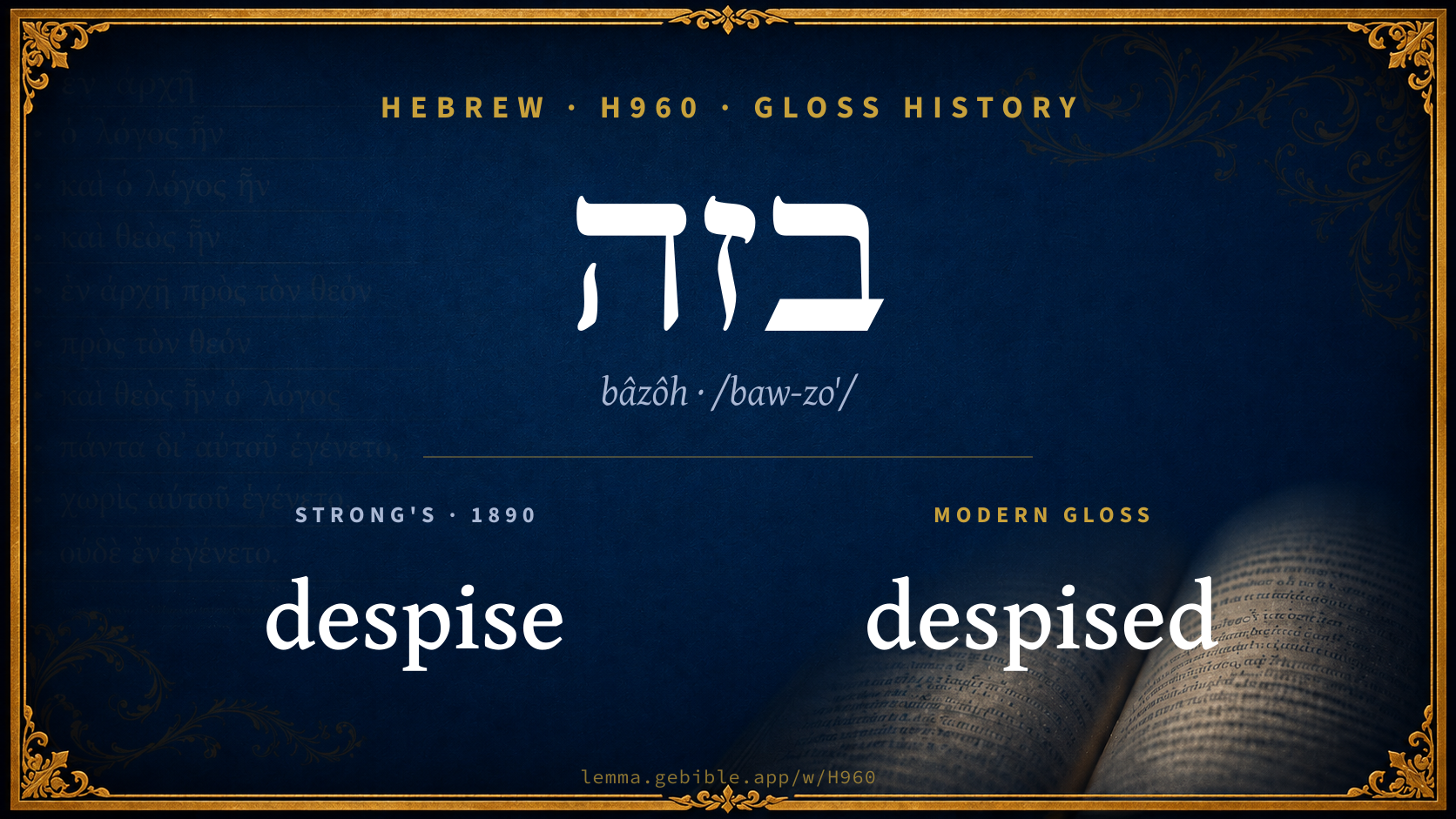
Gloss history
Strong's 1890 vs modern scholarship
About this word
Strong's H960 catalogs a Hebrew word from the Hebrew Old Testament.
These counts are not copied from any lexicon or concordance. They are computed here, from the morphology-tagged Hebrew Old Testament. What Lemma adds →
- 1
- distinct verses
- The word appears in 1 distinct verse.
- 1 / 39
- OT books
- The word appears in 1 of 39 Old Testament books.
- #6,101
- by frequency
- Rank #6,101 (rank 6,101 of 8,640 Hebrew words by occurrence).
View all 1 occurrence in the concordance →
Most concentrated in
- Isaiah 1 verse 100%
By section of the Old Testament
By traditional corpus
Conventional, traditional groupings — biblical authorship is debated, so this is a traditional corpus grouping, not an authorship claim. Each share is this word’s portion of its verses in that division of the Hebrew canon. Each figure is a share of the word’s 1 distinct verse.
- Prophets (Nevi'im) 1 verse · 100%
How translations render this word
Counts come from each version’s own published word-to-Strong’s tagging or interlinear alignment — an approximate guide to how each version renders this word, not a word-level alignment the data otherwise carries. Because each total is that version’s own tagged count, the per-version totals vary from one another and need not match the appearance or distinct-verse counts above. These counts may also differ from a printed concordance because Lemma counts each distinctly tagged rendering and does not collapse phrase taggings into a single head-word total. This is a fixed set of word-tagged versions (KJV, ASV, BSB, ULT) and does not change with the reading translation you choose elsewhere. Each version’s license is shown beside its name below (and on Sources).
- King James Version: Despiseth 1×
- American Standard Version: Despiseth 1×
- unfoldingWord Literal Text: Despiser of 1×
King James Version Public Domain
Renders H960 across 1 tagged occurrence — most commonly:
American Standard Version Public Domain
Renders H960 across 1 tagged occurrence — most commonly:
unfoldingWord Literal Text CC BY-SA 4.0
Renders H960 across 1 tagged occurrence — most commonly:
Senses in the full BDB
Hebrew verbs can shift meaning by stem (binyan): Qal is the basic action, Niphal is often passive or reflexive, Piel often intensifies or makes it factitive, and Hiphil is typically causative. The senses below are grouped under the stem BDB assigns to each.
What do BDB’s symbols mean?
BDB uses these scholarly abbreviations:
| Symbol | Meaning |
|---|---|
| 𝔊 | the Septuagint (the ancient Greek translation, LXX) |
| 𝔙 | the Vulgate (the Latin translation) |
| 𝔖 | the Syriac version (the Peshitta) |
| 𝔗 | the Targum (the Aramaic translation) |
| ψ | the Psalms |
| √ | root (the underlying root or stem) |
| ‖ | parallel passage (a synonymous or contrasted parallel) |
| † | the dagger: every passage where the word occurs is cited |
The 6 senses and sub-senses the full Brown-Driver-Briggs lexicon distinguishes for this word, in lexicon order (not ranked by frequency), with BDB’s own verbatim wording and sub-sense lettering. Shown in Hebrew script with BDB’s own scholarly abbreviations. The condensed entry is in the Lexicon Entry tab.
Qal
- Pf. Nu 15:31 +; בָּזִיתָ 2 S 12:9; sf. בְּזִתָ֑נִי 2 S 12:10, etc.; Impf. וַיִּ֫בֶז Gn 25:34 Est 3:6; sf. וַיִּבְזֵהוּ 1 S 17:42; 3 fs. וַתִּבֶז 2 S 6:16 1 Ch 15:29; 2 ms. תִּבְזֶה ψ 51:19; 73:20; וַיִּבְזוּ Ne 2:19; וַיִּבְזֻהוּ 1 S 10:27; Inf. cstr. בְּזֹה Is 49:7 (Di Ew§ 150 b); Pt. act. בּוֹזֶה Pr 15:20; 19:16; בּוֹזֵהוּ Pr 14:2; בּוֹזִים 2 Ch 36:16; בּוֹזֵי Mal 1:6; sf. בֹּזַי 1 S 2:30; pass. בָּזוּי Je 49:15 +; f. בְּזוּיָה Ec 9:16;—despise, regard with contempt, sq. acc. rei, birthright Gn 25:34 (J); words of י׳ Nu 15:31 (P; not elsewhere. in Hex); 2 S 12:9 cf. 2 Ch 36:16; name of י׳ Mal 1:6(×2) (cf. infr.); oath (אָלָה) Ez 16:59; 17:16, 18, 19; holy things Ez 22:8; one’s own ways Pr 19:16 (i.e. is careless of them, lives recklessly, opp. שֹׁמֵר נַפְשׁוֹ, cf. נֹצֵר דַּרְכּוֹ 16:17); distress of the distressed ψ 22:25 (‖ שִׁקֵּץ, subj. י׳); prayer, subj. id. ψ 102:18; broken & contrite heart ψ 51:19 (c. לֹא), cf. on other hand 73:20; sq. acc. pers. Saul 1 S 10:27, David 17:42 cf. Pr 15:20, י׳ 1 S 2:30 2 S 12:10 Pr 14:2, his prisoners ψ 69:34 (subj. י׳); sq. לְ, וַתִּבֶז לוֹ בְּלִבָּהּ 2 S 6:16 = 1 Ch 15:29; sq. עַל pers. Ne 2:19; [2 K 19:21 = Is 37:22, בּוּז] sq. Inf. וַיִּבֶז בְּעֵינָיו לִשְׁלֹחַ יָד Est 3:6; בְּזֹה נֶפֶשׁ Is 49:7 a despising of soul, i.e. one despised from the soul, thoroughly despised; on otherviews v. Che Di. Pt. pass. despised, of pers. cstr. בְּזוּי עָם despised of people (‖ חֶרְפַּת אָדָם) ψ 22:7, cf. בָּזוּי בָאָדָם Je 49:15 also Ob v 2; of wisdom Ec 9:16. e.g. Numbers 15:31
Niphal
- Pt. נִבְזֶה ψ 15:4 +; f. נִבְזָה 1 S 15:9 (so read for נמבזה cf. We Dr); pl. נִבְזִים Mal 2:9;— e.g. Psalms 15:4
- 1. despised ψ 15:4; 119:141 Is 53:3(×2) Je 22:28. e.g. Psalms 15:4
- 2. vile, worthless 1 S 15:9. e.g. 1 Samuel 15:9
- 3. despicable, contemptible Mal 1:7 said of table of י׳, cf. v 12 2:9; Dn 11:21 as subst. of Antiochus Epiph. e.g. Malachi 1:7
Hiphil
- Inf. לְהַבְזוֹת בַּעְלֵיהֶן Est 1:17 so as to cause to despise their lords (cause their lords to be despised). e.g. Esther 1:17
Senses from the full Brown-Driver-Briggs lexicon (Brown, Driver, Briggs; Oxford 1906 — public domain), digitized via Sefaria, supplemented by the OpenScriptures HebrewLexicon (CC BY 4.0). Full attribution on Sources.
Word origin
vb. despise (Pal. 𝔗 בְּזָא, cf. بَزَا raise the head loftily and disdainfully)—
— Brown-Driver-Briggs (Oxford 1906, public domain), digitized via Sefaria, supplemented by the OpenScriptures HebrewLexicon (CC BY 4.0). See Sources.
Derived from בזה (bâzâh) (H959) — to despise.
Jastrow Dictionary
A second Hebrew/Aramaic lexicon for comparison, covering Aramaic and post-biblical (Talmudic, Targumic, Midrashic) usage that the biblical-Hebrew BDB does not. Matched by lemma rather than by Strong’s number, so a lemma may carry more than one Jastrow headword (shown separately below), and the entries cover usage well beyond the Bible.
בָּזָה
- , v. בזי
בזי
- √בז to tread, v. בּוּז) to tread upon, whence to despise, spurn, degrade. Ab. d’R. Nath. ch. XXIX הבּוֹזֶה את חבירו וכ׳ he who spurns his neighbor (rebuking him) for a sacred cause. Ib. הן בּוֹזִין בעצמן they make themselves contemptible (neglecting their appearance). Part. pass. בָּזוּי, f. בְּזוּיָה. Y. Sot. V, end, 20ᵈ שהיתה נבואתו ב׳ his prophetic gift was degraded (by him). Ruth. R. to I, 1 מי שהוא ב׳ בדבריו he who becomes contemptible through his own words (in not practicing what he teaches). Cant. R. to VI, 5 מה עז זו ב׳ as the goat is despised כך בְּזוּיִין וכ׳ so were the Israelites made despicable at Shittim (through debauchery); a. fr.
- same. Ab. d’R. Nath. l. c. Y. Sot. l. c. he (Isaac) is called Buzi, שבי׳ את וכ׳ because he made all idolatrous temples appear contemptible (by his willingness to be sacrificed to the Lord). Gen. R. s. 30 (play on בוז Job XII, 5) שהיו מְבַזִּים עליו they sneered at him. Snh. 65ᵇ בִּיזִּיתוֹ thou hast insulted him. Aboth III, 11 המְבַזֶּה את וכ׳ he who disregards the festive weeks (treating them as week days); a. fr.—Part. Pu. מְבוּזֶּה, pl. מְבוּזִּין. Ab. Zar. III, 3 המב׳ common vessels, opp. מכובדין ornamental; Tosef. ib. V (VI), 1 בזויין ed. Zuck. (Var. מב׳); Y. ib. III, 42ᵈ; a. e. e.g. Job 12:5
- to be despised, humbled, exposed. Y. Taan. II, beg. 65ᵃ you cannot compare המִתְבַּזֶּה מעצמו וכ׳ one who humbles himself to one who is humbled by others. Keth. 97ᵇ. Ruth. R. to I, 1 אימתי ד"ת מִתְבַּזִּין וכ׳ when are the words of the Law despised by the people? When the scholars make them contemptible (through their conduct); a. fr.
בִּזָּה
- , v. בִּיוָּה
זֶה
- (b. h.) this, that. Men. 53ᵇ יבא זה וכ׳ let this one come and receive this &c.; זה זה משה ‘this one’ that means Moses; זאת זו התורה ‘this’—that means the Law. Gen. R. s. 4 לגיון זה this legion; a. v. fr.—זֶהוּ = זה הוא, this is. Sabb. 40ᵇ הפשרו זהו בישולו (also זה הוא) warming it is the cooking of it, v. הֶפְשֵׁר; a. fr.—Gitt. VIII, 4 אי זֹהו Y. ed. (Mish. אֵיזֶהוּ); a. v. fr.
A Dictionary of the Targumim, the Talmud Babli and Yerushalmi, and the Midrashic Literature (Marcus Jastrow; London, Luzac, 1903) — Public Domain. Digitized via Sefaria. Digitized via Sefaria. Full attribution on Sources.
Same root — word family
Other BDB entries built from the same root as H960, grouped by Strong’s listed origin. These share a root / origin per the lexicon — not necessarily a shared meaning. Each links to that word’s own entry.
Derives from
Shares the same root
Proper names from this root
People and places named from this root — a name, not an additional meaning of the word.
Compare all same-root words → Showing 4 of 5 — not the complete family. 1 of the same-root words is a proper name (a person or place). They share a root, not necessarily a meaning.
Septuagint verse parallels
This word appears in 1 verse that also exists in the Greek Old Testament (Septuagint), out of the 1 Hebrew verse it occurs in. You can read those verses in Greek by switching the Old Testament edition to the Septuagint.
Read these verses in the Septuagint
This is a verse-level parallel only — the same verses exist in both the Hebrew and Greek Old Testaments. No word-level Hebrew↔Greek correspondence is claimed: the data carries no such alignment, so no Greek word is shown as this Hebrew word’s translation. Coverage is not total — the Septuagint omits the deuterocanon and renumbers the Psalms, so some Hebrew verses have no direct Greek parallel.