1 Peter 1:14

Greek (Tischendorf 8th ed.) 1 Peter 1:14 appears in the Greek New Testament. The text above is from the Tischendorf 8th edition. Each word links to its Strong’s number and a concise gloss. Click any word for its full Thayer’s Greek Lexicon entry.
Download image
Cite this verse

1 Peter 1:14 (World English Bible). Public Domain. Lemma interlinear Bible study tool, https://lemma.gebible.app/v/1-peter/1/14.

Show BibTeX & RIS
BibTeX
RIS
English Translation
as children of obedience, not conforming yourselves according to your former lusts as in your ignorance,
World English Bible · Public Domain
Download a study sheet

One document with this verse’s original text, its word-by-word gloss line, the meaning frame, cross-references with their text, attributed commentary, and full source and license credits — printable, and it pastes into notes with its structure intact.

This verse Autodidact and up

Study sheet (.html) Plain text (.txt)

A passage Seminary Student

Up to 50 verses in one chapter. A passage sheet keeps up to 6 commentary sources and 12 cross-references per verse, in the order this page ranks them, and says so on the sheet whenever that leaves anything out. Ask for a single verse and you get the Autodidact verse sheet above.

Everything on this page stays free to read, with no account — the sheet is a download of what is already on screen, not access to it.

Want to remove ads? Support Godless Engineer
Compare translations 3

The same verse in 3 English versions, stacked beneath the original-language interlinear above. Click any original word for its lexicon entry.

Each is an independent rendering of the whole verse — the interlinear is not word-aligned to these translations.

Highlighted words mark where these versions differ — a whole-verse word diff, not a word-by-word alignment.

  • World English Bible Public Domain
    as children of obedience, not conforming yourselves according to your former lusts as in your ignorance,
  • King James Version Public Domain
    As obedient children, not fashioning yourselves according to the former lusts in your ignorance:
  • unfoldingWord Literal Text CC BY-SA 4.0
    As children of obedience, not being conformed to your former desires in your ignorance,

unfoldingWord Literal Text — © unfoldingWord, licensed CC BY-SA 4.0. Word-aligned USFM3 via Door43 (git.door43.org/unfoldingWord/en_ult).

Versions to compare (up to 4)

3 of 4 selected

Show all 19 translations

Every available English version of this verse, each an independent rendering of the whole verse.

  • World English Bible Public Domain
    as children of obedience, not conforming yourselves according to your former lusts as in your ignorance,
  • Berean Standard Bible Public Domain
    As obedient children, do not conform to the passions of your former ignorance.
  • Majority Standard Bible Public Domain
    As obedient children, do not conform to the passions of your former ignorance.
  • King James Version Public Domain
    As obedient children, not fashioning yourselves according to the former lusts in your ignorance:
  • American Standard Version (1901) Public Domain
    as children of obedience, not fashioning yourselves according to your former lusts in `the time of' your ignorance:
  • Revised Version (1885) Public Domain
    as children of obedience, not fashioning yourselves according to your former lusts in the time of your ignorance:
  • Geneva Bible (1599) Public Domain
    As obedient children, not fashioning your selues vnto the former lustes of your ignorance:
  • Douay-Rheims (1899) Public Domain
    As children of obedience, not fashioned according to the former desires of your ignorance:
  • Young's Literal Translation Public Domain
    as obedient children, not fashioning yourselves to the former desires in your ignorance,
  • Literal Standard Version CC BY-SA 4.0
    as obedient children, not fashioning yourselves to the former desires in your ignorance,
  • Unlocked Literal Bible CC BY-SA 4.0
    As obedient children, do not conform yourselves to the desires that you followed when you were ignorant.
  • unfoldingWord Literal Text CC BY-SA 4.0
    As children of obedience, not being conformed to your former desires in your ignorance,
  • Darby Bible Public Domain
    as children of obedience, not conformed to [your] former lusts in your ignorance;
  • World Messianic Bible Public Domain
    as children of obedience, not conforming yourselves according to your former lusts as in your ignorance,
  • Webster's Bible Public Domain
    As obedient children, not fashioning yourselves according to the former lusts in your ignorance:
  • Free Bible Version CC BY-SA 4.0
    Live like children who do what they're told. Don't allow yourselves to be shaped by your former sinful desires when you didn't know any better.
  • Bible in Basic English Public Domain
    Like children ruled by God, do not go back to the old desires of the time when you were without knowledge:
  • Text-Critical English NT CC BY 4.0
    As children of obedience, do not conform yourselves to the evil desires you had when you lived in ignorance.
  • Tyndale New Testament (1534) Public Domain
    as obedient chyldren not facioninge youre selves vnto youre olde lustes of ignorancye:

Literal Standard Version (2020), Covenant Press — licensed CC BY-SA 4.0. Text via the HelloAO Bible API (eBible.org). Unlocked Literal Bible (unfoldingWord) — licensed CC BY-SA 4.0. Text via the HelloAO Bible API (eBible.org). unfoldingWord Literal Text — © unfoldingWord, licensed CC BY-SA 4.0. Word-aligned USFM3 via Door43 (git.door43.org/unfoldingWord/en_ult). Free Bible Version, Dr. Jonathan Gallagher — licensed CC BY-SA 4.0. Text via the HelloAO Bible API (eBible.org).

Word by word

More ways to search: Search by grammar → Find every occurrence → Compare this word →

Practice this passage: Drill this verse → Learn its vocabulary →

συσχηματιζόμενοι
syschēmatízō
G4964
“to conform”
Verb, Present, Middle or Passive, Participle, Nominative, Plural, Masculine
Part of Speech
Verb
Tense
Present
Voice
Middle or Passive
Mood
Participle
Case
Nominative
Number
Plural
Gender
Masculine
Full Thayer's Definition

Origin: from G4862 and a derivative of G4976

TDNT: None

1. to conform one's self (i.e. one's mind and character) to another's pattern, (fashion one's self according to)
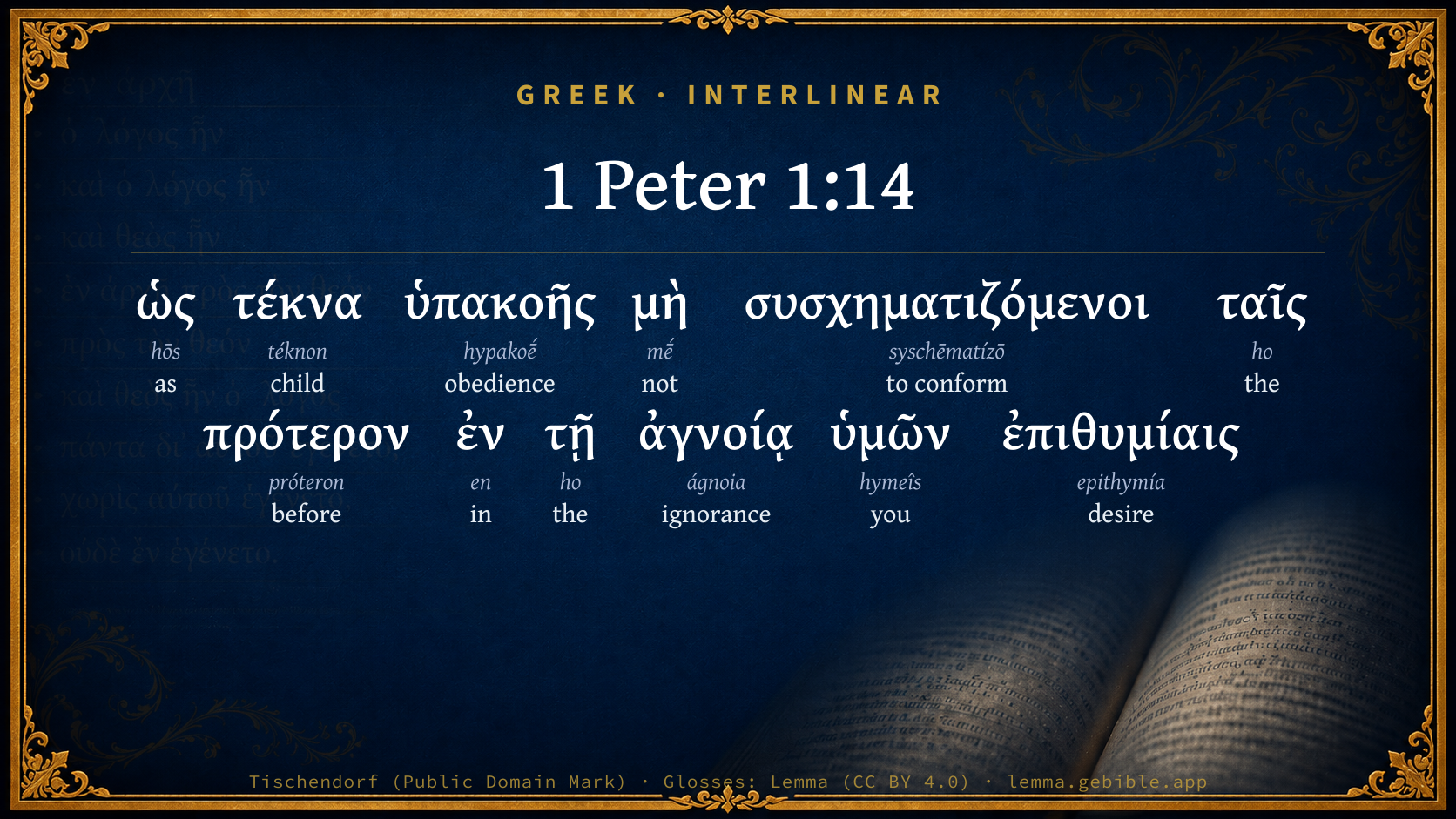
  1. ὡς hōs G5613 “as” Adverb
  2. τέκνα téknon G5043 “child” Noun, Nominative, Plural, Neuter
  3. ὑπακοῆς hypakoḗ G5218 “obedience” Noun, Genitive, Singular, Feminine
  4. μὴ mḗ G3361 “not” Particle, Negative
  5. ταῖς ho G3588 “the” Article, Dative, Plural, Feminine
  6. πρότερον próteron G4386 “before” Adverb, Comparative
  7. ἐν en G1722 “in” Preposition
  8. τῇ ho G3588 “the” Article, Dative, Singular, Feminine
  9. ἀγνοίᾳ ágnoia G52 “ignorance” Noun, Dative, Singular, Feminine
  10. ὑμῶν hymeîs G5210 “you” Personal pronoun, 2nd person, Genitive, Plural
  11. ἐπιθυμίαις epithymía G1939 “desire” Noun, Dative, Plural, Feminine

About this verse

These counts appear in no published source. They are computed here, from the morphology-tagged text and Lemma’s own curated glosses. What Lemma adds →

12
words
11
distinct lemmas
General Epistles
section

Notable vocabulary

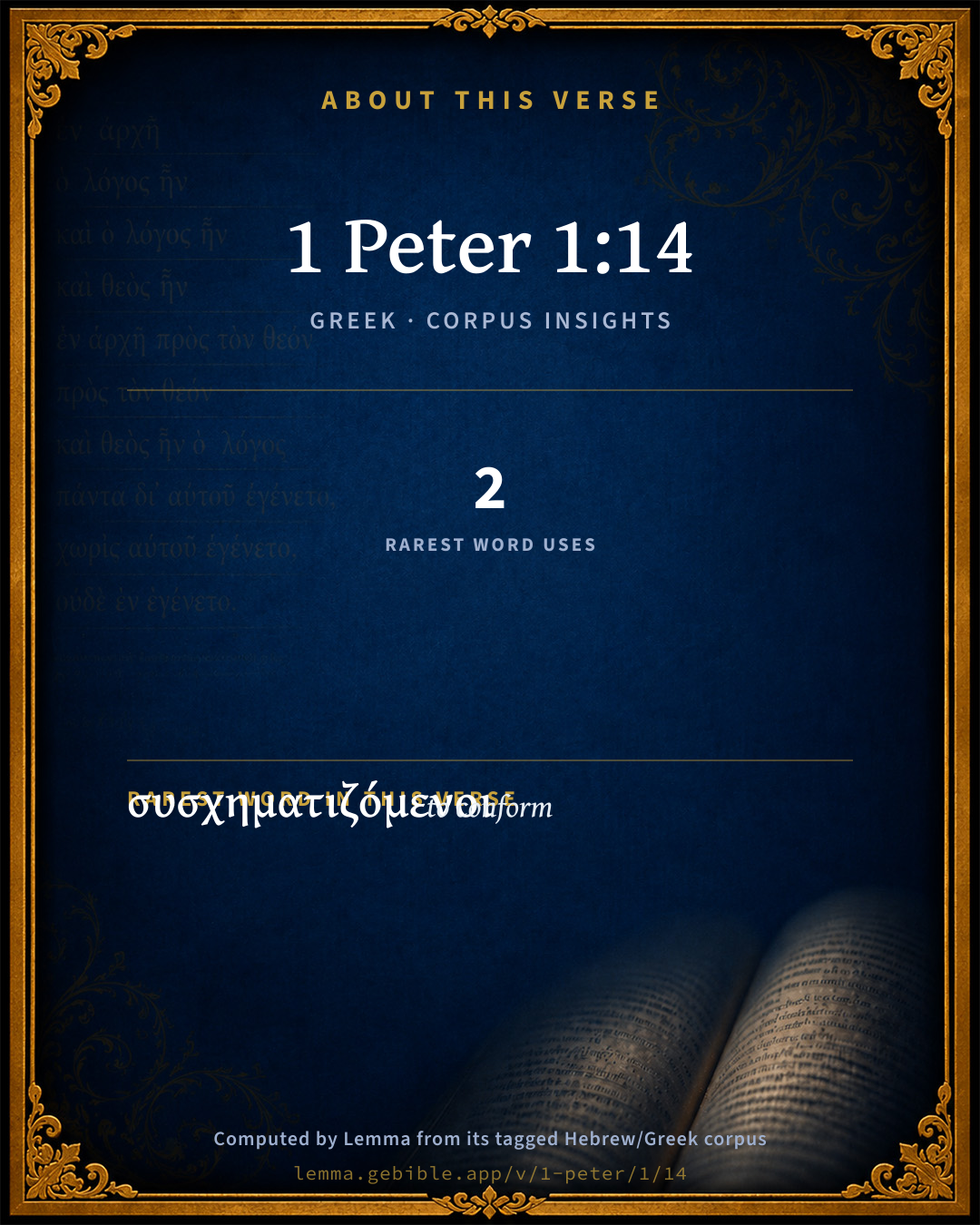
The rarest word here is συσχηματιζόμενοι to conform G4964 — appearing just 2 times in the whole Greek New Testament.

Shared distinctive vocabulary

συσχηματιζόμενοι to conform G4964 occurs in 2 verses of the Greek New Testament. Also found in:

Repetition

A word recurs within this verse:

  • ταῖς the G3588 ×2

Cross-references

10

Topical passages linked to 1 Peter 1:14 in the Treasury of Scripture Knowledge — connected by theme and wording, ordered by reader-vote popularity; previews shown in the World English Bible.

  • Romans 12:2 Don't be conformed to this world, but be transformed by the renewing of your mind, so that you may prove what is the good, well-pleasing, and perfect will of God.
  • Titus 3:3–5 For we were also once foolish, disobedient, deceived, serving various lusts and pleasures, living in malice and envy, hateful, and hating one another.
  • 1 Peter 4:2–3 that you no longer should live the rest of your time in the flesh for the lusts of men, but for the will of God.
  • Ephesians 2:2 in which you once walked according to the course of this world, according to the prince of the powers of the air, the spirit who now works in the children of disobedience;
  • 1 Thessalonians 4:5 not in the passion of lust, even as the Gentiles who don't know God;
  • Colossians 3:5–7 Put to death therefore your members which are on the earth: sexual immorality, uncleanness, depraved passion, evil desire, and covetousness, which is idolatry;
  • Ephesians 4:18–22 being darkened in their understanding, alienated from the life of God, because of the ignorance that is in them, because of the hardening of their hearts;
  • Acts 17:30 The times of ignorance therefore God overlooked. But now he commands that all people everywhere should repent,
  • Romans 6:4 We were buried therefore with him through baptism to death, that just like Christ was raised from the dead through the glory of the Father, so we also might walk in newness of life.
  • Ephesians 5:6 Let no one deceive you with empty words. For because of these things, the wrath of God comes on the children of disobedience.

Cross-references courtesy of OpenBible.info (CC BY 4.0).

Commentary

Notes on 1 Peter 1:14 from classic Christian and Jewish commentators (each source and its license shown beneath its notes). The classic Christian expositions comment on the surrounding passage and are grouped to its opening verse, so a note may address several verses; the Jewish commentaries on the Tanakh (Rashi and others) are per-verse, so they appear only where the commentator wrote on this verse.

Lemma curates 59 commentaries, every one of them public domain or Creative Commons licensed, each selected and text-cleaned for this edition rather than reprinted as found. About our sources →

Jamieson, Fausset & Brown

Robert Jamieson, A. R. Fausset & David Brown

From sobriety of spirit and endurance of hope Peter passes to obedience, holiness, and reverential fear.

As--marking their present actual character as "born again" (Pe1 1:3, Pe1 1:22).

obedient children--Greek, "children of obedience": children to whom obedience is their characteristic and ruling nature, as a child is of the same nature as the mother and father. Contrast Eph 5:6, "the children of disobedience." Compare Pe1 1:17, "obeying the Father" whose "children" ye are. Having the obedience of faith (compare Pe1 1:22) and so of practice (compare Pe1 1:16, Pe1 1:18). "Faith is the highest obedience, because discharged to the highest command" [LUTHER].

fashioning--The outward fashion (Greek, "schema") is fleeting, and merely on the surface. The "form," or conformation in the New Testament, is something deeper and more perfect and essential.

the former lusts in--which were characteristic of your state of ignorance of God: true of both Jews and Gentiles. The sanctification is first described negatively (Pe1 1:14, "not fashioning yourselves," &c.; the putting off the old man, even in the outward fashion, as well as in the inward conformation), then positively (Pe1 1:15, putting on the new man, compare Eph 4:22, Eph 4:24). "Lusts" flow from the original birth-sin (inherited from our first parents, who by self-willed desire brought sin into the world), the lust which, ever since man has been alienated from God, seeks to fill up with earthly things the emptiness of his being; the manifold forms which the mother-lust assumes are called in the plural lusts. In the regenerate, as far as the new man is concerned, which constitutes his truest self, "sin" no longer exists; but in the flesh or old man it does. Hence arises the conflict, uninterruptedly maintained through life, wherein the new man in the main prevails, and at last completely. But the natural man knows only the combat of his lusts with one another, or with the law, without power to conquer them.

Jamieson, Fausset & Brown — Commentary Critical and Explanatory on the Whole Bible (1871) — public domain (CC PDM 1.0). Text via the HelloAO Bible API.

Whedon's Commentary on the Bible

Daniel D. Whedon

b. Exhortation to obedience after the pattern of Christ, 1Pe_1:14-16.

14. As the preceding verse points to the inward state and action, and this to external conduct, with its own proper ground, it is better, with Tregelles, Alford, and others, to read here as beginning a new paragraph.

Obedient children—Literally, children of obedience. See Winer, xxxiv, b. 2. As the child partakes of the nature of the parent, such are they whose moral natures are so imbued with the spirit of obedience that it has become a controlling second nature. See note on Eph_2:2. The condition presupposed is in the “begotten again” of 1Pe_1:3, and the “born again” of 1Pe_1:23. In such this spirit reigns, and the demand of holiness naturally follows.

Not… lusts—Negatively. The sort of conduct to which they led is described in chapter 1Pe_4:3, and includes whatever is contrary to the holy example of Christ.

Ignorance—Before receiving the knowledge of the gospel, or, on the part of the heathen, of the true God.

Daniel D. Whedon (gen. ed.), Commentary on the Old and New Testaments (1874–1909) — public domain. Text from a community e-Sword module.

Bengel's Gnomon

Johann Albrecht Bengel

1Pe 1:14. Τέκνα, children) See 1Pe 1:17, at the beginning.—ὑπακοῆς, of obedience) Obedience is paid either to the Divine truth, 1Pe 1:22, or to the Divine command. The latter is the fruit of faith; the former is faith itself. Therefore Peter expressly stirs them up to hope in 3d and following verses (making mention of hope itself, 1Pe 1:3; 1Pe 1:13); to faith in the 14th and following verses (using the word faith twice in 1Pe 1:21); to love, 1Pe 1:22, but in such a manner that he attempers faith with hope, in 7th and following verses; and again hope with faith, 1Pe 1:21, and faith with love, 1Pe 1:22, and ch. 1Pe 2:6 and following verse.—μὴ συσχηματιζόμενοι[10]) Supply γενήθητε, 1Pe 1:15, be ye not conformed.—ἀγνοίᾳ, in your ignorance) Their former state, even as Jews, before their calling.

[10] σχῆμα and its compounds are used to denote that which is fleeting and changeable, as 1Co 7:13, τὸ σχῆμα τοῦ κόσμου τούτου, “the fashion of this world;” Rom 12:2, μὴ συσχηματίζεσθε τῷ αἰῶνι τούτῳ, “be not conformed to this world.” The word μορφὴ appears to be contrasted with σχῆμα, as that which is essential, as opposed to that which is outward and accidental.

See an excellent article by Mr Lightfoot in the “Journal of Classical and Sacred Philology,” vol. 3, p. 114.—T.

See note on Rom 12:2. Μορφὴ, the form, denotes something deeper and more perfect than σχῆμα, the outward fashion.—E.

Bengel's Gnomon of the New Testament — English translation (T&T Clark, Edinburgh, 1860) — public domain. Text from a community e-Sword module.

Meyer's Critical & Exegetical Commentary

Heinrich August Wilhelm Meyer

1Pe_1:14. Second exhortation (extending to 1Pe_1:21).

ὡς τέκνα ὑπακοῆς] does not belong to what precedes (Hofmann), but serves to introduce the new exhortation.[82]

ὡς does not here introduce a comparison (as 1Pe_2:2; 1Pe_2:5, 1Pe_3:7), but marks the essential quality of the subject. Lorinus correctly remarks on 1Pe_2:14 : constat hujusmodi particulas saepe nihil minuere, sed rei veritatem magis exprimere; it corresponds to our as, i.e. as becomes you who should be τέκνα ὑπακοῆς.

ὑπακοή is used here as absolutely as in 1Pe_1:2, and has the same signification as there. The spirit which pervades the life of believers is the spirit of obedience, and therefore they should be τέκνα ὑπακοῆς. According to the analogy of similar compounds in the N. T., as τέκνα φωτός, Eph_5:8; its opposite: τέκνα κατάρας, 2Pe_2:14; τέκνα τῆς ὀργῆς, Eph_2:3; particularly υἱοὶ τῆς ἀπειθείας, Eph_2:2,the expression τέκνα ὑπακοῆς may be explained so as that τέκνα shall denote only the relation in which the persons in question stand to the idea of the accompanying genitive; cf. Winer, p. 223 f. [E. T. 298]; Buttmann, p. 141; Meyer on Eph_2:2 (thus Grotius, Jachmann, etc.; Fronmüller too). De Wette, Brückner, Schott, Weiss too most probably, p. 172, take τέκνα as the children of God, and ὑπακοῆς as the genitive of character (as Luk_16:8 : ὁ οἰκόνομος τῆς ἀδικίας; Luk_18:6 : ὁ κρίτης τῆς ἀδικίας). But as it is in 1Pe_1:17 that mention is first made of the sonship relation of the Christian, it remains at least doubtful whether the apostle had in this expression that relation in view; at any rate the emphasis here lies not on τέκνα, but on ὑπακοῆς.

μὴ συσχηματιζόμενοι] μή occurs here on account of the imperative cast of the whole sentence. Neither γενήθητε (Bengel) nor any other similar word is to be supplied to the part., inasmuch as it does not correspond to the ἅγιοι γενήθητε but to the κατὰ τὸν καλέσαντα ὑμᾶς ἅγιον (Wiesinger); there is here no departure from the construction (de Wette). The word συσχηματίζεσθαι, occurring in the N. T. only here and in Rom_12:2, and nowhere but in later Greek, means: to form his σχῆμα like that of another;[83] it has reference not to the outward conduct merely, but to the whole outward and inward conformation of life, as the connection with the following words shows: ΤΑῖς ΠΡΌΤΕΡΟΝ ἘΝ Τῇ ἈΓΝΟΊᾼ ὙΜῶΝ ἘΠΙΘΥΜΊΑΙς. The ἘΠΙΘΥΜΊΑΙ, i.e. the sinful desires (not the satisfied lusts, or a life of pleasure, as de Wette understands), which formerly held sway in them, are the σχῆμα, according to which they are not to fashion themselves in their new life.[84] Luthers translation is inexact: take not up your former position, when ye in your ignorance lived according to your lusts. The ἐπιθυμίαι are more precisely characterized as formerly belonging to them ἐν ἀγνοίᾳ; ἐν specifies not merely the time (Calvin: tempus ignorantiae vocat, antequam in fidem Christi vocati essent), but likewise the origin (Wiesinger). ἄγνοια is used here as in Act_17:30, Eph_4:18, ignorance in divine things, and is to be understood, if not exactly of idolatry, at least of heathenism, which is far from the knowledge of the living God and of His will. Paul, in Rom_1:18 ff., shows how the obscuring of the consciousness of God is the source of moral corruption.

[82] Hofmann connects not only these words, but the subsequent participial clause also: μὴ συσχηματιζόμενοι κ.τ.λ., with what precedes. This, however, is opposed, on the one hand, by the correspondence which exists between τέκνα ὑπακοῆς and the subsequent exhortations; and, on the other hand, by ἀλλά, ver. 15, which is in antithesis to μὴ συσχηματιζόμενοι, and therefore not to be separated from it, as though it commenced a new paragraph.

[83] When, in objection to this, Hofmann urges that συσχηματίζεσθαι should here be interpreted not according to Rom_12:2, but on the principle of the expression: συσχ. τοῖς λεγομένοις; so to conduct oneself as to give adequate expression to the words used,he does not consider that in this verse the verb has the same force as in Rom_12:2, for it means: to conform your σχῆμα to that which your words express.

[84] Schott terms this interpretation inexact; for it is not the lusts themselves, but the mode of life which is essentially characterized by these lusts, according to which they are not to fashion themselves; but does then ἐπιθυμίαι mean the mode of life? Besides, Schott himself says that the thought is not altogether correctly expressed.

REMARK.

In answer to Weiss, who can see in this passage no proof that the readers were Gentile-Christians, Wiesinger justly remarks, Schott and Brückner agreeing with him: the ἄγνοια of which the Jews (Act_3:17; Rom_10:3) are accused, or which Paul attributes to himself, 1Ti_1:13 (the same applies to Luk_23:34; Joh_8:19), is of quite a different kind; not an ἄγνοια of the moral demands of the law, but the misapprehension of the purpose of salvation manifesting itself also through the law. If Weiss, on the other hand, insists (Die Petr. Frage, p. 624) that the invectives of Christ most plainly teach how, in the Jewish conception of the law, at that time its deeper moral demands were misapprehended; it must, as opposed to him, be observed that Christs attack was specially directed against the Pharisaic conception of it, and can in no way be applied to the people of Israel as such. Paul, in describing them, expressly allows to the Jews, Rom_2:17 ff., the γινώσκειν τὸ θέλημα; and an ἄγνοια, in the absolute sense here implied, is nowhere cast up to them.

The O. T. distinction between sins of weakness (בִּשְׁגָגָה, LXX.: κατʼ ἄγνοιαν, ἐν ἀγνοίᾳ) and insolent sins of disobedience (בְּיַד רָמָה) (Weiss, p. 175) does not apply here.

Meyer — Critical and Exegetical Commentary on the New Testament — English translation by Peter Christie, edited by Frederick Crombie (T&T Clark, 1880) — public domain. Text from a community e-Sword module.

Expositor's Greek Testament

ed. W. Robertson Nicoll

1Pe 1:14 . ὡς , inasmuch as you are, cf. 1Pe 2:2 ; 1Pe 2:5 , 1Pe 3:7 , etc. τέκνα ὑπακοῆς , obedient corresponds to St. Paul’s υἱοὶ τῆς ἀπειθείας (Col 3:6 ; Eph 2:2 ; Eph 5:6 ). Both phrases reflect the Hebrew use of בן , “followed by word of quality characteristic, etc.” (B.D.B., s.v. , 8). For τέκνα in place of usual υἱοί in this idiom, cf. Hos 9 , τέκνα ἀδικίας and Eph 2:3 , τέκνα ὀργῆς . Here it suits better with βρέφη (1Pe 2:1 ). συσχηματιζόμεναι , from Rom 12:2 , μὴ συσχηματίζεσθε τῷ αἰῶνι τούτῳ . The feminine is peculiar to [146] whose scribe was perhaps influenced by the Alexandrian identification of woman with the flesh (Joh 1:13 ) or regarded such conformity as womanish. The participle has the force of an imperative. The Christians needed to be warned against conformity to the manners and morals of their countrymen, which were incompatible with their new faith (see 1Pe 5:2-4 ). The use of σχῆμα in Isa 3:17 , perhaps assists the use of συσχ . in connection with lusts. ἐντῇ ἀγνοίᾳ ὑμῶν . It was a Jewish axiom that the Gentiles were ignorant (Act 17:30 ; Eph 4:17 f.). Christian teachers demonstrated the equal ignorance of the Jews (Peter, Act 3:17 ; Paul, in Rom.). So Jesus had pronounced even the teachers of Israel to be blind and promised them knowledge of the truth (Joh 8:32 ff., cf. interview with Nicodemus); whereas speaking to the Samaritan woman He adopted the Jewish standpoint (Joh 4:22 ) cf. 2Ki 17:29-41 with Isa 2:3 ; Bar 4:4 , μακάριοί ἐσμεν Ἰσραὴλ ὅτι τὰ ἀρεστὰ τοῦ θεοῦ ἡμῖν γνωστά ἐστιν .

[146] Codex Vaticanus (sæc. iv.), published in photographic facsimile in 1889 under the care of the Abbate Cozza-Luzi.

The Expositor's Greek Testament, edited by W. Robertson Nicoll (1897–1910) — public domain. Text from a community e-Sword module.

Geneva Bible (1599)

Geneva Bible translators

He passeth from faith and hope, to the fruits of them both, which are understood in the name of obedience: And it consisteth in two things, in renouncing our lusts, and living godly: which lusts have their beginning of that blindness wherein all men are born: but holiness proceedeth from the grace and favor of GOD, which adopteth us, and therefore regenerateth us, that the father and the children may be of one disposition.

Geneva Bible (1599) marginal notes — public domain. Text via Bolls.life.

Adam Clarke's Commentary

Verse 14. Not fashioning yourselves] As the offices of certain persons are known by the garb or livery they wear, so are transgressors: where we see the world's livery we see the world's servants; they fashion or habit themselves according to their lusts, and we may guess that they have a worldly mind by their conformity to worldly fashions.

Adam Clarke's Commentary on the Bible (1810–1826) — public domain. Text from a community e-Sword/MySword module.

John Calvin's Commentaries

14 As obedient children He first intimates that we are called by the Lord to the privilege and honor of adoption through the Gospel; and, secondly, that we are adopted for this end, that he might have us as his obedient children. For though obedience does not make us children, as the gift of adoption is gratuitous, yet it distinguishes children from aliens. How far, indeed, this obedience extends, Peter shews, when he forbids God’s children to conform to or to comply with the desires of this world, and when he exhorts them, on the contrary, to conform to the will of God. The sum of the whole law, and of all that God requires of us, is this, that his image should shine forth in us, so that we should not be degenerate children. But this cannot be except we be renewed and put off the image of old Adam.

Hence we learn what Christians ought to propose to themselves as an object throughout life, that is, to resemble God in holiness and purity. But as all the thoughts and feelings of our flesh are in opposition to God, and the whole bent of our mind is enmity to him, hence Peter begins with the renunciation of the world; and certainly, whenever the Scripture speaks of the renewal of God’s image in us, it begins here, that the old man with his lusts is to be destroyed.

In your ignorance The time of ignorance he calls that before they were called into the faith of Christ. We hence learn that unbelief is the fountain of all evils. For he does not use the word ignorance, as we commonly do; for that Platonic dogma is false, that ignorance alone is the cause of sin. But yet, how much soever conscience may reprove the unbelieving, nevertheless they go astray as the blind in darkness, because they know not the right way, and they are without the true light. According to this meaning, Paul says,

“Ye henceforth walk not as the Gentiles, in the vanity of their mind, who have the mind darkened, being alienated from the life of God, because of the ignorance that is in them.” (Ephesians 4:17.)

Where the knowledge of God is not, there darkness, error, vanity, destitution of light and life, prevail. These things, however, do not render it impossible that the ungodly should be conscious of doing wrong when they sin, and know that their judge is in heaven, and feel an executioner within them. In short, as the kingdom of God is a kingdom of light, all who are alienated from him must necessarily be blind and go astray in a labyrinth.

We are in the meantime reminded, that we are for this end illuminated as to the knowledge of God, that we may no longer be carried away by roving lusts. Hence, as much progress any one has made in newness of life, so much progress has he made in the knowledge of God.

Here a question arises, — Since he addressed the Jews, who were acquainted with the law, and were brought up in the worship of the only true God, why did he charge them with ignorance and blindness, as though they were heathens? To this I answer, that it hence appears how profitless is all knowledge without Christ. When Paul exposed the vain boasting of those who wished to be wise apart from Christ, he justly said in one short sentence, that they did not hold the head. (Colossians 2:19.) Such were the Jews; being otherwise imbued with numberless corruptions, they had a veil over the eyes, so that they did not see Christ in the Law. The doctrine in which they had been taught was indeed a true light; but they were blind in the midst of light, as long as the Sun of Righteousness was hid to them. But if Peter declares that the literal disciples even of the Law were in darkness like the heathens, as long as they were ignorant of Christ, the only true wisdom of God, with how much greater care it behoves us to strive for the knowledge of him!

John Calvin's Commentaries (1540-1563) — public domain. Text from the Calvin Translation Society English edition (1840s-50s) via the Christian Classics Ethereal Library (ccel.org). Calvin's coverage is partial (roughly two-thirds of the Bible); uncommented books and verses are honest gaps, never fabricated. The 19th-century editor's footnotes and remarks are omitted so the notes are faithfully Calvin's own voice.

Ellicott's Commentary for English Readers

(14) As obedient children.—Literally, as children of obedience—children, i.e., in the sense of relationship, not of age. It is characteristic of the writer to keep one thought underlying many digressions, and so here, the appeal to them as “children” is based on the “begotten again” of 1Pe_1:3, and “inheritance” of 1Pe_1:4; it comes up again in 1Pe_1:17, “the Father”; in 1Pe_1:22, “the brethren”; and again in 1Pe_1:23, “begotten again.” The usual characteristic of Jews in the New Testament is disobedience. (See Note on 2Th_1:8.) The “as” means “in keeping with your character of,” just as we say in common English, “Do so like obedient children.”

Not fashioning yourselves according to.—This rare verb is the same as is translated “be not conformed,” in Rom_12:2, from which some think it is borrowed. The expression is a little confused, the lusts themselves being spoken of as a model not to be copied, where we should rather have expected “not being conformed to your former selves.”

The former lusts in your ignorance—i.e., which you indulged before you came to know the gospel truth—of course implying also that the ignorance was the mother of the lusts. The same assumption is made here which we shall find again below in 1Pe_2:9, and still more in 1Pe_4:3, that the recipients of this Letter had lived in ignorance and in vice up to a certain point of their lives. And it is contended, with much plausibility, that both accusations show the recipients of the letter to be of Gentile and not of Jewish origin. It is true that lusts of the flesh are not usually laid to the charge of the Jews, as they are of the Gentiles. (See, for instance, 1Th_4:5; Eph_4:17.) It is also true that the ignorance with which the Jews are charged (for instance, Act_3:17; Rom_10:3; 1Ti_1:13) has quite a different tendency from this. But it may be answered that such details are of little weight in comparison with the direct evidence of the first verse, and the indirect evidence of the whole tone of the Letter; also that, putting out of sight expressions of St. Paul’s which have nothing to do with St. Peter, “ignorance” is surely not an unnatural word to represent the contrast between the state of unregenerate Jews and the same persons when they have attained to knowledge higher than that of prophets or of angels; that even Jews were men of flesh and blood, and therefore not exempt from the temptations of the flesh, from which mere legalism was quite insufficient to protect them (see Rom_7:8, “sin through the commandment wrought in me every lust); that in Heb_5:2; Heb_9:7, Jewish people are supposed to have need of a high priest to bear with and atone for their “ignorance” and “ignorances;” that the same writer contemplates the possibility of “many” of his Hebrews being “defiled” through fleshly sin (Heb_12:15-16), and deems it necessary to urge strongly the sanctions of marriage (Heb_13:4).

A Bible Commentary for English Readers, edited by Charles John Ellicott (1878–1897) — public domain. Text from a community e-Sword module.

The Cambridge Bible for Schools and Colleges

gen. ed. J. J. S. Perowne

14. as obedient children] Literally, children of obedience. The phrase is more or less a Hebraism, like “children of wrath,” Eph_2:3, or the more closely parallel “children of disobedience” in Eph_5:6. The “cursed children,” literally, children of a curse, of 2Pe_2:14, furnishes another example of the Hebrew feeling which looks on the relation of sonship as a parable symbolizing the inheritance of character or status.

not fashioning yourselves according to the former lusts] The word is the same as that used by St Paul in Rom_12:2, where the English Version gives “conformed.” The words “in your ignorance” are in the Greek more closely connected with “lusts,” the former lusts that were in your ignorance. We trace an echo of the feeling expressed by St Peter in Act_3:17, and again by St Paul in Act_17:30, that the whole life of men, whether Jews or Gentiles, before the revelation of Christ, was a time of ignorance, to be judged as such. The former was at least likely to remember, as he wrote, his Master’s words as to “the servant who knew not his lord’s will” (Luk_12:48), and who was therefore to be “beaten with few stripes.” It does not follow, as some have thought, that he is thinking here, chiefly or exclusively, of those who had been heathens. The words were in their breadth and fulness as true of Jew and Gentile alike as were St Paul’s in Rom_11:32.

The Cambridge Bible for Schools and Colleges (gen. ed. J. J. S. Perowne; Cambridge University Press, 1878–1918) — public domain. Text from a community e-Sword module.

John Gill's Exposition

As obedient children,.... Or "children of obedience". This may be connected either with what goes before, that seeing they were children of God, by adopting grace, and in regeneration brought to the obedience of faith, to whom the inheritance belonged, therefore they ought to continue hoping for it; or with what follows, that since they were manifestly the children of God by faith in. Christ Jesus, being begotten again to a lively hope, they ought to be followers of him, and imitate him in holiness and righteousness, and show themselves to be obedient ones to his Gospel and ordinances, as children ought to honour, and obey, and imitate their parents:

not fashioning yourselves to the former lusts in your ignorance. The phrase is much the same with that in Rom 12:2 "be not conformed to this world"; for to be conformed, or fashioned to the world, is to be fashioned to the lusts of it; and to be fashioned to the lusts of it is to indulge them, to make provision for them, to obey them, to live and walk in them; which should not be done by the children of God, and who profess themselves to be obedient ones to the Gospel, which teaches otherwise; and that because they are lusts, foolish, hurtful, and deceitful ones, ungodly ones; the lusts of the devil, as well as of the world, and of the flesh, and which war against the soul; and because they are "former" ones, which they served in a time of unregeneracy, and were now convinced and ashamed of, and therefore should no longer live to them; the time past of life being sufficient to have walked in them: and because they were lusts in ignorance, which they had indulged in a state of ignorance; not of Gentilism, though this might be the case of some, but of Judaism; when they knew not God, especially in Christ, and were ignorant of his righteousness, and of the exceeding sinfulness of sin, as committed against a law that was holy and spiritual; nor did they know Christ, and the way of salvation by him, but thought they ought to do many things contrary to his name; nor the work of the Spirit in regeneration, saying with Nicodemus, how can these things be? nor the true sense of the Scriptures, the sacred oracles, that were committed to them; much less the Gospel, which was hidden from them, and they were enemies to: but now it was otherwise with them; they were made light in the Lord, and had knowledge of all these things; and therefore, as their light increased, and the grace of God, bringing salvation, appeared unto them, and shone out on then, it became them to deny ungodliness and worldly lusts, and not to walk as they had done before, since they had not so learned Christ.

John Gill's Exposition of the Whole Bible (1746–1763) — public domain (CC PDM 1.0). Text via the HelloAO Bible API.

Trapp's Complete Commentary

John Trapp

14 As obedient children, not fashioning yourselves according to the former lusts in your ignorance:

Ver. 14. Not fashioning yourselves] συσχηματιζομενοι. As a player is fashioned to the obscene speeches and carriages of him whom he is impersonateting.

In your ignorance] Men may remain grossly ignorant amidst abundance of means, as these Jews did. "Who is blind but my servant? or deaf as my messenger?" &c., Isa 42:19-20.

John Trapp, A Commentary or Exposition upon All the Books of the Old and New Testament (1647–1656) — public domain. Text from a community e-Sword module.

Albert Barnes' Notes on the Bible

As obedient children - That is, conduct yourselves as becomes the children of God, by obeying his commands; by submitting to His will; and by manifesting unwavering confidence in him as your Father at all times.

Not fashioning yourselves - Not forming or modeling your life. Compare the notes at Rom 12:2. The idea is, that they were to have some model or example, in accordance with which they were to frame their lives, but that they were not to make their own former principles and conduct the model. The Christian is to be as different from what he was himself before conversion as he is from his fellow-men. He is to be governed by new laws, to aim at new objects, and to mould his life in accordance with new principles. Before conversion, he was:

(a)Supremely selfish;

(b)He lived for personal gratification;

(c)He gave free indulgence to his appetites and passions, restrained only by a respect for the decencies of life, and by a reference to his own health, property, or reputation, without regard to the will of God;

(d)He conformed himself to the customs and opinions around him, rather than to the requirements of his Maker;

(e)He lived for worldly aggrandizements, his supreme object being wealth or fame; or,

(f)In many cases, those who are now Christians, gave indulgence to every passion which they wished to gratify, regardless of reputation, health, property, or salvation.

Now they are to be governed by a different rule, and their own former standard of morals and of opinions is no longer their guide, but the will of God.

According to the former lusts in your ignorance - When you were ignorant of the requirements of the gospel, and gave yourselves up to the unrestrained indulgence of your passions.

Albert Barnes' Notes on the Bible (1834–1885) — public domain. Text from a community e-Sword/MySword module.

Haydock's Catholic Bible Commentary

As children of obedience; i.e. as obedient children. (Witham)

George Leo Haydock (1774–1849), Haydock's Catholic Family Bible and Commentary, 1859 edition — public domain. Excludes Psalms (Douay-Rheims chapter numbering differs from Protestant) and Deuterocanonical books (Catholic canon only).

Matthew Poole's English Annotations

As obedient children; Greek, children of obedience, by a usual Hebraism, for obedient children. So children of disobedience, Eph 2:2; Col 3:6. And this we may understand either absolutely, children of obedience for obedient persons; or with relation to God, obedient children of God; and then the apostle persuades them to their duty by an argument taken from their adoption; being the children of God, he would have them behave themselves obediently, as becomes them in that relation.

Not fashioning yourselves; not accommodating, not conforming yourselves, not shaping or ordering your conversation. See the same word, Rom 12:2.

According to the former lusts; the lusts you formerly indulged yourselves in: see Eph 4:22.

In your ignorance; your ignorance of Christ and the gospel: q.d. Not fashioning yourselves according to those lusts you lived in when you were ignorant of Christ. He distinguisheth between the time of their ignorance, and of their illumination. Another age requires other manners. They formerly lived according to the dictates of their lusts, but now ought to live according to the will of Christ: see 1Pe 1:18; Act 17:30; Eph 4:17,18.

Matthew Poole's English Annotations on the Holy Bible (1683–1685) — public domain. Text from a community e-Sword/MySword module.

The Pulpit Commentary

As obedient children; rather, children of obedience. (comp. Eph_2:2, 3 5:8; also 2Pe_2:14; 2Th_2:3; Luk_16:8) Winer says ("Grammar," 3. 34.; "Romans," 2), "This mode of expression is to be traced to the more lively imagination of the Orientals, by which the most intimate connection (derivation from and dependence on) even when the reference is to what is not material is viewed under the image of the relation of son or child to parent. Hence "children of disobedience" are those who belong to disobedience as a child to his mother disobedience having become their nature, their predominant disposition." Not fashioning yourselves according to the former lusts in your ignorance. The remarkable word suschmatizomenoi seems to be an echo of Born. 12:2, the only other place where it occurs. It implies that men who live in sensual lusts take up the likeness of those lusts into themselves, and are made, not as man was at first, after the likeness of God, but after the likeness of those lusts of the flesh which are not of the Father, but are of the world. The word "ignorance" is to be taken closely with "lusts former lusts which were in the time of your ignorance." It seems to imply that St. Peter is addressing Gentiles as well as Jews; top, though ignorance is attributed to the Jews (Act_3:17; Rom_10:3; 1Ti_1:13) it was ignorance, not of the moral law, as here, but of the Person and office of Christ. The Jews had the oracles of God; they knew his will. (Rom_2:17 Rom_3:2; comp. also Eph_4:18 and Act_17:30)

Vers. 14-16.

Christians God-like men.

Probably we are not to see in the first words of these verses any reference to the filial relation which Christians bear to God, tempting as the view is which would make them parallel to Paul"s exhortation, "Be ye imitators of God, as dear children." The literal rendering is, "children of obedience," which is plainly a Hebraism, and means simply "persons whose characteristic is obedience," like "sons of light," or "of earth," or "of thunder." Submission to the Divine will in the twofold form of resignation to its appointments and of obedience to its behests is the very life-element of the believing soul. This obedience is to express itself in the ordering of the outward life. There was a time when self-will shaped their lives. They molded themselves according to their own desires, but all that must be at an end now. A new pattern is set before them. They are now to fashion themselves, not after the ideal framed by their own tastes or inclinations, but, as we might read the words, "according to the Holy One who hath called you." So we have here

I THE MOULD OR PATTERN FOR THE CHRISTIAN LIFE. Can that infinitely perfect Divine nature be proposed as a pattern for men with any good results? Is imitation possible? Will not the snowy whiteness of the far-off peak dazzle rather than attract, and its steep height seem to counsel rest in the valleys below rather than the toilsome climb to the summit? How can human virtue in its highest form be analogous to the holiness of a Being who has no weakness, no passions, no temptations, no changes, no limitations? But love, gentleness, goodness, righteousness, must be so far identical in God and man that we know what they are in him by what they are in ourselves. A dewdrop is rounded by the same law which moulds a planet, and its tiny rainbow is the same as the arch which spans the heavens. Power, wisdom, cannot be limited, but righteousness may. To be like God morally is the sum of all religion. Worship presupposes that the character of the being worshipped is regarded with admiration and aspiration. The worshippers make their gods as embodiments of their ideals, and then the gods make the worshippers. They that make them are like unto them" is the law for heathenism, and explains many strange perversions of conscience. In Christianity the end of all the grand manifestations of Divine love and power is just this to make men like God. What is all revelation for? Not, surely, that men may know about God nor that they may feel devout emotion towards him. We know that we may feel, and we know and feel that we may be and love like God and do his will. A holy Godlike character is the crown of all religion and the highest purpose of all revelation. That model is comprehensive, so as to include the whole round of conduct. "All manner of conversation" is included within its great sweep. And it is homely, so as to fit tight to and regulate the smallest duties. The commonest things may be done in imitation of the holy God. The plan of the poorest kitchen garden cannot be made without celestial observations. In our pettiest affairs we can bring the mightiest principles to hear. Indeed, the only way to make life great is to apply great principles to small duties; and every deed of the humblest career may be glorified by not only being done as unto God, but in being done like his own acts, of which love is the motive and righteousness the characteristic.

II THE PROCESS OF COPYING THE PATTERN. The language of the text suggests very clearly these points.

1. We ourselves are to be the artificers of our own holy characters. God gives his grace, and implants his Spirit, which transforms; but all these Divine powers, how numerous and strong soever they may be, do not reach their end without our own strenuous effort. They are the tools put into our hands to fashion the fabric of a holy life; but we must use them, and put our strength into the use of them, or the fabric will not be built. God makes no man holy by magic, without the man"s own hard work.

2. The process is slow. We fashion ourselves by repeated efforts and gradually build up a character like his. Emotion may be quickly excited, but making character is always slow work. It cannot be struck out at a blow as sovereigns are struck, but has to be patiently elaborated like some delicately chased golden cup. Actions often repeated make habits, and habits make character. It is formed slowly, as the sedimentary rocks are laid down at the bottom of the sea, by an unseen process lasting for long eons. More than "forty and six years is this temple in building.

3. It is accompanied by a painful destructive process. The character already formed after another model has to be recast. Formerly they had been molded according to their own "lusts." Each man"s own desires had shaped him. He did as he liked best. That is sin. That is human nature not in absolute exclusion of sense of law and duty. Yet still, on the whole, self-will moulds men"s lives. Negatively, then, the false tendency of pleasing self must be thwarted. The character already formed must be fought against and subdued. The old man has to be put off. The old metal has to be thrown into the melting-pot, and to be run into a new mould. And that cannot be done without self-denial and pain, to which the bodily tortures of crucifixion are compared by St. Paul. Tears and blood are shed with less pain than accompanies tearing off this worser self. It is like tearing the very skin from the quivering flesh. But, hard as it is, it has to be done, if we are ever to be holy as he is holy.

4. The command is made blessed by the motive which enforces it. "He has called us." Then, if he has called us to holiness, we may be quite sure that we shall not aim at it in vain. The thought that we are working in the line of the Divine purposes, and obeying a Divine call, inspires a hope which mightily strengthens us for the task, and goes far to fulfill itself. God"s commands are promises. If he has called us to be holy, certainly, if we try to obey him, we shall be so. He never summons to tasks which he does not give power to perform. He has called, and that makes it certain that he will perfect that which concerneth us. Therefore we may set ourselves with good heart to the glorious task of copying the Divine holiness, assured that to do so is not presumption, but simple obedience, and that, however slow may appear our progress upwards to the shining, snowy summit, it is verily his will that we shall one day stand there, and be satisfied, when we awake, in his likeness. A.M.

The Pulpit Commentary (1880–1919), ed. H.D.M. Spence-Jones & Joseph S. Exell — public domain. Text from a community e-Sword module.

John Wesley's Explanatory Notes

Your desires - Which ye had while ye were ignorant of God.

John Wesley, Explanatory Notes Upon the Whole Bible (1754–1765) — public domain. Text via the GEBible commentary corpus.

Burkitt's Expository Notes on the New Testament

William Burkitt

The next duty he exhorts them to, is to answer the engagements which their adoption laid them under; they were now the children of God, and as such must,

1. Be obedient to their heavenly Father, walking in the path of his commandments, and no longer according to the former lusts, which they were captivated by, and enslaved unto in the time of their ignorance, when they knew not God.

And, 2. They must, imitate their heavenly Father in the love and practice of universal holiness: As he which hath called you is holy, so be ye holy.

Observe, 1. Christians must make God the pattern of their holiness, and be holy as God is holy, though not as holy as God is; the command obliges to a conformity, not to an equality; as God is really holy, positively holy, strictly and exactly holy, universally holy, unchangeably holy, so must we labour to be holy both towards God and man, which is to be holy in all manner of conversation.

Observe, 2. Christians are here required not only to make God the pattern of their holiness, but the motive of their holiness; Be ye holy, for I am holy. Seeing our God is a holy God, therefore we that are his people must be holy also.

Our apostle here represents the holiness of God both as a rule and as a motive of that holiness which should be acted by us.

And whereas the apostle says, It is written, Be ye holy; it plainly intimates, that God has in all former ages obliged all persons, who pretended any relation to him as his children, to be holy as he is holy; though not as to equality, yet as to imitation; though not in measure and degree, yet in quality and kind. God is the original of all holiness, and the first man he created was after his own likeness; and every one that is renewed, is said to be created after God in righteousness and true holiness. What is godliness, but god- likeness? and what is holiness, but the conformity of our nature to the holy nature of God, and the conformity of our lives to the will of God?

William Burkitt's Expository Notes on the New Testament (1700–1703) — public domain. Text from a community e-Sword module.

Godbey's Commentary on the New Testament

William B. Godbey

ARGUMENT 5

SANCTIFICATION AND DEPRAVITY

14. “As children of obedience.” This phrase is a Hebraism, and means the highest order of obedience to God. “Not being fashioned after your former lusts in ignorance.” This recognizes the complete and radical revolution of the entire practical life, which can only result from a total internal transformation of spirit and mind.

15. “But according to the Holy One, who calleth you, be ye also holy in all your deportment.” “Anastrophee” (conversation) is a very strong word, meaning not only the conversation but the entire practical life, deportment and even the moral and spiritual character. Hence this commandment is a hundred per cent. stronger in the Greek than in the English.

16. “Therefore it has been written, Ye shall be holy because I am holy.” The Greek here has the imperative “shall,” identifying it with the Ten Commandments, and thus giving it all the force of the Decalogue. No created intelligent man or angel can ever go back on God’s “shall.” Hence you see that holiness is the one indispensable, inevasible sine qua non of the heavenly administration, which the combined ingenuity of theology, popery, prelacy and priestcraft can never contravene.

17. This verse certifies the utter impartiality of that infallible Judge who will accept nothing but spiritual purity when we stand before the great white throne. Hence the combined incentives of earth, heaven, hell, life, death, judgment and eternity all conspire to flood the heart, soul, mind and body with an irrepressible and indefatigable enthusiasm to utilize each fleeting moment of this fugitive probation, focalizing all the powers of triune humanity, co-operated by the omnipotent grace of Father, Son and Holy Ghost, and inspired by the heroic example of two hundred millions of sainted martyrs to secure and appropriate entire holiness of heart and life at every conceivable cost, fearlessly of men and devils.

18, 19. “Knowing that you have not been redeemed from your depraved character transmitted to you from your fathers, by corruptible things, silver or gold, but by the precious blood of Christ as a lamb, blameless and spotless.” In 1611, when the English Bible was translated, conversation, from the Latin conversatio, meant not only our words, but moral character, deportment and living. In the last two hundred years that word has been spoliated of about nine-tenths of its original meaning. Consequently it is no longer an adequate translation of the original. This is really an unanswerable revelation of total hereditary depravity, transmitted from Satan, through Adam the first, to every fallen son and daughter. The value of this and other parallel Scriptures can not be overestimated as impassable break-waters against the fearful tide of slipshod theology, superficial professions and sham religions, which this day flood Christendom. The great Bible doctrines of hereditary depravity and entire sanctification, like Siamese twins, live or die together. All we mean by total depravity is the uniform Bible recognition of the sinner as spiritually dead. A dead man is entirely deprived of life. Hence total depravity does not mean debauchery, sensuality or criminality, but simply destitution of spiritual life. The great salient fact of redemption focalizes in total depravity. Whenever you ignore the utter ruin of humanity by the fall and the perfect redemption of Christ, you are adrift, compassless and chartless, on the boundless ocean of skepticism.

20. “Known truly before the foundation of the world.” This statement settles forever the absolute and unconditional foreknowledge of God. He foresaw the fall of humanity and provided the remedy before the creation. This fact can not be construed to antagonize most perfect human freedom, as knowledge is not influence, and really determines nothing. “But being made manifest at the last of the times.” God in His inscrutable wisdom is preparing the world for the glorious coming kingdom by a series of consecutive ages, i.e., the Edenic, the antediluvian, the patriarchal, the Judaic and the Gentile, which began with the destruction of Jerusalem and deportation of the Jews by Nebuchadnezzar, B.C. 587, and repeatedly by Christ and the Apostles certified to be the last dispensation. As all the lights of prophecy converge to reveal the momentous fact that we are rapidly approaching the end of this age, when the Lord will ride down on the throne of His glory, the grandest conceivable conspiracy of incentives inspire us to a holy experience and life.

21. God’s resurrection and glorification of Christ forever swept from the field all possible cavil and controversy as to His Christhood, flooring infidelity with-out the possibility of recuperation, and rendering it a laughing stock for men, angels and devils. “So your faith and hope are toward God.” The transcendent victory of Christ over death, hell, the grave, mortality, carnality and Satan, disencumbers faith of every doubt and sweeps every cloud from hope’s azure sky. With the unsanctified, faith and hope are largely selfward, worldward, moneyward and churchward. The baptism of the Holy Ghost and fire exterminates all these carnal elements, so that faith and hope bound away on untiring wing, enjoying a glorious and perpetual balloon ride with God alone.

William B. Godbey, Commentary on the New Testament (1896–1900) — public domain. Text from a community e-Sword module.

The People's New Testament

B. W. Johnson

14. As obedient children. An invariable characteristic of all Christians. The divisions between God's children and the children of this world turns on obedience to God. Not fashioning yourselves. The spirit of obedience would cause them to turn away from their former sinful life when in ignorance of the gospel.

B. W. Johnson's The People's New Testament with Notes (1889–1891) — public domain. Electronic text from the Christian Classics Ethereal Library (CCEL) ThML edition.

Cambridge Greek Testament for Schools and Colleges

14. ὡς τέκνα ὑπακοῆς. The form of the expression is a Hebraism (cf. sons of Belial), but (as in the parallel passage, Eph 2:2, τοῖς υἱοῖς τῆς ἀπειθείας) the phrase is used by St Peter to mean more than merely “obedient children.” “Children of obedience” are those who belong to obedience as a child to its mother. The impulses and principles which mould their lives are derived from it, and they are the representatives or exponents of it to others. To have been “begotten again” by God (1Pe 1:3) demands the character of obedience on the part of His covenant children. They must ever listen to His voice and follow His guidance, striving to be like their Father.

μὴ συνσχηματιζόμενοι. The word is a late and rare one, and only occurs again in Rom 12:2 (where it is contrasted with μεταμορφοῦσθαι). σχῆμα denotes the outward changeable fashion in contrast with μορφή, the permanent and, essential form; cf. Php 3:21. So here conduct which is ruled by capricious desires has no consistent inner principle or fixed pattern (μορφή), but is unstable and at the mercy of transient outward circumstances, “the fashion (σχῆμα) of this world which passeth away” (1Co 7:31).

ἐν τῇ ἀγνοίᾳ ὑμῶν. In St Peter’s speech, Act 3:17, ἀγνοία is used to describe the condition of the Jews in rejecting and crucifying Christ, but it is much more commonly used of the heathen world, cf. Act 17:30; Eph 4:18. So here St Peter is probably contrasting the present condition of his readers with their former condition as heathen when they had no knowledge of God on which to model their lives.

Cambridge Greek Testament for Schools and Colleges (Cambridge University Press, 1896; 21 vols, various authors incl. Carr, Maclear, Plummer, Farrar, Lumby, Moule, M. R. James, Simcox) — public domain. Text from a community e-Sword module.

Alford’s Greek Testament

Henry Alford

14-21.] Second Exhortation—to obedience, and holiness, and reverence. This exhortation is intimately connected with the former; but not therefore, as Wiesinger, to be regarded as one and the same. Each of these is evolved regularly out of the last (cf. again ver. 22), but each is an advance onward through the cycle of Christian graces and dispositions.

14.] As (“ὡς here, as in ch. 2:2, 5; 3:7, does not serve for comparison, but marks the essential quality of the subject: Lorinus says on ch. 2:14 rightly, ‘Constat hujusmodi particulas sæpe nihil minuere, sed rei veritatem magis exprimere.’ ” Huther) children of obedience (cf. τέκνα ὀργῆς, Eph 2:3; τέκνα φωτός, ib 5:8; and esp. τοὺς υἱοὺς τῆς ἀπειθείας, ib. 5:6; τεκνα κατάρας, 2Pe 2:14. “This mode of expression,” says Winer, Gram. § 34. 3. b, Remark 2, “must be referred to the more vivid way of regarding things prevalent among the Orientals, which treats intimate connexion, derivation and dependence, even in spiritual matters, as the relation of a child or a son. ‘Children of disobedience’ are accordingly those, who belong to ἀπείθεια as a child to its mother, to whom disobedience is become a nature, a ruling disposition.” Hence the student may learn to rise above all such silly and shallow interpretations as that τέκνα ὑπακοῆς is a Hebraism for τέκνα ὑπήκοα. The depths of the sacred tongue were given us to descend into, not to bridge over) not conforming yourselves (thus only, by expressing a middle sense, can we bring out the present participle as combined with the subjective prohibitory particle: and so E. V., well: “not fashioning yourselves according to.” [But it would have been better to keep the same English for the word as is given in] ref., where the expression, and tense, are similar. The word συνσχηματίζεσθαι belongs to later Greek. The participial construction is variously explained: Wiesinger refers it back to ἀναζωσάμενοι and νήφοντες above; Bengel supplies γενήθητε; De Wette connects it with γενήθητε following, ἀλλά being inserted in negligence of the strict construction; Huther regards it as belonging not to γενήθητε, but to κατὰ τὸν καλές. ὑμ. ἅγιον below (?). De Wette’s view is in the closest analogy with the construction in ver. 22, ἡγνικότες.… ἀγαπήσατε: and perhaps therefore to be preferred: but Wiesinger’s is very obvious and natural) to your lusts (which were) formerly in your ignorance (ἄγνοια, as in reff., ignorance of things divine, even to the extent of heathenish alienation from God, which latter is most probably here pointed at. Cf. Rom 1:18 ff. This ignorance marks not only the period, but also the ground and element of these lusts prevailing in fashioning the life. As to the construction in ταῖς | πρότερον ἐν τῇ ἀγνοίᾳ ὑμῶν | ἐπιθυμίαις,—πρότερον-ἐν-τῇ-ἀγν.-ὑμῶν, which would more naturally stand as predicate (ταῖς ἐπιθυμίαις ταῖς πρότ.-ἐν-τῇ-ἀγν-ὑμ.), forms an adjectival epithet),

Henry Alford, The Greek Testament (1849–1861) — public domain. Text from a community e-Sword module.

Vincent's Word Studies in the New Testament

Marvin R. Vincent

Obedient children [τεκνα υπακοης] . Literally, and more correctly, as Rev., children of obedience. See on Mr 3:17. The Christian is represented as related to the motive principle of his life as a child to a parent.

Fashioning yourselves [συσχηματιζομενοι] . See on Mt 17:2; and compare Rom 12:2, the only other passage where the word occurs. As schma is the outward, changeable fashion, as contrasted with what is intrinsic, the word really carries a warning against conformity to something changeful, and therefore illusory.

Marvin R. Vincent, Word Studies in the New Testament (1887–1900) — public domain. Text from a community e-Sword/MySword module.

Lesson kit

Teaching starters — assembled from the data on this page, not authored interpretation. Every prompt links to the verse data it draws on. Edit before teaching.

1 Peter, in the General Epistles, opens this verse with 12 words (11 distinct Greek lemmas). Its most distinctive word is syschēmatízō (“to conform”). A historical commentator’s framing appears above. Read the whole chapter for the surrounding context.

Discussion questions

  1. The word syschēmatízō carries the sense “to conform.” How does it shape the verse?
  2. How does Romans 12:2, which shares the word «to conform», read alongside this verse?
  3. What does the repetition of “the” (2× in this one verse) do in this verse?
  4. These translations render this verse differently. What is at stake in choosing one wording over another?
  5. Compare how Jamieson, Fausset & Brown and Whedon's Commentary on the Bible read this verse. Where do they agree or differ?

Things to notice

Reading settings

Reading text

Shown beneath each verse's original-language words.

Old Testament
Old Testament edition

Read the OT as the Masoretic Hebrew (MT) or the Greek Septuagint (LXX).

English shown for the Greek Septuagint (in the Hebrew ↔ Greek comparison).

Comparing translations? Open the Compare panel on any verse page to stack up to four side by side.