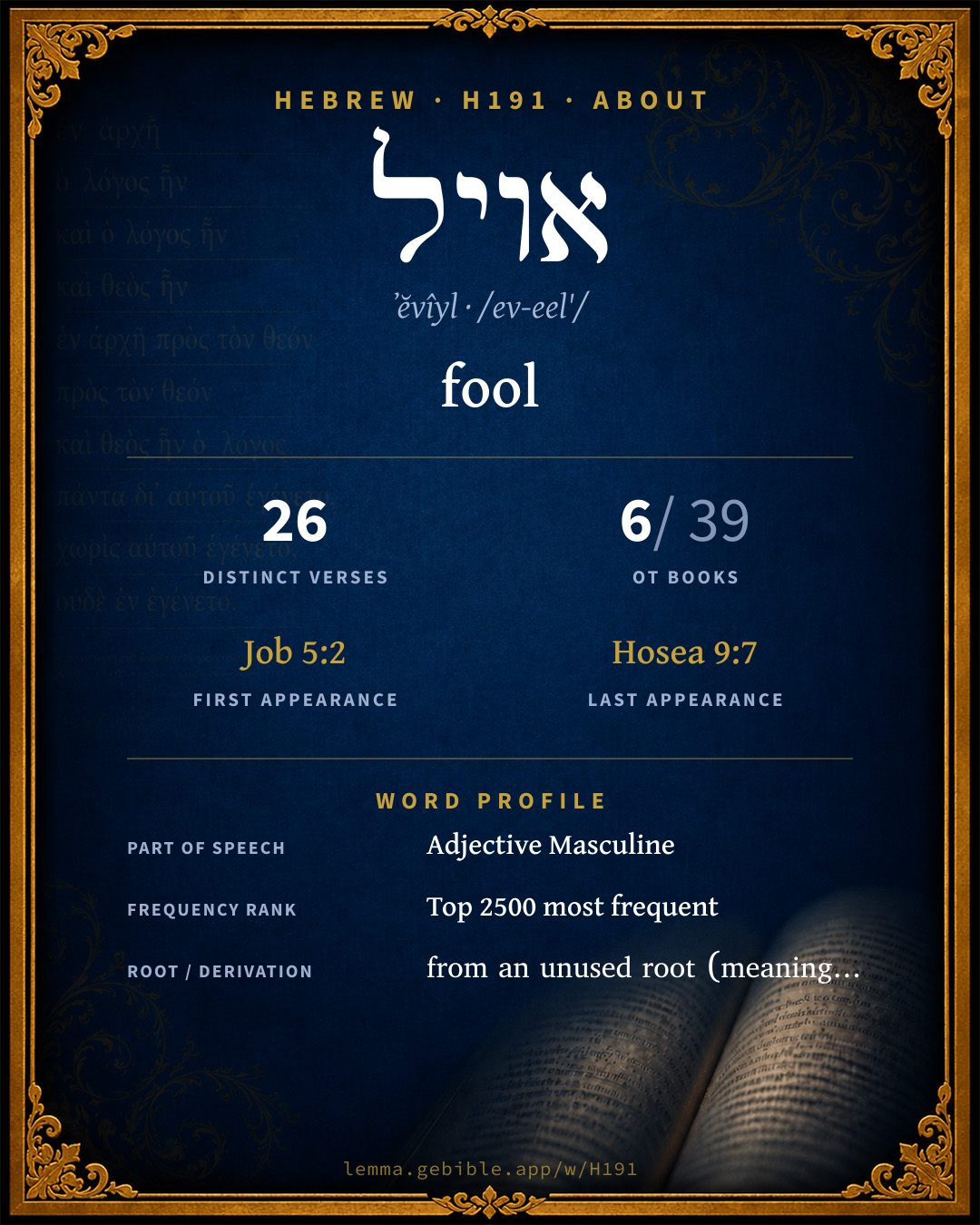
אֱוִיל
fool
‘fool’ is one of 5 main senses fuller range ↓
Full lexicon entry — Brown-Driver-Briggs (BDB)
From Brown-Driver-Briggs (BDB)
Where this word appears
Grammar key — what these labels mean
Part of speech
- Adjective
- A word that describes or qualifies a noun.
State
- Absolute
- The independent form of a noun, not bound to a following word.
Gender
- Masculine
- Grammatically masculine.
Number
- Singular
- One.
- Plural
- More than one (in Hebrew, generally three or more).
Grammatical forms
- Adjective, Adjective, Masculine, Singular, Absolute 19 times (73%)
- Adjective, Adjective, Masculine, Plural, Absolute 7 times (27%)
Parsed forms decoded from the imported morphology (morphhb / Westminster Leningrad Codex — WLC text public domain, morphhb tagging CC BY 4.0), counted across 26 parsed occurrences — not distinct verses.
Every verse where H191 appears — 26 distinct verses across 6 books. Click any verse to open its interlinear word-by-word view. Verse text shown in the World English Bible for context — . Each verse’s Hebrew form is shown with its reference; the English is not keyword-highlighted, since the data carries no word-level English alignment. Use “Compare translations” on any verse to read it across multiple English versions. This concordance covers the Hebrew Bible; Septuagint (Greek Old Testament) occurrences are not indexed here.
Job 2 verses
Psalms 1 verse
Proverbs 19 verses
- Proverbs 1:7 אֱוִילִ֥ים adj Adjective mp The fear of Yahweh is the beginning of knowledge; But the foolish despise wisdom and instruction.
- Proverbs 7:22 אֱוִֽיל adj Adjective ms He followed her immediately, As an ox goes to the slaughter, As a fool stepping into a noose.
- Proverbs 10:8 וֶ/אֱוִ֥יל conj + Adjective Adjective ms The wise in heart accept commandments, But a chattering fool will fall.
- Proverbs 10:10 וֶ/אֱוִ֥יל conj + Adjective Adjective ms One winking with the eye causes sorrow, But a chattering fool will fall.
- Proverbs 10:14 אֱ֝וִיל adj Adjective ms Wise men lay up knowledge, But the mouth of the foolish is near ruin.
- Proverbs 10:21 וֶֽ֝/אֱוִילִ֗ים conj + Adjective Adjective mp The lips of the righteous feed many, But the foolish die for lack of understanding.
- Proverbs 11:29 אֱ֝וִ֗יל adj Adjective ms He who troubles his own house shall inherit the wind. The foolish shall be servant to the wise of heart.
- Proverbs 12:15 אֱ֭וִיל adj Adjective ms The way of a fool is right in his own eyes, But he who is wise listens to counsel.
- Proverbs 12:16 אֱוִ֗יל adj Adjective ms A fool shows his annoyance the same day, But one who overlooks an insult is prudent.
- Proverbs 14:3 אֱ֭וִיל adj Adjective ms The fool's talk brings a rod to his back, But the lips of the wise protect them.
- Proverbs 14:9 אֱ֭וִלִים adj Adjective mp Fools mock at making atonement for sins, But among the upright there is good will.
- Proverbs 15:5 אֱוִ֗יל adj Adjective ms A fool despises his father's correction, But he who heeds reproof shows prudence.
- Proverbs 16:22 אֱוִלִ֣ים adj Adjective mp Understanding is a fountain of life to one who has it, But the punishment of fools is their folly.
- Proverbs 17:28 אֱוִ֣יל adj Adjective ms Even a fool, when he keeps silent, is counted wise. When he shuts his lips, he is thought to be discerning.
- Proverbs 20:3 אֱ֝וִ֗יל adj Adjective ms It is an honor for a man to keep aloof from strife; But every fool will be quarreling.
- Proverbs 24:7 לֶֽ/אֱוִ֣יל prep + Adjective Adjective ms Wisdom is too high for a fool: He doesn't open his mouth in the gate.
- Proverbs 27:3 אֱ֝וִ֗יל adj Adjective ms A stone is heavy, And sand is a burden; But a fool's provocation is heavier than both.
- Proverbs 27:22 הָ/אֱוִ֨יל ptcl def.art + Adjective Adjective ms Though you grind a fool in a mortar with a pestle along with grain, Yet his foolishness will not be removed from him.
- Proverbs 29:9 אֱוִ֑יל adj Adjective ms If a wise man goes to court with a foolish man, The fool rages or scoffs, and there is no peace.
Isaiah 2 verses
- Isaiah 19:11 אֱוִלִים֙ adj Adjective mp The princes of Zoan are utterly foolish; the counsel of the wisest counselors of Pharaoh is become brutish: how do you say to Pharaoh, I am the son of the wise, the son of ancient kings?
- Isaiah 35:8 וֶ/אֱוִילִ֖ים conj + Adjective Adjective mp A highway shall be there, and a way, and it shall be called The way of holiness. The unclean shall not pass over it, but is shall be for for him who walks in the Way. Wicked fools will not go there.
Jeremiah 1 verse
Hosea 1 verse
About this entry
At a glance — auto-summarized from this page’s data, not written by a person. Every figure links to its source below. This summary describes the numbers; it doesn’t interpret them.
The Hebrew adjective אויל centers on the idea of “fool.” Proverbs dominates its distribution — 19 of 26 verses. Spanning 26 verses in 6 books, it ranks among the moderately common words of the Hebrew Bible. Its earliest occurrence is Job 5:2. Lexicons map it across 5 senses. Dig into 26-verse concordance and the renderings breakdown below.
Gloss history
Strong's 1890 vs modern scholarship
About this word
Strong's H191 catalogs a Hebrew word from the Hebrew Old Testament.
These counts are not copied from any lexicon or concordance. They are computed here, from the morphology-tagged Hebrew Old Testament. What Lemma adds →
- 26
- distinct verses
- The word appears in 26 distinct verses.
- 6 / 39
- OT books
- The word appears in 6 of 39 Old Testament books.
- #1,251
- by frequency
- Top 2500 most frequent Hebrew words (rank 1,251 of 8,640 Hebrew words by occurrence).
View all 26 occurrences in the concordance →
By section of the Old Testament
By traditional corpus
Conventional, traditional groupings — biblical authorship is debated, so this is a traditional corpus grouping, not an authorship claim. Each share is this word’s portion of its verses in that division of the Hebrew canon. Each figure is a share of the word’s 26 distinct verses.
- Writings (Ketuvim) 22 verses · 85%
- Prophets (Nevi'im) 4 verses · 15%
How translations render this word
Counts come from each version’s own published word-to-Strong’s tagging or interlinear alignment — an approximate guide to how each version renders this word, not a word-level alignment the data otherwise carries. Because each total is that version’s own tagged count, the per-version totals vary from one another and need not match the appearance or distinct-verse counts above. These counts may also differ from a printed concordance because Lemma counts each distinctly tagged rendering and does not collapse phrase taggings into a single head-word total. This is a fixed set of word-tagged versions (KJV, ASV, BSB, ULT) and does not change with the reading translation you choose elsewhere. Each version’s license is shown beside its name below (and on Sources).
- King James Version: Fool 8×, Fools 6×, Foolish 4×
- American Standard Version: Fool 10×, Foolish 7×, Fools 2×
- Berean Standard Bible: Fool 13×, Fools 7×, Foolish 2×
- unfoldingWord Literal Text: Fool 12×, Foolish 5×, Fools 4×
King James Version Public Domain
Renders H191 across 26 tagged occurrences — most commonly:
Plus 6 renderings that appear only once — usually multi-word phrases or single function words the recovered tagging swept in, not distinct renderings.
American Standard Version Public Domain
Renders H191 across 26 tagged occurrences — most commonly:
Plus 7 renderings that appear only once — usually multi-word phrases or single function words the recovered tagging swept in, not distinct renderings.
Berean Standard Bible Public Domain
Renders H191 across 26 tagged occurrences — most commonly:
Plus 4 renderings that appear only once — usually multi-word phrases or single function words the recovered tagging swept in, not distinct renderings.
unfoldingWord Literal Text CC BY-SA 4.0
Renders H191 across 26 tagged occurrences — most commonly:
Plus 3 renderings that appear only once — usually multi-word phrases or single function words the recovered tagging swept in, not distinct renderings.
Senses in BDB
The 5 senses BDB distinguishes for this word, in lexicon order (not ranked by frequency or importance). The full entry — with sub-senses — is in the Lexicon Entry tab.
- be foolish, foolish
(substantive)
- of one who despises wisdom
- of one who mocks when guilty
- of one who is quarrelsome
- of one who is licentious
Word origin
adj. foolish—א׳ Jb 5:2 +; pl. אֱוִילִים ψ 107:17 +, etc.;—foolish, Pr 29:9 (אִישׁ א׳) Ho 9:7 (pred. of prophet); cf. Is 35:8, elsewhere n.m. fool (always morally bad), who despises wisdom & discipline Pr 1:7; 15:5; mocks at guilt 14:9; is quarrelsome 20:3; licentious 7:22; it is folly & useless to instruct him 16:22; 27:22 (19 times Pr); cf. also Je 4:22; Jb 5:2, 3; Is 19:11 ψ 107:17.
— Brown-Driver-Briggs (Oxford 1906, public domain), digitized via Sefaria, supplemented by the OpenScriptures HebrewLexicon (CC BY 4.0). See Sources.
Origin: from an unused root (meaning to be perverse)
Forms in the corpus
The 17 distinct written forms H191 takes in the Hebrew Bible, most frequent first — each parse links to that state’s occurrences in the concordance. Hebrew forms include their vowel points and cantillation, so a single lemma takes many written forms.
| Form | Parsing | Example | Uses |
|---|---|---|---|
| אֱוִ֣יל | Adjective, Adjective, Masculine, Singular, Absolute | Hosea 9:7 | 4 |
| אֱ֝וִ֗יל | Adjective, Adjective, Masculine, Singular, Absolute | Proverbs 11:29 | 3 |
| אֱ֭וִיל | Adjective, Adjective, Masculine, Singular, Absolute | Proverbs 12:15 | 2 |
| אֱ֭וִלִים | Adjective, Adjective, Masculine, Plural, Absolute | Proverbs 14:9 | 2 |
| אֱוִ֗יל | Adjective, Adjective, Masculine, Singular, Absolute | Proverbs 12:16 | 2 |
| וֶ/אֱוִ֥יל | Adjective, Adjective, Masculine, Singular, Absolute | Proverbs 10:8 | 2 |
| אֱ֝וִיל | Adjective, Adjective, Masculine, Singular, Absolute | Proverbs 10:14 | 1 |
| אֱוִ֑יל | Adjective, Adjective, Masculine, Singular, Absolute | Proverbs 29:9 | 1 |
| אֱוִילִ֥ים | Adjective, Adjective, Masculine, Plural, Absolute | Proverbs 1:7 | 1 |
| אֱוִלִ֣ים | Adjective, Adjective, Masculine, Plural, Absolute | Proverbs 16:22 | 1 |
| אֱוִלִים֙ | Adjective, Adjective, Masculine, Plural, Absolute | Isaiah 19:11 | 1 |
| אֱוִֽיל | Adjective, Adjective, Masculine, Singular, Absolute | Proverbs 7:22 | 1 |
| הָ/אֱוִ֨יל | Adjective, Adjective, Masculine, Singular, Absolute | Proverbs 27:22 | 1 |
| וֶ/אֱוִילִ֖ים | Adjective, Adjective, Masculine, Plural, Absolute | Isaiah 35:8 | 1 |
| וֶֽ֝/אֱוִילִ֗ים | Adjective, Adjective, Masculine, Plural, Absolute | Proverbs 10:21 | 1 |
| לֶֽ/אֱוִ֣יל | Adjective, Adjective, Masculine, Singular, Absolute | Proverbs 24:7 | 1 |
| לֶֽ֭/אֱוִיל | Adjective, Adjective, Masculine, Singular, Absolute | Job 5:2 | 1 |
Same root — word family
Other BDB entries built from the same root as H191, grouped by Strong’s listed origin. These share a root / origin per the lexicon — not necessarily a shared meaning. Each links to that word’s own entry.
Derived from this word
Compare all same-root words → They share a root, not necessarily a meaning.
Septuagint verse parallels
This word appears in 25 verses that also exist in the Greek Old Testament (Septuagint), out of the 26 Hebrew verses it occurs in. You can read those verses in Greek by switching the Old Testament edition to the Septuagint.
Read these verses in the Septuagint
This is a verse-level parallel only — the same verses exist in both the Hebrew and Greek Old Testaments. No word-level Hebrew↔Greek correspondence is claimed: the data carries no such alignment, so no Greek word is shown as this Hebrew word’s translation. Coverage is not total — the Septuagint omits the deuterocanon and renumbers the Psalms, so some Hebrew verses have no direct Greek parallel.