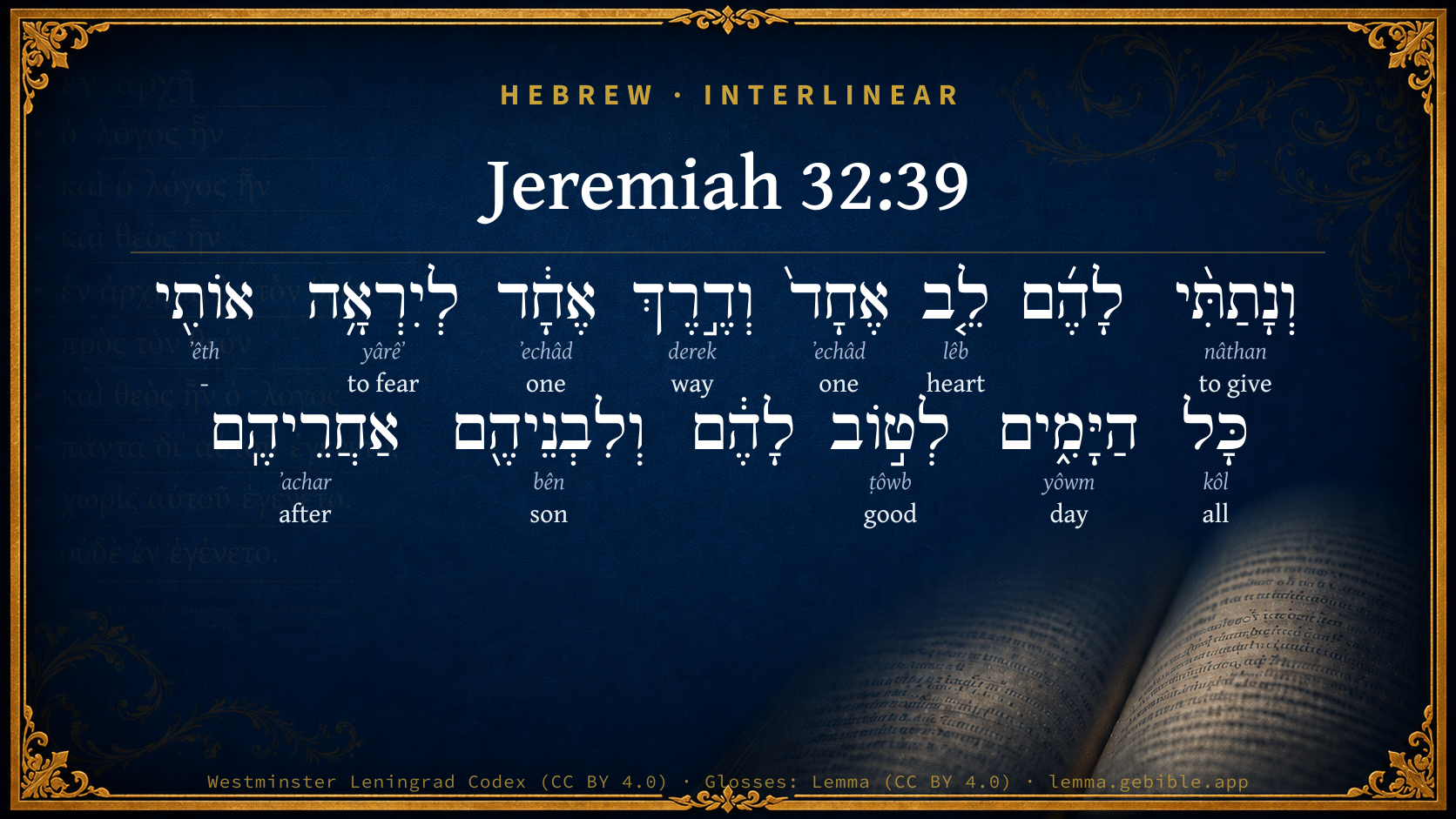
Jeremiah 32:39

Hebrew (Westminster Leningrad Codex) Jeremiah 32:39 appears in the Hebrew Old Testament. The text above is from the Westminster Leningrad Codex. Each word links to its Strong’s number, a concise gloss, and parsing drawn from the Open Scriptures Hebrew Bible morphology. Click any word for its full Brown-Driver-Briggs (BDB) entry.
Download image
Cite this verse

Jeremiah 32:39 (World English Bible). Public Domain. Lemma interlinear Bible study tool, https://lemma.gebible.app/v/jeremiah/32/39.

Show BibTeX & RIS
BibTeX
RIS
English Translation
and I will give them one heart and one way, that they may fear me forever, for the good of them, and of their children after them:
World English Bible · Public Domain
Download a study sheet

One document with this verse’s original text, its word-by-word gloss line, the meaning frame, cross-references with their text, attributed commentary, and full source and license credits — printable, and it pastes into notes with its structure intact.

This verse Autodidact and up

Study sheet (.html) Plain text (.txt)

A passage Seminary Student

Up to 50 verses in one chapter. A passage sheet keeps up to 6 commentary sources and 12 cross-references per verse, in the order this page ranks them, and says so on the sheet whenever that leaves anything out. Ask for a single verse and you get the Autodidact verse sheet above.

Everything on this page stays free to read, with no account — the sheet is a download of what is already on screen, not access to it.

Want to remove ads? Support Godless Engineer
Compare translations 3

The same verse in 3 English versions, stacked beneath the original-language interlinear above. Click any original word for its lexicon entry.

Each is an independent rendering of the whole verse — the interlinear is not word-aligned to these translations.

Highlighted words mark where these versions differ — a whole-verse word diff, not a word-by-word alignment.

  • World English Bible Public Domain
    and I will give them one heart and one way, that they may fear me forever, for the good of them, and of their children after them:
  • King James Version Public Domain
    And I will give them one heart, and one way, that they may fear me for ever, for the good of them, and of their children after them:
  • unfoldingWord Literal Text CC BY-SA 4.0
    I will give them one heart and one way to honor me every day so it will be good for them and their descendants after them.

unfoldingWord Literal Text — © unfoldingWord, licensed CC BY-SA 4.0. Word-aligned USFM3 via Door43 (git.door43.org/unfoldingWord/en_ult).

Versions to compare (up to 4)

3 of 4 selected

Show all 18 translations

Every available English version of this verse, each an independent rendering of the whole verse.

  • World English Bible Public Domain
    and I will give them one heart and one way, that they may fear me forever, for the good of them, and of their children after them:
  • Berean Standard Bible Public Domain
    I will give them one heart and one way, so that they will always fear Me for their own good and for the good of their children after them.
  • Majority Standard Bible Public Domain
    I will give them one heart and one way, so that they will always fear Me for their own good and for the good of their children after them.
  • King James Version Public Domain
    And I will give them one heart, and one way, that they may fear me for ever, for the good of them, and of their children after them:
  • American Standard Version (1901) Public Domain
    and I will give them one heart and one way, that they may fear me for ever, for the good of them, and of their children after them:
  • Revised Version (1885) Public Domain
    and I will give them one heart and one way, that they may fear me for ever; for the good of them, and of their children after them:
  • Geneva Bible (1599) Public Domain
    And I wil giue them one heart and one way that they may feare me for euer for ye wealth of them, and of their children after them.
  • Douay-Rheims (1899) Public Domain
    And I will give them one heart, and one way, that they may fear me all days: and that it may be well with them, and with their children after them.
  • Young's Literal Translation Public Domain
    and I have given to them one heart, and one way, to fear Me all the days, for good to them, and to their sons after them:
  • Literal Standard Version CC BY-SA 4.0
    and I have given to them one heart and one way, to fear Me all the days, for the good of them and their sons after them:
  • Unlocked Literal Bible CC BY-SA 4.0
    I will give them one heart and one way to honor me every day so it will be good for them and their descendants after them.
  • unfoldingWord Literal Text CC BY-SA 4.0
    I will give them one heart and one way to honor me every day so it will be good for them and their descendants after them.
  • Darby Bible Public Domain
    And I will give them one heart, and one way, that they may fear me all [their] days, for the good of them, and of their children after them.
  • World Messianic Bible Public Domain
    I will give them one heart and one way, that they may fear me forever, for their good and the good of their children after them.
  • Webster's Bible Public Domain
    And I will give them one heart, and one way, that they may fear me for ever, for the good of them, and of their children after them:
  • Free Bible Version CC BY-SA 4.0
    I will make sure they think the same way and act in harmony, so that they will always honor me so all will be good for them and their descendants.
  • Bible in Basic English Public Domain
    And I will give them one heart and one way, so that they may go on in the worship of me for ever, for their good and the good of their children after them:
  • JPS Tanakh (1917) Public Domain
    and I will give them one heart and one way, that they may fear Me for ever; for the good of them, and of their children after them;

Literal Standard Version (2020), Covenant Press — licensed CC BY-SA 4.0. Text via the HelloAO Bible API (eBible.org). Unlocked Literal Bible (unfoldingWord) — licensed CC BY-SA 4.0. Text via the HelloAO Bible API (eBible.org). unfoldingWord Literal Text — © unfoldingWord, licensed CC BY-SA 4.0. Word-aligned USFM3 via Door43 (git.door43.org/unfoldingWord/en_ult). Free Bible Version, Dr. Jonathan Gallagher — licensed CC BY-SA 4.0. Text via the HelloAO Bible API (eBible.org).

Word by word

More ways to search: Search by grammar → Find every occurrence → Compare this word →

Practice this passage: Drill this verse → Learn its vocabulary →

לְיִרְאָ֥ה
yârêʼ
H3372
“to fear”
Preposition + Verb, Qal, Infinitive Construct
Part of Speech
Preposition + Verb
Stem
Qal
Form
Infinitive Construct
Full BDB Definition

Origin: a primitive root

TWOT: 907 , 908

to fear, revere, be afraid - (Qal) - to fear, be afraid - to stand in awe of, be awed - to fear, reverence, honour, respect - (Niphal) - to be fearful, be dreadful, be feared - to cause astonishment and awe, be held in awe - to inspire reverence or godly fear or awe - (Piel) to make afraid, terrify - (TWOT) to shoot, pour
  1. וְנָתַתִּ֨י nâthan H5414 “and · to give” Conjunction + Verb, Qal, Sequential Perfect, 1st Person, Common, Singular
  2. לֵ֤ב lêb H3820 “heart” Noun, Common, Masculine, Singular, Absolute
  3. אֶחָד֙ ʼechâd H259 “one” Adjective, Cardinal number, Masculine, Singular, Absolute
  4. וְדֶ֣רֶךְ derek H1870 “and · way” Conjunction + Noun, Common, Both, Singular, Absolute
  5. אֶחָ֔ד ʼechâd H259 “one” Adjective, Cardinal number, Masculine, Singular, Absolute
  6. אוֹתִ֖י ʼêth H853 “- · me” Particle, Direct Object + Suffix, Personal, 1st Person, Common, Singular
  7. כָּל kôl H3605 “all of” Noun, Common, Masculine, Singular, Construct
  8. הַיָּמִ֑ים yôwm H3117 “the · days” Particle, Definite Article + Noun, Common, Masculine, Plural, Absolute
  9. לְט֣וֹב ṭôwb H2896 “to/for · good” Preposition + Adjective, Adjective, Masculine, Singular, Absolute
  10. וְלִבְנֵיהֶ֖ם bên H1121 “and · to/for · sons · their” Conjunction + Preposition + Noun, Common, Masculine, Plural, Construct + Suffix, Personal, 3rd Person, Masculine, Plural
  11. אַחֲרֵיהֶֽם ʼachar H310 “after · them” Preposition + Suffix, Personal, 3rd Person, Masculine, Plural

About this verse

These counts appear in no published source. They are computed here, from the morphology-tagged text and Lemma’s own curated glosses. What Lemma adds →

14
words
11
distinct lemmas
Prophets
section

Grammatical profile

  • 2 verbs
  • 5 nouns
  • 3 adjectives
  • 3 prepositions
  • 1 particle

Verb forms

  • וְנָתַתִּ֨י Qal · Sequential Perfect
  • לְיִרְאָ֥ה Qal · Infinitive Construct

Repetition

A word recurs within this verse — often emphatic in Hebrew:

  • אֶחָד֙ one H259 ×2

Cross-references

31

Topical passages linked to Jeremiah 32:39 in the Treasury of Scripture Knowledge — connected by theme and wording, ordered by reader-vote popularity; previews shown in the World English Bible.

  • Ezekiel 11:19–20 I will give them one heart, and I will put a new spirit within you; and I will take the stony heart out of their flesh, and will give them a heart of flesh;
  • Acts 4:32 The multitude of those who believed were of one heart and soul. Not one of them claimed that anything of the things which he possessed was his own, but they had all things in common.
  • John 17:21 that they may all be one; even as you, Father, are in me, and I in you, that they also may be one in us; that the world may believe that you sent me.
  • Ezekiel 37:25 They shall dwell in the land that I have given to Jacob my servant, in which your fathers lived; and they shall dwell therein, they, and their children, and their children's children, forever: and David my servant shall be their prince for ever.
  • Proverbs 14:26–27 In the fear of Yahweh is a secure fortress, And he will be a refuge for his children.
  • Proverbs 23:17 Don't let your heart envy sinners; But rather fear Yahweh all the day long.
  • Jeremiah 32:40 and I will make an everlasting covenant with them, that I will not turn away from following them, to do them good; and I will put my fear in their hearts, that they may not depart from me.
  • Ezekiel 36:26 A new heart also will I give you, and a new spirit will I put within you; and I will take away the stony heart out of your flesh, and I will give you a heart of flesh.
  • Deuteronomy 11:18–21 Therefore shall you lay up these my words in your heart and in your soul; and you shall bind them for a sign on your hand, and they shall be for symbols between your eyes.
  • 2 Chronicles 30:12 Also on Judah came the hand of God to give them one heart, to do the commandment of the king and of the princes by the word of Yahweh.
  • John 14:6 Jesus said to him, "I am the way, the truth, and the life. No one comes to the Father, except through me.
  • Hebrews 10:20 by the way which he dedicated for us, a new and living way, through the veil, that is to say, his flesh;
  • Genesis 17:7 I will establish my covenant between me and you and your seed after you throughout their generations for an everlasting covenant, to be a God to you and to your seed after you.
  • Genesis 18:19 For I have known him, to the end that he may command his children and his household after him, that they may keep the way of Yahweh, to do righteousness and justice; to the end that Yahweh may bring on Abraham that which he has spoken of him."
  • Genesis 22:12 He said, "Don't lay your hand on the boy, neither do anything to him. For now I know that you fear God, seeing you have not withheld your son, your only son, from me."
  • Deuteronomy 5:29 Oh that there were such a heart in them, that they would fear me, and keep all my commandments always, that it might be well with them, and with their children forever!
  • Psalms 112:1 Praise Yah! Blessed is the man who fears Yahweh, Who delights greatly in his commandments.
  • Psalms 115:13–15 He will bless those who fear Yahweh, Both small and great.
  • Psalms 128:6 Yes, may you see your children's children. Peace be upon Israel.
  • Isaiah 35:8 A highway shall be there, and a way, and it shall be called The way of holiness. The unclean shall not pass over it, but is shall be for for him who walks in the Way. Wicked fools will not go there.
  • Isaiah 52:8 The voice of your watchmen! they lift up the voice, together do they sing; for they shall see eye to eye, when Yahweh returns to Zion.
  • Jeremiah 6:16 Thus says Yahweh, Stand you in the ways and see, and ask for the old paths, where is the good way; and walk therein, and you shall find rest for your souls: but they said, We will not walk [therein].
  • Acts 13:33 that God has fulfilled the same to us, their children, in that he raised up Jesus. As it is also written in the second psalm, 'You are my Son. Today I have become your father.'
  • Romans 11:16 If the first fruit is holy, so is the lump. If the root is holy, so are the branches.
  • 1 Corinthians 7:14 For the unbelieving husband is sanctified in the wife, and the unbelieving wife is sanctified in the husband. Otherwise your children would be unclean, but now are they holy.
  • Ezekiel 37:22 and I will make them one nation in the land, on the mountains of Israel; and one king shall be king to them all; and they shall be no more two nations, neither shall they be divided into two kingdoms any more at all;
  • Acts 2:39 For to you is the promise, and to your children, and to all who are far off, even as many as the Lord our God will call to himself."
  • Acts 3:26 God, having raised up his servant, Jesus, sent him to you first, to bless you, in turning away everyone of you from your wickedness."
  • Acts 9:31 So the assemblies throughout all Judea and Galilee and Samaria had peace, and were built up. They were multiplied, walking in the fear of the Lord and in the comfort of the Holy Spirit.
  • 2 Corinthians 13:11 Finally, brothers, rejoice. Be perfected, be comforted, be of the same mind, live in peace, and the God of love and peace will be with you.
  • Philippians 2:1–2 If there is therefore any exhortation in Christ, if any consolation of love, if any fellowship of the Spirit, if any tender mercies and compassion,

Cross-references courtesy of OpenBible.info (CC BY 4.0).

Hebrew and Greek witnesses Masoretic Hebrew ↔ Greek Septuagint

The same verse in the two great witnesses to the Old Testament, shown verse-for-verse.

These are two independent witnesses, not word-aligned to each other, and the Septuagint is shown in lemma (dictionary) form.

Hebrew Jeremiah 32:39 Masoretic · Westminster Leningrad Codex

וְנָתַתִּ֨י לָהֶ֜ם לֵ֤ב אֶחָד֙ וְדֶ֣רֶךְ אֶחָ֔ד לְיִרְאָ֥ה אוֹתִ֖י כָּל הַיָּמִ֑ים לְט֣וֹב לָהֶ֔ם וְלִבְנֵיהֶ֖ם אַחֲרֵיהֶֽם

and I will give them one heart and one way, that they may fear me forever, for the good of them, and of their children after them:

World English Bible · Public Domain

Greek LXX Structure differs

In the Septuagint, Jeremiah is about an eighth shorter than the Hebrew and arranges its material differently — the Oracles Against the Nations (Hebrew chapters 46–51) appear in the middle of the Greek book, after 25:13. Because the chapter and verse boundaries do not line up, a verse-for-verse comparison with the Hebrew is not shown.

A verse-for-verse comparison isn’t shown here because the chapters and verses don’t line up. Switch to the LXX edition with the MT / LXX toggle above to read the Greek directly.

Hebrew: Westminster Leningrad Codex (CC BY 4.0). Greek: Septuagint (public domain); English from a public-domain English Septuagint. How the Septuagint differs from the Hebrew →

Targum (Aramaic paraphrase)

1

The Targum is the ancient Jewish Aramaic paraphrase of the Hebrew Scriptures — an interpretive translation, not the Hebrew text itself. Onkelos (literal) and Pseudo-Jonathan (expansive) render the Torah, and Jonathan the Prophets. Coverage is partial: where no permissively-licensed English translation exists for a verse, only the Aramaic is shown. This is verse-level text, not a word-by-word alignment to the Hebrew.

  1. Targum Jonathan Prophets (Joshua–Malachi)
    וְאֶתֵּן לְהוֹן לִבָּא חַד וְאוֹרַח חַד לְמִדְחַל קֳדָמַי כָּל יוֹמַיָא דְיִיטַב לְהוֹן וְלִבְנֵיהוֹן בַּתְרֵיהוֹן:

    (no public-domain English translation for this verse)

    Targum Jonathan — Aramaic: “Mikraot Gedolot” (public domain). English: “Sefaria Community Translation” (CC0 1.0 (public-domain dedication)); “London "Chaldee Paraphrase," 1871” (public domain). Text via Sefaria.

Commentary

Notes on Jeremiah 32:39 from classic Christian and Jewish commentators (each source and its license shown beneath its notes). The classic Christian expositions comment on the surrounding passage and are grouped to its opening verse, so a note may address several verses; the Jewish commentaries on the Tanakh (Rashi and others) are per-verse, so they appear only where the commentator wrote on this verse.

Lemma curates 59 commentaries, every one of them public domain or Creative Commons licensed, each selected and text-cleaned for this edition rather than reprinted as found. About our sources →

Trapp's Complete Commentary

John Trapp

Jer 32:39 And I will give them one heart, and one way, that they may fear me for ever, for the good of them, and of their children after them:

Ver. 39. And I will give them one heart.] Oneness or singleness of heart in my service, and unanimity among themselves, until they all come unto that oneness of the faith, and of the knowledge of the Son of God, unto a perfect man, &c. {Eph 4:13}

That they may fear me for ever.] This the Jews say (but falsely) a man may do by the power of nature. See Jer 32:40 Eze 36:26-27.

John Trapp, A Commentary or Exposition upon All the Books of the Old and New Testament (1647–1656) — public domain. Text from a community e-Sword module.

The Biblical Illustrator

Joseph S. Exell

Jer_32:39

I will give them one heart, and one way, that they may fear Me for ever.

Whole-hearted religion

In reference to the heart, one of the earliest works of Divine grace is to unite it in one. Strange to say, I should be equally truthful if I said that one of the first works of grace is to break the heart; but so paradoxical is man that when his heart is unbroken it is divided, and when his heart is broken, then, for the first time, it is united; for a broken heart in every fragment of it mourns over sin, and cries out for mercy. Every shattered particle of a contrite spirit is united in one desire to be reconciled to God. There is no union of the heart with itself till it is broken for sin and from sin.

I. Unitedness of the heart.

1. It is naturally divided. Sin is confusion, and at its entrance it created a Babel, or a confusion, within the heart of mare The lusts crave for that which the intellect condemns; the passions demand that which the reason would deny; the will persists in that which the judgment would forego. To many a man it is given to admire things that are excellent, and still to delight in things which are abominable. His conscience bids him rise to a pure and noble life, but his baser passions hold him down to that which is earthly and sensual. Frequently, too, there is a very great division between a mans inward knowledge and his outward conduct. Men are often wise in the head and foolish in the hand: ,they know the right and do the wrong Man is a puzzle, and none can put him together but He that made him at the first. He is a self-contradiction, a house divided against itself, a mystery of iniquity, a maze of folly, a mass of perversity, obstinacy, and contention.

2. If our heart be not whole and entire in following after God we cannot meet with acceptance. God never did and never will receive the homage of a divided heart. Alexander, when Darius proposed that the two great monarchs should divide the world, replied that there was only room for one sun in the heavens. What his ambition affirmed that God declareth from the necessity of the case. Since one God fills all things there is no room for another. It is idle to attempt to serve two such masters as holiness and iniquity. It was once proposed to the Roman senate to set up the image of Christ in the Pantheon among the gods, but when they were informed that He would not agree that any worship should be mingled with His own, the senate straightway refused Him a shrine. In this they acted in a manner consistent with itself; but those are altogether inexcusable who swear by the Lord and swear by Malcham.

3. It must be united for sincerity: a divided heart is a false heart. Declare that thou wilt serve Belial ever so little, and I know that thy service of Christ is but Judas service--mercenary, temporary, traitorous.

4. Our heart must be united, next, for intensity of life. True religion needs the soul to be ever at a fervent heat. None climb the hill whereon the New Jerusalem is built except such as go on hands and knees, and laying aside every weight give themselves wholly to the Divine ascent.

5. The heart must be united to be consecrated. Will God be served with broken cups and cracked flagons, and shall His altars be polluted with torn and mangled sacrifices?

6. We must have our heart united, or else none of the blessings which, are to follow in covenant order can possibly reach us. For, look, I will give them one heart, and then it follows, one way; no man will have a consistent, uniform way while he has a divided heart, Read next, That they shall fear Me for ever; but no man will fear God for ever unless fear has taken possession of his whole heart. The convert may profess to follow the Lord for awhile, but he will soon turn aside; he who does not begin with his whole heart will soon tire of the race.

7. God will give His chosen this unified heart. I will give them one heart. This the Lord does in part by enlightenment through the light of His Holy Spirit. He shows us the worthlessness and deceptiveness of everything that would attract our hearts away from Jesus and from our God; and when we see the evil of the rival, we give our heart entirely to Him whom we worship. The Lord works this also by a process more thorough still; for He weans us from all idolatrous loves.

II. If we have this we may now advance to the second blessing of the covenant here mentioned, which is consistency of walk. I will give them one way.

1. Without this unity there can be no truth in a mans life. If he spins by day, and unravels at night, he is acting out a falsehood.

2. We must have one walk, or else our life will make no progress. He who travels in two opposite directions will find himself no forwarder.

3. We must choose and keep to one way, or we cannot attain to usefulness. If a man speak for God to-day, and so lives to-morrow that he virtually speaks for the devil, what power has he over those around him? How can he lead who has no way of his own?

4. No person can come to any true personal assurance while his life is of a double character. But if I know that I have one heart, and that my heart belongs to my Lord, and that I have one way, a way of obedience to Him, then may I be assured that I am His. A plain way will make our condition plain. This unity of way is a covenant blessing: it comes not of man, neither by man, but God gives it to His own elect as one of the choice favours of His grace. I will give them one heart and one way.

III. Notice the next covenant blessing, steadfastness of principle. That they may fear Me for ever. Get the heart and the way right, and then the spiritual force of the fear of God will abide in us in all days to come. Notice the basis of true religion,--it is the fear of God: it is not said that they shall join a church and make a profession, and speak holy words for ever; but that They may fear Me for ever. When God has given us a true spiritual fear of Him it will abide all tests. Outward religion depends upon the excitement which created it; but the fear of the Lord lives on when all around it is frost-bitten. Persecution comes, Christians are ridiculed in the workshop, they are pointed out in the street, and an opprobrious name is hooted at them; now we shall know who are Gods elect and who are not. Then, perhaps, comes a more serious test, the trial of prosperity. A man grows rich, he rises into another class of society. If he is not a real Christian he will forsake the Lord, but if he be a true-born heir of the kingdom he will fear the Lord for ever, and consecrate his substance to Him. A heart wholly given to God will stand the wear and tear of life in all conditions, whether in honour or in contempt. With some of you old age is creeping on; but I rejoice to know that your grace is not decaying. Oh, what a mercy it is to have within us a fear of God, which is not to last for a period of years, but for ever!

IV. Personal blessedness. For the good of them. Where God gives us one heart and one way, and steadfast principle, it must be for our good in the highest sense. Tell me who are the happiest Christians. They will be found to be whole-hearted Christians. Plunge into the river of life; let body, soul, and spirit be immersed into its floods, and you shall swim in joy unspeakable. Lose sight of the shores of worldliness and you shall see Gods wonders in the deeps. In intense devotion to the Lord, you will find the rare jewel, satisfaction.

V. The last is a relative blessing. And for their children after them. Wholehearted Christians are usually blessed with a posterity of a like kind. Be thorough and true, and your family will respect your faith. The almost inevitable consequence of respect in a child towards his parent is a desire to imitate him. It is not always so, but as a rule it is so: if the parents live unto God in a thorough, hearted way, their sons and daughters aspire to the same thing. They see the beauty of religion at home around the fireside, and their conscience being quickened they are led to pray to God that they may have the like piety, so that when they themselves commence a household they may enjoy the like happiness. (C. H. Spurgeon.)

The Biblical Illustrator, edited by Joseph S. Exell (c. 1880s–1900s) — public domain. Text from a community e-Sword module.

Tyndale Open Study Notes

Tyndale Open Resources

32:39 Under the new covenant, the people would worship the one true God rather than idols.

Tyndale Open Study Notes — © Tyndale Open Resources, licensed CC BY-SA 4.0. Text via the HelloAO Bible API.

Geneva Bible (1599)

Geneva Bible translators

One consent and one religion, as Ezek. 11:19 and 36:27.

Geneva Bible (1599) marginal notes — public domain. Text via Bolls.life.

Jamieson, Fausset & Brown

Robert Jamieson, A. R. Fausset & David Brown

one heart--all seeking the Lord with one accord, in contrast to their state when only scattered individuals sought Him (Eze 11:19-20; Zep 3:9).

for . . . good of them-- (Psa 34:12-15).

Jamieson, Fausset & Brown — Commentary Critical and Explanatory on the Whole Bible (1871) — public domain (CC PDM 1.0). Text via the HelloAO Bible API.

Adam Clarke's Commentary

Verse 39. I will give them one heart] And that a clean one.

And one way] And that a holy and safe one: and to have this clean heart, and to walk in this good way, will be for the good of them and their children after them. God's blessing is a profitable inheritance. They shall have but one object of worship, and one way of salvation; and being saved from sin, idolatry, and destruction, they must necessarily be happy within and happy without.

Adam Clarke's Commentary on the Bible (1810–1826) — public domain. Text from a community e-Sword/MySword module.

John Calvin's Commentaries

He more clearly explains the last verse; for he mentions the effects of the favor referred to. God indeed includes everything in one word, when he declares that he will be our God, for he thus adopts us as his children. Hence comes the certainty as to our heavenly inheritance, and also as to his mercy, which is better than life. There is then nothing that can be desired beyond this benefit, that is, when God offers himself to us, and deigns to receive and embrace us as his people.

But as I have already said, we do not fully comprehend the benefit of this doctrine; for, first, we are very tardy and dull, we perceive not what God means by this expression, and then we know how much our nature is prone to diffidence, so far is the distance between us and God. Hence this doctrine has need of explanation. Therefore the Prophet, after having pointed out the cause and the beginning of all blessings, now mentions the effects, which more fully confirm what he had said. Hence he says, I willgive to them one heart and one way, that they may fear me for ever: for God does not otherwise own us as his people, nor can he be our Father, except he regenumtes us by his Spirit; for it is of regeneration that the Prophet here speaks. But I must defer the rest until to-morrow.

John Calvin's Commentaries (1540-1563) — public domain. Text from the Calvin Translation Society English edition (1840s-50s) via the Christian Classics Ethereal Library (ccel.org). Calvin's coverage is partial (roughly two-thirds of the Bible); uncommented books and verses are honest gaps, never fabricated. The 19th-century editor's footnotes and remarks are omitted so the notes are faithfully Calvin's own voice.

Ellicott's Commentary for English Readers

(39) I will give them one heart, and one way.—The previous verse has described the restoration of Israel in the old familiar all-inclusive terms—“They shall be my people, and I will be their God” (Exo_6:7; Deu_14:2; Hos_2:23). Here a new feature is added. The prophet, in his vision of the future, in place of the discords of the present—some serving Jehovah, and some Baal and Molech; some urging submission to Babylon, and some intriguing with Egypt—sees a unity in faith showing itself in unity of action. The hope of Jeremiah has never yet been realised, but it has appeared as with a transfigured glory in the prayer of the Christ for His people that they “all may be one,” even as He and the Father are one (Joh_17:21-23), in the prayer of the Apostle, that all might be joined together “in the unity of the faith” (Eph_4:13). And that prayer also waits for its fulfilment, and receives only partial and (to use Bacon’s phrase) “germinant” accomplishments. “For ever” represents the Hebrew all the days.

A Bible Commentary for English Readers, edited by Charles John Ellicott (1878–1897) — public domain. Text from a community e-Sword module.

The Cambridge Bible for Schools and Colleges

gen. ed. J. J. S. Perowne

39. that they may fear me for ever … after them] The words seem suggested by those of Deu_4:10; Deu_6:24.

The Cambridge Bible for Schools and Colleges (gen. ed. J. J. S. Perowne; Cambridge University Press, 1878–1918) — public domain. Text from a community e-Sword module.

John Gill's Exposition

Yea, I will rejoice over them to do them good,.... His covenant people, to whom he gives one heart and one way, and who have his fear implanted in them, and shall never depart from him, but persevere to the end: these he loves with a love of complacency and delight; he rejoices over them, not as considered in themselves, but as in Christ; he rejoices over them, as the bridegroom rejoices over the bride; and which does not merely lie in expression, but appears in fact; he does them good, and with the utmost joy and pleasure; he delights in showing mercy to them, beautifies them with salvation, and takes pleasure in their prosperity; he has taken up good thoughts and resolutions concerning them in his heart; has promised good things to them in his covenant; has provided good things for them in his Son, and bestows them on them in regeneration; and constantly supplies them with his grace, and will withhold no good thing from them, till he has brought them to glory; all which he does cheerfully and with the utmost delight The Targum is,

"my Word shall rejoice over them;''

the essential Word, Christ; he was rejoicing in them, and his delights were with them from eternity; he rejoices over them, as his lost sheep found at conversion; and they shall be his joy and crown of rejoicing to all eternity; and it was for the joy of having them with him that he endured so much for them in the redemption of them:

and I will plant them in this land assuredly; or "in truth", or "in stability and firmness" (n); for it does not seem so much to relate to the truth of the promise, and the assurance that may be had of the fulfilment of that, as to the reality and constancy of the blessing itself. A Gospel church state was first planted in Judea, and from thence has been spread into other parts, and has never been rooted out of the world since; and when the Jews, upon their conversion, are settled in their own land again, they will never more be removed:

with my whole heart and with my whole soul. Grotius thinks these clauses are to be connected with the former part of the verse, that God will rejoice over them to do them good with all his heart and soul; but this the accents will not admit of; but the meaning is, that he will do this particular good for them, as well as all others, in the most cordial and respectable manner, even planting and establishing them in their own land. The Targum is,

"by my Word, and by my will.''

(n) "in veritate", Calvin, Cocceius, Schmidt; "in terra hac firma", Junius & Tremellius; "in terra hac firma", Grotius.

John Gill's Exposition of the Whole Bible (1746–1763) — public domain (CC PDM 1.0). Text via the HelloAO Bible API.

Matthew Poole's English Annotations

I will give them one heart; I will give them union and concord, or a oneness of mind and judgment; as to the things of God, they shall not be some for superstitious and idolatrous worship, and some for my true worship. And one way; they shall all worship me according to the rule I have given them.

That they may fear me for ever; that they may worship me in truth, as a people that have a dread of me upon their hearts.

For the good of them, and of their children after them; this will be for the profit both of them and their posterity many days, even so long as they shall continue so to do.

Matthew Poole's English Annotations on the Holy Bible (1683–1685) — public domain. Text from a community e-Sword/MySword module.

Whedon's Commentary on the Bible

Daniel D. Whedon

39. One heart, and one way — Righteousness carries with it inevitably harmony and unity; sin is everywhere and always a note of discord and strife.

Daniel D. Whedon (gen. ed.), Commentary on the Old and New Testaments (1874–1909) — public domain. Text from a community e-Sword module.

The Pulpit Commentary

One heart, and one way. Unity is always given as the "note" of the ideal, Messianic period. (comp. Zep_3:9 Joh_10:16) That they may fear me forever. This reminds us of a phrase in the exhortation in Deu_4:10, as the next clause does of Deu_6:24.

Unity.

I UNITY IS PROMISED AS A CHARACTERISTIC OF THE GOLDEN AGE OF THE FUTURE. This is unity of thought, "one heart," and unity of conduct, "one way." Men shall then see "eye to eye," discord and controversy cease, peace and amity prevail. There may still be diversity of ideas in the sense of personal difference, because individual characters, positions, and opportunities must still vary. But in a perfect condition there will be no discord. The variations will harmonize. So all will not do exactly the same thing in exactly the same manner. There will, doubtless, be various spheres of action and various personal styles of work. But these will not conflict. They will all tend the same way.

II UNITY IS INVOLVED IN THE IDEA OF PERFECTION.

1. Unity of thought. Truth is one. It may be variously conceived; at first broken lights caught up in opposite quarters may look very different. But the more we eliminate personal "views," the more we can get of the white light of facts, the nearer we approach to the central verity, the more unity shall we obtain. Absolute truth is an absolute unity. This is apparent in mathematics. Two and two cannot be both four and five at the same time four to one man, five to his neighbour.

2. Unity of action. As there is but one absolute truth, so there is but one absolute right. Under all circumstances there can be but one thing which is absolutely the best to be done. That one thing is the right. Till we find this, we make blundering attempts to reach it from different directions. Hence the contradictions in the conduct even in good men. When the right is found and followed by all, there must he unity of conduct.

III UNITY IS TO BE REALIZED THROUGH THE PERFECTED INFLUENCE OF CHRISTIANITY. It was promised as one of the great Messianic blessings. In Christianity we see the growing realization of those blessings.

1. This is accomplished by the personal influence of Christ. One powerful centre of attraction binds into unity all that comes under its influence. The sun makes one system of the several planets that revolve about it. The general of genius welds the scattered regiments of his army into one body through his common command over them and their common devotion to him. Christ exerts a similar influence. He is broad enough in his humanity and strong enough in his divinity to attract and influence all kinds of men. Thus "he is our Peace, who made both" (Jew and Gentile) "one, and broke down the middle wall of partition". (Eph_2:14) All may see a unity of truth in him who is "the Light of the world" and be led in one way as they follow his footsteps.

2. This unity is further realized in the inwardness of Christianity. The new covenant is written on the heart. (Jer_31:33) We differ most in externals; under various clothes there beats the same human heart. When we come to the heart we come to unity. Thus the inward principles of truth and love in Christianity tend to bind Christians together. We are divided because these have not yet their perfect work. No external compulsion will accomplish the same end. On the contrary, this will only aggravate internal dissension. Persecution is the parent of heresy; charity is the mother of unity.

The Pulpit Commentary (1880–1919), ed. H.D.M. Spence-Jones & Joseph S. Exell — public domain. Text from a community e-Sword module.

John Wesley's Explanatory Notes

One heart - I will give them union and concord, one mind and judgment. One way - They shall all worship me according, to the rule I have given them.

John Wesley, Explanatory Notes Upon the Whole Bible (1754–1765) — public domain. Text via the GEBible commentary corpus.

Lesson kit

Teaching starters — assembled from the data on this page, not authored interpretation. Every prompt links to the verse data it draws on. Edit before teaching.

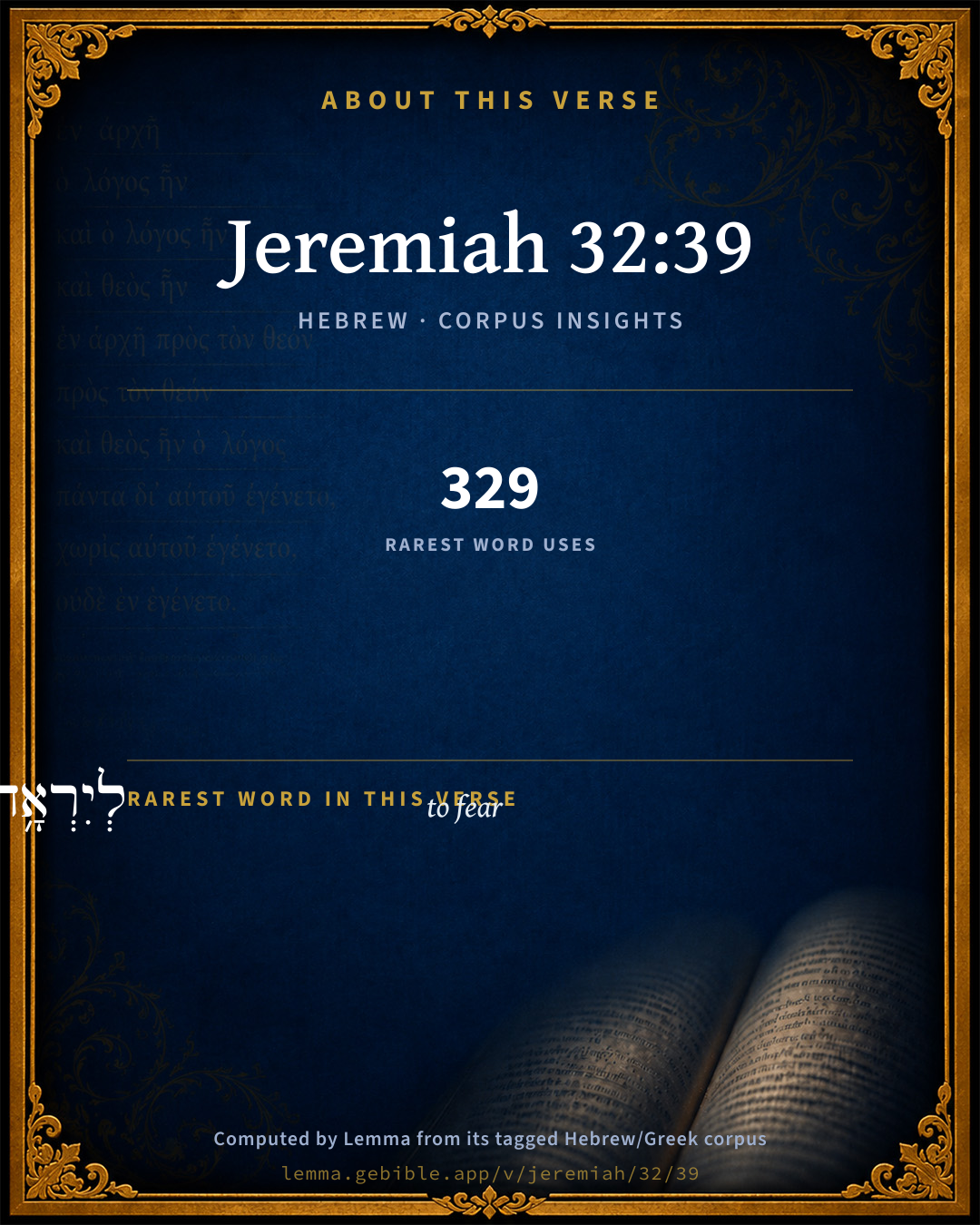
Jeremiah, in the Prophets, opens this verse with 14 words (11 distinct Hebrew lemmas). Its most distinctive word is yârêʼ (“to fear”). A historical commentator’s framing appears above. Read the whole chapter for the surrounding context.

Discussion questions

  1. The word yârêʼ carries the sense “to fear.” How does it shape the verse?
  2. Ezekiel 11:19–20 shares this passage’s theme. How do the two illuminate each other?
  3. “one” occurs 2× in this one verse. What is the effect of the repetition?
  4. These translations render this verse differently. What is at stake in choosing one wording over another?
  5. The verb «וְנָתַתִּ֨י» is Qal Sequential Perfect. How does its form color the action?
  6. Reading how Trapp's Complete Commentary and The Biblical Illustrator read this verse, where do the two commentators agree and where do they part?

Things to notice

Reading settings

Reading text

Shown beneath each verse's original-language words.

Old Testament
Old Testament edition

Read the OT as the Masoretic Hebrew (MT) or the Greek Septuagint (LXX).

English shown for the Greek Septuagint (in the Hebrew ↔ Greek comparison).

Comparing translations? Open the Compare panel on any verse page to stack up to four side by side.