
Proverbs 7:22

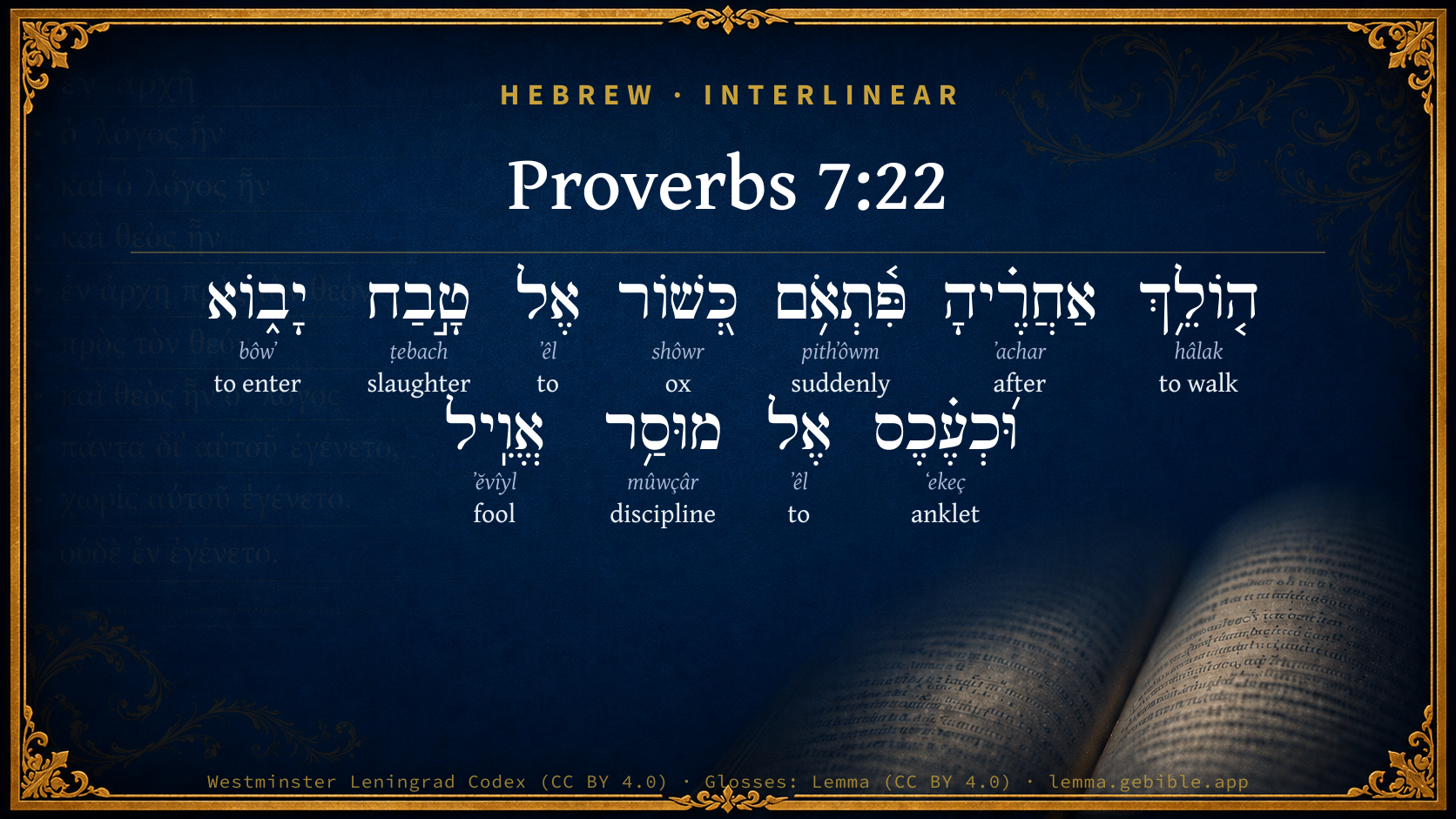
Hebrew (Westminster Leningrad Codex) Proverbs 7:22 appears in the Hebrew Old Testament. The text above is from the Westminster Leningrad Codex. Each word links to its Strong’s number, a concise gloss, and parsing drawn from the Open Scriptures Hebrew Bible morphology. Click any word for its full Brown-Driver-Briggs (BDB) entry.
Download image
Cite this verse

Proverbs 7:22 (World English Bible). Public Domain. Lemma interlinear Bible study tool, https://lemma.gebible.app/v/proverbs/7/22.

Show BibTeX & RIS
BibTeX
RIS
English Translation
He followed her immediately, As an ox goes to the slaughter, As a fool stepping into a noose.
World English Bible · Public Domain
Highlights Full analysis ↓
Download a study sheet

One document with this verse’s original text, its word-by-word gloss line, the meaning frame, cross-references with their text, attributed commentary, and full source and license credits — printable, and it pastes into notes with its structure intact.

This verse Autodidact and up

Study sheet (.html) Plain text (.txt)

A passage Seminary Student

Up to 50 verses in one chapter. A passage sheet keeps up to 6 commentary sources and 12 cross-references per verse, in the order this page ranks them, and says so on the sheet whenever that leaves anything out. Ask for a single verse and you get the Autodidact verse sheet above.

Everything on this page stays free to read, with no account — the sheet is a download of what is already on screen, not access to it.

Want to remove ads? Support Godless Engineer
Compare translations 3

The same verse in 3 English versions, stacked beneath the original-language interlinear above. Click any original word for its lexicon entry.

Each is an independent rendering of the whole verse — the interlinear is not word-aligned to these translations.

Highlighted words mark where these versions differ — a whole-verse word diff, not a word-by-word alignment.

  • World English Bible Public Domain
    He followed her immediately, As an ox goes to the slaughter, As a fool stepping into a noose.
  • King James Version Public Domain
    He goeth after her straightway, as an ox goeth to the slaughter, or as a fool to the correction of the stocks;
  • unfoldingWord Literal Text CC BY-SA 4.0
    Following after her suddenly, like an ox to slaughter he goes, and like an ankle chain to the correction of a fool,

unfoldingWord Literal Text — © unfoldingWord, licensed CC BY-SA 4.0. Word-aligned USFM3 via Door43 (git.door43.org/unfoldingWord/en_ult).

Versions to compare (up to 4)

3 of 4 selected

Show all 18 translations

Every available English version of this verse, each an independent rendering of the whole verse.

  • World English Bible Public Domain
    He followed her immediately, As an ox goes to the slaughter, As a fool stepping into a noose.
  • Berean Standard Bible Public Domain
    He follows her on impulse, like an ox going to the slaughter, like a deer bounding into a trap,
  • Majority Standard Bible Public Domain
    He follows her on impulse, like an ox going to the slaughter, like a deer bounding into a trap,
  • King James Version Public Domain
    He goeth after her straightway, as an ox goeth to the slaughter, or as a fool to the correction of the stocks;
  • American Standard Version (1901) Public Domain
    He goeth after her straightway, As an ox goeth to the slaughter, Or as `one in' fetters to the correction of the fool;
  • Revised Version (1885) Public Domain
    He goeth after her straightway, as an ox goeth to the slaughter, or as fetters to the correction of the fool;
  • Geneva Bible (1599) Public Domain
    And he followed her straight wayes, as an oxe that goeth to the slaughter, and as a foole to the stockes for correction,
  • Douay-Rheims (1899) Public Domain
    Immediately he followeth her as an ox led to be a victim, and as a lamb playing the wanton, and not knowing that he is drawn like a fool to bonds,
  • Young's Literal Translation Public Domain
    He is going after her straightway, As an ox unto the slaughter he cometh, And as a fetter unto the chastisement of a fool,
  • Literal Standard Version CC BY-SA 4.0
    He is going after her straight away, he comes as an ox to the slaughter, || And as a chain to the discipline of a fool,
  • Unlocked Literal Bible CC BY-SA 4.0
    He went after her suddenly like an ox going to slaughter, like a deer caught in a trap,
  • unfoldingWord Literal Text CC BY-SA 4.0
    Following after her suddenly, like an ox to slaughter he goes, and like an ankle chain to the correction of a fool,
  • Darby Bible Public Domain
    He went after her straightway, as an ox goeth to the slaughter, and as stocks [serve] for the correction of the fool;
  • World Messianic Bible Public Domain
    He followed her immediately, as an ox goes to the slaughter, as a fool stepping into a noose.
  • Webster's Bible Public Domain
    He goeth after her quickly, as an ox goeth to the slaughter, or as a fool to the correction of the stocks;
  • Free Bible Version CC BY-SA 4.0
    He followed her right away, like an ox to the slaughter. Like a stag that's caught in a snare
  • Bible in Basic English Public Domain
    The simple man goes after her, like an ox going to its death, like a roe pulled by a cord;
  • JPS Tanakh (1917) Public Domain
    He goeth after her straightway, as an ox that goeth to the slaughter, or as one in fetters to the correction of the fool;

Literal Standard Version (2020), Covenant Press — licensed CC BY-SA 4.0. Text via the HelloAO Bible API (eBible.org). Unlocked Literal Bible (unfoldingWord) — licensed CC BY-SA 4.0. Text via the HelloAO Bible API (eBible.org). unfoldingWord Literal Text — © unfoldingWord, licensed CC BY-SA 4.0. Word-aligned USFM3 via Door43 (git.door43.org/unfoldingWord/en_ult). Free Bible Version, Dr. Jonathan Gallagher — licensed CC BY-SA 4.0. Text via the HelloAO Bible API (eBible.org).

Word by word

More ways to search: Search by grammar → Find every occurrence → Compare this word →

Practice this passage: Drill this verse → Learn its vocabulary →

וּ֝כְעֶ֗כֶס
ʻekeç
H5914
“and · like/as · anklet”
Conjunction + Preposition + Noun, Common, Masculine, Singular, Absolute
Part of Speech
Conjunction + Preposition + Noun
Type
Common
Gender
Masculine
Number
Singular
State
Absolute
Full BDB Definition

Origin: from H5913

TWOT: 1620a

anklet, bangle
  1. ה֤וֹלֵ֥ךְ hâlak H1980 “walking” Verb, Qal, Participle Active, Masculine, Singular, Absolute
  2. אַחֲרֶ֗יהָ ʼachar H310 “after · her” Preposition + Suffix, Personal, 3rd Person, Feminine, Singular
  3. פִּ֫תְאֹ֥ם pithʼôwm H6597 “suddenly” Adverb
  4. כְּ֭שׁוֹר shôwr H7794 “like/as · ox” Preposition + Noun, Common, Masculine, Singular, Absolute
  5. אֶל ʼêl H413 “to” Preposition
  6. טָ֣בַח ṭebach H2874 “slaughter” Noun, Common, Masculine, Singular, Absolute
  7. יָב֑וֹא bôwʼ H935 “to enter” Verb, Qal, Imperfect, 3rd Person, Masculine, Singular
  8. אֶל ʼêl H413 “to” Preposition
  9. מוּסַ֥ר mûwçâr H4148 “discipline of” Noun, Common, Masculine, Singular, Construct
  10. אֱוִֽיל ʼĕvîyl H191 “fool” Adjective, Adjective, Masculine, Singular, Absolute

About this verse

These counts appear in no published source. They are computed here, from the morphology-tagged text and Lemma’s own curated glosses. What Lemma adds →

11
words
10
distinct lemmas
Wisdom
section

Notable vocabulary

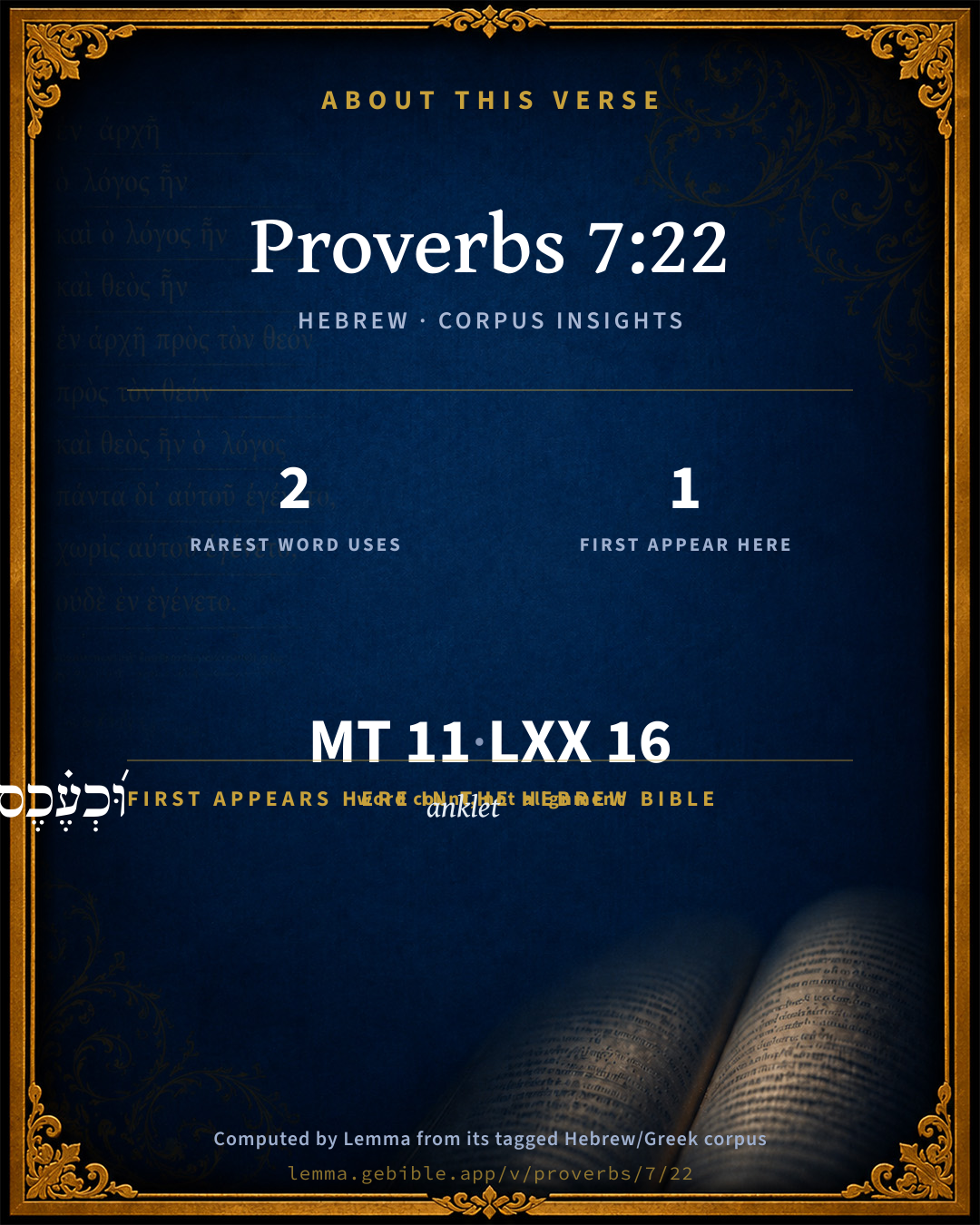
The rarest word here is וּ֝כְעֶ֗כֶס anklet H5914 — appearing just 2 times in the whole Hebrew Bible.

First appearance in Scripture

This word makes its first canonical appearance in the Hebrew Bible here:

  • וּ֝כְעֶ֗כֶס anklet H5914

Shared distinctive vocabulary

וּ֝כְעֶ֗כֶס anklet H5914 occurs in 2 verses of the Hebrew Bible. Also found in:

Grammatical profile

  • 2 verbs
  • 4 nouns
  • 1 adjective
  • 3 prepositions
  • 1 adverb

Verb forms

  • ה֤וֹלֵ֥ךְ Qal · Participle Active
  • יָב֑וֹא Qal · Imperfect

Repetition

A word recurs within this verse — often emphatic in Hebrew:

  • אֶל to H413 ×2

Hebrew & Septuagint length

In English translation the verse runs 18 words from the Hebrew and 35 from the Septuagint (LXX English) — the Septuagint runs noticeably longer here. See the side-by-side →

A rough comparison of the two English renderings, which tokenize alike — not a word-level alignment.

Word counts can differ between the Hebrew and the Greek without any difference in meaning — e.g. the Hebrew direct-object marker אֵת has no separate Greek word, and Greek often adds the article ὁ.

In the original languages it is 11 Hebrew tokens and 16 Greek tokens — but the two are counted differently (Hebrew bundles its prefixes and suffixes into one token; the Greek is in lemma form), so that isn’t a like-for-like length.

Cross-references

4

Topical passages linked to Proverbs 7:22 in the Treasury of Scripture Knowledge — connected by theme and wording, ordered by reader-vote popularity; previews shown in the World English Bible.

  • Job 13:27 You also put my feet in the stocks, And mark all my paths. You set a bound to the soles of my feet:
  • Jeremiah 20:2 Then Pashhur struck Jeremiah the prophet, and put him in the stocks that were in the upper gate of Benjamin, which was in the house of Yahweh.
  • Acts 14:13 The priest of Jupiter, whose temple was in front of their city, brought oxen and garlands to the gates, and would have made a sacrifice along with the multitudes.
  • Acts 16:24 who, having received such a charge, threw them into the inner prison, and secured their feet in the stocks.

Cross-references courtesy of OpenBible.info (CC BY 4.0).

Hebrew and Greek witnesses Masoretic Hebrew ↔ Greek Septuagint

The same verse in the two great witnesses to the Old Testament, shown verse-for-verse.

Here the Septuagint runs noticeably longer than the Hebrew — LXX2012 (modern English Septuagint) 35 words vs World English Bible 18. A rough length comparison of the two English translations, not a word-level alignment — read both below.

These are two independent witnesses, not word-aligned to each other, and the Septuagint is shown in lemma (dictionary) form.

Hebrew Proverbs 7:22 Masoretic · Westminster Leningrad Codex

ה֤וֹלֵ֥ךְ אַחֲרֶ֗יהָ פִּ֫תְאֹ֥ם כְּ֭שׁוֹר אֶל טָ֣בַח יָב֑וֹא וּ֝כְעֶ֗כֶס אֶל מוּסַ֥ר אֱוִֽיל

He followed her immediately, As an ox goes to the slaughter, As a fool stepping into a noose.

World English Bible · Public Domain

Greek LXX Proverbs 7:22 Septuagint · lemma form

ὁ δέ ἐπιἀκολουθέω αὐτός κεπφόομαι ὥσπερ δέ βοῦς ἐπί σφαγή ἄγω καί ὥσπερ κύων ἐπί δεσμός

And he followed her, being gently led on, and that as an ox is led to the slaughter, and as a dog to bonds, or as a hart shot in the liver with an arrow:

LXX2012 (modern English Septuagint) · Public Domain

On this verse, The Cambridge Bible for Schools and Colleges discusses the Septuagint’s reading. Read the note in Commentary ↓

Hebrew: Westminster Leningrad Codex (CC BY 4.0). Greek: Septuagint (public domain); English from LXX2012 (modern English Septuagint) (Public Domain). How the Septuagint differs from the Hebrew →

Commentary

Notes on Proverbs 7:22 from classic Christian and Jewish commentators (each source and its license shown beneath its notes). The classic Christian expositions comment on the surrounding passage and are grouped to its opening verse, so a note may address several verses; the Jewish commentaries on the Tanakh (Rashi and others) are per-verse, so they appear only where the commentator wrote on this verse.

Lemma curates 59 commentaries, every one of them public domain or Creative Commons licensed, each selected and text-cleaned for this edition rather than reprinted as found. About our sources →

Trapp's Complete Commentary

John Trapp

Pro 7:22 He goeth after her straightway, as an ox goeth to the slaughter, or as a fool to the correction of the stocks;

Ver. 22. He goeth after her straightway.] Without any consideration of the sad consequences. Lust had blinded and besotted him, and even transformed him into a brute. Nos animas etiam incarnavimus, saith one. Many men have made their very spirit a lump of flesh, and are hurried on to hell with greatest violence. Chide them, you do but give medicine in a fit; counsel them, you do but give advice to a man that is running a race; be your counsel never so good, he cannot stay to hear you, but will be ready to answer, as Antipater did when one presented him with a book treating of happiness, he rejected it, and said ου σχολαζω, I have no leisure to read such discourses.

As an ox goeth to the slaughter.] When he thinks he goeth to the pasture; or as those oxen brought forth by Jupiter’s priest, with garlands unto the gates, but it was for a slain sacrifice. {Act 14:13} Fatted ware are but fitted for the shambles.

Or as a fool to the correction of the stocks.] Such stocks as Paul and Silas (yet no fools) were thrust into, feet and neck also, as the word there signifieth {a} {Act 14:24} This the fool fears not till he feels; till his head be cooled, and his heels too till he hath slept out his drunkenness, and then he finds where he is, and must stick by it. See this exemplified in Pro 5:11. How many such fools have we today ( mori morantur quocunque sub axe morantur) that rejoice in their spiritual bondage, and dance to hell in their bolts, as one saith; nay, are weary of deliverance. They sit in the stocks when they are at prayers, and come out of the church when the tedious sermon runs somewhat beyond the hour, like prisoners out of a jail. The devil is at inn with such, saith Master Bradford; and the devil will keep holiday, as it were in hell, in respect of such, saith another.

{a} Beza in loc.

John Trapp, A Commentary or Exposition upon All the Books of the Old and New Testament (1647–1656) — public domain. Text from a community e-Sword module.

The Biblical Illustrator

Joseph S. Exell

Pro_7:22

As a fool to the correction of the stocks.

Slaughter of young men

1. We are apt to blame young men for being destroyed, when we ought to blame the influences that destroy them. Society slaughters a great many young men by the behest, You must keep up appearances. Our young men are growing up in a depraved state of commercial ethics, and I want to warn them against being slaughtered on the sharp edges of debt. For the sake of your own happiness, for the sake of your good morals, for the sake of your immortal soul, and for Gods sake, young man, as far as possible keep out of debt.

2. Many young men are slaughtered through irreligion. Take away a young mans religion, and you make him the prey of evil. If you want to destroy a young mans morals take his Bible away. You can do it by caricaturing his reverence for Scripture. Young man, take care of yourself. There is no class of persons that so stirs my sympathies as young men in great cities. Not quite enough salary to live on, and all the temptations that come from that deficit. Unless Almighty God help them they will all go under. Sin pays well neither in this life nor in the next, but right thinking, right believing, and right acting will take you in safety through this life and in transport through the next. (T. De Witt Talmage.)

The Biblical Illustrator, edited by Joseph S. Exell (c. 1880s–1900s) — public domain. Text from a community e-Sword module.

Geneva Bible (1599)

Geneva Bible translators

Which goeth cheerfully, not knowing that he shall be chastised.

Which thinking he goeth to the pasture, goeth willingly to his own destruction.

Geneva Bible (1599) marginal notes — public domain. Text via Bolls.life.

Jamieson, Fausset & Brown

Robert Jamieson, A. R. Fausset & David Brown

straightway--quickly, either as ignorant of danger, or incapable of resistance.

Jamieson, Fausset & Brown — Commentary Critical and Explanatory on the Whole Bible (1871) — public domain (CC PDM 1.0). Text via the HelloAO Bible API.

Adam Clarke's Commentary

Verse 22. As an ox goeth to the slaughter] The original of this and the following verse has been variously translated. Dr. Grey corrects and translates thus: "He goeth after her straightway, as an OX goeth to the SLAUGHTER; as a DOG to the CHAIN; and as a DEER till the DART strike through his liver; as a BIRD hasteneth to the SNARE, and knoweth not that it is for its life." Very slight alterations in the Hebrew text produce these differences; but it is not necessary to pursue them; all serve to mark the stupidity and folly of the man who is led away by enticing women or who lives a life of intemperance.

Adam Clarke's Commentary on the Bible (1810–1826) — public domain. Text from a community e-Sword/MySword module.

Ellicott's Commentary for English Readers

(22) Or as a fool to the correction of the stocks.—This sense is only gained by a transposition of the original. It has been attempted to translate it literally “and as if in fetters to where one corrects fools,” i.e., to prison.

A Bible Commentary for English Readers, edited by Charles John Ellicott (1878–1897) — public domain. Text from a community e-Sword module.

The Cambridge Bible for Schools and Colleges

gen. ed. J. J. S. Perowne

22. straightway] “Heb. suddenly,” A.V. and R.V. margins. He has been as one hesitating on the brink. Now he takes the sudden plunge. “Here is evidently a stroke in the picture of the profoundest psychological truth.” Lange, Comm.

as a fool to the correction of the stocks] This rendering is reached by transposing the Heb. words fool and stocks. The rendering of R.V. text, as fetters to the correction of the fool, is literal, and is taken to mean, as senselessly and as certainly as the dumb instruments of his punishment dog the steps of the fool. The alternative of R.V. marg., as one in fetters, is admissible in grammar, but loses the point of comparison, viz. his entire oblivion of consequences. The reading of the LXX., ὥσπερ κύων ἐπὶ δεσμούς, “as a dog to his chain,” keeps all three comparisons to animals, and at the same time favours the suggestion that the text is corrupt.

The Cambridge Bible for Schools and Colleges (gen. ed. J. J. S. Perowne; Cambridge University Press, 1878–1918) — public domain. Text from a community e-Sword module.

John Gill's Exposition

Till a dart strike through his liver,.... The fountain of blood, and so of life; which, being pierced through and poured out, is certain death, Lam 2:11; the meaning is, till he is slain either by the hand of God, or by the civil magistrate, or by the jealous husband; and be thrust through by him, as Zimri and Cozbi were by Phinehas. The "liver" may be particularly mentioned, not only for the reason before given, but because it is the seat of lust (l); so he is stricken in the part where his lust begins, where he has been smitten by Cupid's darts: or this dart through the liver may denote some disease, infecting the blood through sinful lust. The Targum is,

"as an hart into whose liver an arrow flies;''

or is wounded by an arrow in the liver, as the Septuagint, Syriac, and Arabic versions: and so the meaning is, that this young man went as swiftly after the harlot as a hart does when it is wounded;

as a bird hasteth to the snare; it has its eye upon the bait, and flies swiftly to that, insensible of the snare that is laid for it;

and knoweth not that it is for his life; the bird knows not that the snare is set for its life, as Jarchi; or the fool knows not that it is for his soul; that it shall die, which hates correction, as Aben Ezra. The man that goes after the harlot knows not, or does not consider, that it is to the destruction of his precious and immortal soul; so the Targum,

"he knows not that it tends to the death of his soul;''

and to the same sense the Syriac and Arabic versions; the second death, which adulterers and idolaters shall have their part in, Rev 21:8. The souls of men, and the ruin of them, are what the whore of Rome deals in, Rev 18:13; she goes into perdition, into the bottomless pit, herself, and carries all her worshippers with her, Rev 17:8.

(l) "Spleu ridere facit, cogit amare jecur", Ovid. "Si torrere jecur quaeris idoneum", Horat. Carmin. l. 4. Ode 1. v. 12. "Cum tibi flagrans amor et libido saeviet circa jecur ulcerosum". lbid l. 1. Ode 25. v. 13, 15.

John Gill's Exposition of the Whole Bible (1746–1763) — public domain (CC PDM 1.0). Text via the HelloAO Bible API.

Albert Barnes' Notes on the Bible

As a fool ... - literally, “As a fetter to the correction of a fool,” the order of which is inverted in the King James Version The Septuagint, followed by the Syriac Version, has another reading, and interprets the clause: “As a dog, enticed by food, goes to the chain that is to bind him, so does the youth go to the temptress.” None of the attempts of commentators to get a meaning out of the present text are in any degree satisfactory.

Albert Barnes' Notes on the Bible (1834–1885) — public domain. Text from a community e-Sword/MySword module.

Haydock's Catholic Bible Commentary

Lamb. Protestants, "fool to the correction of the stocks," (Haydock) or "like a shackle (abs.) for the chastisement of a fool." (Mont.[Montanus?]) --- Interpreters have read different words. (Calmet) --- Sinners who have given way to temptations, are as inconsiderate as oxen, or birds which hasten to their own ruin. (Worthington)

George Leo Haydock (1774–1849), Haydock's Catholic Family Bible and Commentary, 1859 edition — public domain. Excludes Psalms (Douay-Rheims chapter numbering differs from Protestant) and Deuterocanonical books (Catholic canon only).

Matthew Poole's English Annotations

Straightway; without delay and consideration.

As an ox to the slaughter; either being drawn and driven to it; or going to it securely, as if it were going to a good pasture.

As a fool to the correction of the stocks; or, which is more agreeable to the order of the words in the Hebrew text, as one in fetters, or bound with fetters, to the correction of a fool, i.e. to receive such correction or punishment as belongs to fools; which may imply either,

1. That he hath no more sense of the shame and mischief which he is bringing upon himself than a fool. Or,

2. That he can no more resist the temptation, nor avoid the danger, than a man fast tied with chains or fetters can free himself, although his be a moral and voluntary, and not a natural impotency.

Matthew Poole's English Annotations on the Holy Bible (1683–1685) — public domain. Text from a community e-Sword/MySword module.

Whedon's Commentary on the Bible

Daniel D. Whedon

22, 23. He goeth after her — The participle הולךְ, (holekh,) goeth, involves its own nominative, which may as well be an indefinite one, he who, or whoever; and the teacher may not so much intend to give historically the fate of this particular youth, as the general results of such indulgence. Such a conclusion to a poetic narrative — a sudden transition from the particular to the general — is altogether in the Hebrew manner. See Jdg_5:31. These verses are somewhat involved, and obscure as to the particular meaning and relations of the several clauses. But the general meaning is plain enough, which is, that unexpected and terrible evils will speedily overtake him that yields to unlawful hast. Miller renders the last clause, “And knows not that he is in its very throat.” Compare Isa_5:14; and Hab_2:5, in the original. There is a general impression among the critics that these verses have somehow been disturbed. By the aid of the versions something like the following has been proposed as approximating to the true reading: —

1. He goeth after her straightway, —

2. As an ox goeth to the slaughter, 3. As a dog goeth to the halter, 4. As a stag, till a dart pierce his liver, 5. As a bird hasteth to the snare, — 6. And knoweth not that it is for his life.

The first and sixth lines form a parallelism, and state the proposition. If these be read consecutively, the sense and connexion will be perceived: —

He goeth after her straightway,

And knoweth not that it is for his life.

The intervening four lines give the illustrations or similes. Such artistic constructions occur elsewhere in the Hebrew poets. Psa_84:6-7, is regarded as a similar example of a six line stanza, the first and the last forming a parallelism or continuous sense; and the intervening lines showing the progress from the beginning to the end of the action.

The progress of the motion in this passage may be observed: With her much fair speech or “taking ways” she bent his will: with the flattering of her lips she forced him to go after her, slowly, (1) as the ox to the slaughter; (2) as a dog to his chains; (3) as a stag with greater swiftness to the place where the arrow pierces him; (4) and lastly, as a bird flying with greater rapidity into the snare.

This arrangement of the passage is made by a comparison of various Versions, the Septuagint, Chaldee, Syriac, Arabic, etc. It does not receive the sanction of critics generally.

The paraphrase of good Bishop Patrick is quaint and characteristic: “He made not the least objection, but away he went immediately, and followed her, like a great calf (as we speak in our language) or a stupid ox, that fancies he is led to the pasture when he is going to be killed, or like a fool who takes it for an ornament when the stocks are brought for his correction, to be clapt upon his legs.”

Daniel D. Whedon (gen. ed.), Commentary on the Old and New Testaments (1874–1909) — public domain. Text from a community e-Sword module.

The Pulpit Commentary

He teeth after her straightway; suddenly, as though, casting aside all scruples, he gave himself up to the temptation, and with no further delay accompanied her to the house. Septuagint, "He followed, being cajoled ( kepfwyeiv ), ensnared like a silly bird" (see the article on Cepphus Larus, in Erasmus"s "Adag," s.v. "Garrulitas"). As an ox goeth to the slaughter. He no more realizes the serious issue of his action than an irrational beast which, without prevision of the future, walks contentedly to the slaughter house, and is stupidly placid in the face of death. Or as a fool to the correction of the stocks. There is some difficulty in the translation of this clause. The Authorized Version, with which Delitzsch virtually agrees, is obtained by transposition of the nouns, the natural rendering of the Hebrew being "as fetters to the correction of a fool." The sense thus obtained is obvious: the youth follows the woman, as a fool or a criminal is led unresisting to confinement and degradation. Doubtless there is some error in the text, as may be seen by comparison of the versions. Septuagint (with which the Syriac agrees), "As a dog to chains, or as a hart struck to the liver with an arrow;" Vulgate, "As a frisking lamb, and not knowing that as a fool he is being dragged to bondage." The commentators are much divided. Fleischer, "As if in fetters to the punishment of the fool," i.e. of himself; Ewald, "As when a steel trap (springs up) for the correction of a fool," i.e. when a hidden trap suddenly catches an incautious person wandering where he has no business. The direct interpretation, that the youth follows the harlot, as fetters the proper punishment of fools, is unsatisfactory, because the parallelism leads us to expect a living being instead of "fetters." We are constrained to fall back on the Authorized Version as exhibiting the best mode of reconstructing a corrupt text. The youth, with his insensate passion, is compared to the madman or idiot who is taken away, unconscious of his fate, to a shameful deprivation of liberty.

The Pulpit Commentary (1880–1919), ed. H.D.M. Spence-Jones & Joseph S. Exell — public domain. Text from a community e-Sword module.

John Wesley's Explanatory Notes

As an ox - Going to it securely, as if it were going to a good pasture.

John Wesley, Explanatory Notes Upon the Whole Bible (1754–1765) — public domain. Text via the GEBible commentary corpus.

Keil & Delitzsch

C. F. Keil & F. Delitzsch

What followed: -

22 So he goes after her at once

As an ox which goeth to the slaughter-house,

And as one bereft of reason to the restraint of fetters,

23 As a bird hastens to the net,

Without knowing that his life is at stake -

Till the arrow pierces his liver.

The part. הולך (thus to be accentuated according to the rule in Baer's Torath Emeth, p. 25, with Mercha to the tone-syllable and Mahpach to the preceding open syllable) preserves the idea of the fool's going after her. פּתאם (suddenly) fixes the point, when he all at once resolves to betake himself to the rendezvous in the house of the adulteress, now a κεπφωθείς, as the lxx translates, i.e., as we say, a simpleton who has gone on the lime-twig. He follows her as an ox goes to the slaughter-house, unconscious that he is going thither to be slaughtered; the lxx ungrammatically destroying the attributive clause: ὥσπερ δὲ βοῦς ἐπὶ σφαγὴν ἄγεται. The difficulties in וּכעכס (thus punctuated, after Kimchi, with a double Segol, and not וכעכס, as is frequently the case) multiply, and it is not to be reconciled with the traditional text. The ox appears to require another beast as a side-piece; and accordingly the lxx, Syr., and Targ. find in עכס a dog (to which from אויל they also pick out איּל, a stag), Jerome a lamb (et quasi agnus כבשׂ), Rashi a venomous serpent (perhaps after ἔχις?), Lwenstein and Malbim a rattlesnake (נחשׁ מצלצל after עכּס); but all this is mere conjecture. Symmachus' σκιρτῶν (ἐπὶ δεσμῶν ἄφρων) is without support, and, like the favourite rendering of Schelling, et sicut saliens in vinculum cervus (איל), is unsuitable on account of the unsemitic position of the words. The noun עכס, plur. עכסים, signifies, Isa 3:18, an anklet as a female ornament (whence Isa 3:16 the denom. עכּס, to make a tinkling of the anklets). In itself the word only means the fetter, compes, from עכס, Arab. 'akas, 'akash, contrahere, constringere (vid., Fleischer under Isa 59:5); and that it can also be used of any kind of means of checking free movement, the Arab. 'ikâs, as the name of a cord with which the camel is made fast by the head and forefeet, shows. With this signification the interpretation is: et velut pedic (= וכבעכס) implicatus ad castigationem stulti, he follows her as if (bound) with a fetter to the punishment of the fool, i.e., of himself (Michaelis, Fleischer, and others). Otherwise Luther, who first translated "in a fetter," but afterwards (supplying ל, not ב): "and as if to fetters, where one corrects fools." But the ellipsis is harsh, and the parallelism leads us to expect a living being in the place of עכס. Now since, according to Gesenius, עכס, fetter, can be equivalent to a fettered one neither at Isa 17:5; Isa 21:17, nor Pro 23:28 (according to which עכס must at least have an active personal signification), we transpose the nouns of the clause and write וכאויל אל־מוּסר עכס, he follows her as a fool (Psychol. p. 292) to correction (restraint) with fetters; or if אויל is to be understood not so much physically as morally, and refers to self-destroying conduct (Psa 107:7): as a madman, i.e., a criminal, to chains. The one figure denotes the fate into which he rushes, like a beast devoid of reason, as the loss of life; and the other denotes the fate to which he permits himself to be led by that woman, like a criminal by the officer, as the loss of freedom and of honour.

Pro 7:23

The confusion into which the text has fallen is continued in this verse. For the figure of the deadly arrow connects itself neither with that of the ox which goes to the slaughter-house, nor with that of the madman who is put in chains: the former is not killed by being shot; and with the latter, the object is to render him harmless, not to put him to death. The lxx therefore converts אויל into איל, a stag, and connects the shooting with an arrow with this: ἢ ὡς ἔλαφος τοξεύματι πεπληγὼς εἰς τὸ ἧπαρ. But we need no encroachment on the text itself, only a correct placing of its members. The three thoughts, Pro 7:23, reach a right conclusion and issue, if with כּמהר צפּור אל־פּח (here Mercha-mahpach) a new departure is begun with a comparison: he follows her with eager desires, like as a bird hastens to the snare (vid., regarding פח, a snare, and מוקשׁ, a noose, under Isa 8:15). What then follows is a continuation of 22a. The subject is again the youth, whose way is compared to that of an ox going to the slaughter, of a culprit in chains, and of a fool; and he knows not (non novit, as Pro 4:19; Pro 9:18, and according to the sense, non curat, Pro 3:6; Pro 5:6) that it is done at the risk of his life (בנפשׁו as Kg1 2:23; Num 17:3), that his life is the price with which this kind of love is bought (הוּא, neut., as not merely Ecc 2:1 and the like, but also e.g., Lev 10:3; Est 9:1) - that does not concern him till (עד = עד אשׁר or עד כי) the arrow breaks or pierces through (פּלּח as Job 16:13) his liver, i.e., till he receives the death-wound, from which, if not immediately, yet at length he certainly dies. Elsewhere the part of the body struck with a deadly wound is called the reins or loins (Job, etc.), or the gall-bladder (Job 20:25); here the liver, which is called כּבד, Arab. kebid, perhaps as the organ in which sorrowful and painful affections make themselves felt (cf. Aeschylus, Agam. 801: δῆγμα λύπης ἐφ ̓ ἧπαρ προσικνεῖται), especially the latter, because the passion of sensual love, according to the idea of the ancients, reflected itself in the liver. He who is love-sick has jecur ulcerosum (Horace, Od. i. 25. 15); he is diseased in his liver (Psychol. p. 268). But the arrow is not here the arrow of love which makes love-sick, but the arrow of death, which slays him who is ensnared in sinful love. The befooled youth continues the disreputable relation into which he has entered till it terminates in adultery and in lingering disease upon his body, remorse in his soul, and dishonour to his name, speedily ending in inevitable ruin both spiritually and temporally.

Keil & Delitzsch — Biblical Commentary on the Old Testament (1861–1891) — public domain (CC PDM 1.0). Text via the HelloAO Bible API. (Old Testament only.)

unfoldingWord translationNotes

Door43 World Missions Community

He went after her suddenly

This seems to imply that the young man took very little time to think about what he should do. AT: "He quickly decided to go after her" (See: Assumed Knowledge and Implicit Information)

like an ox going ... into a snare

The naive and unsuspecting way the young man follows the adulteress is compared to the way three animals are unaware of the danger they are in. (See: Simile)

slaughter

This refers to killing an animal in order to eat its meat.

deer

See how you translated this word in Proverbs 5:19.

until an arrow pierces through its liver

This passage implies that a hunter has trapped the deer in order to shoot it with arrows. AT: "until a hunter shoots it in its most important part" (See: Assumed Knowledge and Implicit Information)

liver

Here this organ represents a very important part of the deer's body.

it would cost his life

This is a way of saying that this person will die as a result. AT: "it would kill him" or "he would die soon" (See: Idiom)

translationWords

cow

slaughter

bow and arrow

life

unfoldingWord translationNotes — © Distant Shores Media and the Door43 World Missions Community, licensed CC BY-SA 4.0. Source: git.door43.org/Door43/en_tn.

Rashi

Rabbi Shlomo Yitzchaki (Rashi)

and as a viper Heb. וכעכס. This is the venom of a snake.

to the chastisement of a fool Like a snake that runs quickly as an agent of the Holy One, blessed be He, to chastise the fool who is condemned by the Omnipresent, blessed be He, so does this one run after her until he stumbles on her, and her arrow splits his liver.

Rashi on the Tanakh — English translations: “The Judaica Press complete Tanach with Rashi, translated by A. J. Rosenberg” (CC BY 4.0); “Pentateuch with Rashi's commentary by M. Rosenbaum and A.M. Silbermann, 1929-1934” (public domain); “The Metsudah Tanach series, Lakewood, N.J” (CC BY 4.0); and “The Book of Joshua, Metsudah Publications, 1997” (CC BY 4.0). Text via Sefaria.

Lesson kit

Teaching starters — assembled from the data on this page, not authored interpretation. Every prompt links to the verse data it draws on. Edit before teaching.

Proverbs, in the Wisdom, opens this verse with 11 words (10 distinct Hebrew lemmas). Its most distinctive word is ʻekeç (“anklet”). The Greek Septuagint runs longer here. A historical commentator’s framing appears above. Read the whole chapter for the surrounding context.

Discussion questions

  1. The word ʻekeç carries the sense “anklet.” How does it shape the verse?
  2. The word “anklet” first appears here in Scripture. What is being introduced at this debut?
  3. Isaiah 3:18 shares the word «anklet» with this verse. How do the two illuminate each other?
  4. “to” occurs 2× in this one verse. What is the effect of the repetition?
  5. Compared with the Hebrew, the Septuagint runs longer here. What questions does that raise?
  6. The translations on this page render this verse differently — a whole-verse word diff, not a word-by-word alignment. What might account for the different wordings?
  7. The verb «ה֤וֹלֵ֥ךְ» is Qal Participle Active. How does its form color the action?
  8. Reading how Trapp's Complete Commentary and The Biblical Illustrator read this verse, where do the two commentators agree and where do they part?

Things to notice

Reading settings

Reading text

Shown beneath each verse's original-language words.

Old Testament
Old Testament edition

Read the OT as the Masoretic Hebrew (MT) or the Greek Septuagint (LXX).

English shown for the Greek Septuagint (in the Hebrew ↔ Greek comparison).

Comparing translations? Open the Compare panel on any verse page to stack up to four side by side.