Isaiah 65:9

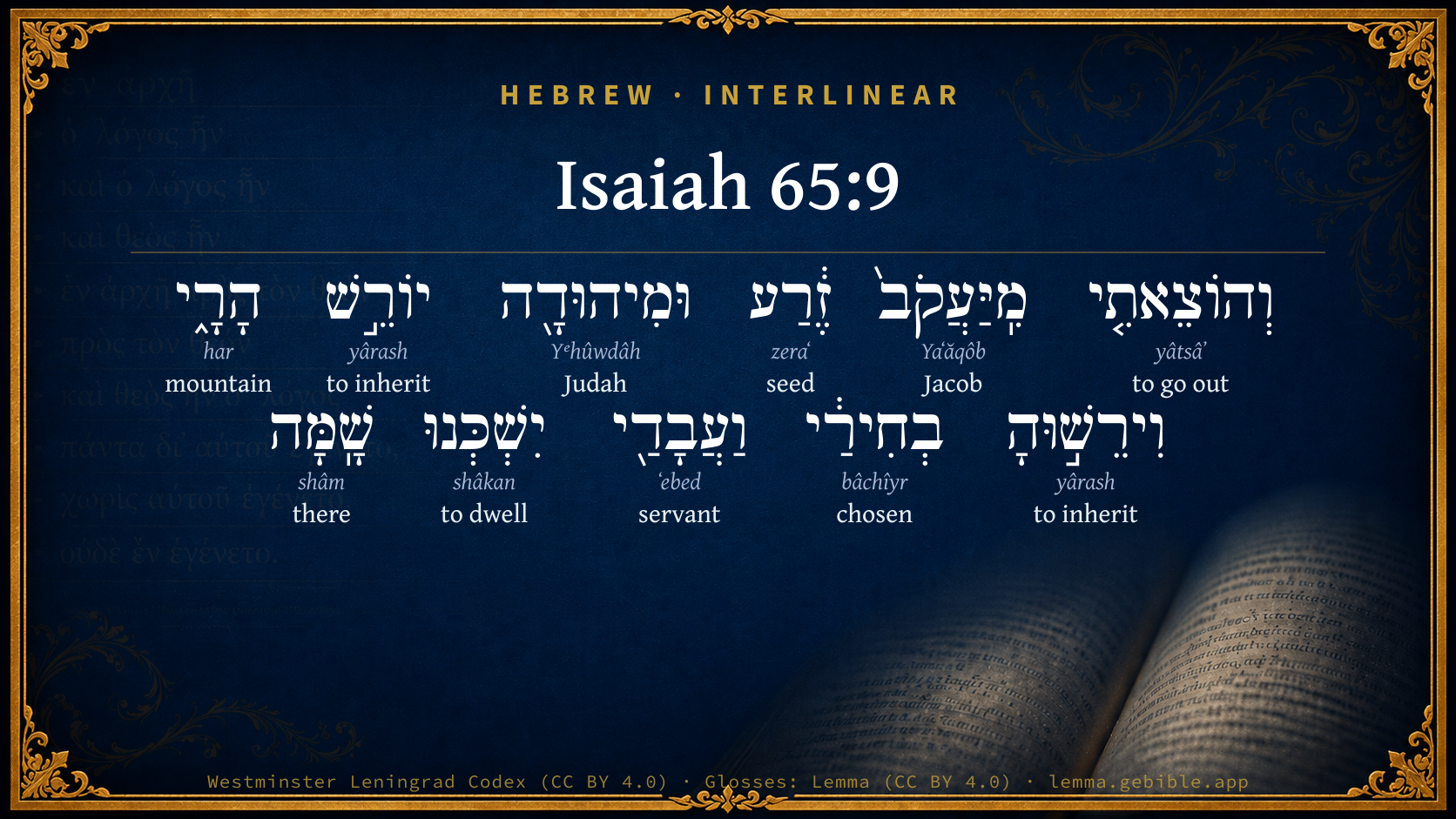
Hebrew (Westminster Leningrad Codex) Isaiah 65:9 appears in the Hebrew Old Testament. The text above is from the Westminster Leningrad Codex. Each word links to its Strong’s number, a concise gloss, and parsing drawn from the Open Scriptures Hebrew Bible morphology. Click any word for its full Brown-Driver-Briggs (BDB) entry.
Download image
Cite this verse

Isaiah 65:9 (World English Bible). Public Domain. Lemma interlinear Bible study tool, https://lemma.gebible.app/v/isaiah/65/9.

Show BibTeX & RIS
BibTeX
RIS
English Translation
I will bring forth a seed out of Jacob, and out of Judah an inheritor of my mountains; and my chosen shall inherit it, and my servants shall dwell there.
World English Bible · Public Domain
Download a study sheet

One document with this verse’s original text, its word-by-word gloss line, the meaning frame, cross-references with their text, attributed commentary, and full source and license credits — printable, and it pastes into notes with its structure intact.

This verse Autodidact and up

Study sheet (.html) Plain text (.txt)

A passage Seminary Student

Up to 50 verses in one chapter. A passage sheet keeps up to 6 commentary sources and 12 cross-references per verse, in the order this page ranks them, and says so on the sheet whenever that leaves anything out. Ask for a single verse and you get the Autodidact verse sheet above.

Everything on this page stays free to read, with no account — the sheet is a download of what is already on screen, not access to it.

Want to remove ads? Support Godless Engineer
Compare translations 3

The same verse in 3 English versions, stacked beneath the original-language interlinear above. Click any original word for its lexicon entry.

Each is an independent rendering of the whole verse — the interlinear is not word-aligned to these translations.

Highlighted words mark where these versions differ — a whole-verse word diff, not a word-by-word alignment.

  • World English Bible Public Domain
    I will bring forth a seed out of Jacob, and out of Judah an inheritor of my mountains; and my chosen shall inherit it, and my servants shall dwell there.
  • King James Version Public Domain
    And I will bring forth a seed out of Jacob, and out of Judah an inheritor of my mountains: and mine elect shall inherit it, and my servants shall dwell there.
  • unfoldingWord Literal Text CC BY-SA 4.0
    And I will bring out seed from Jacob, and from Judah, a possessor of my mountains, and my chosen ones will possess it, and my servants will dwell there.

unfoldingWord Literal Text — © unfoldingWord, licensed CC BY-SA 4.0. Word-aligned USFM3 via Door43 (git.door43.org/unfoldingWord/en_ult).

Versions to compare (up to 4)

3 of 4 selected

Show all 18 translations

Every available English version of this verse, each an independent rendering of the whole verse.

  • World English Bible Public Domain
    I will bring forth a seed out of Jacob, and out of Judah an inheritor of my mountains; and my chosen shall inherit it, and my servants shall dwell there.
  • Berean Standard Bible Public Domain
    And I will bring forth descendants from Jacob, and heirs from Judah; My elect will possess My mountains, and My servants will dwell there.
  • Majority Standard Bible Public Domain
    And I will bring forth descendants from Jacob, and heirs from Judah; My elect will possess My mountains, and My servants will dwell there.
  • King James Version Public Domain
    And I will bring forth a seed out of Jacob, and out of Judah an inheritor of my mountains: and mine elect shall inherit it, and my servants shall dwell there.
  • American Standard Version (1901) Public Domain
    And I will bring forth a seed out of Jacob, and out of Judah an inheritor of my mountains; and my chosen shall inherit it, and my servants shall dwell there.
  • Revised Version (1885) Public Domain
    And I will bring forth a seed out of Jacob, and out of Judah an inheritor of my mountains: and my chosen shall inherit it, and my servants shall dwell there.
  • Geneva Bible (1599) Public Domain
    But I will bring a seede out of Iaakob, and out of Iudah, that shall inherit my mountaine: and mine elect shall inherit it, and my seruants shall dwell there.
  • Douay-Rheims (1899) Public Domain
    And I will bring forth a seed out of Jacob, and out of Juda a possessor of my mountains: and my elect shall inherit it, and my servants shall dwell there.
  • Young's Literal Translation Public Domain
    And I have brought out from Jacob a seed, And from Judah a possessor of My mount, And possess it do My chosen ones, And My servants do dwell there.
  • Literal Standard Version CC BY-SA 4.0
    And I have brought out a Seed from Jacob, || And from Judah a Possessor of My mountain, || And My chosen ones possess it, || And My servants dwell there.
  • Unlocked Literal Bible CC BY-SA 4.0
    I will bring descendants from Jacob, and from Judah ones who will possess my mountains. My chosen ones will possess the land, and my servants will live there.
  • unfoldingWord Literal Text CC BY-SA 4.0
    And I will bring out seed from Jacob, and from Judah, a possessor of my mountains, and my chosen ones will possess it, and my servants will dwell there.
  • Darby Bible Public Domain
    And I will bring forth a seed out of Jacob, and out of Judah a possessor of my mountains; and mine elect shall possess it, and my servants shall dwell there.
  • World Messianic Bible Public Domain
    I will bring offspring out of Jacob, and out of Judah an inheritor of my mountains. My chosen will inherit it, and my servants will dwell there.
  • Webster's Bible Public Domain
    And I will bring forth a seed out of Jacob, and out of Judah an inheritor of my mountains: and my elect shall inherit it, and my servants shall dwell there.
  • Free Bible Version CC BY-SA 4.0
    I will make sure Jacob has descendants, and people from Judah who can take ownership of my mountain. My chosen ones, my servants, will own the land and live there.
  • Bible in Basic English Public Domain
    And I will take a seed out of Jacob, and out of Judah one who will have my mountains for a heritage: and the people I have taken to be mine will have it for themselves, and my servants will have their resting-place there.
  • JPS Tanakh (1917) Public Domain
    And I will bring forth a seed out of Jacob, and out of Judah an inheritor of My mountains; and Mine elect shall inherit it, and My servants shall dwell there.

Literal Standard Version (2020), Covenant Press — licensed CC BY-SA 4.0. Text via the HelloAO Bible API (eBible.org). Unlocked Literal Bible (unfoldingWord) — licensed CC BY-SA 4.0. Text via the HelloAO Bible API (eBible.org). unfoldingWord Literal Text — © unfoldingWord, licensed CC BY-SA 4.0. Word-aligned USFM3 via Door43 (git.door43.org/unfoldingWord/en_ult). Free Bible Version, Dr. Jonathan Gallagher — licensed CC BY-SA 4.0. Text via the HelloAO Bible API (eBible.org).

Word by word

More ways to search: Search by grammar → Find every occurrence → Compare this word →

Practice this passage: Drill this verse → Learn its vocabulary →

בְחִירַ֔י
bâchîyr
H972
“chosen · my”
Adjective, Adjective, Masculine, Plural, Construct + Suffix, Personal, 1st Person, Common, Singular
Part of Speech
Adjective
Type
Adjective
Gender
Masculine
Number
Plural
State
Construct
Full BDB Definition

Origin: from H977

TWOT: 231c

chosen, choice one, chosen one, elect (of God)
  1. וְהוֹצֵאתִ֤י yâtsâʼ H3318 “and · to go out” Conjunction + Verb, Qal, Perfect, 1st Person, Common, Singular
  2. מִֽיַּעֲקֹב֙ Yaʻăqôb H3290 “from · Jacob” Preposition + Noun, Proper
  3. זֶ֔רַע zeraʻ H2233 “seed” Noun, Common, Masculine, Singular, Absolute
  4. וּמִיהוּדָ֖ה Yᵉhûwdâh H3063 “and · from · Judah” Conjunction + Preposition + Noun, Proper
  5. יוֹרֵ֣שׁ yârash H3423 “inheriting” Verb, Qal, Participle Active, Masculine, Singular, Construct
  6. הָרָ֑י har H2022 “mountains · my” Noun, Common, Masculine, Plural, Construct + Suffix, Personal, 1st Person, Common, Singular
  7. וִירֵשׁ֣וּהָ yârash H3423 “and · to inherit · her” Conjunction + Verb, Qal, Sequential Perfect, 3rd Person, Common, Plural + Suffix, Personal, 3rd Person, Feminine, Singular
  8. וַעֲבָדַ֖י ʻebed H5650 “and · servants · my” Conjunction + Noun, Common, Masculine, Plural, Construct + Suffix, Personal, 1st Person, Common, Singular
  9. יִשְׁכְּנוּ shâkan H7931 “to dwell” Verb, Qal, Imperfect, 3rd Person, Masculine, Plural
  10. שָֽׁמָּה shâm H8033 “there · toward” Adverb + Suffix, Demonstrative

About this verse

These counts appear in no published source. They are computed here, from the morphology-tagged text and Lemma’s own curated glosses. What Lemma adds →

11
words
10
distinct lemmas
Prophets
section

Notable vocabulary

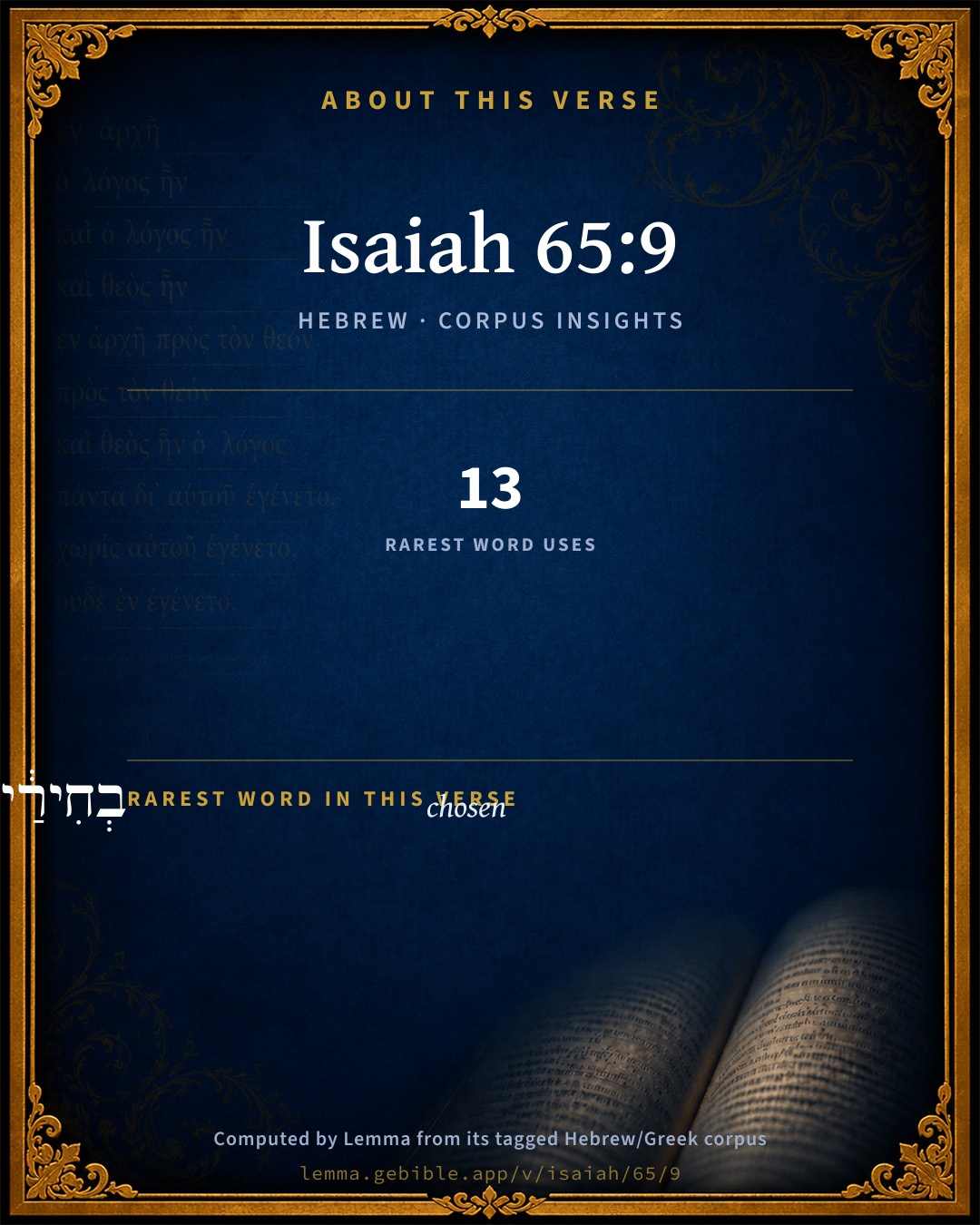
The rarest word here is בְחִירַ֔י chosen H972 — appearing just 13 times in the whole Hebrew Bible.

Shared distinctive vocabulary

בְחִירַ֔י chosen H972 occurs in 13 verses of the Hebrew Bible. Also found in:

Grammatical profile

  • 4 verbs
  • 5 nouns
  • 1 adjective
  • 1 adverb

Verb forms

  • וְהוֹצֵאתִ֤י Qal · Perfect
  • יוֹרֵ֣שׁ Qal · Participle Active
  • וִירֵשׁ֣וּהָ Qal · Sequential Perfect
  • יִשְׁכְּנוּ Qal · Imperfect

Repetition

A word recurs within this verse — often emphatic in Hebrew:

  • יוֹרֵ֣שׁ to inherit H3423 ×2

Hebrew & Septuagint length

In English translation the verse runs 30 words from the Hebrew and 34 from the Septuagint (LXX English) — closely comparable.

A rough comparison of the two English renderings, which tokenize alike — not a word-level alignment.

Word counts can differ between the Hebrew and the Greek without any difference in meaning — e.g. the Hebrew direct-object marker אֵת has no separate Greek word, and Greek often adds the article ὁ.

Cross-references

20

Topical passages linked to Isaiah 65:9 in the Treasury of Scripture Knowledge — connected by theme and wording, ordered by reader-vote popularity; previews shown in the World English Bible.

  • Amos 9:11–15 In that day I will raise up the tent of David who is fallen, and close up its breaches, and I will raise up its ruins, and I will build it as in the days of old;
  • Isaiah 27:6 In days to come shall Jacob take root; Israel shall blossom and bud; and they shall fill the surface of the world with fruit.
  • Romans 11:5–7 Even so then at this present time also there is a remnant according to the election of grace.
  • Isaiah 10:20–22 It shall come to pass in that day, that the remnant of Israel, and those who are escaped of the house of Jacob, shall no more again lean on him who struck them, but shall lean on Yahweh, the Holy One of Israel, in truth.
  • Isaiah 11:11–16 It shall happen in that day, that the Lord will set his hand again the second time to recover the remnant of his people, who shall remain, from Assyria, and from Egypt, and from Pathros, and from Cush, and from Elam, and from Shinar, and from Hamath, and from the islands of the sea.
  • Isaiah 32:18 My people shall abide in a peaceable habitation, and in safe dwellings, and in quiet resting-places.
  • Isaiah 45:19 I have not spoken in secret, in a place of the land of darkness; I didn't say to the seed of Jacob, Seek you me in vain: I, Yahweh, speak righteousness, I declare things that are right.
  • Isaiah 65:15 You shall leave your name for a curse to my chosen; and the Lord Yahweh will kill you; and he will call his servants by another name:
  • Isaiah 65:22 They shall not build, and another inhabit; they shall not plant, and another eat: for as the days of a tree shall be the days of my people, and my chosen shall long enjoy the work of their hands.
  • Jeremiah 31:36–40 If these ordinances depart from before me, says Yahweh, then the seed of Israel also shall cease from being a nation before me forever.
  • Jeremiah 33:17–26 For thus says Yahweh: David shall never want a man to sit on the throne of the house of Israel;
  • Ezekiel 36:8–15 But you, mountains of Israel, you shall shoot forth your branches, and yield your fruit to my people Israel; for they are at hand to come.
  • Ezekiel 36:24 For I will take you from among the nations, and gather you out of all the countries, and will bring you into your own land.
  • Ezekiel 37:21–28 Say to them, Thus says the Lord Yahweh: Behold, I will take the children of Israel from among the nations, where they are gone, and will gather them on every side, and bring them into their own land:
  • Ezekiel 39:25–29 Therefore thus says the Lord Yahweh: Now will I bring back the captivity of Jacob, and have mercy on the whole house of Israel; and I will be jealous for my holy name.
  • Obadiah 1:17–21 But in Mount Zion, there will be those who escape, and it will be holy. The house of Jacob will possess their possessions.
  • Zephaniah 3:20 At that time will I bring you in, and at that time will I gather you; for I will give you honor and praise among all the peoples of the earth, when I bring back your captivity before your eyes, says Yahweh.
  • Zechariah 10:6–12 "I will strengthen the house of Judah, And I will save the house of Joseph, And I will bring them back; For I have mercy on them; And they will be as though I had not cast them off: For I am Yahweh their God, and I will hear them.
  • Matthew 24:22 Unless those days had been shortened, no flesh would have been saved. But for the sake of the chosen ones, those days will be shortened.
  • Romans 11:28 Concerning the Gospel, they are enemies for your sake. But concerning the election, they are beloved for the fathers' sake.

Cross-references courtesy of OpenBible.info (CC BY 4.0).

Hebrew and Greek witnesses Masoretic Hebrew ↔ Greek Septuagint

The same verse in the two great witnesses to the Old Testament, shown verse-for-verse.

These are two independent witnesses, not word-aligned to each other, and the Septuagint is shown in lemma (dictionary) form.

Hebrew Isaiah 65:9 Masoretic · Westminster Leningrad Codex

וְהוֹצֵאתִ֤י מִֽיַּעֲקֹב֙ זֶ֔רַע וּמִיהוּדָ֖ה יוֹרֵ֣שׁ הָרָ֑י וִירֵשׁ֣וּהָ בְחִירַ֔י וַעֲבָדַ֖י יִשְׁכְּנוּ שָֽׁמָּה

I will bring forth a seed out of Jacob, and out of Judah an inheritor of my mountains; and my chosen shall inherit it, and my servants shall dwell there.

World English Bible · Public Domain

Greek LXX Isaiah 65:9 Septuagint · lemma form

καί ἐκἄγω ὁ ἐκ ἰακώβ σπέρμα καί ὁ ἐκ ιουδα καί κληρονομέω ὁ ὄρος ὁ ἅγιος ἐγώ καί κληρονομέω ὁ ἐκλεκτός ἐγώ καί ὁ δοῦλος ἐγώ καί καταοἱκέω ἐκεῖ

And I will lead forth the seed that came of Jacob and of Juda, and they shall inherit my holy mountain: and my elect and my servants shall inherit it, and shall dwell there.

LXX2012 (modern English Septuagint) · Public Domain

On this verse, Adam Clarke's Commentary discusses the Septuagint’s reading. Read the note in Commentary ↓

Hebrew: Westminster Leningrad Codex (CC BY 4.0). Greek: Septuagint (public domain); English from LXX2012 (modern English Septuagint) (Public Domain). How the Septuagint differs from the Hebrew →

Targum (Aramaic paraphrase)

1

The Targum is the ancient Jewish Aramaic paraphrase of the Hebrew Scriptures — an interpretive translation, not the Hebrew text itself. Onkelos (literal) and Pseudo-Jonathan (expansive) render the Torah, and Jonathan the Prophets. Coverage is partial: where no permissively-licensed English translation exists for a verse, only the Aramaic is shown. This is verse-level text, not a word-by-word alignment to the Hebrew.

  1. Targum Jonathan Prophets (Joshua–Malachi)
    וְאַפֵיק מִיַעֲקֹב זַרְעָא וּמִיהוּדָה יָרֵית טוּרֵי וְיַחְסְנוּנָהּ בְּחִירִי וְעַבְדֵי צַדִיקַיָא יֵשְׁרוּן תַּמָן:

    And I will bring forth a seed out of Jacob, and out of Judah an inheritor of my mountains: and mine elect shall inherit it, and my righteous servants shall dwell there.

    Targum Jonathan — Aramaic: “Mikraot Gedolot” (public domain). English: “Sefaria Community Translation” (CC0 1.0 (public-domain dedication)); “London "Chaldee Paraphrase," 1871” (public domain). Text via Sefaria.

Commentary

Notes on Isaiah 65:9 from classic Christian and Jewish commentators (each source and its license shown beneath its notes). The classic Christian expositions comment on the surrounding passage and are grouped to its opening verse, so a note may address several verses; the Jewish commentaries on the Tanakh (Rashi and others) are per-verse, so they appear only where the commentator wrote on this verse.

Lemma curates 59 commentaries, every one of them public domain or Creative Commons licensed, each selected and text-cleaned for this edition rather than reprinted as found. About our sources →

Trapp's Complete Commentary

John Trapp

Isa 65:9 And I will bring forth a seed out of Jacob, and out of Judah an inheritor of my mountains: and mine elect shall inherit it, and my servants shall dwell there.

Ver. 9. And I will bring forth a seed out of Jacob.] The good husband keeps some of his corn for seed; which, though it be not much, yet it will come to much.

And mine elect shall inherit it,] i.e., Reinhabit the land, a type of the last conversion of the Jews to Christ. {Rom 11:25-26}

John Trapp, A Commentary or Exposition upon All the Books of the Old and New Testament (1647–1656) — public domain. Text from a community e-Sword module.

Jamieson, Fausset & Brown

Robert Jamieson, A. R. Fausset & David Brown

seed--"the holy seed" (Isa 6:13), a posterity from Jacob, designed to repossess the Holy Land, forfeited by the sin of the former Jews.

my mountains--Jerusalem and the rest of Judea, peculiarly God's (compare Isa 2:2; Isa 11:9; Isa 14:32).

it--the Holy Land.

elect-- (Isa 65:15, Isa 65:22).

Jamieson, Fausset & Brown — Commentary Critical and Explanatory on the Whole Bible (1871) — public domain (CC PDM 1.0). Text via the HelloAO Bible API.

Adam Clarke's Commentary

Verse 9. An inheritor of my mountains - "An inheritor of my mountain"] הרי hari, in the singular number; so the Septuagint and Syriac; that is, of Mount Sion. See Isa 65:11 and Isa 56:7, to which Sion, the pronoun feminine singular, added to the verb in the next line, refers; ירשוה yereshuah, "shall inherit her." - L.

Adam Clarke's Commentary on the Bible (1810–1826) — public domain. Text from a community e-Sword/MySword module.

Ellicott's Commentary for English Readers

(9) I will bring forth a seed out of Jacob . . .—Jacob (i.e., Israel) and Judah are used to represent respectively the remnants of the two kingdoms that had been carried into captivity.

My mountains.—One of Isaiah’s characteristic phrases (comp. Isa_14:25; Isa_29:11; Eze_6:2-3. Not Zion only, but every hill in Canaan was a sharer in a derived sanctity.

A Bible Commentary for English Readers, edited by Charles John Ellicott (1878–1897) — public domain. Text from a community e-Sword module.

The Cambridge Bible for Schools and Colleges

gen. ed. J. J. S. Perowne

9. When a separation is effected the true Israelites shall possess the land (ch. Isa_57:13, Isa_60:21).

a seed] Cf. ch. Isa_6:13, Isa_53:10.

my mountains] the mountain land of Palestine, an Isaianic phrase (ch. Isa_14:25). shall inherit it] i.e. the land.

shall dwell there] Dillmann infers from the adv. “there” that neither the prophet nor his hearers lived in Palestine; but the argument cannot be sustained. “There” may be said of a place just mentioned, irrespective of the speaker’s relation to it. Thus in ch. Isa_37:33 Isaiah says that the king of Assyria “shall not shoot an arrow there,” referring to Jerusalem (“this city”) where he was living.

The Cambridge Bible for Schools and Colleges (gen. ed. J. J. S. Perowne; Cambridge University Press, 1878–1918) — public domain. Text from a community e-Sword module.

John Gill's Exposition

And I will bring forth a seed out of Jacob,.... Jerom says most understand this of Christ; and who indeed is called the seed of the woman, the seed of Abraham, the seed of David, and sprang from Jacob or Israel, and came out of the tribe of Judah; and may be fitly signified by the cluster, in which new wine and a blessing were, which "seed" here is explanative of; since the clusters of all divine perfections, of all the blessings of grace, and of all the promises of it, are in him: and since he is that seed in whom all the nations of the earth are blessed, and with whom the covenant of grace was made, Gal 3:16, but others, the above ancient writer observes, understood it of the apostles; and it seems to design the first that believed in Christ, who were of the Jewish nation, the apostles and others; for though the generality of that people rejected the Messiah, there were a few that believed on him, a remnant according to the election of grace, whom the apostle calls a seed, the Lord left among them, and reserved for himself, Rom 9:29, Rom 11:4 such who received the seed of the word into their hearts, and were born again of incorruptible seed, and which remained in them; these were distinguished by the grace of God from the rest of the people, and were called and brought forth from among them:

and out of Judah an inheritor of my mountains; this also is true of Christ, who not only came out of the tribe of Judah, as was foretold he should, and as it is manifest he did; hence he is called the Lion of that tribe; but he is also an heir or inheritor of the mountains of God; he is indeed heir of all things, Heb 1:2, as he is the Son of God, he is heir by nature of all the Father has; and, as Mediator, he is heir by appointment of all persons and things; he has all persons for his inheritance, and in his possession, and at his dispose, angels and men; and he is possessed of all things, of all blessings of goodness, natural and temporal, spiritual and eternal; and his chosen people are joint heirs with him, and who may be here meant; such as are the seed of the Lord are sons and heirs; they are heirs of God, being the sons of God; heirs of his covenant, the blessings and promises of it, which is as a mountain, firm and immovable; they are heirs of the grace of life, and of the kingdom; heirs of righteousness, life, and salvation; of eternal glory, the heavenly Canaan, signified by the mountains of the Lord; alluding to the mountains on which the temple and Jerusalem stood, or to those about Jerusalem, or in the land of Judea in general:

and mine elect shall inherit it; Christ is God's first and chief elect, and his people are chosen in him through grace to glory; and these are the seed and heirs that do inherit grace, and shall inherit glory; for this is to be understood not literally of the land of Judea, which was not long inherited by any after the times of Christ and his apostles, to which this prophecy respects; unless it can be thought to belong to the latter day, when the Jews will be converted, and return to it; but figuratively of Mount Zion, or of the heavenly country:

and my servants shall dwell there; my righteous servants, as the Targum; these are the same with the seed, the inheritor, and the elect, who become the servants of God, through the power of his grace, and serve him cheerfully, willingly, and without selfish ends and views; to this they are chosen, and for this purpose become a spiritual seed; nor is this inconsistent with their being heirs; and who shall receive the inheritance in a way of grace, and possess it for ever; they shall dwell in the church below, and enjoy all the privileges of it, and shall dwell upon their estate for ever; for their inheritance is an eternal one, reserved in the heavens.

John Gill's Exposition of the Whole Bible (1746–1763) — public domain (CC PDM 1.0). Text via the HelloAO Bible API.

Albert Barnes' Notes on the Bible

And I will bring forth a seed - I will give descendants to Jacob, who shall share my favor and repossess the land.

An inheritor of my mountains - The mountains of Palestine - Jerusalem and the vicinity - called the mountains of God because he claimed that land as his special residence, and the place where his holy religion was established.

And mine elect - They who have been chosen by me to maintain my religion in the world.

Albert Barnes' Notes on the Bible (1834–1885) — public domain. Text from a community e-Sword/MySword module.

Haydock's Catholic Bible Commentary

Mountains of Judea, (Deuteronomy iii. 25.) which the captives shall recover, as a figure of those who shall embrace the Christian faith.

George Leo Haydock (1774–1849), Haydock's Catholic Family Bible and Commentary, 1859 edition — public domain. Excludes Psalms (Douay-Rheims chapter numbering differs from Protestant) and Deuterocanonical books (Catholic canon only).

Matthew Poole's English Annotations

I will bring forth a seed out of Jacob; no seed beareth a proportion to the tree or plant that it produceth, but in comparison with that is very little; yet it is enough, through the virtue which the God of nature hath put into it, to preserve and uphold the species to which it doth relate. They are but a remnant (saith God) that shall be saved; see Rom 11:5; but a small number that shall come out of the captivity of Babylon: or, (which I rather choose) they will be but a few that shall believe in my Son. yet they shall be enough for my promise to live in: this Paul argueth, Ro 11. As the plant yet lives in the seed, when the root is plucked up, the leaves dropped off, and the stalk is burnt up; so the promise of God lives in a few, when the generality of the people for their sins are cast off and destroyed. The favour of God to men, and the promise of God to good men, lived in one family of Lot, when the five cities were burned, and in the one family of Noah, when the world was drowned; the favour and promise of God to Abraham, Isaac, and Jacob, and David lived in the few that returned out of Babylon, and in those few who under the gospel received Christ, and believed in him, though the generality of them rejected the counsel of God against themselves. God further promiseth to bring out of

Judah an inheritor of his mountains, which the most and best interpreters do interpret of the Jews’ return out of the captivity of Babylon to Jerusalem, and into their own country, and particularly to worship God in his temple upon Mount Zion. My mountains: the country of Judea was a mountainous country, Eze 36:1,8. The mountains were round about Jerusalem, Psa 125:2. See also Eze 38:8. God calls these mountains his mountains, because he had chosen that country before all others, and was once truly worshipped there.

Mine elect signifieth here God’s chosen ones, as in Psa 106:23; Isa 48:10. The term doth not always signify such as belong to the

election of grave, but such as are dignified with some special favour. The whole nation of the Jews are called a chosen people. But possibly this promise is to be interpreted with relation to the sincerer part of that people, after that the others should be wasted by the captivity.

Matthew Poole's English Annotations on the Holy Bible (1683–1685) — public domain. Text from a community e-Sword/MySword module.

Whedon's Commentary on the Bible

Daniel D. Whedon

9, 10. Seed out of Jacob… Judah — “Out of Jacob and… Judah” (which means the faithful few taken from the whole body of Israelites) the small worthy number (Isa_65:7-8) shall prove to be the “handful of corn upon the top of the mountains,” the fruit whereof “shall shake like Lebanon, and they of the city shall flourish like grass of the earth,” (Psa_72:16-17,) enduring in glorious fertility as long as the sun and moon endure. And the whole land shall be in peace, from Sharon in the west, to the valley of Achor, near Jericho. Jos_7:24.

Daniel D. Whedon (gen. ed.), Commentary on the Old and New Testaments (1874–1909) — public domain. Text from a community e-Sword module.

The Pulpit Commentary

A seed out of Jacob, and out of Judah. Scarcely, "the people of the two captivities" (Delitzsch), though no doubt many Israelites of the ten tribes did return with Zerubbabel. (1Ch_9:3 Ezr_2:2, 70 3:1 6:17 8:35, etc.) Rather, a mere pleonasm, as in Isa_9:8 Isa_10:21, 22 27:6 29:23 40:27 41:8, etc.. (see the comment on Isa_40:27) An inheritor of my mountains. The whole of Palestine is little more than a cluster of mountains. The cluster may be divided into three groups:

(1) The mountains of Galilee, extending from Hermon to Tabor, separated from the next group by the plain of Esdraelon;

(2) the mountains of Samaria and Judaea, extending from Carmel and Gilbea to the plateau of Mature above Hebron, which is 3600 feet above the sea;

(3) the mountains of the trans-Jordanic region, including those of Bashan, Gilead, Moab, and Edom, separated from the two other groups by the Jordan valley. The highest elevation attained is that of Hermon (9400 feet); other minor heights are Jebel Jurmuk, in Galilee, 4000 feet; Safed, also in Galilee, 2775 feet; Ebal and Gerizim, in Samaria, 2700 feet; Sinjil, 2685; Neby Samwill, 2650; and the Mount of Olives, 2724 feet. The plateau of Mature reaches a height of 3600 feet. The only Palestinian plains are those of Esdraelon, Sharon, and the Ghor, or Jordan valley. Thus the land may well be spoken of as "my mountains." Mine elect. (comp. Isa_43:20 Isa_45:4) The same expression is used of Israel in 1Ch_16:13 Psa_89:3 Psa_105:6, 43 106:5. God "chose" Israel out of all the nations of the earth to be his "peculiar people.

Vers. 9, 10. From depression to prosperity.

We learn here

I THAT THE PEOPLE OF GOD MAY FALL INTO A STATE OF SAD DEPRESSION. "Jacob" and "Judah," at the time of this prophecy, were reduced to a very low estate. It seemed as if they would produce nothing.

II THAT COMFORT MAY THEN BE FOUND IN GOD"S RELATION TO THEM. They are still "mine elect;" still those whom the Divine Father pities and purposes to bless, for whom the Divine Saviour died, with whom the Divine Spirit pleads.

III THAT THEY SHOULD SPEND THEIR STRENGTH IN SEEKING AND IN SERVING. "My servants shall dwell there... for my people that have sought me." In the time of difficulty and distress let good men be earnest and constant in prayer; let them be consistent in life and active in holy labour. Then they will find

IV THAT THEY MAY LOOK FOR A RENEWED AND A NOBLE HERITAGE. From end to end of the land (from Sharon to Achor) the scenes of pastoral industry shall be witnessed, and God"s servants shall dwell in the land; there shall be fulness and permanence of blessing. C.

The Pulpit Commentary (1880–1919), ed. H.D.M. Spence-Jones & Joseph S. Exell — public domain. Text from a community e-Sword module.

John Wesley's Explanatory Notes

Judah - God farther promises to bring out of Judah, an inheritor of his mountains which refers to the Jews return out of the captivity of Babylon to Jerusalem, to worship God in his temple, upon Mount Zion. Mine elect - My chosen ones. The term signifies such as are dignified with some special favour. The whole nation of the Jews are called a chosen people.

John Wesley, Explanatory Notes Upon the Whole Bible (1754–1765) — public domain. Text via the GEBible commentary corpus.

J. A. Alexander on Isaiah

Joseph Addison Alexander

“And I will bring forth from Jacob a seed and from Judah an heir of my mountains, and my chosen ones shall inherit it, and my servants shall dwell there.” This is an amplification of the promise, ‘I will do so’, in the foregoing verse. ‘My mountains’ denotes the whole of Palestine, as being an uneven, hilly country. See the same use of the plural in Isa 14:25, and the analogous phrase, mountains of Israel, repeatedly employed by Ezekiel (Eze 36:1; Eze 36:8; Eze 38:8). The corresponding singular, ‘my mountain’ (Isa 11:9; Isa 57:13) is by many understood in the same manner. The adverb at the end of the sentence properly means ‘thither’, and is never perhaps put for ‘there’ except in cases where a change of place is previously mentioned or implied. If so, the sense is not merely that they shall abide there, but that they shall first go or return thither, which in this connection is peculiarly appropriate. Of the promise here recorded there are three principal interpretations. The first, embraced by nearly all the modern Germans, is that the verse predicts the restoration of the Jews from Babylon. The second may be stated in the words of Henderson, viz. that "the future happy occupation of Palestine by a regenerated race of Jews is here clearly predicted.” The third is that the verse foretells the perpetuation of the old theocracy or Jewish church; not in the body of the nation, but in the remnant which believed on Christ; and which, enlarged by the access on of the Gentiles, is identical in character and rights with the church of the old dispensation, the heir to all its promises, and this among the rest, which either has been or is to be fulfilled both in a literal and figurative sense; in the latter, because the Church already has what is essentially equivalent to the possession of the land of Canaan under a local ceremonial system; in the former, because Palestine is yet to be recovered from the Paynim and the Infidel, and rightfully occupied, if not by Jews, by Christians, as the real seed of Abraham, partakers of the same faith and heirs of the same promise (Heb 11:9), for the promise that he should be the heir of the world was not to Abraham, or to his seed through the law, but through the righteousness of faith (Rom 4:13). If it should please God to collect the natural descendants of the patriarch in that land and convert them in a body to the true faith, there would be an additional coincidence between the prophecy and the event, even in minor circumstances, such as we often find in the history of Christ. But if no such national restoration of the Jews to Palestine should ever happen, the extension of the true religion over that benighted region, which both prophecy and providence encourage us to look for, would abundantly redeem the pledge which God has given to His people in this and other parts of Scripture.

Joseph Addison Alexander, The Prophecies of Isaiah (1846–1847; New York: Scribner, 1870–1878) — public domain. Text from a community e-Sword module.

unfoldingWord translationNotes

Door43 World Missions Community

General Information:

Yahweh continues speaking.

my mountains

This refers to the highest locations of Jerusalem and all of Judea.

Sharon

This was a fertile grazing area. (See: How to Translate Names)

Valley of Achor

This is the name of a valley that possibly ran from Jerusalem to south of Jericho. This was also a fertile grazing area. (See: How to Translate Names)

translationWords

descend

Jacob

Judah

chosen one

servant

life

Sharon

flocks

rest

people of God

unfoldingWord translationNotes — © Distant Shores Media and the Door43 World Missions Community, licensed CC BY-SA 4.0. Source: git.door43.org/Door43/en_tn.

Ibn Ezra

Rabbi Abraham ibn Ezra

And I will bring forth out of Jacob, of those that had gone into exile, of the righteous among them: who deserve to be called mine elect.

Ibn Ezra on the Tanakh — English translations: “Sefaria Community Translation” (CC0 1.0 (public-domain dedication)); “Yalkut, Sifsei Chachomim Chumash, Metsudah Publications, 2009” (CC BY 4.0); and “Commentary of Ibn Ezra on Isaiah - trans. by M. Friedlander, 1873” (public domain). Text via Sefaria.

Lesson kit

Teaching starters — assembled from the data on this page, not authored interpretation. Every prompt links to the verse data it draws on. Edit before teaching.

Isaiah, in the Prophets, opens this verse with 11 words (10 distinct Hebrew lemmas). Its most distinctive word is bâchîyr (“chosen”). A historical commentator’s framing appears above. Read the whole chapter for the surrounding context.

Discussion questions

  1. What does “chosen” (bâchîyr) contribute to the verse as a whole?
  2. How does 2 Samuel 21:6, which shares the word «chosen», read alongside this verse?
  3. What does the repetition of “to inherit” (2× in this one verse) do in this verse?
  4. These translations render this verse differently; the difference is in the English rendering, not the original. What questions does that raise?
  5. «וְהוֹצֵאתִ֤י» is a Qal Perfect verb. How does that grammatical form shape the action described?
  6. Compare how Trapp's Complete Commentary and Jamieson, Fausset & Brown read this verse. Where do they agree or differ?

Things to notice

Reading settings

Reading text

Shown beneath each verse's original-language words.

Old Testament
Old Testament edition

Read the OT as the Masoretic Hebrew (MT) or the Greek Septuagint (LXX).

English shown for the Greek Septuagint (in the Hebrew ↔ Greek comparison).

Comparing translations? Open the Compare panel on any verse page to stack up to four side by side.