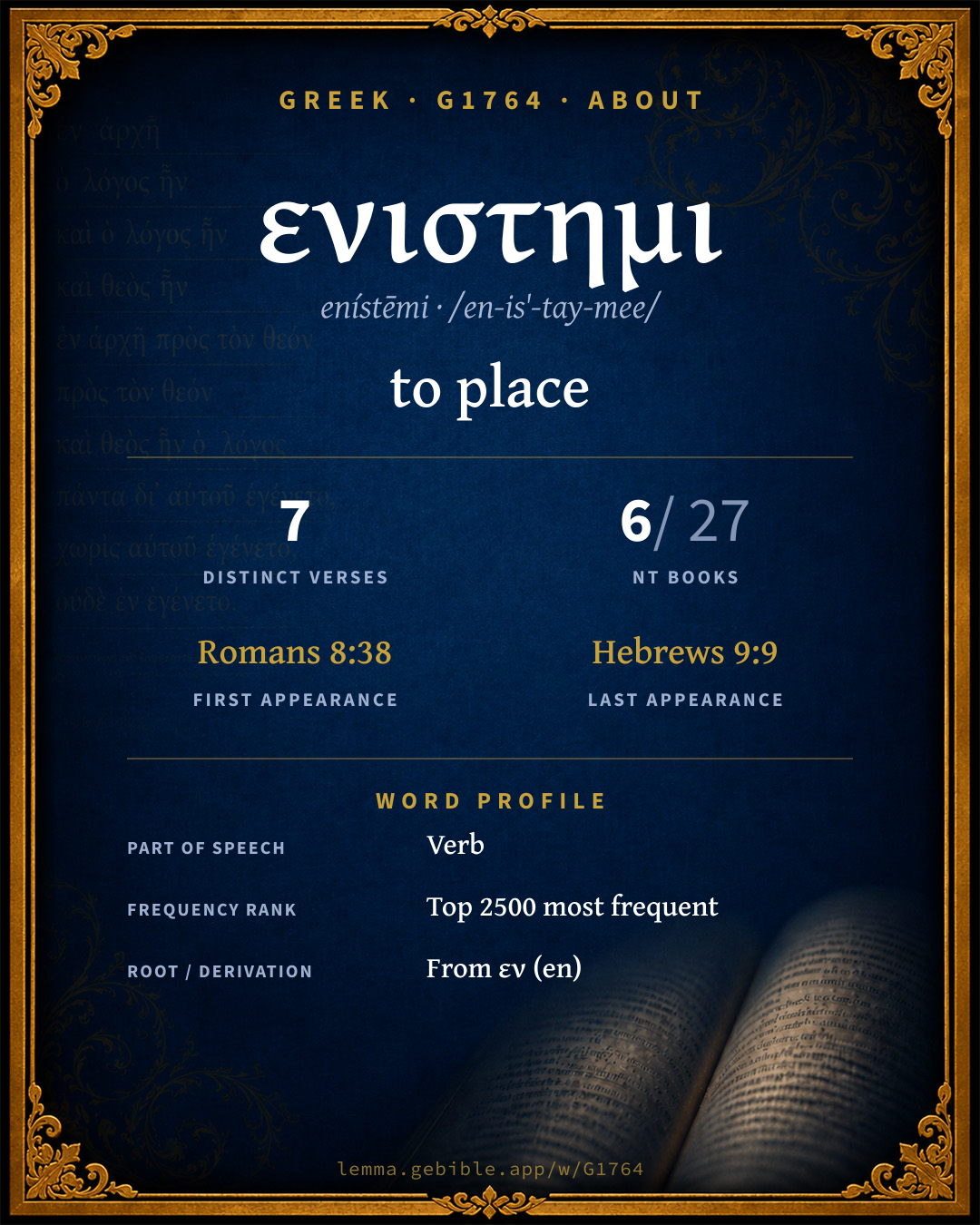
ἐνίστημι
to place
‘to place’ is one of 4 main senses fuller range ↓
Full lexicon entry — Thayer's Greek Lexicon
From Thayer's Greek Lexicon
Where this word appears
See every Perfect-tense verb in the Greek New Testament →
Grammar key — what these labels mean
Part of speech
- Verb
- An action or state-of-being word.
Tense
- Perfect
- A completed past action with continuing present results.
- Future
- Action expected in future time.
Voice
- Active
- The subject performs the action.
- Middle deponent
- Middle in form but active in meaning.
Mood
- Participle
- A verbal adjective (“writing,” “having written”).
- Indicative
- States a fact or asks a factual question (the mood of reality).
Case
- Nominative
- The case of the subject (and the predicate nominative).
- Accusative
- The case of the direct object and of extent.
- Genitive
- The case of source, possession, or “of” — answers “whose / from what.”
Person
- 3rd person
- The one spoken about (“he / she / it / they”).
Gender
- Neuter
- Grammatically neuter.
- Feminine
- Grammatically feminine.
- Masculine
- Grammatically masculine.
Number
- Plural
- More than one.
- Singular
- One.
Grammatical forms
- Verb, Perfect, Active, Participle, Nominative, Plural, Neuter 2 times (29%)
- Verb, Future, Middle deponent, Indicative, 3rd person, Plural 1 time (14%)
- Verb, Perfect, Active, Indicative, 3rd person, Singular 1 time (14%)
- Verb, Perfect, Active, Participle, Accusative, Singular, Feminine 1 time (14%)
- Verb, Perfect, Active, Participle, Accusative, Singular, Masculine 1 time (14%)
- Verb, Perfect, Active, Participle, Genitive, Singular, Masculine 1 time (14%)
Parsed forms decoded from the imported morphology (Robinson–Tischendorf, public domain), counted across 7 parsed occurrences — not distinct verses.
Every verse where G1764 appears — 7 distinct verses across 6 books. Click any verse to open its interlinear word-by-word view. Verse text shown in the World English Bible for context — . Each verse’s Greek form is shown with its reference; the English is not keyword-highlighted, since the data carries no word-level English alignment. Use “Compare translations” on any verse to read it across multiple English versions. This concordance covers the Greek New Testament; Septuagint (Greek Old Testament) occurrences of this word are not indexed here.
Romans 1 verse
1 Corinthians 2 verses
- 1 Corinthians 3:22 ἐνεστῶτα perf act ptcp nom pl neut whether Paul, or Apollos, or Cephas, or the world, or life, or death, or things present, or things to come. All are yours,
- 1 Corinthians 7:26 ἐνεστῶσαν perf act ptcp acc sg fem I think that it is good therefore, because of the distress that is on us, that it is good for a man to be as he is.
Galatians 1 verse
2 Thessalonians 1 verse
2 Timothy 1 verse
Hebrews 1 verse
About this entry
At a glance — auto-summarized from this page’s data, not written by a person. Every figure links to its source below. This summary describes the numbers; it doesn’t interpret them.
The Greek verb ενιστημι centers on the idea of “to place.” Thayer's distinguishes 4 senses for it. It appears 7 verses across 6 books of the Greek New Testament, among its uncommon vocabulary. The word gravitates to 1 Corinthians (29%), then Romans and Galatians. Debuting at Romans 8:38, it then recurs through the corpus. For the data behind this summary, explore the sense tree and the renderings breakdown below.
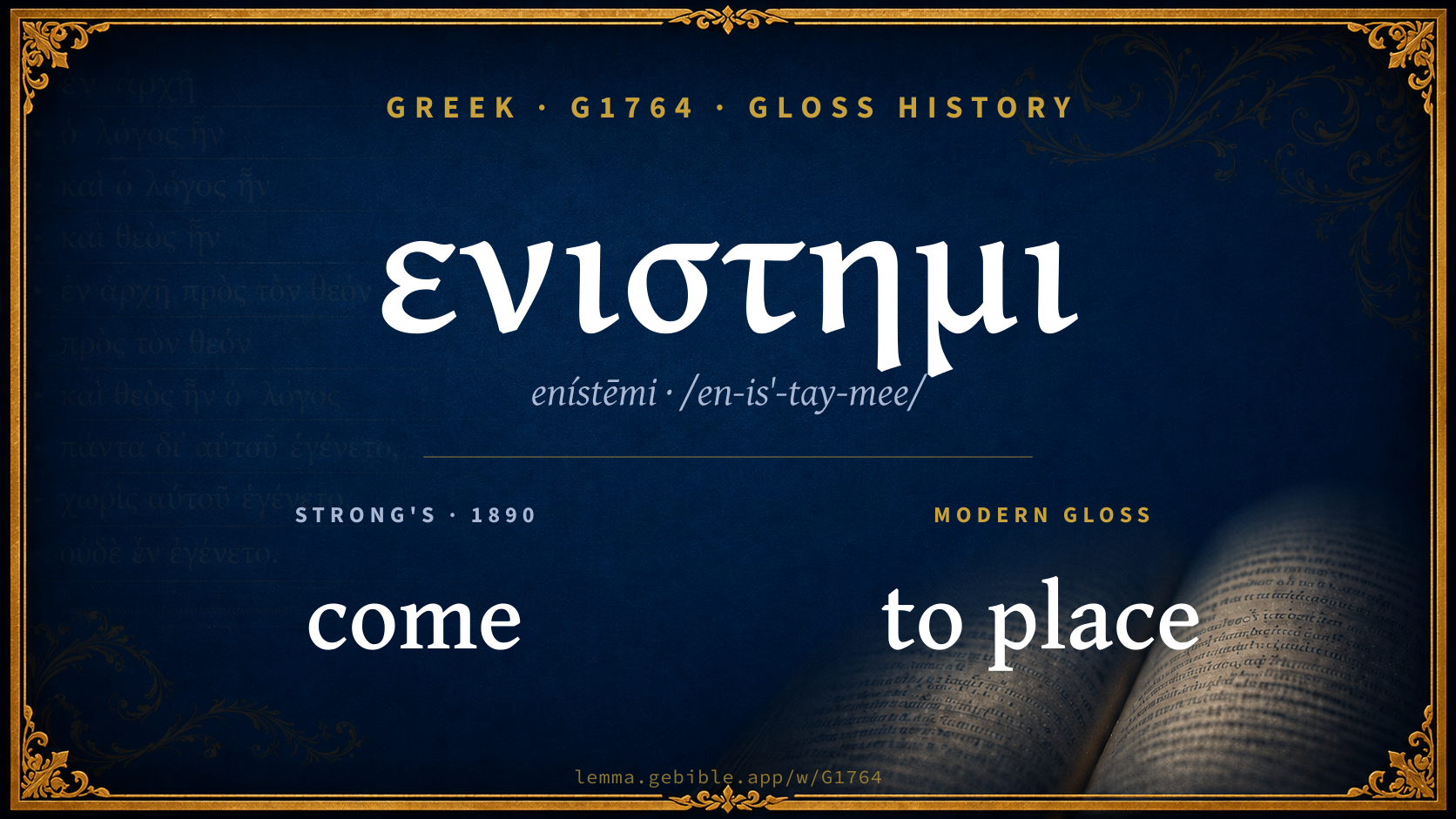
Gloss history
Strong's 1890 vs modern scholarship
About this word
Strong's G1764 catalogs a Greek word from the Greek New Testament.
These counts are not copied from any lexicon or concordance. They are computed here, from the morphology-tagged Greek New Testament. What Lemma adds →
- 7
- distinct verses
- The word appears in 7 distinct verses.
- 6 / 27
- NT books
- The word appears in 6 of 27 New Testament books.
- #1,358
- by frequency
- Top 2500 most frequent Greek words (rank 1,358 of 5,347 Greek words by occurrence).
View all 7 occurrences in the concordance →
Most concentrated in
- 1 Corinthians 2 verses 29%
- Romans 1 verse 14%
- Galatians 1 verse 14%
By section of the New Testament
By traditional corpus
Conventional, traditional groupings — biblical authorship is debated, so this is a traditional corpus grouping, not an authorship claim. Some books belong to more than one corpus (Luke is in both the Gospels and the Lukan corpus, and so on), so these shares overlap and need not total 100%. Each figure is a share of the word’s 7 distinct verses.
- Pauline corpus 6 verses · 86%
- Hebrews 1 verse · 14%
How translations render this word
Counts come from each version’s own published word-to-Strong’s tagging or interlinear alignment — an approximate guide to how each version renders this word, not a word-level alignment the data otherwise carries. Because each total is that version’s own tagged count, the per-version totals vary from one another and need not match the appearance or distinct-verse counts above. These counts may also differ from a printed concordance because Lemma counts each distinctly tagged rendering and does not collapse phrase taggings into a single head-word total. This is a fixed set of word-tagged versions (KJV, ASV, BSB, ULT) and does not change with the reading translation you choose elsewhere. Each version’s license is shown beside its name below (and on Sources).
- King James Version: Present 3×, Things present 2×
- American Standard Version: Present 2×, Things present 2×
- Berean Standard Bible: Present 5×
- unfoldingWord Literal Text: Present 2×, Things present 2×
King James Version Public Domain
Renders G1764 across 7 tagged occurrences — most commonly:
Plus 2 renderings that appear only once — usually multi-word phrases or single function words the recovered tagging swept in, not distinct renderings.
American Standard Version Public Domain
Renders G1764 across 7 tagged occurrences — most commonly:
Plus 3 renderings that appear only once — usually multi-word phrases or single function words the recovered tagging swept in, not distinct renderings.
Berean Standard Bible Public Domain
Renders G1764 across 7 tagged occurrences — most commonly:
Plus 2 renderings that appear only once — usually multi-word phrases or single function words the recovered tagging swept in, not distinct renderings.
unfoldingWord Literal Text CC BY-SA 4.0
Renders G1764 across 7 tagged occurrences — most commonly:
Plus 3 renderings that appear only once — usually multi-word phrases or single function words the recovered tagging swept in, not distinct renderings.
Senses in Thayer's
The 4 senses Thayer's distinguishes for this word, in lexicon order (not ranked by frequency or importance). The full entry — with sub-senses — is in the Lexicon Entry tab.
- to place in or among, to put in
- to be upon, impend, threaten
- close at hand
- present
Word origin
Derived from εν (en) (G1722).
Forms in the corpus
The 6 distinct written forms G1764 takes in the Greek New Testament, most frequent first — each parse links to that tense’s occurrences in the concordance.
| Form | Parsing | Example | Uses |
|---|---|---|---|
| ἐνεστῶτα enestō̂ta | Verb, Perfect, Active, Participle, Nominative, Plural, Neuter | Romans 8:38 | 2 |
| ἐνέστηκεν enéstēken | Verb, Perfect, Active, Indicative, 3rd person, Singular | 2 Thessalonians 2:2 | 1 |
| ἐνεστηκότα enestēkóta | Verb, Perfect, Active, Participle, Accusative, Singular, Masculine | Hebrews 9:9 | 1 |
| ἐνεστῶσαν enestō̂san | Verb, Perfect, Active, Participle, Accusative, Singular, Feminine | 1 Corinthians 7:26 | 1 |
| ἐνεστῶτος enestō̂tos | Verb, Perfect, Active, Participle, Genitive, Singular, Masculine | Galatians 1:4 | 1 |
| ἐνστήσονται enstḗsontai | Verb, Future, Middle deponent, Indicative, 3rd person, Plural | 2 Timothy 3:1 | 1 |
Same root — word family
Other Thayer's entries built from the same root as G1764, grouped by Strong’s listed origin. These share a root / origin per the lexicon — not necessarily a shared meaning. Each links to that word’s own entry.
Derives from
Shares the same root
- εγγραφω engráphō G1449 to inscribe
- εγγυος éngyos G1450 surety
- εγκαθετος enkáthetos G1455 to spy
- εγκαινια enkaínia G1456 dedication
- εγκαλεω enkaléō G1458 to accuse
- εγκαταλειπω enkataleípō G1459 to abandon
- εγκατοικεω enkatoikéō G1460 to dwell
- εγκεντριζω enkentrízō G1461 to graft
- εγκομβοομαι enkombóomai G1463 band
- εγκοπτω enkóptō G1465 to hinder
- εγκρατης enkratḗs G1468 strong
- εγκρινω enkrínō G1469 to judge worthy
- εγκρυπτω enkrýptō G1470 to conceal
- εγκυος énkyos G1471 pregnant
- εγχριω enchríō G1472 to anoint
- ελλογεω ellogéō G1677 impute
- εμβαινω embaínō G1684 to enter
- εμβαλλω embállō G1685 to cast in
- εμβαπτω embáptō G1686 to dip in
- εμβατευω embateúō G1687 to enter
- εμβιβαζω embibázō G1688 to lead in
- εμβλεπω emblépō G1689 to look at
- εμβριμαομαι embrimáomai G1690 to warn sternly
- εμμαινομαι emmaínomai G1693 to rage against
+58 more words share this root (not shown).
Compare all same-root words → Showing 4 of 84 — not the complete family. They share a root, not necessarily a meaning.
Septuagint usage
The same Greek word ενιστημι appears 1 time in the Greek Old Testament (Septuagint), across 1 verse in 1 book.
- 1
- LXX occurrences
- Tagged occurrences of this Greek word in the Septuagint.
- 1
- verse
- Distinct Septuagint verses containing this word.
- 1 / 39
- OT books
- The word appears in 1 of the 39 Old Testament books.
Sample Septuagint occurrences
- 1 Kings 12:24 ἐνἵστημι
Septuagint occurrences (same lexeme)
Every verse where the same Strong’s number (G1764) appears in the Greek Septuagint. Verse text shown in the World English Bible for context; the Greek form is the matched word — the English is not keyword-highlighted.
These are occurrences of the same Greek lexeme (G1764) in the Septuagint — not a translation of any one Hebrew word. The store carries no word-level Hebrew↔Greek alignment, so no Hebrew original is asserted here. Counts come from the recovered LXX Strong's tagging — high-frequency vocabulary is well covered, while rare or late forms may be untagged — so they reflect tagged occurrences and may slightly undercount.