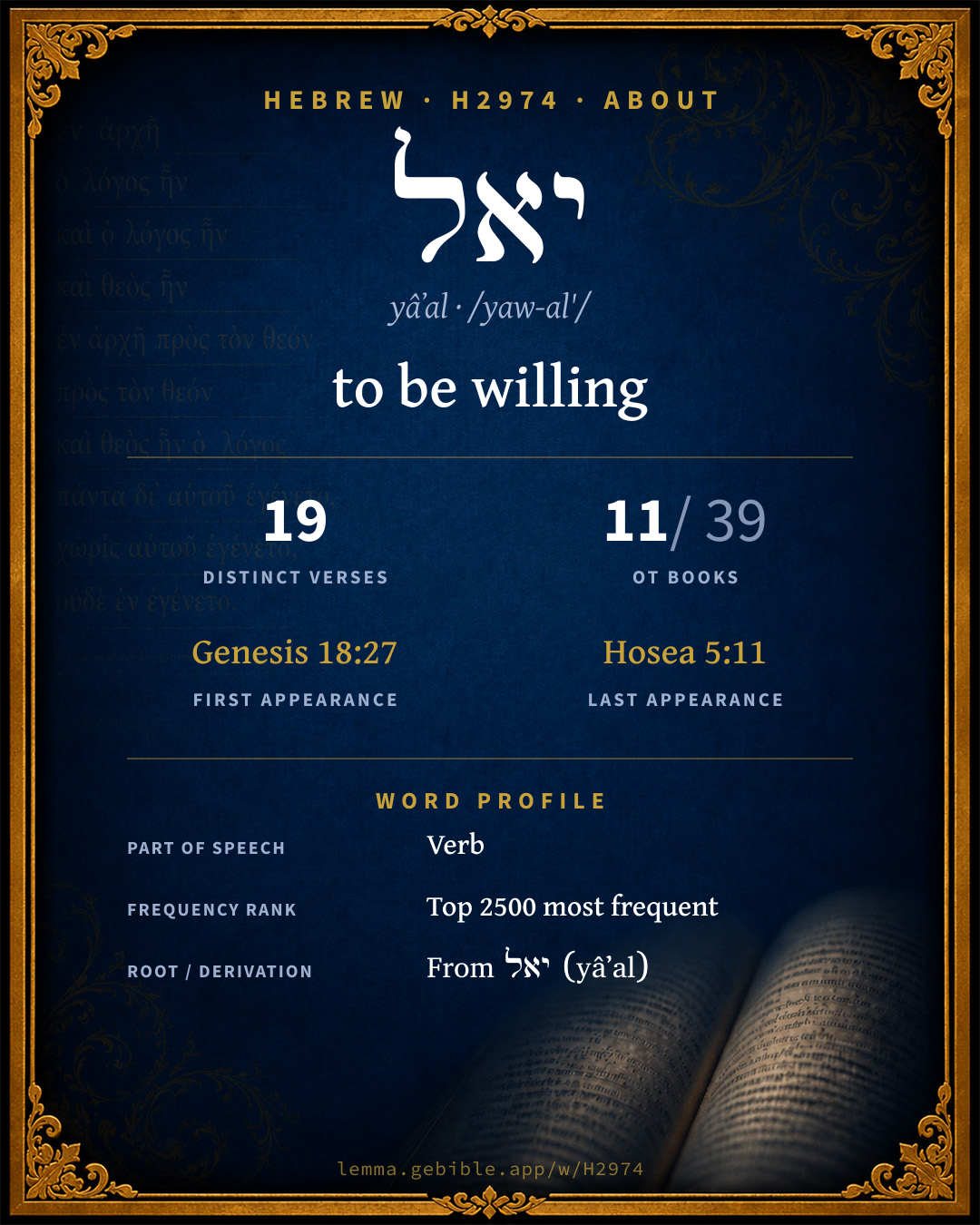
יָאַל
to be willing
‘to be willing’ is one of 4 main senses fuller range ↓
Full lexicon entry — Brown-Driver-Briggs (BDB)
From Brown-Driver-Briggs (BDB)
Where this word appears
Grammar key — what these labels mean
Part of speech
- Verb
- An action or state-of-being word.
Stem
- Hiphil
- The causative active stem (“he caused / brought about”).
Form
- Sequential Imperfect
- An imperfect with prefixed waw — the standard past-narrative form (waw-consecutive imperfect).
- Imperative
- A direct command (“write!”).
- Perfect
- A completed action or state — Hebrew marks aspect (completeness) more than strict tense (“he wrote”).
- Jussive
- A third- or second-person volitional form expressing wish or command (“let him write”).
Person
- 3rd Person
- The one spoken about (“he / she / it / they”).
- 2nd Person
- The one addressed (“you”).
- 1st Person
- The speaker (“I / we”).
Gender
- Masculine
- Grammatically masculine.
- Common
- Either gender — not distinguished for this form.
Number
- Singular
- One.
- Plural
- More than one (in Hebrew, generally three or more).
Grammatical forms
- Verb, Hiphil, Sequential Imperfect, 3rd Person, Masculine, Singular 6 times (32%)
- Verb, Hiphil, Imperative, 2nd Person, Masculine, Singular 4 times (21%)
- Verb, Hiphil, Perfect, 3rd Person, Masculine, Singular 3 times (16%)
- Verb, Hiphil, Perfect, 1st Person, Common, Singular 2 times (11%)
- Verb, Hiphil, Jussive, 3rd Person, Masculine, Singular 1 time (5%)
- Verb, Hiphil, Perfect, 1st Person, Common, Plural 1 time (5%)
- Verb, Hiphil, Perfect, 2nd Person, Masculine, Singular 1 time (5%)
- Verb, Hiphil, Imperative, 2nd Person, Masculine, Plural 1 time (5%)
Parsed forms decoded from the imported morphology (morphhb / Westminster Leningrad Codex — WLC text public domain, morphhb tagging CC BY 4.0), counted across 19 parsed occurrences — not distinct verses.
Every verse where H2974 appears — 19 distinct verses across 11 books. Click any verse to open its interlinear word-by-word view. Verse text shown in the World English Bible for context — . Each verse’s Hebrew form is shown with its reference; the English is not keyword-highlighted, since the data carries no word-level English alignment. Use “Compare translations” on any verse to read it across multiple English versions. This concordance covers the Hebrew Bible; Septuagint (Greek Old Testament) occurrences are not indexed here.
Genesis 2 verses
- Genesis 18:27 הוֹאַ֨לְתִּי֙ Hiphil pf 1cs Abraham answered, "See now, I have taken it on myself to speak to the Lord, who am but dust and ashes.
- Genesis 18:31 הוֹאַ֨לְתִּי֙ Hiphil pf 1cs He said, "See now, I have taken it on myself to speak to the Lord. What if there are twenty found there?" He said, "I will not destroy it for the twenty's sake."
Exodus 1 verse
Deuteronomy 1 verse
Joshua 2 verses
- Joshua 7:7 הוֹאַ֣לְנוּ Hiphil pf 1cp Joshua said, Alas, Lord Yahweh, why have you at all brought this people over the Jordan, to deliver us into the hand of the Amorites, to cause us to perish? would that we had been content and lived beyond the Jordan!
- Joshua 17:12 וַ/יּ֨וֹאֶל֙ conj + Hiphil wimpf 3ms Yet the children of Manasseh couldn't drive out [the inhabitants of] those cities; but the Canaanites would dwell in that land.
Judges 4 verses
- Judges 1:27 וַ/יּ֨וֹאֶל֙ conj + Hiphil wimpf 3ms Manasseh did not drive out [the inhabitants of] Beth-shean and its towns, nor [of] Taanach and its towns, nor the inhabitants of Dor and its towns, nor the inhabitants of Ibleam and its towns, nor the inhabitants of Megiddo and its towns; but the Canaanites would dwell in that land.
- Judges 1:35 וַ/יּ֤וֹאֶל conj + Hiphil wimpf 3ms but the Amorites would dwell in Mount Heres, in Aijalon, and in Shaalbim: yet the hand of the house of Joseph prevailed, so that they became subject to forced labor.
- Judges 17:11 וַ/יּ֥וֹאֶל conj + Hiphil wimpf 3ms The Levite was content to dwell with the man; and the young man was to him as one of his sons.
- Judges 19:6 הֽוֹאֶל Hiphil impv 2ms So they sat down, and ate and drink, both of them together: and the young lady's father said to the man, Please be pleased to stay all night, and let your heart be merry.
1 Samuel 2 verses
- 1 Samuel 12:22 הוֹאִ֣יל Hiphil pf 3ms For Yahweh will not forsake his people for his great name's sake, because it has pleased Yahweh to make you a people to himself.
- 1 Samuel 17:39 וַ/יֹּ֣אֶל conj + Hiphil wimpf 3ms David girded his sword on his clothing, and he tried to go; for he had not proved it. David said to Saul, I can't go with these; for I have not proved them. David put them off him.
2 Samuel 1 verse
2 Kings 2 verses
- 2 Kings 5:23 הוֹאֵ֖ל Hiphil impv 2ms Naaman said, Be pleased to take two talents. He urged him, and bound two talents of silver in two bags, with two changes of clothing, and laid them on two of his servants; and they bore them before him.
- 2 Kings 6:3 ה֥וֹאֶל Hiphil impv 2ms One said, Be pleased, I pray you, to go with your servants. He answered, I will go.
1 Chronicles 1 verse
Job 2 verses
Hosea 1 verse
About this entry
At a glance — auto-summarized from this page’s data, not written by a person. Every figure links to its source below. This summary describes the numbers; it doesn’t interpret them.
The Hebrew verb יאל centers on the idea of “to be willing.” BDB distinguishes 4 senses for it. It turns up in 19 verses across 11 books, an uncommon footprint. Its earliest occurrence is Genesis 18:27. For the data behind this summary, explore the sense tree and the renderings breakdown below.
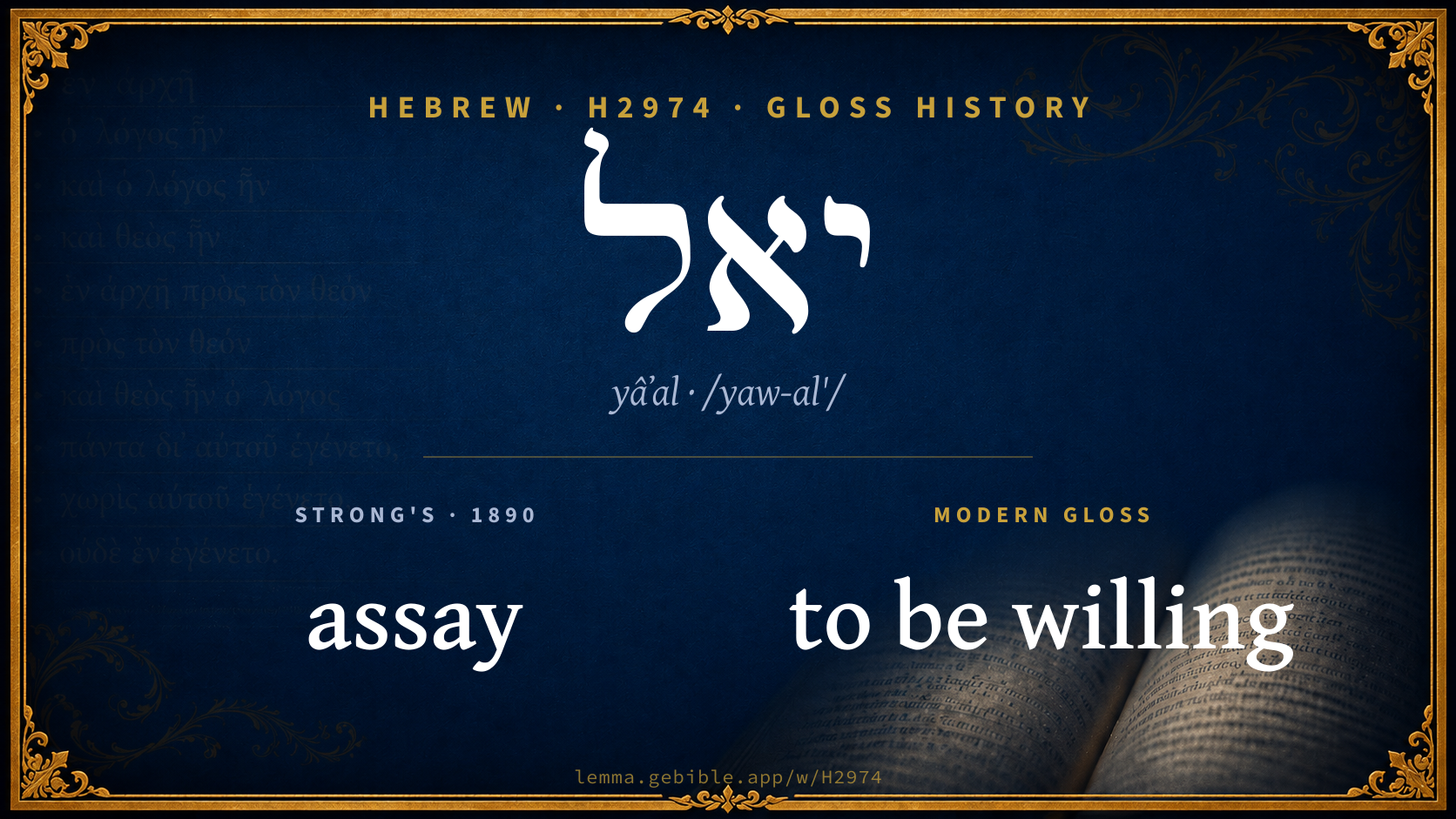
Gloss history
Strong's 1890 vs modern scholarship
About this word
Strong's H2974 catalogs a Hebrew word from the Hebrew Old Testament.
These counts are not copied from any lexicon or concordance. They are computed here, from the morphology-tagged Hebrew Old Testament. What Lemma adds →
- 19
- distinct verses
- The word appears in 19 distinct verses.
- 11 / 39
- OT books
- The word appears in 11 of 39 Old Testament books.
- #1,563
- by frequency
- Top 2500 most frequent Hebrew words (rank 1,563 of 8,640 Hebrew words by occurrence).
View all 19 occurrences in the concordance →
By section of the Old Testament
By traditional corpus
Conventional, traditional groupings — biblical authorship is debated, so this is a traditional corpus grouping, not an authorship claim. Each share is this word’s portion of its verses in that division of the Hebrew canon. Each figure is a share of the word’s 19 distinct verses.
- Prophets (Nevi'im) 12 verses · 63%
- Torah (Pentateuch) 4 verses · 21%
- Writings (Ketuvim) 3 verses · 16%
How translations render this word
Counts come from each version’s own published word-to-Strong’s tagging or interlinear alignment — an approximate guide to how each version renders this word, not a word-level alignment the data otherwise carries. Because each total is that version’s own tagged count, the per-version totals vary from one another and need not match the appearance or distinct-verse counts above. These counts may also differ from a printed concordance because Lemma counts each distinctly tagged rendering and does not collapse phrase taggings into a single head-word total. This is a fixed set of word-tagged versions (KJV, ASV, BSB, ULT) and does not change with the reading translation you choose elsewhere. Each version’s license is shown beside its name below (and on Sources).
- King James Version: Be content 3×, Would 3×, Behold now i have taken upon me 2×
- American Standard Version: Be pleased 3×, Would 3×, Behold now 2×
- Berean Standard Bible: Were determined 3×, Agreed 2×, I have ventured 2×
- unfoldingWord Literal Text: Be willing 4×, And 3×, For 2×
King James Version Public Domain
Renders H2974 across 19 tagged occurrences — most commonly:
Plus 9 renderings that appear only once — usually multi-word phrases or single function words the recovered tagging swept in, not distinct renderings.
American Standard Version Public Domain
Renders H2974 across 19 tagged occurrences — most commonly:
Plus 9 renderings that appear only once — usually multi-word phrases or single function words the recovered tagging swept in, not distinct renderings.
Berean Standard Bible Public Domain
Renders H2974 across 18 tagged occurrences — most commonly:
Plus 9 renderings that appear only once — usually multi-word phrases or single function words the recovered tagging swept in, not distinct renderings. Not rendered by a distinct English word in 1 further occurrence.
unfoldingWord Literal Text CC BY-SA 4.0
Renders H2974 across 25 tagged occurrences — most commonly:
Plus 12 renderings that appear only once — usually multi-word phrases or single function words the recovered tagging swept in, not distinct renderings.
Senses in BDB
The 4 senses BDB distinguishes for this word, in lexicon order (not ranked by frequency or importance). The full entry — with sub-senses — is in the Lexicon Entry tab.
- to begin, make a beginning, show willingness, undertake to do, be pleased, be determined
(Hiphil)
- to agree to, show willingness, acquiesce, accept an invitation, be willing
- to undertake
- to resolve, be pleased, be determined
Word origin
[ יָאַל ] vb. only Hiph. shew willingness, be pleased, determine, undertake to do anything (and do it)
— Brown-Driver-Briggs (Oxford 1906, public domain), digitized via Sefaria, supplemented by the OpenScriptures HebrewLexicon (CC BY 4.0). See Sources.
Derived from יאל (yâʼal) (H2973) — to be foolish.
Jastrow Dictionary
A second Hebrew/Aramaic lexicon for comparison, covering Aramaic and post-biblical (Talmudic, Targumic, Midrashic) usage that the biblical-Hebrew BDB does not. Matched by lemma rather than by Strong’s number, so a lemma may carry more than one Jastrow headword (shown separately below), and the entries cover usage well beyond the Bible.
יָאַל
- , v. הוֹאִיל
A Dictionary of the Targumim, the Talmud Babli and Yerushalmi, and the Midrashic Literature (Marcus Jastrow; London, Luzac, 1903) — Public Domain. Digitized via Sefaria. Digitized via Sefaria. Full attribution on Sources.
Forms in the corpus
The 15 distinct written forms H2974 takes in the Hebrew Bible, most frequent first — each parse links to that stem’s occurrences in the concordance. Hebrew forms include their vowel points and cantillation, so a single lemma takes many written forms.
| Form | Parsing | Example | Uses |
|---|---|---|---|
| הוֹאִ֣יל | Verb, Hiphil, Perfect, 3rd Person, Masculine, Singular | Deuteronomy 1:5 | 2 |
| הוֹאַ֨לְתִּי֙ | Verb, Hiphil, Perfect, 1st Person, Common, Singular | Genesis 18:27 | 2 |
| וַ/יּ֥וֹאֶל | Verb, Hiphil, Sequential Imperfect, 3rd Person, Masculine, Singular | Exodus 2:21 | 2 |
| וַ/יּ֨וֹאֶל֙ | Verb, Hiphil, Sequential Imperfect, 3rd Person, Masculine, Singular | Joshua 17:12 | 2 |
| ה֥וֹאֶל | Verb, Hiphil, Imperative, 2nd Person, Masculine, Singular | 2 Kings 6:3 | 1 |
| הֽוֹאֶל | Verb, Hiphil, Imperative, 2nd Person, Masculine, Singular | Judges 19:6 | 1 |
| הוֹאִ֔יל | Verb, Hiphil, Perfect, 3rd Person, Masculine, Singular | Hosea 5:11 | 1 |
| הוֹאִ֣ילוּ | Verb, Hiphil, Imperative, 2nd Person, Masculine, Plural | Job 6:28 | 1 |
| הוֹאֵ֖ל | Verb, Hiphil, Imperative, 2nd Person, Masculine, Singular | 2 Kings 5:23 | 1 |
| הוֹאֵל֙ | Verb, Hiphil, Imperative, 2nd Person, Masculine, Singular | 2 Samuel 7:29 | 1 |
| הוֹאַ֣לְנוּ | Verb, Hiphil, Perfect, 1st Person, Common, Plural | Joshua 7:7 | 1 |
| הוֹאַ֨לְתָּ֙ | Verb, Hiphil, Perfect, 2nd Person, Masculine, Singular | 1 Chronicles 17:27 | 1 |
| וְ/יֹאֵ֣ל | Verb, Hiphil, Jussive, 3rd Person, Masculine, Singular | Job 6:9 | 1 |
| וַ/יּ֤וֹאֶל | Verb, Hiphil, Sequential Imperfect, 3rd Person, Masculine, Singular | Judges 1:35 | 1 |
| וַ/יֹּ֣אֶל | Verb, Hiphil, Sequential Imperfect, 3rd Person, Masculine, Singular | 1 Samuel 17:39 | 1 |
Septuagint verse parallels
This word appears in 18 verses that also exist in the Greek Old Testament (Septuagint), out of the 19 Hebrew verses it occurs in. You can read those verses in Greek by switching the Old Testament edition to the Septuagint.
Read these verses in the Septuagint
- Genesis 18:27
- Exodus 2:21
- Deuteronomy 1:5
- Joshua 7:7
- Judges 1:27
- 1 Samuel 12:22
- 2 Samuel 7:29
- 2 Kings 5:23
- 1 Chronicles 17:27
- Job 6:9
- Hosea 5:11
This is a verse-level parallel only — the same verses exist in both the Hebrew and Greek Old Testaments. No word-level Hebrew↔Greek correspondence is claimed: the data carries no such alignment, so no Greek word is shown as this Hebrew word’s translation. Coverage is not total — the Septuagint omits the deuterocanon and renumbers the Psalms, so some Hebrew verses have no direct Greek parallel.