Jeremiah 49:17

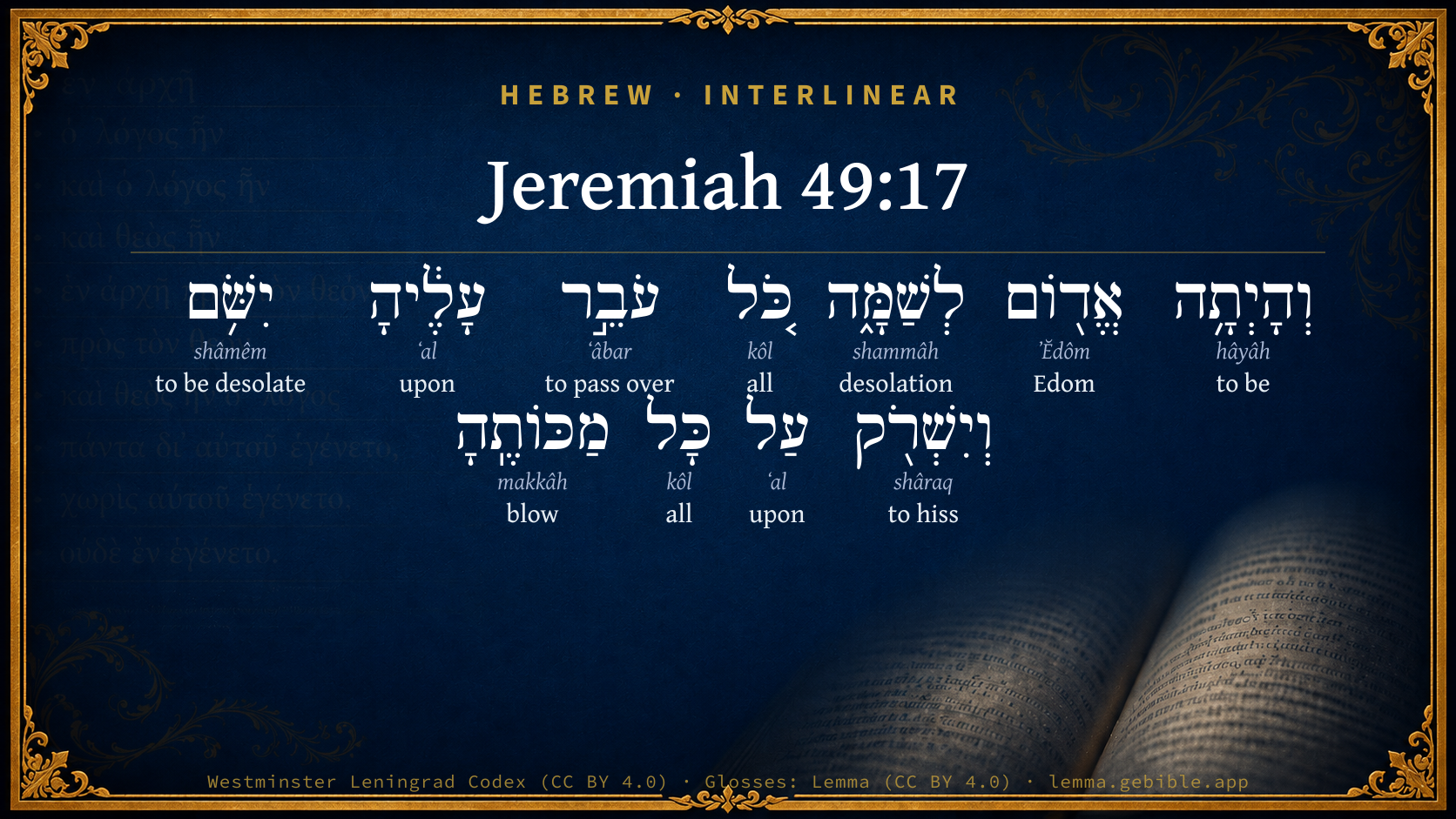
Hebrew (Westminster Leningrad Codex) Jeremiah 49:17 appears in the Hebrew Old Testament. The text above is from the Westminster Leningrad Codex. Each word links to its Strong’s number, a concise gloss, and parsing drawn from the Open Scriptures Hebrew Bible morphology. Click any word for its full Brown-Driver-Briggs (BDB) entry.
Download image
Cite this verse

Jeremiah 49:17 (World English Bible). Public Domain. Lemma interlinear Bible study tool, https://lemma.gebible.app/v/jeremiah/49/17.

Show BibTeX & RIS
BibTeX
RIS
English Translation
Edom shall become an astonishment: everyone who passes by it shall be astonished, and shall hiss at all the plagues of it.
World English Bible · Public Domain
Download a study sheet

One document with this verse’s original text, its word-by-word gloss line, the meaning frame, cross-references with their text, attributed commentary, and full source and license credits — printable, and it pastes into notes with its structure intact.

This verse Autodidact and up

Study sheet (.html) Plain text (.txt)

A passage Seminary Student

Up to 50 verses in one chapter. A passage sheet keeps up to 6 commentary sources and 12 cross-references per verse, in the order this page ranks them, and says so on the sheet whenever that leaves anything out. Ask for a single verse and you get the Autodidact verse sheet above.

Everything on this page stays free to read, with no account — the sheet is a download of what is already on screen, not access to it.

Want to remove ads? Support Godless Engineer
Compare translations 3

The same verse in 3 English versions, stacked beneath the original-language interlinear above. Click any original word for its lexicon entry.

Each is an independent rendering of the whole verse — the interlinear is not word-aligned to these translations.

Highlighted words mark where these versions differ — a whole-verse word diff, not a word-by-word alignment.

  • World English Bible Public Domain
    Edom shall become an astonishment: everyone who passes by it shall be astonished, and shall hiss at all the plagues of it.
  • King James Version Public Domain
    Also Edom shall be a desolation: every one that goeth by it shall be astonished, and shall hiss at all the plagues thereof.
  • unfoldingWord Literal Text CC BY-SA 4.0
    Edom will become a horror to everyone passing by it. Every such person will tremble and hiss because all of its disasters.

unfoldingWord Literal Text — © unfoldingWord, licensed CC BY-SA 4.0. Word-aligned USFM3 via Door43 (git.door43.org/unfoldingWord/en_ult).

Versions to compare (up to 4)

3 of 4 selected

Show all 18 translations

Every available English version of this verse, each an independent rendering of the whole verse.

  • World English Bible Public Domain
    Edom shall become an astonishment: everyone who passes by it shall be astonished, and shall hiss at all the plagues of it.
  • Berean Standard Bible Public Domain
    “Edom will become an object of horror. All who pass by will be appalled and will scoff at all her wounds.
  • Majority Standard Bible Public Domain
    “Edom will become an object of horror. All who pass by will be appalled and will scoff at all her wounds.
  • King James Version Public Domain
    Also Edom shall be a desolation: every one that goeth by it shall be astonished, and shall hiss at all the plagues thereof.
  • American Standard Version (1901) Public Domain
    And Edom shall become an astonishment: every one that passeth by it shall be astonished, and shall hiss at all the plagues thereof.
  • Revised Version (1885) Public Domain
    And Edom shall become an astonishment: every one that passeth by it shall he astonished, and shall hiss at all the plagues thereof.
  • Geneva Bible (1599) Public Domain
    Also Edom shall be desolate: euery one that goeth by it, shall be astonished, and shall hisse at all the plagues thereof,
  • Douay-Rheims (1899) Public Domain
    And Edom shall be desolate: every one that shall pass by it, shall be astonished, and shall hiss at all its plagues.
  • Young's Literal Translation Public Domain
    And Edom hath been for a desolation, Every passer by her is astonished, And doth hiss because of all her plagues.
  • Literal Standard Version CC BY-SA 4.0
    And Edom has been for a desolation, || Everyone passing by her is astonished, || And hisses because of all her plagues.
  • Unlocked Literal Bible CC BY-SA 4.0
    Edom will become a horror to everyone passing by it. Every such person will tremble and hiss because all of its disasters.
  • unfoldingWord Literal Text CC BY-SA 4.0
    Edom will become a horror to everyone passing by it. Every such person will tremble and hiss because all of its disasters.
  • Darby Bible Public Domain
    And Edom shall be an astonishment: every one that goeth by it shall be astonished, and shall hiss, because of all the plagues thereof.
  • World Messianic Bible Public Domain
    “Edom will become an astonishment. Everyone who passes by it will be astonished, and will hiss at all its plagues.
  • Webster's Bible Public Domain
    Also Edom shall be a desolation: every one that goeth by it shall be astonished, and shall hiss at all her plagues.
  • Free Bible Version CC BY-SA 4.0
    People will be horrified at what's happened to Edom. Everyone passing by will be shocked, and will sneer at all its damage.
  • Bible in Basic English Public Domain
    And Edom will become a cause of wonder: everyone who goes by will be overcome with wonder, and make sounds of fear at all her punishments.
  • JPS Tanakh (1917) Public Domain
    And Edom shall become an astonishment; every one that passeth by it shall be astonished and shall hiss at all the plagues thereof.

Literal Standard Version (2020), Covenant Press — licensed CC BY-SA 4.0. Text via the HelloAO Bible API (eBible.org). Unlocked Literal Bible (unfoldingWord) — licensed CC BY-SA 4.0. Text via the HelloAO Bible API (eBible.org). unfoldingWord Literal Text — © unfoldingWord, licensed CC BY-SA 4.0. Word-aligned USFM3 via Door43 (git.door43.org/unfoldingWord/en_ult). Free Bible Version, Dr. Jonathan Gallagher — licensed CC BY-SA 4.0. Text via the HelloAO Bible API (eBible.org).

Word by word

More ways to search: Search by grammar → Find every occurrence → Compare this word →

Practice this passage: Drill this verse → Learn its vocabulary →

וְיִשְׁרֹ֖ק
shâraq
H8319
“and · to hiss”
Conjunction + Verb, Qal, Imperfect, 3rd Person, Masculine, Singular
Part of Speech
Conjunction + Verb
Stem
Qal
Form
Imperfect
Person
3rd Person
Gender
Masculine
Number
Singular
Full BDB Definition

Origin: a primitive root

TWOT: 2468

to hiss, whistle, pipe - (Qal) to hiss (as a signal)
  1. וְהָיְתָ֥ה hâyâh H1961 “and · to be” Conjunction + Verb, Qal, Sequential Perfect, 3rd Person, Feminine, Singular
  2. אֱד֖וֹם ʼĔdôm H123 “Edom” Noun, Proper
  3. לְשַׁמָּ֑ה shammâh H8047 “to/for · desolation” Preposition + Noun, Common, Feminine, Singular, Absolute
  4. כֹּ֚ל kôl H3605 “all of” Noun, Common, Masculine, Singular, Construct
  5. עֹבֵ֣ר ʻâbar H5674 “passing over” Verb, Qal, Participle Active, Masculine, Singular, Absolute
  6. עָלֶ֔יהָ ʻal H5921 “upon · her” Preposition + Suffix, Personal, 3rd Person, Feminine, Singular
  7. יִשֹּׁ֥ם shâmêm H8074 “to be desolate” Verb, Qal, Imperfect, 3rd Person, Masculine, Singular
  8. עַל ʻal H5921 “upon” Preposition
  9. כָּל kôl H3605 “all of” Noun, Common, Masculine, Singular, Construct
  10. מַכּוֹתֶֽהָ makkâh H4347 “blows · her” Noun, Common, Feminine, Plural, Construct + Suffix, Personal, 3rd Person, Feminine, Singular

About this verse

These counts appear in no published source. They are computed here, from the morphology-tagged text and Lemma’s own curated glosses. What Lemma adds →

11
words
9
distinct lemmas
Prophets
section

Notable vocabulary

The rarest word here is וְיִשְׁרֹ֖ק to hiss H8319 — appearing just 12 times in the whole Hebrew Bible.

Shared distinctive vocabulary

וְיִשְׁרֹ֖ק to hiss H8319 occurs in 12 verses of the Hebrew Bible. Also found in:

Grammatical profile

  • 4 verbs
  • 5 nouns
  • 2 prepositions

Verb forms

  • וְהָיְתָ֥ה Qal · Sequential Perfect
  • עֹבֵ֣ר Qal · Participle Active
  • יִשֹּׁ֥ם Qal · Imperfect
  • וְיִשְׁרֹ֖ק Qal · Imperfect

Repetition

Words recur within this verse — often emphatic in Hebrew:

  • כֹּ֚ל all H3605 ×2
  • עָלֶ֔יהָ upon H5921 ×2

Cross-references

13

Topical passages linked to Jeremiah 49:17 in the Treasury of Scripture Knowledge — connected by theme and wording, ordered by reader-vote popularity; previews shown in the World English Bible.

  • Ezekiel 35:7 Thus will I make Mount Seir an astonishment and a desolation; and I will cut off from it him who passes through and him who returns.
  • Jeremiah 50:13 Because of the wrath of Yahweh she shall not be inhabited, but she shall be wholly desolate: everyone who goes by Babylon shall be astonished, and hiss at all her plagues.
  • Jeremiah 49:13 For I have sworn by myself, says Yahweh, that Bozrah shall become an astonishment, a reproach, a waste, and a curse; and all the cities of it shall be perpetual wastes.
  • 1 Kings 9:8 Though this house is so high, yet shall everyone who passes by it be astonished, and shall hiss; and they shall say, Why has Yahweh done thus to this land, and to this house?
  • Jeremiah 18:16 to make their land an astonishment, and a perpetual hissing; everyone who passes thereby shall be astonished, and shake his head.
  • Jeremiah 51:37 Babylon shall become heaps, a dwelling-place for jackals, an astonishment, and a hissing, without inhabitant.
  • 2 Chronicles 7:20–21 then will I pluck them up by the roots out of my land which I have given them; and this house, which I have made holy for my name, will I cast out of my sight, and I will make it a proverb and a byword among all peoples.
  • Isaiah 34:9–15 The streams of [Edom] shall be turned into pitch, and the dust of it into sulfur, and the land of it shall become burning pitch.
  • Lamentations 2:15–16 All that pass by clap their hands at you; They hiss and wag their head at the daughter of Jerusalem, [saying], Is this the city that men called The perfection of beauty, The joy of the whole earth?
  • Ezekiel 25:13 therefore thus says the Lord Yahweh, I will stretch out my hand on Edom, and will cut off man and animal from it; and I will make it desolate from Teman; even to Dedan shall they fall by the sword.
  • Ezekiel 35:15 As you did rejoice over the inheritance of the house of Israel, because it was desolate, so will I do to you: you shall be desolate, Mount Seir, and all Edom, even all of it; and they shall know that I am Yahweh.
  • Micah 6:16 For the statutes of Omri are kept, And all the works of the house of Ahab. You walk in their counsels, That I may make you a ruin, And her inhabitants a hissing; And you will bear the reproach of my people."
  • Zephaniah 2:15 This is the joyous city that lived carelessly, that said in her heart, "I am, and there is none besides me." How she has become a desolation, a place for animals to lie down in! Everyone who passes by her will hiss, and shake their fists.

Cross-references courtesy of OpenBible.info (CC BY 4.0).

Hebrew and Greek witnesses Masoretic Hebrew ↔ Greek Septuagint

The same verse in the two great witnesses to the Old Testament, shown verse-for-verse.

These are two independent witnesses, not word-aligned to each other, and the Septuagint is shown in lemma (dictionary) form.

Hebrew Jeremiah 49:17 Masoretic · Westminster Leningrad Codex

וְהָיְתָ֥ה אֱד֖וֹם לְשַׁמָּ֑ה כֹּ֚ל עֹבֵ֣ר עָלֶ֔יהָ יִשֹּׁ֥ם וְיִשְׁרֹ֖ק עַל כָּל מַכּוֹתֶֽהָ

Edom shall become an astonishment: everyone who passes by it shall be astonished, and shall hiss at all the plagues of it.

World English Bible · Public Domain

Greek LXX Structure differs

In the Septuagint, Jeremiah is about an eighth shorter than the Hebrew and arranges its material differently — the Oracles Against the Nations (Hebrew chapters 46–51) appear in the middle of the Greek book, after 25:13. Because the chapter and verse boundaries do not line up, a verse-for-verse comparison with the Hebrew is not shown.

A verse-for-verse comparison isn’t shown here because the chapters and verses don’t line up. Switch to the LXX edition with the MT / LXX toggle above to read the Greek directly.

On this verse, Joseph Benson's Commentary discusses the Septuagint’s reading. Read the note in Commentary ↓

Hebrew: Westminster Leningrad Codex (CC BY 4.0). Greek: Septuagint (public domain); English from a public-domain English Septuagint. How the Septuagint differs from the Hebrew →

Targum (Aramaic paraphrase)

1

The Targum is the ancient Jewish Aramaic paraphrase of the Hebrew Scriptures — an interpretive translation, not the Hebrew text itself. Onkelos (literal) and Pseudo-Jonathan (expansive) render the Torah, and Jonathan the Prophets. Coverage is partial: where no permissively-licensed English translation exists for a verse, only the Aramaic is shown. This is verse-level text, not a word-by-word alignment to the Hebrew.

  1. Targum Jonathan Prophets (Joshua–Malachi)
    וּתְהֵי אֱדוֹם לְצָדוּ כָּל דְיֶעְבַּר עֲלָהּ יִכְלֵי וְיָגִיד עַל כָּל מְחָתָהָא:

    (no public-domain English translation for this verse)

    Targum Jonathan — Aramaic: “Mikraot Gedolot” (public domain). English: “Sefaria Community Translation” (CC0 1.0 (public-domain dedication)); “London "Chaldee Paraphrase," 1871” (public domain). Text via Sefaria.

Commentary

Notes on Jeremiah 49:17 from classic Christian and Jewish commentators (each source and its license shown beneath its notes). The classic Christian expositions comment on the surrounding passage and are grouped to its opening verse, so a note may address several verses; the Jewish commentaries on the Tanakh (Rashi and others) are per-verse, so they appear only where the commentator wrote on this verse.

Lemma curates 59 commentaries, every one of them public domain or Creative Commons licensed, each selected and text-cleaned for this edition rather than reprinted as found. About our sources →

Trapp's Complete Commentary

John Trapp

Jer 49:17 Also Edom shall be a desolation: every one that goeth by it shall be astonished, and shall hiss at all the plagues thereof.

Ver. 17. And Edom shall be a desolation] Heb., For a desolation. See on Jer 49:13.

John Trapp, A Commentary or Exposition upon All the Books of the Old and New Testament (1647–1656) — public domain. Text from a community e-Sword module.

Joseph Benson's Commentary

Jer 49:17-19. Edom shall be a desolation; every one shall hiss, &c. — See note on Jer 18:16. As in the overthrow of Sodom, &c. — A proverbial expression, denoting an utter destruction. Behold, he shall come up like a lion, &c. — This is a description of Nebuchadnezzar’s marching with his army against Idumea, whom the prophet compares to a lion coming out of his den near Jordan. When that river swells, in the time of harvest, the lions, that lie in the thickets on the river side, are raised out of their coverts, and infest the country: see note on Jer 12:5, and Maundrell’s Travels, pp. 81, 82. Against the habitation of the strong — Hebrew, אל נוה איתן, the strong folds, or rough pastures. The LXX. read εις τοπον Αιθαμ, to the place Aitham, considering the word which we render strong as a proper name. But I will suddenly make him run away from her — This clause should rather be rendered, I will rouse him up and make him, run upon her, the preposition מעל, here rendered from likewise signifying upon, and being so rendered by our translators, 1Ki 9:5. To this purpose the Vulgate, quia subito currere faciam eum ad illam, because I will cause him to run suddenly against her. And who is a chosen man that I may appoint over her? — Namely, to spoil and destroy her. What select man shall I employ for this purpose? for it must be one who will do it effectually. Nebuchadnezzar, or his captain-general Nebuzar- adan, seems to be here meant. For who is like me? — Who is able, like me, to prepare instruments to perform his work? And who will appoint me the time? and who is that shepherd? &c. — Who will challenge me to meet him in the field, as if we were upon equal terms? or what leader or general can enter the lists with me? “The word shepherd often signifies a prince, or commander. But here it is used in opposition to the lion mentioned before; as if he had said, A shepherd may as well encounter a lion as the best appointed warrior contend with the Almighty, or those whom he makes the instruments of his vengeance.” — Lowth.

Joseph Benson's Commentary on the Old and New Testaments (1811–1818) — public domain. Text from a community e-Sword module.

Jamieson, Fausset & Brown

Robert Jamieson, A. R. Fausset & David Brown

(Compare Kg1 9:8).

Jamieson, Fausset & Brown — Commentary Critical and Explanatory on the Whole Bible (1871) — public domain (CC PDM 1.0). Text via the HelloAO Bible API.

John Calvin's Commentaries

Here again the Prophet confirms what he had said. We have before stated how necessary was such a repetition, because no one could have thought that destruction was so nigh the Idumeans. He did not then repeat what he had said, in order to explain more clearly what might have been otherwise obscure, but to fix more fully in the hearts of the faithful what appeared incredible.

He then says that Edom would become a waste; and then, that every one passing by it would be astonished and hiss on account of all her wounds, or strokes. Hissing may refer to derision, or to astonishment, or, at least, to wonder: for many hiss, or shake the head through mockery; and others hiss through wonder, when any unusual thing happens. And as he had said before, Whosoever shall pass through it shall be astonished, I am disposed to refer this also to what is produced by wonder or amazement. It afterwards follows —

John Calvin's Commentaries (1540-1563) — public domain. Text from the Calvin Translation Society English edition (1840s-50s) via the Christian Classics Ethereal Library (ccel.org). Calvin's coverage is partial (roughly two-thirds of the Bible); uncommented books and verses are honest gaps, never fabricated. The 19th-century editor's footnotes and remarks are omitted so the notes are faithfully Calvin's own voice.

Ellicott's Commentary for English Readers

(17) Edom shall be a desolation.—The words did not receive an immediate or even a rapid fulfilment. Idumæa was a populous and powerful country in the time of John Hyrcanus. Petra, as we have seen, was rebuilt by the Romans as a centre of trade and government, and had its baths, and theatres, and temples. But the end came at last, and there are few lands, once the seat of a thriving nation, more utterly desolate than that of Edom. From the ninth century of the Christian era it disappears from history (Robinson’s Researches, ii. 575).

A Bible Commentary for English Readers, edited by Charles John Ellicott (1878–1897) — public domain. Text from a community e-Sword module.

The Cambridge Bible for Schools and Colleges

gen. ed. J. J. S. Perowne

17. Cp. Jer_19:8.

The Cambridge Bible for Schools and Colleges (gen. ed. J. J. S. Perowne; Cambridge University Press, 1878–1918) — public domain. Text from a community e-Sword module.

John Gill's Exposition

Also Edom shall be a desolation,.... Not only Bozrah, its principal city, before spoken of, but the whole country of Idumea should be laid waste; its fortified cities destroyed; its riches plundered; and its inhabitants slain with the sword; or carried captive:

everyone that goeth by it shall be astonished; at the desolation made, so suddenly and so universally:

and shall hiss at all the plagues thereof; rejoice at them; clap their hands, and shake their heads, as the Targum; and hiss with their tongues, insulting and deriding them.

John Gill's Exposition of the Whole Bible (1746–1763) — public domain (CC PDM 1.0). Text via the HelloAO Bible API.

Haydock's Catholic Bible Commentary

Desolate. The few who survived left their ancient territories, which are now a desert, like most of Stony Arabia. (Calmet) --- Hiss, out of contempt. The punishment was so great as to excite surprise. (Worthington)

George Leo Haydock (1774–1849), Haydock's Catholic Family Bible and Commentary, 1859 edition — public domain. Excludes Psalms (Douay-Rheims chapter numbering differs from Protestant) and Deuterocanonical books (Catholic canon only).

Matthew Poole's English Annotations

The like is said of Babylon, Jer 50:13; it appears from 1Ki 9:8, that it was a kind of proverbial expression, when they would express a great desolation, or great plagues, that those who passed by such a place should be astonished, and hiss at it.

Matthew Poole's English Annotations on the Holy Bible (1683–1685) — public domain. Text from a community e-Sword/MySword module.

The Pulpit Commentary

A desolation; rather, an astonishment. The word is from the same root as the following verb. The phrase is characteristic of Jeremiah, who has no scruple in repeating a forcible expression, and so enforcing an important truth. (comp. Jer_25:11, 38 1:2-3 51:43) What so "astonishing" as the reverses of once flourishing kingdoms! For the Bible knows nothing of the "necessity" of the decay and death of nations. The "covenant" which Jehovah offers contains the pledge of indestructibility. Everyone that goeth by it, etc. Another self-reminiscence. (see Jer_19:8)

The Pulpit Commentary (1880–1919), ed. H.D.M. Spence-Jones & Joseph S. Exell — public domain. Text from a community e-Sword module.

Scofield Reference Notes

C. I. Scofield

Edom

See Jer 49:14-22 (See Scofield "Gen 36:1").

The Scofield Reference Bible (1917 edition), notes by C. I. Scofield — public domain. Text from a community e-Sword module.

unfoldingWord translationNotes

Door43 World Missions Community

General Information:

Yahweh continues speaking to the people of Edom.

Edom will become a horror to everyone passing by it

The abstract noun "horror" can be stated using the verb "horrified." AT: "The people passing by will be horrified when they what happened to Edom" (See: Abstract Nouns)

tremble and hiss

The word "hiss" refers to a sound that shows horror or awe. AT: "shake from fear and gasp" (See: Symbolic Action)

no one will live there; no person will stay there

Yahweh says the same thing twice to emphasize that Edom will be completely uninhabited. (See: Parallelism)

translationWords

Edom

Sodom

Gomorrah

neighbor

Yahweh

life

unfoldingWord translationNotes — © Distant Shores Media and the Door43 World Missions Community, licensed CC BY-SA 4.0. Source: git.door43.org/Door43/en_tn.

Lesson kit

Teaching starters — assembled from the data on this page, not authored interpretation. Every prompt links to the verse data it draws on. Edit before teaching.

Jeremiah, in the Prophets, opens this verse with 11 words (9 distinct Hebrew lemmas). Its most distinctive word is shâraq (“to hiss”). A historical commentator’s framing appears above. Read the whole chapter for the surrounding context.

Discussion questions

  1. What does “to hiss” (shâraq) contribute to the verse as a whole?
  2. 1 Kings 9:8 shares the word «to hiss» with this verse. How do the two illuminate each other?
  3. “all” occurs 2× in this one verse. What is the effect of the repetition?
  4. These translations render this verse differently; the difference is in the English rendering, not the original. What questions does that raise?
  5. The verb «וְהָיְתָ֥ה» is Qal Sequential Perfect. How does its form color the action?
  6. Reading how Trapp's Complete Commentary and Joseph Benson's Commentary read this verse, where do the two commentators agree and where do they part?

Things to notice

Reading settings

Reading text

Shown beneath each verse's original-language words.

Old Testament
Old Testament edition

Read the OT as the Masoretic Hebrew (MT) or the Greek Septuagint (LXX).

English shown for the Greek Septuagint (in the Hebrew ↔ Greek comparison).

Comparing translations? Open the Compare panel on any verse page to stack up to four side by side.