
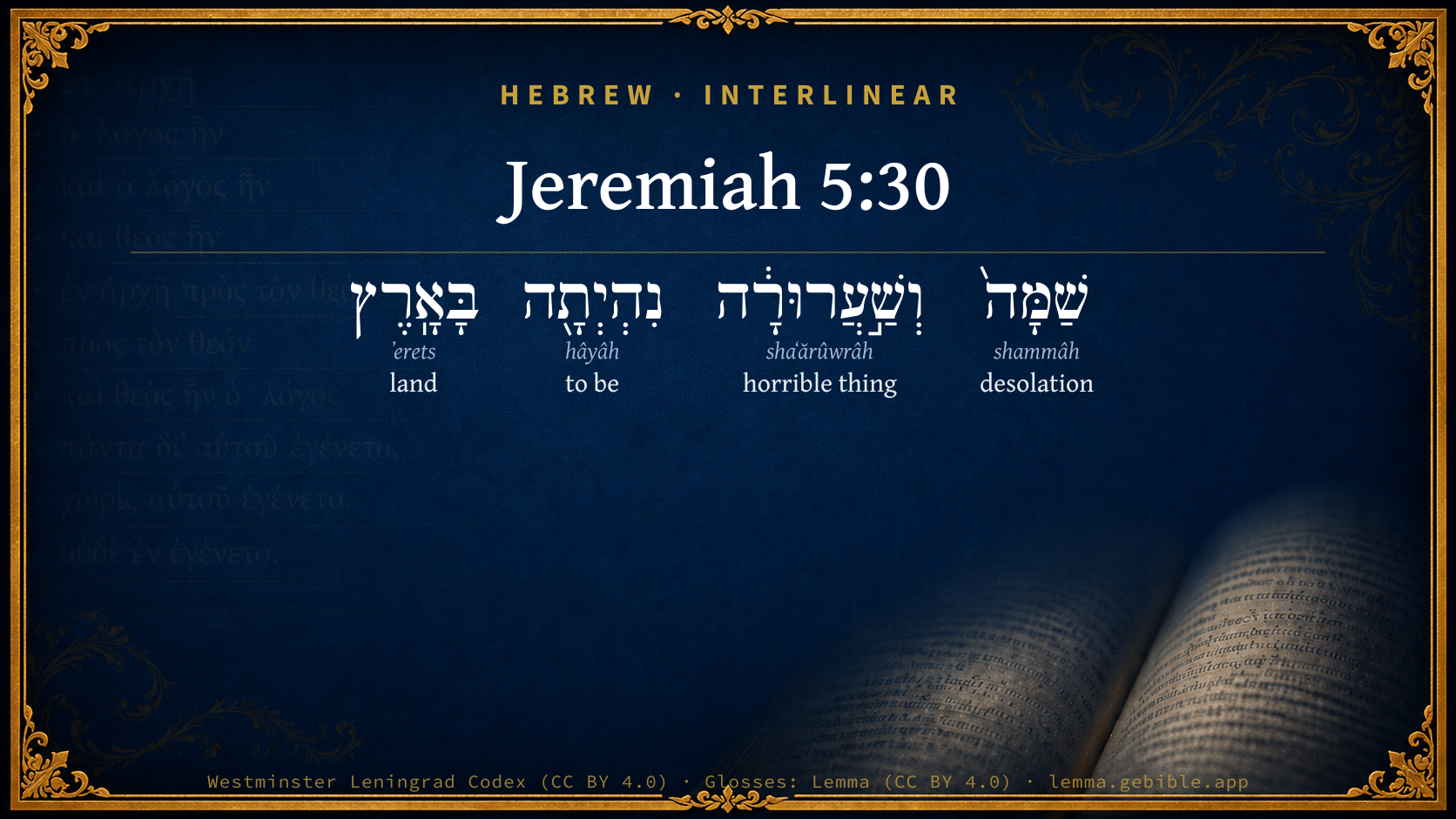
Jeremiah 5:30

Hebrew (Westminster Leningrad Codex) Jeremiah 5:30 appears in the Hebrew Old Testament. The text above is from the Westminster Leningrad Codex. Each word links to its Strong’s number, a concise gloss, and parsing drawn from the Open Scriptures Hebrew Bible morphology. Click any word for its full Brown-Driver-Briggs (BDB) entry.
Download image
Cite this verse

Jeremiah 5:30 (World English Bible). Public Domain. Lemma interlinear Bible study tool, https://lemma.gebible.app/v/jeremiah/5/30.

Show BibTeX & RIS
BibTeX
RIS
English Translation
A wonderful and horrible thing is happen in the land:
World English Bible · Public Domain
Highlights
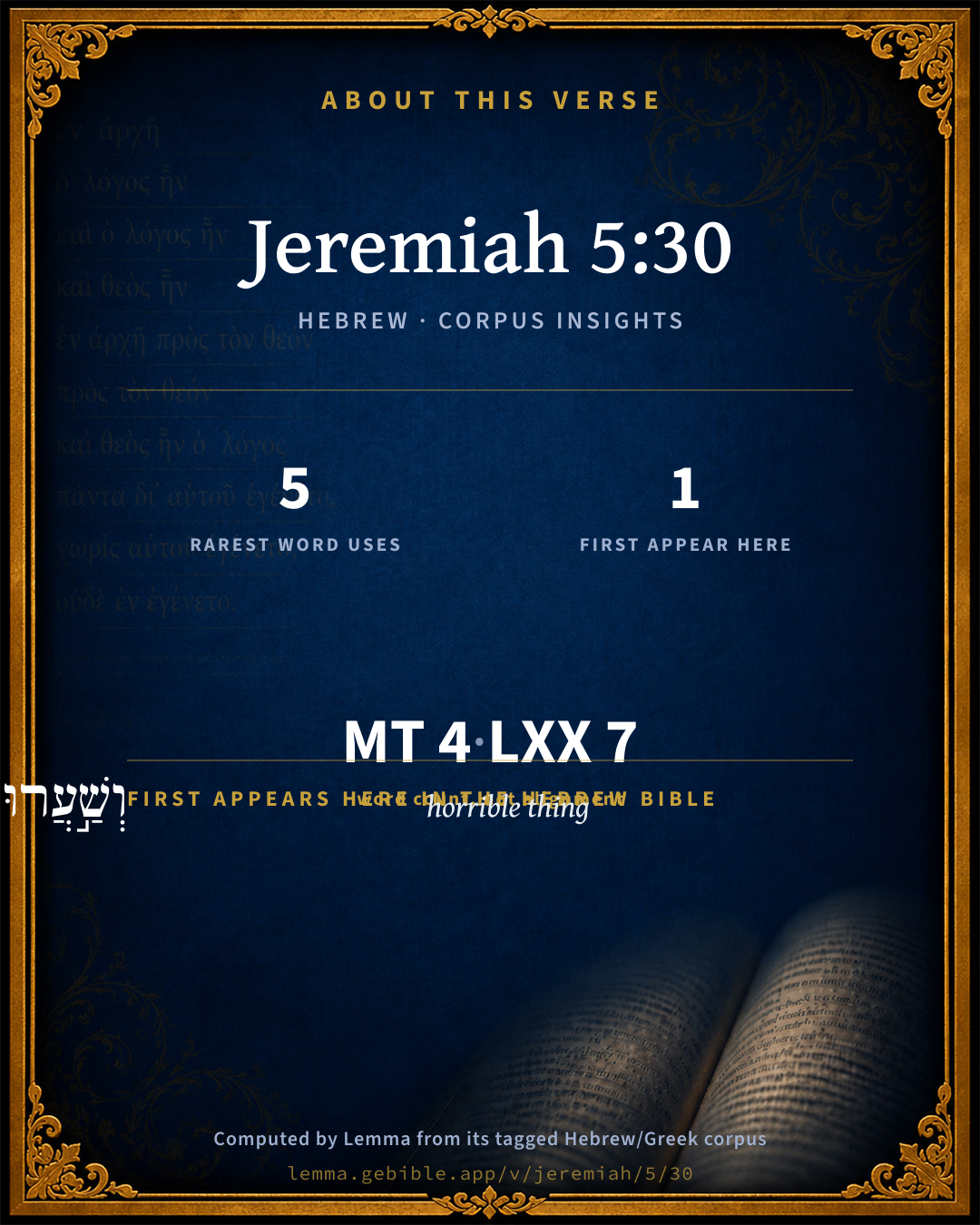
  • 1 first appearance in the Hebrew Bible
Full analysis ↓
Download a study sheet

One document with this verse’s original text, its word-by-word gloss line, the meaning frame, cross-references with their text, attributed commentary, and full source and license credits — printable, and it pastes into notes with its structure intact.

This verse Autodidact and up

Study sheet (.html) Plain text (.txt)

A passage Seminary Student

Up to 50 verses in one chapter. A passage sheet keeps up to 6 commentary sources and 12 cross-references per verse, in the order this page ranks them, and says so on the sheet whenever that leaves anything out. Ask for a single verse and you get the Autodidact verse sheet above.

Everything on this page stays free to read, with no account — the sheet is a download of what is already on screen, not access to it.

Want to remove ads? Support Godless Engineer
Compare translations 3

The same verse in 3 English versions, stacked beneath the original-language interlinear above. Click any original word for its lexicon entry.

Each is an independent rendering of the whole verse — the interlinear is not word-aligned to these translations.

Highlighted words mark where these versions differ — a whole-verse word diff, not a word-by-word alignment.

  • World English Bible Public Domain
    A wonderful and horrible thing is happen in the land:
  • King James Version Public Domain
    A wonderful and horrible thing is committed in the land;
  • unfoldingWord Literal Text CC BY-SA 4.0
    Desolation and horror has happened in the land.

unfoldingWord Literal Text — © unfoldingWord, licensed CC BY-SA 4.0. Word-aligned USFM3 via Door43 (git.door43.org/unfoldingWord/en_ult).

Versions to compare (up to 4)

3 of 4 selected

Show all 18 translations

Every available English version of this verse, each an independent rendering of the whole verse.

  • World English Bible Public Domain
    A wonderful and horrible thing is happen in the land:
  • Berean Standard Bible Public Domain
    A horrible and shocking thing has happened in the land.
  • Majority Standard Bible Public Domain
    A horrible and shocking thing has happened in the land.
  • King James Version Public Domain
    A wonderful and horrible thing is committed in the land;
  • American Standard Version (1901) Public Domain
    A wonderful and horrible thing is come to pass in the land:
  • Revised Version (1885) Public Domain
    A wonderful and horrible thing is come to pass in the land;
  • Geneva Bible (1599) Public Domain
    An horrible and filthie thing is committed in the land.
  • Douay-Rheims (1899) Public Domain
    Astonishing and wonderful things have been done in the land.
  • Young's Literal Translation Public Domain
    An astonishing and horrible thing hath been in the land.
  • Literal Standard Version CC BY-SA 4.0
    An astonishing and horrible thing has been in the land:
  • Unlocked Literal Bible CC BY-SA 4.0
    Atrocities and horrors have occurred in the land.
  • unfoldingWord Literal Text CC BY-SA 4.0
    Desolation and horror has happened in the land.
  • Darby Bible Public Domain
    An appalling and horrible thing is committed in the land:
  • World Messianic Bible Public Domain
    “An astonishing and horrible thing has happened in the land.
  • Webster's Bible Public Domain
    A wonderful and horrible thing is committed in the land;
  • Free Bible Version CC BY-SA 4.0
    Something horrible, something terrible has happened here in this country.
  • Bible in Basic English Public Domain
    A thing of wonder and fear has come about in the land;
  • JPS Tanakh (1917) Public Domain
    An appalling and horrible thing is come to pass in the land:

Literal Standard Version (2020), Covenant Press — licensed CC BY-SA 4.0. Text via the HelloAO Bible API (eBible.org). Unlocked Literal Bible (unfoldingWord) — licensed CC BY-SA 4.0. Text via the HelloAO Bible API (eBible.org). unfoldingWord Literal Text — © unfoldingWord, licensed CC BY-SA 4.0. Word-aligned USFM3 via Door43 (git.door43.org/unfoldingWord/en_ult). Free Bible Version, Dr. Jonathan Gallagher — licensed CC BY-SA 4.0. Text via the HelloAO Bible API (eBible.org).

Word by word

More ways to search: Search by grammar → Find every occurrence → Compare this word →

Practice this passage: Drill this verse → Learn its vocabulary →

About this verse

These counts appear in no published source. They are computed here, from the morphology-tagged text and Lemma’s own curated glosses. What Lemma adds →

4
words
4
distinct lemmas
Prophets
section

Notable vocabulary

The rarest word here is וְשַׁ֣עֲרוּרָ֔ה horrible thing H8186 — appearing just 5 times in the whole Hebrew Bible.

First appearance in Scripture

This word makes its first canonical appearance in the Hebrew Bible here:

  • וְשַׁ֣עֲרוּרָ֔ה horrible thing H8186

Shared distinctive vocabulary

וְשַׁ֣עֲרוּרָ֔ה horrible thing H8186 occurs in 4 verses of the Hebrew Bible. Also found in:

Grammatical profile

  • 1 verb
  • 3 nouns

Verb forms

  • נִהְיְתָ֖ה Niphal · Perfect

Hebrew & Septuagint length

In the original languages it is 4 Hebrew tokens and 7 Greek tokens — but the two are counted differently (Hebrew bundles its prefixes and suffixes into one token; the Greek is in lemma form), so that isn’t a like-for-like length.

Cross-references

4

Topical passages linked to Jeremiah 5:30 in the Treasury of Scripture Knowledge — connected by theme and wording, ordered by reader-vote popularity; previews shown in the World English Bible.

  • Jeremiah 23:14 In the prophets of Jerusalem also I have seen a horrible thing: they commit adultery, and walk in lies; and they strengthen the hands of evil-doers, so that none does return from his wickedness: they are all of them become to me as Sodom, and the inhabitants of it as Gomorrah.
  • Hosea 6:10 In the house of Israel I have seen a horrible thing. There is prostitution in Ephraim. Israel is defiled.
  • Isaiah 1:2 Hear, heavens, And listen, earth; for Yahweh has spoken: I have nourished and brought up children, And they have rebelled against me.
  • Jeremiah 2:12 Be astonished, you heavens, at this, and be horribly afraid, be you very desolate, says Yahweh.

Cross-references courtesy of OpenBible.info (CC BY 4.0).

Hebrew and Greek witnesses Masoretic Hebrew ↔ Greek Septuagint

The same verse in the two great witnesses to the Old Testament, shown verse-for-verse.

These are two independent witnesses, not word-aligned to each other, and the Septuagint is shown in lemma (dictionary) form.

Hebrew Jeremiah 5:30 Masoretic · Westminster Leningrad Codex

שַׁמָּה֙ וְשַׁ֣עֲרוּרָ֔ה נִהְיְתָ֖ה בָּאָֽרֶץ

A wonderful and horrible thing is happen in the land:

World English Bible · Public Domain

Greek LXX Structure differs

In the Septuagint, Jeremiah is about an eighth shorter than the Hebrew and arranges its material differently — the Oracles Against the Nations (Hebrew chapters 46–51) appear in the middle of the Greek book, after 25:13. Because the chapter and verse boundaries do not line up, a verse-for-verse comparison with the Hebrew is not shown.

A verse-for-verse comparison isn’t shown here because the chapters and verses don’t line up. Switch to the LXX edition with the MT / LXX toggle above to read the Greek directly.

Hebrew: Westminster Leningrad Codex (CC BY 4.0). Greek: Septuagint (public domain); English from a public-domain English Septuagint. How the Septuagint differs from the Hebrew →

Targum (Aramaic paraphrase)

1

The Targum is the ancient Jewish Aramaic paraphrase of the Hebrew Scriptures — an interpretive translation, not the Hebrew text itself. Onkelos (literal) and Pseudo-Jonathan (expansive) render the Torah, and Jonathan the Prophets. Coverage is partial: where no permissively-licensed English translation exists for a verse, only the Aramaic is shown. This is verse-level text, not a word-by-word alignment to the Hebrew.

  1. Targum Jonathan Prophets (Joshua–Malachi)
    תֵּימָא וּשְׁנוּ הֲווֹ בְּאַרְעָא:

    (no public-domain English translation for this verse)

    Targum Jonathan — Aramaic: “Mikraot Gedolot” (public domain). English: “Sefaria Community Translation” (CC0 1.0 (public-domain dedication)); “London "Chaldee Paraphrase," 1871” (public domain). Text via Sefaria.

Commentary

Notes on Jeremiah 5:30 from classic Christian and Jewish commentators (each source and its license shown beneath its notes). The classic Christian expositions comment on the surrounding passage and are grouped to its opening verse, so a note may address several verses; the Jewish commentaries on the Tanakh (Rashi and others) are per-verse, so they appear only where the commentator wrote on this verse.

Lemma curates 59 commentaries, every one of them public domain or Creative Commons licensed, each selected and text-cleaned for this edition rather than reprinted as found. About our sources →

Trapp's Complete Commentary

John Trapp

Jer 5:30 A wonderful and horrible thing is committed in the land;

Ver. 30. A wonderful and horrible thing.] Res stupenda et horrenda; an abhorred filth, such as may well draw from us a Heu, heu, Domine Deus

Is committed in the land.] Heb., In this land, where men are therefore the worse, because they should be better.

John Trapp, A Commentary or Exposition upon All the Books of the Old and New Testament (1647–1656) — public domain. Text from a community e-Sword module.

Joseph Benson's Commentary

Jer 5:30-31. A wonderful and horrible thing is committed — So stupendous a crime, that it is beyond the apprehension of man to conceive, much more to express, its greatness; and so abominable, that a man ought even to loathe the thoughts of it. What this is, we have in the next verse; in the land — That is, this land, which aggravates the greatness of the wonder that such a thing should exist in such a land! The prophets prophesy falsely, &c. — Both priests and prophets agree to speak pleasing things to the people, thereby to keep up their interest and authority with them. And my people love to have it so — They are well enough pleased to be thus misled. If the prophets and priests will let them alone in their sins, they will give them no disturbance in theirs. They love to be held and governed by a loose rein, and like those rulers very well that will not restrain their lusts, and those teachers that will not reprove them: see note on Isa 30:10. And what will ye do in the end thereof — And what can this end in, but a total corruption of manners? The consequence of which must be the utter ruin of the state.

Joseph Benson's Commentary on the Old and New Testaments (1811–1818) — public domain. Text from a community e-Sword module.

Jamieson, Fausset & Brown

Robert Jamieson, A. R. Fausset & David Brown

(Jer 23:14; Hos 6:10).

Jamieson, Fausset & Brown — Commentary Critical and Explanatory on the Whole Bible (1871) — public domain (CC PDM 1.0). Text via the HelloAO Bible API.

Adam Clarke's Commentary

Verse 30. A wonderful and horrible thing is committed on the land] Dahler translates: "Strange crimes and horrible trespasses have been committed in the land." These have been already detailed; but this may refer to what follows.

Adam Clarke's Commentary on the Bible (1810–1826) — public domain. Text from a community e-Sword/MySword module.

John Calvin's Commentaries

The Prophet, being not satisfied with the reproof which we have observed, speaks still more strongly against the wickedness of the people. He then says, that so deplorable was their state as to make all to feel amazed. A stupendous thing, he says, has happened, which exceeds all human conception, and cannot be comprehended. By the two words he uses, he intimates that the impiety of the people could not be expressed in words or could not be conceived by the mind; for it was a monstrous thing. This is the meaning.

John Calvin's Commentaries (1540-1563) — public domain. Text from the Calvin Translation Society English edition (1840s-50s) via the Christian Classics Ethereal Library (ccel.org). Calvin's coverage is partial (roughly two-thirds of the Bible); uncommented books and verses are honest gaps, never fabricated. The 19th-century editor's footnotes and remarks are omitted so the notes are faithfully Calvin's own voice.

Ellicott's Commentary for English Readers

(30) Wonderful.—Better, terrible.

Is committed.—Better, has come to pass.

A Bible Commentary for English Readers, edited by Charles John Ellicott (1878–1897) — public domain. Text from a community e-Sword module.

The Cambridge Bible for Schools and Colleges

gen. ed. J. J. S. Perowne

30. wonderful] appalling. The word properly means desolation, destruction.

30, 31. See introd. summary to section. Leaders and people unite in disaffection.

The Cambridge Bible for Schools and Colleges (gen. ed. J. J. S. Perowne; Cambridge University Press, 1878–1918) — public domain. Text from a community e-Sword module.

John Gill's Exposition

The prophets prophesied falsely,.... That the people would have peace and prosperity, and not be carried captive into Babylon, as Jeremiah and other true prophets of the Lord had predicted:

and the priests bear rule by their means; or rather "the princes"; for the word signifies princes as well as priests, and to the former government more properly belongs; and so Jarchi interprets it of the judges of the people, and their exactors; these governed the people according to the words of the false prophets, as the same writer explains it; they were "under" their influence and direction, they went after them, as the phrase is sometimes used; see Ch1 25:2 or, as Kimchi understands it, the priests received gifts by their hands to pervert judgment, and they declined doing justice, according to their will. The Targum is,

"the priests helped upon their hands;''

took the false prophets, as it were, and carried them in their hands. Some render it, "the priests remove, or depart by their means" (h); through their false prophesies they departed from the law, and the worship of God and his ordinances, from attending to them, and performing them in the manner appointed; in the whole it denotes great friendship, unity, and agreement between the priests, or princes, and the false prophets; they agreed together to keep the people in awe and in bondage; and what was of all the most surprising is what follows:

and my people love to have it so; both that the prophets prophesy smooth things to them, though false; and that the princes should govern as they directed:

and what will ye do in the end thereof? that these evils will bring unto; namely, the destruction of the city and nation. The meaning is, what will become of them at last? or what would they do, when this wicked government would come to an end, and they should be taken and carried captive by the Chaldeans? which would be their case; and how would they like that, who love to have things as they were, which would bring on their ruin?

(h) So R. Sol. Urbin. Ohel Moed, for. 62. I.

Next: Jeremiah Chapter 6

John Gill's Exposition of the Whole Bible (1746–1763) — public domain (CC PDM 1.0). Text via the HelloAO Bible API.

Matthew Poole's English Annotations

So prodigious or stupendous a crime, that it is beyond the thought or apprehension of man to conceive, much more to express; and so abominable, that a man would even loathe the thoughts of. What this is we have in the next verse.

The land, Heb. this land, aggravating the greatness of the wonder, that such a thing should be in such a land: see Isa 26:10.

Matthew Poole's English Annotations on the Holy Bible (1683–1685) — public domain. Text from a community e-Sword/MySword module.

The Pulpit Commentary

Vers. 30, 31. The result of the prophet"s examination of the moral condition of the people.

A wonderful and horrible thing, etc.; rather, an appalling and horrible thins hath happened in the land. The word rendered "appalling" (or stupefying) has a peculiar force, it only occurs again in Jer_23:14, though a cognate adjective is found in Jer_18:13. (comp. on Jer_2:11)

Vers. 30, 31. The most appalling condition to which a nation can sink.

After enumerating the sins of his people in ever-darkening series, the prophet at length reaches a form of evil worse than all others, at the sight of which he starts back with an exclamation of horror; this is corruption at the very fountain of instruction and worship, and the willing acquiescence in it by the nation.

I CONSIDER THE FEARFUL NATURE OF THIS EVIL.

1. False prophecy. The prophet should be the highest oracle of truth. If he utters lies, knowledge is corrupted at its source. The guilt of such conduct is exceptionally great, because

(1) it is a sin against light;

(2) it is a prostitution of the highest powers to the basest ends; and

(3) it is a cause of widespread ruin to those who follow these "blind leaders of the blind.

1. Subservient priesthood. The priests were at the beck of the false prophets. These men had not the excuse of the prophets. The prophets represented a progressive religion, a religion of inward lights, a religion in which new departures were expected, and therefore one in which the excuse of honest though mistaken enthusiasm might be urged in defense of a lapse into error. But the priests were the custodians of a rigid ritual defined by a written Law. They were put in trust, and their apostasy was a deliberate act of unfaithfulness. The Christian teacher, though free from the letter of the Law, and gifted with the spiritual freedom of prophecy, is put in trust with the gospel. (1Ti_1:11) If he, while retaining the influence and emoluments of his office, consciously forsakes the guidance of the New Testament for the fascinations of groundless speculation, he too is guilty of unfaithfulness; and if he knows the speculation to be false, but accepts it out of deference to its popularity, he is guilty of base treason like that of the commander of a fortress who surrenders to the enemy from sheer cowardice.

2. Popular acquiescence in these evils. "My people love to have it so." This is pleasing, since

(1) the false prophets flatter and prophesy smooth things, while the true prophets like Jeremiah must often rebuke and denounce judgments; and

(2) the priests are satisfied with an unspiritual religion, ritual without morality, perhaps even immorality in religion. But this fact completes the terrible depravity of the nation. The people cannot plead ignorance nor compulsory obedience. The willing followers of corrupt religious leaders must share their guilt; nay, they are responsible for the aggravation of it by fostering with applause that which would die out if neglected.

II CONSIDER THE FINAL RESULT OF THIS EVIL. "And what will ye do in the end thereof?" It was characteristic of the false prophets that they aimed only at immediate popularity, and thought only of the present, while the true prophets were concerned with the future. But the future wilt some day be the present. Is it not best to inquire what this is becoming while yet there is time to modify it?

1. Consider the moral results of this depravity, the corruption of conscience, the falsifying of the nature of those who live in falsehood, the destruction of all spiritual life in those who lower spiritual functions before the claims of worldly convenience.

2. Consider the penal results of this depravity. Can this of all evils go unpunished? (See ver. 29)

Vers. 30, 31. Mutual helpers in wrong-doing.

I THE TEMPTATIONS HERE SET FORTH. Three classes are mentioned the prophet, the priest, and the people in general. Each class plays only too well its iniquitous and deplorable part, just because of the strong assistance which it gains from the attitude of the others. Each class acts as tempter in its turn, and that none the less effectually because it may do it unconsciously. Each one also tempts because he is tempted, and one hardly knows where the malign influence begins save by remembering the words of James, "Every man is tempted when he is drawn away of his own lust and enticed." The prophet, however, is here put first, and this can hardly be without reason. On him there did indeed lie a peculiar burden of responsibility. The prophets here mentioned, we may take it, were not false prophets, although they spoke falsely. The false prophet was he who pretended to be a prophet, although God never sent him; and of such there were doubtless some in the land at this very time. But the horrible thing here was that men whom God had set apart to speak the truth used the prophetic office to tell convenient lies, such as seemed to afford security and profit. Jonah, in his cowardice fleeing from duty, is an illustration of what many other prophets must have done, only they went further and never came back to truth and peace. We know how men in all ages have sold the heritage of faculty which God has given them to the service of lying and darkness. Instead of fighting where their hearts ought to have been, among the soldiers for truth and liberty, they have become mercenaries under despots. These prophets on whom Jehovah had put his hand had allowed themselves to be filled with fear and greed and schemes for worldly success, instead of with the Spirit of Jehovah. They went not with what was true, but with what was acceptable. How much higher the faithful prophets should stand in our esteem when we consider the temptations they resisted, the pains they suffered, the pious heroism which marked their sometimes long career! Imagine what the consequences would have been if the apostles had altered and trimmed the gospel. Then there were the priests. "The priests bear rule by their means." The allusion may be to the hands of the prophets, but perhaps a better meaning is to take it that the prophet sinned in his way, and the priest again in his way. The prophet"s great instrument of service was his mouth, and with this he prophesied falsely. The priest"s great instrument of service was his hand, and this he used to get superstitious deference to his privileges, instead of for the purpose of presenting, with his whole heart, offering and atonement for the people. In addition to this, there may have been, and very likely was, a corrupt understanding between priest and prophet. Then both priest and prophet had in their eyes the great mass of the people. God himself looked down on this unfaithfulness of the great officials with a warmth of indignation that would soon burst into flame, but the people regarded it all with a very different feeling. They "loved to have it so." When a true prophet came, speaking truth, his message was so hateful and humiliating that they denied his office. "Surely the man who speaks such things cannot be a prophet; a madman he may be, or a fanatic, or a disloyal man whose Israelite form hides a foreign heart; anything you like, but not a prophet." But when the prophet comes speaking lies, looking into the faces of his audience for all that he has to put into their ears, then his office will be approved. And so with the priest. If he makes it clear that burnt offerings and all sacrifices are nothing without repentance and reform, he will be thought very little of. He must let the people sin and sin as much as they like. They will cram the temple area with multitudes of flocks and herds to take the effect of sin away, if only they may go on sinning. What God had given to teach the dreadful malignity of sin, these priests had turned into an agency for making it seem a mere trifle.

II THERE WAS ALSO AN OPPORTUNITY OF REBUKE AND REMONSTRANCE. The people were not obliged to accept these priests and prophets on their own ipse dixit. It was not because a man came forth with his "Thus saith the Lord" that he was to be followed. Anybody can say, "Thus saith the Lord." The devil attempted persuasions of this sort when he came to Jesus in the wilderness. There must be a strict searching into what is said. One purpose for which God used prophets and priests was as a test of those whom they had to do with. God wishes to know the extent of our regard for the truth, and he has not left us helpless in discovering that truth with the almost certainty. There is always something to appeal to. Every true prophet with his "Thus saith the Lord" had behind him a Law and testimony, already written and indisputably valid, to which he could point. Each prophet as he came along was more firmly tied to the truth, because he had behind him so many who had already spoken, and whom he must not contradict. So the apostles could be checked in speaking lies or inventions, because an appeal was possible to what Jesus had said in the flesh. There were twelve men with one message, and only as long as the message was one were people bound to receive it. And happily, if a difference had arisen, there was always the means of testing which speaker was right. "No man speaking by the Spirit of God calleth Jesus accursed." As things stand today, it is perfectly clear that we can test every one professing to be a messenger of Divine truth; we can test him effectually. We are not left unprovided amid modern imposture, knavery, and delusion. Y.

The Pulpit Commentary (1880–1919), ed. H.D.M. Spence-Jones & Joseph S. Exell — public domain. Text from a community e-Sword module.

John Wesley's Explanatory Notes

The land - Hebrew. This land: aggravating the greatness of the wonder, that such a thing should be in such a land.

John Wesley, Explanatory Notes Upon the Whole Bible (1754–1765) — public domain. Text via the GEBible commentary corpus.

unfoldingWord translationNotes

Door43 World Missions Community

General Information:

Yahweh continues to speak.

Atrocities and horrors have occurred

This can be stated more actively. AT: "People do terrible and horrible things" (See: Assumed Knowledge and Implicit Information)

in the land

Here "the land" refers to the land of Israel.' AT: "in the land of Israel" (See: Assumed Knowledge and Implicit Information)

The prophets prophesy with deceit, and the priests rule with their own power

These are the atrocities and horrors that are spoken of in verse 30.

The prophets prophesy with deceit

"The prophets prophesy lies" or "The prophets tell lies when they prophesy"

the priests rule with their own power

Possible meanings are 1) the priests do not submit to God's authority. AT: "the priests rule by their own authority" or 2) the priests rule according to the directions of the prophets (See: Assumed Knowledge and Implicit Information)

but what will happen in the end?

"but what will you do at the end of all of this?" Yahweh uses this question to emphasize that the people will regret being wicked when he punishes them for it. AT: "but in the end I will punish you and you will be regret your wicked behavior" (See: Rhetorical Question and Assumed Knowledge and Implicit Information)

translationWords

horror

prophet

deceive

priest

rule

power

love

unfoldingWord translationNotes — © Distant Shores Media and the Door43 World Missions Community, licensed CC BY-SA 4.0. Source: git.door43.org/Door43/en_tn.

Rashi

Rabbi Shlomo Yitzchaki (Rashi)

An appalling...thing Heb. שמה, a wonder.

and horrible thing Heb. ושערורה, a disgraceful thing to all, and what is the appalling thing? The prophets prophesy falsely and say, “Rob and plunder,” and the priests, who are the judges of the people and their overseers, govern the people on the hands of the prophets, that is to say, after them. Comp. (II Sam. 15) “And the king was crossing and all the people were crossing on his hand,” stated concerning David, meaning ‘after him.’ Here too, “on their hands” means ‘after them,’ to do according to the words of the prophets.

Rashi on the Tanakh — English translations: “The Judaica Press complete Tanach with Rashi, translated by A. J. Rosenberg” (CC BY 4.0); “Pentateuch with Rashi's commentary by M. Rosenbaum and A.M. Silbermann, 1929-1934” (public domain); “The Metsudah Tanach series, Lakewood, N.J” (CC BY 4.0); and “The Book of Joshua, Metsudah Publications, 1997” (CC BY 4.0). Text via Sefaria.

Lesson kit

Teaching starters — assembled from the data on this page, not authored interpretation. Every prompt links to the verse data it draws on. Edit before teaching.

Jeremiah, in the Prophets, opens this verse with 4 words (4 distinct Hebrew lemmas). Its most distinctive word is shaʻărûwrâh (“horrible thing”). A historical commentator’s framing appears above. Read the whole chapter for the surrounding context.

Discussion questions

  1. What does “horrible thing” (shaʻărûwrâh) contribute to the verse as a whole?
  2. This is the first place “horrible thing” appears in Scripture (first appears here). What does its debut here establish?
  3. How does Jeremiah 18:13, which shares the word «horrible thing», read alongside this verse?
  4. These translations render this verse differently. What is at stake in choosing one wording over another?
  5. «נִהְיְתָ֖ה» is a Niphal Perfect verb. How does that grammatical form shape the action described?
  6. Compare how Trapp's Complete Commentary and Joseph Benson's Commentary read this verse. Where do they agree or differ?

Things to notice

Reading settings

Reading text

Shown beneath each verse's original-language words.

Old Testament
Old Testament edition

Read the OT as the Masoretic Hebrew (MT) or the Greek Septuagint (LXX).

English shown for the Greek Septuagint (in the Hebrew ↔ Greek comparison).

Comparing translations? Open the Compare panel on any verse page to stack up to four side by side.