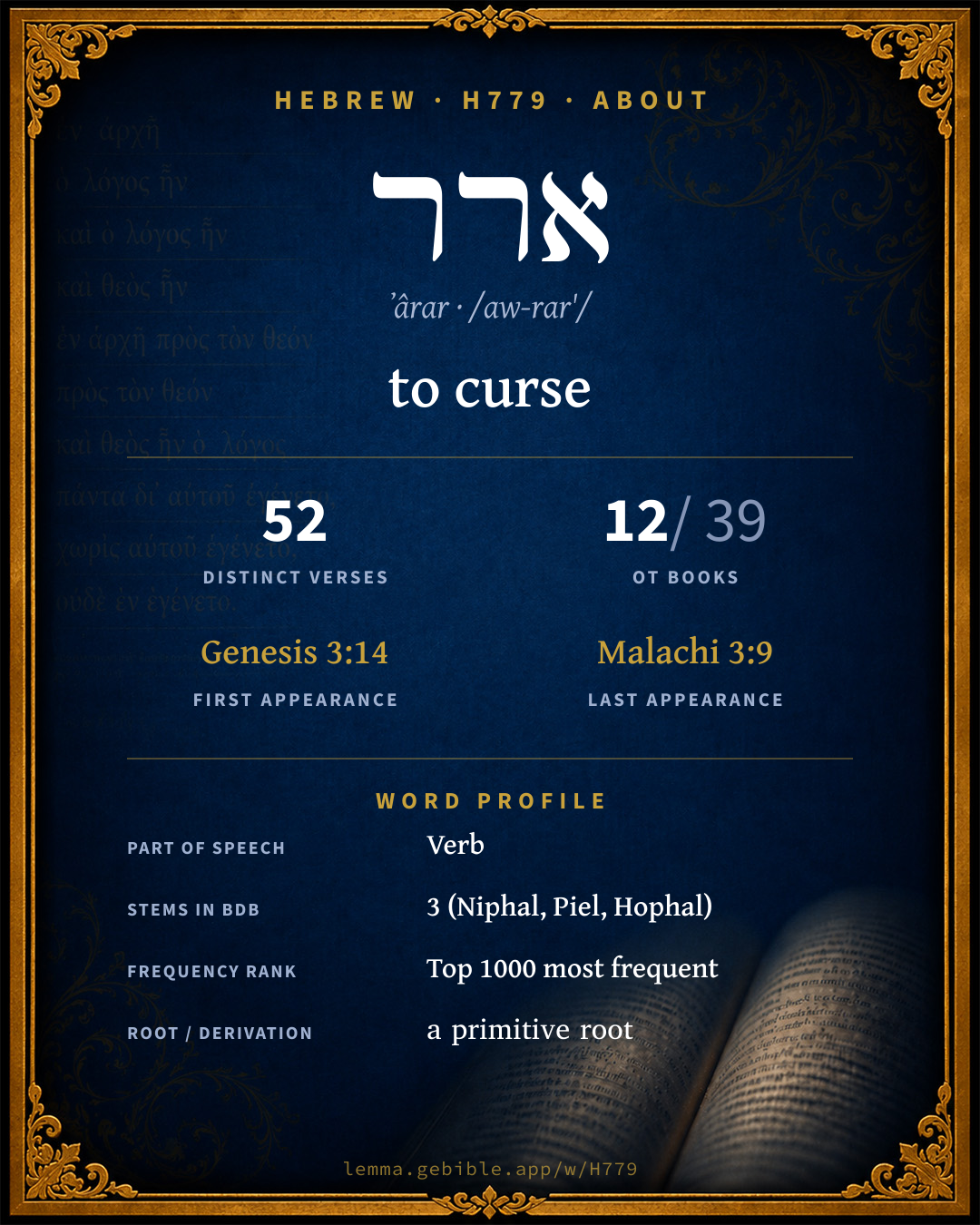
אָרַר
to curse
‘to curse’ is one of 4 main senses fuller range ↓
Full lexicon entry — Brown-Driver-Briggs (BDB)
From Brown-Driver-Briggs (BDB)
Where this word appears
See every Qal verb in the Hebrew Bible →
Grammar key — what these labels mean
Part of speech
- Verb
- An action or state-of-being word.
Stem
- Qal
- The basic, simple active stem — the plain form of the verb (“he wrote”).
- Piel
- An intensive or resultative active stem.
- Hophal
- The passive counterpart of the Hiphil (“he was caused to…”).
- Niphal
- Usually the simple passive or reflexive of the Qal (“he was written”).
Form
- Participle Passive
- A verbal adjective expressing action received (“written”).
- Participle Active
- A verbal adjective expressing ongoing or characteristic action (“writing / one who writes”).
- Imperfect
- An incomplete, ongoing, or future action (“he will / would write”).
- Imperative
- A direct command (“write!”).
- Sequential Perfect
- A perfect with prefixed waw continuing a preceding imperfect or command (waw-consecutive perfect).
- Perfect
- A completed action or state — Hebrew marks aspect (completeness) more than strict tense (“he wrote”).
- Infinitive Absolute
- An unbound verbal noun, often intensifying or standing in for a finite verb.
State
- Absolute
- The independent form of a noun, not bound to a following word.
- Construct
- A noun bound to a following noun in a possessive / “of” relationship (the construct chain).
Person
- 2nd Person
- The one addressed (“you”).
- 1st Person
- The speaker (“I / we”).
- 3rd Person
- The one spoken about (“he / she / it / they”).
Gender
- Masculine
- Grammatically masculine.
- Common
- Either gender — not distinguished for this form.
- Feminine
- Grammatically feminine.
Number
- Singular
- One.
- Plural
- More than one (in Hebrew, generally three or more).
Grammatical forms 15 distinct
- Verb, Qal, Participle Passive, Masculine, Singular, Absolute 35 times (56%)
- Verb, Piel, Participle Active, Masculine, Plural, Absolute 6 times (10%)
- Verb, Qal, Imperfect, 2nd Person, Masculine, Singular 3 times (5%)
- Verb, Qal, Participle Passive, Masculine, Plural, Absolute 3 times (5%)
- Verb, Qal, Participle Active, Masculine, Plural, Construct 3 times (5%)
- Verb, Qal, Imperative, 2nd Person, Masculine, Plural 2 times (3%)
- Verb, Qal, Imperative, 2nd Person, Masculine, Singular 2 times (3%)
- Verb, Qal, Participle Passive, Feminine, Singular, Absolute 2 times (3%)
+7 more forms (7 occurrences)
Parsed forms decoded from the imported morphology (morphhb / Westminster Leningrad Codex — WLC text public domain, morphhb tagging CC BY 4.0), counted across 63 parsed occurrences — not distinct verses.
Every verse where H779 appears — 52 distinct verses across 12 books. Click any verse to open its interlinear word-by-word view. Verse text shown in the World English Bible for context — . Each verse’s Hebrew form is shown with its reference; the English is not keyword-highlighted, since the data carries no word-level English alignment. Use “Compare translations” on any verse to read it across multiple English versions. This concordance covers the Hebrew Bible; Septuagint (Greek Old Testament) occurrences are not indexed here.
Genesis 8 verses
- Genesis 3:14 אָר֤וּר Qal ptcp.pass ms Yahweh God said to the serpent, "Because you have done this, cursed are you above all cattle, and above every animal of the field. On your belly shall you go, and you shall eat dust all the days of your life.
- Genesis 3:17 אֲרוּרָ֤ה Qal ptcp.pass fs To Adam he said, "Because you have listened to your wife's voice, and have eaten of the tree, of which I commanded you, saying, 'You shall not eat of it,' cursed is the ground for your sake. In toil you will eat of it all the days of your life.
- Genesis 4:11 אָר֣וּר Qal ptcp.pass ms Now you are cursed because of the ground, which has opened its mouth to receive your brother's blood from your hand.
- Genesis 5:29 אֵֽרְרָ֖/הּ Piel pf 3ms + sfx pers 3fs and he named him Noah, saying, "This same will comfort us in our work and in the toil of our hands, because of the ground which Yahweh has cursed."
- Genesis 9:25 אָר֣וּר Qal ptcp.pass ms He said, "Cursed be Canaan; A servant of servants will he be to his brothers."
- Genesis 12:3 אָאֹ֑ר Qal impf 1cs I will bless those who bless you, and I will curse him who curses you. In you will all of the families of the earth be blessed."
- Genesis 27:29 אֹרְרֶ֣י/ךָ אָר֔וּר Qal ptcp.act mp cs + sfx pers 2ms Qal ptcp.pass ms Let peoples serve you, Nations bow down to you. Be lord over your brothers, Let your mother's sons bow down to you. Cursed be everyone who curses you, Blessed be everyone who blesses you."
- Genesis 49:7 אָר֤וּר Qal ptcp.pass ms Cursed be their anger, for it was fierce; And their wrath, for it was cruel. I will divide them in Jacob, Scatter them in Israel.
Exodus 1 verse
Numbers 9 verses
- Numbers 5:18 הַ/מְאָֽרֲרִֽים ptcl def.art + Piel ptcp.act mp The priest shall set the woman before Yahweh, and let the hair of the woman's head go loose, and put the meal offering of memorial in her hands, which is the meal offering of jealousy. The priest shall have in his hand the water of bitterness that brings a curse.
- Numbers 5:19 הַֽ/מְאָרֲרִ֖ים ptcl def.art + Piel ptcp.act mp The priest shall cause her to swear, and shall tell the woman, 'If no man has lain with you, and if you haven't gone aside to uncleanness, being under your husband, be free from this water of bitterness that brings a curse.
- Numbers 5:22 הַ/מְאָרְרִ֤ים ptcl def.art + Piel ptcp.act mp and this water that brings a curse will go into your bowels, and make your body swell, and your thigh fall away.' The woman shall say, 'Amen, Amen.'
- Numbers 5:24 הַ/מְאָֽרֲרִ֑ים הַֽ/מְאָרֲרִ֖ים ptcl def.art + Piel ptcp.act mp ptcl def.art + Piel ptcp.act mp He shall make the woman drink the water of bitterness that causes the curse; and the water that causes the curse shall enter into her and become bitter.
- Numbers 5:27 הַ/מְאָֽרֲרִים֙ ptcl def.art + Piel ptcp.act mp When he has made her drink the water, then it shall happen, if she is defiled, and has committed a trespass against her husband, that the water that causes the curse will enter into her and become bitter, and her body will swell, and her thigh will fall away: and the woman will be a curse among her people.
- Numbers 22:6 אָֽרָ/ה תָּאֹ֖ר יוּאָֽר Qal impv 2ms + sfx h Qal impf 2ms Hophal impf 3ms Please come now therefore curse me this people; for they are too mighty for me: peradventure I shall prevail, that we may strike them, and that I may drive them out of the land; for I know that he whom you bless is blessed, and he whom you curse is cursed.
- Numbers 22:12 תָאֹר֙ Qal impf 2ms God said to Balaam, You shall not go with them; you shall not curse the people; for they are blessed.
- Numbers 23:7 אָֽרָ/ה Qal impv 2ms + sfx h He took up his parable, and said, From Aram has Balak brought me, The king of Moab from the mountains of the East: Come, curse me Jacob, Come, defy Israel.
- Numbers 24:9 וְ/אֹרְרֶ֖י/ךָ אָרֽוּר conj + Qal ptcp.act mp cs + sfx pers 2ms Qal ptcp.pass ms He couched, he lay down as a lion, As a lioness; who shall rouse him up? Blessed be everyone who blesses you, Cursed be everyone who curses you.
Deuteronomy 16 verses
- Deuteronomy 27:15 אָר֣וּר Qal ptcp.pass ms Cursed be the man who makes an engraved or molten image, an abomination to Yahweh, the work of the hands of the craftsman, and sets it up in secret. All the people shall answer and say, Amen.
- Deuteronomy 27:16 אָר֕וּר Qal ptcp.pass ms Cursed be he who sets light by his father or his mother. All the people shall say, Amen.
- Deuteronomy 27:17 אָר֕וּר Qal ptcp.pass ms Cursed be he who removes his neighbor's landmark. All the people shall say, Amen.
- Deuteronomy 27:18 אָר֕וּר Qal ptcp.pass ms Cursed be he who makes the blind to wander out of the way. All the people shall say, Amen.
- Deuteronomy 27:19 אָר֗וּר Qal ptcp.pass ms Cursed be he who wrests the justice [due] to the foreigner, fatherless, and widow. All the people shall say, Amen.
- Deuteronomy 27:20 אָר֗וּר Qal ptcp.pass ms Cursed be he who lies with his father's wife, because he has uncovered his father's skirt. All the people shall say, Amen.
- Deuteronomy 27:21 אָר֕וּר Qal ptcp.pass ms Cursed be he who lies with any manner of animal. All the people shall say, Amen.
- Deuteronomy 27:22 אָר֗וּר Qal ptcp.pass ms Cursed be he who lies with his sister, the daughter of his father, or the daughter of his mother. All the people shall say, Amen.
- Deuteronomy 27:23 אָר֕וּר Qal ptcp.pass ms Cursed be he who lies with his mother-in-law. All the people shall say, Amen.
- Deuteronomy 27:24 אָר֕וּר Qal ptcp.pass ms Cursed be he who strikes his neighbor in secret. All the people shall say, Amen.
- Deuteronomy 27:25 אָרוּר֙ Qal ptcp.pass ms Cursed be he who takes a bribe to kill an innocent person. All the people shall say, Amen.
- Deuteronomy 27:26 אָר֗וּר Qal ptcp.pass ms Cursed be he who doesn't confirm the words of this law to do them. All the people shall say, Amen.
- Deuteronomy 28:16 אָר֥וּר וְ/אָר֥וּר Qal ptcp.pass ms conj + Qal ptcp.pass ms Cursed shall you be in the city, and cursed shall you be in the field.
- Deuteronomy 28:17 אָר֥וּר Qal ptcp.pass ms Cursed shall be your basket and your kneading-trough.
- Deuteronomy 28:18 אָר֥וּר Qal ptcp.pass ms Cursed shall be the fruit of your body, and the fruit of your ground, the increase of your cattle, and the young of your flock.
- Deuteronomy 28:19 אָר֥וּר וְ/אָר֥וּר Qal ptcp.pass ms conj + Qal ptcp.pass ms Cursed shall you be when you come in, and cursed shall you be when you go out.
Joshua 2 verses
- Joshua 6:26 אָר֨וּר Qal ptcp.pass ms Joshua charged them with an oath at that time, saying, Cursed be the man before Yahweh, that rises up and builds this city Jericho: with the loss of his firstborn shall he lay the foundation of it, and with the loss of his youngest son shall he set up the gates of it.
- Joshua 9:23 אֲרוּרִ֣ים Qal ptcp.pass mp Now therefore you are cursed, and there shall never fail to be of you bondservants, both wood cutters and drawers of water for the house of my God.
Judges 2 verses
- Judges 5:23 א֣וֹרוּ אֹ֥רוּ אָר֖וֹר Qal impv 2mp Qal impv 2mp Qal inf.abs Curse you Meroz, said the angel of Yahweh. Curse you bitterly the inhabitants of it, Because they didn't come to the help of Yahweh, To the help of Yahweh against the mighty.
- Judges 21:18 אָר֕וּר Qal ptcp.pass ms However we may not give them wives of our daughters, for the children of Israel had sworn, saying, Cursed be he who gives a wife to Benjamin.
1 Samuel 3 verses
- 1 Samuel 14:24 אָר֣וּר Qal ptcp.pass ms The men of Israel were distressed that day; for Saul had adjured the people, saying, Cursed be the man who eats any food until it be evening, and I be avenged on my enemies. So none of the people tasted food.
- 1 Samuel 14:28 אָר֥וּר Qal ptcp.pass ms Then answered one of the people, and said, Your father directly charged the people with an oath, saying, Cursed be the man who eats food this day. The people were faint.
- 1 Samuel 26:19 אֲרוּרִ֥ים Qal ptcp.pass mp Now therefore, please let my lord the king hear the words of his servant. If it be Yahweh that has stirred you up against me, let him accept an offering: but if it be the children of men, cursed be they before Yahweh: for they have driven me out this day that I shouldn't cling to Yahweh's inheritance, saying, Go, serve other gods.
2 Kings 1 verse
Job 1 verse
Psalms 1 verse
Jeremiah 5 verses
- Jeremiah 11:3 אָר֣וּר Qal ptcp.pass ms and say you to them, Thus says Yahweh, the God of Israel: Cursed be the man who doesn't hear the words of this covenant,
- Jeremiah 17:5 אָר֤וּר Qal ptcp.pass ms Thus says Yahweh: Cursed is the man who trusts in man, and makes flesh his arm, and whose heart departs from Yahweh.
- Jeremiah 20:14 אָר֣וּר Qal ptcp.pass ms Cursed be the day in which I was born: don't let the day in which my mother bore me be blessed.
- Jeremiah 20:15 אָר֣וּר Qal ptcp.pass ms Cursed be the man who brought news to my father, saying, A man-child is born to you; making him very glad.
- Jeremiah 48:10 אָר֗וּר וְ/אָר֕וּר Qal ptcp.pass ms conj + Qal ptcp.pass ms Cursed be he who does the work of Yahweh negligently; and cursed be he who keeps back his sword from blood.
Malachi 3 verses
- Malachi 1:14 וְ/אָר֣וּר conj + Qal ptcp.pass ms "But the deceiver is cursed, who has in his flock a male, and vows, and sacrifices to the Lord a blemished thing; for I am a great King," says Yahweh of hosts, "and my name is awesome among the nations."
- Malachi 2:2 וְ/אָרוֹתִ֖י אָרוֹתִ֔י/הָ conj + Qal wpf 1cs Qal pf 1cs + sfx pers 3fs If you will not listen, and if you will not lay it to heart, to give glory to my name," says Yahweh of Hosts, "then will I send the curse on you, and I will curse your blessings. Indeed, I have cursed them already, because you do not lay it to heart.
- Malachi 3:9 נֵֽאָרִ֔ים Niphal ptcp.pass mp You are cursed with the curse; for you rob me, even this whole nation.
About this entry
At a glance — auto-summarized from this page’s data, not written by a person. Every figure links to its source below. This summary describes the numbers; it doesn’t interpret them.
ארר — transliterated ʼârar — is a Hebrew verb carrying the sense “to curse.” Translators differ — “cursed” in the King James Version, then “cursed is” (Berean Standard Bible), as the renderings breakdown shows. With 52 verses in 12 books, it is a moderately common word in the Hebrew Bible. Its uses concentrate in Deuteronomy (31% of all occurrences). Read the stem: it spans 3 stems, including Niphal and Piel. See the sense tree, 52-verse concordance, and the renderings breakdown below.
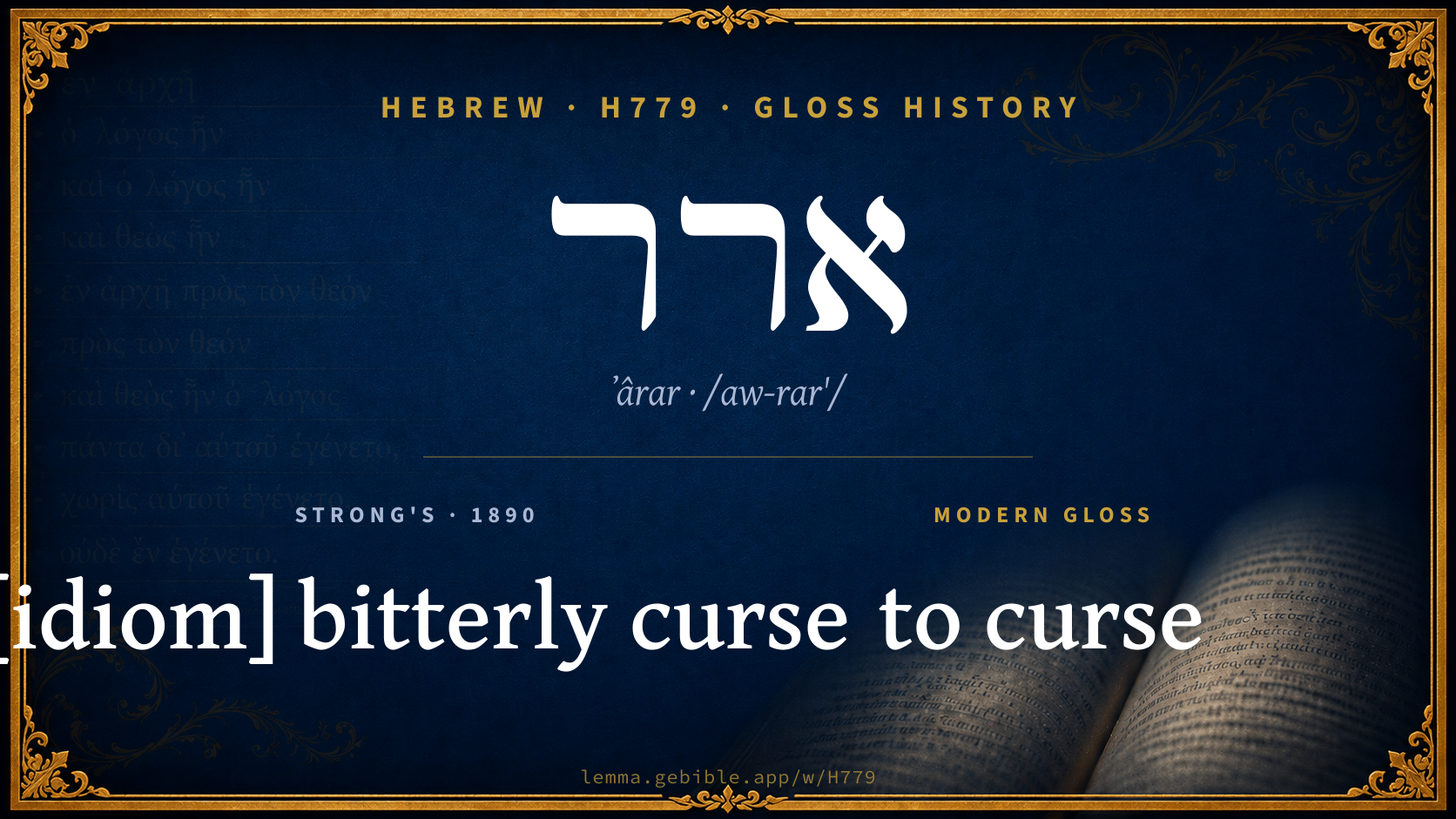
Gloss history
Strong's 1890 vs modern scholarship
About this word
Strong's H779 catalogs a Hebrew word from the Hebrew Old Testament.
These counts are not copied from any lexicon or concordance. They are computed here, from the morphology-tagged Hebrew Old Testament. What Lemma adds →
- 52
- distinct verses
- The word appears in 52 distinct verses.
- 12 / 39
- OT books
- The word appears in 12 of 39 Old Testament books.
- #611
- by frequency
- Top 1000 most frequent Hebrew words (rank 611 of 8,640 Hebrew words by occurrence).
View all 52 occurrences in the concordance →
Most concentrated in
- Deuteronomy 16 verses 31%
- Numbers 9 verses 17%
- Genesis 8 verses 15%
By section of the Old Testament
By traditional corpus
Conventional, traditional groupings — biblical authorship is debated, so this is a traditional corpus grouping, not an authorship claim. Each share is this word’s portion of its verses in that division of the Hebrew canon. Each figure is a share of the word’s 52 distinct verses.
- Torah (Pentateuch) 34 verses · 65%
- Prophets (Nevi'im) 16 verses · 31%
- Writings (Ketuvim) 2 verses · 4%
How translations render this word
Counts come from each version’s own published word-to-Strong’s tagging or interlinear alignment — an approximate guide to how each version renders this word, not a word-level alignment the data otherwise carries. Because each total is that version’s own tagged count, the per-version totals vary from one another and need not match the appearance or distinct-verse counts above. These counts may also differ from a printed concordance because Lemma counts each distinctly tagged rendering and does not collapse phrase taggings into a single head-word total. This is a fixed set of word-tagged versions (KJV, ASV, BSB, ULT) and does not change with the reading translation you choose elsewhere. Each version’s license is shown beside its name below (and on Sources).
- King James Version: Cursed 33×, Causeth the curse 6×, Curse 5×
- American Standard Version: Cursed 32×, Causeth the curse 6×, Curse 5×
- Berean Standard Bible: Cursed is 18×, Cursed 10×, Brings a curse 5×
- unfoldingWord Literal Text: Cursed 28×, Brings a curse 6×, Will be 6×
King James Version Public Domain
Renders H779 across 63 tagged occurrences — most commonly:
Plus 19 renderings that appear only once — usually multi-word phrases or single function words the recovered tagging swept in, not distinct renderings.
American Standard Version Public Domain
Renders H779 across 63 tagged occurrences — most commonly:
Plus 18 renderings that appear only once — usually multi-word phrases or single function words the recovered tagging swept in, not distinct renderings.
Berean Standard Bible Public Domain
Renders H779 across 62 tagged occurrences — most commonly:
Plus 13 renderings that appear only once — usually multi-word phrases or single function words the recovered tagging swept in, not distinct renderings. Not rendered by a distinct English word in 1 further occurrence.
unfoldingWord Literal Text CC BY-SA 4.0
Renders H779 across 76 tagged occurrences — most commonly:
Plus 15 renderings that appear only once — usually multi-word phrases or single function words the recovered tagging swept in, not distinct renderings.
Senses in the full BDB
Hebrew verbs can shift meaning by stem (binyan): Qal is the basic action, Niphal is often passive or reflexive, Piel often intensifies or makes it factitive, and Hiphil is typically causative. The senses below are grouped under the stem BDB assigns to each. This entry also uses Hophal (the passive of Hiphil).
What do BDB’s symbols mean?
BDB uses these scholarly abbreviations:
| Symbol | Meaning |
|---|---|
| 𝔊 | the Septuagint (the ancient Greek translation, LXX) |
| 𝔙 | the Vulgate (the Latin translation) |
| 𝔖 | the Syriac version (the Peshitta) |
| 𝔗 | the Targum (the Aramaic translation) |
| ψ | the Psalms |
| √ | root (the underlying root or stem) |
| ‖ | parallel passage (a synonymous or contrasted parallel) |
| † | the dagger: every passage where the word occurs is cited |
The 3 senses and sub-senses the full Brown-Driver-Briggs lexicon distinguishes for this word, in lexicon order (not ranked by frequency), with BDB’s own verbatim wording and sub-sense lettering. Shown in Hebrew script with BDB’s own scholarly abbreviations. The condensed entry is in the Lexicon Entry tab. See also the Forms in the corpus table below.
Niphal
- Pt. נֵאָרִים cursed Mal 3:9. e.g. Malachi 3:9
Piel
- Pf. 3 ms. sf. אֵרֲרָהּ curse, lay under a curse Gn 5:29 (J); Pt. הַמַּיִם הַמְאָרְרִים the curse-bringing waters Nu 5:18–27 (P 6 times waters destroying the perjured adulteress drinking them). e.g. Genesis 5:29
Hophal
- Impf. יוּאָ֑ר be cursed Nu 22:6 (E). e.g. Numbers 22:6
Senses from the full Brown-Driver-Briggs lexicon (Brown, Driver, Briggs; Oxford 1906 — public domain), digitized via Sefaria, supplemented by the OpenScriptures HebrewLexicon (CC BY 4.0). Full attribution on Sources.
Word origin
vb. curse (Assyrian arâru ZimBP 68; on relation of meanings bind & curse in Assyrian v. DlPr 101)—Qal Pf. 1 s. וְאָרוֹתִ֫י, אָרוֹתִיהָ Mal 2:2; Impf. 2 ms. תָּאֹר Ex 22:27 Nu 22:6, 12; אָאֹר Gn 12:3; Imv. אָ֫רָה־ Nu 22:6; 23:7; אוֹרוּ, אֹרוּ & Inf. abs. אָרוֹר all Ju 5:23; Pt. אֹרְרֵי Jb 3:8; אֹרְרֶיךָ Gn 27:29 Nu 24:9; אָרוּר Gn 3:14 + 36 times etc.;—curse ‖ בֵּרֵךְ bless, chiefly in poetic & legal sources of JED & later imitations: Gn 12:3; 27:29 (J) Nu 22:6, 12; 23:7; 24:9 (E) Ex 22:27 (E) Mal 2:2; אֹרוּ אָרוֹר ישְׁבֶיהָ = curse for ever her inhabitants Ju 5:23; אֹרְרֵי יוֹם cursers of the day (magicians whose imprecations made days unlucky) Jb 3:8. Pt. pass. אָרוּר, chiefly as exclamation, ‖ בָּרוּךְ Gn 3:14, 17; 4:11; 9:25; 27:29; 49:7 Nu 24:9 (E, poet.) Dt 27:15–26 Ju 21:18 1 S 14:24, 28; 26:19 Je 11:3; 17:5; 20:14, 15; 48:10(×2) Mal 1:14; אֲרוּרִים הַשֹּׁגִים מִמִּצְוֹתֶיךָ cursed be those who wander from thy commands ψ 119:21 (𝔊 𝔖 Jer De Ri), הָאֲרוּרָה הַזֹּאת this cursed woman 2 K 9:34.
— Brown-Driver-Briggs (Oxford 1906, public domain), digitized via Sefaria, supplemented by the OpenScriptures HebrewLexicon (CC BY 4.0). See Sources.
Origin: a primitive root
Jastrow Dictionary
A second Hebrew/Aramaic lexicon for comparison, covering Aramaic and post-biblical (Talmudic, Targumic, Midrashic) usage that the biblical-Hebrew BDB does not. Matched by lemma rather than by Strong’s number, so a lemma may carry more than one Jastrow headword (shown separately below), and the entries cover usage well beyond the Bible.
אָרַר
- 1. to dig, stab; v. אֲרָרָן.
- 2. to point out for execration, [or to set outside]; (cmp. חרם a. נקב, a. also ברך); to curse.—Part. pass. אָרוּר, f. אֲרוּרָה, pl. אֲרוּרִים &c. Shebu. 36ᵃ; a. fr.—*Y. Sot. II, 18ᵃ top מֵי יכול מראה מים ת"ל ארד (read אָרַר) you might infer from the word mé (Num. V, 18) that it must have the color of water, therefore the root arar is used in connection therewith (i.e. water in which the curse written with ink has been washed off and is recognizable in the mixture); אי ארד וכ׳ (read ארר) from arar again you might infer that the drink must have the color of ink, therefore we read mé, which means the color of water and the color of ink (a colored thin fluid); cmp. Bab. Sot. 16ᵇ (where the same argument is used with reference to blood).—Part. pass. f. אֲרוּרָה cacophem. for idol. Ab. Zar. 51ᵃ לא׳ זו מיבעיא Ms. M. (ed. לע"ז) so much the more for that cursed (idol). e.g. Numbers 5:18
- to curse. Gen. R. s. 36, end מְאָרֵר. Cant. R. to IV, 11 שאֵרְרָהּ וכ׳ which Joshuah had cursed. Pesik. R. s. 26 שאֵירְרוּ; a. fr.
- to be cursed. Num. R. s. 14 לא נֶאֶרְרוּ וכ׳ they were not cursed before seventy verses were completed (Gen. I, 1 to III, 14; Esth. III, 1 to VII, 10). Y. Sot. IX, 24ᵇ bot.; Tosef. ib. XV, 2 נִתְאָרְרוּ. e.g. Genesis 1:1
אֲרַר
- Targ. II Kings IX, 34 אֲרוּרְתָּא the cursed.—אֲרוּרַיָּיא, אֲרוּרֵי m. pl. Arurs, the Bible chapters containing the word arur (Lev. XXVI, 14—46; Deut. XXVIII, 15—69); [Hebr. תוכחות or קללות]. Y. Meg. III, 74ᵇ bot.—Meg. 31ᵇ קא מגמגם … בא׳ read the arurs in an undertone. Koh. R. to VIII, 3. e.g. Leviticus 26:14
A Dictionary of the Targumim, the Talmud Babli and Yerushalmi, and the Midrashic Literature (Marcus Jastrow; London, Luzac, 1903) — Public Domain. Digitized via Sefaria. Digitized via Sefaria. Full attribution on Sources.
Forms in the corpus
The 38 distinct written forms H779 takes in the Hebrew Bible, most frequent first — each parse links to that stem’s occurrences in the concordance. Hebrew forms include their vowel points and cantillation, so a single lemma takes many written forms.
Same root — word family
Other BDB entries built from the same root as H779, grouped by Strong’s listed origin. These share a root / origin per the lexicon — not necessarily a shared meaning. Each links to that word’s own entry.
Derived from this word
Compare all same-root words → They share a root, not necessarily a meaning.
Septuagint verse parallels
This word appears in 51 verses that also exist in the Greek Old Testament (Septuagint), out of the 52 Hebrew verses it occurs in. You can read those verses in Greek by switching the Old Testament edition to the Septuagint.
Read these verses in the Septuagint
- Genesis 3:14
- Exodus 22:28
- Numbers 5:18
- Deuteronomy 27:15
- Joshua 6:26
- Judges 5:23
- 1 Samuel 14:24
- 2 Kings 9:34
- Job 3:8
- Jeremiah 11:3
- Malachi 1:14
This is a verse-level parallel only — the same verses exist in both the Hebrew and Greek Old Testaments. No word-level Hebrew↔Greek correspondence is claimed: the data carries no such alignment, so no Greek word is shown as this Hebrew word’s translation. Coverage is not total — the Septuagint omits the deuterocanon and renumbers the Psalms, so some Hebrew verses have no direct Greek parallel.