Jeremiah 11:3

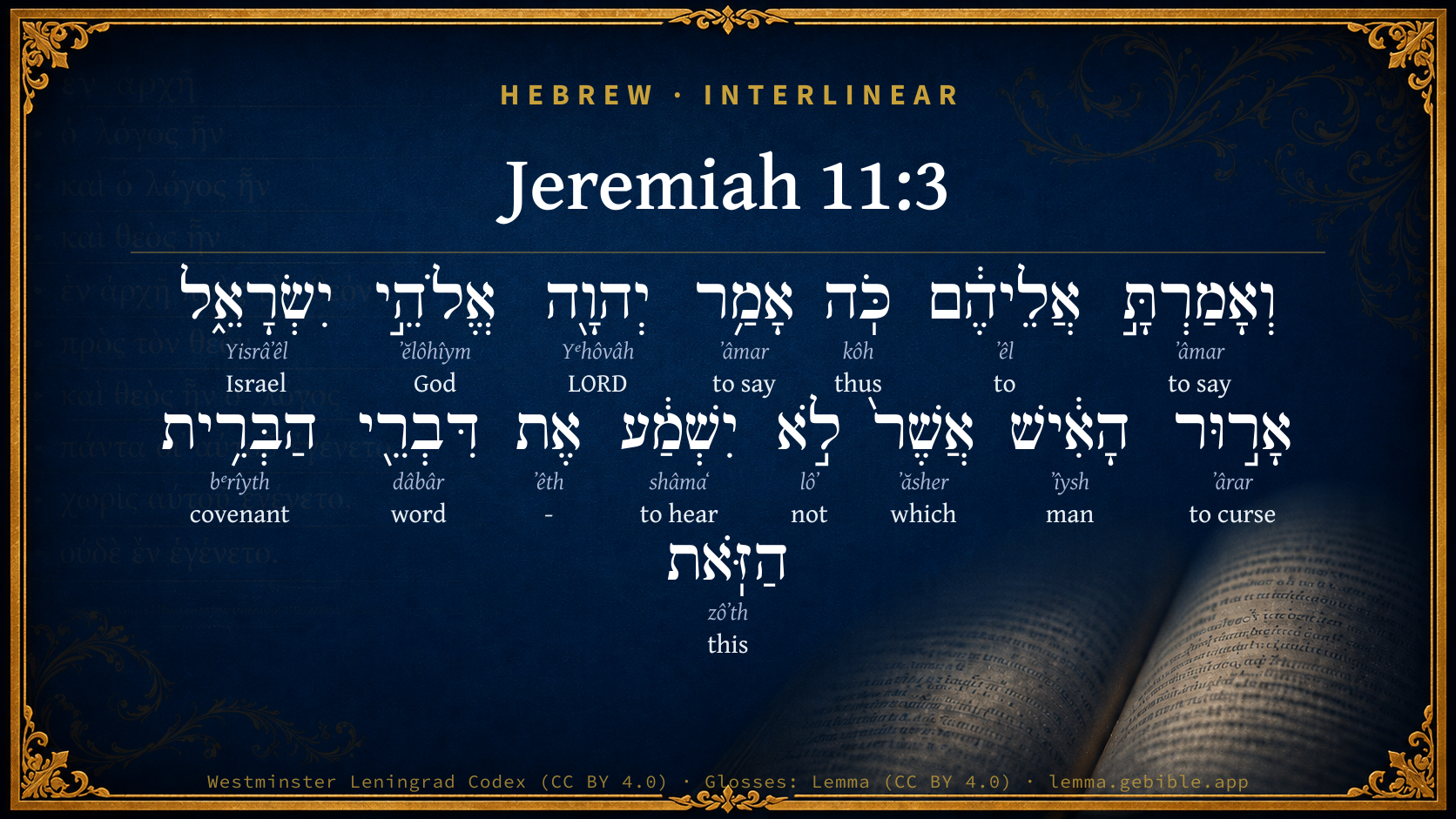
Hebrew (Westminster Leningrad Codex) Jeremiah 11:3 appears in the Hebrew Old Testament. The text above is from the Westminster Leningrad Codex. Each word links to its Strong’s number, a concise gloss, and parsing drawn from the Open Scriptures Hebrew Bible morphology. Click any word for its full Brown-Driver-Briggs (BDB) entry.
Download image
Cite this verse

Jeremiah 11:3 (World English Bible). Public Domain. Lemma interlinear Bible study tool, https://lemma.gebible.app/v/jeremiah/11/3.

Show BibTeX & RIS
BibTeX
RIS
English Translation
and say you to them, Thus says Yahweh, the God of Israel: Cursed be the man who doesn't hear the words of this covenant,
World English Bible · Public Domain
Download a study sheet

One document with this verse’s original text, its word-by-word gloss line, the meaning frame, cross-references with their text, attributed commentary, and full source and license credits — printable, and it pastes into notes with its structure intact.

This verse Autodidact and up

Study sheet (.html) Plain text (.txt)

A passage Seminary Student

Up to 50 verses in one chapter. A passage sheet keeps up to 6 commentary sources and 12 cross-references per verse, in the order this page ranks them, and says so on the sheet whenever that leaves anything out. Ask for a single verse and you get the Autodidact verse sheet above.

Everything on this page stays free to read, with no account — the sheet is a download of what is already on screen, not access to it.

Want to remove ads? Support Godless Engineer
Compare translations 3

The same verse in 3 English versions, stacked beneath the original-language interlinear above. Click any original word for its lexicon entry.

Each is an independent rendering of the whole verse — the interlinear is not word-aligned to these translations.

Highlighted words mark where these versions differ — a whole-verse word diff, not a word-by-word alignment.

  • World English Bible Public Domain
    and say you to them, Thus says Yahweh, the God of Israel: Cursed be the man who doesn't hear the words of this covenant,
  • King James Version Public Domain
    And say thou unto them, Thus saith the LORD God of Israel; Cursed be the man that obeyeth not the words of this covenant,
  • unfoldingWord Literal Text CC BY-SA 4.0
    and say to them, ‘Thus says Yahweh, the God of Israel, “Cursed is the man who does not hear the words of this covenant

unfoldingWord Literal Text — © unfoldingWord, licensed CC BY-SA 4.0. Word-aligned USFM3 via Door43 (git.door43.org/unfoldingWord/en_ult).

Versions to compare (up to 4)

3 of 4 selected

Show all 18 translations

Every available English version of this verse, each an independent rendering of the whole verse.

  • World English Bible Public Domain
    and say you to them, Thus says Yahweh, the God of Israel: Cursed be the man who doesn't hear the words of this covenant,
  • Berean Standard Bible Public Domain
    You must tell them that this is what the LORD, the God of Israel, says: Cursed is the man who does not obey the words of this covenant,
  • Majority Standard Bible Public Domain
    You must tell them that this is what the LORD, the God of Israel, says: Cursed is the man who does not obey the words of this covenant,
  • King James Version Public Domain
    And say thou unto them, Thus saith the LORD God of Israel; Cursed be the man that obeyeth not the words of this covenant,
  • American Standard Version (1901) Public Domain
    and say thou unto them, Thus saith Jehovah, the God of Israel: Cursed be the man that heareth not the words of this covenant,
  • Revised Version (1885) Public Domain
    and say thou unto them, Thus saith the LORD, the God of Israel: Cursed be the man that heareth not the words of this covenant,
  • Geneva Bible (1599) Public Domain
    And say thou vnto them, Thus sayeth the Lord God of Israel, Cursed be the man that obeyeth not the wordes of this couenant,
  • Douay-Rheims (1899) Public Domain
    And thou shalt say to them: Thus saith the Lord the God of Israel: Cursed is the man that shall not hearken to the words of yethis covenant,
  • Young's Literal Translation Public Domain
    and thou hast said unto them, Thus said Jehovah God of Israel: Cursed `is' the man who doth not obey the words of this covenant,
  • Literal Standard Version CC BY-SA 4.0
    and you have said to them, Thus said YHWH God of Israel: Cursed [is] the man who does not obey the words of this covenant,
  • Unlocked Literal Bible CC BY-SA 4.0
    Say to them, 'Yahweh, God of Israel says this: Cursed is anyone who does not listen to the words of this covenant.
  • unfoldingWord Literal Text CC BY-SA 4.0
    and say to them, ‘Thus says Yahweh, the God of Israel, “Cursed is the man who does not hear the words of this covenant
  • Darby Bible Public Domain
    And thou shalt say unto them, Thus saith Jehovah, the God of Israel: Cursed be the man that obeyeth not the words of this covenant
  • World Messianic Bible Public Domain
    and say to them, the LORD, the God of Israel says: ‘Cursed is the man who doesn’t hear the words of this covenant,
  • Webster's Bible Public Domain
    And say thou to them, Thus saith the LORD God of Israel; Cursed be the man that obeyeth not the words of this covenant,
  • Free Bible Version CC BY-SA 4.0
    Tell them this is what the Lord, the God of Israel, says: You are cursed if you don't obey the terms of this agreement.
  • Bible in Basic English Public Domain
    The Lord, the God of Israel, has said, Let that man be cursed who does not give ear to the words of this agreement,
  • JPS Tanakh (1917) Public Domain
    and say thou unto them: Thus saith the LORD, the God of Israel: Cursed be the man that heareth not the words of this covenant,

Literal Standard Version (2020), Covenant Press — licensed CC BY-SA 4.0. Text via the HelloAO Bible API (eBible.org). Unlocked Literal Bible (unfoldingWord) — licensed CC BY-SA 4.0. Text via the HelloAO Bible API (eBible.org). unfoldingWord Literal Text — © unfoldingWord, licensed CC BY-SA 4.0. Word-aligned USFM3 via Door43 (git.door43.org/unfoldingWord/en_ult). Free Bible Version, Dr. Jonathan Gallagher — licensed CC BY-SA 4.0. Text via the HelloAO Bible API (eBible.org).

Word by word

More ways to search: Search by grammar → Find every occurrence → Compare this word →

Practice this passage: Drill this verse → Learn its vocabulary →

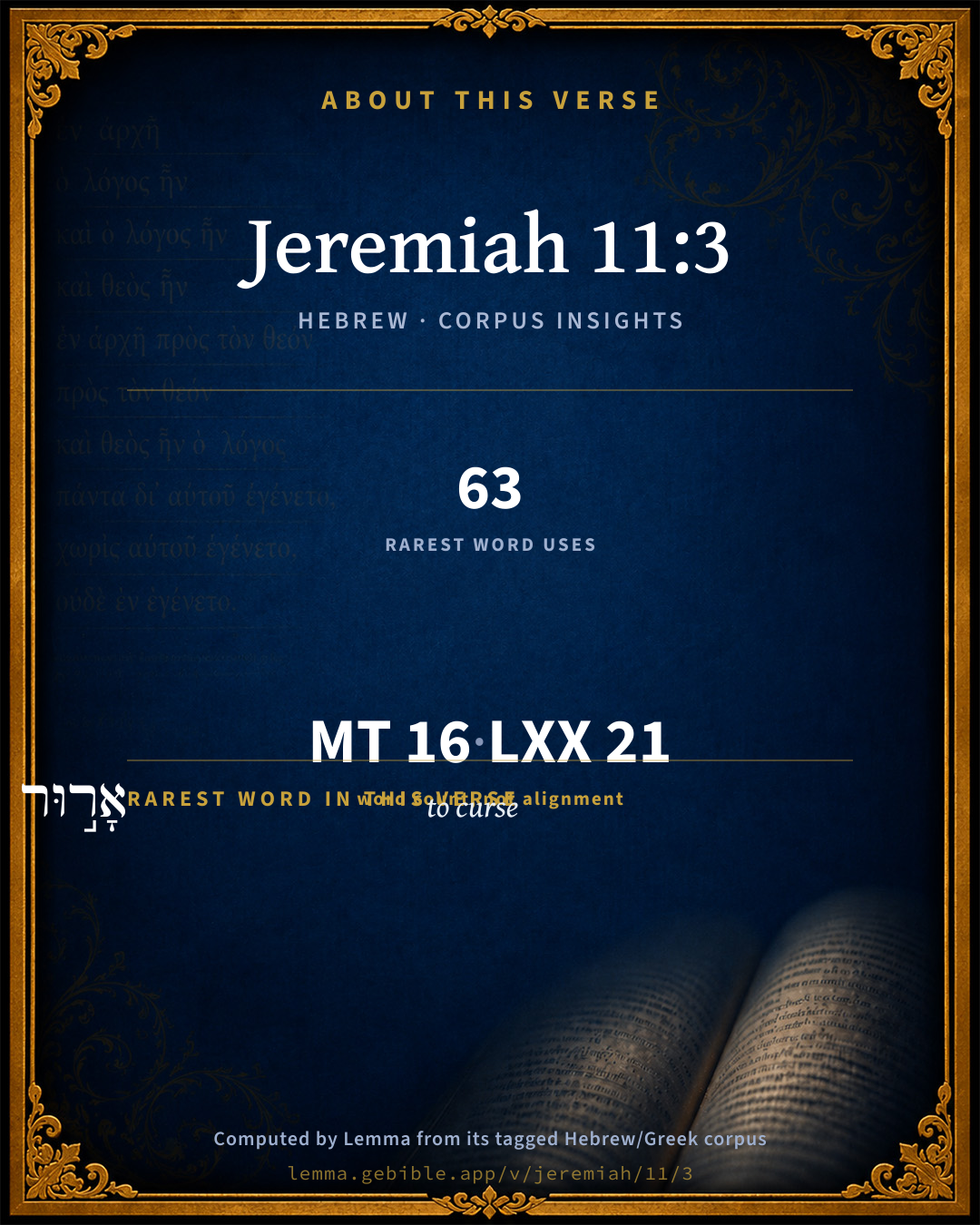
אָר֣וּר
ʼârar
H779
“cursed”
Verb, Qal, Participle Passive, Masculine, Singular, Absolute
Part of Speech
Verb
Stem
Qal
Form
Participle Passive
Gender
Masculine
Number
Singular
State
Absolute
Full BDB Definition

Origin: a primitive root

TWOT: 168

to curse - (Qal) - to curse - cursed be he (participle used pr in curses) - (Niphal) to be cursed, cursed - (Piel) to curse, lay under a curse, put a curse on - (Hophal) to be made a curse, be cursed
  1. וְאָמַרְתָּ֣ ʼâmar H559 “and · to say” Conjunction + Verb, Qal, Sequential Perfect, 2nd Person, Masculine, Singular
  2. אֲלֵיהֶ֔ם ʼêl H413 “to · them” Preposition + Suffix, Personal, 3rd Person, Masculine, Plural
  3. כֹּֽה kôh H3541 “thus” Adverb
  4. אָמַ֥ר ʼâmar H559 “to say” Verb, Qal, Perfect, 3rd Person, Masculine, Singular
  5. יְהוָ֖ה Yᵉhôvâh H3068 “LORD” Noun, Proper
  6. אֱלֹהֵ֣י ʼĕlôhîym H430 “God(s) of” Noun, Common, Masculine, Plural, Construct
  7. יִשְׂרָאֵ֑ל Yisrâʼêl H3478 “Israel” Noun, Proper
  8. הָאִ֔ישׁ ʼîysh H376 “the · man” Particle, Definite Article + Noun, Common, Masculine, Singular, Absolute
  9. אֲשֶׁר֙ ʼăsher H834 “which” Particle, Relative
  10. לֹ֣א lôʼ H3808 “not” Particle, Negative
  11. יִשְׁמַ֔ע shâmaʻ H8085 “to hear” Verb, Qal, Imperfect, 3rd Person, Masculine, Singular
  12. אֶת ʼêth H853 “-” Particle, Direct Object
  13. דִּבְרֵ֖י dâbâr H1697 “words of” Noun, Common, Masculine, Plural, Construct
  14. הַבְּרִ֥ית bᵉrîyth H1285 “the · covenant” Particle, Definite Article + Noun, Common, Feminine, Singular, Absolute
  15. הַזֹּֽאת zôʼth H2063 “the · this” Particle, Definite Article + Pronoun, Demonstrative, Feminine, Singular

About this verse

These counts appear in no published source. They are computed here, from the morphology-tagged text and Lemma’s own curated glosses. What Lemma adds →

16
words
15
distinct lemmas
Prophets
section

Grammatical profile

  • 4 verbs
  • 6 nouns
  • 1 pronoun
  • 1 preposition
  • 1 adverb
  • 3 particles

Verb forms

  • וְאָמַרְתָּ֣ Qal · Sequential Perfect
  • אָמַ֥ר Qal · Perfect
  • אָר֣וּר Qal · Participle Passive
  • יִשְׁמַ֔ע Qal · Imperfect

Repetition

A word recurs within this verse — often emphatic in Hebrew:

  • וְאָמַרְתָּ֣ to say H559 ×2

Hebrew & Septuagint length

In the original languages it is 16 Hebrew tokens and 21 Greek tokens — but the two are counted differently (Hebrew bundles its prefixes and suffixes into one token; the Greek is in lemma form), so that isn’t a like-for-like length.

Cross-references

4

Topical passages linked to Jeremiah 11:3 in the Treasury of Scripture Knowledge — connected by theme and wording, ordered by reader-vote popularity; previews shown in the World English Bible.

  • Deuteronomy 27:26 Cursed be he who doesn't confirm the words of this law to do them. All the people shall say, Amen.
  • Deuteronomy 28:15–68 But it shall come to pass, if you will not listen to the voice of Yahweh your God, to observe to do all his commandments and his statutes which I command you this day, that all these curses shall come on you, and overtake you.
  • Deuteronomy 29:19–20 and it happen, when he hears the words of this curse, that he bless himself in his heart, saying, I shall have peace, though I walk in the stubbornness of my heart, to destroy the moist with the dry.
  • Galatians 3:10–13 For as many as are of the works of the law are under a curse. For it is written, "Cursed is everyone who doesn't continue in all things that are written in the book of the law, to do them."

Cross-references courtesy of OpenBible.info (CC BY 4.0).

Hebrew and Greek witnesses Masoretic Hebrew ↔ Greek Septuagint

The same verse in the two great witnesses to the Old Testament, shown verse-for-verse.

These are two independent witnesses, not word-aligned to each other, and the Septuagint is shown in lemma (dictionary) form.

Hebrew Jeremiah 11:3 Masoretic · Westminster Leningrad Codex

וְאָמַרְתָּ֣ אֲלֵיהֶ֔ם כֹּֽה אָמַ֥ר יְהוָ֖ה אֱלֹהֵ֣י יִשְׂרָאֵ֑ל אָר֣וּר הָאִ֔ישׁ אֲשֶׁר֙ לֹ֣א יִשְׁמַ֔ע אֶת דִּבְרֵ֖י הַבְּרִ֥ית הַזֹּֽאת

and say you to them, Thus says Yahweh, the God of Israel: Cursed be the man who doesn't hear the words of this covenant,

World English Bible · Public Domain

Greek LXX Structure differs

In the Septuagint, Jeremiah is about an eighth shorter than the Hebrew and arranges its material differently — the Oracles Against the Nations (Hebrew chapters 46–51) appear in the middle of the Greek book, after 25:13. Because the chapter and verse boundaries do not line up, a verse-for-verse comparison with the Hebrew is not shown.

A verse-for-verse comparison isn’t shown here because the chapters and verses don’t line up. Switch to the LXX edition with the MT / LXX toggle above to read the Greek directly.

Hebrew: Westminster Leningrad Codex (CC BY 4.0). Greek: Septuagint (public domain); English from a public-domain English Septuagint. How the Septuagint differs from the Hebrew →

Targum (Aramaic paraphrase)

1

The Targum is the ancient Jewish Aramaic paraphrase of the Hebrew Scriptures — an interpretive translation, not the Hebrew text itself. Onkelos (literal) and Pseudo-Jonathan (expansive) render the Torah, and Jonathan the Prophets. Coverage is partial: where no permissively-licensed English translation exists for a verse, only the Aramaic is shown. This is verse-level text, not a word-by-word alignment to the Hebrew.

  1. Targum Jonathan Prophets (Joshua–Malachi)
    וְתֵימַר לְהוֹן כִּדְנַן אֲמַר יְיָ אֱלָהָא דְיִשְׂרָאֵל לִיט גַבְרָא דְלָא יְקַבֵּיל יַת פִּתְגְמֵי קְיָמָא הָדֵין:

    (no public-domain English translation for this verse)

    Targum Jonathan — Aramaic: “Mikraot Gedolot” (public domain). English: “Sefaria Community Translation” (CC0 1.0 (public-domain dedication)); “London "Chaldee Paraphrase," 1871” (public domain). Text via Sefaria.

Commentary

Notes on Jeremiah 11:3 from classic Christian and Jewish commentators (each source and its license shown beneath its notes). The classic Christian expositions comment on the surrounding passage and are grouped to its opening verse, so a note may address several verses; the Jewish commentaries on the Tanakh (Rashi and others) are per-verse, so they appear only where the commentator wrote on this verse.

Lemma curates 59 commentaries, every one of them public domain or Creative Commons licensed, each selected and text-cleaned for this edition rather than reprinted as found. About our sources →

Trapp's Complete Commentary

John Trapp

Jer 11:3 And say thou unto them, Thus saith the LORD God of Israel; Cursed [be] the man that obeyeth not the words of this covenant,

Ver. 3. And say thou unto them.] Thou, Jeremiah, whether the rest will join with thee or not.

Cursed be the man that obeyeth not the words of this covenant.] It is probable that Jeremiah, when he said thus, held the book in his hand, viz., the book of Deuteronomy, which the Rabbis call Sepher Tochechoth, because of the many increpations and curses therein contained.

John Trapp, A Commentary or Exposition upon All the Books of the Old and New Testament (1647–1656) — public domain. Text from a community e-Sword module.

Geneva Bible (1599)

Geneva Bible translators

He calleth the Jews to the consideration of God’s mercy, who freely chose them, made a covenant of eternal felicity with them, and how he ever performed it on his behalf, and how they ever showed themselves rebellious and ingrate toward him, and brake it on their part, and so are subject to the curse of the Law, Deut. 27:26.

Geneva Bible (1599) marginal notes — public domain. Text via Bolls.life.

Jamieson, Fausset & Brown

Robert Jamieson, A. R. Fausset & David Brown

(Deu 27:26; Gal 3:10).

Jamieson, Fausset & Brown — Commentary Critical and Explanatory on the Whole Bible (1871) — public domain (CC PDM 1.0). Text via the HelloAO Bible API.

Adam Clarke's Commentary

Verse 3. Cursed be the man that obeyeth not] After the reading, the prophet appears to sum up the things contained in what was read to them; as if he had said, "Ye hear what the Lord saith unto you: remember, the sum of it is this: The man is cursed who obeyeth not; and he is blessed who obeys. From these declarations God will not depart."

Adam Clarke's Commentary on the Bible (1810–1826) — public domain. Text from a community e-Sword/MySword module.

John Calvin's Commentaries

The Prophet afterwards shews more clearly that the command was especially given to him, for he uses the singular number, Thou shalt say to them Nor is it inconsistent that at first he joined others with himself; for God might have united the suffrages of the few who wished the restoration of pure religion among the people, while yet Jeremiah, who was superior to the rest, sustained the chief part. There is no doubt but that others were anxious by their consent to confirm his doctrine: but there was no emulation among them; and though he excelled them, he yet winingly admitted into a connection with himself all those whom he found to be united with him in so good and holy a cause. God then, in the last verse, spoke of them in common, for he wished all his servants to add their testimony to that of his Prophet; but now he addresses the Prophet alone, for his authority was greater.

It follows, Thus saith Jehovah, the God of Israel, cursed the man who does not hearken to the words of this covenant As often as the word covenant is mentioned, Jeremiah no doubt cuts off every pretext for all those evasions to which the Jews, according to what we have said, had recourse: for they never winingly allowed that they took away anytiling from the law, though they yet despised Jeremiah, who was its true and faithful interpreter, who had blended with it nothing of his own, but only applied what had been taught by Moses to the condition of the people at that time. There is then to be understood an implied contrast between the word covenant and the doctrine of Jeremiah; not that there was any difference or contrariety, or that Jeremiah had anything apart from the law, but that he formed his discourse so as to suit the condition of the people. And there is a kind of concession, as though he had said, “I do not now demand to be heard by you, but hear only the law itself: I have hitherto brought forward nothing but what God has commanded; and I have taught nothing at variance with Moses; there has been nothing additional in my doctrine: but as I cannot convince you of this, I now give over speaking to you; Moses himself speaks, hear him.”

By adding the pronoun demonstrative, “Hear ye the words of this covenant,” it is the same as though he had openly shewed them as by his finger, so that there was no room for any doubt. He then upbraided them by pointing out the covenant, as though he had said, “What avails you to feign and to pretend that what we say is ambiguous, and to hold it as uncertain whether we are or not the servants of God? whether we speak by his Spirit? whether he himself has sent us? The thing is clear; this is the covenant.” We now perceive the force of this pronoun.

But in referring to the curse, his purpose, no doubt, was to bend the stubbornness of the people. Had the Jews been teachable and submissive, God would have used a milder strain, and allured them by words of kindness and love: but as he had to do with perverse minds, he was under the necessity of addressing them in this manner, in order to strike them with terror, and to render them more attentive, and also to make them to hear with more reverence, as they usually treated with contempt what he had spoken before. We hence see why he began with mentioning a curse. God followed in the law another order; for he first introduced the rule of life, and added also promises to render the people wining to obey; and then he subjoined the curses. But Jeremiah here begins by saying, Cursed are all those who hear not the words of this covenant Why was this done? Even because he had already found out the hardness and the obstinate wickedness of the people. He then does not propound a simple doctrine, but before all things he sets before them the curse of God; as though he had said, “It is very strange that you have not hitherto been moved, since God’s curse has been so often denounced on you: as then ye are so stupid, before I begin to speak of God’s commands, his curse shall be mentioned to awaken your torpidity.”

But we learn from the Prophet’s words that he alluded to the form prescribed in the law: for after Moses rehearsed all the precepts, he added, “Cursed is every one who turns aside to foreign gods;” and he commanded the people to respond, Amen; and, “Cursed is every one who curses father and mother,” and he bade them to respond, Amen; and after having narrated all the precepts, he added, “Cursed is every one who fulfils not all the words of this law,” and the people responded, Amen. (Deuteronomy 27:15, 16, 26) The same form does Jeremiah now adopt when he says,

“Declare then to the people, that they are all accursed who obey not my precepts;”

and then the Prophet adds, I answered and said, Amen, O Jehovah But it must be observed, that the Prophet here personates as before the whole people; as though he had said, “I subscribe to God’s judgment, even though ye should be all gainsayers, as ye really are. Though then ye think that ye can escape from God’s hand, as though it were easy to elude the curse which is pronounced in his law, yet I subscribe with my own name, and answer before God, Amen, O Jehovah

But we must notice also the other words, Cursed, he says, is every one who hears not the words of this covenant To hear, in this place, and in many other places, is to be taken for obeying. He then speaks of the words or of the covenant itself; for the expression may be taken in either sense, as God had made a covenant with the Jews and at the same time expressed words. I am inclined to consider the covenant itself as intended. God then says that he had made a covenant with them. There is yet a fuller explanation, The words which I commanded your fathers, he says, in the day when I brought them up from the land of Egypt, God shews here by a circumstance as to the time how inexcusable the Jews were; for he says that he gave the law to their fathers at the very time when they were extricated from death; as they were drawn out of the grave, as it were, when God made them a passage through the Red Sea. That redemption ought to have made such a deep impression as to convince them wholly to devote themselves to God; yea,, the memory of such a benefit ought to have been deeply fixed in their hearts.

We hence see how aggravated here is the sin of ingratitude; for the law was given to the Israelites when they had before their eyes the many deaths to which they had been exposed, and from which the Lord had miraculously delivered them. For the same reason also he mentions their miserable state as an iron furnace, according to what we find in the third chapter of Exodus and in many other places, he then compares their Egyptian bondage to a furnace; for the Jews were then like wood and straw in a burning furnace; and he calls the furnace iron, as it could melt and reduce to nothing things harder than wood, evcn gold or silver or any other metal. In short, the deplorable state of the people is here set forth; and the Prophet, by the comparison, magnifies the favor shewn to them — that God, beyond all hope, had delivered them from death. Since then the authority of the law was sanctioned by so great a benefit, it became evident how much was the impiety of the people, and how unbecoming and wicked their ingratitude; for they did not winingly suffer God’s yoke to be laid on them.

He says that God commanded these things This expression, as I have said, is to be applied to the words of the law, and not to the covenant. But the Prophet speaks indiscriminately, now of the covenant, then of the things it embraces, that is, of all the precepts it includes. In other words, he expresses how inexcusable was the sin of the people; for God, in substance, required of them no other thing but to hear his voice: and what can be more just than that they who have been redeemed should obey the voice of their deliverer? and what could have been more detestable and monstrous than for the Israelites to refuse what God had a right to demand? We now then perceive the design of the Prophet in saying, that God commanded this only to his redeemed people, even to hear his voice, and to do what he commanded.

He further adds a promise, which ought to have softened their stony hearts, Ye shall be, he says, to me a people, and I will be to you a God God might have positively required of the Jews what is implanted in all by nature; for they who have never been taught acknowledge that God ought to be worshipped; and the right way of worshipping him is when we obey his precepts. God then might have thus commanded them according to his supreme aufilority. The commands of kings, as it is said, are brief, for they are no soothing expressions, nor do they reason, nor employ any persuasive language. How much greater is the authority of God, who can intimate by a nod what he pleases and what he demands? But as though he descended from his high station, he seeks by promises to attach people to himself, so that they may winingly obey him. Thus God recommends his law by manifesting his favor, and does not merely assert his own authority. Since then God thus kindly addresses his people, and promises so great a reward to obedience, how base and abominable is the contumacy of men when they repudiate his law. Hence the Prophet shews here more clearly why he began by saying, Cursed is every one who obeys not, etc.: for kindness had profited nothing; friendly and tender words, the paternal invitation of God, produced no effect; as though he had said, “God could not, doubtless, have treated you more gently and kindly than by reminding you in a paternal manner of your duty, and by adding promises sufficient to soften even the hardest hearts; but as this has been done without effect, what now remains for God to do but to thunder and announce only his curses?”

We now understand what the Prophet had in view. But it may be here objected, — that all this was useless and without any benefit, for the Jews could not have undertaken the yoke of the law, until it was inscribed on their hearts. To this I answer, that of this very thing they were here at the same time reminded: for though the teaching of the letter could do nothing but condemn the people, and hence it is said by Paul to be what brings death, (2 Corinthians 3:6) yet the faithful knew that the Spirit of regeneration would not be denied them, if they sought it of God. Then, in the first place, it was their fault that the law was not inscribed on their hearts; and, in the second place, a free promise of forgiveness was added; for why were those sacrifices and expiations under the law, and so many ceremonies, which had respect to their reconciliation to God, but in order that the people might feel assured that God would be propitious and appeasable to them, though they could not satisfy the law? This teaching then was not useless as to the faithful; for God, when he required from the Israelites what they ought to have done, was at the time ready to inscribe the law on their hearts, and also to forgive their sins. But when through obstinate wickedness they rejected the whole law, the Prophet justly declares here that the curse of God was on them; because they basely rejected God’s promises, by which he testified his paternal kindness towards them.

John Calvin's Commentaries (1540-1563) — public domain. Text from the Calvin Translation Society English edition (1840s-50s) via the Christian Classics Ethereal Library (ccel.org). Calvin's coverage is partial (roughly two-thirds of the Bible); uncommented books and verses are honest gaps, never fabricated. The 19th-century editor's footnotes and remarks are omitted so the notes are faithfully Calvin's own voice.

Ellicott's Commentary for English Readers

(3) Cursed be the man . . .—The verse is, as it were, a mosaic, so to speak, of phrases, with slight verbal changes, from the recently discovered book of Deuteronomy—the “iron furnace” from Deu_4:20; 1Ki_8:51, “Hear my voice and do them” from Deu_28:1, “Ye shall be my people” from Deu_29:13. The “iron furnace” was, of course, Egypt, the “furnace of affliction,” as in Isa_48:10, in which the people had endured sufferings of which that was the only adequate symbol. The word used denoted the “furnace” of the smelter, but the actual form of bondage through which the Israelites had passed, working in the brick-kiln furnaces (Exo_1:14), had probably given a special force to the phrase.

A Bible Commentary for English Readers, edited by Charles John Ellicott (1878–1897) — public domain. Text from a community e-Sword module.

The Cambridge Bible for Schools and Colleges

gen. ed. J. J. S. Perowne

3. Cursed be the man that heareth not] Cp. Deu_27:15-26, especially the last v.

the words of this covenant] Cp. for the expression Deu_29:1; Deu_29:9.

The Cambridge Bible for Schools and Colleges (gen. ed. J. J. S. Perowne; Cambridge University Press, 1878–1918) — public domain. Text from a community e-Sword module.

John Gill's Exposition

Which I commanded your fathers,.... To observe and keep:

in the day that I brought them forth out of the land of Egypt: that is, quickly after, when they were in the wilderness, and before they came into the land of Canaan. The "day" seems to include the whole time from their coming out of Egypt, to their entrance into Canaan's land; it was in the first year of their coming out from thence that the law was given them on Mount Sinai, Exo 19:1, and it was in the fortieth year, and when they were upon the borders of Canaan, that the covenant was made with them in the land of Moab, Deu 1:3, "from the iron furnace"; meaning Egypt, and their bondage and affliction in it, compared to an iron furnace for the grievousness of it, its long continuance, and the use of it to try and prove them; see Deu 4:20,

saying, obey my voice; in the law:

and do them; the commands of it, the words of the covenant:

according to all which I command you; everything was to be done that was commanded, and as it was commanded; a perfect and uniform obedience is to be yielded to the law, in order to enjoy the blessing, or a penalty is incurred:

so shall ye be my people, and I will be your God; this is the tenor of the covenant of works; covenant interest in God, according to the law, depends upon obedience; that is the condition of it; but the covenant of grace is not clogged with such a condition; but runs absolutely,

they shall be my people, and I will be their God, Jer 32:39.

John Gill's Exposition of the Whole Bible (1746–1763) — public domain (CC PDM 1.0). Text via the HelloAO Bible API.

Matthew Poole's English Annotations

In Deu 27:26, it is, Cursed be he that confirmeth not all the words of this law to do them. And all the people shall say, Amen. The people’s saying Amen testified their assent, and made the law a covenant; but they had besides formally and explicitly covenanted with God, Exo 24:3,7, with religious rites and ceremonies used in stipulations, and afterwards consented that God should punish those that violated that covenant, Deu 27:26.

Matthew Poole's English Annotations on the Holy Bible (1683–1685) — public domain. Text from a community e-Sword/MySword module.

Whedon's Commentary on the Bible

Daniel D. Whedon

3. Cursed, etc. — An exact quotation from Deu_27:26, except that here obeyeth is put for confirmeth; this word having been used originally with reference to the formal ratification of the people. The word here used, however, is the common and the vital word.

Daniel D. Whedon (gen. ed.), Commentary on the Old and New Testaments (1874–1909) — public domain. Text from a community e-Sword module.

The Pulpit Commentary

Here begins a series of direct references to Deuteronomy, determining the date of the discourse. Cursed be the man, etc.; alluding Deu_27:26 (which has, however, not "obeyeth," but "confirmeth," i.e. ratifieth as his own personal rule of conduct. The words of this covenant; rather, the words of this ordinance. The rendering "covenant," however, is not so much erroneous as unsuitable in this context; it is a secondary meaning of the Hebrew b rith, the original sense being rather "authoritative appointment" (from barah, to cut, hence to decide). Nothing, perhaps, is so injurious to a correct understanding of the Scriptures as persistently rendering a Hebrew or Greek word by the same supposed equivalent. "Covenant" is no doubt appropriate in some passages, (Jos_9:6 1Sa_18:3) because an "appointment" between men, if equals, involves "giving and taking;" but is inadequate when the parties are not equals, and most of all when the superior party is the Divine Being. In these cases we must clearly recur to the original meaning of" appointment" or "ordinance;" and we have one such case here. (see also Hos_6:7 2Ki_11:4 Job_31:1 Psa_105:10; but not Gen_17:9) Diayhkh (1, an arrangement; 2, a will or testament; 3, a covenant) is to some extent parallel (see Cremer"s "Biblico-Theological Lexicon of New Testament Greek," s.v.).

HOMILIES BY S. CONWAY Ver. 3. The doom of disobedience.

This new discourse, which begins with Jeremiah 11. is a continuation of the same sad monotone of denunciation and doom which goes on throughout well-nigh the whole of Jeremiah"s prophecies. The curse pronounced here on the disobedient

I IS VERY TERRIBLE. The words, "Cursed," etc., are fearful words to come from the lips of the God of grace and mercy. And that which they threatened was terrible also. What a catalogue of woes, which were denounced against the guilty people, might be compiled from these chapters! And how exactly the event answered to the prediction! Read the history of the destruction of Jerusalem and of the sufferings of the people, which is given in the records of the times, for proof of this. It is a dismal story, heart-sickening, and one from which we should at once turn away were it possible for us to do so. But all this, which was written aforetime, was written for our learning, and therefore we cannot but give heed. For not only is the curse terrible

II IT IS ALTOGETHER JUST. What makes a sentence, such as is pronounced here, just? Is it not such considerations as these?

1. That the Law which has been violated should have been altogether righteous. None can read over the moral Law given by God to his people without confessing its righteousness. "The Law was holy, just and good." Those who disobeyed it and were punished by it could not dispute its righteousness.

2. That it should have been fully known. If ignorance could have been pleaded the equity of the sentence might have been questioned. But amid all possible publicity and solemnity the Law was given at the first; and at a time (Ver. 4) when their hearts, by reason of God"s exceeding goodness to them, were peculiarly susceptible to impression. And ever since then, by repeated, prolonged, and earnest appeal (Ver. 7) that obedience should be rendered.

3. When conscience consents to the Law that it is good. (Ver. 5.) They said "Amen" to it. The prophet is not giving his personal account only, but referring to the fact that all the people said "Amen" when the curse upon disobedience was pronounced from Mount Ebal; cf. also a more recent "standing to the covenant" to which probably Jeremiah alludes. (2Ki_23:3)

4. When the transgression has been notorious. (Ver. 8) It was not simply that they would not obey, but they would not even listen, and they went on in their own way, utterly disregarding the covenant to which they had promised obedience (cf. also Vers. 9, 10).

5. When ingratitude has been added to disobedience. (Ver. 4) What had not God done for them? How deep was the obligation to obey!

6. When forbearance has been exercised. For a thousand years and more they had been suffered to occupy the land of promise (Ver. 5, "As it is this day"). Wherever, then, was there or could there be a righteous doom if this were not?

III AND AS NECESSARY AS RIGHTEOUS. Remember the purpose for which God had chosen Israel that they might be the channels of his truth and righteousness to all other people. God was merciful to them and blessed them, "that his way," etc.. (Ps 67) "In thee and in thy seed," said God to Abraham, "shall all the nations," etc. But if the men of the nation had rendered themselves incapable of this service, it was essential for the well-being of the world that they should make room for more faithful men. And this they had to do.

IV AND CERTAIN OF ACCOMPLISHMENT IF THE DISOBEDIENCE BE NOT FORSAKEN. The judgment that came upon Judah and Jerusalem was not at all a solitary isolated fact. The like of it had happened before, has since, happens now, and will again whenever like provocation is given, as it all too often is. God"s way of dealing with Israel is God"s way of dealing with man everywhere and in all ages; therefore his way of dealing with us. God"s Law, his demand for obedience, man"s disobedience, and the consequent doom, are all facts with which we are familiar. The history of Israel is but an example of what is ever taking place. Even the gospel of the Lord Jesus, however much it may avert the eternal results of our transgressions, will not save us from the present temporal consequences in this world. "These all died in faith," so we read in the Epistle to the Hebrews, of those "whose carcasses," nevertheless, "fell in the wilderness." "The way of transgressors is," has been, must, and ever will be, "hard. C.

The Pulpit Commentary (1880–1919), ed. H.D.M. Spence-Jones & Joseph S. Exell — public domain. Text from a community e-Sword module.

unfoldingWord translationNotes

Door43 World Missions Community

Cursed is anyone

This can be stated in active form. AT: "I will curse anyone" (See: Active or Passive)

from the land of Egypt, from the furnace for smelting iron

This speaks of the horrible circumstances and oppression the Israelites were living in in Egypt by comparing them to a smelting furnace. AT: "of Egypt. What happened to them in Egypt was terrible; it was as though they were living in a hot furnace" (See: Metaphor)

smelting

heating iron to liquid form

Listen to my voice

The word "voice" here is a metonym for what the speaker says with the voice, and "listen" is a metonym for "obey." AT: "Obey what I say" (See: Metonymy)

the land flowing with milk and honey

"the land where milk and honey flow." God spoke of the land being good for animals and plants as if the milk and honey from those animals and plants were flowing through the land. AT: "the land that is excellent for raising livestock and growing crops" (See: Metaphor and Metonymy)

translationWords

God

Israel

curse

command

Egypt

furnace

voice

people of God

obey

confirm

oath

honey

life

unfoldingWord translationNotes — © Distant Shores Media and the Door43 World Missions Community, licensed CC BY-SA 4.0. Source: git.door43.org/Door43/en_tn.

Lesson kit

Teaching starters — assembled from the data on this page, not authored interpretation. Every prompt links to the verse data it draws on. Edit before teaching.

Jeremiah, in the Prophets, opens this verse with 16 words (15 distinct Hebrew lemmas). Its most distinctive word is ʼârar (“to curse”). A historical commentator’s framing appears above. Read the whole chapter for the surrounding context.

Discussion questions

  1. The word ʼârar carries the sense “to curse.” How does it shape the verse?
  2. Deuteronomy 27:26 shares this passage’s theme. How do the two illuminate each other?
  3. “to say” occurs 2× in this one verse. What is the effect of the repetition?
  4. The translations on this page render this verse differently — a whole-verse word diff, not a word-by-word alignment. What might account for the different wordings?
  5. The verb «וְאָמַרְתָּ֣» is Qal Sequential Perfect. How does its form color the action?
  6. Reading how Trapp's Complete Commentary and Geneva Bible (1599) read this verse, where do the two commentators agree and where do they part?

Things to notice

Reading settings

Reading text

Shown beneath each verse's original-language words.

Old Testament
Old Testament edition

Read the OT as the Masoretic Hebrew (MT) or the Greek Septuagint (LXX).

English shown for the Greek Septuagint (in the Hebrew ↔ Greek comparison).

Comparing translations? Open the Compare panel on any verse page to stack up to four side by side.