
Malachi 3:9

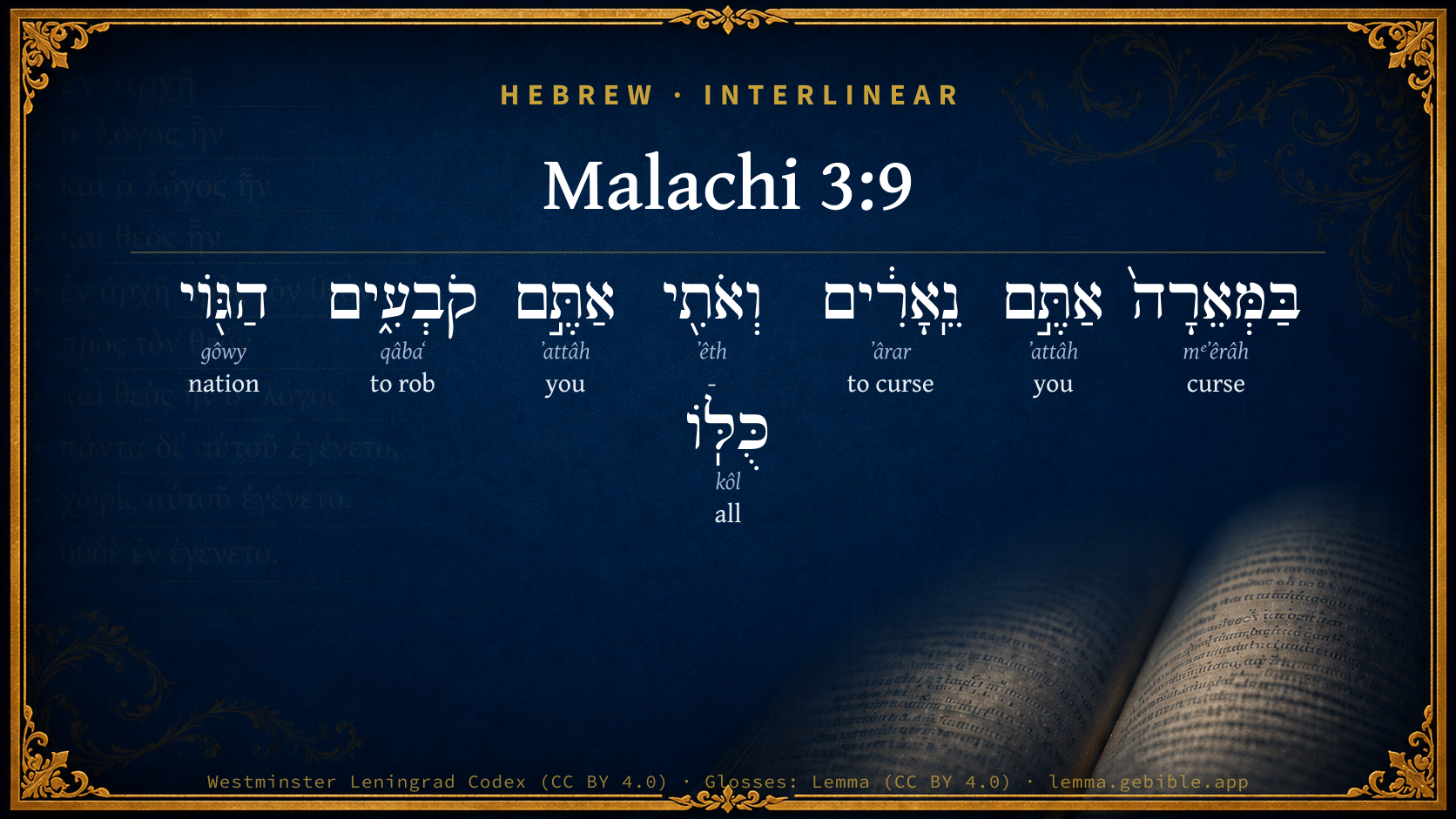
Hebrew (Westminster Leningrad Codex) Malachi 3:9 appears in the Hebrew Old Testament. The text above is from the Westminster Leningrad Codex. Each word links to its Strong’s number, a concise gloss, and parsing drawn from the Open Scriptures Hebrew Bible morphology. Click any word for its full Brown-Driver-Briggs (BDB) entry.
Download image
Cite this verse

Malachi 3:9 (World English Bible). Public Domain. Lemma interlinear Bible study tool, https://lemma.gebible.app/v/malachi/3/9.

Show BibTeX & RIS
BibTeX
RIS
English Translation
You are cursed with the curse; for you rob me, even this whole nation.
World English Bible · Public Domain
Download a study sheet

One document with this verse’s original text, its word-by-word gloss line, the meaning frame, cross-references with their text, attributed commentary, and full source and license credits — printable, and it pastes into notes with its structure intact.

This verse Autodidact and up

Study sheet (.html) Plain text (.txt)

A passage Seminary Student

Up to 50 verses in one chapter. A passage sheet keeps up to 6 commentary sources and 12 cross-references per verse, in the order this page ranks them, and says so on the sheet whenever that leaves anything out. Ask for a single verse and you get the Autodidact verse sheet above.

Everything on this page stays free to read, with no account — the sheet is a download of what is already on screen, not access to it.

Want to remove ads? Support Godless Engineer
Compare translations 3

The same verse in 3 English versions, stacked beneath the original-language interlinear above. Click any original word for its lexicon entry.

Each is an independent rendering of the whole verse — the interlinear is not word-aligned to these translations.

Highlighted words mark where these versions differ — a whole-verse word diff, not a word-by-word alignment.

  • World English Bible Public Domain
    You are cursed with the curse; for you rob me, even this whole nation.
  • King James Version Public Domain
    Ye are cursed with a curse: for ye have robbed me, even this whole nation.
  • unfoldingWord Literal Text CC BY-SA 4.0
    With a curse you cursed, for you robbing me, the nation, all of it.

unfoldingWord Literal Text — © unfoldingWord, licensed CC BY-SA 4.0. Word-aligned USFM3 via Door43 (git.door43.org/unfoldingWord/en_ult).

Versions to compare (up to 4)

3 of 4 selected

Show all 18 translations

Every available English version of this verse, each an independent rendering of the whole verse.

  • World English Bible Public Domain
    You are cursed with the curse; for you rob me, even this whole nation.
  • Berean Standard Bible Public Domain
    You are cursed with a curse, yet you—the whole nation—are still robbing Me.
  • Majority Standard Bible Public Domain
    You are cursed with a curse, yet you—the whole nation—are still robbing Me.
  • King James Version Public Domain
    Ye are cursed with a curse: for ye have robbed me, even this whole nation.
  • American Standard Version (1901) Public Domain
    Ye are cursed with the curse; for ye rob me, even this whole nation.
  • Revised Version (1885) Public Domain
    Ye are cursed with the curse; for ye rob me, even this whole nation.
  • Geneva Bible (1599) Public Domain
    Ye are cursed with a curse: for ye haue spoyled me, euen this whole nation.
  • Douay-Rheims (1899) Public Domain
    And you are cursed with want, and you afflict me, even the whole nation of you.
  • Young's Literal Translation Public Domain
    With a curse ye are cursed! And Me ye are deceiving -- this nation -- all of it.
  • Literal Standard Version CC BY-SA 4.0
    You are cursed with a curse! And you are deceiving Me—this nation—all of it.
  • Unlocked Literal Bible CC BY-SA 4.0
    You are cursed with a curse, for you are robbing me, the whole nation.
  • unfoldingWord Literal Text CC BY-SA 4.0
    With a curse you cursed, for you robbing me, the nation, all of it.
  • Darby Bible Public Domain
    Ye are cursed with a curse; and me ye rob, [even] this whole nation.
  • World Messianic Bible Public Domain
    You are cursed with the curse; for you rob me, even this whole nation.
  • Webster's Bible Public Domain
    Ye are cursed with a curse: for ye have robbed me, even this whole nation.
  • Free Bible Version CC BY-SA 4.0
    You are under a curse, for you and the whole nation are defrauding me.
  • Bible in Basic English Public Domain
    You are cursed with a curse; for you have kept back from me what is mine, even all this nation.
  • JPS Tanakh (1917) Public Domain
    Ye are cursed with the curse, yet ye rob Me, even this whole nation.

Literal Standard Version (2020), Covenant Press — licensed CC BY-SA 4.0. Text via the HelloAO Bible API (eBible.org). Unlocked Literal Bible (unfoldingWord) — licensed CC BY-SA 4.0. Text via the HelloAO Bible API (eBible.org). unfoldingWord Literal Text — © unfoldingWord, licensed CC BY-SA 4.0. Word-aligned USFM3 via Door43 (git.door43.org/unfoldingWord/en_ult). Free Bible Version, Dr. Jonathan Gallagher — licensed CC BY-SA 4.0. Text via the HelloAO Bible API (eBible.org).

Word by word

More ways to search: Search by grammar → Find every occurrence → Compare this word →

Practice this passage: Drill this verse → Learn its vocabulary →

About this verse

These counts appear in no published source. They are computed here, from the morphology-tagged text and Lemma’s own curated glosses. What Lemma adds →

8
words
7
distinct lemmas
Prophets
section

Notable vocabulary

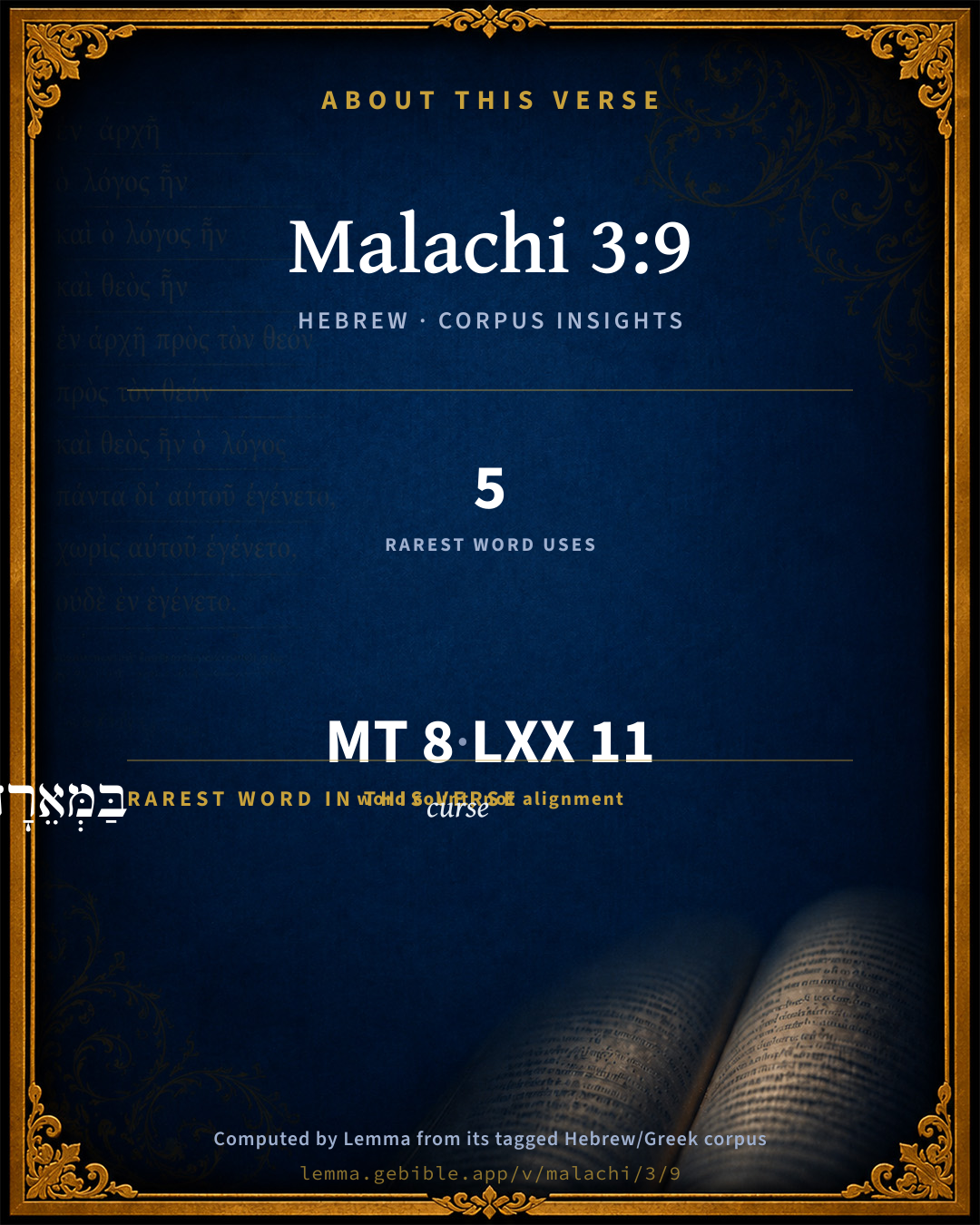
The rarest word here is בַּמְּאֵרָה֙ curse H3994 — appearing just 5 times in the whole Hebrew Bible.

Shared distinctive vocabulary

בַּמְּאֵרָה֙ curse H3994 occurs in 5 verses of the Hebrew Bible. Also found in:

Grammatical profile

  • 2 verbs
  • 3 nouns
  • 2 pronouns
  • 1 particle

Verb forms

  • נֵֽאָרִ֔ים Niphal · Participle Passive
  • קֹבְעִ֑ים Qal · Participle Active

Repetition

A word recurs within this verse — often emphatic in Hebrew:

  • אַתֶּ֣ם you H859 ×2

Hebrew & Septuagint length

In English translation the verse runs 14 words from the Hebrew and 12 from the Septuagint (LXX English) — closely comparable.

A rough comparison of the two English renderings, which tokenize alike — not a word-level alignment.

Word counts can differ between the Hebrew and the Greek without any difference in meaning — e.g. the Hebrew direct-object marker אֵת has no separate Greek word, and Greek often adds the article ὁ.

In the original languages it is 8 Hebrew tokens and 11 Greek tokens — but the two are counted differently (Hebrew bundles its prefixes and suffixes into one token; the Greek is in lemma form), so that isn’t a like-for-like length.

Cross-references

7

Topical passages linked to Malachi 3:9 in the Treasury of Scripture Knowledge — connected by theme and wording, ordered by reader-vote popularity; previews shown in the World English Bible.

  • Deuteronomy 28:15–19 But it shall come to pass, if you will not listen to the voice of Yahweh your God, to observe to do all his commandments and his statutes which I command you this day, that all these curses shall come on you, and overtake you.
  • Haggai 1:6–11 You have sown much, and bring in little. You eat, but you don't have enough. You drink, but you aren't filled with drink. You clothe yourselves, but no one is warm, and he who earns wages earns wages to put them into a bag with holes in it."
  • Haggai 2:14–17 Then Haggai answered, "'So is this people, and so is this nation before me,' says Yahweh; 'and so is every work of their hands. That which they offer there is unclean.
  • Malachi 2:2 If you will not listen, and if you will not lay it to heart, to give glory to my name," says Yahweh of Hosts, "then will I send the curse on you, and I will curse your blessings. Indeed, I have cursed them already, because you do not lay it to heart.
  • Joshua 22:20 Didn't Achan the son of Zerah commit a trespass in the devoted thing, and wrath fell on all the congregation of Israel? and that man didn't perish alone in his iniquity.
  • Isaiah 43:28 Therefore I will profane the princes of the sanctuary; and I will make Jacob a curse, and Israel a reviling.
  • Joshua 7:12–13 Therefore the children of Israel can't stand before their enemies; they turn their backs before their enemies, because they are become accursed: I will not be with you any more, except you destroy the devoted thing from among you.

Cross-references courtesy of OpenBible.info (CC BY 4.0).

Hebrew and Greek witnesses Masoretic Hebrew ↔ Greek Septuagint

The same verse in the two great witnesses to the Old Testament, shown verse-for-verse.

These are two independent witnesses, not word-aligned to each other, and the Septuagint is shown in lemma (dictionary) form.

Hebrew Malachi 3:9 Masoretic · Westminster Leningrad Codex

בַּמְּאֵרָה֙ אַתֶּ֣ם נֵֽאָרִ֔ים וְאֹתִ֖י אַתֶּ֣ם קֹבְעִ֑ים הַגּ֖וֹי כֻּלּֽוֹ

You are cursed with the curse; for you rob me, even this whole nation.

World English Bible · Public Domain

Greek LXX Malachi 3:9 Septuagint · lemma form

καί ἀποβλέπω σύ ἀποβλέπω καί ἐγώ σύ πτερνίζω ὁ ἔθνος συντελέω

And you⌃ do surely look off from me, and you⌃ insult me.

LXX2012 (modern English Septuagint) · Public Domain

On this verse, Haydock's Catholic Bible Commentary discusses the Septuagint’s reading. Read the note in Commentary ↓

Hebrew: Westminster Leningrad Codex (CC BY 4.0). Greek: Septuagint (public domain); English from LXX2012 (modern English Septuagint) (Public Domain). How the Septuagint differs from the Hebrew →

Targum (Aramaic paraphrase)

1

The Targum is the ancient Jewish Aramaic paraphrase of the Hebrew Scriptures — an interpretive translation, not the Hebrew text itself. Onkelos (literal) and Pseudo-Jonathan (expansive) render the Torah, and Jonathan the Prophets. Coverage is partial: where no permissively-licensed English translation exists for a verse, only the Aramaic is shown. This is verse-level text, not a word-by-word alignment to the Hebrew.

  1. Targum Jonathan Prophets (Joshua–Malachi)
    בְּלוּטָא אַתּוּן מִתְלָטִין וּקָדָמַי אַתּוּן מַרְגְזִין עַמָא כּוּלְהוֹן:

    בְּלוּטָא אַתּוּן מִתְלָטִין וּקָדָמַי אַתּוּן מַרְגְזִין עַמָא כּוּלְהוֹן:

    Targum Jonathan — Aramaic: “Mikraot Gedolot” (public domain). English: “Sefaria Community Translation” (CC0 1.0 (public-domain dedication)); “London "Chaldee Paraphrase," 1871” (public domain). Text via Sefaria.

Commentary

Notes on Malachi 3:9 from classic Christian and Jewish commentators (each source and its license shown beneath its notes). The classic Christian expositions comment on the surrounding passage and are grouped to its opening verse, so a note may address several verses; the Jewish commentaries on the Tanakh (Rashi and others) are per-verse, so they appear only where the commentator wrote on this verse.

Lemma curates 59 commentaries, every one of them public domain or Creative Commons licensed, each selected and text-cleaned for this edition rather than reprinted as found. About our sources →

Trapp's Complete Commentary

John Trapp

Mal 3:9 Ye [are] cursed with a curse: for ye have robbed me, [even] this whole nation.

Ver. 9. Ye are cursed with a curse] Vulgate: Ye are cursed with penury and scarcity of victuals, according to Deu 28:23, &c., and so great was this people’s poverty, that they were forced for food to sell not their fields only, but their sons and daughters, Neh 5:1-5 They had pinched on God’s side, and he had paid them home in the same kind; they thought in the famine to have kept the more to themselves, and they had the less for keeping from him that which was his. A just hand of God upon all church robbers; for the most part they are always in want and needy, their wealth melting away as snow before the sun, and their fields of blood, purchased with the spoils of Christ, proving as unfortunate and fatal to them as the gold of the temple of Tholose did to Scipio’s soldiers, of which whoever carried any part away never prospered afterwards. What get men by such a detiny that shall prove their fatal destiny? Say they leave the gold behind them, yet they are likely to carry the guilt to hell with them, Jas 5:1-2; yea, to cough in hell, as Latimer phrased it, unless they make restitution; to digest in hell, what they have devoured on earth, as Austin. Because Pharaoh saith, the river is mine own, therefore, saith God, I will dry up the river, Eze 29:3; Eze 29:9. The merchant that denieth to pay his custom forfeits all his commodities: so here.

For ye have robbed me] And therefore I have cursed you. God never punisheth people but there is just cause for it, could they but see it; but that they are hardly drawn to, as here, and Isa 26:11; the root of the matter is in themselves, as Job speaks in another case; the plague of their own hearts, 1Ki 8:38, procureth them all the mischief, and may say to them, as the heart of Apollodorus, the tyrant, seemed to say to him; who dreamed one night that he was flayed by the Scythians, and boiled in a caldron, and that his heart spake to him out of the kettle, it is I that have drawn thee to all this (’Eγω σοι τουτων αιτια). Let men, therefore, when under any misery, lay their hand upon their heart, thrust their hand into their bosom, with Moses, they shall be sure to bring it out leprous; let them turn short again upon themselves, and say every man, What have I done? what evil have I committed, or, at least, admitted? what good have I omitted, or intermitted? Profane Esau, beguiled of the blessing, cries out of his father’s store, of his brother’s subtlety; not a word of his own profaneness in slighting and selling his birthright; he had forgot since he did eat and drink, and went his way, Gen 25:34. The Jerusalem paraphrast adds, that he also despised his portion in the world to come, and denied the resurrection. But this he never taketh notice of. So Pompey, beaten by Caesar out of the field, blamed the Divine providence for his ill success, when he should rather have assaulted his own reckless security (that he never considered into what place he were best to retire if worsted), and especially his sacrilege not long before the defeat, when he sacked Jerusalem, and ransacked the temple, 1Ma 9:54-56; 2Ma 3:24-25; 2Ma 4:39-42; 2Ma 5:15-16; 2Ma 13:4; 2Ma 13:8; 2Ma 15:30; 2Ma 15:34. He might have considered what became (a little before his time) for the same offence of Alcimus, Heliodorus, Lysimachus, Antiochus, Menelaus, and Nicanor, all notorious church robbers, and all hanged up in gibbets, as it were, for an example and admonition to all that should come after. Sacrilege is a snare (saith Solomon, Pro 20:25), that, 1. catcheth suddenly; 2. holdeth surely; 3. destroyeth certainly. Cavete.

Even this whole nation] The disease was grown into an epidemic, like that which physicians call corruptio totius substantiae, the entire nature is diseased, or that which the prophet Isaiah also complaineth of, Mal 1:5-6 "The whole head is sick, the whole heart is faint," &c. This sin of sacrilege was grown national; there was a conjuncture of all sorts in this wickedness; a rabble of rebels they were, ripe for judgment; yea, though God’s judgments were upon them, yet they persisted, Neh 13:18, and increased wrath, Ezr 10:14. God had smitten them, but they sorrowed not, Jer 5:3; but to be revenged on him, as it were, for laying famine upon them, they took away his tithes.

John Trapp, A Commentary or Exposition upon All the Books of the Old and New Testament (1647–1656) — public domain. Text from a community e-Sword module.

Jamieson, Fausset & Brown

Robert Jamieson, A. R. Fausset & David Brown

cursed-- (Mal 2:2). As ye despoil Me, so I despoil you, as I threatened I would, if ye continued to disregard Me. In trying to defraud God we only defraud ourselves. The eagle who robbed the altar set fire to her nest from the burning coal that adhered to the stolen flesh. So men who retain God's money in their treasuries will find it a losing possession. No man ever yet lost by serving God with a whole heart, nor gained by serving Him with a half one. We may compromise with conscience for half the price, but God will not endorse the compromise; and, like Ananias and Sapphira, we shall lose not only what we thought we had purchased so cheaply, but also the price we paid for it. If we would have God "open" His treasury, we must open ours. One cause of the barrenness of the Church is the parsimony of its members [MOORE].

Jamieson, Fausset & Brown — Commentary Critical and Explanatory on the Whole Bible (1871) — public domain (CC PDM 1.0). Text via the HelloAO Bible API.

Adam Clarke's Commentary

Verse 9. Ye are cursed with a curse] The whole nation is under my displeasure. The curse of God is upon you.

Adam Clarke's Commentary on the Bible (1810–1826) — public domain. Text from a community e-Sword/MySword module.

John Calvin's Commentaries

Malachi pursues the same subject; for he answers the Jews in the name of God — that they unjustly complained of his rigour as being immoderate, since they themselves were the cause of all their evils. He says that they were cursed, but he adds that this happened to them deservedly, as though he had said — “Be that granted what you say, (for lamentations were continually made,) why is it that God afflicts us without end or limits?” God seems to grant what they were wont reproachfully to declare; but he says in answer to this — “But ye have defrauded Me; what wonder then that my curse consumes you? As then I have been robbed by you, as far as ye could, I will render to you your just recompense; for it is not right that I should be bountiful and kind to you, while ye thus defraud me, and take from me what is my own.”

The meaning then is this — that it was indeed true that the Jews lamented that they were under a curse, but that the cause ought to have been searched out. They indeed wished their rapines and sacrileges to be forgiven, by which they defrauded God; but God declares that he punished them justly in consuming them with poverty and want, since they so sparingly rendered to him what they owed.

He mentions the whole nation, and thus aggravates the wickedness of the Jews; for not a few were guilty of the sacrilege mentioned, but all, from the least to the greatest, they all plundered the tenths and the oblations. It hence follows that God’s vengeance did not exceed due limits, since there was as it were a common conspiracy; there were not ten or a hundred implicated in this sin, but, as he says, the whole people. It follows —

John Calvin's Commentaries (1540-1563) — public domain. Text from the Calvin Translation Society English edition (1840s-50s) via the Christian Classics Ethereal Library (ccel.org). Calvin's coverage is partial (roughly two-thirds of the Bible); uncommented books and verses are honest gaps, never fabricated. The 19th-century editor's footnotes and remarks are omitted so the notes are faithfully Calvin's own voice.

Ellicott's Commentary for English Readers

(9) Comp. Mal_2:2; Mal_3:11.

A Bible Commentary for English Readers, edited by Charles John Ellicott (1878–1897) — public domain. Text from a community e-Sword module.

The Cambridge Bible for Schools and Colleges

gen. ed. J. J. S. Perowne

9. a curse] Rather, the curse. The threatened curse has already fallen upon you. See ch. Mal_2:2 with Mal_3:11.

have robbed] Rather rob, as in Mal_3:8.

The pronouns in the Hebrew are emphatic: Me ye are robbing. And the evil is not confined to the priests (ch. Mal_1:6-8; Mal_1:12-14), but extends to “the whole nation”.

The Cambridge Bible for Schools and Colleges (gen. ed. J. J. S. Perowne; Cambridge University Press, 1878–1918) — public domain. Text from a community e-Sword module.

John Gill's Exposition

Ye are cursed with a curse,.... Or "with penury", as the Vulgate Latin version; which, though not a proper rendering of the word, is the meaning of the curse they were cursed with; rain was withheld from them for their sins, and the earth did not bring forth its usual increase; wherefore there was want of food in all their land; their blessings were cursed, as in Mal 2:2 for the following reason,

for ye have robbed me; because of this their iniquity, in not bringing their offerings to the Lord, and the tithes to the priests and Levites, their land was stricken with barrenness, and God gave them cleanness of teeth, and want of bread in all places: or, "but ye have robbed me" (d); notwithstanding they were thus chastised of the Lord, yet were not reformed, but went on in withholding from God and the priests, what belonged to them:

even this whole nation; the sin was become general, and therefore a general judgment was inflicted on them: Grotius thinks, that the people seeing the priests withhold the tithes from the Levites, they refused to pay them to them, and so the sin became universal. Kimchi observes, that in other sins charged upon the nation, the people were not all alike guilty, but in this which respected the tithes and offerings they were.

(d) "et tamen diripitis me", De Dieu.

John Gill's Exposition of the Whole Bible (1746–1763) — public domain (CC PDM 1.0). Text via the HelloAO Bible API.

Albert Barnes' Notes on the Bible

Ye have been cursed with the curse - (not “with a curse”). The curse threatened had come upon them: but, as fore-supposed in Leviticus by the repeated burden, “If ye still walk contrary to Me,” they had persevered in evil. God had already shown His displeasure. But they, so far from being amended by it, were the more hardened in their sin. Perhaps as men do, they pleaded their punishment, as a reason why they should not amend. They defrauded God, under false pretences. They were impoverished by His curse, and so they could not afford to pay the tithes; as men say, “the times are bad; so we cannot help the poor” of Christ. “And Me ye still are defrauding” Me, ye; man, God. And that not one or other, but this whole people. It was a requital as to that, in which they had offended. “Because ye have not rendered tithes and first-fruits, therefore ye are cursed in famine and penury.” “Because the people did not render tithes and first-fruits to the Levites, the Lord saith, that He Himself suffered fraud, whose ministers, constrained by hunger and penury, deserted the temple. For, if He is visited by others in prison, and sick, is received and cared for, and, hungry and athirst, receives food and drink, why should He not receive tithes in His ministers, and, if they are not given, be Himself deprived of His portion?”

Albert Barnes' Notes on the Bible (1834–1885) — public domain. Text from a community e-Sword/MySword module.

Haydock's Catholic Bible Commentary

Want. Hebrew, "malediction." St. Jerome specifies the kind. (Calmet) --- Septuagint, "and you obstinately turn away your eyes, and supplant me," &c. (Haydock)

George Leo Haydock (1774–1849), Haydock's Catholic Family Bible and Commentary, 1859 edition — public domain. Excludes Psalms (Douay-Rheims chapter numbering differs from Protestant) and Deuterocanonical books (Catholic canon only).

Matthew Poole's English Annotations

Ye, O priests, your sin, your sacrilege, of which you are guilty, hath provoked me.

Are cursed with a curse; are greatly cursed, and are likely still to be cursed, the curse shall continue whilst you continue in this your sinful course.

For ye have robbed me; this brought, increased, and multiplied your curse. Or, as some, yet ye do rob me! Strange that you dare sin, whilst I am punishing for this very sin! Or by way of question, and do ye rob me? will you go on thus to sin when you are under the curse for it? will you, as Ahaz, sin when in distress; or, Pharaoh-like, harden under the judgment?

Even this whole nation: like priest like people; the priests and Levites did unduly employ the tithes and offerings, and the people did unduly pay: it is like the people observed how much of the tithes were laid out otherwise than the law directed, and they were ready to think they might do well enough to keep that for a use better (as they did think) than the use the priests and Levites put it to, they thought it was ill spent by the priests, and well saved by them; but this, however seemingly excuse them to themselves, it leaves them guilty before God: the whole nation is sacrilegious, and the whole nation cursed for it.

Matthew Poole's English Annotations on the Holy Bible (1683–1685) — public domain. Text from a community e-Sword/MySword module.

The Pulpit Commentary

Ye are cursed with a (the) curse. The effect of the curse was scarcity and barrenness, as we see from vers. 10-12. (comp. Hag_1:6) The Vulgate assumes the result: In penuria vos maledicti estis. The next clause given the reason of the curse. This whole nation. Not individuals only, but the whole nation (he does not any longer call them God"s people) were implicated in this sin. The LXX, reading differently, has, "The year is ended, and ye have brought," etc.

The Pulpit Commentary (1880–1919), ed. H.D.M. Spence-Jones & Joseph S. Exell — public domain. Text from a community e-Sword module.

John Wesley's Explanatory Notes

Cursed with a curse - Are greatly cursed.

John Wesley, Explanatory Notes Upon the Whole Bible (1754–1765) — public domain. Text via the GEBible commentary corpus.

Rashi

Rabbi Shlomo Yitzchaki (Rashi)

You are cursed with a curse because of this iniquity, for which I send a curse into the work of your hands; but nevertheless, you rob Me.

Rashi on the Tanakh — English translations: “The Judaica Press complete Tanach with Rashi, translated by A. J. Rosenberg” (CC BY 4.0); “Pentateuch with Rashi's commentary by M. Rosenbaum and A.M. Silbermann, 1929-1934” (public domain); “The Metsudah Tanach series, Lakewood, N.J” (CC BY 4.0); and “The Book of Joshua, Metsudah Publications, 1997” (CC BY 4.0). Text via Sefaria.

Lesson kit

Teaching starters — assembled from the data on this page, not authored interpretation. Every prompt links to the verse data it draws on. Edit before teaching.

Malachi, in the Prophets, opens this verse with 8 words (7 distinct Hebrew lemmas). Its most distinctive word is mᵉʼêrâh (“curse”). A historical commentator’s framing appears above. Read the whole chapter for the surrounding context.

Discussion questions

  1. The word mᵉʼêrâh carries the sense “curse.” How does it shape the verse?
  2. How does Deuteronomy 28:20, which shares the word «curse», read alongside this verse?
  3. What does the repetition of “you” (2× in this one verse) do in this verse?
  4. These translations render this verse differently; the difference is in the English rendering, not the original. What questions does that raise?
  5. «נֵֽאָרִ֔ים» is a Niphal Participle Passive verb. How does that grammatical form shape the action described?
  6. Compare how Trapp's Complete Commentary and Jamieson, Fausset & Brown read this verse. Where do they agree or differ?

Things to notice

Reading settings

Reading text

Shown beneath each verse's original-language words.

Old Testament
Old Testament edition

Read the OT as the Masoretic Hebrew (MT) or the Greek Septuagint (LXX).

English shown for the Greek Septuagint (in the Hebrew ↔ Greek comparison).

Comparing translations? Open the Compare panel on any verse page to stack up to four side by side.