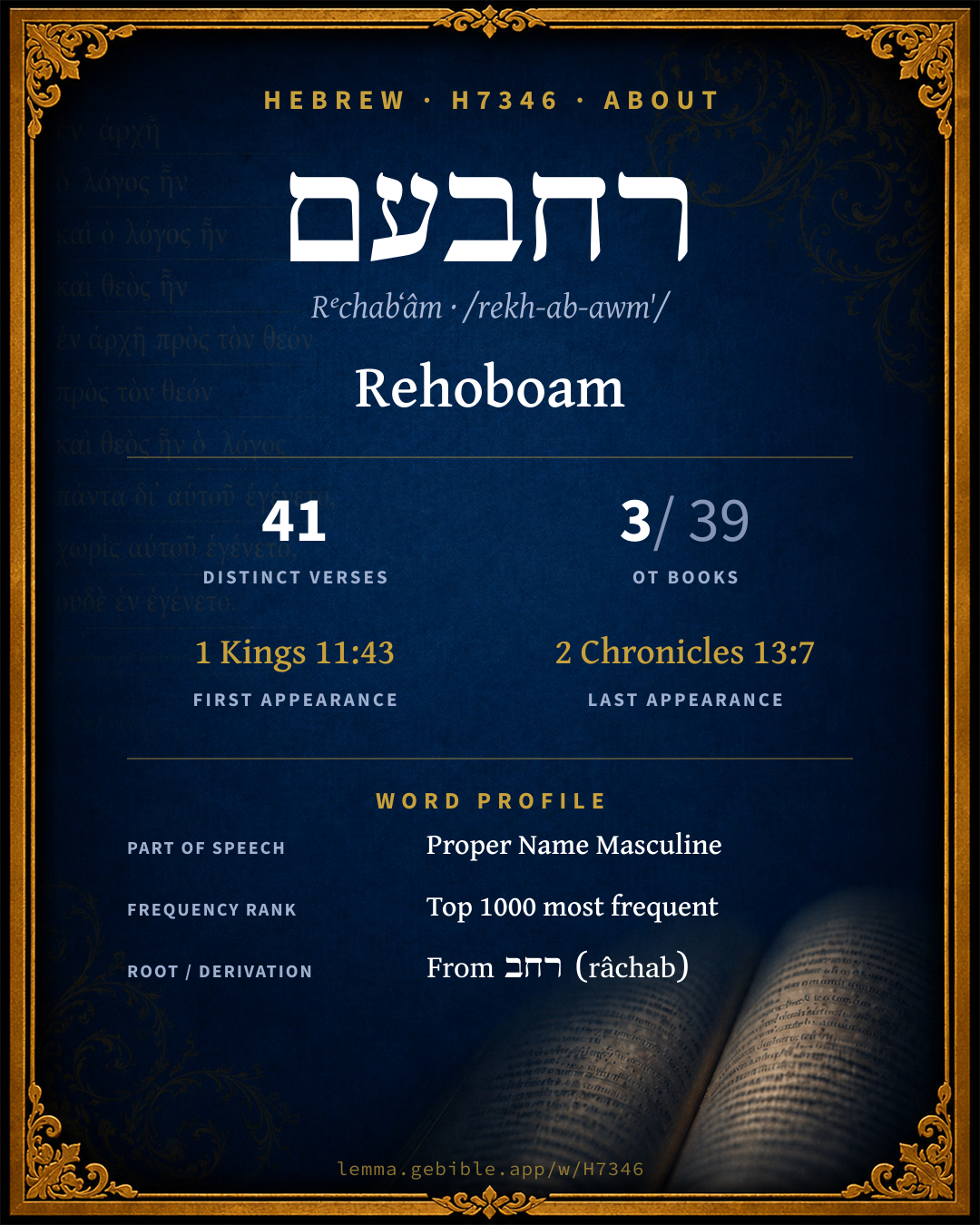
רְחַבְעָם
Rehoboam
BDB lists 2 entries for ‘Rehoboam’ fuller range ↓
Full lexicon entry — Brown-Driver-Briggs (BDB)
From Brown-Driver-Briggs (BDB)
Where this word appears
Grammar key — what these labels mean
Part of speech
- Noun
- A naming word — a person, place, thing, or idea.
Noun type
- Proper
- A name of a specific person, place, or people (e.g. Abraham, Zion, Israel).
Every verse where H7346 appears — 41 distinct verses across 3 books. Click any verse to open its interlinear word-by-word view. Verse text shown in the World English Bible for context — . Each verse’s Hebrew form is shown with its reference; the English is not keyword-highlighted, since the data carries no word-level English alignment. Use “Compare translations” on any verse to read it across multiple English versions. This concordance covers the Hebrew Bible; Septuagint (Greek Old Testament) occurrences are not indexed here.
1 Kings 17 verses
- 1 Kings 11:43 רְחַבְעָ֥ם n Proper Solomon slept with his fathers, and was buried in the city of David his father: and Rehoboam his son reigned in his place.
- 1 Kings 12:1 רְחַבְעָ֖ם n Proper Rehoboam went to Shechem: for all Israel were come to Shechem to make him king.
- 1 Kings 12:3 רְחַבְעָ֖ם n Proper and they sent and called him), that Jeroboam and all the assembly of Israel came, and spoke to Rehoboam, saying,
- 1 Kings 12:6 רְחַבְעָ֗ם n Proper King Rehoboam took counsel with the old men, who had stood before Solomon his father while he yet lived, saying, What counsel give you me to return answer to this people?
- 1 Kings 12:12 רְחַבְעָ֖ם n Proper So Jeroboam and all the people came to Rehoboam the third day, as the king bade, saying, Come to me again the third day.
- 1 Kings 12:17 רְחַבְעָֽם n Proper But as for the children of Israel who lived in the cities of Judah, Rehoboam reigned over them.
- 1 Kings 12:18 רְחַבְעָ֗ם רְחַבְעָ֗ם n Proper n Proper Then king Rehoboam sent Adoram, who was over the men subject to forced labor; and all Israel stoned him to death with stones. King Rehoboam made speed to get him up to his chariot, to flee to Jerusalem.
- 1 Kings 12:21 רְחַבְעָם֮ לִ/רְחַבְעָ֖ם n Proper prep + n Proper When Rehoboam was come to Jerusalem, he assembled all the house of Judah, and the tribe of Benjamin, a hundred and eighty thousand chosen men, who were warriors, to fight against the house of Israel, to bring the kingdom again to Rehoboam the son of Solomon.
- 1 Kings 12:23 רְחַבְעָ֤ם n Proper Speak to Rehoboam the son of Solomon, king of Judah, and to all the house of Judah and Benjamin, and to the rest of the people, saying,
- 1 Kings 12:27 רְחַבְעָ֖ם רְחַבְעָ֥ם n Proper n Proper if this people go up to offer sacrifices in the house of Yahweh at Jerusalem, then will the heart of this people turn again to their lord, even to Rehoboam king of Judah; and they will kill me, and return to Rehoboam king of Judah.
- 1 Kings 14:21 וּ/רְחַבְעָם֙ רְחַבְעָ֨ם conj + n Proper n Proper Rehoboam the son of Solomon reigned in Judah. Rehoboam was forty-one years old when he began to reign, and he reigned seventeen years in Jerusalem, the city which Yahweh had chosen out of all the tribes of Israel, to put his name there: and his mother's name was Naamah the Ammonitess.
- 1 Kings 14:25 רְחַבְעָ֑ם n Proper It happened in the fifth year of king Rehoboam, that Shishak king of Egypt came up against Jerusalem;
- 1 Kings 14:27 רְחַבְעָם֙ n Proper King Rehoboam made in their place shields of brass, and committed them to the hands of the captains of the guard, who kept the door of the king's house.
- 1 Kings 14:29 רְחַבְעָ֖ם n Proper Now the rest of the acts of Rehoboam, and all that he did, aren't they written in the book of the chronicles of the kings of Judah?
- 1 Kings 14:30 רְחַבְעָ֛ם n Proper There was war between Rehoboam and Jeroboam continually.
- 1 Kings 14:31 רְחַבְעָ֜ם n Proper Rehoboam slept with his fathers, and was buried with his fathers in the city of David: and his mother's name was Naamah the Ammonitess. Abijam his son reigned in his place.
- 1 Kings 15:6 רְחַבְעָ֛ם n Proper Now there was war between Rehoboam and Jeroboam all the days of his life.
1 Chronicles 1 verse
2 Chronicles 23 verses
- 2 Chronicles 9:31 רְחַבְעָ֥ם n Proper Solomon slept with his fathers, and he was buried in the city of David his father: and Rehoboam his son reigned in his place.
- 2 Chronicles 10:1 רְחַבְעָ֖ם n Proper Rehoboam went to Shechem; for all Israel were come to Shechem to make him king.
- 2 Chronicles 10:3 רְחַבְעָ֖ם n Proper They sent and called him; and Jeroboam and all Israel came, and they spoke to Rehoboam, saying,
- 2 Chronicles 10:6 רְחַבְעָ֗ם n Proper King Rehoboam took counsel with the old men, who had stood before Solomon his father while he yet lived, saying, What counsel give you me to return answer to this people?
- 2 Chronicles 10:12 רְחַבְעָ֖ם n Proper So Jeroboam and all the people came to Rehoboam the third day, as the king bade, saying, Come to me again the third day.
- 2 Chronicles 10:13 רְחַבְעָ֔ם n Proper The king answered them roughly; and king Rehoboam forsook the counsel of the old men,
- 2 Chronicles 10:17 רְחַבְעָֽם n Proper But as for the children of Israel who lived in the cities of Judah, Rehoboam reigned over them.
- 2 Chronicles 10:18 רְחַבְעָ֗ם רְחַבְעָ֗ם n Proper n Proper Then king Rehoboam sent Hadoram, who was over the men subject to forced labor; and the children of Israel stoned him to death with stones. King Rehoboam made speed to get him up to his chariot, to flee to Jerusalem.
- 2 Chronicles 11:1 רְחַבְעָם֮ לִ/רְחַבְעָֽם n Proper prep + n Proper When Rehoboam was come to Jerusalem, he assembled the house of Judah and Benjamin, one hundred eighty thousand chosen men, who were warriors, to fight against Israel, to bring the kingdom again to Rehoboam.
- 2 Chronicles 11:3 רְחַבְעָ֥ם n Proper Speak to Rehoboam the son of Solomon, king of Judah, and to all Israel in Judah and Benjamin, saying,
- 2 Chronicles 11:5 רְחַבְעָ֖ם n Proper Rehoboam lived in Jerusalem, and built cities for defense in Judah.
- 2 Chronicles 11:17 רְחַבְעָ֥ם n Proper So they strengthened the kingdom of Judah, and made Rehoboam the son of Solomon strong, three years; for they walked three years in the way of David and Solomon.
- 2 Chronicles 11:18 רְחַבְעָם֙ n Proper Rehoboam took him a wife, Mahalath the daughter of Jerimoth the son of David, [and of] Abihail the daughter of Eliab the son of Jesse;
- 2 Chronicles 11:21 רְחַבְעָ֜ם n Proper Rehoboam loved Maacah the daughter of Absalom above all his wives and his concubines: (for he took eighteen wives, and sixty concubines, and became the father of twenty-eight sons and sixty daughters.)
- 2 Chronicles 11:22 רְחַבְעָ֛ם n Proper Rehoboam appointed Abijah the son of Maacah to be chief, [even] the prince among his brothers; for [he was minded] to make him king.
- 2 Chronicles 12:1 רְחַבְעָם֙ n Proper It happened, when the kingdom of Rehoboam was established, and he was strong, that he forsook the law of Yahweh, and all Israel with him.
- 2 Chronicles 12:2 רְחַבְעָ֔ם n Proper It happened in the fifth year of king Rehoboam, that Shishak king of Egypt came up against Jerusalem, because they had trespassed against Yahweh,
- 2 Chronicles 12:5 רְחַבְעָ֔ם n Proper Now Shemaiah the prophet came to Rehoboam, and to the princes of Judah, who were gathered together to Jerusalem because of Shishak, and said to them, Thus says Yahweh, You have forsaken me, therefore have I also left you in the hand of Shishak.
- 2 Chronicles 12:10 רְחַבְעָם֙ n Proper King Rehoboam made in their place shields of brass, and committed them to the hands of the captains of the guard, who kept the door of the king's house.
- 2 Chronicles 12:13 רְחַבְעָ֛ם רְחַבְעָ֨ם n Proper n Proper So king Rehoboam strengthened himself in Jerusalem, and reigned: for Rehoboam was forty-one years old when he began to reign, and he reigned seventeen years in Jerusalem, the city which Yahweh had chosen out of all the tribes of Israel, to put his name there: and his mother's name was Naamah the Ammonitess.
- 2 Chronicles 12:15 רְחַבְעָ֗ם רְחַבְעָ֛ם n Proper n Proper Now the acts of Rehoboam, first and last, aren't they written in the histories of Shemaiah the prophet and of Iddo the seer, after the manner of genealogies? There were wars between Rehoboam and Jeroboam continually.
- 2 Chronicles 12:16 רְחַבְעָם֙ n Proper Rehoboam slept with his fathers, and was buried in the city of David: and Abijah his son reigned in his place.
- 2 Chronicles 13:7 רְחַבְעָ֣ם וּ/רְחַבְעָ֗ם n Proper conj + n Proper There were gathered to him worthless men, base fellows, who strengthened themselves against Rehoboam the son of Solomon, when Rehoboam was young and tender-hearted, and could not withstand them.
About this entry
At a glance — auto-summarized from this page’s data, not written by a person. Every figure links to its source below. This summary describes the numbers; it doesn’t interpret them.
רחבעם (Rᵉchabʻâm) is a Hebrew name most often rendered “Rehoboam.” It clusters heavily in 2 Chronicles, which alone accounts for 56% of its uses. With 41 verses in 3 books, it is a moderately common word in the Hebrew Bible. It first appears in 1 Kings 11:43. For the data behind this summary, explore 41-verse concordance and the renderings breakdown below.
Gloss history
Strong's 1890 vs modern scholarship
About this word
Strong's H7346 catalogs a Hebrew word from the Hebrew Old Testament.
These counts are not copied from any lexicon or concordance. They are computed here, from the morphology-tagged Hebrew Old Testament. What Lemma adds →
- 41
- distinct verses
- The word appears in 41 distinct verses.
- 3 / 39
- OT books
- The word appears in 3 of 39 Old Testament books.
- #739
- by frequency
- Top 1000 most frequent Hebrew words (rank 739 of 8,640 Hebrew words by occurrence).
View all 41 occurrences in the concordance →
Most concentrated in
- 2 Chronicles 23 verses 56%
- 1 Kings 17 verses 41%
- 1 Chronicles 1 verse 2%
By section of the Old Testament
By traditional corpus
Conventional, traditional groupings — biblical authorship is debated, so this is a traditional corpus grouping, not an authorship claim. Each share is this word’s portion of its verses in that division of the Hebrew canon. Each figure is a share of the word’s 41 distinct verses.
- Writings (Ketuvim) 24 verses · 59%
- Prophets (Nevi'im) 17 verses · 41%
How translations render this word
Counts come from each version’s own published word-to-Strong’s tagging or interlinear alignment — an approximate guide to how each version renders this word, not a word-level alignment the data otherwise carries. Because each total is that version’s own tagged count, the per-version totals vary from one another and need not match the appearance or distinct-verse counts above. These counts may also differ from a printed concordance because Lemma counts each distinctly tagged rendering and does not collapse phrase taggings into a single head-word total. This is a fixed set of word-tagged versions (KJV, ASV, BSB, ULT) and does not change with the reading translation you choose elsewhere. Each version’s license is shown beside its name below (and on Sources).
- King James Version: Rehoboam 43×, Between rehoboam 3×
- American Standard Version: Rehoboam 42×, Between rehoboam 3×
- Berean Standard Bible: Rehoboam 41×, Rehoboam’s 2×
- unfoldingWord Literal Text: Rehoboam 49×
King James Version Public Domain
Renders H7346 across 50 tagged occurrences — most commonly:
Plus 4 renderings that appear only once — usually multi-word phrases or single function words the recovered tagging swept in, not distinct renderings.
American Standard Version Public Domain
Renders H7346 across 50 tagged occurrences — most commonly:
Plus 5 renderings that appear only once — usually multi-word phrases or single function words the recovered tagging swept in, not distinct renderings.
Berean Standard Bible Public Domain
Renders H7346 across 48 tagged occurrences — most commonly:
Plus 5 renderings that appear only once — usually multi-word phrases or single function words the recovered tagging swept in, not distinct renderings. Not rendered by a distinct English word in 2 further occurrences.
unfoldingWord Literal Text CC BY-SA 4.0
Renders H7346 across 50 tagged occurrences — most commonly:
Plus 1 rendering that appears only once — usually multi-word phrases or single function words the recovered tagging swept in, not distinct renderings.
Senses in BDB
The 2 senses BDB distinguishes for this word, in lexicon order (not ranked by frequency or importance). The full entry — with sub-senses — is in the Lexicon Entry tab.
- Rehoboam = "a people has enlarged"
- son of Solomon and the 1st king of Judah after the split up of the kingdom of Israel
Word origin
n.pr.m. Rehoboam (word-play on רחב Ecclus 47:23 c);—king of Judah, son of Solomon; Ροβοαμ: 1 K 11:43; 12:1, 3, 6 + 16 times 1 K 12, 14, + 15:6 ‖ 2 Ch 9:31; 10:1, 3, 6 + 21 times 2 Ch 10, 11, 12, + 13:7(×2); also 1 Ch 3:10.
— Brown-Driver-Briggs (Oxford 1906, public domain), digitized via Sefaria, supplemented by the OpenScriptures HebrewLexicon (CC BY 4.0). See Sources.
Derived from רחב (râchab) (H7337) — to grow wide.
Forms in the corpus
The 17 distinct written forms H7346 takes in the Hebrew Bible, most frequent first — each parse links to that state’s occurrences in the concordance. Hebrew forms include their vowel points and cantillation, so a single lemma takes many written forms.
| Form | Parsing | Example | Uses |
|---|---|---|---|
| רְחַבְעָ֖ם | Noun, Proper | 1 Kings 12:1 | 9 |
| רְחַבְעָ֗ם | Noun, Proper | 1 Kings 12:6 | 7 |
| רְחַבְעָ֛ם | Noun, Proper | 1 Kings 14:30 | 5 |
| רְחַבְעָ֥ם | Noun, Proper | 1 Kings 11:43 | 5 |
| רְחַבְעָם֙ | Noun, Proper | 1 Kings 14:27 | 5 |
| רְחַבְעָ֔ם | Noun, Proper | 2 Chronicles 10:13 | 3 |
| רְחַבְעָ֑ם | Noun, Proper | 1 Chronicles 3:10 | 2 |
| רְחַבְעָ֜ם | Noun, Proper | 1 Kings 14:31 | 2 |
| רְחַבְעָ֨ם | Noun, Proper | 1 Kings 14:21 | 2 |
| רְחַבְעָֽם | Noun, Proper | 1 Kings 12:17 | 2 |
| רְחַבְעָם֮ | Noun, Proper | 1 Kings 12:21 | 2 |
| וּ/רְחַבְעָ֗ם | Noun, Proper | 2 Chronicles 13:7 | 1 |
| וּ/רְחַבְעָם֙ | Noun, Proper | 1 Kings 14:21 | 1 |
| לִ/רְחַבְעָ֖ם | Noun, Proper | 1 Kings 12:21 | 1 |
| לִ/רְחַבְעָֽם | Noun, Proper | 2 Chronicles 11:1 | 1 |
| רְחַבְעָ֣ם | Noun, Proper | 2 Chronicles 13:7 | 1 |
| רְחַבְעָ֤ם | Noun, Proper | 1 Kings 12:23 | 1 |
Same root — word family
Other BDB entries built from the same root as H7346, grouped by Strong’s listed origin. These share a root / origin per the lexicon — not necessarily a shared meaning. Each links to that word’s own entry.
Derives from
Shares the same root
- מרחב merchâb H4800 wide place
- רחב rachab H7338 breadth
- רחב rᵉchôb H7339 plaza
- רחב rôchab H7341 breadth
- רחב râchâb H7342 wide
Proper names from this root
People and places named from this root — a name, not an additional meaning of the word.
Compare all same-root words → Showing 4 of 9 — not the complete family. 2 of the same-root words are proper names (people or places). They share a root, not necessarily a meaning.
Bible dictionary
Public-domain dictionary articles matched to this entry by name (Rehoboam). A biblical name can be shared by more than one person or place, so an article may treat several.
Easton's Bible Dictionary · M. G. Easton, 1897
He enlarges the people, the successor of Solomon on the throne, and apparently his only son. He was the son of Naamah "the Ammonitess," some well-known Ammonitish princess (1 Kings 14:21; 2 Chr. 12:13). He was forty-one years old when he ascended the throne, and he reigned seventeen years (B.C. 975-958). Although he was acknowledged at once as the rightful heir to the throne, yet there was a strongly-felt desire to modify the character of the government. The burden of taxation to which they had been subjected during Solomon's reign was very oppressive, and therefore the people assembled at Shechem and demanded from the king an alleviation of their burdens. He went to meet them at Shechem, and heard their demands for relief (1 Kings 12:4). After three days, having consulted with a younger generation of courtiers that had grown up around him, instead of following the advice of elders, he answered the people haughtily (6-15). "The king hearkened not unto the people; for the cause was from the Lord" (comp. 11:31). This brought matters speedily to a crisis. The terrible cry was heard (comp. 2 Sam. 20:1):
"What portion have we in David? Neither have we inheritance in the son of Jesse: To your tents, O Israel: Now see to thine own house, David" (1 Kings 12:16).
And now at once the kingdom was rent in twain. Rehoboam was appalled, and tried concessions, but it was too late (18). The tribe of Judah, Rehoboam's own tribe, alone remained faithful to him. Benjamin was reckoned along with Judah, and these two tribes formed the southern kingdom, with Jerusalem as its capital; while the northern ten tribes formed themselves into a separate kingdom, choosing Jeroboam as their king. Rehoboam tried to win back the revolted ten tribes by making war against them, but he was prevented by the prophet Shemaiah (21-24; 2 Chr. 11:1-4) from fulfilling his purpose. (See JEROBOAM.)
In the fifth year of Rehoboam's reign, Shishak (q.v.), one of the kings of Egypt of the Assyrian dynasty, stirred up, no doubt, by Jeroboam his son-in-law, made war against him. Jerusalem submitted to the invader, who plundered the temple and virtually reduced the kingdom to the position of a vassal of Egypt (1 Kings 14:25, 26; 2 Chr. 12:5-9). A remarkable memorial of this invasion has been discovered at Karnac, in Upper Egypt, in certain sculptures on the walls of a small temple there. These sculptures represent the king, Shishak, holding in his hand a train of prisoners and other figures, with the names of the captured towns of Judah, the towns which Rehoboam had fortified (2 Chr. 11:5-12).
The kingdom of Judah, under Rehoboam, sank more and more in moral and spiritual decay. "There was war between Rehoboam and Jeroboam all their days." At length, in the fifty-eighth year of his age, Rehoboam "slept with his fathers, and was buried with his fathers in the city of David" (1 Kings 14:31). He was succeeded by his son Abijah. (See EGYPT.)
Smith's Bible Dictionary · William Smith, 1863
(enlarger of the people), son of Solomon by the Ammonite princess Naamah, (1 Kings 14:21,31) and his successor. (1 Kings 11:43) Rehoboam selected Shechem as the place of his coronation (B.C. 975), probably as an act of concession to the Ephraimites. The people demanded a remission of the severe burdens imposed by Solomon, and Rehoboam, rejecting the advice of his father's counsellors, followed that of his young courtiers, and returned an insulting answer, which led to an open rebellion among the tribes, and he was compelled to fly to Jerusalem, Judah and Benjamin alone remaining true to him. Jeroboam was made king of the northern tribes. [Jeroboam] An expedition to reconquer Israel was forbidden by the prophet Shemaiah, (1 Kings 12:21) still during Rehoboam's lifetime peaceful relations between Israel and Judah were never restored. (2 Chronicles 12:15; 1 Kings 14:30) In the fifth year of Rehoboam's reign the country was invaded by a host of Egyptians and other African nations under Shishak. Jerusalem itself was taken and Rehoboam had to purchase an ignominious peace by delivering up the treasures with which Solomon had adorned the temple and palace. The rest of Rehoboam's life was unmarked by any events of importance. He died B.C. 958, after a reign of 17 years, having ascended the throne B.C. 975, at the age of 41. (1 Kings 14:21; 2 Chronicles 12:13) He had 18 wives, 60 concubines, 28 sons and 60 daughters.
Hitchcock's Bible Names Dictionary · Roswell D. Hitchcock, 1869
who sets the people at liberty
Classic public-domain reference works; full attribution on Sources.
Septuagint verse parallels
This word appears in 33 verses that also exist in the Greek Old Testament (Septuagint), out of the 41 Hebrew verses it occurs in. You can read those verses in Greek by switching the Old Testament edition to the Septuagint.
Read these verses in the Septuagint
This is a verse-level parallel only — the same verses exist in both the Hebrew and Greek Old Testaments. No word-level Hebrew↔Greek correspondence is claimed: the data carries no such alignment, so no Greek word is shown as this Hebrew word’s translation. Coverage is not total — the Septuagint omits the deuterocanon and renumbers the Psalms, so some Hebrew verses have no direct Greek parallel.