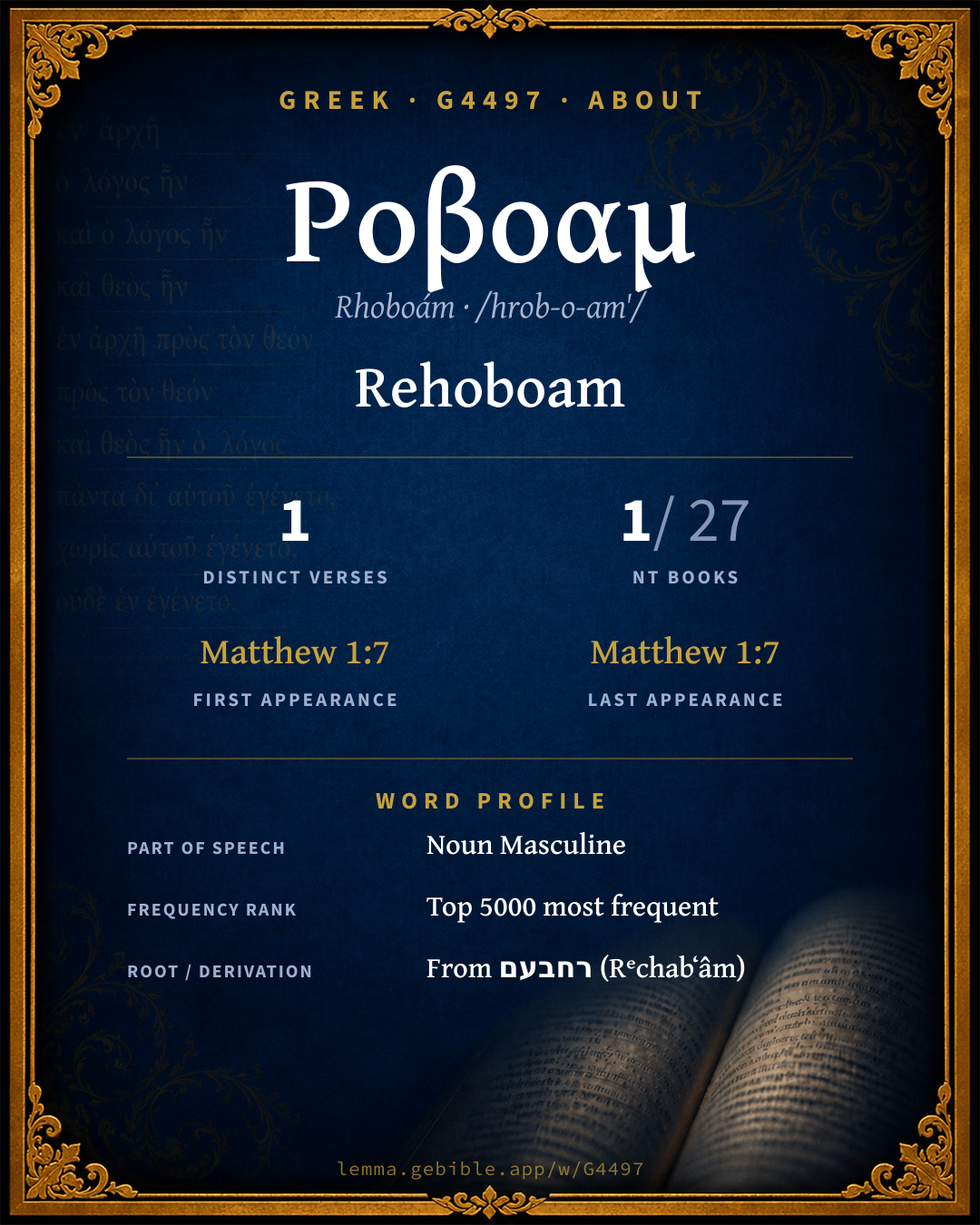
Ῥοβοάμ
Rehoboam
Thayer's lists 2 entries for ‘Rehoboam’ fuller range ↓
Full lexicon entry — Thayer's Greek Lexicon
From Thayer's Greek Lexicon
Where this word appears
Every verse where G4497 appears — 1 distinct verse across 1 book. Click any verse to open its interlinear word-by-word view. Verse text shown in the World English Bible for context — . Each verse’s Greek form is shown with its reference; the English is not keyword-highlighted, since the data carries no word-level English alignment. Use “Compare translations” on any verse to read it across multiple English versions. This concordance covers the Greek New Testament; Septuagint (Greek Old Testament) occurrences of this word are not indexed here.
Matthew 1 verse
About this entry
At a glance — auto-summarized from this page’s data, not written by a person. Every figure links to its source below. This summary describes the numbers; it doesn’t interpret them.
At its core, Ροβοαμ (Rhoboám) means “Rehoboam.” With only 1 verse it sits in the long tail of Greek New Testament vocabulary. Its uses cluster heavily in Matthew (100% of all occurrences). A true hapax — its single appearance is Matthew 1:7. Each statement above links to its evidence; the full detail follows below.
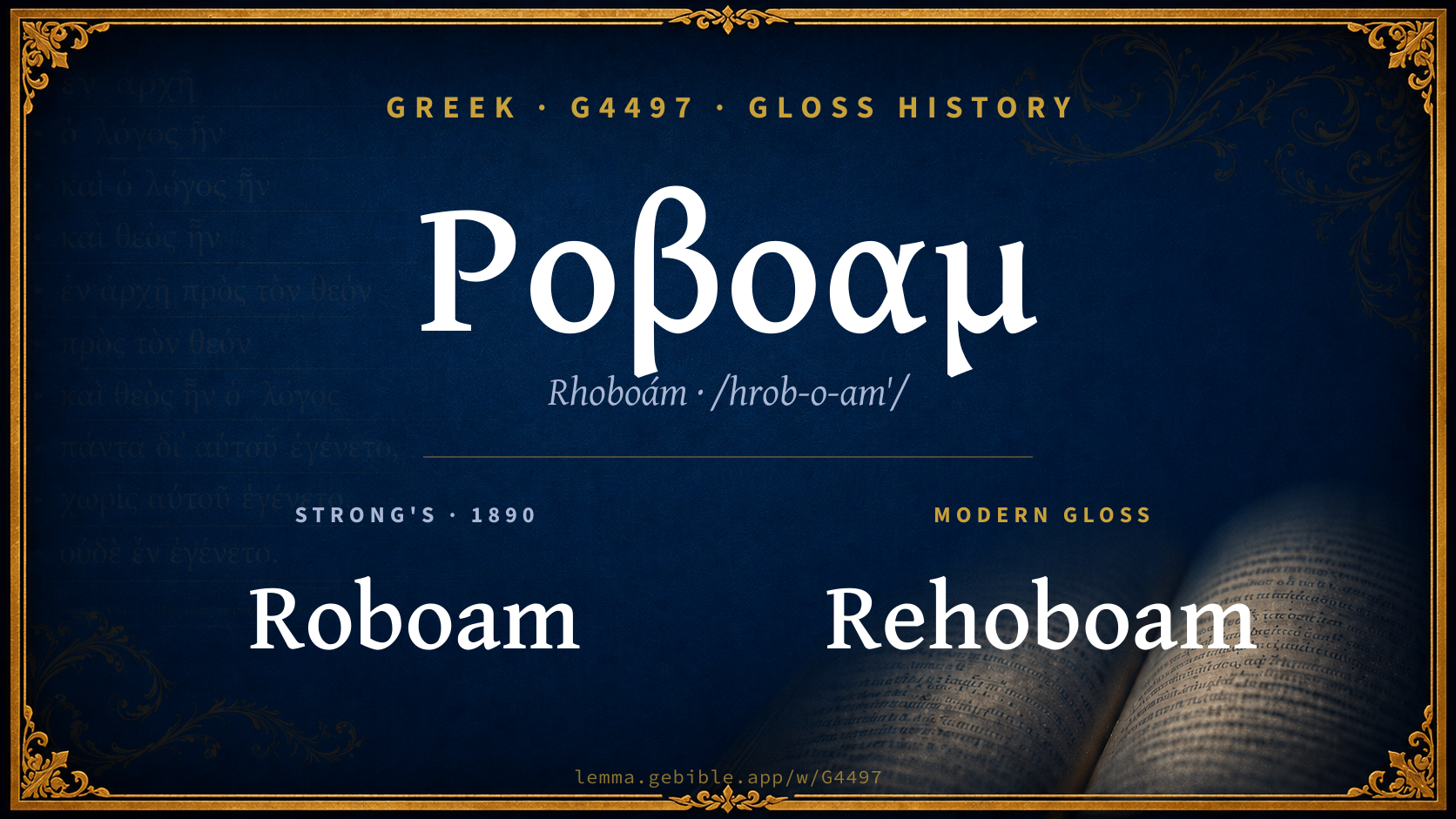
Gloss history
Strong's 1890 vs modern scholarship
About this word
Strong's G4497 catalogs a Greek word from the Greek New Testament.
These counts are not copied from any lexicon or concordance. They are computed here, from the morphology-tagged Greek New Testament. What Lemma adds →
- 1
- distinct verses
- The word appears in 1 distinct verse.
- 1 / 27
- NT books
- The word appears in 1 of 27 New Testament books.
- #2,678
- by frequency
- Top 5000 most frequent Greek words (rank 2,678 of 5,347 Greek words by occurrence).
View all 1 occurrence in the concordance →
Most concentrated in
- Matthew 1 verse 100%
By section of the New Testament
By traditional corpus
Conventional, traditional groupings — biblical authorship is debated, so this is a traditional corpus grouping, not an authorship claim. Some books belong to more than one corpus (Luke is in both the Gospels and the Lukan corpus, and so on), so these shares overlap and need not total 100%. Each figure is a share of the word’s 1 distinct verse.
- Gospels 1 verse · 100%
How translations render this word
Counts come from each version’s own published word-to-Strong’s tagging or interlinear alignment — an approximate guide to how each version renders this word, not a word-level alignment the data otherwise carries. Because each total is that version’s own tagged count, the per-version totals vary from one another and need not match the appearance or distinct-verse counts above. These counts may also differ from a printed concordance because Lemma counts each distinctly tagged rendering and does not collapse phrase taggings into a single head-word total. This is a fixed set of word-tagged versions (KJV, ASV, BSB, ULT) and does not change with the reading translation you choose elsewhere. Each version’s license is shown beside its name below (and on Sources).
- King James Version: Roboam 2×
- American Standard Version: Rehoboam 2×
- Berean Standard Bible: Rehoboam 2×
- unfoldingWord Literal Text: Rehoboam 2×
King James Version Public Domain
Renders G4497 across 2 tagged occurrences — most commonly:
American Standard Version Public Domain
Renders G4497 across 2 tagged occurrences — most commonly:
Berean Standard Bible Public Domain
Renders G4497 across 2 tagged occurrences — most commonly:
unfoldingWord Literal Text CC BY-SA 4.0
Renders G4497 across 2 tagged occurrences — most commonly:
Senses in Thayer's
The 2 senses Thayer's distinguishes for this word, in lexicon order (not ranked by frequency or importance). The full entry — with sub-senses — is in the Lexicon Entry tab.
- Rehoboam = "enlarger of the people"
- the son of Solomon by an Ammonite princess Naamah
Word origin
Derived from רחבעם (Rᵉchabʻâm) (H7346) — Rehoboam.
Of hebrew origin [ H7346 ]; Roboam (that is Rechabam ) an Israelite : - Roboam.
— Strong’s Exhaustive Concordance (1890), public domain.
Forms in the corpus
The 2 distinct written forms G4497 takes in the Greek New Testament, most frequent first — each parse links to that case’s occurrences in the concordance.
| Form | Parsing | Example | Uses |
|---|---|---|---|
| Ῥοβοάμ Rhoboám | Noun, Proper, indeclinable | Matthew 1:7 | 1 |
| Ῥοβοὰμ Rhoboàm | Noun, Proper, indeclinable | Matthew 1:7 | 1 |
Bible dictionary
Public-domain dictionary articles matched to this entry by name (Rehoboam). A biblical name can be shared by more than one person or place, so an article may treat several.
Easton's Bible Dictionary · M. G. Easton, 1897
He enlarges the people, the successor of Solomon on the throne, and apparently his only son. He was the son of Naamah "the Ammonitess," some well-known Ammonitish princess (1 Kings 14:21; 2 Chr. 12:13). He was forty-one years old when he ascended the throne, and he reigned seventeen years (B.C. 975-958). Although he was acknowledged at once as the rightful heir to the throne, yet there was a strongly-felt desire to modify the character of the government. The burden of taxation to which they had been subjected during Solomon's reign was very oppressive, and therefore the people assembled at Shechem and demanded from the king an alleviation of their burdens. He went to meet them at Shechem, and heard their demands for relief (1 Kings 12:4). After three days, having consulted with a younger generation of courtiers that had grown up around him, instead of following the advice of elders, he answered the people haughtily (6-15). "The king hearkened not unto the people; for the cause was from the Lord" (comp. 11:31). This brought matters speedily to a crisis. The terrible cry was heard (comp. 2 Sam. 20:1):
"What portion have we in David? Neither have we inheritance in the son of Jesse: To your tents, O Israel: Now see to thine own house, David" (1 Kings 12:16).
And now at once the kingdom was rent in twain. Rehoboam was appalled, and tried concessions, but it was too late (18). The tribe of Judah, Rehoboam's own tribe, alone remained faithful to him. Benjamin was reckoned along with Judah, and these two tribes formed the southern kingdom, with Jerusalem as its capital; while the northern ten tribes formed themselves into a separate kingdom, choosing Jeroboam as their king. Rehoboam tried to win back the revolted ten tribes by making war against them, but he was prevented by the prophet Shemaiah (21-24; 2 Chr. 11:1-4) from fulfilling his purpose. (See JEROBOAM.)
In the fifth year of Rehoboam's reign, Shishak (q.v.), one of the kings of Egypt of the Assyrian dynasty, stirred up, no doubt, by Jeroboam his son-in-law, made war against him. Jerusalem submitted to the invader, who plundered the temple and virtually reduced the kingdom to the position of a vassal of Egypt (1 Kings 14:25, 26; 2 Chr. 12:5-9). A remarkable memorial of this invasion has been discovered at Karnac, in Upper Egypt, in certain sculptures on the walls of a small temple there. These sculptures represent the king, Shishak, holding in his hand a train of prisoners and other figures, with the names of the captured towns of Judah, the towns which Rehoboam had fortified (2 Chr. 11:5-12).
The kingdom of Judah, under Rehoboam, sank more and more in moral and spiritual decay. "There was war between Rehoboam and Jeroboam all their days." At length, in the fifty-eighth year of his age, Rehoboam "slept with his fathers, and was buried with his fathers in the city of David" (1 Kings 14:31). He was succeeded by his son Abijah. (See EGYPT.)
Smith's Bible Dictionary · William Smith, 1863
(enlarger of the people), son of Solomon by the Ammonite princess Naamah, (1 Kings 14:21,31) and his successor. (1 Kings 11:43) Rehoboam selected Shechem as the place of his coronation (B.C. 975), probably as an act of concession to the Ephraimites. The people demanded a remission of the severe burdens imposed by Solomon, and Rehoboam, rejecting the advice of his father's counsellors, followed that of his young courtiers, and returned an insulting answer, which led to an open rebellion among the tribes, and he was compelled to fly to Jerusalem, Judah and Benjamin alone remaining true to him. Jeroboam was made king of the northern tribes. [Jeroboam] An expedition to reconquer Israel was forbidden by the prophet Shemaiah, (1 Kings 12:21) still during Rehoboam's lifetime peaceful relations between Israel and Judah were never restored. (2 Chronicles 12:15; 1 Kings 14:30) In the fifth year of Rehoboam's reign the country was invaded by a host of Egyptians and other African nations under Shishak. Jerusalem itself was taken and Rehoboam had to purchase an ignominious peace by delivering up the treasures with which Solomon had adorned the temple and palace. The rest of Rehoboam's life was unmarked by any events of importance. He died B.C. 958, after a reign of 17 years, having ascended the throne B.C. 975, at the age of 41. (1 Kings 14:21; 2 Chronicles 12:13) He had 18 wives, 60 concubines, 28 sons and 60 daughters.
Hitchcock's Bible Names Dictionary · Roswell D. Hitchcock, 1869
who sets the people at liberty
Classic public-domain reference works; full attribution on Sources.
Septuagint usage
The same Greek word Ροβοαμ appears 61 times in the Greek Old Testament (Septuagint), across 44 verses in 4 books.
- 61
- LXX occurrences
- Tagged occurrences of this Greek word in the Septuagint.
- 44
- verses
- Distinct Septuagint verses containing this word.
- 4 / 39
- OT books
- The word appears in 4 of the 39 Old Testament books.
Sample Septuagint occurrences
- 2 Samuel 8:7 ροβοαμ
- 1 Kings 11:43 ροβοαμ
- 1 Chronicles 3:10 ροβοαμ
- 2 Chronicles 9:31 ροβοαμ
Septuagint occurrences (same lexeme)
Every verse where the same Strong’s number (G4497) appears in the Greek Septuagint. Verse text shown in the World English Bible for context; the Greek form is the matched word — the English is not keyword-highlighted.
- 2 Samuel 8:7 ροβοαμ David took the shields of gold that were on the servants of Hadadezer, and brought them to Jerusalem.
- 2 Samuel 14:27 ροβοαμ To Absalom there were born three sons, and one daughter, whose name was Tamar: she was a woman of a beautiful face.
- 1 Kings 11:43 ροβοαμ Solomon slept with his fathers, and was buried in the city of David his father: and Rehoboam his son reigned in his place.
- 1 Kings 12:1 ροβοαμ Rehoboam went to Shechem: for all Israel were come to Shechem to make him king.
- 1 Kings 12:3 ροβοαμ and they sent and called him), that Jeroboam and all the assembly of Israel came, and spoke to Rehoboam, saying,
- 1 Kings 12:12 ροβοαμ So Jeroboam and all the people came to Rehoboam the third day, as the king bade, saying, Come to me again the third day.
- 1 Kings 12:13 ροβοαμ The king answered the people roughly, and forsook the counsel of the old men which they had given him,
- 1 Kings 12:18 ροβοαμ Then king Rehoboam sent Adoram, who was over the men subject to forced labor; and all Israel stoned him to death with stones. King Rehoboam made speed to get him up to his chariot, to flee to Jerusalem.
- 1 Kings 12:21 ροβοαμ When Rehoboam was come to Jerusalem, he assembled all the house of Judah, and the tribe of Benjamin, a hundred and eighty thousand chosen men, who were warriors, to fight against the house of Israel, to bring the kingdom again to Rehoboam the son of Solomon.
- 1 Kings 12:23 ροβοαμ Speak to Rehoboam the son of Solomon, king of Judah, and to all the house of Judah and Benjamin, and to the rest of the people, saying,
- 1 Kings 12:24 ροβοαμ Thus says Yahweh, You shall not go up, nor fight against your brothers the children of Israel: return every man to his house; for this thing is of me. So they listened to the word of Yahweh, and returned and went their way, according to the word of Yahweh.
- 1 Kings 12:27 ροβοαμ if this people go up to offer sacrifices in the house of Yahweh at Jerusalem, then will the heart of this people turn again to their lord, even to Rehoboam king of Judah; and they will kill me, and return to Rehoboam king of Judah.
- 1 Kings 14:1 ροβοαμ At that time Abijah the son of Jeroboam fell sick.
- 1 Kings 14:2 ροβοαμ Jeroboam said to his wife, Please get up and disguise yourself, that you not be known to be the wife of Jeroboam; and get you to Shiloh: behold, there is Ahijah the prophet, who spoke concerning me that I should be king over this people.
- 1 Kings 14:5 ροβοαμ Yahweh said to Ahijah, Behold, the wife of Jeroboam comes to inquire of you concerning her son; for he is sick: thus and thus shall you tell her; for it will be, when she comes in, that she will feign herself to be another woman.
- 1 Kings 14:7 ροβοαμ Go, tell Jeroboam, Thus says Yahweh, the God of Israel: Because I exalted you from among the people, and made you prince over my people Israel,
- 1 Kings 14:9 ροβοαμ but have done evil above all who were before you, and have gone and made you other gods, and molten images, to provoke me to anger, and have cast me behind your back:
- 1 Kings 14:10 ροβοαμ therefore, behold, I will bring evil on the house of Jeroboam, and will cut off from Jeroboam every man-child, him who is shut up and him who is left at large in Israel, and will utterly sweep away the house of Jeroboam, as a man sweeps away dung, until it be all gone.
- 1 Kings 14:11 ροβοαμ Him who dies of Jeroboam in the city shall the dogs eat; and him who dies in the field shall the birds of the sky eat: for Yahweh has spoken it.
- 1 Kings 15:1 ροβοαμ Now in the eighteenth year of king Jeroboam the son of Nebat began Abijam to reign over Judah.
- 1 Chronicles 3:10 ροβοαμ Solomon's son was Rehoboam, Abijah his son, Asa his son, Jehoshaphat his son,
- 2 Chronicles 9:31 ροβοαμ Solomon slept with his fathers, and he was buried in the city of David his father: and Rehoboam his son reigned in his place.
- 2 Chronicles 10:1 ροβοαμ Rehoboam went to Shechem; for all Israel were come to Shechem to make him king.
- 2 Chronicles 10:3 ροβοαμ They sent and called him; and Jeroboam and all Israel came, and they spoke to Rehoboam, saying,
- 2 Chronicles 10:6 ροβοαμ King Rehoboam took counsel with the old men, who had stood before Solomon his father while he yet lived, saying, What counsel give you me to return answer to this people?
- 2 Chronicles 10:12 ροβοαμ So Jeroboam and all the people came to Rehoboam the third day, as the king bade, saying, Come to me again the third day.
- 2 Chronicles 10:13 ροβοαμ The king answered them roughly; and king Rehoboam forsook the counsel of the old men,
- 2 Chronicles 10:17 ροβοαμ But as for the children of Israel who lived in the cities of Judah, Rehoboam reigned over them.
- 2 Chronicles 10:18 ροβοαμ Then king Rehoboam sent Hadoram, who was over the men subject to forced labor; and the children of Israel stoned him to death with stones. King Rehoboam made speed to get him up to his chariot, to flee to Jerusalem.
- 2 Chronicles 11:1 ροβοαμ When Rehoboam was come to Jerusalem, he assembled the house of Judah and Benjamin, one hundred eighty thousand chosen men, who were warriors, to fight against Israel, to bring the kingdom again to Rehoboam.
- 2 Chronicles 11:3 ροβοαμ Speak to Rehoboam the son of Solomon, king of Judah, and to all Israel in Judah and Benjamin, saying,
- 2 Chronicles 11:5 ροβοαμ Rehoboam lived in Jerusalem, and built cities for defense in Judah.
- 2 Chronicles 11:17 ροβοαμ So they strengthened the kingdom of Judah, and made Rehoboam the son of Solomon strong, three years; for they walked three years in the way of David and Solomon.
- 2 Chronicles 11:18 ροβοαμ Rehoboam took him a wife, Mahalath the daughter of Jerimoth the son of David, [and of] Abihail the daughter of Eliab the son of Jesse;
- 2 Chronicles 11:21 ροβοαμ Rehoboam loved Maacah the daughter of Absalom above all his wives and his concubines: (for he took eighteen wives, and sixty concubines, and became the father of twenty-eight sons and sixty daughters.)
- 2 Chronicles 11:22 ροβοαμ Rehoboam appointed Abijah the son of Maacah to be chief, [even] the prince among his brothers; for [he was minded] to make him king.
- 2 Chronicles 12:1 ροβοαμ It happened, when the kingdom of Rehoboam was established, and he was strong, that he forsook the law of Yahweh, and all Israel with him.
- 2 Chronicles 12:2 ροβοαμ It happened in the fifth year of king Rehoboam, that Shishak king of Egypt came up against Jerusalem, because they had trespassed against Yahweh,
- 2 Chronicles 12:5 ροβοαμ Now Shemaiah the prophet came to Rehoboam, and to the princes of Judah, who were gathered together to Jerusalem because of Shishak, and said to them, Thus says Yahweh, You have forsaken me, therefore have I also left you in the hand of Shishak.
- 2 Chronicles 12:10 ροβοαμ King Rehoboam made in their place shields of brass, and committed them to the hands of the captains of the guard, who kept the door of the king's house.
- 2 Chronicles 12:13 ροβοαμ So king Rehoboam strengthened himself in Jerusalem, and reigned: for Rehoboam was forty-one years old when he began to reign, and he reigned seventeen years in Jerusalem, the city which Yahweh had chosen out of all the tribes of Israel, to put his name there: and his mother's name was Naamah the Ammonitess.
- 2 Chronicles 12:15 ροβοαμ Now the acts of Rehoboam, first and last, aren't they written in the histories of Shemaiah the prophet and of Iddo the seer, after the manner of genealogies? There were wars between Rehoboam and Jeroboam continually.
- 2 Chronicles 12:16 ροβοαμ Rehoboam slept with his fathers, and was buried in the city of David: and Abijah his son reigned in his place.
- 2 Chronicles 13:7 ροβοαμ There were gathered to him worthless men, base fellows, who strengthened themselves against Rehoboam the son of Solomon, when Rehoboam was young and tender-hearted, and could not withstand them.
These are occurrences of the same Greek lexeme (G4497) in the Septuagint — not a translation of any one Hebrew word. The store carries no word-level Hebrew↔Greek alignment, so no Hebrew original is asserted here. Counts come from the recovered LXX Strong's tagging — high-frequency vocabulary is well covered, while rare or late forms may be untagged — so they reflect tagged occurrences and may slightly undercount.