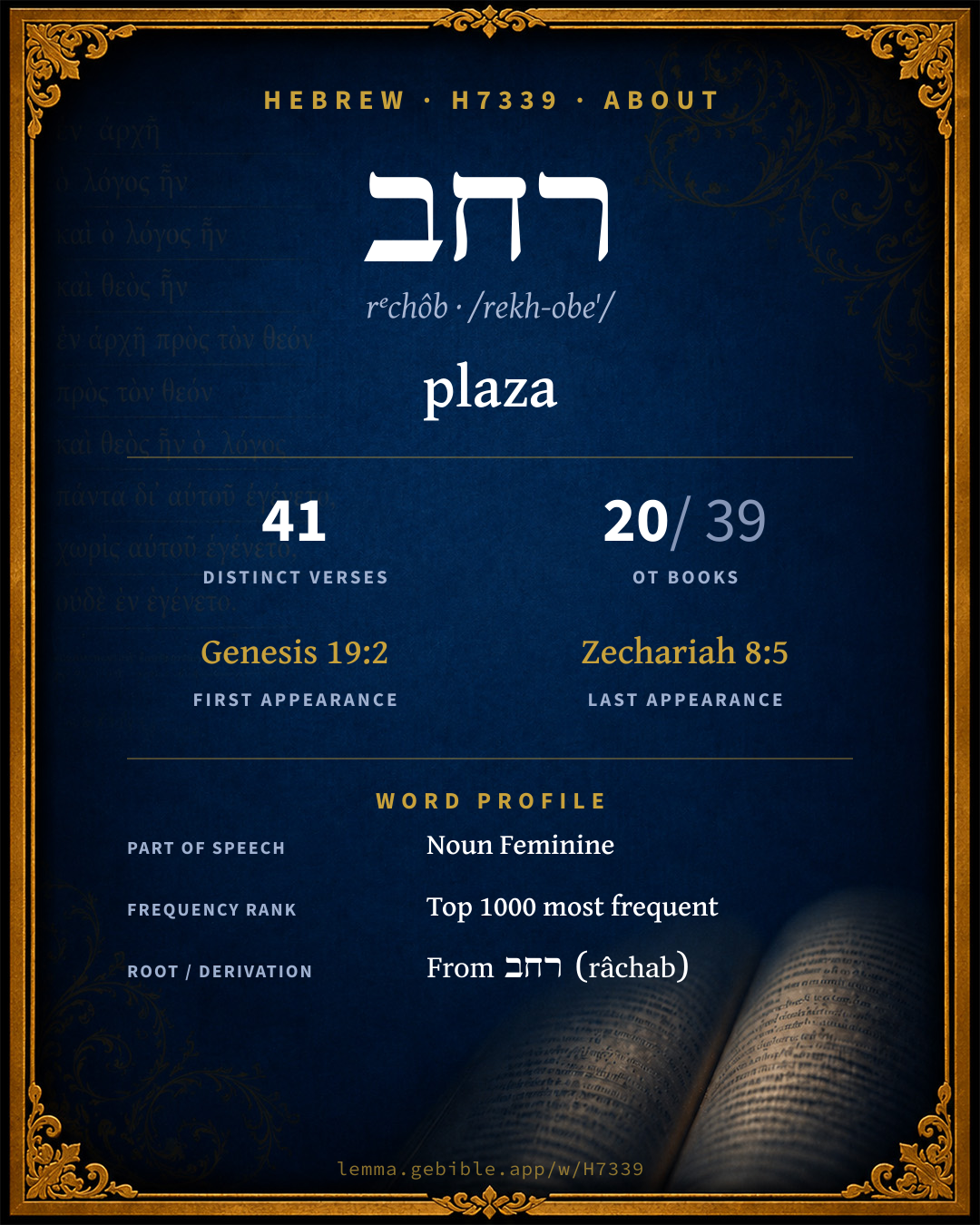
רְחוֹב
plaza
Full lexicon entry — Brown-Driver-Briggs (BDB)
From Brown-Driver-Briggs (BDB)
Where this word appears
See every Construct-state word in the Hebrew Bible →
Grammar key — what these labels mean
Part of speech
- Noun
- A naming word — a person, place, thing, or idea.
Noun type
- Common
- A common noun — a general class of person, place, or thing (“king,” “city,” “water”), not a specific name.
State
- Construct
- A noun bound to a following noun in a possessive / “of” relationship (the construct chain).
- Absolute
- The independent form of a noun, not bound to a following word.
Gender
- Feminine
- Grammatically feminine.
Number
- Singular
- One.
- Plural
- More than one (in Hebrew, generally three or more).
Grammatical forms
- Noun, Common, Feminine, Singular, Construct 13 times (30%)
- Noun, Common, Feminine, Plural, Construct 12 times (28%)
- Noun, Common, Feminine, Plural, Absolute 9 times (21%)
- Noun, Common, Feminine, Singular, Absolute 9 times (21%)
Parsed forms decoded from the imported morphology (morphhb / Westminster Leningrad Codex — WLC text public domain, morphhb tagging CC BY 4.0), counted across 43 parsed occurrences — not distinct verses.
Every verse where H7339 appears — 41 distinct verses across 20 books. Click any verse to open its interlinear word-by-word view. Verse text shown in the World English Bible for context — . Each verse’s Hebrew form is shown with its reference; the English is not keyword-highlighted, since the data carries no word-level English alignment. Use “Compare translations” on any verse to read it across multiple English versions. This concordance covers the Hebrew Bible; Septuagint (Greek Old Testament) occurrences are not indexed here.
Genesis 1 verse
Deuteronomy 1 verse
Judges 3 verses
- Judges 19:15 בִּ/רְח֣וֹב prep + n c fs cs They turned aside there, to go in to lodge in Gibeah: and he went in, and sat him down in the street of the city; for there was no man who took them into his house to lodge.
- Judges 19:17 בִּ/רְחֹ֣ב prep + n c fs cs He lifted up his eyes, and saw the wayfaring man in the street of the city; and the old man said, Where go you? and whence come you?
- Judges 19:20 בָּ/רְח֖וֹב prep det + n c fs The old man said, Peace be to you; howsoever let all your wants lie on me; only don't lodge in the street.
2 Samuel 1 verse
2 Chronicles 2 verses
- 2 Chronicles 29:4 לִ/רְח֥וֹב prep + n c fs cs He brought in the priests and the Levites, and gathered them together into the broad place on the east,
- 2 Chronicles 32:6 רְחוֹב֙ n c fs cs He set captains of war over the people, and gathered them together to him in the broad place at the gate of the city, and spoke comfortably to them, saying,
Ezra 1 verse
Nehemiah 3 verses
- Nehemiah 8:1 הָ֣/רְח֔וֹב ptcl def.art + n c fs All the people gathered themselves together as one man into the broad place that was before the water gate; and they spoke to Ezra the scribe to bring the book of the law of Moses, which Yahweh had commanded to Israel.
- Nehemiah 8:3 הָ/רְח֜וֹב ptcl def.art + n c fs He read therein before the broad place that was before the water gate from early morning until midday, in the presence of the men and the women, and of those who could understand; and the ears of all the people were [attentive] to the book of the law.
- Nehemiah 8:16 וּ/בִ/רְחוֹב֙ וּ/בִ/רְח֖וֹב conj + prep + n c fs cs conj + prep + n c fs cs So the people went forth, and brought them, and made themselves booths, everyone on the roof of his house, and in their courts, and in the courts of the house of God, and in the broad place of the water gate, and in the broad place of the gate of Ephraim.
Esther 3 verses
- Esther 4:6 רְח֣וֹב n c fs cs So Hathach went forth to Mordecai to the broad place of the city, which was before the king's gate.
- Esther 6:9 בִּ/רְח֣וֹב prep + n c fs cs and let the clothing and the horse be delivered to the hand of one of the king's most noble princes, that they may array the man therewith whom the king delights to honor, and cause him to ride on horseback through the street of the city, and proclaim before him, Thus shall it be done to the man whom the king delights to honor.
- Esther 6:11 בִּ/רְח֣וֹב prep + n c fs cs Then took Haman the clothing and the horse, and arrayed Mordecai, and caused him to ride through the street of the city, and proclaimed before him, Thus shall it be done to the man whom the king delights to honor.
Job 1 verse
Psalms 2 verses
- Psalms 55:11 מֵ֝/רְחֹבָ֗/הּ prep + n c fs cs + sfx pers 3fs Destructive forces are within her. Threats and lies don't depart from her streets.
- Psalms 144:14 בִּ/רְחֹבֹתֵֽי/נוּ prep + n c fp cs + sfx pers 1cp Our oxen will pull heavy loads. There is no breaking in, and no going away, And no outcry in our streets.
Proverbs 5 verses
- Proverbs 1:20 בָּ֝/רְחֹב֗וֹת prep det + n c fp Wisdom calls aloud in the street. She utters her voice in the public squares.
- Proverbs 5:16 בָּ֝/רְחֹב֗וֹת prep det + n c fp Should your springs overflow in the streets, Streams of water in the public squares?
- Proverbs 7:12 בָּ/רְחֹב֑וֹת prep det + n c fp Now she is in the streets, now in the squares, And lurking at every corner.
- Proverbs 22:13 רְ֝חֹב֗וֹת n c fp The sluggard says, "There is a lion outside! I will be killed in the streets!"
- Proverbs 26:13 הָ/רְחֹבֽוֹת ptcl def.art + n c fp The sluggard says, "There is a lion in the road! A fierce lion roams the streets!"
Song of Solomon 1 verse
Isaiah 2 verses
- Isaiah 15:3 וּ/בִ/רְחֹבֹתֶ֛י/הָ conj + prep + n c fp cs + sfx pers 3fs In their streets they gird themselves with sackcloth; on their housetops, and in their broad places, everyone wails, weeping abundantly.
- Isaiah 59:14 בָֽ/רְחוֹב֙ prep det + n c fs Justice is turned away backward, and righteousness stands afar off; for truth is fallen in the street, and uprightness can't enter.
Jeremiah 5 verses
- Jeremiah 5:1 בִ/רְחוֹבוֹתֶ֔י/הָ prep + n c fp cs + sfx pers 3fs Run you back and forth through the streets of Jerusalem, and see now, and know, and seek in the broad places of it, if you can find a man, if there are any who does justly, who seeks truth; and I will pardon her.
- Jeremiah 9:21 מֵ/רְחֹבֽוֹת prep + n c fp For death is come up into our windows, it is entered into our palaces; to cut off the children from outside, [and] the young men from the streets.
- Jeremiah 48:38 וּ/בִ/רְחֹבֹתֶ֖י/הָ conj + prep + n c fp cs + sfx pers 3fs On all the housetops of Moab and in the streets of it there is lamentation every where; for I have broken Moab like a vessel in which none delights, says Yahweh.
- Jeremiah 49:26 בִּ/רְחֹבֹתֶ֑י/הָ prep + n c fp cs + sfx pers 3fs Therefore her young men shall fall in her streets, and all the men of war shall be brought to silence in that day, says Yahweh of Hosts.
- Jeremiah 50:30 בִּ/רְחֹבֹתֶ֑י/הָ prep + n c fp cs + sfx pers 3fs Therefore shall her young men fall in her streets, and all her men of war shall be brought to silence in that day, says Yahweh.
Lamentations 3 verses
- Lamentations 2:11 בִּ/רְחֹב֖וֹת prep + n c fp cs My eyes do fail with tears, my heart is troubled; My liver is poured on the earth, because of the destruction of the daughter of my people, Because the young children and the infants swoon in the streets of the city.
- Lamentations 2:12 בִּ/רְחֹב֣וֹת prep + n c fp cs They tell their mothers, Where is grain and wine? When they swoon as the wounded in the streets of the city, When their soul is poured out into their mothers' bosom.
- Lamentations 4:18 בִּ/רְחֹבֹתֵ֑י/נוּ prep + n c fp cs + sfx pers 1cp They hunt our steps, so that we can't go in our streets: Our end is near, our days are fulfilled; for our end is come.
Ezekiel 2 verses
- Ezekiel 16:24 רְחֽוֹב n c fs that you have built to you a vaulted place, and have made you a lofty place in every street.
- Ezekiel 16:31 רְח֑וֹב n c fs in that you build your vaulted place at the head of every way, and make your lofty place in every street, and have not been as a prostitute, in that you scorn pay.
Daniel 1 verse
Amos 1 verse
Nahum 1 verse
Zechariah 2 verses
- Zechariah 8:4 בִּ/רְחֹב֖וֹת prep + n c fp cs Thus says Yahweh of Hosts: "Old men and old women will again dwell in the streets of Jerusalem, every man with his staff in his hand for very age.
- Zechariah 8:5 וּ/רְחֹב֤וֹת בִּ/רְחֹֽבֹתֶֽי/הָ conj + n c fp cs prep + n c fp cs + sfx pers 3fs The streets of the city will be full of boys and girls playing in its streets."
About this entry
At a glance — auto-summarized from this page’s data, not written by a person. Every figure links to its source below. This summary describes the numbers; it doesn’t interpret them.
The Hebrew noun רחב centers on the idea of “plaza.” Translators differ — “street” in the King James Version, then “square” (Berean Standard Bible) and “open area of” (unfoldingWord Literal Text), as the renderings breakdown shows. It turns up in 41 verses across 20 books, a moderately common footprint. First canonically at Genesis 19:2, it enters the text early. It clusters with רחב, מרחב and רחב under a shared root. Dig into 41-verse concordance and the renderings breakdown below.
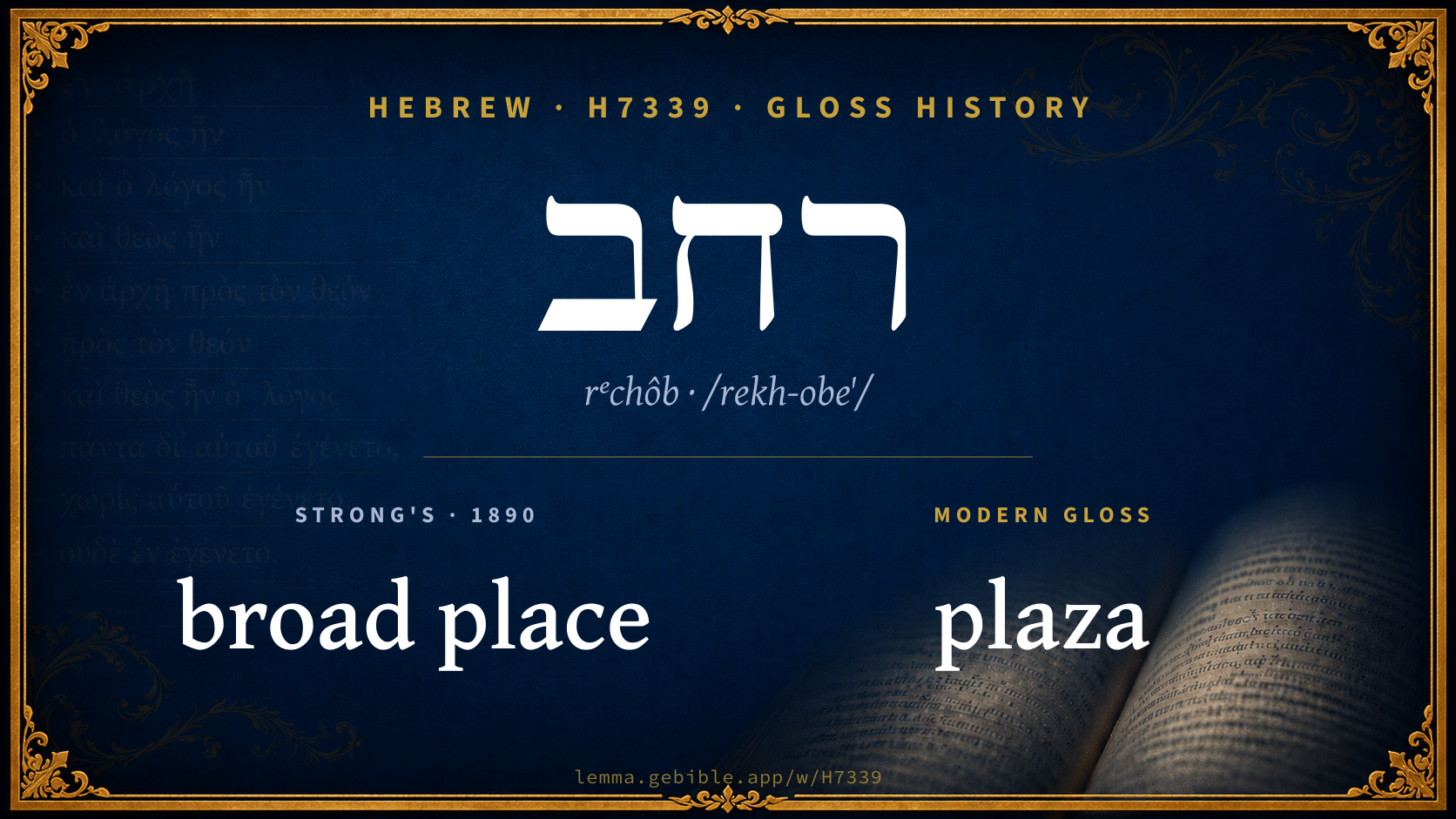
Gloss history
Strong's 1890 vs modern scholarship
About this word
Strong's H7339 catalogs a Hebrew word from the Hebrew Old Testament.
These counts are not copied from any lexicon or concordance. They are computed here, from the morphology-tagged Hebrew Old Testament. What Lemma adds →
- 41
- distinct verses
- The word appears in 41 distinct verses.
- 20 / 39
- OT books
- The word appears in 20 of 39 Old Testament books.
- #837
- by frequency
- Top 1000 most frequent Hebrew words (rank 837 of 8,640 Hebrew words by occurrence).
View all 41 occurrences in the concordance →
By section of the Old Testament
By traditional corpus
Conventional, traditional groupings — biblical authorship is debated, so this is a traditional corpus grouping, not an authorship claim. Each share is this word’s portion of its verses in that division of the Hebrew canon. Each figure is a share of the word’s 41 distinct verses.
- Writings (Ketuvim) 22 verses · 54%
- Prophets (Nevi'im) 17 verses · 41%
- Torah (Pentateuch) 2 verses · 5%
How translations render this word
Counts come from each version’s own published word-to-Strong’s tagging or interlinear alignment — an approximate guide to how each version renders this word, not a word-level alignment the data otherwise carries. Because each total is that version’s own tagged count, the per-version totals vary from one another and need not match the appearance or distinct-verse counts above. These counts may also differ from a printed concordance because Lemma counts each distinctly tagged rendering and does not collapse phrase taggings into a single head-word total. This is a fixed set of word-tagged versions (KJV, ASV, BSB, ULT) and does not change with the reading translation you choose elsewhere. Each version’s license is shown beside its name below (and on Sources).
BDB lists this Strong’s number as 2 distinct words (homographs). Each count above pools all of them and is not split by sense — see the Senses section below. A low-frequency rendering may belong to a different one of those words, not the primary meaning.
- King James Version†: Street 17×, Streets 16×, Broad ways 2×
- American Standard Version†: Streets 13×, Broad 10×, Street 7×
- Berean Standard Bible†: Square 13×, Streets 10×, Public square 7×
- unfoldingWord Literal Text†: Open area of 5×, Open areas 5×, Squares 5×
King James Version Public Domain
Renders H7339 across 43† tagged occurrences — most commonly:
Plus 4 renderings that appear only once — usually multi-word phrases or single function words the recovered tagging swept in, not distinct renderings.
American Standard Version Public Domain
Renders H7339 across 44† tagged occurrences — most commonly:
Plus 8 renderings that appear only once — usually multi-word phrases or single function words the recovered tagging swept in, not distinct renderings.
Berean Standard Bible Public Domain
Renders H7339 across 42† tagged occurrences — most commonly:
Plus 4 renderings that appear only once — usually multi-word phrases or single function words the recovered tagging swept in, not distinct renderings. Not rendered by a distinct English word in 1 further occurrence.
unfoldingWord Literal Text CC BY-SA 4.0
Renders H7339 across 40† tagged occurrences — most commonly:
Plus 10 renderings that appear only once — usually multi-word phrases or single function words the recovered tagging swept in, not distinct renderings.
Senses in the full BDB
What do BDB’s symbols mean?
BDB uses these scholarly abbreviations:
| Symbol | Meaning |
|---|---|
| 𝔊 | the Septuagint (the ancient Greek translation, LXX) |
| 𝔙 | the Vulgate (the Latin translation) |
| 𝔖 | the Syriac version (the Peshitta) |
| 𝔗 | the Targum (the Aramaic translation) |
| ψ | the Psalms |
| √ | root (the underlying root or stem) |
| ‖ | parallel passage (a synonymous or contrasted parallel) |
| † | the dagger: every passage where the word occurs is cited |
The 6 senses and sub-senses the full Brown-Driver-Briggs lexicon distinguishes for this word, in lexicon order (not ranked by frequency), with BDB’s own verbatim wording and sub-sense lettering. Shown in Hebrew script with BDB’s own scholarly abbreviations. The condensed entry is in the Lexicon Entry tab. See also the Forms in the corpus table below.
- 1. (cf. LagBN 56 f.) loc.:
- a. towards Hamath, רְחוֹב 2 S 10:8 (𝔊L Βαιθρααβ), רְחֹב Nu 13:21 (P); = בֵּית ר׳ q.v. p. 112 (also 𝔊 1 S 14:47 Βαιθεωρ, 𝔊L Βαιθροωβι). e.g. 2 Samuel 10:8
- b. רְחֹב in Asher: (1) Jos 19:28 (P); (2) [perhaps = (1)], v 30 (P), Ju 1:31, Levit. city Jos 21:31 (P) = 1 Ch 6:60; Egypt. Raḥubu, N. of Kishon, WMMAs. u. Eur. 153. e.g. Joshua 19:28
- 2. m.:
- a. Aramaic name, רְחֹב 2 S 8:3, 12. e.g. 2 Samuel 8:3
- b. post-exilic Levite, רְחוֹב Ne 10:12. e.g. Nehemiah 10:12
Senses from the full Brown-Driver-Briggs lexicon (Brown, Driver, Briggs; Oxford 1906 — public domain), digitized via Sefaria, supplemented by the OpenScriptures HebrewLexicon (CC BY 4.0). Full attribution on Sources.
Word origin
I. n.f. Dn 9:25 [not m. Zc 8:5 AlbrZAW xvi (1896), 51 cf. Ges§ 145 p, t, u] broad open place, plaza (LagBN 178 BaNB 142);—ר׳ abs. Gn 19:2 +, cstr. Ju 19:17 +, רְחֹב v 15; 2 S 21:12; sf. רְחֹבָהּ Dt 13:17 ψ 55:12; pl. abs. רְחֹבוֹת Am 5:16 +, cstr. id. Zc 8:4 + (v. also רְחֹבוֹת n.pr., infr.); sf. רְחֹבֹתֶיהָ Is 15:3 +, etc.;—broad open place in city (usually near gate, Ne 8:1, 3, 16(×2); 2 Ch 32:6; Jb 29:7; ‖ חוּץ Je 5:1 + 8 times, דֶּרֶךְ Pr 26:13, שְׁוָקִים Ct 3:2), for various private and public uses Gn 19:2 (J), Ju 19:15, 17, 20; Dt 13:17; 2 S 21:12; Je 5:1; Ez 16:24, 31; Ne 8:16(×2); Is 59:14 ψ 55:12; Jb 29:7, essential part of city Dn 9:25; for lamentations Am 5:16; Is 15:3; Je 48:38, ר׳ הָעִיר אֲשֶׁר לִפְנֵי שַׁעַר הַמֶּלֶךְ Est 4:6 (cf. v 1 f.), cf. Je 9:20; 49:26; 50:30; La 2:11, 12, ψ 144:14, assemblies 2 Ch 29:4; 32:6; Ezr 10:9 (ר׳ בֵּית הָא׳), Ne 8:1, 3, proclamations Est 6:9, 11, speeches Pr 1:20; social life Zc 8:4, 5(×2); La 4:18; Pr 5:16; 7:12, cf. 22:13; 26:13, Ct 3:2; ר׳ in Na 2:5 is appar. outside city (cf. Assyrian rêbit Ninâ, etc.).
II. n.pr. Πααβ, Ποωβ, etc.:
— Brown-Driver-Briggs (Oxford 1906, public domain), digitized via Sefaria, supplemented by the OpenScriptures HebrewLexicon (CC BY 4.0). See Sources.
Derived from רחב (râchab) (H7337) — to grow wide.
Jastrow Dictionary
A second Hebrew/Aramaic lexicon for comparison, covering Aramaic and post-biblical (Talmudic, Targumic, Midrashic) usage that the biblical-Hebrew BDB does not. Matched by lemma rather than by Strong’s number, so a lemma may carry more than one Jastrow headword (shown separately below), and the entries cover usage well beyond the Bible.
רָחָב I
- (b. h.) pr. n. f. Rahab, a woman of Jericho who received the Israelitish spies. Zeb. 116ᵃ, sq. Sot. 34ᵃ. Meg. 15ᵃ; Taan. 5ᵇ; a. fr.
רָחַב
- (b. h.) to be wide.
- 1. (neut. verb) (neut. verb) to widen, be broader; to extend. Lev. R. s. 31 היו מקטינות … ומַרְחִיבוֹת וכ׳ (the windows of the Temple) became narrow towards the inside and wider towards the outside, in order to send light forth to the world; Pesik. Ḳumi, p. 145ᵃ, sq. Sifré Deut. s. 1; Yalk. Zech. 575 מַרְחֶבֶת, v. infra. Yalk. Is. 302, v. פָּתָה.
- 2. to broaden, widen; (with דעת) to comfort, gratify. Ber. 57ᵇ שלשה מַרְחִיבִין דעתו וכ׳ three things give a man comfort: a nice dwelling &c.
- 3. to amplify. B. Bath. 61ᵇ, v. מֵצַר.
- to be enlarged, extend. Cant. R. to VII, 5 עתידה … מִתְרַחֶבֶת וכ׳ Jerusalem will be enlarged on all sides; Sifré l. c.; Yalk. Zech. l. c. מרחבת.
רָחָב II
- preced.) wide, broad. Midd. IV, 7 מה ארי צר … ור׳ מלפניו וכ׳ (not ורוחב) as the lion’s body is narrow behind and wide in front, so was the Temple &c.; a. fr.—נפש ר׳ (wide desire,) ambition, greed, opp. שפלה. Ab. V, 19; a. e.—יד ר׳, v. יָד.—Pl. רְחָבִים, רְחָבִין; רְחָבוֹת. Tanḥ. B’haʿăl. 5 שהיו ר׳ מבחוץ וכ׳ they (the Temple windows) were wide without &c., v. preced.; Tanḥ. T’tsav. 6; Num. R. s. 15, beg. Y. Sot. IX, 24ᵃ bot., v. צַר; a. fr.
רְחַב
- , esp. (with or sub. נפשא) ambitious, greedy. Targ. Prov. XXVIII, 25 גברא ר׳ (Bxt. ר׳ נפשא; Ms. רעיינא, read: רחב עיינא or רחב רעיינא).
רֹחַב
- preced. wds.) width. Midd. II, 6 אורך … על ר׳ וכ׳ one hundred and twenty-five cubits in length by eleven in width. Ib. IV, 1 ורָחְבּוֹ וכ׳ and its width was ten cubits. Tam. 29ᵇ; Shek. VIII, 5 ורָחְבָּהּ; a. fr.—Sifré Deut. 120 בר׳ יד with liberality.
A Dictionary of the Targumim, the Talmud Babli and Yerushalmi, and the Midrashic Literature (Marcus Jastrow; London, Luzac, 1903) — Public Domain. Digitized via Sefaria. Digitized via Sefaria. Full attribution on Sources.
Forms in the corpus
The 36 distinct written forms H7339 takes in the Hebrew Bible, most frequent first — each parse links to that state’s occurrences in the concordance. Hebrew forms include their vowel points and cantillation, so a single lemma takes many written forms.
Same root — word family
Other BDB entries built from the same root as H7339, grouped by Strong’s listed origin. These share a root / origin per the lexicon — not necessarily a shared meaning. Each links to that word’s own entry.
Derives from
Shares the same root
- מרחב merchâb H4800 wide place
- רחב rachab H7338 breadth
- רחב rôchab H7341 breadth
- רחב râchâb H7342 wide
Proper names from this root
People and places named from this root — a name, not an additional meaning of the word.
- רחביה Rᵉchabyâh H7345 Rehabiah
- רחבעם Rᵉchabʻâm H7346 Rehoboam
- רחב Rᵉchôb H7340 Rehob
- רחבות Rᵉchôbôwth H7344 Rehoboth
Compare all same-root words → Showing 4 of 10 — not the complete family. 4 of the same-root words are proper names (people or places). They share a root, not necessarily a meaning.
Septuagint verse parallels
This word appears in 34 verses that also exist in the Greek Old Testament (Septuagint), out of the 41 Hebrew verses it occurs in. You can read those verses in Greek by switching the Old Testament edition to the Septuagint.
Read these verses in the Septuagint
- Genesis 19:2
- Deuteronomy 13:16
- Judges 19:15
- 2 Samuel 21:12
- 2 Chronicles 29:4
- Ezra 10:9
- Esther 6:9
- Job 29:7
- Psalms 55:11
- Proverbs 1:20
- Song of Solomon 3:2
- Isaiah 15:3
This is a verse-level parallel only — the same verses exist in both the Hebrew and Greek Old Testaments. No word-level Hebrew↔Greek correspondence is claimed: the data carries no such alignment, so no Greek word is shown as this Hebrew word’s translation. Coverage is not total — the Septuagint omits the deuterocanon and renumbers the Psalms, so some Hebrew verses have no direct Greek parallel.