
2 Chronicles 10:18

Hebrew (Westminster Leningrad Codex) 2 Chronicles 10:18 appears in the Hebrew Old Testament. The text above is from the Westminster Leningrad Codex. Each word links to its Strong’s number, a concise gloss, and parsing drawn from the Open Scriptures Hebrew Bible morphology. Click any word for its full Brown-Driver-Briggs (BDB) entry.
Download image
Cite this verse

2 Chronicles 10:18 (World English Bible). Public Domain. Lemma interlinear Bible study tool, https://lemma.gebible.app/v/2-chronicles/10/18.

Show BibTeX & RIS
BibTeX
RIS
English Translation
Then king Rehoboam sent Hadoram, who was over the men subject to forced labor; and the children of Israel stoned him to death with stones. King Rehoboam made speed to get him up to his chariot, to flee to Jerusalem.
World English Bible · Public Domain
Download a study sheet

One document with this verse’s original text, its word-by-word gloss line, the meaning frame, cross-references with their text, attributed commentary, and full source and license credits — printable, and it pastes into notes with its structure intact.

This verse Autodidact and up

Study sheet (.html) Plain text (.txt)

A passage Seminary Student

Up to 50 verses in one chapter. A passage sheet keeps up to 6 commentary sources and 12 cross-references per verse, in the order this page ranks them, and says so on the sheet whenever that leaves anything out. Ask for a single verse and you get the Autodidact verse sheet above.

Everything on this page stays free to read, with no account — the sheet is a download of what is already on screen, not access to it.

Want to remove ads? Support Godless Engineer
Compare translations 3

The same verse in 3 English versions, stacked beneath the original-language interlinear above. Click any original word for its lexicon entry.

Each is an independent rendering of the whole verse — the interlinear is not word-aligned to these translations.

Highlighted words mark where these versions differ — a whole-verse word diff, not a word-by-word alignment.

  • World English Bible Public Domain
    Then king Rehoboam sent Hadoram, who was over the men subject to forced labor; and the children of Israel stoned him to death with stones. King Rehoboam made speed to get him up to his chariot, to flee to Jerusalem.
  • King James Version Public Domain
    Then king Rehoboam sent Hadoram that was over the tribute; and the children of Israel stoned him with stones, that he died. But king Rehoboam made speed to get him up to his chariot, to flee to Jerusalem.
  • unfoldingWord Literal Text CC BY-SA 4.0
    And King Rehoboam sent Hadoram, who was over the forced labor, but the sons of Israel stoned him with stones and he died. And King Rehoboam strengthened himself to go up in the chariot to flee to Jerusalem.

unfoldingWord Literal Text — © unfoldingWord, licensed CC BY-SA 4.0. Word-aligned USFM3 via Door43 (git.door43.org/unfoldingWord/en_ult).

Versions to compare (up to 4)

3 of 4 selected

Show all 18 translations

Every available English version of this verse, each an independent rendering of the whole verse.

  • World English Bible Public Domain
    Then king Rehoboam sent Hadoram, who was over the men subject to forced labor; and the children of Israel stoned him to death with stones. King Rehoboam made speed to get him up to his chariot, to flee to Jerusalem.
  • Berean Standard Bible Public Domain
    Then King Rehoboam sent out Hadoram, who was in charge of the forced labor, but the Israelites stoned him to death. And King Rehoboam mounted his chariot in haste and escaped to Jerusalem.
  • Majority Standard Bible Public Domain
    Then King Rehoboam sent out Hadoram, who was in charge of the forced labor, but the Israelites stoned him to death. And King Rehoboam mounted his chariot in haste and escaped to Jerusalem.
  • King James Version Public Domain
    Then king Rehoboam sent Hadoram that was over the tribute; and the children of Israel stoned him with stones, that he died. But king Rehoboam made speed to get him up to his chariot, to flee to Jerusalem.
  • American Standard Version (1901) Public Domain
    Then king Rehoboam sent Hadoram, who was over the men subject to taskwork; and the children of Israel stoned him to death with stones. And king Rehoboam made speed to get him up to his chariot, to flee to Jerusalem.
  • Revised Version (1885) Public Domain
    Then king Rehoboam sent Hadoram, who was over the levy; and the children of Israel stoned him with stones, that he died. And king Rehoboam made speed to get him up to his chariot, to flee to Jerusalem.
  • Geneva Bible (1599) Public Domain
    Then King Rehoboam sent Hadoram that was ouer the tribute, and the children of Israel stoned him with stones, that he died: then King Rehoboam made speede to get him vp to his charet, to flee to Ierusalem.
  • Douay-Rheims (1899) Public Domain
    And king Roboam sent Aduram, who was over the tributes, and the children of Israel stoned him, and he died: and king Roboam made haste to gee up into his chariot, and fled into Jerusalem.
  • Young's Literal Translation Public Domain
    And king Rehoboam sendeth Hadoram, who `is' over the tribute, and the sons of Israel cast at him stones, and he dieth; and king Rehoboam hath strengthened himself to go up into a chariot to flee to Jerusalem;
  • Literal Standard Version CC BY-SA 4.0
    And King Rehoboam sends Hadoram, who [is] over the tribute, and the sons of Israel cast stones at him, and he dies; and King Rehoboam has strengthened himself to go up into a chariot to flee to Jerusalem;
  • Unlocked Literal Bible CC BY-SA 4.0
    Then King Rehoboam sent Adoniram, who was over the forced laborers, but the people of Israel stoned him to death with stones. King Rehoboam fled quickly in his chariot to Jerusalem.
  • unfoldingWord Literal Text CC BY-SA 4.0
    And King Rehoboam sent Hadoram, who was over the forced labor, but the sons of Israel stoned him with stones and he died. And King Rehoboam strengthened himself to go up in the chariot to flee to Jerusalem.
  • Darby Bible Public Domain
    And king Rehoboam sent Hadoram, who was over the levy; but the children of Israel stoned him with stones, that he died. And king Rehoboam hastened to mount his chariot, to flee to Jerusalem.
  • World Messianic Bible Public Domain
    Then King Rehoboam sent Hadoram, who was over the men subject to forced labor; and the children of Israel stoned him to death with stones. King Rehoboam hurried to get himself up to his chariot, to flee to Jerusalem.
  • Webster's Bible Public Domain
    Then king Rehoboam sent Hadoram that was over the tribute; and the children of Israel stoned him with stones, that he died. But king Rehoboam made speed to get into his chariot, to flee to Jerusalem.
  • Free Bible Version CC BY-SA 4.0
    Then King Rehoboam sent out Hadoram, who was in charge of forced labor, but the Israelites stoned him to death. King Rehoboam quickly jumped into his chariot and raced back to Jerusalem.
  • Bible in Basic English Public Domain
    Then Rehoboam sent Adoniram, the overseer of the forced work; and he was stoned to death by all Israel. And King Rehoboam went quickly and got into his carriage to go in flight to Jerusalem.
  • JPS Tanakh (1917) Public Domain
    Then king Rehoboam sent Hadoram, who was over the levy; and the children of Israel stoned him with stones, so that he died. And king Rehoboam made speed to get him up to his chariot, to flee to Jerusalem.

Literal Standard Version (2020), Covenant Press — licensed CC BY-SA 4.0. Text via the HelloAO Bible API (eBible.org). Unlocked Literal Bible (unfoldingWord) — licensed CC BY-SA 4.0. Text via the HelloAO Bible API (eBible.org). unfoldingWord Literal Text — © unfoldingWord, licensed CC BY-SA 4.0. Word-aligned USFM3 via Door43 (git.door43.org/unfoldingWord/en_ult). Free Bible Version, Dr. Jonathan Gallagher — licensed CC BY-SA 4.0. Text via the HelloAO Bible API (eBible.org).

Word by word

More ways to search: Search by grammar → Find every occurrence → Compare this word →

Practice this passage: Drill this verse → Learn its vocabulary →

הֲדֹרָם֙
Hădôwrâm
H1913
“Hadoram”
Noun, Proper
Part of Speech
Noun
Type
Proper
Full BDB Definition

Origin: probably of foreign derivation

TWOT: None

Hadoram = "noble honour" - the 5th son of Joktan - a son of Tou, king of Hamath, was his father's ambassador to congratulate David on his victory over Hadarezer, king of Zobah - the intendant of taxes under David, Solomon, and Rehoboam; called also 'Adoniram' and 'Adoram'
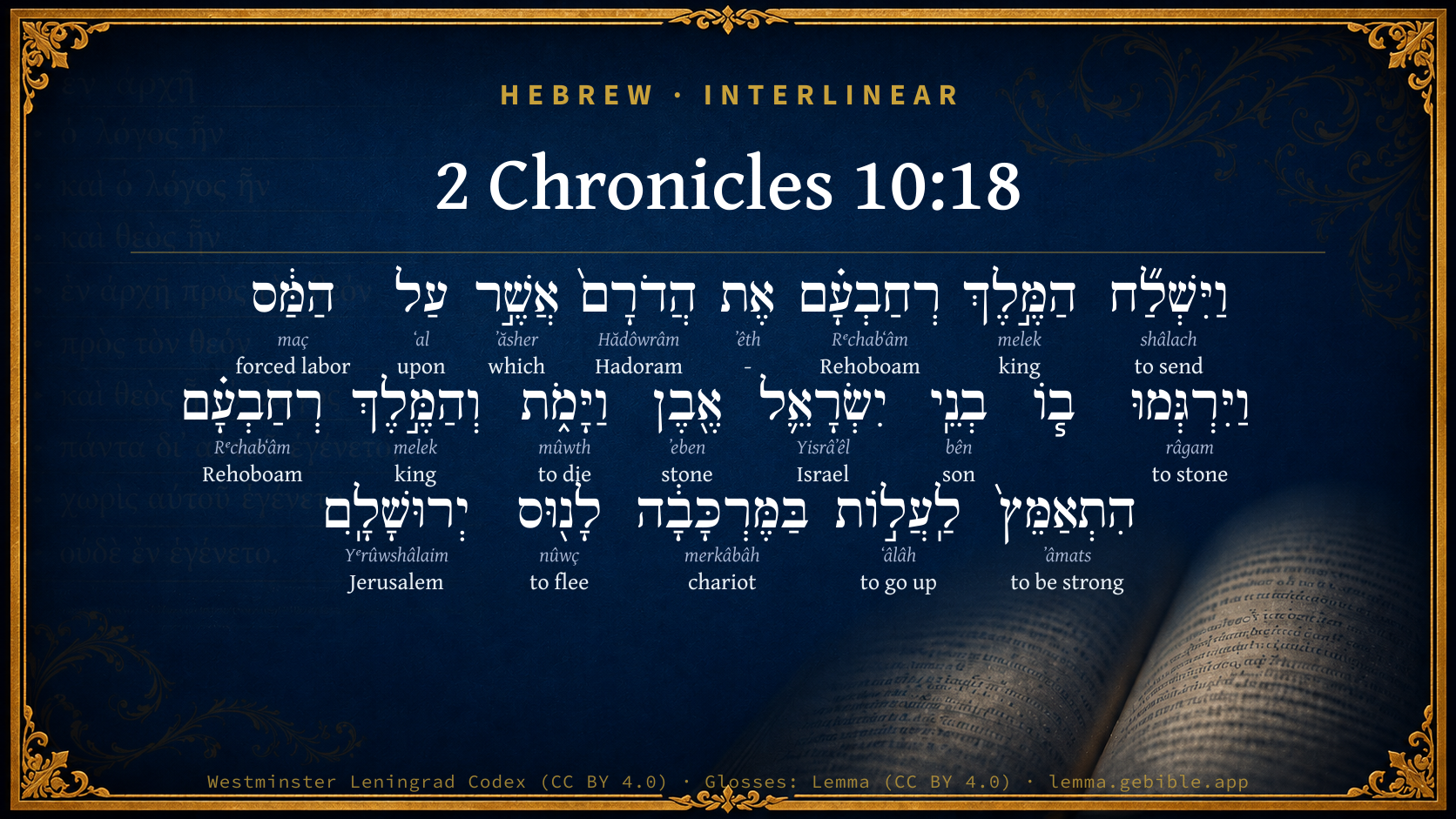
  1. וַיִּשְׁלַ֞ח shâlach H7971 “and · to send” Conjunction + Verb, Qal, Sequential Imperfect, 3rd Person, Masculine, Singular
  2. הַמֶּ֣לֶךְ melek H4428 “the · king” Particle, Definite Article + Noun, Common, Masculine, Singular, Absolute
  3. רְחַבְעָ֗ם Rᵉchabʻâm H7346 “Rehoboam” Noun, Proper
  4. אֶת ʼêth H853 “-” Particle, Direct Object
  5. אֲשֶׁ֣ר ʼăsher H834 “which” Particle, Relative
  6. עַל ʻal H5921 “upon” Preposition
  7. הַמַּ֔ס maç H4522 “the · forced labor” Particle, Definite Article + Noun, Common, Masculine, Singular, Absolute
  8. וַיִּרְגְּמוּ râgam H7275 “and · to stone” Conjunction + Verb, Qal, Sequential Imperfect, 3rd Person, Masculine, Plural
  9. בְנֵֽי bên H1121 “sons of” Noun, Common, Masculine, Plural, Construct
  10. יִשְׂרָאֵ֛ל Yisrâʼêl H3478 “Israel” Noun, Proper
  11. אֶ֖בֶן ʼeben H68 “stone” Noun, Common, Feminine, Singular, Absolute
  12. וַיָּמֹ֑ת mûwth H4191 “and · to die” Conjunction + Verb, Qal, Sequential Imperfect, 3rd Person, Masculine, Singular
  13. וְהַמֶּ֣לֶךְ melek H4428 “and · the · king” Conjunction + Particle, Definite Article + Noun, Common, Masculine, Singular, Absolute
  14. רְחַבְעָ֗ם Rᵉchabʻâm H7346 “Rehoboam” Noun, Proper
  15. הִתְאַמֵּץ֙ ʼâmats H553 “to be strong” Verb, Hithpael, Perfect, 3rd Person, Masculine, Singular
  16. לַֽעֲל֣וֹת ʻâlâh H5927 “to go up” Preposition + Verb, Qal, Infinitive Construct
  17. בַּמֶּרְכָּבָ֔ה merkâbâh H4818 “in/at the · chariot” Preposition, Determined + Noun, Common, Feminine, Singular, Absolute
  18. לָנ֖וּס nûwç H5127 “to flee” Preposition + Verb, Qal, Infinitive Construct
  19. יְרוּשָׁלִָֽם Yᵉrûwshâlaim H3389 “Jerusalem” Noun, Proper

About this verse

These counts appear in no published source. They are computed here, from the morphology-tagged text and Lemma’s own curated glosses. What Lemma adds →

21
words
18
distinct lemmas
Historical
section

Notable vocabulary

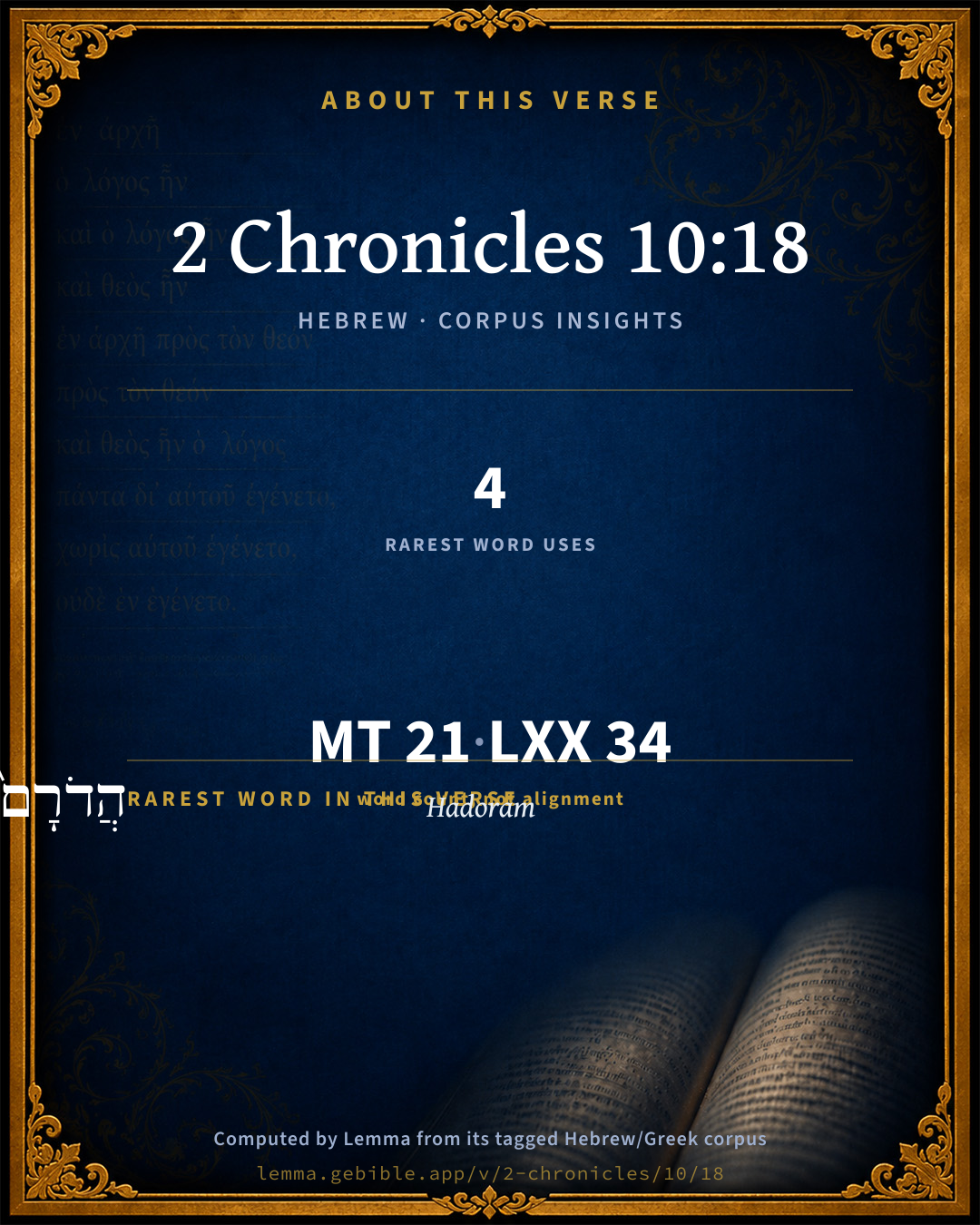
The rarest word here is הֲדֹרָם֙ Hadoram H1913 — appearing just 4 times in the whole Hebrew Bible.

Shared distinctive vocabulary

הֲדֹרָם֙ Hadoram H1913 occurs in 4 verses of the Hebrew Bible. Also found in:

Grammatical profile

  • 6 verbs
  • 11 nouns
  • 2 prepositions
  • 2 particles

Verb forms

  • וַיִּשְׁלַ֞ח Qal · Sequential Imperfect
  • וַיִּרְגְּמוּ Qal · Sequential Imperfect
  • וַיָּמֹ֑ת Qal · Sequential Imperfect
  • הִתְאַמֵּץ֙ Hithpael · Perfect
  • לַֽעֲל֣וֹת Qal · Infinitive Construct
  • לָנ֖וּס Qal · Infinitive Construct

Repetition

Words recur within this verse — often emphatic in Hebrew:

  • הַמֶּ֣לֶךְ king H4428 ×2
  • רְחַבְעָ֗ם Rehoboam H7346 ×2

Hebrew & Septuagint length

In English translation the verse runs 40 words from the Hebrew and 36 from the Septuagint (LXX English) — closely comparable.

A rough comparison of the two English renderings, which tokenize alike — not a word-level alignment.

Word counts can differ between the Hebrew and the Greek without any difference in meaning — e.g. the Hebrew direct-object marker אֵת has no separate Greek word, and Greek often adds the article ὁ.

In the original languages it is 21 Hebrew tokens and 34 Greek tokens — but the two are counted differently (Hebrew bundles its prefixes and suffixes into one token; the Greek is in lemma form), so that isn’t a like-for-like length.

Cross-references

4

Topical passages linked to 2 Chronicles 10:18 in the Treasury of Scripture Knowledge — connected by theme and wording, ordered by reader-vote popularity; previews shown in the World English Bible.

  • 1 Kings 5:14 He sent them to Lebanon, ten thousand a month by courses; a month they were in Lebanon, and two months at home; and Adoniram was over the men subject to forced labor.
  • 1 Kings 4:6 and Ahishar was over the household; and Adoniram the son of Abda was over the men subject to forced labor.
  • 2 Chronicles 24:21 They conspired against him, and stoned him with stones at the commandment of the king in the court of the house of Yahweh.
  • Acts 7:57–58 But they cried out with a loud voice, and stopped their ears, and rushed at him with one accord.

Cross-references courtesy of OpenBible.info (CC BY 4.0).

Hebrew and Greek witnesses Masoretic Hebrew ↔ Greek Septuagint

The same verse in the two great witnesses to the Old Testament, shown verse-for-verse.

These are two independent witnesses, not word-aligned to each other, and the Septuagint is shown in lemma (dictionary) form.

Hebrew 2 Chronicles 10:18 Masoretic · Westminster Leningrad Codex

וַיִּשְׁלַ֞ח הַמֶּ֣לֶךְ רְחַבְעָ֗ם אֶת הֲדֹרָם֙ אֲשֶׁ֣ר עַל הַמַּ֔ס וַיִּרְגְּמוּ ב֧וֹ בְנֵֽי יִשְׂרָאֵ֛ל אֶ֖בֶן וַיָּמֹ֑ת וְהַמֶּ֣לֶךְ רְחַבְעָ֗ם הִתְאַמֵּץ֙ לַֽעֲל֣וֹת בַּמֶּרְכָּבָ֔ה לָנ֖וּס יְרוּשָׁלִָֽם

Then king Rehoboam sent Hadoram, who was over the men subject to forced labor; and the children of Israel stoned him to death with stones. King Rehoboam made speed to get him up to his chariot, to flee to Jerusalem.

World English Bible · Public Domain

Greek LXX 2 Chronicles 10:18 Septuagint · lemma form

καί ἀποστέλλω ὁ βασιλεύς ροβοαμ ὁ αδωνιραμ ὁ ἐπί ὁ φόρος καί λιθοβολέω αὐτός ὁ υἱός ἰσραήλ λίθος καί ἀποθνήσκω καί ὁ βασιλεύς ροβοαμ σπεύδω ὁ ἀναβαίνω εἰς ὁ ἅρμα ὁ φεύγω εἰς ἰερουσαλήμ

And king Roboam sent to them Adoniram that was over the tribute; and the children of Israel stoned him with stones, and he died. And king Roboam hasted to mount his chariot, to flee to Jerusalem.

LXX2012 (modern English Septuagint) · Public Domain

On this verse, Ellicott's Commentary for English Readers discusses the Septuagint’s reading. Read the note in Commentary ↓

Hebrew: Westminster Leningrad Codex (CC BY 4.0). Greek: Septuagint (public domain); English from LXX2012 (modern English Septuagint) (Public Domain). How the Septuagint differs from the Hebrew →

Commentary

Notes on 2 Chronicles 10:18 from classic Christian and Jewish commentators (each source and its license shown beneath its notes). The classic Christian expositions comment on the surrounding passage and are grouped to its opening verse, so a note may address several verses; the Jewish commentaries on the Tanakh (Rashi and others) are per-verse, so they appear only where the commentator wrote on this verse.

Lemma curates 59 commentaries, every one of them public domain or Creative Commons licensed, each selected and text-cleaned for this edition rather than reprinted as found. About our sources →

Trapp's Complete Commentary

John Trapp

2Ch 10:18 Then king Rehoboam sent Hadoram that [was] over the tribute; and the children of Israel stoned him with stones, that he died. But king Rehoboam made speed to get him up to [his] chariot, to flee to Jerusalem.

Ver. 18. Then king Rehoboam sent Adoram.] But all too late.

“ Quid iuvat amisso claudere septa grege! ”

The people are a most dangerous and heady water when once it is out.

John Trapp, A Commentary or Exposition upon All the Books of the Old and New Testament (1647–1656) — public domain. Text from a community e-Sword module.

Tyndale Open Study Notes

Tyndale Open Resources

10:18 Rehoboam came to Shechem to be anointed king but barely escaped with his life. His poor understanding of the situation was particularly evident when he sent a civilian official, rather than an army commander, to enforce conscription.

Tyndale Open Study Notes — © Tyndale Open Resources, licensed CC BY-SA 4.0. Text via the HelloAO Bible API.

Geneva Bible (1599)

Geneva Bible translators

Or, receiver.

Hebrew, strengthened himself.

Geneva Bible (1599) marginal notes — public domain. Text via Bolls.life.

Adam Clarke's Commentary

Verse 18. Stoned him] When he endeavoured to collect the tribute which Solomon had imposed on them. - Jarchi.

Adam Clarke's Commentary on the Bible (1810–1826) — public domain. Text from a community e-Sword/MySword module.

Ellicott's Commentary for English Readers

(18) Hadoram.—Kings, “Adoram.” LXX. (Vat.), Adoniram. (Comp. 1Ki_4:6.)

The tribute.—The levy (ha-mas).

The children of Israel.—Kings, “all Israel.”

Made speed.—Had made speed.

His chariot.—The (royal) chariot.

A Bible Commentary for English Readers, edited by Charles John Ellicott (1878–1897) — public domain. Text from a community e-Sword module.

The Cambridge Bible for Schools and Colleges

gen. ed. J. J. S. Perowne

18. Hadoram] Called “Adoram” in the parallel passage (1Ki_12:18) and “Adoniram” (1Ki_4:6; 1Ki_5:14; [28 Heb.]).

over the tribute] R.V. over the levy.

The Cambridge Bible for Schools and Colleges (gen. ed. J. J. S. Perowne; Cambridge University Press, 1878–1918) — public domain. Text from a community e-Sword module.

The Pulpit Commentary

Hadoram that was over the tribute stoned him Rehoboam made speed to flee. Hadoram was perhaps the same as Adoniram, son of Abda, (1Ki_4:6 1Ki_5:14) but on the arbitrament of age this is less likely, and certainly it is very unlikely that he was one with Hadoram of 2Sa_20:24. Rehoboam must be supposed to have sent Hadoram either to make some "tribute" summons, or try some arrangement respecting it, or respecting conciliatory steps. The reception he met warns Rehoboam to make the quickest escape possible, and no doubt opens his eyes fully to what he has done. It was the remanet of his delusive self-confidence to send this collector of taxes to those who had begged some remission of taxation.

Ignominy, its source and its avoidance.

For the son of Solomon and the grandson of David to meet the tribes of Israel in solemn assembly, and, after holding conference with them, to have his officer and ambassador scornfully stoned to death, and then to betake himself to his chariot with all speed and flee to Jerusalem, this was a pitiable illustration of human ignominy. We Almost pity the abject prince for his misery as much as we blame him for his folly.

I THE SOURCE OF IGNOMINY. What is it that brings men down to such dishonour? It is:

1. When they assume a position to which they are not entitled; when they take a higher place than they can fairly claim, and the "more honourable man" comes in to supplant them, and they "begin with shame to take the lower place". (Luk_14:9) An assumption of social or literary or ecclesiastical superiority, unwarranted by the facts, must sooner or later end in an ignominious surrender.

2. When they undertake a task for which they are unfitted. The son of Gideon wisely shrank from the act of execution for which his immaturity rendered him unfitted. "As the man is, so is his strength," said he. Youth must not undertake the task of manhood, nor ignorance that of learning, nor inexperience that of trained and proved ability, nor mental feebleness that of intellectual vigour, nor moral frailty that of spiritual strength. Else it will sustain an ignominious fall.

3. When they adopt a course which should have been scrupulously avoided. What could have been the result of such insensate folly as that of which Rehoboam had just been guilty but this ignominious flight? When his far stronger father had incensed the citizens by heavy and burdensome taxation, what a ruinous mistake it was for him to declare that he would go even further than Solomon himself had gone in this direction! To take a course which conflicts with men"s natural rights, or which kindles their just indignation, or which wounds their keen susceptibilities, is to invite dishonour to our door; it is to robe our own shoulders with the mantle of shame.

4. When we credit ourself with a character which we have not gained; when we assume that we are in spirit and in principle what in truth we are not, that we have moral qualities which we really do not possess; in this case, the dishonour that awaits us may come either in this world or the next.

(1) We may be found unable to resist the temptations which we encounter, and our lamentable failure may expose us to the rebuke and the condemnation of man (see Act_5:1-11 Act_13:13 Act_15:38; 2Ti_4:10)

(2) We may find ourselves rejected and expelled on the great day of judgment. (Mat_6:21-23 Mat_25:44, Mat_25:45)

II THE AVOIDANCE OF IGNOMINY. If we would not be put to shame by our fellow-men or by the Divine Judge, we must do these things:

1. Study until we know ourselves; examine our hearts until we know what is in them what is the spirit we are of, what are the principles at the root of our behaviour.

2. Be content with the position and the work which our heavenly Fatherhas assigned us. (see Psa_84:10 Psa_131:1)

3. Make continual and earnest supplication that God will reveal us toourselves. (Psa_19:12 Psa_139:23, Psa_139:24) Then, instead of an ignominious retreat, our path will be that of the just, shining more and more; we shall advance from honour to honour; God himself will crown us with his Divine commendation. C.

The Pulpit Commentary (1880–1919), ed. H.D.M. Spence-Jones & Joseph S. Exell — public domain. Text from a community e-Sword module.

Rashi

Rabbi Shlomo Yitzchaki (Rashi)

Hadoram He is identical with Adoniram (I Kings 4:6), for during Solomon’s time, he enjoyed great eminence, but in Rehoboam’s time his greatness was humbled. Therefore, he was called Hadoram.

and the Children of Israel pelted him with stones and because Rehoboam did not know the cause of the rebellion in which they turned away from him, he was slain when he requested the levy that Solomon had levied upon them.

Rashi on the Tanakh — English translations: “The Judaica Press complete Tanach with Rashi, translated by A. J. Rosenberg” (CC BY 4.0); “Pentateuch with Rashi's commentary by M. Rosenbaum and A.M. Silbermann, 1929-1934” (public domain); “The Metsudah Tanach series, Lakewood, N.J” (CC BY 4.0); and “The Book of Joshua, Metsudah Publications, 1997” (CC BY 4.0). Text via Sefaria.

Lesson kit

Teaching starters — assembled from the data on this page, not authored interpretation. Every prompt links to the verse data it draws on. Edit before teaching.

2 Chronicles, in the Historical, opens this verse with 21 words (18 distinct Hebrew lemmas). Its most distinctive word is Hădôwrâm (“Hadoram”). A historical commentator’s framing appears above. Read the whole chapter for the surrounding context.

Discussion questions

  1. The word Hădôwrâm carries the sense “Hadoram.” How does it shape the verse?
  2. Genesis 10:27 shares the word «Hadoram» with this verse. How do the two illuminate each other?
  3. “king” occurs 2× in this one verse. What is the effect of the repetition?
  4. These translations render this verse differently; the difference is in the English rendering, not the original. What questions does that raise?
  5. The verb «וַיִּשְׁלַ֞ח» is Qal Sequential Imperfect. How does its form color the action?
  6. Reading how Trapp's Complete Commentary and Tyndale Open Study Notes read this verse, where do the two commentators agree and where do they part?

Things to notice

Reading settings

Reading text

Shown beneath each verse's original-language words.

Old Testament
Old Testament edition

Read the OT as the Masoretic Hebrew (MT) or the Greek Septuagint (LXX).

English shown for the Greek Septuagint (in the Hebrew ↔ Greek comparison).

Comparing translations? Open the Compare panel on any verse page to stack up to four side by side.