1 Kings 14:25

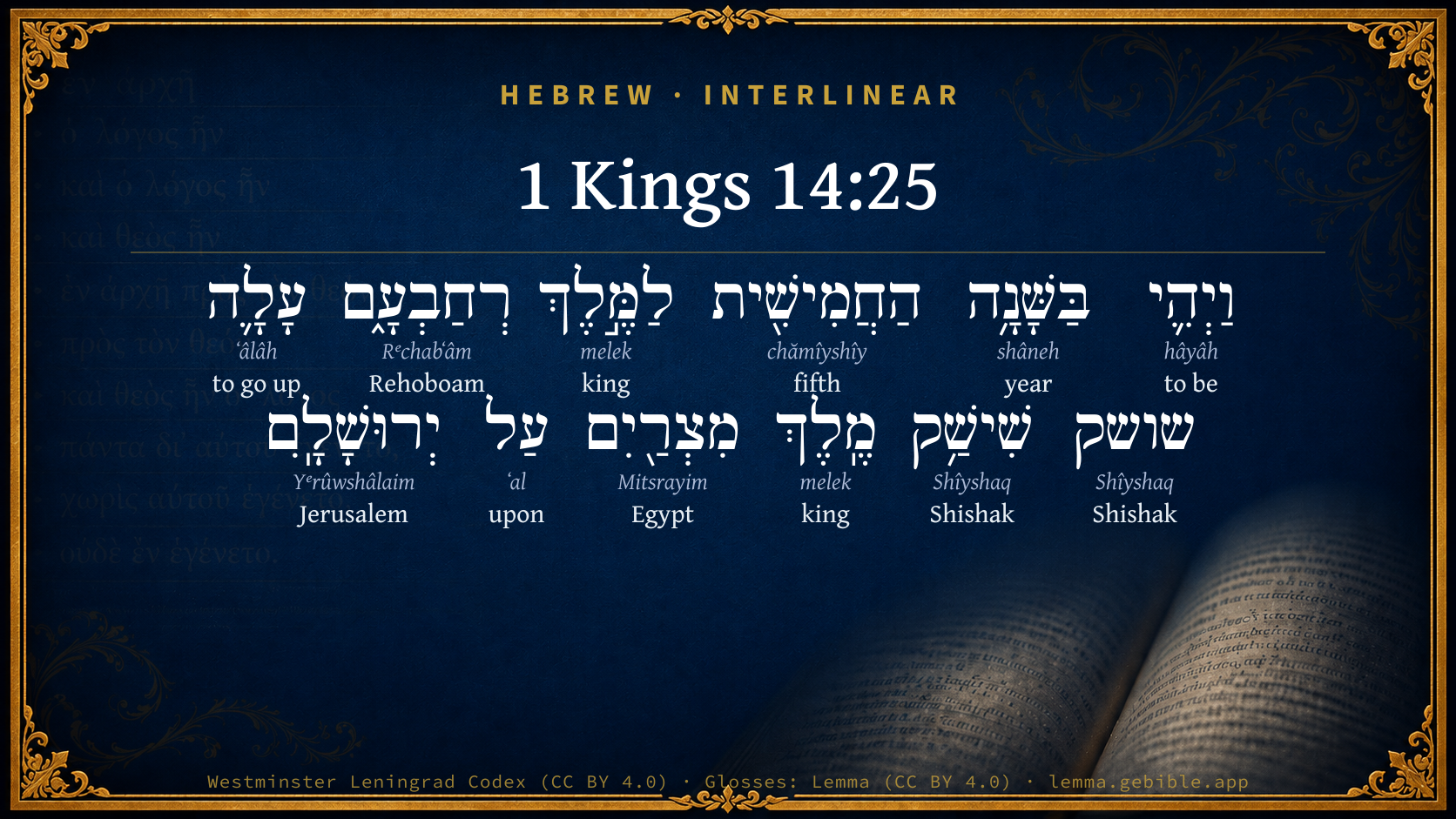
Hebrew (Westminster Leningrad Codex) 1 Kings 14:25 appears in the Hebrew Old Testament. The text above is from the Westminster Leningrad Codex. Each word links to its Strong’s number, a concise gloss, and parsing drawn from the Open Scriptures Hebrew Bible morphology. Click any word for its full Brown-Driver-Briggs (BDB) entry.
Download image
Cite this verse

1 Kings 14:25 (World English Bible). Public Domain. Lemma interlinear Bible study tool, https://lemma.gebible.app/v/1-kings/14/25.

Show BibTeX & RIS
BibTeX
RIS
English Translation
It happened in the fifth year of king Rehoboam, that Shishak king of Egypt came up against Jerusalem;
World English Bible · Public Domain
Download a study sheet

One document with this verse’s original text, its word-by-word gloss line, the meaning frame, cross-references with their text, attributed commentary, and full source and license credits — printable, and it pastes into notes with its structure intact.

This verse Autodidact and up

Study sheet (.html) Plain text (.txt)

A passage Seminary Student

Up to 50 verses in one chapter. A passage sheet keeps up to 6 commentary sources and 12 cross-references per verse, in the order this page ranks them, and says so on the sheet whenever that leaves anything out. Ask for a single verse and you get the Autodidact verse sheet above.

Everything on this page stays free to read, with no account — the sheet is a download of what is already on screen, not access to it.

Want to remove ads? Support Godless Engineer
Compare translations 3

The same verse in 3 English versions, stacked beneath the original-language interlinear above. Click any original word for its lexicon entry.

Each is an independent rendering of the whole verse — the interlinear is not word-aligned to these translations.

Highlighted words mark where these versions differ — a whole-verse word diff, not a word-by-word alignment.

  • World English Bible Public Domain
    It happened in the fifth year of king Rehoboam, that Shishak king of Egypt came up against Jerusalem;
  • King James Version Public Domain
    And it came to pass in the fifth year of king Rehoboam, that Shishak king of Egypt came up against Jerusalem:
  • unfoldingWord Literal Text CC BY-SA 4.0
    And it happened that in the fifth year of King Rehoboam, Shishak the king of Egypt came up against Jerusalem.

unfoldingWord Literal Text — © unfoldingWord, licensed CC BY-SA 4.0. Word-aligned USFM3 via Door43 (git.door43.org/unfoldingWord/en_ult).

Versions to compare (up to 4)

3 of 4 selected

Show all 18 translations

Every available English version of this verse, each an independent rendering of the whole verse.

  • World English Bible Public Domain
    It happened in the fifth year of king Rehoboam, that Shishak king of Egypt came up against Jerusalem;
  • Berean Standard Bible Public Domain
    In the fifth year of Rehoboam’s reign, Shishak king of Egypt came up and attacked Jerusalem.
  • Majority Standard Bible Public Domain
    In the fifth year of Rehoboam’s reign, Shishak king of Egypt attacked Jerusalem.
  • King James Version Public Domain
    And it came to pass in the fifth year of king Rehoboam, that Shishak king of Egypt came up against Jerusalem:
  • American Standard Version (1901) Public Domain
    And it came to pass in the fifth year of king Rehoboam, that Shishak king of Egypt came up against Jerusalem;
  • Revised Version (1885) Public Domain
    And it came to pass in the fifth year of king Rehoboam, that Shishak king of Egypt came up against Jerusalem:
  • Geneva Bible (1599) Public Domain
    And in the fift yere of King Rehoboam, Shishak King of Egypt came vp against Ierusale,
  • Douay-Rheims (1899) Public Domain
    And in the fifth year of the reign of Roboam, Sesac king of Egypt came up against Jerusalem.
  • Young's Literal Translation Public Domain
    And it cometh to pass, in the fifth year of king Rehoboam, gone up hath Shishak king of Egypt against Jerusalem,
  • Literal Standard Version CC BY-SA 4.0
    And it comes to pass, in the fifth year of King Rehoboam, Shishak king of Egypt has gone up against Jerusalem,
  • Unlocked Literal Bible CC BY-SA 4.0
    It happened in the fifth year of King Rehoboam that Shishak king of Egypt came up against Jerusalem.
  • unfoldingWord Literal Text CC BY-SA 4.0
    And it happened that in the fifth year of King Rehoboam, Shishak the king of Egypt came up against Jerusalem.
  • Darby Bible Public Domain
    And it came to pass in the fifth year of king Rehoboam, [that] Shishak king of Egypt came up against Jerusalem.
  • World Messianic Bible Public Domain
    In the fifth year of King Rehoboam, Shishak king of Egypt came up against Jerusalem;
  • Webster's Bible Public Domain
    And it came to pass in the fifth year of king Rehoboam, that Shishak king of Egypt came up against Jerusalem:
  • Free Bible Version CC BY-SA 4.0
    In the fifth year of King Rehoboam's reign, Shishak, king of Egypt, attacked Jerusalem.
  • Bible in Basic English Public Domain
    Now in the fifth year of King Rehoboam, Shishak, king of Egypt, came up against Jerusalem;
  • JPS Tanakh (1917) Public Domain
    And it came to pass in the fifth year of king Rehoboam, that Shishak king of Egypt came up against Jerusalem;

Literal Standard Version (2020), Covenant Press — licensed CC BY-SA 4.0. Text via the HelloAO Bible API (eBible.org). Unlocked Literal Bible (unfoldingWord) — licensed CC BY-SA 4.0. Text via the HelloAO Bible API (eBible.org). unfoldingWord Literal Text — © unfoldingWord, licensed CC BY-SA 4.0. Word-aligned USFM3 via Door43 (git.door43.org/unfoldingWord/en_ult). Free Bible Version, Dr. Jonathan Gallagher — licensed CC BY-SA 4.0. Text via the HelloAO Bible API (eBible.org).

Word by word

More ways to search: Search by grammar → Find every occurrence → Compare this word →

Practice this passage: Drill this verse → Learn its vocabulary →

שושק
Shîyshaq
H7895
“Shishak”
Noun, Proper
Part of Speech
Noun
Type
Proper
Full BDB Definition

Origin: of Egyptian derivation

TWOT: None

Shishak = "greedy of fine linen" - king of Egypt, Sheshonk I, 1st king of the Bubastite 22nd dynasty; ruled in Egypt during the reigns of Solomon and Rehoboam and attacked the southern kingdom under Rehoboam and apparently made it tributary
  1. וַיְהִ֛י hâyâh H1961 “and · to be” Conjunction + Verb, Qal, Sequential Imperfect, 3rd Person, Masculine, Singular
  2. בַּשָּׁנָ֥ה shâneh H8141 “in/at the · year” Preposition, Determined + Noun, Common, Feminine, Singular, Absolute
  3. הַחֲמִישִׁ֖ית chămîyshîy H2549 “the · fifth” Particle, Definite Article + Adjective, Ordinal number, Feminine, Singular, Absolute
  4. לַמֶּ֣לֶךְ melek H4428 “to/for the · king” Preposition, Determined + Noun, Common, Masculine, Singular, Absolute
  5. רְחַבְעָ֑ם Rᵉchabʻâm H7346 “Rehoboam” Noun, Proper
  6. עָלָ֛ה ʻâlâh H5927 “to go up” Verb, Qal, Perfect, 3rd Person, Masculine, Singular
  7. שִׁישַׁ֥ק Shîyshaq H7895 “Shishak” Noun, Proper
  8. מֶֽלֶךְ melek H4428 “king of” Noun, Common, Masculine, Singular, Construct
  9. מִצְרַ֖יִם Mitsrayim H4714 “Egypt” Noun, Proper
  10. עַל ʻal H5921 “upon” Preposition
  11. יְרוּשָׁלִָֽם Yᵉrûwshâlaim H3389 “Jerusalem” Noun, Proper

About this verse

These counts appear in no published source. They are computed here, from the morphology-tagged text and Lemma’s own curated glosses. What Lemma adds →

12
words
10
distinct lemmas
Historical
section

Notable vocabulary

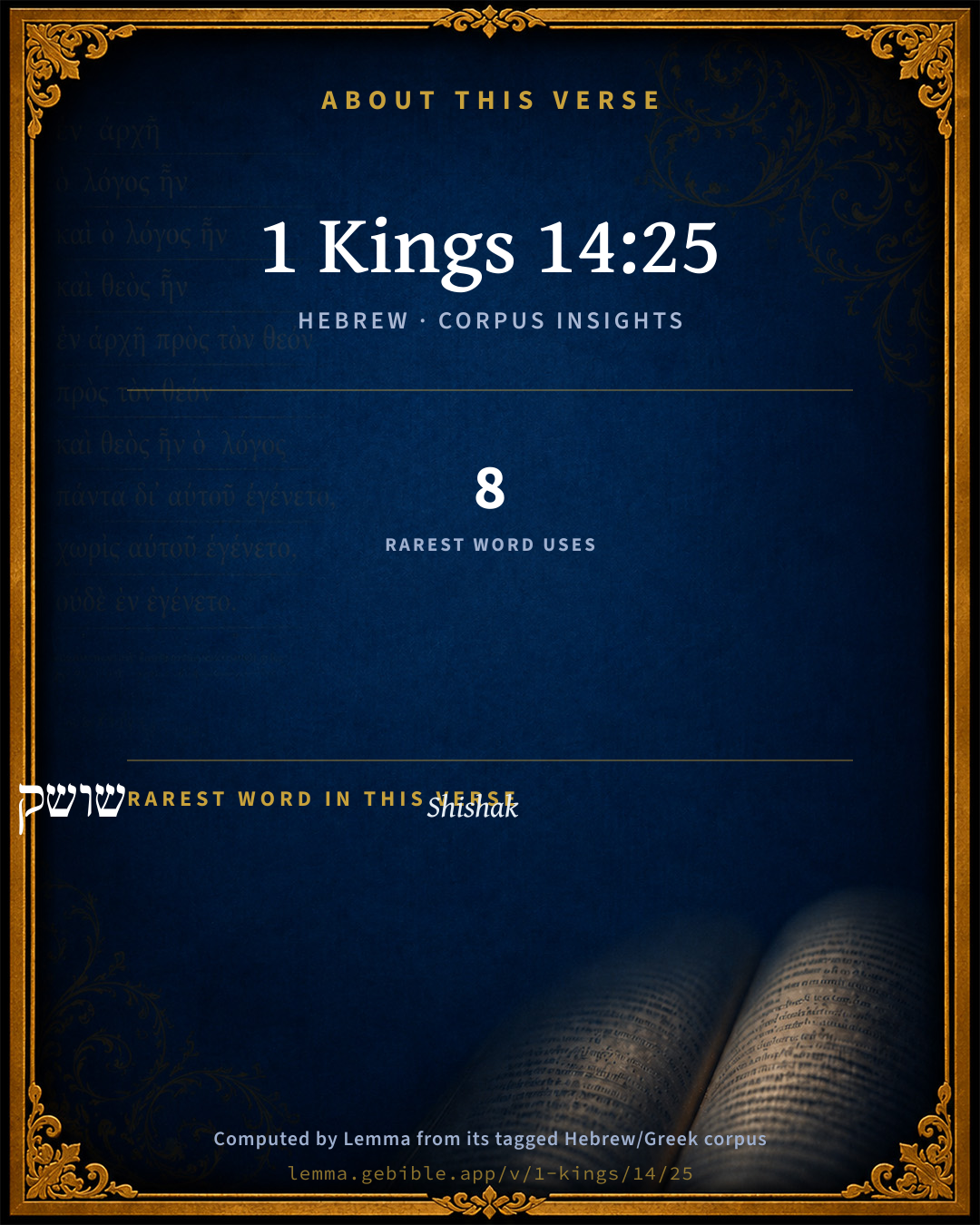
The rarest word here is שושק Shishak H7895 — appearing just 8 times in the whole Hebrew Bible.

Shared distinctive vocabulary

שושק Shishak H7895 occurs in 6 verses of the Hebrew Bible. Also found in:

Grammatical profile

  • 2 verbs
  • 8 nouns
  • 1 adjective
  • 1 preposition

Verb forms

  • וַיְהִ֛י Qal · Sequential Imperfect
  • עָלָ֛ה Qal · Perfect

Repetition

Words recur within this verse — often emphatic in Hebrew:

  • לַמֶּ֣לֶךְ king H4428 ×2
  • שושק Shishak H7895 ×2

Hebrew & Septuagint length

In English translation the verse runs 18 words from the Hebrew and 22 from the Septuagint (LXX English) — closely comparable.

A rough comparison of the two English renderings, which tokenize alike — not a word-level alignment.

Word counts can differ between the Hebrew and the Greek without any difference in meaning — e.g. the Hebrew direct-object marker אֵת has no separate Greek word, and Greek often adds the article ὁ.

Cross-references

3

Topical passages linked to 1 Kings 14:25 in the Treasury of Scripture Knowledge — connected by theme and wording, ordered by reader-vote popularity; previews shown in the World English Bible.

  • 1 Kings 11:40 Solomon sought therefore to kill Jeroboam; but Jeroboam arose, and fled into Egypt, to Shishak king of Egypt, and was in Egypt until the death of Solomon.
  • 2 Chronicles 12:2–4 It happened in the fifth year of king Rehoboam, that Shishak king of Egypt came up against Jerusalem, because they had trespassed against Yahweh,
  • 2 Chronicles 12:9 So Shishak king of Egypt came up against Jerusalem, and took away the treasures of the house of Yahweh, and the treasures of the king's house: he took all away: he took away also the shields of gold which Solomon had made.

Cross-references courtesy of OpenBible.info (CC BY 4.0).

Hebrew and Greek witnesses Masoretic Hebrew ↔ Greek Septuagint

The same verse in the two great witnesses to the Old Testament, shown verse-for-verse.

These are two independent witnesses, not word-aligned to each other, and the Septuagint is shown in lemma (dictionary) form.

Hebrew 1 Kings 14:25 Masoretic · Westminster Leningrad Codex

וַיְהִ֛י בַּשָּׁנָ֥ה הַחֲמִישִׁ֖ית לַמֶּ֣לֶךְ רְחַבְעָ֑ם עָלָ֛ה שושק שִׁישַׁ֥ק מֶֽלֶךְ מִצְרַ֖יִם עַל יְרוּשָׁלִָֽם

It happened in the fifth year of king Rehoboam, that Shishak king of Egypt came up against Jerusalem;

World English Bible · Public Domain

Greek LXX 1 Kings 14:25 Septuagint · lemma form
And it came to pass in the fifth year of the reign of Roboam, Susakim king of Egypt came up against Jerusalem;

LXX2012 (modern English Septuagint) · Public Domain

Hebrew: Westminster Leningrad Codex (CC BY 4.0). Greek: Septuagint (public domain); English from LXX2012 (modern English Septuagint) (Public Domain). How the Septuagint differs from the Hebrew →

Targum (Aramaic paraphrase)

1

The Targum is the ancient Jewish Aramaic paraphrase of the Hebrew Scriptures — an interpretive translation, not the Hebrew text itself. Onkelos (literal) and Pseudo-Jonathan (expansive) render the Torah, and Jonathan the Prophets. Coverage is partial: where no permissively-licensed English translation exists for a verse, only the Aramaic is shown. This is verse-level text, not a word-by-word alignment to the Hebrew.

  1. Targum Jonathan Prophets (Joshua–Malachi)
    וַהֲוָה בְּשַׁתָּא חֲמִישָׁתָא לְמַלְכָּא רְחַבְעָם סְלִיק שִׁישַׁק מַלְכָּא דְמִצְרַיִם עַל יְרוּשְׁלֵם:

    (no public-domain English translation for this verse)

    Targum Jonathan — Aramaic: “Mikraot Gedolot” (public domain). English: “Sefaria Community Translation” (CC0 1.0 (public-domain dedication)); “London "Chaldee Paraphrase," 1871” (public domain). Text via Sefaria.

Commentary

Notes on 1 Kings 14:25 from classic Christian and Jewish commentators (each source and its license shown beneath its notes). The classic Christian expositions comment on the surrounding passage and are grouped to its opening verse, so a note may address several verses; the Jewish commentaries on the Tanakh (Rashi and others) are per-verse, so they appear only where the commentator wrote on this verse.

Lemma curates 59 commentaries, every one of them public domain or Creative Commons licensed, each selected and text-cleaned for this edition rather than reprinted as found. About our sources →

Jamieson, Fausset & Brown

Robert Jamieson, A. R. Fausset & David Brown

SHISHAK SPOILS JERUSALEM. (Kg1 14:25-31)

Shishak king of Egypt came up--He was the instrument in the hand of Providence for punishing the national defection. Even though this king had been Solomon's father-in-law, he was no relation of Rehoboam's; but there is a strong probability that he belonged to another dynasty (see on Ch2 12:2). He was the Sheshonk of the Egyptian monuments, who is depicted on a bas-relief at Karnak, as dragging captives, who, from their peculiar physiognomy, are universally admitted to be Jews.

Jamieson, Fausset & Brown — Commentary Critical and Explanatory on the Whole Bible (1871) — public domain (CC PDM 1.0). Text via the HelloAO Bible API.

Trapp's Complete Commentary

John Trapp

1Ki 14:25 And it came to pass in the fifth year of king Rehoboam, [that] Shishak king of Egypt came up against Jerusalem:

Ver. 25. Shishak king of Egypt.] Diodorus Siculus calleth him Sasokis; Justin, Susakis.

Came up.] Drawn by a desire of Solomon’s ivory throne, say some; like as the pearls usually cast out with the flood and gathered with the ebb, drew Caesar’s affection for the conquest of Britain. {a}

{a} Sueton.

John Trapp, A Commentary or Exposition upon All the Books of the Old and New Testament (1647–1656) — public domain. Text from a community e-Sword module.

Joseph Benson's Commentary

1Ki 14:25. In the fifth year of King Rehoboam — Presently after his and his people’s apostacy, which was not till his fourth year; while apostate Israel enjoyed peace, and some kind of prosperity; of which difference two reasons may be given: first, Judah’s sins were committed against clearer light, and more powerful means and remedies of all sorts, and therefore deserved more severe and speedy judgments. Secondly, God discovered more love to Judah in chastising them speedily, that they might be humbled, reformed, and preserved, as it happened; and more anger against Israel, whom he spared to that total destruction which he intended to bring upon them. Shishak — He is thought to be Solomon’s brother-in-law; but how little such relations signify among princes, when their interest is concerned, all histories witness: besides, Rehoboam was not Solomon’s son by Pharaoh’s daughter, and so the relation was in a manner extinct. Came up — Either from a desire to enlarge his empire; or by Jeroboam’s instigation; or from a covetous desire of possessing those great treasures which David and Solomon had left; and, above all, by God’s providence disposing his heart to this expedition, for Rehoboam’s punishment.

Joseph Benson's Commentary on the Old and New Testaments (1811–1818) — public domain. Text from a community e-Sword module.

Tyndale Open Study Notes

Tyndale Open Resources

14:25 Shishak (Shoshenq I, 945–924 BC), of Egypt’s 22nd dynasty, reunited the land of Egypt that was divided during the 21st dynasty. He gave Egypt renewed stability, economic expansion, and military power. His attack on Judah is also recorded by the Chronicler (2 Chr 12:2-4) and is written on the Amon Temple in Thebes.

Tyndale Open Study Notes — © Tyndale Open Resources, licensed CC BY-SA 4.0. Text via the HelloAO Bible API.

Ellicott's Commentary for English Readers

(25) Shishak.—His invasion is narrated at greater length in the record of Chronicles (2Ch_12:2-12), which contains a description of his army, and a notice of the preservation of Jerusalem from destruction, though not from surrender, on the repentance of the people at the call of Shemaiah. It records also the taking of “fenced cities,” having noticed previously the fortifications of many such “cities of defence” by Rehoboam (2Ch_11:5-10). This record is remarkably confirmed by the celebrated inscription at Karnak (see Dict. of the Bible: “SHISHAK”) enumerating the conquests of Sheshenk (Shishak), in which names of cities, partly in Judah, partly in Israel, are traced. The latter are Levitical or Canaanitish cities; and it has been conjectured that, much as the Pharaoh of Solomon’s day took Gezer and gave it to Israel (see 1Ki_9:16), so the Egyptian army, coming as allies of Jeroboam, took, or helped him to take, those cities which were hostile or disloyal to him. It is not unlikely that the whole invasion was instigated by Jeroboam, in that desire to crush the kingdom of Judah which afterwards suggested his war with Abijam. (See 2 Chronicles 13)

A Bible Commentary for English Readers, edited by Charles John Ellicott (1878–1897) — public domain. Text from a community e-Sword module.

The Cambridge Bible for Schools and Colleges

gen. ed. J. J. S. Perowne

25–31. Shishak king of Egypt invades Judah. Death of Rehoboam (2Ch_12:2-4; 2Ch_12:9-16)

25. Shishak king of Egypt] See on 1Ki_11:40. Shishak is there represented as giving a friendly reception to Jeroboam. It may have been at Jeroboam’s prompting that the invasion of Judah was undertaken by him within such a short time after Rehoboam’s accession. A monument of this king, the first of the 22nd dynasty, has been discovered at Karnak in Upper Egypt, recording his conquests and the names of certain towns which he had taken in Palestine.

The Cambridge Bible for Schools and Colleges (gen. ed. J. J. S. Perowne; Cambridge University Press, 1878–1918) — public domain. Text from a community e-Sword module.

John Gill's Exposition

And he took away the treasures of the house of the Lord,.... Which perhaps Jeroboam had informed him of, and for the sake of which he came, as well as to make a diversion in favour of Jeroboam, who had contracted an intimacy with him when in Egypt; and who might have no regard for Rehoboam, who was not a son of Pharaoh's daughter, and so no relation to him: these were the treasures which David had left to his son Solomon, and had dedicated for the temple, even gold, silver, and vessels, which he put among the treasures of the house of the Lord, and perhaps added to them, Kg1 7:51, and the treasures of the king's house; the riches, gold, silver, and jewels, whatever of worth and value he had in his chests and cabinets:

he even took away all: that he could find and come at; for that there were some left is plain from Kg1 15:18,

and he took away all the shields of gold which Solomon had made; and which were put in the house of the forest of Lebanon, Kg1 10:16.

John Gill's Exposition of the Whole Bible (1746–1763) — public domain (CC PDM 1.0). Text via the HelloAO Bible API.

Albert Barnes' Notes on the Bible

The examination of the famous inscription of Shishak at Karnak has resulted in the proof that the expedition commemorated was directed against Palestine, and has further thrown a good deal of light on the relations of the two kingdoms at the period. Of the fifteen fenced cities fortified by Rehoboam in the early part of his reign 2Ch 11:5-12, three, Shoco, Adoraim, and Aijalon are distinctly mentioned among Shishak’s conquests. Other towns of Judah or Benjamin also occur. Further, a considerable number of the captured cities are in the territory of Jeroboam: these cities “are either Canaanite or Levitical.” Hence, we gather, that, during the four years which immediately followed the separation of the kingdoms, Rehoboam retained a powerful hold on the dominions of his rival, many Canaanite and Levitical towns acknowledging his sovereignty, and maintaining themselves against Jeroboam, who probably called in Shishak mainly to assist him in compelling these cities to submission. The campaign was completely successful.

Albert Barnes' Notes on the Bible (1834–1885) — public domain. Text from a community e-Sword/MySword module.

Haydock's Catholic Bible Commentary

Sesac. See chap. xi. 40. He was allied to Jeroboam, (Calmet) so that he might come to his assistance, (Haydock) being attracted by the ivory throne, (Rabbins) and immense riches of Jeroboam. (Calmet) --- Roboam was informed by Semeias, that resistance would be fruitless; and being humbled, he repaired more frequently to the temple, ver. 18. But his piety was of short duration, as it was influenced only by fear, 2 Paralipomenon xii. 14.

George Leo Haydock (1774–1849), Haydock's Catholic Family Bible and Commentary, 1859 edition — public domain. Excludes Psalms (Douay-Rheims chapter numbering differs from Protestant) and Deuterocanonical books (Catholic canon only).

Matthew Poole's English Annotations

In the fifth year of king Rehoboam; presently after his and his people’s apostacy, which was not till his fourth year; when the apostical Israelites enjoyed peace and some kind of prosperity, at first, for many years together; of which difference two reasons may be given: first, That Judah’s sins were committed against clearer light, and more powerful means and remedies of all sorts, and therefore deserved more severe and speed judgments. Secondly, that God discovered more love to Judah in chastising them speedily, that so they might be humbled, and reformed, and so graciously preserved, as it happened; and more anger against Israel, that he spared them, and by their impunity hardened and ripened them to that total destruction which he intend ed to bring upon them.

Shishak king of Egypt; of whom see 1Ki 11:40; 2Ch 12:2, &c., where this history is more fully described. He is thought by many to be Solomon’s brother-in-law. But how little such relations signify among princes, when their interest is concerned, all histories witness. Besides, Rehoboam was not Solomon’s son by Pharaoh’s daughter, and so the relation was in a manner extinct.

Came up against Jerusalem; either from ambition, and a desire to enlarge his empire; or from jealousy of Rehoboam’s growing greatness; of which see 2Ch 11; or by Jeroboam’s instigation; or from a covetous desire of possessing these great treasures which David and Solomon had left; and, above all, by God’s providence, disposing his heart to this expedition for Rehoboam’s punishment.

Matthew Poole's English Annotations on the Holy Bible (1683–1685) — public domain. Text from a community e-Sword/MySword module.

Whedon's Commentary on the Bible

Daniel D. Whedon

25. Shishak — See note on 1Ki_11:40.

Came up against Jerusalem — This notice of Shishak’s invasion is very brief, and records only his going to Jerusalem and taking away the treasures of the temple and the palace. 2Ch_12:2-10 more fully describes the invasion, tells the number and nationality of his forces, informs us that he took certain fortified cities of Judah, and that when he came to Jerusalem the king and princes of Israel, at the word of the prophet Jeremiah, humbled themselves before God, and were thus by the hand of God delivered from utter destruction. Rehoboam seems to have submitted to the Egyptian invader without a struggle, and to have delivered over his treasures and become tributary to Egypt on condition that the besieging forces should retire from before Jerusalem. A record of this expedition, and thus a confirmation of the Scripture history, is found written in hieroglyphics upon the wall of the great temple of Karnak. There, in a long list of captured cities and provinces which Shishak claims to have added to his dominions, occur the names Gibeon, Beth-horon, Aijalon, and Yudeh-malk, which Champollion, Wilkinson, and others read kingdom of Judah, but Brugsch regards it as the name of a town in Palestine.

Daniel D. Whedon (gen. ed.), Commentary on the Old and New Testaments (1874–1909) — public domain. Text from a community e-Sword module.

The Pulpit Commentary

And it came to pass in the fifth year that is, two years after king and people forsook the law of the Lord. (2Ch_12:11) Retribution seems to have overtaken Judah sooner than Israel. They had the less excuse, and they seem to have plunged deeper into idolatry and immorality (see Homiletics, p. 335) of King Rehoboam, that Shishak king of Egypt to whom Jeroboam had fled (1Ki_11:26, 1Ki_11:40) came up against Jerusalem. This expedition is related with somewhat more of detail in 2Ch_12:2-4. For Shishak, see 1Ki_11:40. It was in the twentieth year of his reign that Shishak, once Jeroboam"s protector and friend, invaded Palestine. It has been conjectured (Ewald, al.) that he was incited so to do by Jeroboam, and that the two kings waged war against Judah in concert (see on ver. 30). But as to this Scripture is silent; and moreover if Jeroboam summoned Shishak to his assistance, it is certain that his own kingdom did not altogether escape invasion; and it is perhaps more probable that the divided and weakened state of the country seemed to promise the Egyptian king an easy capture of Jerusalem, of the treasures of which he had doubtless heard. It is well known that a record of this expedition exists in the sculptures and inscriptions of the great temple at Karnak. The bassi relievi of the temple wall contain over 130 figures, representatives, as the names on the shields show, of so many conquered cities. Amongst these are found three of the "cities for defence" which Rehoboam had built, viz., Shoco, Adoraim, and Aijalon, (2Ch_11:7-10) while many other towns of Palestine, such as Gibeon, Taanach, Shunem, Megiddo, etc., are identified with more or less of probability. One feature in the list is remarkable, viz., the number of Levitical and Canaanite ciies cities of Israel which Shishak is said to have conquered. The usual inference is that such cities, although in Jeroboam"s dominions, had nevertheless held out against his rule the former for religious reasons; the latter, perhaps, in the effort to recover their independence. Mr. Peele, however (Dict. Bib., art. "Egypt"), accounts for the names on the supposition that Shishak directed, his forces against the northern as well as the southern kingdom, and certainly this seems to agree better with the facts. It is hardly likely that Jeroboam, with the army at his command, would tolerate so many centres of disaffection in his midst. Besides, the Levites, we are told, had migrated in a body to Judah; and the Canaanites at this period can hardly have been in a position to defy any Hebrew monarch. The silence alike of our historian and of the chronicler as to the invasion of Israel is easily accounted for by the fact that Judah bore the brunt of the war.

Ver. 25.

The Invasion of Shishak.

Three years after the death of David, the foundations of the temple, the glory of that age some have called it orbis mira-culum, the marvel of every age were laid. Four years after the death of Solomon his son some forty years, that is to say, after its foundation, three and thirty years after its completion, according to some only twenty years after its dedication the treasures of that temple, its gold and gems, were carried off by an invader. A short time after his accession, again, Solomon made alliance with the strongest and proudest of the empires of that age, with Egypt, and a Hebrew, one whose forefathers were Pharaoh"s bondmen, was gladly recognized as great Pharaoh"s son-in-law. A short time after his death, this same Egyptian kingdom is become an assailant of Solomon"s son, and Pharaoh is turned to be the oppressor and plunderer of his realm. For a great part of Solomon"s reign it was the boast of the people that an Egyptian princess occupied one of his splendid palaces in Jerusalem, but he has not been long dead before those same palaces are rifled by Egyptian princes, and Jerusalem is environed by the legions of Shishak.

And yet that temple, the magnificence of which has been so short-lived, which was hardly completed ere it was despoiled, was built to the name of the Lord, and as a habitation for the mighty God of Jacob. And as such it was accepted by Him. That house had had a greater glory and consecration than of gold and precious stones, for "the glory of the Lord had filled the house of the Lord". (1Ki_8:11) Why, then, is it, we may well ask, as the men of that age would ask, that it is so soon left comparatively desolate? Cannot the Deity to whom it was dedicated protect it against spoliation. Or have His worshippers provoked Him to anger, so that He has "abhorred his sanctuary," and "delivered his glory into the enemies" hand"?

For we may be quite sure that there was a profound reason for this profound dishonour and disgrace. We cannot account for the fact that the temple of the Lord, the "house of the great God", (Ezr_5:8) was stripped bare and left a wreck within a few years of its erection, on the supposition that a chance happened to it, and that it only suffered as other shrines have done from the vicissitudes of fortune and the impartial, inevitable havoc of war. In rebus bellicis," it has been said, maxime dominatur Fortuna." But if we feel at liberty to interpret other histories by a theory of chance, that idea must be excluded in thinking of God"s people. If their history was fortuitous, then the Old Testament is a delusion. No; we may not be able always to trace the finger of God in profane history, but it will be passing strange if we cannot recognize it here.

Now the immediate cause of the invasion was, no doubt, the divided and therefore weakened state of the kingdom. We might have been tempted to think that Jeroboam had summoned his patron Shishak to his aid, had we not proof that Israel as well as Judah suffered from this campaign. And of course it is possible that Jeroboam instigated a war which ultimately extended to his own kingdom. But it is obvious that Shishak would need no invitation to attack Jerusalem. The fame of its immense treasure is quite sufficient of itself to account for his advance. So long as it was guarded by the armies of Solomon it was secure. But Rehoboam, whose troops would not number a third of his father"s, and who was paralyzed by the hostility of Israel crouching like a wild beast on his northern border, offered an easy prey to a general with 1, 200 chariots and 60, 000 horsemen, and "people without number" under his command.

We see, then, that it was the treasures of the Holy City the vast accumulation of the precious metals which excited the cupidity of the Egyptians, while theft defenceless state suggested the idea of seizing them. Observe here

I THE RETRIBUTION OF SOLOMON"S SIN.

1. Of his greed and pride. He has "multiplied silver and gold to himself" only to provoke an invasion of his territory and the humiliation of his people. If he had obeyed the law; if he had been content to embellish the house of the Lord and leave the palaces alone; if his overweening pride and his insatiable thirst for fame had not prompted him to amass treasures which excited universal attention, it is probable that Judah would have escaped invasion. In this case "pride has gone before destruction." The very magnitude of his treasures led to their dispersion.

2. Of his idolatry. We have already seen how this sin (1Ki_11:5-8) was punished by the partition of his realm. In the plunder of his palaces, provoked and made possible by that division, we see a further recompense of his outrage and defiance of the almighty. The hills on which his idol altars were erected now swarmed with idolaters, assembled not to sacrifice, but to slay. We are reminded here of the retribution which befell the Jerusalem of a later day. On one of the hills before Jerusalem the Jews raised a cross they crucified the Prince of Life. On all the hills that are round about Jerusalem, the Romans raised crosses, the crosses of His murderers (Jos., Bell. Jud_1:5:11:1).

3. Of his multiplication of horses. For it is to be remembered from what quarter the retribution came. There is an exquisite judicial propriety in an invasion from Egypt, and an invasion of chariots and horses. This was retaliation in the proper sense of the word; it was like for like. Why, there was almost a beaten track made for those same chariots by the horses and chariots which Solomon had imported in such prodigious numbers. Literally the trade horses paved the way for the horses of war. This illegal traffic had long since familiarized Egyptian charioteers with the shortest way to the Holy City.

4. Of his multiplication of wives. Solomon"s lawful wife came from Egypt. Had he been true to her, he would probably have been true to his Lord, (1Ki_11:3) and so his realm would have escaped invasion. It is a kind of Nemesis for the wrong done to his Egyptian consort that his harem was plundered by Egyptians. There are those who connect Napoleon"s fall with the repudiation of Josephine. The "judge of the widow" (Psa_68:5) is also the avenger of the injured and dishonoured. (Heb_13:4) Human laws seldom take cognizance of these, the deepest of wrongs, but the cry of the heart-broken woman goes up into the ears of One who has said, "I will repay.

II THE PUNISHMENT OF REHOBOAM"S FOLLY AND SIN.

1. Of his obstinacy. For in the first place, but for his infatuation, humanly speaking, the kingdom would have escaped division, and the land would have escaped invasion. That infatuation, it is true, was the product of his breeding and his training, but that consideration does not wholly exonerate him from blame. No man can charge his parents or surroundings with his sin. The law does not excuse the thief on the ground that from infancy he has been taught to steal. Rehoboam was a free agent, and ought to have acted otherwise, and doubtless he knew it when it was too late.

2. Of his pride. It was his pride had rejected all compromise, and had prated of scorpions, etc. It had been humbled once in the dismemberment of his realm. It must be humbled again in the spoliation of his palaces. For observe, it was when he "had strengthened himself" (2Ch_12:1) that Shishak came to prove his weakness. St. Paul is not the only one who has had to learn the lesson, "When I am weak, then am I strong." It is extremely probable that this vainglorious prince, after losing most of his realm, still piqued himself on the abundance of his treasures. His trust was in his shields of gold. So he must be reduced to shields of pinchbeck.

3. Of his infidelity. "He forsook the law of the Lord" Much as his father had done before him. "What the old sing," says the German proverb, "the young chirp." That is to say, he still worshipped Jehovah (ver. 28; cf., 1Ki_9:25) but he sanctioned, or did not suppress, idolatry. The son of an Ammonitess, he would find it difficult to trample on the gods of his mother, (1Ki_11:5) and he was probably too much afraid of another insurrection to stamp out the abominations of vers. 28, 24.

III THE RECOMPENSE OF ISRAEL"S IDOLATRIES. Though the chronicler informs us that Rehoboam "forsook the law and all Israel with him," yet it seems probable from vers. 22, 24, "And Judah did evil," etc., that he rather followed than led his people. He could hardly fail, at first, to see that his strength lay in a rigid adherence to the law; that his policy was one of piety. The Levites and others who streamed into Judah, shocked by the innovations of Jeroboam, cannot fail to have suggested that his role was orthodoxy. It is probable, therefore, that it was not until a large section of his people, infected with the superstitions and vices they had learned in Solomon"s reign, clamoured for the tolerance of shameful shrines, that he yielded to idolatry. Ver. 25 seems to connect the invasion directly with the people"s sin. But for the high places and images. etc., the land would have been spared this humiliation. It is to be carefully noted that, so long as king and people served the Lord, Shishak was held back from attacking them. Hence we understand why Judah receives earlier and greater stripes than Israel It was Jeroboam made Israel to sin. It was Judah made Rehoboam to sin. The guilty people, accordingly, are punished by the invasion of their land and the spoliation of their treasure; the guilty king by the destruction of his house. And here again, let us observe, how significant that the chastisement should come from Egypt. Time was when God had punished the idolatries of Egypt through the instrumentality of the Jewish people (Exodus 7-14.) Now the tables are turned, and Egypt is employed to avenge the idolatries of Judah. This was the first time that an Egyptian army had crossed their border the first time, indeed, that the land had sustained the brunt of any invasion. It was the Sodomites and the like had drawn forth those swords from their scabbards. What a contrast between Ex 14 and 1Ki 14. Israel, who then "saw the Egyptians dead upon the seashore," now feels the grip of Pharaoh at his throat, and the iron of Pharaoh in his soul.

Vers. 25-31.

The Entailments of Sin.

During the three first years of his reign in Judah, Rehoboam walked in the steps of Solomon and David, enjoyed peace, and became established in his throne. Afterwards he gave himself up to idolatrous abominations, and brought evil upon himself and upon his people. The entailments of their sin were

I TROUBLE.

1. There was continual war between the kingdoms.

(1) While they remained faithful to God they had peace. God interposed to preserve peace by the hand of Shemaiah. (1Ki_12:21-24)

(2) But when they forsook the Lord, they soon got to strife, which continued as long as the kings lived (ver. 80). This strife was also handed down to their successors,

(3) Thus sinners become God"s instruments to punish one another. So it is seen to this day in the contentions and litigations of individuals. Men are slow to see the hand of God.

2. Shishak aggravated the mischief.

(1) The influences which brought him upon the scene may be discerned. Hadad, who occasioned so much trouble to Solomon, was Shishak"s brother-in-law. Shishak was thus disposed to give asylum to Jeroboam when he fled for his life from Solomon. Shishak now conspires with Jeroboam to ruin Rehoboam.

(2) The array brought against Judah by Shishak was formidable. (see 2Ch_12:3) It would have been crushing had not Rehoboam and his people, in their extremity, humbled themselves before God. (2Ch_12:7)

(3) But they still had to feel the smart of their sins.

II FORFEITURE.

1. In war there is always loss.

(1) Necessarily there is the forfeiture of peace. Who can estimate the value of peace? Perfect peace is the resultant of perfect harmony as the white light is composed of all the colours in the iris.

(2) There is the loss of property. Labour is the source of wealth: the labour withdrawn from industry to wage war is so much loss of wealth. The soldier also is a consumer. When he does not provide for his own sustenance, the labour of others must be taxed to feed him.

(3) There is the loss of life. War is seldom bloodless. Often the slaughter is fearful. Wellington is reported to have said that the calamity next in severity to a defeat is a victory.

2. Shishak despoiled the temple of its treasure.

(1) The booty here was enormous. The spoils of David"s victories were there; also the accumulations of Solomon"s peaceful commerce.

(2) The shields of gold that Solomon had made are particularly mentioned. It is added that Rehoboam had brazen shields made to replace them. How sin reduces the fine gold to brass!

3. Shishak also rifled the palace.

(1) The treasures here also were immense. Perhaps there never was such plunder as this in human annals.

(2) Rehoboam handed down a diminished inheritance to his son. By his folly he alienated ten tribes of his nation from his kingdom. Abijam likewise succeeded to a kingdom greatly impoverished. He became heir also to embroilments. The entailments of sin pursue the spirit into the invisible world. Forfeiture. Trouble: J.A.M.

The Pulpit Commentary (1880–1919), ed. H.D.M. Spence-Jones & Joseph S. Exell — public domain. Text from a community e-Sword module.

John Wesley's Explanatory Notes

Fifth year - Presently after his and his people's apostacy, which was not 'till his fourth year: while apostate, Israel enjoyed peace and some kind of prosperity, of which difference, two reasons may be given: first, Judah's sins were committed against clearer light, and more powerful means and remedies of all sorts, and therefore deserved more severe and speedy judgments. Secondly, God discovered more love to Judah in chastizing them speedily, that they might be humbled, reformed, and preserved, as it happened; and more anger against Israel, whom he spared to that total destruction which he intended to bring upon them. Sishak - He is thought to be Solomon's brother-in-law. But how little such relations signify among princes, when their interest is concerned, all histories witness. Besides Rehoboam was not Solomon's son by Pharaoh's daughter and so the relation was in a manner extinct. Came up - Either, from a desire to enlarge his empire: or, by Jeroboam's instigation: or from a covetous desire of possessing those great treasures which David and Solomon had left: and above all, by God's providence, disposing his heart to this expedition for Rehoboam's punishment.

John Wesley, Explanatory Notes Upon the Whole Bible (1754–1765) — public domain. Text via the GEBible commentary corpus.

unfoldingWord translationNotes

Door43 World Missions Community

in the fifth year of King Rehoboam

This refers to the fifth year of Rehoboam's reign as king. AT: "in the fifth year that Rehoboam was king" (See: Assumed Knowledge and Implicit Information)

in the fifth year

"in year 5" (See: Ordinal Numbers)

Shishak king of Egypt came up against Jerusalem

"Shishak king of Egypt" represents himself along with the Egyptian army. AT: "Shishak king of Egypt, and his army with him, came up against Jerusalem" (See: Synecdoche)

Shishak

This is the name of a man. See how you translated this in 1 Kings 11:40. (See: How to Translate Names)

came up against

This is an idiom that means marched against or attacked. AT: "came to attack" (See: Idiom)

He took everything away

This is a generalization that indicates every valuable thing that could be found was taken away. AT: "He took away many valuable things" (See: Hyperbole and Generalization)

He took

The word "He" represents Shishak and the soldiers who were with him. AT: "Shishak and his army took" (See: Synecdoche)

that Solomon had made

Here "Solomon" refers to the craftsmen who worked for Solomon to make the shields. AT: "that Solomon had his workers make" (See: Metonymy)

translationWords

Egypt

house of God

house

shield

gold

unfoldingWord translationNotes — © Distant Shores Media and the Door43 World Missions Community, licensed CC BY-SA 4.0. Source: git.door43.org/Door43/en_tn.

Rashi

Rabbi Shlomo Yitzchaki (Rashi)

Shishak. We find in Midrash Shir Hashirim that this was Pharaoh Neco. He was called Shishak because all his life he longed for [=שוקק] the ivory throne that belonged to Shlomo his son-in-law, and now, he went up and took it.

Rashi on the Tanakh — English translations: “The Judaica Press complete Tanach with Rashi, translated by A. J. Rosenberg” (CC BY 4.0); “Pentateuch with Rashi's commentary by M. Rosenbaum and A.M. Silbermann, 1929-1934” (public domain); “The Metsudah Tanach series, Lakewood, N.J” (CC BY 4.0); and “The Book of Joshua, Metsudah Publications, 1997” (CC BY 4.0). Text via Sefaria.

Lesson kit

Teaching starters — assembled from the data on this page, not authored interpretation. Every prompt links to the verse data it draws on. Edit before teaching.

1 Kings, in the Historical, opens this verse with 12 words (10 distinct Hebrew lemmas). Its most distinctive word is Shîyshaq (“Shishak”). A historical commentator’s framing appears above. Read the whole chapter for the surrounding context.

Discussion questions

  1. How does “Shishak” (Shîyshaq) shape what this verse is saying?
  2. How does 1 Kings 11:40, which shares the word «Shishak», read alongside this verse?
  3. What does the repetition of “king” (2× in this one verse) do in this verse?
  4. These translations render this verse differently. What is at stake in choosing one wording over another?
  5. «וַיְהִ֛י» is a Qal Sequential Imperfect verb. How does that grammatical form shape the action described?
  6. Compare how Jamieson, Fausset & Brown and Trapp's Complete Commentary read this verse. Where do they agree or differ?

Things to notice

Reading settings

Reading text

Shown beneath each verse's original-language words.

Old Testament
Old Testament edition

Read the OT as the Masoretic Hebrew (MT) or the Greek Septuagint (LXX).

English shown for the Greek Septuagint (in the Hebrew ↔ Greek comparison).

Comparing translations? Open the Compare panel on any verse page to stack up to four side by side.