Psalms 144:14

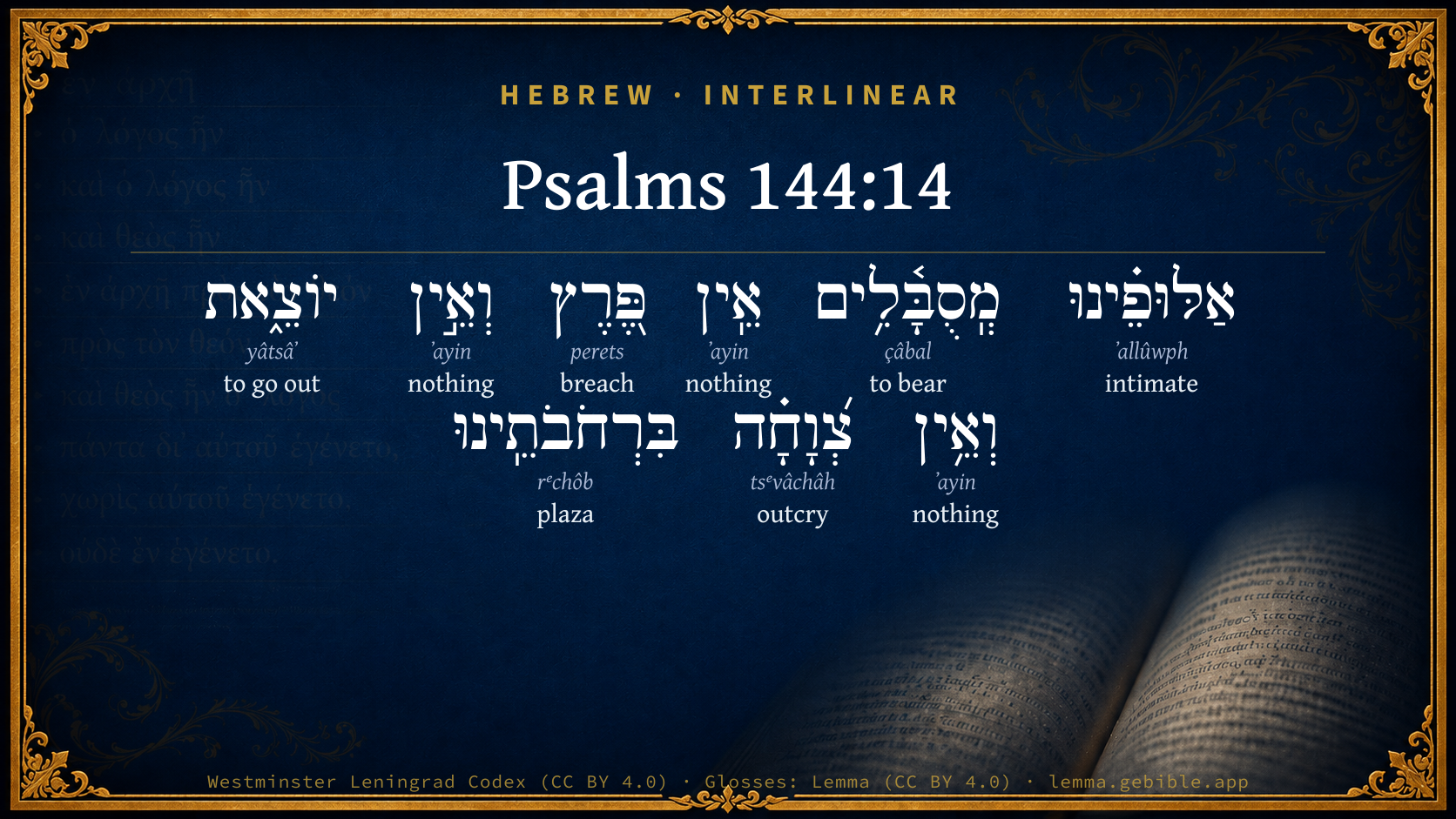
Hebrew (Westminster Leningrad Codex) Psalms 144:14 appears in the Hebrew Old Testament. The text above is from the Westminster Leningrad Codex. Each word links to its Strong’s number, a concise gloss, and parsing drawn from the Open Scriptures Hebrew Bible morphology. Click any word for its full Brown-Driver-Briggs (BDB) entry.
Download image
Cite this verse

Psalms 144:14 (World English Bible). Public Domain. Lemma interlinear Bible study tool, https://lemma.gebible.app/v/psalms/144/14.

Show BibTeX & RIS
BibTeX
RIS
English Translation
Our oxen will pull heavy loads. There is no breaking in, and no going away, And no outcry in our streets.
World English Bible · Public Domain
Highlights
  • 1 first appearance in the Hebrew Bible
Full analysis ↓
Download a study sheet

One document with this verse’s original text, its word-by-word gloss line, the meaning frame, cross-references with their text, attributed commentary, and full source and license credits — printable, and it pastes into notes with its structure intact.

This verse Autodidact and up

Study sheet (.html) Plain text (.txt)

A passage Seminary Student

Up to 50 verses in one chapter. A passage sheet keeps up to 6 commentary sources and 12 cross-references per verse, in the order this page ranks them, and says so on the sheet whenever that leaves anything out. Ask for a single verse and you get the Autodidact verse sheet above.

Everything on this page stays free to read, with no account — the sheet is a download of what is already on screen, not access to it.

Want to remove ads? Support Godless Engineer
Compare translations 3

The same verse in 3 English versions, stacked beneath the original-language interlinear above. Click any original word for its lexicon entry.

Each is an independent rendering of the whole verse — the interlinear is not word-aligned to these translations.

Highlighted words mark where these versions differ — a whole-verse word diff, not a word-by-word alignment.

  • World English Bible Public Domain
    Our oxen will pull heavy loads. There is no breaking in, and no going away, And no outcry in our streets.
  • King James Version Public Domain
    That our oxen may be strong to labour; that there be no breaking in, nor going out; that there be no complaining in our streets.
  • unfoldingWord Literal Text CC BY-SA 4.0
    our oxen burdened; no breach and no going out and no cry in our squares.

unfoldingWord Literal Text — © unfoldingWord, licensed CC BY-SA 4.0. Word-aligned USFM3 via Door43 (git.door43.org/unfoldingWord/en_ult).

Versions to compare (up to 4)

3 of 4 selected

Show all 17 translations

Every available English version of this verse, each an independent rendering of the whole verse.

  • World English Bible Public Domain
    Our oxen will pull heavy loads. There is no breaking in, and no going away, And no outcry in our streets.
  • Berean Standard Bible Public Domain
    Our oxen will bear great loads. There will be no breach in the walls, no going into captivity, and no cry of lament in our streets.
  • Majority Standard Bible Public Domain
    Our oxen will bear great loads. There will be no breach in the walls, no going into captivity, and no cry of lament in our streets.
  • King James Version Public Domain
    That our oxen may be strong to labour; that there be no breaking in, nor going out; that there be no complaining in our streets.
  • American Standard Version (1901) Public Domain
    `When' our oxen are well laden; `When there is' no breaking in, and no going forth, And no outcry in our streets:
  • Revised Version (1885) Public Domain
    When our oxen are well laden; when there is no breaking in, and no going forth, and no outcry in our streets;
  • Geneva Bible (1599) Public Domain
    That our oxen may be strong to labour: that there be none inuasion, nor going out, nor no crying in our streetes.
  • Young's Literal Translation Public Domain
    Our oxen are carrying, there is no breach, And there is no outgoing, And there is no crying in our broad places.
  • Literal Standard Version CC BY-SA 4.0
    Our oxen are carrying, there is no breach, || And there is no outgoing, || And there is no crying in our broad places.
  • Unlocked Literal Bible CC BY-SA 4.0
    Then our oxen will have many young. No one will break through our walls; there will be no exile and no outcry in our streets.
  • unfoldingWord Literal Text CC BY-SA 4.0
    our oxen burdened; no breach and no going out and no cry in our squares.
  • Darby Bible Public Domain
    Our kine laden [with young]; no breaking in and no going forth, and no outcry in our streets.
  • World Messianic Bible Public Domain
    Our oxen will pull heavy loads. There is no breaking in, and no going away, and no outcry in our streets.
  • Webster's Bible Public Domain
    That our oxen may be strong to labor; that there be no breaking in, nor going out; that there be no complaining in our streets.
  • Free Bible Version CC BY-SA 4.0
    Our cattle will grow fat. No one will break down our city walls, there will be no exile, no cries of mourning in our town squares.
  • Bible in Basic English Public Domain
    Our oxen are well weighted down; our cows give birth safely; there is no going out, and there is no cry of sorrow in our open places.
  • JPS Tanakh (1917) Public Domain
    Whose oxen are well laden; with no breach, and no going forth, and no outcry in our broad places;

Literal Standard Version (2020), Covenant Press — licensed CC BY-SA 4.0. Text via the HelloAO Bible API (eBible.org). Unlocked Literal Bible (unfoldingWord) — licensed CC BY-SA 4.0. Text via the HelloAO Bible API (eBible.org). unfoldingWord Literal Text — © unfoldingWord, licensed CC BY-SA 4.0. Word-aligned USFM3 via Door43 (git.door43.org/unfoldingWord/en_ult). Free Bible Version, Dr. Jonathan Gallagher — licensed CC BY-SA 4.0. Text via the HelloAO Bible API (eBible.org).

Word by word

More ways to search: Search by grammar → Find every occurrence → Compare this word →

Practice this passage: Drill this verse → Learn its vocabulary →

About this verse

These counts appear in no published source. They are computed here, from the morphology-tagged text and Lemma’s own curated glosses. What Lemma adds →

9
words
7
distinct lemmas
Wisdom
section

Notable vocabulary

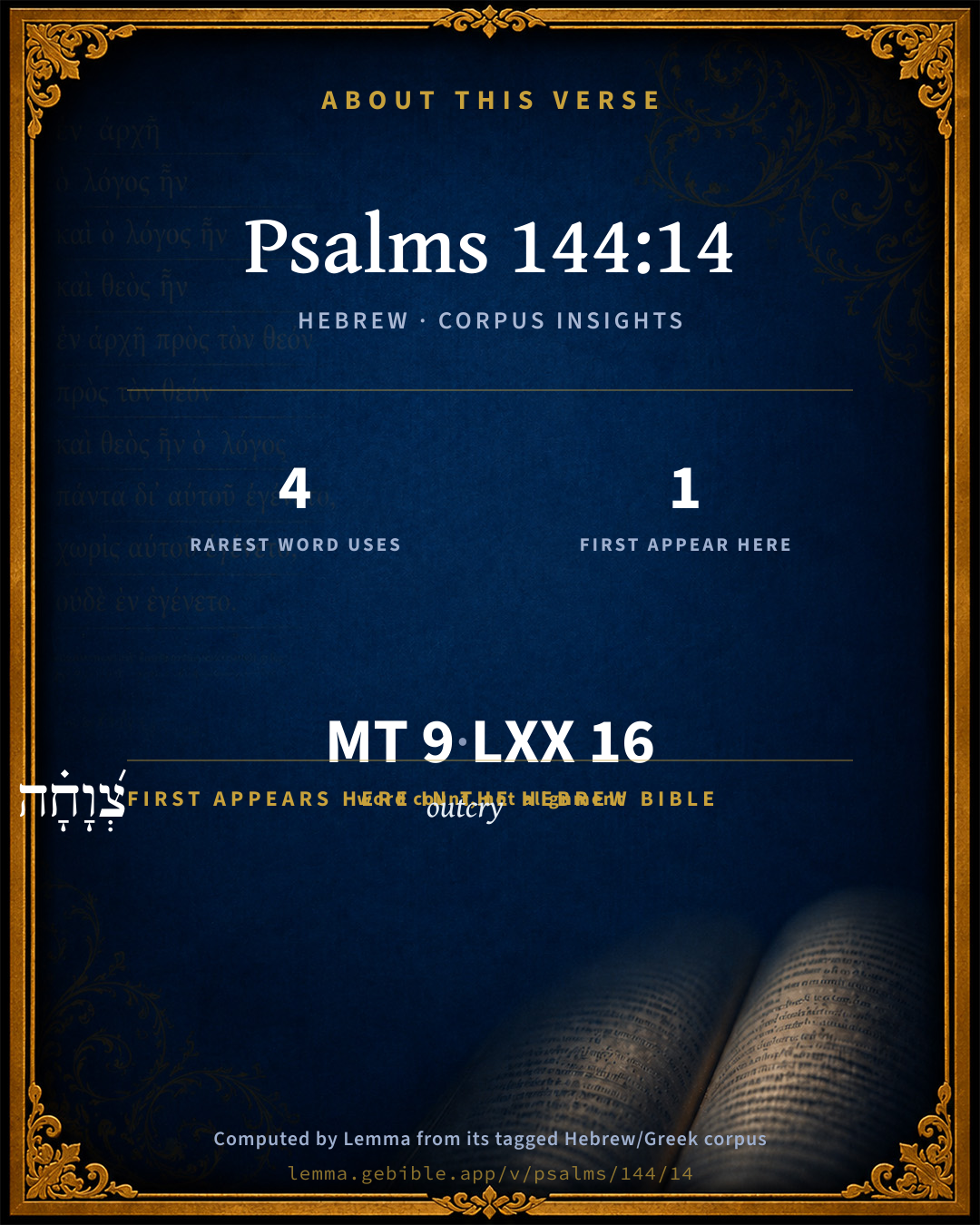
The rarest word here is צְ֝וָחָ֗ה outcry H6682 — appearing just 4 times in the whole Hebrew Bible.

First appearance in Scripture

This word makes its first canonical appearance in the Hebrew Bible here:

  • צְ֝וָחָ֗ה outcry H6682

Shared distinctive vocabulary

צְ֝וָחָ֗ה outcry H6682 occurs in 4 verses of the Hebrew Bible. Also found in:

Grammatical profile

  • 2 verbs
  • 4 nouns
  • 3 particles

Verb forms

  • מְֽסֻבָּ֫לִ֥ים Pual · Participle Passive
  • יוֹצֵ֑את Qal · Participle Active

Repetition

A word recurs within this verse — often emphatic in Hebrew:

  • אֵֽין nothing H369 ×3

Hebrew & Septuagint length

In English translation the verse runs 21 words from the Hebrew and 20 from the Septuagint (LXX English) — closely comparable.

A rough comparison of the two English renderings, which tokenize alike — not a word-level alignment.

Word counts can differ between the Hebrew and the Greek without any difference in meaning — e.g. the Hebrew direct-object marker אֵת has no separate Greek word, and Greek often adds the article ὁ.

In the original languages it is 9 Hebrew tokens and 16 Greek tokens — but the two are counted differently (Hebrew bundles its prefixes and suffixes into one token; the Greek is in lemma form), so that isn’t a like-for-like length.

Cross-references

13

Topical passages linked to Psalms 144:14 in the Treasury of Scripture Knowledge — connected by theme and wording, ordered by reader-vote popularity; previews shown in the World English Bible.

  • Deuteronomy 28:7 Yahweh will cause your enemies who rise up against you to be struck before you: they shall come out against you one way, and shall flee before you seven ways.
  • Zechariah 8:3–5 Thus says Yahweh: "I have returned to Zion, and will dwell in the midst of Jerusalem. Jerusalem shall be called 'The City of Truth;' and the mountain of Yahweh of Hosts, 'The Holy Mountain.'"
  • Deuteronomy 28:25 Yahweh will cause you to be struck before your enemies; you shall go out one way against them, and shall flee seven ways before them: and you shall be tossed back and forth among all the kingdoms of the earth.
  • Judges 5:8 They chose new gods; Then was war in the gates: Was there a shield or spear seen Among forty thousand in Israel?
  • Judges 6:3 So it was, when Israel had sown, that the Midianites came up, and the Amalekites, and the children of the east; they came up against them;
  • Judges 6:6 Israel was brought very low because of Midian; and the children of Israel cried to Yahweh.
  • 1 Samuel 13:17–23 The spoilers came out of the camp of the Philistines in three companies: one company turned to the way that leads to Ophrah, to the land of Shual;
  • 1 Samuel 31:7 When the men of Israel who were on the other side of the valley, and those who were beyond the Jordan, saw that the men of Israel fled, and that Saul and his sons were dead, they forsook the cities, and fled; and the Philistines came and lived in them.
  • Isaiah 24:11 There is a crying in the streets because of the wine; all joy is darkened, the mirth of the land is gone.
  • Jeremiah 13:17–19 But if you will not hear it, my soul shall weep in secret for [your] pride; and my eye shall weep sore, and run down with tears, because Yahweh's flock is taken captive.
  • Jeremiah 14:2 Judah mourns, and the gates of it languish, they sit in black on the ground; and the cry of Jerusalem is gone up.
  • Jeremiah 14:18 If I go forth into the field, then, behold, the slain with the sword! and if I enter into the city, then, behold, those who are sick with famine! for both the prophet and the priest go about in the land, and have no knowledge.
  • Lamentations 1:4–6 The ways of Zion do mourn, because none come to the solemn assembly; All her gates are desolate, her priests do sigh: Her virgins are afflicted, and she herself is in bitterness.

Cross-references courtesy of OpenBible.info (CC BY 4.0).

Hebrew and Greek witnesses Masoretic Hebrew ↔ Greek Septuagint

The same verse in the two great witnesses to the Old Testament, shown verse-for-verse.

You’re reading Greek Psalm 143 (Hebrew Psalm 144). The Septuagint counts the superscription, so verse numbers can differ from the Hebrew — chapter-level alignment, not verse-by-verse. Numbering follows Rahlfs.

These are two independent witnesses, not word-aligned to each other, and the Septuagint is shown in lemma (dictionary) form.

Hebrew Psalms 144:14 Masoretic · Westminster Leningrad Codex

אַלּוּפֵ֗ינוּ מְֽסֻבָּ֫לִ֥ים אֵֽין פֶּ֭רֶץ וְאֵ֣ין יוֹצֵ֑את וְאֵ֥ין צְ֝וָחָ֗ה בִּרְחֹבֹתֵֽינוּ

Our oxen will pull heavy loads. There is no breaking in, and no going away, And no outcry in our streets.

World English Bible · Public Domain

Greek LXX Greek Psalm 143:14 Septuagint · lemma form

ὁ βοῦς αὐτός παχύς οὐ εἰμί κατάπτωμα φραγμός οὐδέ διέξοδος οὐδέ κραυγή ἐν ὁ πλατύς αὐτός

Their oxen are fat: there is no falling down of a hedge, nor going out, nor cry in their folds.

LXX2012 (modern English Septuagint) · Public Domain

On this verse, Ellicott's Commentary for English Readers discusses the Septuagint’s reading. Read the note in Commentary ↓

Hebrew: Westminster Leningrad Codex (CC BY 4.0). Greek: Septuagint (public domain); English from LXX2012 (modern English Septuagint) (Public Domain). How the Septuagint differs from the Hebrew →

Commentary

Notes on Psalms 144:14 from classic Christian and Jewish commentators (each source and its license shown beneath its notes). The classic Christian expositions comment on the surrounding passage and are grouped to its opening verse, so a note may address several verses; the Jewish commentaries on the Tanakh (Rashi and others) are per-verse, so they appear only where the commentator wrote on this verse.

Lemma curates 59 commentaries, every one of them public domain or Creative Commons licensed, each selected and text-cleaned for this edition rather than reprinted as found. About our sources →

Trapp's Complete Commentary

John Trapp

Psa 144:14 [That] our oxen [may be] strong to labour; [that there be] no breaking in, nor going out; that [there be] no complaining in our streets.

Ver. 14. Nor going out] viz. To encounter the enemy, or to be led into captivity.

No complaining] No outcries but harvest homes.

John Trapp, A Commentary or Exposition upon All the Books of the Old and New Testament (1647–1656) — public domain. Text from a community e-Sword module.

The Biblical Illustrator

Joseph S. Exell

Psa_144:14

That there be no complaining in our streets.

English pauperism

English pauperism is a peculiar product of this island. You see nothing like it anywhere else. Those who have heard me speak on this topic know what an essential difference I draw between pauperism and poverty. Poverty is a relative term. Man may be poor, and yet may be healthy and very happy, and may not need your sympathy. But pauperism describes the conditions of those unhappy fellow-citizens of ours in such wretched circumstances that it is absolutely impossible for them to maintain themselves and their families in health and decency. Now, this kind of extreme poverty or pauperism is quite different from anything that you witness anywhere else. As a distinguished minister of my own church, Dr. Rigg, said a quarter of a century, ago, in a book which he published on the subject of Education, English pauperism is a national institution, a legacy from mediaeval times and dregs of an outworn feudalism. In other words, the peculiar pauperism which exists in this country arises from the fact that the people have been divorced from the soil. (H. P. Hughes, M. A.)

Remedy for pauperism

Many who have no sympathy with abstract committees would be delighted to help particular cases. If any such committee were able to put affluent men and women into direct relations with some starving families, it would be a great gain every way. This suggestion is not novel. It was made five years ago by a gentleman at the second conference we ever held. Suppose we could get every household represented here to look after one destitute household. Instead of giving their charity here and there, suppose I could introduce you to one family--husband, wife, and children--all in great need of work. You could in various ways assist with practical sympathy and advice as well as with money. I do not know how many families there are likely to be out of work. Suppose 20,000 or 30,000 are in this condition, and suppose I could get 20,000 or 30,000 men and women to undertake to be a real friend to one family each, it would not be a great strain upon their purse or time, and it would be an untold blessing. Oh, that we could do something to bring together into direct personal contact the unprivileged and the privileged! Their separation is the root of the want of social sympathy between them. But let me say that many of those who seem to be the most remote from the poor are deeply touched by their condition, and are extremely anxious to help them. And I think the way suggested by Mr. Arnold White is one of the most effectual. Further, it will be found that if we could only prevent the pauperism occasioned by intemperance, there would scarcely be any pauperism left. (H. P. Hughes, M. A.)

The Biblical Illustrator, edited by Joseph S. Exell (c. 1880s–1900s) — public domain. Text from a community e-Sword module.

J. A. Alexander on Psalms

Joseph Addison Alexander

14. (Psa 144:14) Our oxen loaded—no damage and no loss—and no complaint in our streets. The first particular implies abundance. For the use of oxen as beasts of burden, see 1Ch 12:40. Damage and loss, literally breach and going forth. Complaint, literally cry, but especially for loss of the fruits of the earth. See Isa 24:11. Some give the sentence an entirely different meaning, by supposing the word translated oxen to mean princes, as it does in Zec 9:7; Zec 12:5-6, and giving the participle joined with it the Chaldee sense of raised erect or upright. Going out then means going out to war, as in Amo 5:3, breach the incursion of an enemy, and cry a war-cry. But the first Hebrew word in question is applied only to the chiefs of Edom (Gen 36:15), except in the latest books of the Old Testament, such as Zechariah; and we naturally look for oxen after sheep, as in Psa 8:7.

Joseph Addison Alexander, The Psalms Translated and Explained (1850) — public domain. Text from a community e-Sword module.

Geneva Bible (1599)

Geneva Bible translators

He attributeth not only the great commodities, but even the least also to God’s favor.

Geneva Bible (1599) marginal notes — public domain. Text via Bolls.life.

Adam Clarke's Commentary

Verse 14. Our oxen may be strong to labour] We have not only an abundance of cattle; but they are of the most strong and vigorous breed.

No breaking in] So well ordered is the police of the kingdom, that there are no depredations, no robbers, house-breakers, or marauding parties, in the land; no sudden incursions of neighbouring tribes or banditti breaking into fields or houses, carrying away property, and taking with them the people to sell them into captivity: there is no such breaking in, and no such going out, in the nation. My enemies are either become friends, and are united with me in political interests; or are, through fear, obliged to stand aloof.

Adam Clarke's Commentary on the Bible (1810–1826) — public domain. Text from a community e-Sword/MySword module.

John Calvin's Commentaries

14. Our oxen, etc. The Hebrew word סבל, sabal, is properly to carry. Accordingly some understand מסובלים, mesubbalim, to mean robust, מסבלים, burdened, viz. with flesh, according to Pagninus, who has onusti carne. The root is סכל, and the form is the pual participle, which occurs only in this place. Compensis has paraphrased it: santi et ferendis oneribus apti. Perhaps burdened oxen may be a phrase equivalent to our beasts of burden such as are strong and adapted to carry burdens; and here the prayer of the Psalmist is, that they may be eminently fitted for this service.” — Phillips

John Calvin's Commentaries (1540-1563) — public domain. Text from the Calvin Translation Society English edition (1840s-50s) via the Christian Classics Ethereal Library (ccel.org). Calvin's coverage is partial (roughly two-thirds of the Bible); uncommented books and verses are honest gaps, never fabricated. The 19th-century editor's footnotes and remarks are omitted so the notes are faithfully Calvin's own voice.

Ellicott's Commentary for English Readers

(14) This verse is full of obscurities. The words rendered “oxen, strong to labour,” can hardly bear this meaning with the present pointing, since the participle is passive, and there is no authority for rendering oxen bearing burdens. The words have been rendered oxen laden, either with the produce of the land, or with their own fat (so apparently the LXX.), or with young, pregnant—all open to the objection that the passive of to bear must mean “to be borne,” and the latter to the further objection that the words are in the masculine. But since allûphîm elsewhere means “heads of families” (Jer_13:21, &c) or “princes,” and the noun cognate with the verb is used of a post connected with the revenue (1Ki_11:28; comp. the connection between the Greek ϕορός and ϕέρτερος), the participle passive may easily here mean “honoured,” or “high in office.” Or, from the use of the cognate Chaldee form in Ezr_6:3, “strongly laid,” we might render, our princes firmly established; and this is the best explanation of the passage.

No breaking in.—Heb., a “breach,” i.e., in the town walls. LXX. and Vulg., “no falling of the fence.” Others refer to the folds for cattle. (See Psa_60:2.) Ewald, however, connecting closely with the mention of “pregnant oxen,” renders no abortion. So Syriac: “Our cattle are great (with young), and there is not a barren one among them.”

Nor going out—i.e., either to war, or into captivity (Prayer Book version), or the breaking out of cattle. The first is the more probable.

Complaining.—Rather, outcry, cry of sorrow, as in Jer_14:2; or possibly, cry of battle.

Streets.—Better, squares.

A Bible Commentary for English Readers, edited by Charles John Ellicott (1878–1897) — public domain. Text from a community e-Sword module.

The Cambridge Bible for Schools and Colleges

gen. ed. J. J. S. Perowne

14. our oxen … strong to labour] Both words are of uncertain meaning. (1) Most commentators follow the Ancient Versions in regarding the word allûphîm here as a variant form for alâphîm, ‘oxen’ or ‘cattle.’ Oxen, it is thought, are naturally mentioned after sheep. The participle m’subbâlîm is variously explained. As it is passive in form it can hardly mean capable of bearing burdens, strong to labour (A.V.); and as it is masculine, it can hardly mean laden with young, pregnant. It is not a natural expression fox fat and strong, as the LXX, Aq., Symm. and Jerome render it, i.e. loaded with flesh. Most probably it means well laden (R.V.) with the produce of the fields which they draw home in carts.

(2) Allûphîm however may mean chieftains (cp. Zec_12:5-6), and in Ezr_6:3 the verb in Aramaic appears to mean set up or firmly established. In such a late Psalm it is quite possible that the word might be used in the sense it bears in Aramaic (cp. the word for rescue in Psa_144:7), and the meaning our chieftains firmly established suits the context very well. It is of course to be connected with the remainder of the verse, and not with Psa_144:13. If the leaders of the community are strong and their authority well established, the community will be in less danger of attacks from without.

no breaking in] No hostile invasion of the country: or, no breach in the city walls by which the enemy may enter (Neh_6:1).

nor going out] No going forth to surrender to the enemy (Amo_4:3; 2Ki_24:11), or into captivity (Jer_29:16): or no sallying forth to repel an attacking force.

no complaining in our streets] No outcry of citizens surprised by the enemy, or generally, no cry of mourning for disaster (Jer_14:2; Jer_46:12), in our broad places (Jer_5:1), the open space inside the city gates, which was the usual place of concourse for the citizens, where justice was administered, and business transacted.

The Cambridge Bible for Schools and Colleges (gen. ed. J. J. S. Perowne; Cambridge University Press, 1878–1918) — public domain. Text from a community e-Sword module.

John Gill's Exposition

That our oxen may be strong to labour,.... To draw carriages, to plough with, and to tread out the corn: or "may be burdened" (w); fit to carry burdens; or burdened with flesh, be plump and fat, and in good condition to work; or burdened with young, as some (x) understand it, and then it must be meant of cows, as the word is used, Deu 7:13; and so here an increase of kine is wished for, as of sheep before. Ministers of the word are compared to oxen for their patience in suffering, and their laboriousness in working, Co1 9:9, Ti1 5:17; and happy is it for the churches of Christ when their ministers are laborious ones; are strong to labour, and do labour, in the word and doctrine; stand fast in the faith, and quit themselves like men, and are strong;

that there be no breaking in: of the enemy into the land to invade it, into cities and houses to plunder and spoil them;

nor going out: of the city to meet the enemy and fight with him, peace and not war is desirable; or no going out of one's nation into captivity into a foreign country, as Kimchi; or no breaking in to folds and herds, and leading out and driving away cattle, to the loss of the owners thereof. Some (y) understand both these of abortion, of any violent rupture of the womb, and an immature birth;

that there be no complaining in our streets; on account of famine, pestilence, the sword, violence, and oppression; or no crying (z), no mournful cry or howling and shrieking on account of the enemy being at hand, and just ready to enter in, or being there, killing, plundering, and spoiling.

(w) "onusti", Pagninus, Montanus, Gejerus; "onerarii", so some in Vatablus; "onerati", Schmidt; "loden", Ainsworth, (x) So Bochart. Hierozoic. par. 1. l. 2. c. 295. (y) lbid. (z) "clamor", Pagninus, Montanus, Tigurine version, Musculus, Cocceius, Gejerus, Michaelis.

John Gill's Exposition of the Whole Bible (1746–1763) — public domain (CC PDM 1.0). Text via the HelloAO Bible API.

Albert Barnes' Notes on the Bible

That our oxen may be strong to labour - Margin, “able to bear burdens;” or, “laden with flesh.” The Hebrew is simply loaded or laden: that is, with a burden; or, with flesh; or, as Gesenius renders it, with young. The latter idea would best suit the connection - that of cattle producing abundantly or multiplying.

That there be no breaking in, nor going out - No breaking in of other cattle into enclosed grounds, and no escape of those which are shut up for pasture. That property may be safe everywhere. The image is that of security, peace, order, prosperity.

That there be no complaining in our streets - literally, “outcry; clamor.” That the land may be at peace; that order and law may be observed; that the rights of all may be respected; that among neighbors there may be no strifes and contentions.

Albert Barnes' Notes on the Bible (1834–1885) — public domain. Text from a community e-Sword/MySword module.

Matthew Poole's English Annotations

To labour, Heb. laden, either with flesh and fat, as many understand it; or, as others, with young: but then the foregoing word is not to be rendered

oxen, but cows, as the same word and in the same masculine gender is used Deu 7:13. And so this agrees best with the former prayer for the sheep, Psa 144:13, and he wisheth the same blessing of fruitfulness both for greater and smaller cattle.

No breaking in, to wit, of enemies invading the land, or assaulting our cities, and making breaches in their walls.

Nor going out, to wit, of our people; either out of the towns and cities, to fight with an invading enemy; or out of the land into captivity.

No complaining; or, no outcry, or howling, for any sad tidings, or public grievances or calamities.

Matthew Poole's English Annotations on the Holy Bible (1683–1685) — public domain. Text from a community e-Sword/MySword module.

The Treasury of David

Charles H. Spurgeon

Ver. 14. That our oxen may be strong to labour; so that the ploughing and cartage of the farm may be duly performed, and the husbandman's work may be accomplished without unduly taxing the cattle, or working them cruelly.

That there be no breaking in, nor going out; no irruption of marauders, and no forced emigration; no burglaries and no evictions.

That there be no complaining in our streets; no secret dissatisfaction, no public riot; no fainting of poverty, no clamour for rights denied, nor concerning wrongs unredressed. The state of things here pictured is very delightful: all is peaceful and prosperous; the throne is occupied efficiently, and even the beasts in their stalls are the better for it. This has been the condition of our own country, and if it should now be changed, who can wonder? For our ingratitude well deserves to be deprived of blessings which it has despised.

These verses may with a little accommodation be applied to a prosperous church, where the converts are growing and beautiful, the gospel stores abundant, and the spiritual increase most cheering. There ministers and workers are in full vigour, and the people are happy and united. The Lord make it so in all our churches evermore.

Ver. 14. That our oxen may be strong to labour. (Margin: "able to bear burdens", or, loaded with flesh.) As in the verse before he had ascribed the fruitfulness of the herds and flocks to God's goodness, so now the fattening of their oxen, to show that there is nothing relating to us here which he overlooks. John Calvin.

Ver. 14. That our oxen may be strong to labour. Oxen were not only used for ploughing, thrashing, and drawing, but also for bearing burdens; compare 1Ch 12:40, which passage is peculiarly fitted to throw light on the verse before us. Laden oxen presuppose a rich abundance of produce. E.W. Hengstenberg.

Ver. 14. That there be no complaining in our streets, etc. Rather, "and no cry of sorrow" (comp. Isa 24:11 Jer 14:2 46:12) "in our open places", i.e., the places where the people commonly assembled near the gate of the city (comp. 2Ch 32:6 Ne 8:1). The word rendered "complaining" does not occur elsewhere in the psalter. Speaker's Commentary.

Ver. 14. No complaining. No outcries but "Harvest homes." John Trapp.

Ver. 14. A prayer for our ministers, and for the security, unity, and happiness of the church.

Ver. 14. The prosperous Church. There

1. Labour is cheerfully performed.

2. The enemy is kept without the gate.

3. There are few or no departures.

4. Faith and content silence complaint.

5. Pray that such may be our case as a church. W.B.H.

Psalms 144:15*

Charles H. Spurgeon's The Treasury of David (1869–1885) — public domain. Psalms only. Text from a community e-Sword/MySword module.

Whedon's Commentary on the Bible

Daniel D. Whedon

14. Breaking in, is in Hebrew only “breaking,” and refers to damage or painful casualty; while going out is loss or failure. These verses follow beautifully Psa_144:11, and continue its prayer; portraying in few words a copious prosperity, such as a king might wish for his people.

Daniel D. Whedon (gen. ed.), Commentary on the Old and New Testaments (1874–1909) — public domain. Text from a community e-Sword module.

The Pulpit Commentary

That our oxen may be strong to labor; rather, and our oxen are heavily laden. A sign that an abundant harvest is being gathered in. That there be no breaking in, nor going out; literally, and there is no breach and no removal; i.e. no breach made in our walls, and no removal of our population into captivity. That there be no complaining in our streets; rather, and no wailing in our streets. Here the description of a happy time ends, and a burst of congratulation follows (see the next verse).

The Pulpit Commentary (1880–1919), ed. H.D.M. Spence-Jones & Joseph S. Exell — public domain. Text from a community e-Sword module.

John Wesley's Explanatory Notes

Breaking in - Of enemies invading the land, or assaulting our cities, and making breaches in their walls. Going out - Of our people, either out of the cities to fight with an invading enemy: or out of the land into captivity.

John Wesley, Explanatory Notes Upon the Whole Bible (1754–1765) — public domain. Text via the GEBible commentary corpus.

unfoldingWord translationNotes

Door43 World Missions Community

No one will break through our walls

"No one will be able to invade our city"

no outcry

Here the outcry is associated with a severe problem that causes the person to cry out. AT: "no one crying in pain" or "no one crying for help" or "no one calling out for justice" (See: Metonymy)

translationWords

cow

exile

bless

people group

unfoldingWord translationNotes — © Distant Shores Media and the Door43 World Missions Community, licensed CC BY-SA 4.0. Source: git.door43.org/Door43/en_tn.

Rashi

Rabbi Shlomo Yitzchaki (Rashi)

Our princes are borne The great princes among us are borne by those smaller than they, for the small ones obey the greater ones, the result being that there is no breach among us.

nor rumor going out No bad news goes far away.

nor is there a cry There is no sound of the confusion of war.

Rashi on the Tanakh — English translations: “The Judaica Press complete Tanach with Rashi, translated by A. J. Rosenberg” (CC BY 4.0); “Pentateuch with Rashi's commentary by M. Rosenbaum and A.M. Silbermann, 1929-1934” (public domain); “The Metsudah Tanach series, Lakewood, N.J” (CC BY 4.0); and “The Book of Joshua, Metsudah Publications, 1997” (CC BY 4.0). Text via Sefaria.

Lesson kit

Teaching starters — assembled from the data on this page, not authored interpretation. Every prompt links to the verse data it draws on. Edit before teaching.

Psalms, in the Wisdom, opens this verse with 9 words (7 distinct Hebrew lemmas). Its most distinctive word is tsᵉvâchâh (“outcry”). A historical commentator’s framing appears above. Read the whole chapter for the surrounding context.

Discussion questions

  1. What does “outcry” (tsᵉvâchâh) contribute to the verse as a whole?
  2. The word “outcry” first appears here in Scripture. What is being introduced at this debut?
  3. Isaiah 24:11 shares the word «outcry» with this verse. How do the two illuminate each other?
  4. “nothing” occurs 3× in this one verse. What is the effect of the repetition?
  5. These translations render this verse differently; the difference is in the English rendering, not the original. What questions does that raise?
  6. The verb «מְֽסֻבָּ֫לִ֥ים» is Pual Participle Passive. How does its form color the action?
  7. Reading how Trapp's Complete Commentary and The Biblical Illustrator read this verse, where do the two commentators agree and where do they part?

Things to notice

Reading settings

Reading text

Shown beneath each verse's original-language words.

Old Testament
Old Testament edition

Read the OT as the Masoretic Hebrew (MT) or the Greek Septuagint (LXX).

English shown for the Greek Septuagint (in the Hebrew ↔ Greek comparison).

Comparing translations? Open the Compare panel on any verse page to stack up to four side by side.