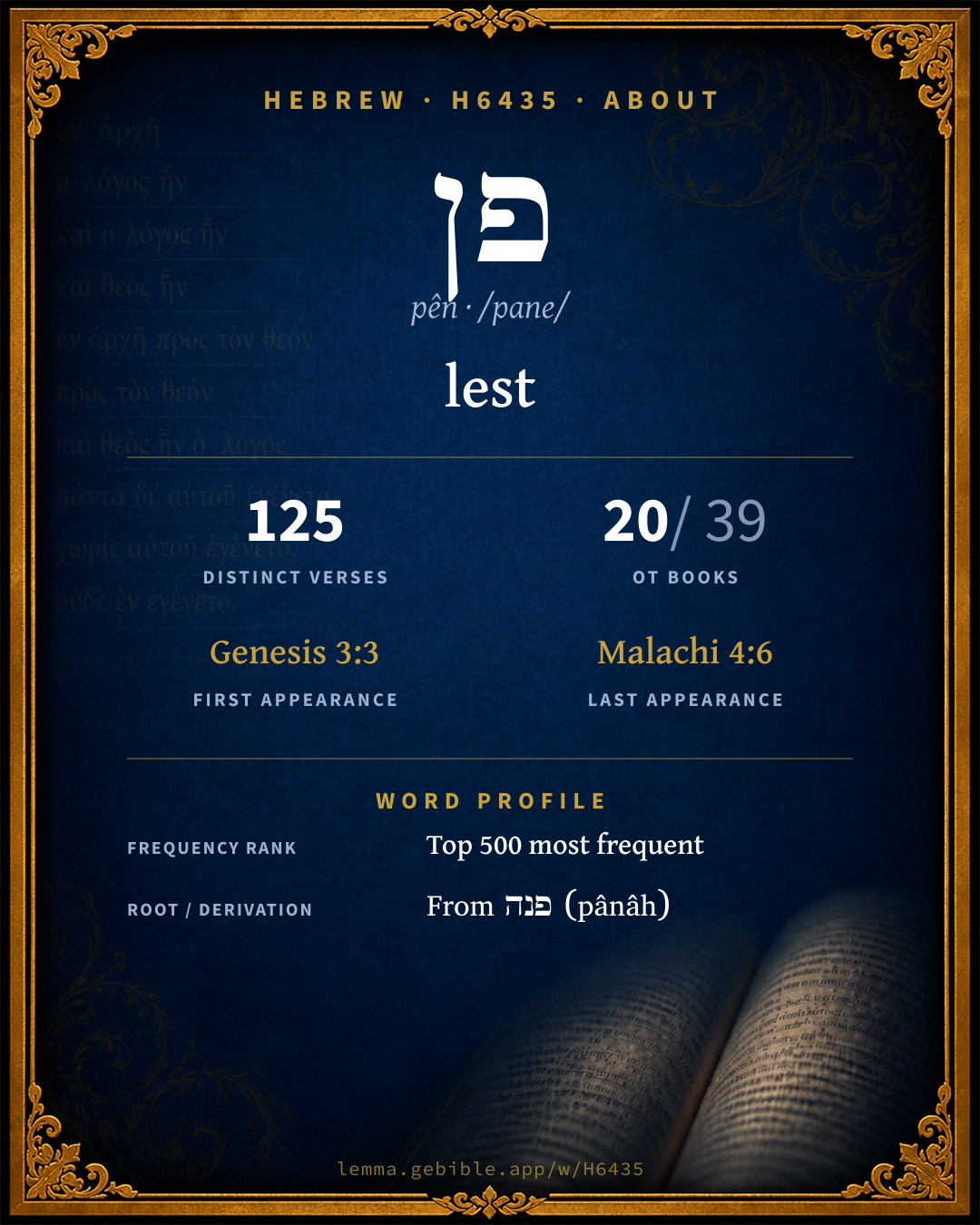
פֶּן־
lest
also: not, beware lest fuller range ↓
Full lexicon entry — Brown-Driver-Briggs (BDB)
From Brown-Driver-Briggs (BDB)
Where this word appears
Grammar key — what these labels mean
Part of speech
- Conjunction
- A joining word (e.g. “and,” “but”) linking words or clauses.
Every verse where H6435 appears in the Book of Deuteronomy — 24 distinct verses. Click any verse to open its interlinear word-by-word view. Verse text shown in the World English Bible for context — . Each verse’s Hebrew form is shown with its reference; the English is not keyword-highlighted, since the data carries no word-level English alignment. Use “Compare translations” on any verse to read it across multiple English versions. This concordance covers the Hebrew Bible; Septuagint (Greek Old Testament) occurrences are not indexed here.
Deuteronomy
- Deuteronomy 4:9 פֶּן וּ/פֶן conj conj + conj Only take heed to yourself, and keep your soul diligently, lest you forget the things which your eyes saw, and lest they depart from your heart all the days of your life; but make them known to your children and your children's children;
- Deuteronomy 4:16 פֶּ֨ן conj Lest you corrupt yourselves, and make yourself an engraved image in the form of any figure, the likeness of male or female,
- Deuteronomy 4:19 וּ/פֶן conj + conj and lest you lift up your eyes to the sky, and when you see the sun and the moon and the stars, even all the host of the sky, you are drawn away and worship them, and serve them, which Yahweh your God has allotted to all the peoples under the whole sky.
- Deuteronomy 4:23 פֶּֽן conj Take heed to yourselves, lest you forget the covenant of Yahweh your God, which he made with you, and make you an engraved image in the form of anything which Yahweh your God has forbidden you.
- Deuteronomy 6:12 פֶּן conj then beware lest you forget Yahweh, who brought you forth out of the land of Egypt, out of the house of bondage.
- Deuteronomy 6:15 פֶּן conj for Yahweh your God in the midst of you is a jealous God; lest the anger of Yahweh your God be kindled against you, and he destroy you from off the face of the earth.
- Deuteronomy 7:22 פֶּן conj Yahweh your God will cast out those nations before you by little and little: you may not consume them at once, lest the animals of the field increase on you.
- Deuteronomy 7:25 פֶּ֚ן conj The engraved images of their gods shall you burn with fire: you shall not covet the silver or the gold that is on them, nor take it to you, lest you be snared therein; for it is an abomination to Yahweh your God.
- Deuteronomy 8:11 פֶּן conj Beware lest you forget Yahweh your God, in not keeping his commandments, and his ordinances, and his statutes, which I command you this day:
- Deuteronomy 8:12 פֶּן conj lest, when you have eaten and are full, and have built goodly houses, and lived therein;
- Deuteronomy 9:28 פֶּן conj lest the land whence you brought us out say, Because Yahweh was not able to bring them into the land which he promised to them, and because he hated them, he has brought them out to kill them in the wilderness.
- Deuteronomy 11:16 פֶּ֥ן conj Take heed to yourselves, lest your heart be deceived, and you turn aside, and serve other gods, and worship them;
- Deuteronomy 12:13 פֶּֽן conj Take heed to yourself that you don't offer your burnt offerings in every place that you see;
- Deuteronomy 12:19 פֶּֽן conj Take heed to yourself that you don't forsake the Levite as long as you live in your land.
- Deuteronomy 12:30 פֶּן וּ/פֶן conj conj + conj take heed to yourself that you not be ensnared to follow them, after that they are destroyed from before you; and that you not inquire after their gods, saying, How do these nations serve their gods? even so will I do likewise.
- Deuteronomy 15:9 פֶּן conj Beware that there not be a base thought in your heart, saying, The seventh year, the year of release, is at hand; and your eye be evil against your poor brother, and you give him nothing; and he cry to Yahweh against you, and it be sin to you.
- Deuteronomy 19:6 פֶּן conj lest the avenger of blood pursue the manslayer, while his heart is hot, and overtake him, because the way is long, and strike him mortally; whereas he was not worthy of death, inasmuch as he didn't hate him in time past.
- Deuteronomy 20:5 פֶּן conj The officers shall speak to the people, saying, What man is there who has built a new house, and has not dedicated it? let him go and return to his house, lest he die in the battle, and another man dedicate it.
- Deuteronomy 20:6 פֶּן conj What man is there who has planted a vineyard, and has not used the fruit of it? let him go and return to his house, lest he die in the battle, and another man use the fruit of it.
- Deuteronomy 20:7 פֶּן conj What man is there who has pledged to be married a wife, and has not taken her? let him go and return to his house, lest he die in the battle, and another man take her.
- Deuteronomy 22:9 פֶּן conj You shall not sow your vineyard with two kinds of seed, lest the whole fruit be forfeited, the seed which you have sown, and the increase of the vineyard.
- Deuteronomy 25:3 פֶּן conj Forty stripes he may give him, he shall not exceed; lest, if he should exceed, and beat him above these with many stripes, then your brother should seem vile to you.
- Deuteronomy 29:18 פֶּן פֶּן conj conj lest there should be among you man, or woman, or family, or tribe, whose heart turns away this day from Yahweh our God, to go to serve the gods of those nations; lest there should be among you a root that bears gall and wormwood;
- Deuteronomy 32:27 פֶּֽן פֶּן conj conj Were it not that I feared the provocation of the enemy, Lest their adversaries should judge wrongly, Lest they should say, Our hand is exalted, Yahweh has not done all this.
About this entry
At a glance — auto-summarized from this page’s data, not written by a person. Every figure links to its source below. This summary describes the numbers; it doesn’t interpret them.
פן (pên) is a Hebrew word most often rendered “lest.” Debuting at Genesis 3:3, it then recurs through the corpus. The Hebrew Bible uses it across 125 verses — common. It also covers “not” and “beware lest”, alongside “lest” — see its full sense range. Related forms include פנה, פנים and יפנה. For the data behind this summary, explore the sense tree and the renderings breakdown below.
Gloss history
Strong's 1890 vs modern scholarship
About this word
Strong's H6435 catalogs a Hebrew word from the Hebrew Old Testament.
These counts are not copied from any lexicon or concordance. They are computed here, from the morphology-tagged Hebrew Old Testament. What Lemma adds →
- 125
- distinct verses
- The word appears in 125 distinct verses.
- 20 / 39
- OT books
- The word appears in 20 of 39 Old Testament books.
- #339
- by frequency
- Top 500 most frequent Hebrew words (rank 339 of 8,640 Hebrew words by occurrence).
View all 125 occurrences in the concordance →
Most concentrated in
- Deuteronomy 24 verses 19%
- Genesis 17 verses 14%
- Proverbs 17 verses 14%
By section of the Old Testament
By traditional corpus
Conventional, traditional groupings — biblical authorship is debated, so this is a traditional corpus grouping, not an authorship claim. Each share is this word’s portion of its verses in that division of the Hebrew canon. Each figure is a share of the word’s 125 distinct verses.
- Torah (Pentateuch) 57 verses · 46%
- Prophets (Nevi'im) 38 verses · 30%
- Writings (Ketuvim) 30 verses · 24%
How translations render this word
Counts come from each version’s own published word-to-Strong’s tagging or interlinear alignment — an approximate guide to how each version renders this word, not a word-level alignment the data otherwise carries. Because each total is that version’s own tagged count, the per-version totals vary from one another and need not match the appearance or distinct-verse counts above. These counts may also differ from a printed concordance because Lemma counts each distinctly tagged rendering and does not collapse phrase taggings into a single head-word total. This is a fixed set of word-tagged versions (KJV, ASV, BSB, ULT) and does not change with the reading translation you choose elsewhere. Each version’s license is shown beside its name below (and on Sources).
- King James Version: Lest 1×, Lest peradventure 1×, Not 1×
- American Standard Version: Lest 1×, Lest peradventure 1×, Not 1×
- Berean Standard Bible: Or 38×, Lest 21×, Otherwise 19×
- unfoldingWord Literal Text: Lest 110×, That 11×, Not 10×
King James Version Public Domain
Renders H6435 across 4 tagged occurrences — most commonly:
American Standard Version Public Domain
Renders H6435 across 4 tagged occurrences — most commonly:
Berean Standard Bible Public Domain
Renders H6435 across 124 tagged occurrences — most commonly:
Plus 22 renderings that appear only once — usually multi-word phrases or single function words the recovered tagging swept in, not distinct renderings. Not rendered by a distinct English word in 8 further occurrences.
unfoldingWord Literal Text CC BY-SA 4.0
Renders H6435 across 142 tagged occurrences — most commonly:
Plus 9 renderings that appear only once — usually multi-word phrases or single function words the recovered tagging swept in, not distinct renderings.
Senses in the full BDB
What do BDB’s symbols mean?
BDB uses these scholarly abbreviations:
| Symbol | Meaning |
|---|---|
| 𝔊 | the Septuagint (the ancient Greek translation, LXX) |
| 𝔙 | the Vulgate (the Latin translation) |
| 𝔖 | the Syriac version (the Peshitta) |
| 𝔗 | the Targum (the Aramaic translation) |
| ψ | the Psalms |
| √ | root (the underlying root or stem) |
| ‖ | parallel passage (a synonymous or contrasted parallel) |
| † | the dagger: every passage where the word occurs is cited |
The 2 senses and sub-senses the full Brown-Driver-Briggs lexicon distinguishes for this word, in lexicon order (not ranked by frequency), with BDB’s own verbatim wording and sub-sense lettering. Shown in Hebrew script with BDB’s own scholarly abbreviations. The condensed entry is in the Lexicon Entry tab. See also the Forms in the corpus table below.
- 1. with impf.
- 2. with Pf., the result feared being conceived as having possibly already taken place
Senses from the full Brown-Driver-Briggs lexicon (Brown, Driver, Briggs; Oxford 1906 — public domain), digitized via Sefaria, supplemented by the OpenScriptures HebrewLexicon (CC BY 4.0). Full attribution on Sources.
Word origin
פֶּן־ 133 (alw. with Makkeph) conj. (adverting or deprecating), lest
— Brown-Driver-Briggs (Oxford 1906, public domain), digitized via Sefaria, supplemented by the OpenScriptures HebrewLexicon (CC BY 4.0). See Sources.
Derived from פנה (pânâh) (H6437) — to turn.
Jastrow Dictionary
A second Hebrew/Aramaic lexicon for comparison, covering Aramaic and post-biblical (Talmudic, Targumic, Midrashic) usage that the biblical-Hebrew BDB does not. Matched by lemma rather than by Strong’s number, so a lemma may carry more than one Jastrow headword (shown separately below), and the entries cover usage well beyond the Bible.
פן
- , Targ. Jon. I, 8 some ed. ומפן, read ומנן, v. מְנָן
פֶּן
- [eventually,] lest. Zeb. 106ᵃ כל מקום שנאמר השמר פן ואל וכ׳ wherever the Scripture has ‘be guarded, lest’, or al, it introduces a prohibitory law (v. עָשָׂה); Sot. 5ᵃ, a. fr. Sifré Deut. 70, quot. in Yalk. ib. 882 השמר בלא תעשה פן בלא תעשה ‘be guarded’ means a prohibitory law, and so does ‘lest’.
A Dictionary of the Targumim, the Talmud Babli and Yerushalmi, and the Midrashic Literature (Marcus Jastrow; London, Luzac, 1903) — Public Domain. Digitized via Sefaria. Digitized via Sefaria. Full attribution on Sources.
Forms in the corpus
The 9 distinct written forms H6435 takes in the Hebrew Bible, most frequent first — each parse links to that state’s occurrences in the concordance. Hebrew forms include their vowel points and cantillation, so a single lemma takes many written forms.
| Form | Parsing | Example | Uses |
|---|---|---|---|
| פֶּן | Conjunction | Amos 5:6 | 97 |
| פֶּֽן | Conjunction | Deuteronomy 4:23 | 19 |
| פֶּ֚ן | Conjunction | Deuteronomy 7:25 | 6 |
| וּ/פֶן | Conjunction | Deuteronomy 4:9 | 4 |
| פֶּ֥ן | Conjunction | Deuteronomy 11:16 | 2 |
| פֶּ֨ן | Conjunction | Deuteronomy 4:16 | 2 |
| וּ/פֶֽן | Conjunction | Proverbs 30:9 | 1 |
| פֶּ֖ן | Conjunction | Genesis 38:23 | 1 |
| פֶּ֣ן | Conjunction | Proverbs 25:8 | 1 |
Same root — word family
Other BDB entries built from the same root as H6435, grouped by Strong’s listed origin. These share a root / origin per the lexicon — not necessarily a shared meaning. Each links to that word’s own entry.
Derives from
Shares the same root
Proper names from this root
People and places named from this root — a name, not an additional meaning of the word.
Compare all same-root words → Showing 4 of 5 — not the complete family. 2 of the same-root words are proper names (people or places). They share a root, not necessarily a meaning.
Septuagint verse parallels
This word appears in 121 verses that also exist in the Greek Old Testament (Septuagint), out of the 125 Hebrew verses it occurs in. You can read those verses in Greek by switching the Old Testament edition to the Septuagint.
Read these verses in the Septuagint
- Genesis 3:3
- Exodus 1:10
- Leviticus 10:7
- Numbers 16:26
- Deuteronomy 4:9
- Joshua 2:16
- Judges 7:2
- Ruth 4:6
- 1 Samuel 4:9
- 2 Samuel 1:20
- 2 Kings 2:16
- 1 Chronicles 10:4
This is a verse-level parallel only — the same verses exist in both the Hebrew and Greek Old Testaments. No word-level Hebrew↔Greek correspondence is claimed: the data carries no such alignment, so no Greek word is shown as this Hebrew word’s translation. Coverage is not total — the Septuagint omits the deuterocanon and renumbers the Psalms, so some Hebrew verses have no direct Greek parallel.