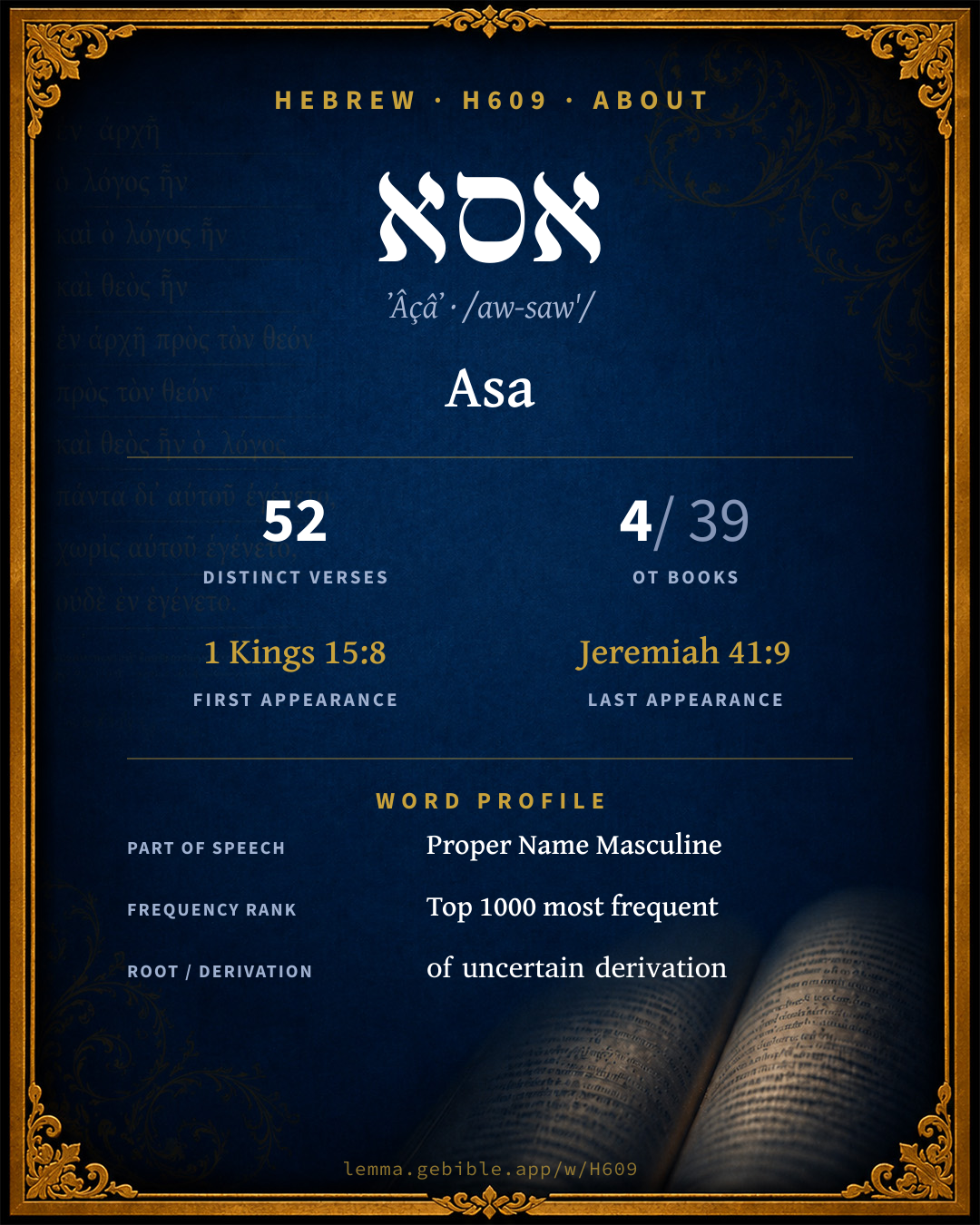
אָסָא
Asa
BDB lists 3 entries for ‘Asa’ fuller range ↓
Full lexicon entry — Brown-Driver-Briggs (BDB)
From Brown-Driver-Briggs (BDB)
Where this word appears
Grammar key — what these labels mean
Part of speech
- Noun
- A naming word — a person, place, thing, or idea.
Noun type
- Proper
- A name of a specific person, place, or people (e.g. Abraham, Zion, Israel).
Every verse where H609 appears — 52 distinct verses across 4 books. Click any verse to open its interlinear word-by-word view. Verse text shown in the World English Bible for context — . Each verse’s Hebrew form is shown with its reference; the English is not keyword-highlighted, since the data carries no word-level English alignment. Use “Compare translations” on any verse to read it across multiple English versions. This concordance covers the Hebrew Bible; Septuagint (Greek Old Testament) occurrences are not indexed here.
1 Kings 24 verses
- 1 Kings 15:8 אָסָ֥א n Proper Abijam slept with his fathers; and they buried him in the city of David: and Asa his son reigned in his place.
- 1 Kings 15:9 אָסָ֖א n Proper In the twentieth year of Jeroboam king of Israel began Asa to reign over Judah.
- 1 Kings 15:11 אָסָ֛א n Proper Asa did that which was right in the eyes of Yahweh, as did David his father.
- 1 Kings 15:13 אָסָא֙ n Proper Also Maacah his mother he removed from being queen, because she had made an abominable image for an Asherah; and Asa cut down her image, and burnt it at the brook Kidron.
- 1 Kings 15:14 אָסָ֗א n Proper But the high places were not taken away: nevertheless the heart of Asa was perfect with Yahweh all his days.
- 1 Kings 15:16 אָסָ֗א n Proper There was war between Asa and Baasha king of Israel all their days.
- 1 Kings 15:17 לְ/אָסָ֖א prep + n Proper Baasha king of Israel went up against Judah, and built Ramah, that he might not allow anyone to go out or come in to Asa king of Judah.
- 1 Kings 15:18 אָ֠סָא אָסָ֗א n Proper n Proper Then Asa took all the silver and the gold that were left in the treasures of the house of Yahweh, and the treasures of the king's house, and delivered them into the hand of his servants; and king Asa sent them to Ben Hadad, the son of Tabrimmon, the son of Hezion, king of Syria, who lived at Damascus, saying,
- 1 Kings 15:20 אָסָ֗א n Proper Ben Hadad listened to king Asa, and sent the captains of his armies against the cities of Israel, and struck Ijon, and Dan, and Abel Beth Maacah, and all Chinneroth, with all the land of Naphtali.
- 1 Kings 15:22 אָסָ֜א אָסָ֔א n Proper n Proper Then king Asa made a proclamation to all Judah; none was exempted: and they carried away the stones of Ramah, and the timber of it, with which Baasha had built; and king Asa built therewith Geba of Benjamin, and Mizpah.
- 1 Kings 15:23 אָ֠סָא n Proper Now the rest of all the acts of Asa, and all his might, and all that he did, and the cities which he built, aren't they written in the book of the chronicles of the kings of Judah? But in the time of his old age he was diseased in his feet.
- 1 Kings 15:24 אָסָא֙ n Proper Asa slept with his fathers, and was buried with his fathers in the city of David his father; and Jehoshaphat his son reigned in his place.
- 1 Kings 15:25 לְ/אָסָ֖א prep + n Proper Nadab the son of Jeroboam began to reign over Israel in the second year of Asa king of Judah; and he reigned over Israel two years.
- 1 Kings 15:28 לְ/אָסָ֖א prep + n Proper Even in the third year of Asa king of Judah did Baasha kill him, and reigned in his place.
- 1 Kings 15:32 אָסָ֗א n Proper There was war between Asa and Baasha king of Israel all their days.
- 1 Kings 15:33 לְ/אָסָ֖א prep + n Proper In the third year of Asa king of Judah began Baasha the son of Ahijah to reign over all Israel in Tirzah, [and reigned] twenty-four years.
- 1 Kings 16:8 לְ/אָסָ֖א prep + n Proper In the twenty-sixth year of Asa king of Judah began Elah the son of Baasha to reign over Israel in Tirzah, [and reigned] two years.
- 1 Kings 16:10 לְ/אָסָ֖א prep + n Proper and Zimri went in and struck him, and killed him, in the twenty-seventh year of Asa king of Judah, and reigned in his place.
- 1 Kings 16:15 לְ/אָסָא֙ prep + n Proper In the twenty-seventh year of Asa king of Judah did Zimri reign seven days in Tirzah. Now the people were encamped against Gibbethon, which belonged to the Philistines.
- 1 Kings 16:23 לְ/אָסָא֙ prep + n Proper In the thirty-first year of Asa king of Judah began Omri to reign over Israel, [and reigned] twelve years: six years reigned he in Tirzah.
- 1 Kings 16:29 לְ/אָסָ֖א prep + n Proper In the thirty-eighth year of Asa king of Judah began Ahab the son of Omri to reign over Israel: and Ahab the son of Omri reigned over Israel in Samaria twenty-two years.
- 1 Kings 22:41 אָסָ֔א n Proper Jehoshaphat the son of Asa began to reign over Judah in the fourth year of Ahab king of Israel.
- 1 Kings 22:43 אָסָ֥א n Proper He walked in all the way of Asa his father; He didn't turn aside from it, doing that which was right in the eyes of Yahweh: however the high places were not taken away; the people still sacrificed and burnt incense in the high places.
- 1 Kings 22:46 אָסָ֣א n Proper The remnant of the sodomites, that remained in the days of his father Asa, he put away out of the land.
1 Chronicles 2 verses
- 1 Chronicles 3:10 אָסָ֥א n Proper Solomon's son was Rehoboam, Abijah his son, Asa his son, Jehoshaphat his son,
- 1 Chronicles 9:16 אָסָא֙ n Proper and Obadiah the son of Shemaiah, the son of Galal, the son of Jeduthun, and Berechiah the son of Asa, the son of Elkanah, who lived in the villages of the Netophathites.
2 Chronicles 25 verses
- 2 Chronicles 14:1 אָסָ֥א n Proper So Abijah slept with his fathers, and they buried him in the city of David; and Asa his son reigned in his place. In his days the land was quiet ten years.
- 2 Chronicles 14:2 אָסָא֙ n Proper Asa did that which was good and right in the eyes of Yahweh his God:
- 2 Chronicles 14:8 לְ/אָסָ֗א prep + n Proper Asa had an army that bore bucklers and spears, out of Judah three hundred thousand; and out of Benjamin, that bore shields and drew bows, two hundred eighty thousand: all these were mighty men of valor.
- 2 Chronicles 14:10 אָסָ֖א n Proper Then Asa went out to meet him, and they set the battle in array in the valley of Zephathah at Mareshah.
- 2 Chronicles 14:11 אָסָ֜א n Proper Asa cried to Yahweh his God, and said, Yahweh, there is none besides you to help, between the mighty and him who has no strength: help us, Yahweh our God; for we rely on you, and in your name are we come against this multitude. Yahweh, you are our God; don't let man prevail against you.
- 2 Chronicles 14:12 אָסָ֖א n Proper So Yahweh struck the Ethiopians before Asa, and before Judah; and the Ethiopians fled.
- 2 Chronicles 14:13 אָסָ֜א n Proper Asa and the people who were with him pursued them to Gerar: and there fell of the Ethiopians so many that they could not recover themselves; for they were destroyed before Yahweh, and before his host; and they carried away very much booty.
- 2 Chronicles 15:2 אָסָא֒ אָסָ֖א n Proper n Proper and he went out to meet Asa, and said to him, Hear you me, Asa, and all Judah and Benjamin: Yahweh is with you, while you are with him; and if you seek him, he will be found of you; but if you forsake him, he will forsake you.
- 2 Chronicles 15:8 אָסָ֜א n Proper When Asa heard these words, and the prophecy of Oded the prophet, he took courage, and put away the abominations out of all the land of Judah and Benjamin, and out of the cities which he had taken from the hill-country of Ephraim; and he renewed the altar of Yahweh, that was before the porch of Yahweh.
- 2 Chronicles 15:10 אָסָֽא n Proper So they gathered themselves together at Jerusalem in the third month, in the fifteenth year of the reign of Asa.
- 2 Chronicles 15:16 אָסָ֣א אָסָא֙ n Proper n Proper Also Maacah, the mother of Asa the king, he removed from being queen, because she had made an abominable image for an Asherah; and Asa cut down her image, and made dust of it, and burnt it at the brook Kidron.
- 2 Chronicles 15:17 אָסָ֛א n Proper But the high places were not taken away out of Israel: nevertheless the heart of Asa was perfect all his days.
- 2 Chronicles 15:19 אָסָֽא n Proper There was no more war to the five and thirtieth year of the reign of Asa.
- 2 Chronicles 16:1 אָסָ֔א לְ/אָסָ֖א n Proper prep + n Proper In the six and thirtieth year of the reign of Asa, Baasha king of Israel went up against Judah, and built Ramah, that he might not allow anyone to go out or come in to Asa king of Judah.
- 2 Chronicles 16:2 אָסָ֜א n Proper Then Asa brought out silver and gold out of the treasures of the house of Yahweh and of the king's house, and sent to Ben Hadad king of Syria, who lived at Damascus, saying,
- 2 Chronicles 16:4 אָסָ֗א n Proper Ben Hadad listened to king Asa, and sent the captains of his armies against the cities of Israel; and they struck Ijon, and Dan, and Abel Maim, and all the store-cities of Naphtali.
- 2 Chronicles 16:6 וְ/אָסָ֣א conj + n Proper Then Asa the king took all Judah; and they carried away the stones of Ramah, and the timber of it, with which Baasha had built; and he built therewith Geba and Mizpah.
- 2 Chronicles 16:7 אָסָ֖א n Proper At that time Hanani the seer came to Asa king of Judah, and said to him, Because you have relied on the king of Syria, and have not relied on Yahweh your God, therefore is the host of the king of Syria escaped out of your hand.
- 2 Chronicles 16:10 אָסָ֜א אָסָ֛א n Proper n Proper Then Asa was angry with the seer, and put him in the prison-house; for he was in a rage with him because of this thing. Asa oppressed some of the people at the same time.
- 2 Chronicles 16:11 אָסָ֔א n Proper Behold, the acts of Asa, first and last, behold, they are written in the book of the kings of Judah and Israel.
- 2 Chronicles 16:12 אָסָ֡א n Proper In the thirty-ninth year of his reign Asa was diseased in his feet; his disease was exceeding great: yet in his disease he didn't seek Yahweh, but to the physicians.
- 2 Chronicles 16:13 אָסָ֖א n Proper Asa slept with his fathers, and died in the one and fortieth year of his reign.
- 2 Chronicles 17:2 אָסָ֥א n Proper He placed forces in all the fortified cities of Judah, and set garrisons in the land of Judah, and in the cities of Ephraim, which Asa his father had taken.
- 2 Chronicles 20:32 אָסָ֖א n Proper He walked in the way of Asa his father, and didn't turn aside from it, doing that which was right in the eyes of Yahweh.
- 2 Chronicles 21:12 אָסָ֥א n Proper There came a writing to him from Elijah the prophet, saying, Thus says Yahweh, the God of David your father, Because you have not walked in the ways of Jehoshaphat your father, nor in the ways of Asa king of Judah,
Jeremiah 1 verse
About this entry
At a glance — auto-summarized from this page’s data, not written by a person. Every figure links to its source below. This summary describes the numbers; it doesn’t interpret them.
אסא (ʼÂçâʼ) is a Hebrew name most often rendered “Asa.” It first appears in 1 Kings 15:8. It turns up in 52 verses across 4 books, a moderately common footprint. It concentrates in 2 Chronicles, which alone accounts for 48% of its uses. For the data behind this summary, explore 52-verse concordance and the renderings breakdown below.
Gloss history
Strong's 1890 vs modern scholarship
About this word
Strong's H609 catalogs a Hebrew word from the Hebrew Old Testament.
These counts are not copied from any lexicon or concordance. They are computed here, from the morphology-tagged Hebrew Old Testament. What Lemma adds →
- 52
- distinct verses
- The word appears in 52 distinct verses.
- 4 / 39
- OT books
- The word appears in 4 of 39 Old Testament books.
- #658
- by frequency
- Top 1000 most frequent Hebrew words (rank 658 of 8,640 Hebrew words by occurrence).
View all 52 occurrences in the concordance →
Most concentrated in
- 2 Chronicles 25 verses 48%
- 1 Kings 24 verses 46%
- 1 Chronicles 2 verses 4%
By section of the Old Testament
By traditional corpus
Conventional, traditional groupings — biblical authorship is debated, so this is a traditional corpus grouping, not an authorship claim. Each share is this word’s portion of its verses in that division of the Hebrew canon. Each figure is a share of the word’s 52 distinct verses.
- Writings (Ketuvim) 27 verses · 52%
- Prophets (Nevi'im) 25 verses · 48%
How translations render this word
Counts come from each version’s own published word-to-Strong’s tagging or interlinear alignment — an approximate guide to how each version renders this word, not a word-level alignment the data otherwise carries. Because each total is that version’s own tagged count, the per-version totals vary from one another and need not match the appearance or distinct-verse counts above. These counts may also differ from a printed concordance because Lemma counts each distinctly tagged rendering and does not collapse phrase taggings into a single head-word total. This is a fixed set of word-tagged versions (KJV, ASV, BSB, ULT) and does not change with the reading translation you choose elsewhere. Each version’s license is shown beside its name below (and on Sources).
- King James Version: Asa 52×, Between asa 2×
- American Standard Version: Asa 51×, Between asa 2×
- Berean Standard Bible: Asa 44×, Asa’s 13×
- unfoldingWord Literal Text: Asa 57×
King James Version Public Domain
Renders H609 across 58 tagged occurrences — most commonly:
Plus 4 renderings that appear only once — usually multi-word phrases or single function words the recovered tagging swept in, not distinct renderings.
American Standard Version Public Domain
Renders H609 across 58 tagged occurrences — most commonly:
Plus 5 renderings that appear only once — usually multi-word phrases or single function words the recovered tagging swept in, not distinct renderings.
Berean Standard Bible Public Domain
Renders H609 across 57 tagged occurrences — most commonly:
Not rendered by a distinct English word in 1 further occurrence.
unfoldingWord Literal Text CC BY-SA 4.0
Renders H609 across 58 tagged occurrences — most commonly:
Plus 1 rendering that appears only once — usually multi-word phrases or single function words the recovered tagging swept in, not distinct renderings.
Senses in BDB
The 3 senses BDB distinguishes for this word, in lexicon order (not ranked by frequency or importance). The full entry — with sub-senses — is in the Lexicon Entry tab.
- Asa = "healer: injurious (?)"
- king of Judah, son of Abijam, father of Jehoshaphat
- a Levite
Word origin
n.pr.m. (perhaps healer) I king of Judah, son of Abijam and father of Jehoshaphat 1 K 15:8, 9, 11 + 24 times 1 K 15; 16; 22; 1 Ch 3:10 2 Ch 13:23 + 28 times 2 Ch 14–21; Je 41:9. Perhaps apoc. theophoric name, cf. רְפָאֵל. Also son of Elkanah and father of Berechiah 1 Ch 9:16.
— Brown-Driver-Briggs (Oxford 1906, public domain), digitized via Sefaria, supplemented by the OpenScriptures HebrewLexicon (CC BY 4.0). See Sources.
Origin: of uncertain derivation
Jastrow Dictionary
A second Hebrew/Aramaic lexicon for comparison, covering Aramaic and post-biblical (Talmudic, Targumic, Midrashic) usage that the biblical-Hebrew BDB does not. Matched by lemma rather than by Strong’s number, so a lemma may carry more than one Jastrow headword (shown separately below), and the entries cover usage well beyond the Bible.
אסא
- to heal, v. אֲסִי.
אַסָּא
- (?) (infin. of אסי, as noun) healing, remedy. Targ. Jer. XIV, 19 (Regia אַסּוּ). Targ. II. Chr. XXI, 18 דְּלֵית א׳ incurable
אַסָּא ²
- (preced.) physician. Targ. O. Ex. XV, 26 אַסָּךְ (אָסָךְ); Y. אַסְאָךְ thy &c. V. אָסֵי, אַסְיָא.
אָסָא III
- (contr. of אדסא, v. הדס) myrtle. Targ. II, Esth. II, 7; a. e. R. Hash. 23ᵃ הדס א׳ hadas (Is. XLI, 19) is asa. Pes. 56ᵃ א׳ רדא׳ Ar., Ms. O. (ed. דרא) fresh (moist) myrtle. Ber. 9ᵇ דאמטיית א׳ וכ׳ you had to carry a myrtle-tree to the palace (when forced into public labor, v. אַנְגַרְיָא). Snh. 44ᵃ (prov.) א׳ דקאי ביני וכ׳ a myrtle between willows still is a myrtle by name, and people call it a myrtle.—Pl. אָסַיָּא. Targ. Esth. VIII, 15.—Nidd. 37ᵃ (Rashi, sing.) e.g. Esther 2:7
*אָסָא
- (v. אסי, cmp. יָשִׁישׁ, יָשָׁן, אשונא &c.) old. Gitt. 69ᵃ א׳ כלבא (Ar. אשא) old dog (in a charm formula); v. אכסא. Cmp. Assyr. āsi Kalbi, V, R. 8, 12.
אֲסִי
- (sec. r. of אוס, v. אנס; cmp. יש, איש, אינש &c.; v. Ges. H. Dict. s. vv. אשׁה, עשׂה) to be strong, well. [Act. v. to make well, v. infra a. אָסֵי.]
- to cure. Targ. O. Gen. XX, 17 (Targ. Y. אָסֵי); a. fr.—Part. מַסֵּי, מְאַסֵּי.—Ned. 49ᵃ לאַסָּיֵיה, לאַסָּאָה יתיה to cure him. Sabb. 111ᵃ איכא מכה מסי where there is a wound, it (the vinegar) heals it. Lev. R. s. 16, end, read: מְאַסִּינָא ליה לגרמי I shall cure him all alone. Gitt. 56ᵇ מסיין = מאסיין, v. next w.
- to be cured, to recover. Targ. Josh. V, 8; a. fr.—Sabb. 33ᵃ. Gitt. 12ᵇ דבעי אִתְּסוּיֵי ביה for he wants to get cured with the money he receives as damages. Yoma 84ᵃ אִיתְּסָאִי I got cured. Keth. 62ᵇ איתסיאת she grew well. Koh. R. to I, 8 he went &c. מִיתְאַסְּיָא in order to be cured. Cmp. וֶסֶת.
A Dictionary of the Targumim, the Talmud Babli and Yerushalmi, and the Midrashic Literature (Marcus Jastrow; London, Luzac, 1903) — Public Domain. Digitized via Sefaria. Digitized via Sefaria. Full attribution on Sources.
Forms in the corpus
The 16 distinct written forms H609 takes in the Hebrew Bible, most frequent first — each parse links to that state’s occurrences in the concordance. Hebrew forms include their vowel points and cantillation, so a single lemma takes many written forms.
| Form | Parsing | Example | Uses |
|---|---|---|---|
| לְ/אָסָ֖א | Noun, Proper | 1 Kings 15:17 | 8 |
| אָסָ֖א | Noun, Proper | 1 Kings 15:9 | 7 |
| אָסָ֗א | Noun, Proper | 1 Kings 15:14 | 6 |
| אָסָ֜א | Noun, Proper | 1 Kings 15:22 | 6 |
| אָסָ֥א | Noun, Proper | 1 Chronicles 3:10 | 6 |
| אָסָ֔א | Noun, Proper | 1 Kings 15:22 | 5 |
| אָסָא֙ | Noun, Proper | 1 Chronicles 9:16 | 5 |
| אָסָ֛א | Noun, Proper | 1 Kings 15:11 | 3 |
| אָ֠סָא | Noun, Proper | 1 Kings 15:18 | 2 |
| אָסָ֣א | Noun, Proper | 1 Kings 22:46 | 2 |
| אָסָֽא | Noun, Proper | 2 Chronicles 15:10 | 2 |
| לְ/אָסָא֙ | Noun, Proper | 1 Kings 16:15 | 2 |
| אָסָ֡א | Noun, Proper | 2 Chronicles 16:12 | 1 |
| אָסָא֒ | Noun, Proper | 2 Chronicles 15:2 | 1 |
| וְ/אָסָ֣א | Noun, Proper | 2 Chronicles 16:6 | 1 |
| לְ/אָסָ֗א | Noun, Proper | 2 Chronicles 14:8 | 1 |
Same root — word family
Other BDB entries built from the same root as H609, grouped by Strong’s listed origin. These share a root / origin per the lexicon — not necessarily a shared meaning. Each links to that word’s own entry.
Proper names from this root
People and places named from this root — a name, not an additional meaning of the word.
Compare all same-root words → 1 of the same-root words is a proper name (a person or place). They share a root, not necessarily a meaning.
Bible dictionary
Public-domain dictionary articles matched to this entry by name (Asa). A biblical name can be shared by more than one person or place, so an article may treat several.
Easton's Bible Dictionary · M. G. Easton, 1897
Physician, son of Abijah and grandson of Rehoboam, was the third king of Judah. He was zealous in maintaining the true worship of God, and in rooting all idolatry, with its accompanying immoralities, out of the land (1 Kings 15:8-14). The Lord gave him and his land rest and prosperity. It is recorded of him, however, that in his old age, when afflicted, he "sought not to the Lord, but to the physicians" (comp. Jer. 17:5). He died in the forty-first year of his reign, greatly honoured by his people (2 Chr. 16:1-13), and was succeeded by his son Jehoshaphat.
Smith's Bible Dictionary · William Smith, 1863
(physician, or cure).
+ Son of Abijah and third king of Judah. (B.C. 956-916.) (His long reign of 41 years was peaceful in its earlier portion, and he undertook the reformation of all abuses, especially of idolatry. He burnt the symbol of his grandmother Maachah's religion and deposed her from the dignity of "king's mother,") and renewed the great altar which the idolatrous priests apparently had desecrated. (2 Chronicles 15:8) Besides this he fortified cities on his frontiers, and raised an army, amounting, according to (2 Chronicles 14:8) to 580,000 men, a number probably exaggerated by an error of the copyist. During Asa's reign, Zerah, at the head of an enormous host, (2 Chronicles 14:9) attacked Mareshah. There he was utterly defeated, and driven back with immense loss to Gerar. The peace which followed this victory was broken by the attempt of Baasha of Israel to fortify Ramah. To stop this Asa purchased the help of Benhadad I. king of Damascus, by a large payment of treasure, forced Baasha to abandon his purpose, and destroyed the works which he had begun at Ramah. In his old age Asa suffered from gout, He died, greatly loved and honored, in the 41st year of his reign. + Ancestor of Berechiah a Levite who resided in one of the villages of the Netophathites after the return from Babylon. (1 Chronicles 9:16)
Hitchcock's Bible Names Dictionary · Roswell D. Hitchcock, 1869
physician; cure
Classic public-domain reference works; full attribution on Sources.
Septuagint verse parallels
This word appears in 51 verses that also exist in the Greek Old Testament (Septuagint), out of the 52 Hebrew verses it occurs in. You can read those verses in Greek by switching the Old Testament edition to the Septuagint.
Read these verses in the Septuagint
This is a verse-level parallel only — the same verses exist in both the Hebrew and Greek Old Testaments. No word-level Hebrew↔Greek correspondence is claimed: the data carries no such alignment, so no Greek word is shown as this Hebrew word’s translation. Coverage is not total — the Septuagint omits the deuterocanon and renumbers the Psalms, so some Hebrew verses have no direct Greek parallel.