
1 Chronicles 9:16

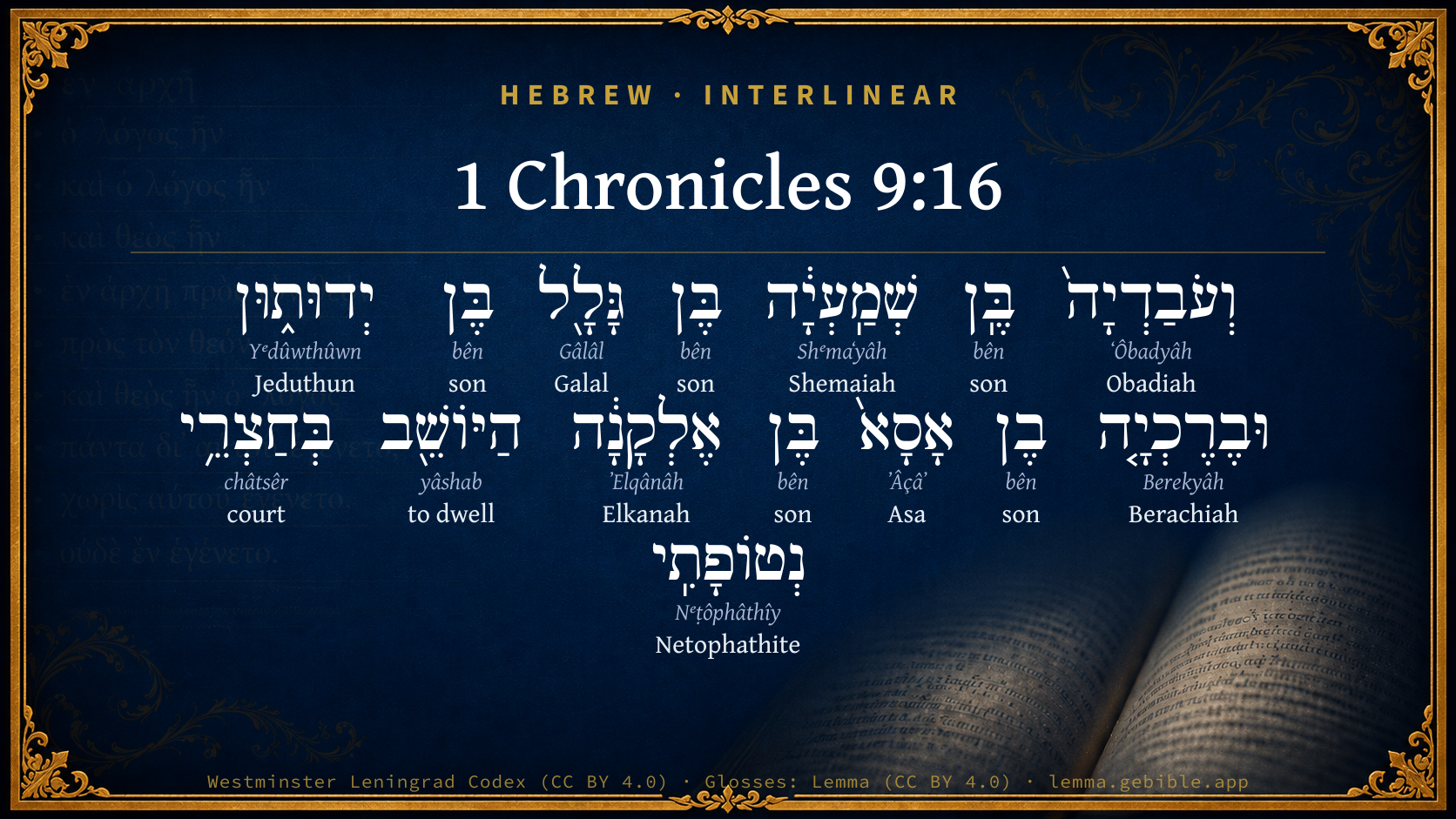
Hebrew (Westminster Leningrad Codex) 1 Chronicles 9:16 appears in the Hebrew Old Testament. The text above is from the Westminster Leningrad Codex. Each word links to its Strong’s number, a concise gloss, and parsing drawn from the Open Scriptures Hebrew Bible morphology. Click any word for its full Brown-Driver-Briggs (BDB) entry.
Download image
Cite this verse

1 Chronicles 9:16 (World English Bible). Public Domain. Lemma interlinear Bible study tool, https://lemma.gebible.app/v/1-chronicles/9/16.

Show BibTeX & RIS
BibTeX
RIS
English Translation
and Obadiah the son of Shemaiah, the son of Galal, the son of Jeduthun, and Berechiah the son of Asa, the son of Elkanah, who lived in the villages of the Netophathites.
World English Bible · Public Domain
Highlights
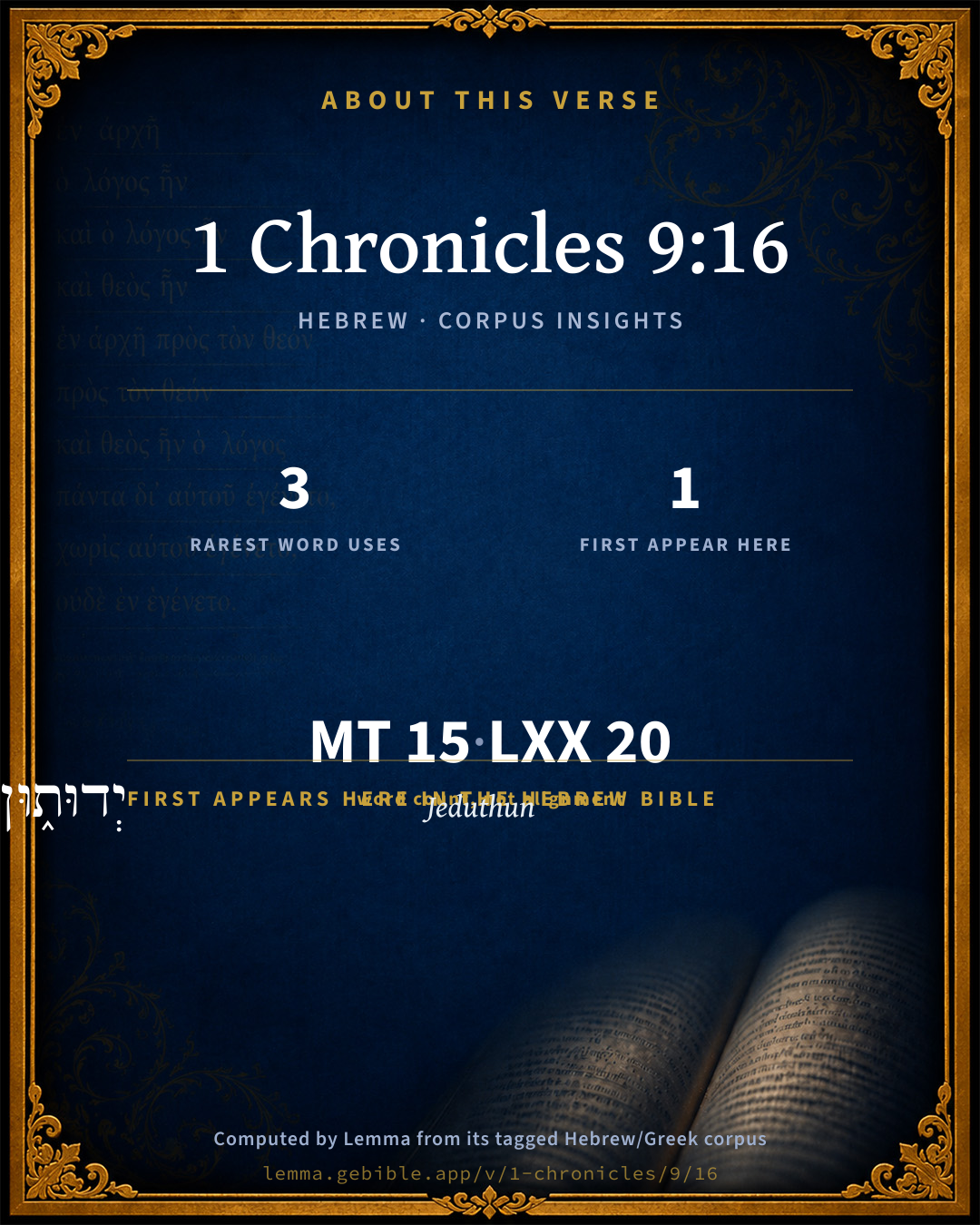
  • 1 first appearance in the Hebrew Bible
Full analysis ↓
Download a study sheet

One document with this verse’s original text, its word-by-word gloss line, the meaning frame, cross-references with their text, attributed commentary, and full source and license credits — printable, and it pastes into notes with its structure intact.

This verse Autodidact and up

Study sheet (.html) Plain text (.txt)

A passage Seminary Student

Up to 50 verses in one chapter. A passage sheet keeps up to 6 commentary sources and 12 cross-references per verse, in the order this page ranks them, and says so on the sheet whenever that leaves anything out. Ask for a single verse and you get the Autodidact verse sheet above.

Everything on this page stays free to read, with no account — the sheet is a download of what is already on screen, not access to it.

Want to remove ads? Support Godless Engineer
Compare translations 3

The same verse in 3 English versions, stacked beneath the original-language interlinear above. Click any original word for its lexicon entry.

Each is an independent rendering of the whole verse — the interlinear is not word-aligned to these translations.

Highlighted words mark where these versions differ — a whole-verse word diff, not a word-by-word alignment.

  • World English Bible Public Domain
    and Obadiah the son of Shemaiah, the son of Galal, the son of Jeduthun, and Berechiah the son of Asa, the son of Elkanah, who lived in the villages of the Netophathites.
  • King James Version Public Domain
    And Obadiah the son of Shemaiah, the son of Galal, the son of Jeduthun, and Berechiah the son of Asa, the son of Elkanah, that dwelt in the villages of the Netophathites.
  • unfoldingWord Literal Text CC BY-SA 4.0
    and Obadiah, the son of Shemaiah, the son of Galal, the son of Jeduthun, and Berekiah, the son of Asa, the son of Elkanah, a dweller in the villages of the Netophathite.

unfoldingWord Literal Text — © unfoldingWord, licensed CC BY-SA 4.0. Word-aligned USFM3 via Door43 (git.door43.org/unfoldingWord/en_ult).

Versions to compare (up to 4)

3 of 4 selected

Show all 18 translations

Every available English version of this verse, each an independent rendering of the whole verse.

  • World English Bible Public Domain
    and Obadiah the son of Shemaiah, the son of Galal, the son of Jeduthun, and Berechiah the son of Asa, the son of Elkanah, who lived in the villages of the Netophathites.
  • Berean Standard Bible Public Domain
    Obadiah son of Shemaiah, the son of Galal, the son of Jeduthun; and Berechiah son of Asa, the son of Elkanah, who lived in the villages of the Netophathites.
  • Majority Standard Bible Public Domain
    Obadiah son of Shemaiah, the son of Galal, the son of Jeduthun; and Berechiah son of Asa, the son of Elkanah, who lived in the villages of the Netophathites.
  • King James Version Public Domain
    And Obadiah the son of Shemaiah, the son of Galal, the son of Jeduthun, and Berechiah the son of Asa, the son of Elkanah, that dwelt in the villages of the Netophathites.
  • American Standard Version (1901) Public Domain
    and Obadiah the son of Shemaiah, the son of Galal, the son of Jeduthun, and Berechiah the son of Asa, the son of Elkanah, that dwelt in the villages of the Netophathites.
  • Revised Version (1885) Public Domain
    and Obadiah the son of Shemaiah, the son of Galal, the son of Jeduthun, and Berechiah the son of Asa, the son of Elkanah, that dwelt in the villages of the Netophathites.
  • Geneva Bible (1599) Public Domain
    And Obadiah the sonne of Shemaiah, the sonne of Galal, the sonne of Ieduthun, and Berechiah, the sonne of Asa, the sonne of Elkanah, that dwelt in the villages of the Netophathites.
  • Douay-Rheims (1899) Public Domain
    And Obdia the son of Semeia, the son of Galal, the son of Idithum: and Barachia the son of Asa, the son of Elcana, who dwelt in the suburbs of Netophati.
  • Young's Literal Translation Public Domain
    and Obadiah son of Shemariah, son of Galal, son of Jeduthun, and Berechiah, son of Asa, son of Elkanah, who is dwelling in the villages of the Netophathite.
  • Literal Standard Version CC BY-SA 4.0
    and Obadiah son of Shemariah, son of Galal, son of Jeduthun, and Berechiah, son of Asa, son of Elkanah, who is dwelling in the villages of the Netophathite.
  • Unlocked Literal Bible CC BY-SA 4.0
    There were also Obadiah son of Shemaiah son of Galal son of Jeduthun; and Berekiah son of Asa son of Elkanah, who lived in the villages of the Netophathites.
  • unfoldingWord Literal Text CC BY-SA 4.0
    and Obadiah, the son of Shemaiah, the son of Galal, the son of Jeduthun, and Berekiah, the son of Asa, the son of Elkanah, a dweller in the villages of the Netophathite.
  • Darby Bible Public Domain
    and Obadiah the son of Shemaiah, the son of Galal, the son of Jeduthun; and Berechiah the son of Asa, the son of Elkanah, who dwelt in the villages of the Netophathites.
  • World Messianic Bible Public Domain
    and Obadiah the son of Shemaiah, the son of Galal, the son of Jeduthun; and Berechiah the son of Asa, the son of Elkanah, who lived in the villages of the Netophathites.
  • Webster's Bible Public Domain
    And Obadiah the son of Shemaiah, the son of Galal, the son of Jeduthun, and Berechiah the son of Asa, the son of Elkanah, that dwelt in the villages of the Netophathites.
  • Free Bible Version CC BY-SA 4.0
    Obadiah son of Shemaiah, son of Galal, son of Jeduthun; and Berekiah son of Asa, son of Elkanah, who used to live in the villages of the Netophathites.
  • Bible in Basic English Public Domain
    And Obadiah, the son of Shemaiah, the son of Galal, the son of Jeduthun, and Berechiah, the son of Asa, the son of Elkanah, who were living in the small towns of the Netophathites.
  • JPS Tanakh (1917) Public Domain
    and Obadiah the son of Shemaiah, the son of Galal, the son of Jeduthun, and Berechiah the son of Asa, the son of Elkanah, that dwelt in the villages of the Netophathites.

Literal Standard Version (2020), Covenant Press — licensed CC BY-SA 4.0. Text via the HelloAO Bible API (eBible.org). Unlocked Literal Bible (unfoldingWord) — licensed CC BY-SA 4.0. Text via the HelloAO Bible API (eBible.org). unfoldingWord Literal Text — © unfoldingWord, licensed CC BY-SA 4.0. Word-aligned USFM3 via Door43 (git.door43.org/unfoldingWord/en_ult). Free Bible Version, Dr. Jonathan Gallagher — licensed CC BY-SA 4.0. Text via the HelloAO Bible API (eBible.org).

Word by word

More ways to search: Search by grammar → Find every occurrence → Compare this word →

Practice this passage: Drill this verse → Learn its vocabulary →

גָּלָ֖ל
Gâlâl
H1559
“Galal”
Noun, Proper
Part of Speech
Noun
Type
Proper
Full BDB Definition

Origin: from H1556

TWOT: None

Galal = "influential" - a Levite, one of the sons of Asaph - a third Levite, son of Jeduthun
  1. וְעֹבַדְיָה֙ ʻÔbadyâh H5662 “and · Obadiah” Conjunction + Noun, Proper
  2. בֶּֽן bên H1121 “son of” Noun, Common, Masculine, Singular, Construct
  3. שְׁמַֽעְיָ֔ה Shᵉmaʻyâh H8098 “Shemaiah” Noun, Proper
  4. בֶּן bên H1121 “son of” Noun, Common, Masculine, Singular, Construct
  5. בֶּן bên H1121 “son of” Noun, Common, Masculine, Singular, Construct
  6. יְדוּת֑וּן Yᵉdûwthûwn H3038 “Jeduthun” Noun, Proper
  7. וּבֶרֶכְיָ֤ה Berekyâh H1296 “and · Berachiah” Conjunction + Noun, Proper
  8. בֶן bên H1121 “son of” Noun, Common, Masculine, Singular, Construct
  9. אָסָא֙ ʼÂçâʼ H609 “Asa” Noun, Proper
  10. בֶּן bên H1121 “son of” Noun, Common, Masculine, Singular, Construct
  11. אֶלְקָנָ֔ה ʼElqânâh H511 “Elkanah” Noun, Proper
  12. הַיּוֹשֵׁ֖ב yâshab H3427 “the · dwelling” Particle, Definite Article + Verb, Qal, Participle Active, Masculine, Singular, Absolute
  13. בְּחַצְרֵ֥י châtsêr H2691 “in/at · courts of” Preposition + Noun, Common, Both, Plural, Construct
  14. נְטוֹפָתִֽי Nᵉṭôphâthîy H5200 “Netophathite” Noun, Gentilic, Masculine, Singular, Absolute

About this verse

These counts appear in no published source. They are computed here, from the morphology-tagged text and Lemma’s own curated glosses. What Lemma adds →

15
words
11
distinct lemmas
Historical
section

Notable vocabulary

The rarest word here is גָּלָ֖ל Galal H1559 — appearing just 3 times in the whole Hebrew Bible.

First appearance in Scripture

This word makes its first canonical appearance in the Hebrew Bible here:

  • יְדוּת֑וּן Jeduthun H3038

Shared distinctive vocabulary

גָּלָ֖ל Galal H1559 occurs in 3 verses of the Hebrew Bible. Also found in:

Grammatical profile

  • 1 verb
  • 14 nouns

Verb forms

  • הַיּוֹשֵׁ֖ב Qal · Participle Active

Repetition

A word recurs within this verse — often emphatic in Hebrew:

  • בֶּֽן son H1121 ×5

Hebrew & Septuagint length

In English translation the verse runs 32 words from the Hebrew and 26 from the Septuagint (LXX English) — closely comparable.

A rough comparison of the two English renderings, which tokenize alike — not a word-level alignment.

Word counts can differ between the Hebrew and the Greek without any difference in meaning — e.g. the Hebrew direct-object marker אֵת has no separate Greek word, and Greek often adds the article ὁ.

In the original languages it is 15 Hebrew tokens and 20 Greek tokens — but the two are counted differently (Hebrew bundles its prefixes and suffixes into one token; the Greek is in lemma form), so that isn’t a like-for-like length.

Cross-references

9

Topical passages linked to 1 Chronicles 9:16 in the Treasury of Scripture Knowledge — connected by theme and wording, ordered by reader-vote popularity; previews shown in the World English Bible.

  • Nehemiah 12:28–30 The sons of the singers gathered themselves together, both out of the plain round about Jerusalem, and from the villages of the Netophathites;
  • 1 Chronicles 2:54 The sons of Salma: Bethlehem, and the Netophathites, Atroth Beth Joab, and half of the Manahathites, the Zorites.
  • 1 Chronicles 12:25 Of the children of Simeon, mighty men of valor for the war, seven thousand and one hundred.
  • 1 Chronicles 25:1 Moreover, David and the captains of the host set apart for the service certain of the sons of Asaph, and of Heman, and of Jeduthun, who should prophesy with harps, with psalteries, and with cymbals: and the number of those who did the work according to their service was:
  • 1 Chronicles 25:3 Of Jeduthun; the sons of Jeduthun: Gedaliah, and Zeri, and Jeshaiah, Hashabiah, and Mattithiah, six, under the hands of their father Jeduthun with the harp, who prophesied in giving thanks and praising Yahweh.
  • 1 Chronicles 25:6 All these were under the hands of their father for song in the house of Yahweh, with cymbals, psalteries, and harps, for the service of the house of God; Asaph, Jeduthun, and Heman being under the order of the king.
  • 2 Chronicles 35:15 The singers the sons of Asaph were in their place, according to the commandment of David, and Asaph, and Heman, and Jeduthun the king's seer; and the porters were at every gate: they didn't need to depart from their service; for their brothers the Levites prepared for them.
  • Nehemiah 7:26 The men of Bethlehem and Netophah, one hundred eighty-eight.
  • Nehemiah 11:17 and Mattaniah the son of Mica, the son of Zabdi, the son of Asaph, who was the chief to begin the thanksgiving in prayer, and Bakbukiah, the second among his brothers; and Abda the son of Shammua, the son of Galal, the son of Jeduthun.

Cross-references courtesy of OpenBible.info (CC BY 4.0).

Hebrew and Greek witnesses Masoretic Hebrew ↔ Greek Septuagint

The same verse in the two great witnesses to the Old Testament, shown verse-for-verse.

These are two independent witnesses, not word-aligned to each other, and the Septuagint is shown in lemma (dictionary) form.

Hebrew 1 Chronicles 9:16 Masoretic · Westminster Leningrad Codex

וְעֹבַדְיָה֙ בֶּֽן שְׁמַֽעְיָ֔ה בֶּן גָּלָ֖ל בֶּן יְדוּת֑וּן וּבֶרֶכְיָ֤ה בֶן אָסָא֙ בֶּן אֶלְקָנָ֔ה הַיּוֹשֵׁ֖ב בְּחַצְרֵ֥י נְטוֹפָתִֽי

and Obadiah the son of Shemaiah, the son of Galal, the son of Jeduthun, and Berechiah the son of Asa, the son of Elkanah, who lived in the villages of the Netophathites.

World English Bible · Public Domain

Greek LXX 1 Chronicles 9:16 Septuagint · lemma form

καί αβδια υἱός σαμια υἱός γαλαλ υἱός ιδιθων καί βαραχια υἱός οσσα υἱός ηλκανα ὁ κατοίκος ἐν ὁ κώμη νετωφατι

and Abdia, son of Samia, son of Galaal, son of Idithun, and Barachia son of Ossa, son of Helcana—who lived in the villages of the Notephatites.

LXX2012 (modern English Septuagint) · Public Domain

On this verse, John Gill's Exposition discusses the Septuagint’s reading. Read the note in Commentary ↓

Hebrew: Westminster Leningrad Codex (CC BY 4.0). Greek: Septuagint (public domain); English from LXX2012 (modern English Septuagint) (Public Domain). How the Septuagint differs from the Hebrew →

Commentary

Notes on 1 Chronicles 9:16 from classic Christian and Jewish commentators (each source and its license shown beneath its notes). The classic Christian expositions comment on the surrounding passage and are grouped to its opening verse, so a note may address several verses; the Jewish commentaries on the Tanakh (Rashi and others) are per-verse, so they appear only where the commentator wrote on this verse.

Lemma curates 59 commentaries, every one of them public domain or Creative Commons licensed, each selected and text-cleaned for this edition rather than reprinted as found. About our sources →

Joseph Benson's Commentary

1Ch 9:16-17. The villages of the Netophathite — Or, Netophathites: which were in Judah, 1Ch 2:54. Here they now dwelt, either because their proper cities were not yet built; or because they were not yet numerous enough to replenish them. The porters were, &c. — Whose office it was to keep all the gates of the temple, that no unclean person or thing might enter into it.

Joseph Benson's Commentary on the Old and New Testaments (1811–1818) — public domain. Text from a community e-Sword module.

The Cambridge Bible for Schools and Colleges

gen. ed. J. J. S. Perowne

16. Obadiah the son of Shemaiah] In Neh. Abda the son of Shammua. Which was the reading of the original document cannot be determined.

Jeduthun] See note on 1Ch_16:41.

Berechiah … the son of Elkanah] Not mentioned in Neh. He probably represented the Kohathite division of the singers; cp. 1Ch_6:33-38 (18–23 Heb.), where the name Elkanah occurs several times in the genealogy of the Kohathites.

the villages of the Netophathites] Cp. Neh_12:28-29 (R.V.), whence it appears that these villages were close to Jerusalem. The exact site is uncertain.

The Cambridge Bible for Schools and Colleges (gen. ed. J. J. S. Perowne; Cambridge University Press, 1878–1918) — public domain. Text from a community e-Sword module.

John Gill's Exposition

Who hitherto waited in the king's gate eastward,.... At the gate through which the king went into the temple, and was at the east of it; and here these porters were placed in the same order after the captivity, and their return from it, as before:

they were porters in the companies of the children of Levi; or in the camp of Levi, which was placed around the tabernacle, as in the wilderness: the Septuagint version is, "these are the gates of the camp of the children of Levi"; at which these porters were placed.

John Gill's Exposition of the Whole Bible (1746–1763) — public domain (CC PDM 1.0). Text via the HelloAO Bible API.

Haydock's Catholic Bible Commentary

Suburbs, or "courts," atriis. (Haydock) --- Hebrew, "villages." (Menochius) --- Netophati was a town of Juda. The ancient regulations could not be observed exactly. (Calmet) --- The priests received the Levites into their cities. (Du Hamel)

George Leo Haydock (1774–1849), Haydock's Catholic Family Bible and Commentary, 1859 edition — public domain. Excludes Psalms (Douay-Rheims chapter numbering differs from Protestant) and Deuterocanonical books (Catholic canon only).

Matthew Poole's English Annotations

The Netophathites were in Judah, 1Ch 2:54. There they now dwelt, either because their proper cities were not yet built, or because they were not yet numerous enough to replenish them.

Matthew Poole's English Annotations on the Holy Bible (1683–1685) — public domain. Text from a community e-Sword/MySword module.

Keil & Delitzsch

C. F. Keil & F. Delitzsch

Who hitherto waited in the king's gate eastward,.... At the gate through which the king went into the temple, and was at the east of it; and here these porters were placed in the same order after the captivity, and their return from it, as before:

they were porters in the companies of the children of Levi; or in the camp of Levi, which was placed around the tabernacle, as in the wilderness: the Septuagint version is, "these are the gates of the camp of the children of Levi"; at which these porters were placed.

Keil & Delitzsch — Biblical Commentary on the Old Testament (1861–1891) — public domain (CC PDM 1.0). Text via the HelloAO Bible API. (Old Testament only.)

Lesson kit

Teaching starters — assembled from the data on this page, not authored interpretation. Every prompt links to the verse data it draws on. Edit before teaching.

1 Chronicles, in the Historical, opens this verse with 15 words (11 distinct Hebrew lemmas). Its most distinctive word is Gâlâl (“Galal”). A historical commentator’s framing appears above. Read the whole chapter for the surrounding context.

Discussion questions

  1. What does “Galal” (Gâlâl) contribute to the verse as a whole?
  2. This is the first place “Jeduthun” appears in Scripture (first appears here). What does its debut here establish?
  3. How does 1 Chronicles 9:15, which shares the word «Galal», read alongside this verse?
  4. What does the repetition of “son” (5× in this one verse) do in this verse?
  5. The translations on this page render this verse differently — a whole-verse word diff, not a word-by-word alignment. What might account for the different wordings?
  6. «הַיּוֹשֵׁ֖ב» is a Qal Participle Active verb. How does that grammatical form shape the action described?
  7. Compare how Joseph Benson's Commentary and The Cambridge Bible for Schools and Colleges read this verse. Where do they agree or differ?

Things to notice

Reading settings

Reading text

Shown beneath each verse's original-language words.

Old Testament
Old Testament edition

Read the OT as the Masoretic Hebrew (MT) or the Greek Septuagint (LXX).

English shown for the Greek Septuagint (in the Hebrew ↔ Greek comparison).

Comparing translations? Open the Compare panel on any verse page to stack up to four side by side.