
2 Chronicles 16:2

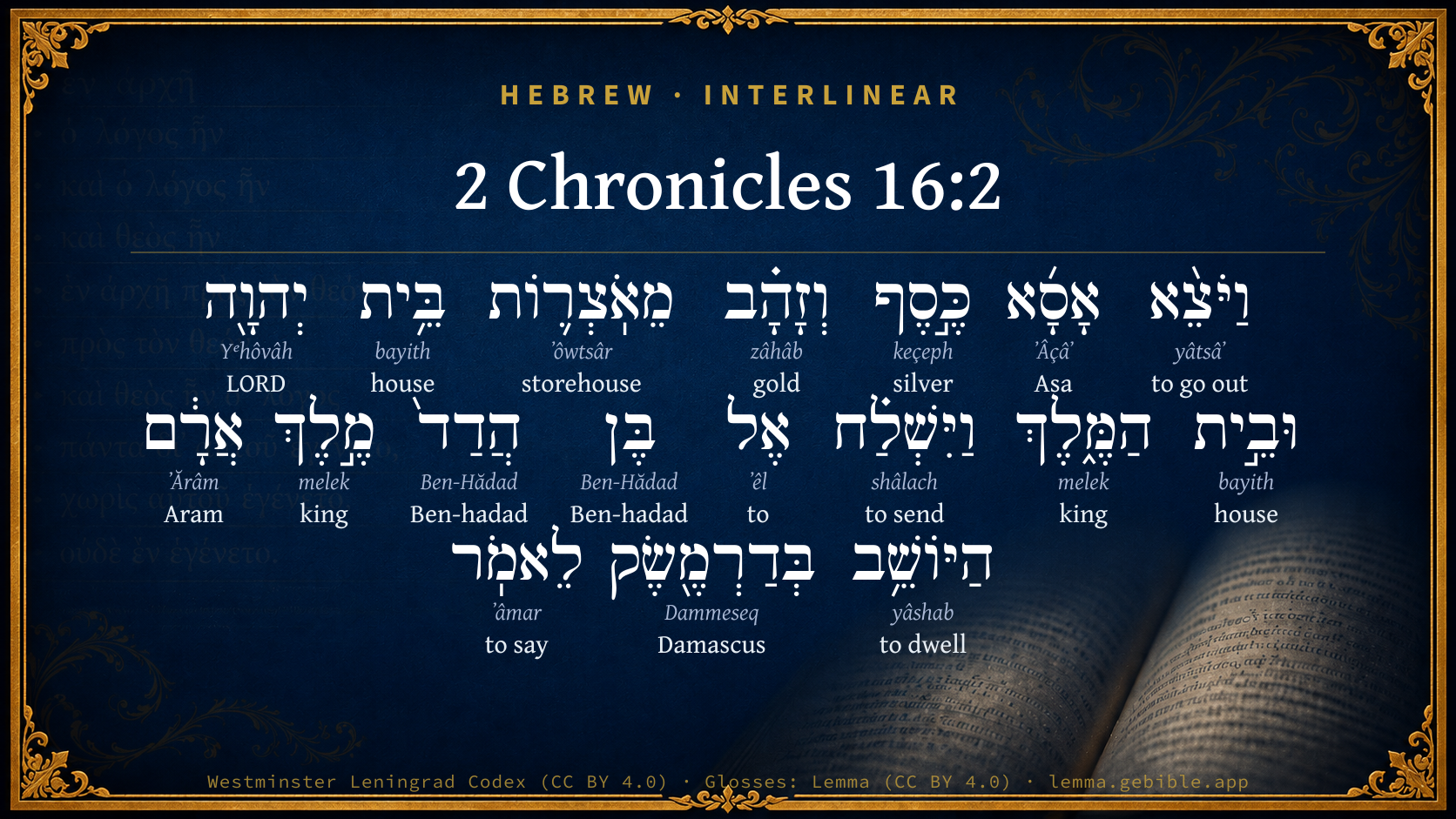
Hebrew (Westminster Leningrad Codex) 2 Chronicles 16:2 appears in the Hebrew Old Testament. The text above is from the Westminster Leningrad Codex. Each word links to its Strong’s number, a concise gloss, and parsing drawn from the Open Scriptures Hebrew Bible morphology. Click any word for its full Brown-Driver-Briggs (BDB) entry.
Download image
Cite this verse

2 Chronicles 16:2 (World English Bible). Public Domain. Lemma interlinear Bible study tool, https://lemma.gebible.app/v/2-chronicles/16/2.

Show BibTeX & RIS
BibTeX
RIS
English Translation
Then Asa brought out silver and gold out of the treasures of the house of Yahweh and of the king's house, and sent to Ben Hadad king of Syria, who lived at Damascus, saying,
World English Bible · Public Domain
Download a study sheet

One document with this verse’s original text, its word-by-word gloss line, the meaning frame, cross-references with their text, attributed commentary, and full source and license credits — printable, and it pastes into notes with its structure intact.

This verse Autodidact and up

Study sheet (.html) Plain text (.txt)

A passage Seminary Student

Up to 50 verses in one chapter. A passage sheet keeps up to 6 commentary sources and 12 cross-references per verse, in the order this page ranks them, and says so on the sheet whenever that leaves anything out. Ask for a single verse and you get the Autodidact verse sheet above.

Everything on this page stays free to read, with no account — the sheet is a download of what is already on screen, not access to it.

Want to remove ads? Support Godless Engineer
Compare translations 3

The same verse in 3 English versions, stacked beneath the original-language interlinear above. Click any original word for its lexicon entry.

Each is an independent rendering of the whole verse — the interlinear is not word-aligned to these translations.

Highlighted words mark where these versions differ — a whole-verse word diff, not a word-by-word alignment.

  • World English Bible Public Domain
    Then Asa brought out silver and gold out of the treasures of the house of Yahweh and of the king's house, and sent to Ben Hadad king of Syria, who lived at Damascus, saying,
  • King James Version Public Domain
    Then Asa brought out silver and gold out of the treasures of the house of the LORD and of the king's house, and sent to Benhadad king of Syria, that dwelt at Damascus, saying,
  • unfoldingWord Literal Text CC BY-SA 4.0
    And Asa brought silver and gold from the treasuries of the house of Yahweh and the house of the king. And he sent to Ben Hadad, the king of Aram, who was dwelling in Damascus, saying,

unfoldingWord Literal Text — © unfoldingWord, licensed CC BY-SA 4.0. Word-aligned USFM3 via Door43 (git.door43.org/unfoldingWord/en_ult).

Versions to compare (up to 4)

3 of 4 selected

Show all 18 translations

Every available English version of this verse, each an independent rendering of the whole verse.

  • World English Bible Public Domain
    Then Asa brought out silver and gold out of the treasures of the house of Yahweh and of the king's house, and sent to Ben Hadad king of Syria, who lived at Damascus, saying,
  • Berean Standard Bible Public Domain
    So Asa withdrew the silver and gold from the treasuries of the house of the LORD and the royal palace, and he sent it with this message to Ben-hadad king of Aram, who was ruling in Damascus:
  • Majority Standard Bible Public Domain
    So Asa withdrew the silver and gold from the treasuries of the house of the LORD and the royal palace, and he sent it with this message to Ben-hadad king of Aram, who was ruling in Damascus:
  • King James Version Public Domain
    Then Asa brought out silver and gold out of the treasures of the house of the LORD and of the king's house, and sent to Benhadad king of Syria, that dwelt at Damascus, saying,
  • American Standard Version (1901) Public Domain
    Then Asa brought out silver and gold out of the treasures of the house of Jehovah and of the king's house, and sent to Ben-hadad king of Syria, that dwelt at Damascus, saying,
  • Revised Version (1885) Public Domain
    Then Asa brought out silver and gold out of the treasures of the house of the LORD and of the king’s house, and sent to Ben-hadad king of Syria, that dwelt at Damascus, saying,
  • Geneva Bible (1599) Public Domain
    Then Asa brought out siluer and gold out of the treasures of the house of the Lord, and of the Kings house, and sent to Benhadad King of Aram that dwelt at Damascus, saying,
  • Douay-Rheims (1899) Public Domain
    Then Asa brought out silver and gold out of the treasures of the house of the Lord, and of the king's treasures, and sent to Benadad king of Syria, who dwelt in Damascus, saying:
  • Young's Literal Translation Public Domain
    And Asa bringeth out silver and gold from the treasures of the house of Jehovah, and of the house of the king, and sendeth unto Ben-Hadad king of Aram, who is dwelling in Damascus, saying,
  • Literal Standard Version CC BY-SA 4.0
    And Asa brings out silver and gold from the treasures of the house of YHWH and of the house of the king, and sends [them] to Ben-Hadad king of Aram, who is dwelling in Damascus, saying,
  • Unlocked Literal Bible CC BY-SA 4.0
    Then Asa brought the silver and gold out of the storerooms in the house of Yahweh and of the king's house, and sent it to Ben Hadad king of Aram, who lived in Damascus. He said,
  • unfoldingWord Literal Text CC BY-SA 4.0
    And Asa brought silver and gold from the treasuries of the house of Yahweh and the house of the king. And he sent to Ben Hadad, the king of Aram, who was dwelling in Damascus, saying,
  • Darby Bible Public Domain
    And Asa brought out silver and gold out of the treasures of the house of Jehovah and of the king's house, and sent to Ben-hadad king of Syria, who dwelt at Damascus, saying,
  • World Messianic Bible Public Domain
    Then Asa brought out silver and gold out of the treasures of the LORD’s house and of the king’s house, and sent to Ben Hadad king of Syria, who lived at Damascus, saying,
  • Webster's Bible Public Domain
    Then Asa brought silver and gold out of the treasures of the house of the LORD and of the king's house, and sent to Ben-hadad king of Syria, that dwelt at Damascus, saying,
  • Free Bible Version CC BY-SA 4.0
    Asa took the silver and gold from the treasuries of the Lord's Temple and the king's palace and sent them to Ben-hadad, king of Syria, who lived in Damascus, with a message that said:
  • Bible in Basic English Public Domain
    Then Asa took silver and gold out of the stores of the Lord's house and of the king's store-house, and sent to Ben-hadad, king of Aram, at Damascus, saying,
  • JPS Tanakh (1917) Public Domain
    Then Asa brought out silver and gold out of the treasures of the house of the LORD and of the king's house, and sent to Ben-hadad king of Aram, that dwelt at Damascus, saying:

Literal Standard Version (2020), Covenant Press — licensed CC BY-SA 4.0. Text via the HelloAO Bible API (eBible.org). Unlocked Literal Bible (unfoldingWord) — licensed CC BY-SA 4.0. Text via the HelloAO Bible API (eBible.org). unfoldingWord Literal Text — © unfoldingWord, licensed CC BY-SA 4.0. Word-aligned USFM3 via Door43 (git.door43.org/unfoldingWord/en_ult). Free Bible Version, Dr. Jonathan Gallagher — licensed CC BY-SA 4.0. Text via the HelloAO Bible API (eBible.org).

Word by word

More ways to search: Search by grammar → Find every occurrence → Compare this word →

Practice this passage: Drill this verse → Learn its vocabulary →

בְּדַרְמֶ֖שֶׂק
Dammeseq
H1834
“in/at · Damascus”
Preposition + Noun, Proper
Part of Speech
Preposition + Noun
Type
Proper
Full BDB Definition

Origin: of foreign origin

TWOT: None

Damascus = "silent is the sackcloth weaver" - an ancient trading city, capital of Syria, located in the plain east of Hermon, 130 (205 kilometers) miles northeast of Jerusalem
  1. וַיֹּצֵ֨א yâtsâʼ H3318 “and · to go out” Conjunction + Verb, Hiphil, Sequential Imperfect, 3rd Person, Masculine, Singular
  2. אָסָ֜א ʼÂçâʼ H609 “Asa” Noun, Proper
  3. כֶּ֣סֶף keçeph H3701 “silver” Noun, Common, Masculine, Singular, Absolute
  4. וְזָהָ֗ב zâhâb H2091 “and · gold” Conjunction + Noun, Common, Masculine, Singular, Absolute
  5. מֵאֹֽצְר֛וֹת ʼôwtsâr H214 “from · storehouses of” Preposition + Noun, Common, Masculine, Plural, Construct
  6. בֵּ֥ית bayith H1004 “house of” Noun, Common, Masculine, Singular, Construct
  7. יְהוָ֖ה Yᵉhôvâh H3068 “LORD” Noun, Proper
  8. וּבֵ֣ית bayith H1004 “and · house of” Conjunction + Noun, Common, Masculine, Singular, Construct
  9. הַמֶּ֑לֶךְ melek H4428 “the · king” Particle, Definite Article + Noun, Common, Masculine, Singular, Absolute
  10. וַיִּשְׁלַ֗ח shâlach H7971 “and · to send” Conjunction + Verb, Qal, Sequential Imperfect, 3rd Person, Masculine, Singular
  11. אֶל ʼêl H413 “to” Preposition
  12. בֶּן Ben-Hădad H1130 “Ben-hadad” Noun, Proper
  13. הֲדַד֙ Ben-Hădad H1130 “Ben-hadad” Noun, Proper
  14. מֶ֣לֶךְ melek H4428 “king of” Noun, Common, Masculine, Singular, Construct
  15. אֲרָ֔ם ʼĂrâm H758 “Aram” Noun, Proper
  16. הַיּוֹשֵׁ֥ב yâshab H3427 “the · dwelling” Particle, Definite Article + Verb, Qal, Participle Active, Masculine, Singular, Absolute
  17. לֵאמֹֽר ʼâmar H559 “to say” Preposition + Verb, Qal, Infinitive Construct

About this verse

These counts appear in no published source. They are computed here, from the morphology-tagged text and Lemma’s own curated glosses. What Lemma adds →

18
words
15
distinct lemmas
Historical
section

Shared distinctive vocabulary

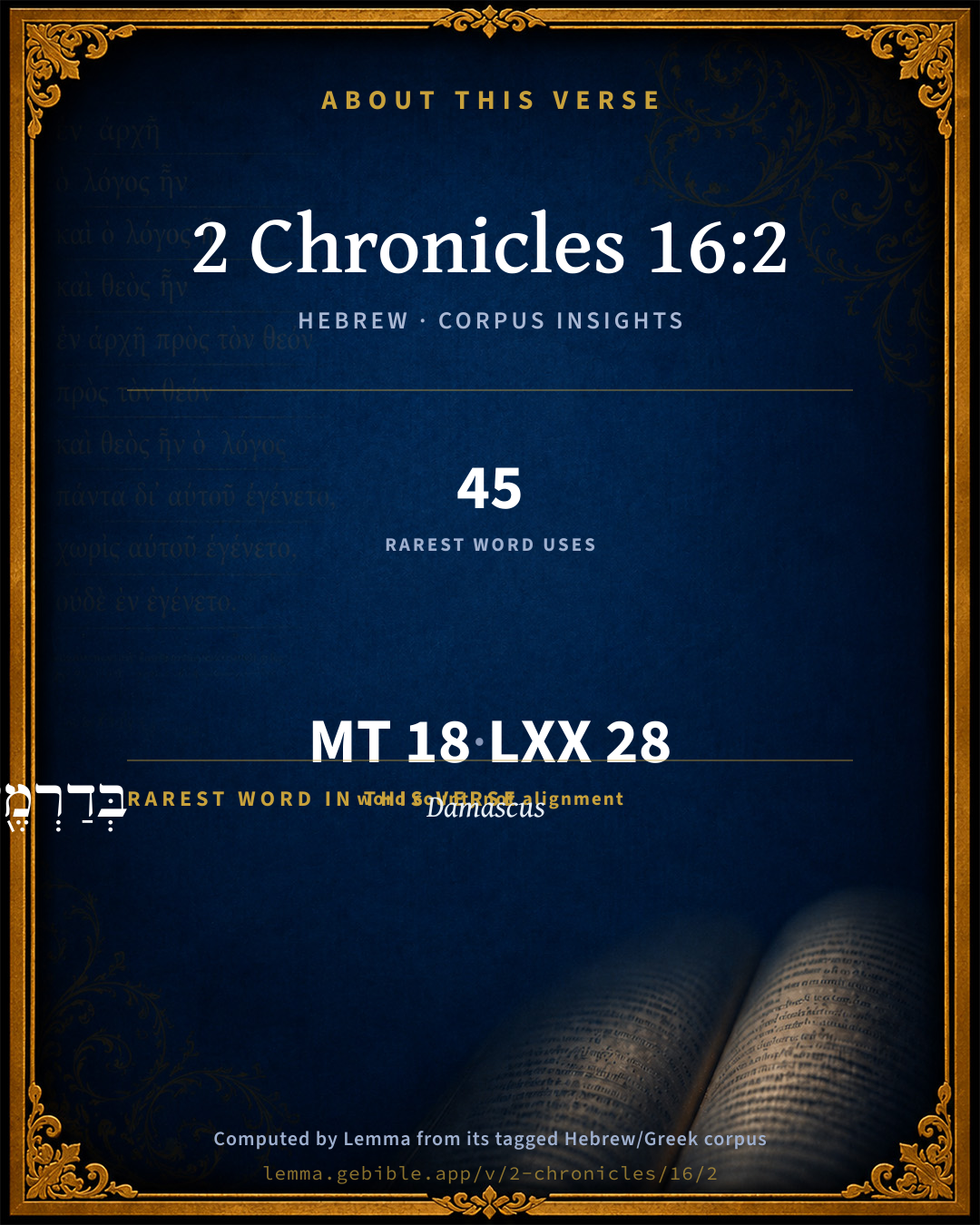
בְּדַרְמֶ֖שֶׂק Damascus H1834 occurs in 40 verses of the Hebrew Bible. Also found in:

Grammatical profile

  • 4 verbs
  • 13 nouns
  • 1 preposition

Verb forms

  • וַיֹּצֵ֨א Hiphil · Sequential Imperfect
  • וַיִּשְׁלַ֗ח Qal · Sequential Imperfect
  • הַיּוֹשֵׁ֥ב Qal · Participle Active
  • לֵאמֹֽר Qal · Infinitive Construct

Repetition

Words recur within this verse — often emphatic in Hebrew:

  • בֵּ֥ית house H1004 ×2
  • הַמֶּ֑לֶךְ king H4428 ×2
  • בֶּן Ben-hadad H1130 ×2

Hebrew & Septuagint length

In English translation the verse runs 34 words from the Hebrew and 37 from the Septuagint (LXX English) — closely comparable.

A rough comparison of the two English renderings, which tokenize alike — not a word-level alignment.

Word counts can differ between the Hebrew and the Greek without any difference in meaning — e.g. the Hebrew direct-object marker אֵת has no separate Greek word, and Greek often adds the article ὁ.

In the original languages it is 18 Hebrew tokens and 28 Greek tokens — but the two are counted differently (Hebrew bundles its prefixes and suffixes into one token; the Greek is in lemma form), so that isn’t a like-for-like length.

Cross-references

4

Topical passages linked to 2 Chronicles 16:2 in the Treasury of Scripture Knowledge — connected by theme and wording, ordered by reader-vote popularity; previews shown in the World English Bible.

  • 2 Kings 12:18 Jehoash king of Judah took all the holy things that Jehoshaphat and Jehoram and Ahaziah, his fathers, kings of Judah, had dedicated, and his own holy things, and all the gold that was found in the treasures of the house of Yahweh, and of the king's house, and sent it to Hazael king of Syria: and he went away from Jerusalem.
  • 2 Kings 16:8 Ahaz took the silver and gold that was found in the house of Yahweh, and in the treasures of the king's house, and sent it for a present to the king of Assyria.
  • 2 Kings 18:15 Hezekiah gave [him] all the silver that was found in the house of Yahweh, and in the treasures of the king's house.
  • 2 Chronicles 28:21 For Ahaz took away a portion out of the house of Yahweh, and out of the house of the king and of the princes, and gave it to the king of Assyria: but it didn't help him.

Cross-references courtesy of OpenBible.info (CC BY 4.0).

Hebrew and Greek witnesses Masoretic Hebrew ↔ Greek Septuagint

The same verse in the two great witnesses to the Old Testament, shown verse-for-verse.

These are two independent witnesses, not word-aligned to each other, and the Septuagint is shown in lemma (dictionary) form.

Hebrew 2 Chronicles 16:2 Masoretic · Westminster Leningrad Codex

וַיֹּצֵ֨א אָסָ֜א כֶּ֣סֶף וְזָהָ֗ב מֵאֹֽצְר֛וֹת בֵּ֥ית יְהוָ֖ה וּבֵ֣ית הַמֶּ֑לֶךְ וַיִּשְׁלַ֗ח אֶל בֶּן הֲדַד֙ מֶ֣לֶךְ אֲרָ֔ם הַיּוֹשֵׁ֥ב בְּדַרְמֶ֖שֶׂק לֵאמֹֽר

Then Asa brought out silver and gold out of the treasures of the house of Yahweh and of the king's house, and sent to Ben Hadad king of Syria, who lived at Damascus, saying,

World English Bible · Public Domain

Greek LXX 2 Chronicles 16:2 Septuagint · lemma form

καί λαμβάνω ασα χρυσίον καί ἀργύριον ἐκ θησαυρός οἶκος κύριος καί οἶκος ὁ βασιλεύς καί ἀποστέλλω πρός ὁ υἱός ὁ αδερ βασιλεύς συρία ὁ καταοἰκέω ἐν δαμάσκος λέγω

And Asa took silver and gold out of the treasures of the house of the Lord, and of the king's house, and sent them to the son of Ader king of Syria, which lived in Damascus, saying,

LXX2012 (modern English Septuagint) · Public Domain

On this verse, The Pulpit Commentary discusses the Septuagint’s reading. Read the note in Commentary ↓

Hebrew: Westminster Leningrad Codex (CC BY 4.0). Greek: Septuagint (public domain); English from LXX2012 (modern English Septuagint) (Public Domain). How the Septuagint differs from the Hebrew →

Commentary

Notes on 2 Chronicles 16:2 from classic Christian and Jewish commentators (each source and its license shown beneath its notes). The classic Christian expositions comment on the surrounding passage and are grouped to its opening verse, so a note may address several verses; the Jewish commentaries on the Tanakh (Rashi and others) are per-verse, so they appear only where the commentator wrote on this verse.

Lemma curates 59 commentaries, every one of them public domain or Creative Commons licensed, each selected and text-cleaned for this edition rather than reprinted as found. About our sources →

Trapp's Complete Commentary

John Trapp

2Ch 16:2 Then Asa brought out silver and gold out of the treasures of the house of the LORD and of the king’s house, and sent to Benhadad king of Syria, that dwelt at Damascus, saying,

Ver. 2. Then Asa brought out silver and gold.] Here good Asa began to decline; which was the worse in him, because in his old age, after so great a victory, and so strict a covenant to cleave close to the Lord.

John Trapp, A Commentary or Exposition upon All the Books of the Old and New Testament (1647–1656) — public domain. Text from a community e-Sword module.

Tyndale Open Study Notes

Tyndale Open Resources

16:2 To obtain relief from Baasha’s aggression, Asa bribed the Arameans with silver and gold from . . . the Temple, appealing to an earlier treaty that his father Abijah had made with them.

Tyndale Open Study Notes — © Tyndale Open Resources, licensed CC BY-SA 4.0. Text via the HelloAO Bible API.

Geneva Bible (1599)

Geneva Bible translators

Or, Darmesek.

Geneva Bible (1599) marginal notes — public domain. Text via Bolls.life.

Ellicott's Commentary for English Readers

(2) Then Asa brought out silver and gold.—This verse is abridged as compared with 1Ki_15:18, but the substance of it is the same. The differences are characteristic. In the first clause Kings reads: “And Asa took all the silver and the gold that were left in the treasures of the house of the Lord.” The chronicler has purposely weakened this statement. He has also omitted the pedigree of Benhahad (“ben Ta- brimmôn ben Hezyôn”), and written the Aramaizing form Darmeseq for Dammèseg. (Syriac, Darmĕsûq.)

A Bible Commentary for English Readers, edited by Charles John Ellicott (1878–1897) — public domain. Text from a community e-Sword module.

The Cambridge Bible for Schools and Colleges

gen. ed. J. J. S. Perowne

2. silver and gold] In 1 Kin., “all the silver and the gold that were left.”

Ben-hadad] At least three kings of Syria bore this name, the two others being severally (1) a contemporary of Ahab (1Ki_20:1 ff.), (2) a contemporary of Jehoash the grandson of Jehu, 2Ki_13:25.

that dwelt at Damascus] The epithet distinguishes the king of Damascus from other kings of Syria, e.g. from the king of Hamath.

Damascus] Heb. “Darmesek”; see note on 1Ch_18:5.

The Cambridge Bible for Schools and Colleges (gen. ed. J. J. S. Perowne; Cambridge University Press, 1878–1918) — public domain. Text from a community e-Sword module.

Matthew Poole's English Annotations

This verse, and 2Ch 16:3-6, are explained 1Ki 15:18, &c.

Matthew Poole's English Annotations on the Holy Bible (1683–1685) — public domain. Text from a community e-Sword/MySword module.

The Pulpit Commentary

The writer of Chronicles omits the pedigree of this Benhadad King of Syria, given in the parallel "the son of Tabrimon, the son of Hezion." Benhidri is the name of Benhadad in the Assyrian monuments. The Septuagint gives Ader, which tallies with it, For Damascus, we have here Dar-mesek, instead of the more usual Dammesek of the parallel and Gen_15:2; the resh representing (as in Syriac) the dagesh forte in men. The parallel (1Ki_15:18) says that Asa took all the silver and the gold left in the treasures, etc.; but the reading "left" should very possibly (see Septuagint Version) be "found," the Hebrew characters easily permitting it.

The Pulpit Commentary (1880–1919), ed. H.D.M. Spence-Jones & Joseph S. Exell — public domain. Text from a community e-Sword module.

unfoldingWord translationNotes

Door43 World Missions Community

Then Asa brought the silver ... of the king's house, and sent it

Asa would have had his workers gather the gold and silver for him. AT: "Then Asa told his workers to take the silver ... of the king's house, and to take it" (See: Metonymy)

Ben Hadad

This is the name of a man. (See: How to Translate Names)

He said

This means he spoke by means of his servants. Asa told his servants what to say to Ben Hadad and they did. The meaning of this can be made clear. AT: "Asa told his servants to say to Ben Hadad" or "Through his servants, Asa said to Ben Hadad" (See: Metonymy and Assumed Knowledge and Implicit Information)

Let there be a covenant between me and you ... between my father and your father

A covenant being between two people represents those two people having a covenant with each other. AT: "Let us have a covenant with each other ... with my father and your father" or "Let us make a peace treaty ... with my father and your father" (See: Metaphor)

Look, I have sent

"As proof that I want a treaty with you, I have sent"

Break your covenant with Baasha, king of Israel

Breaking a covenant represents canceling it and not doing what one has promised to do. AT: "Cancel your covenant with Baasha king of Israel" or "Do not be loyal to Baasha king of Israel as you promised in your covenant with him" (See: Metaphor)

Break your covenant with Baasha, king of Israel

Asa wanted Ben Hadad to attack Israel. Ben Hadad could only do that if he broke his covenant with the king of Israel. The meaning of this statement can be made explicit. AT: "Break your covenant with Baasha, king of Israel, and attack Israel" (See: Assumed Knowledge and Implicit Information)

leave me alone

This is an idiom. Here Asa speaks of himself to represent himself along with his army. AT: "not attack me" (See: Idiom and Synecdoche)

translationWords

silver

gold

storehouse

house of God

Aram

Damascus

ancestor

unfoldingWord translationNotes — © Distant Shores Media and the Door43 World Missions Community, licensed CC BY-SA 4.0. Source: git.door43.org/Door43/en_tn.

Rashi

Rabbi Shlomo Yitzchaki (Rashi)

in Damascus And in I Kings (15:18) it is written, “Damesek,” and in another verse (II Kings 16: 10) it is written, “Dumesek.” It is all the same, an example being שׁוֹט, שֵׁבֶט, שַׁרְבִיט, whip, rod, scepter.

Rashi on the Tanakh — English translations: “The Judaica Press complete Tanach with Rashi, translated by A. J. Rosenberg” (CC BY 4.0); “Pentateuch with Rashi's commentary by M. Rosenbaum and A.M. Silbermann, 1929-1934” (public domain); “The Metsudah Tanach series, Lakewood, N.J” (CC BY 4.0); and “The Book of Joshua, Metsudah Publications, 1997” (CC BY 4.0). Text via Sefaria.

Lesson kit

Teaching starters — assembled from the data on this page, not authored interpretation. Every prompt links to the verse data it draws on. Edit before teaching.

2 Chronicles, in the Historical, opens this verse with 18 words (15 distinct Hebrew lemmas). Its most distinctive word is Dammeseq (“Damascus”). A historical commentator’s framing appears above. Read the whole chapter for the surrounding context.

Discussion questions

  1. What does “Damascus” (Dammeseq) contribute to the verse as a whole?
  2. How does Genesis 14:15, which shares the word «Damascus», read alongside this verse?
  3. What does the repetition of “house” (2× in this one verse) do in this verse?
  4. The translations on this page render this verse differently — a whole-verse word diff, not a word-by-word alignment. What might account for the different wordings?
  5. «וַיֹּצֵ֨א» is a Hiphil Sequential Imperfect verb. How does that grammatical form shape the action described?
  6. Compare how Trapp's Complete Commentary and Tyndale Open Study Notes read this verse. Where do they agree or differ?

Things to notice

Reading settings

Reading text

Shown beneath each verse's original-language words.

Old Testament
Old Testament edition

Read the OT as the Masoretic Hebrew (MT) or the Greek Septuagint (LXX).

English shown for the Greek Septuagint (in the Hebrew ↔ Greek comparison).

Comparing translations? Open the Compare panel on any verse page to stack up to four side by side.