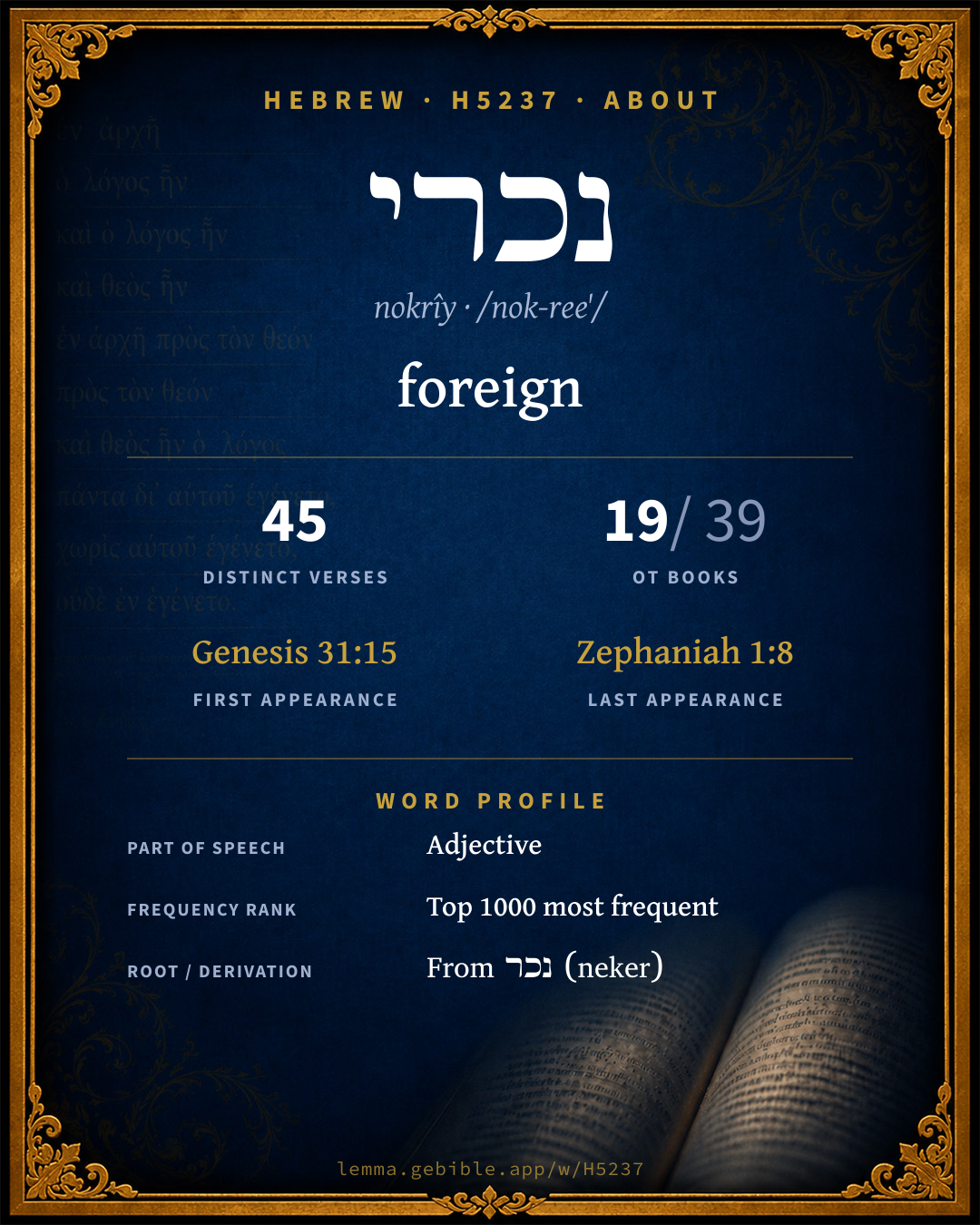
נׇכְרִי
foreign
‘foreign’ is one of 5 main senses fuller range ↓
Full lexicon entry — Brown-Driver-Briggs (BDB)
From Brown-Driver-Briggs (BDB)
Where this word appears
Grammar key — what these labels mean
Part of speech
- Adjective
- A word that describes or qualifies a noun.
State
- Absolute
- The independent form of a noun, not bound to a following word.
Gender
- Feminine
- Grammatically feminine.
- Masculine
- Grammatically masculine.
Number
- Singular
- One.
- Plural
- More than one (in Hebrew, generally three or more).
Grammatical forms
- Adjective, Adjective, Masculine, Singular, Absolute 18 times (39%)
- Adjective, Adjective, Feminine, Singular, Absolute 12 times (26%)
- Adjective, Adjective, Feminine, Plural, Absolute 12 times (26%)
- Adjective, Adjective, Masculine, Plural, Absolute 4 times (9%)
Parsed forms decoded from the imported morphology (morphhb / Westminster Leningrad Codex — WLC text public domain, morphhb tagging CC BY 4.0), counted across 46 parsed occurrences — not distinct verses.
Every verse where H5237 appears — 45 distinct verses across 19 books. Click any verse to open its interlinear word-by-word view. Verse text shown in the World English Bible for context — . Each verse’s Hebrew form is shown with its reference; the English is not keyword-highlighted, since the data carries no word-level English alignment. Use “Compare translations” on any verse to read it across multiple English versions. This concordance covers the Hebrew Bible; Septuagint (Greek Old Testament) occurrences are not indexed here.
Genesis 1 verse
Exodus 3 verses
- Exodus 2:22 נָכְרִיָּֽה adj Adjective fs She bore a son, and he named him Gershom, for he said, "I have lived as a foreigner in a foreign land."
- Exodus 18:3 נָכְרִיָּֽה adj Adjective fs and her two sons. The name of one son was Gershom, for Moses said, "I have lived as a foreigner in a foreign land".
- Exodus 21:8 נָכְרִ֛י adj Adjective ms If she doesn't please her master, who has married her to himself, then he shall let her be redeemed. He shall have no right to sell her to a foreign people, seeing he has dealt deceitfully with her.
Deuteronomy 5 verses
- Deuteronomy 14:21 לְ/נָכְרִ֔י prep + Adjective Adjective ms You shall not eat of anything that dies of itself: you may give it to the foreigner living among you who is within your gates, that he may eat it; or you may sell it to a foreigner: for you are a holy people to Yahweh your God. You shall not boil a kid in its mother's milk.
- Deuteronomy 15:3 הַ/נָּכְרִ֖י ptcl def.art + Adjective Adjective ms Of a foreigner you may exact it: but whatever of your is with your brother your hand shall release.
- Deuteronomy 17:15 נָכְרִ֔י adj Adjective ms you shall surely set him king over you, whom Yahweh your God shall choose: one from among your brothers shall you set king over you; you may not put a foreigner over you, who is not your brother.
- Deuteronomy 23:20 לַ/נָּכְרִ֣י prep det + Adjective Adjective ms to a foreigner you may lend on interest; but to your brother you shall not lend on interest, that Yahweh your God may bless you in all that you put your hand to, in the land where you go in to possess it.
- Deuteronomy 29:22 וְ/הַ֨/נָּכְרִ֔י conj + ptcl def.art + Adjective Adjective ms The generation to come, your children who shall rise up after you, and the foreigner who shall come from a far land, shall say, when they see the plagues of that land, and the sicknesses with which Yahweh has made it sick;
Judges 1 verse
Ruth 1 verse
2 Samuel 1 verse
1 Kings 4 verses
- 1 Kings 8:41 הַ/נָּכְרִ֔י ptcl def.art + Adjective Adjective ms Moreover concerning the foreigner, who is not of your people Israel, when he shall come out of a far country for your name's sake
- 1 Kings 8:43 הַ/נָּכְרִ֑י ptcl def.art + Adjective Adjective ms hear in heaven, your dwelling-place, and do according to all that the foreigner calls to you for; that all the peoples of the earth may know your name, to fear you, as does your people Israel, and that they may know that this house which I have built is called by my name.
- 1 Kings 11:1 נָכְרִיּ֛וֹת adj Adjective fp Now king Solomon loved many foreign women, together with the daughter of Pharaoh, women of the Moabites, Ammonites, Edomites, Sidonians, and Hittites;
- 1 Kings 11:8 הַ/נָּכְרִיּ֑וֹת ptcl def.art + Adjective Adjective fp So did he for all his foreign wives, who burnt incense and sacrificed to their gods.
2 Chronicles 2 verses
- 2 Chronicles 6:32 הַ/נָּכְרִ֗י ptcl def.art + Adjective Adjective ms Moreover concerning the foreigner, who is not of your people Israel, when he shall come from a far country for your great name's sake, and your mighty hand, and your outstretched arm; when they shall come and pray toward this house:
- 2 Chronicles 6:33 הַ/נָּכְרִ֑י ptcl def.art + Adjective Adjective ms then hear from heaven, even from your dwelling-place, and do according to all that the foreigner calls to you for; that all the peoples of the earth may know your name, and fear you, as does your people Israel, and that they may know that this house which I have built is called by your name.
Ezra 7 verses
- Ezra 10:2 נָכְרִיּ֖וֹת adj Adjective fp Shecaniah the son of Jehiel, one of the sons of Elam, answered Ezra, We have trespassed against our God, and have married foreign women of the peoples of the land: yet now there is hope for Israel concerning this thing.
- Ezra 10:10 נָכְרִיּ֑וֹת adj Adjective fp Ezra the priest stood up, and said to them, You have trespassed, and have married foreign women, to increase the guilt of Israel.
- Ezra 10:11 הַ/נָּכְרִיּֽוֹת ptcl def.art + Adjective Adjective fp Now therefore make confession to Yahweh, the God of your fathers, and do his pleasure; and separate yourselves from the peoples of the land, and from the foreign women.
- Ezra 10:14 נָכְרִיּוֹת֙ adj Adjective fp Let now our princes be appointed for all the assembly, and let all those who are in our cities who have married foreign women come at appointed times, and with them the elders of every city, and the judges of it, until the fierce wrath of our God be turned from us, until this matter be dispatched.
- Ezra 10:17 נָכְרִיּ֑וֹת adj Adjective fp They made an end with all the men who had married foreign women by the first day of the first month.
- Ezra 10:18 נָכְרִיּ֑וֹת adj Adjective fp Among the sons of the priests there were found who had married foreign women: [namely], of the sons of Jeshua, the son of Jozadak, and his brothers, Maaseiah, and Eliezer, and Jarib, and Gedaliah.
- Ezra 10:44 נָכְרִיּ֑וֹת adj Adjective fp All these had taken foreign wives; and some of them had wives by whom they had children.
Nehemiah 2 verses
- Nehemiah 13:26 הַ/נָּכְרִיּֽוֹת ptcl def.art + Adjective Adjective fp Did not Solomon king of Israel sin by these things? yet among many nations was there no king like him, and he was beloved of his God, and God made him king over all Israel: nevertheless even him did foreign women cause to sin.
- Nehemiah 13:27 נָכְרִיּֽוֹת adj Adjective fp Shall we then listen to you to do all this great evil, to trespass against our God in marrying foreign women?
Job 1 verse
Psalms 1 verse
Proverbs 9 verses
- Proverbs 2:16 מִ֝/נָּכְרִיָּ֗ה prep + Adjective Adjective fs To deliver you from the strange woman, Even from the foreigner who flatters with her words;
- Proverbs 5:10 נָכְרִֽי adj Adjective ms Lest strangers feast on your wealth, And your labors enrich another man's house.
- Proverbs 5:20 נָכְרִיָּֽה adj Adjective fs For why should you, my son, be captivated with an adulteress? Why embrace the bosom of another?
- Proverbs 6:24 נָכְרִיָּֽה adj Adjective fs To keep you from the immoral woman, From the flattery of the wayward wife's tongue.
- Proverbs 7:5 מִ֝/נָּכְרִיָּ֗ה prep + Adjective Adjective fs That they may keep you from the strange woman, From the foreigner who flatters with her words.
- Proverbs 20:16 נכרים נָכְרִיָּ֣ה adj Adjective mp adj Adjective fs Take the garment of one who puts up collateral for a stranger; And hold him in pledge for a wayward woman.
- Proverbs 23:27 נָכְרִיָּֽה adj Adjective fs For a prostitute is a deep pit; And a wayward wife is a narrow well.
- Proverbs 27:2 נָ֝כְרִ֗י adj Adjective ms Let another man praise you, And not your own mouth; A stranger, and not your own lips.
- Proverbs 27:13 נָכְרִיָּ֣ה adj Adjective fs Take his garment when he puts up collateral for a stranger; Hold it for a wayward woman!
Ecclesiastes 1 verse
Isaiah 2 verses
- Isaiah 2:6 נָכְרִ֖ים adj Adjective mp For you have forsaken your people, the house of Jacob, Because they are filled from the east, With those who practice divination like the Philistines, And they clasp hands with the children of foreigners.
- Isaiah 28:21 נָכְרִיָּ֖ה adj Adjective fs For Yahweh will rise up as on Mount Perazim, he will be angry as in the valley of Gibeon; that he may do his work, his strange work, and bring to pass his act, his strange act.
Jeremiah 1 verse
Lamentations 1 verse
Obadiah 1 verse
Zephaniah 1 verse
About this entry
At a glance — auto-summarized from this page’s data, not written by a person. Every figure links to its source below. This summary describes the numbers; it doesn’t interpret them.
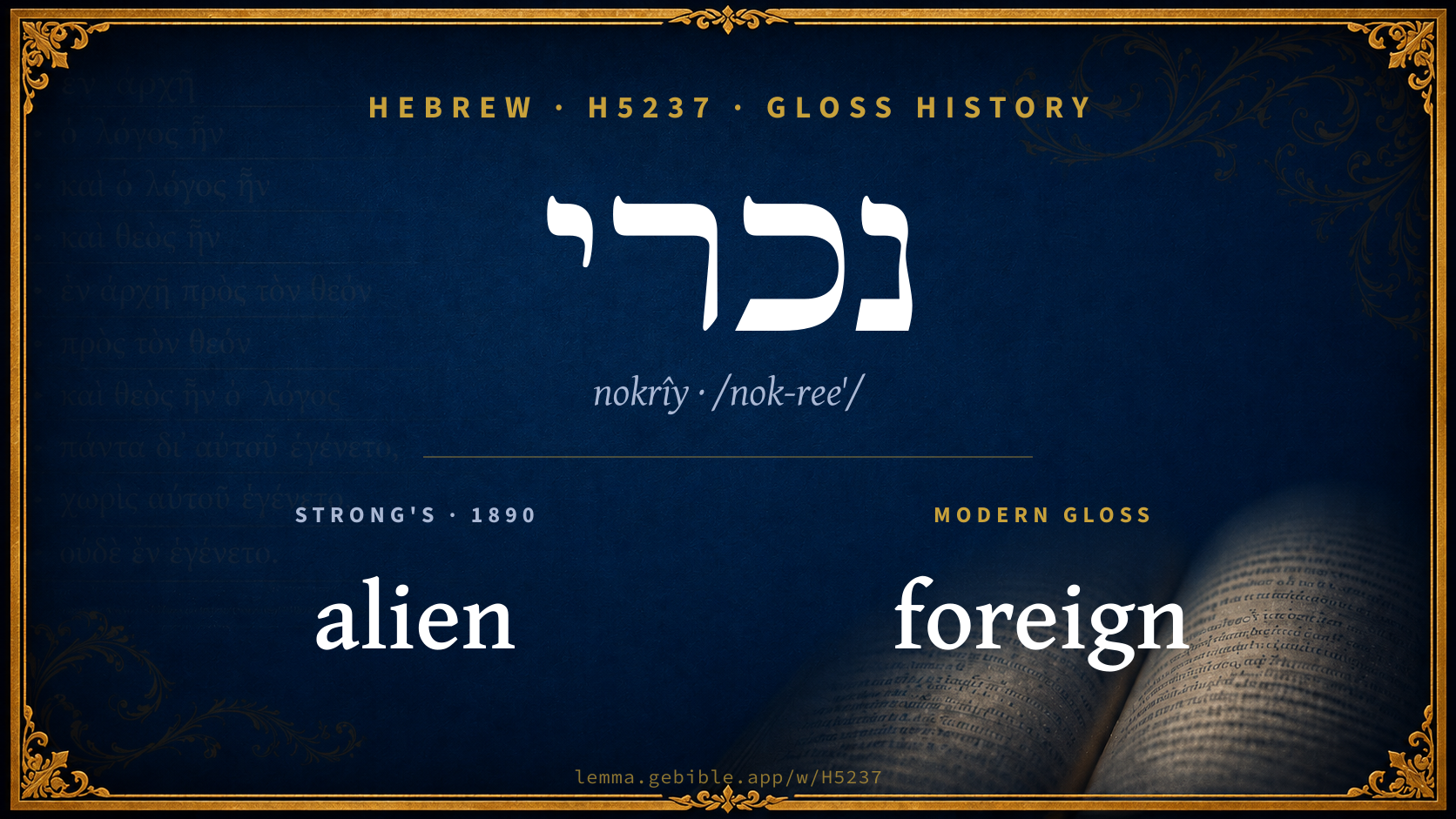
The Hebrew adjective נכרי centers on the idea of “foreign.” Older and newer Bibles part ways — “strange” in the King James Version, “foreign” (Berean Standard Bible) in modern versions. See the renderings breakdown. It appears 45 verses across 19 books of the Hebrew Bible, among its moderately common vocabulary. Its earliest occurrence is Genesis 31:15. Its meaning spans more than one sense — see its full sense range. Dig into 45-verse concordance and the renderings breakdown below.
Gloss history
Strong's 1890 vs modern scholarship
About this word
Strong's H5237 catalogs a Hebrew word from the Hebrew Old Testament.
These counts are not copied from any lexicon or concordance. They are computed here, from the morphology-tagged Hebrew Old Testament. What Lemma adds →
- 45
- distinct verses
- The word appears in 45 distinct verses.
- 19 / 39
- OT books
- The word appears in 19 of 39 Old Testament books.
- #796
- by frequency
- Top 1000 most frequent Hebrew words (rank 796 of 8,640 Hebrew words by occurrence).
View all 45 occurrences in the concordance →
Most concentrated in
- Proverbs 9 verses 20%
- Ezra 7 verses 16%
- Deuteronomy 5 verses 11%
By section of the Old Testament
By traditional corpus
Conventional, traditional groupings — biblical authorship is debated, so this is a traditional corpus grouping, not an authorship claim. Each share is this word’s portion of its verses in that division of the Hebrew canon. Each figure is a share of the word’s 45 distinct verses.
- Writings (Ketuvim) 25 verses · 56%
- Prophets (Nevi'im) 11 verses · 24%
- Torah (Pentateuch) 9 verses · 20%
How translations render this word
Counts come from each version’s own published word-to-Strong’s tagging or interlinear alignment — an approximate guide to how each version renders this word, not a word-level alignment the data otherwise carries. Because each total is that version’s own tagged count, the per-version totals vary from one another and need not match the appearance or distinct-verse counts above. These counts may also differ from a printed concordance because Lemma counts each distinctly tagged rendering and does not collapse phrase taggings into a single head-word total. This is a fixed set of word-tagged versions (KJV, ASV, BSB, ULT) and does not change with the reading translation you choose elsewhere. Each version’s license is shown beside its name below (and on Sources).
- King James Version: Strange 15×, Stranger 8×, Strange woman 4×
- American Standard Version: Foreign 14×, Foreigner 8×, Foreigners 3×
- Berean Standard Bible: Foreign 14×, Foreigner 12×, Foreigners 4×
- unfoldingWord Literal Text: Foreign 17×, Foreigner 14×, Foreign woman 7×
King James Version Public Domain
Renders H5237 across 44 tagged occurrences — most commonly:
Plus 11 renderings that appear only once — usually multi-word phrases or single function words the recovered tagging swept in, not distinct renderings. Not rendered by a distinct English word in 1 further occurrence.
American Standard Version Public Domain
Renders H5237 across 44 tagged occurrences — most commonly:
Plus 13 renderings that appear only once — usually multi-word phrases or single function words the recovered tagging swept in, not distinct renderings.
Berean Standard Bible Public Domain
Renders H5237 across 42 tagged occurrences — most commonly:
Plus 6 renderings that appear only once — usually multi-word phrases or single function words the recovered tagging swept in, not distinct renderings. Not rendered by a distinct English word in 3 further occurrences.
unfoldingWord Literal Text CC BY-SA 4.0
Renders H5237 across 45 tagged occurrences — most commonly:
Plus 3 renderings that appear only once — usually multi-word phrases or single function words the recovered tagging swept in, not distinct renderings.
Senses in the full BDB
What do BDB’s symbols mean?
BDB uses these scholarly abbreviations:
| Symbol | Meaning |
|---|---|
| 𝔊 | the Septuagint (the ancient Greek translation, LXX) |
| 𝔙 | the Vulgate (the Latin translation) |
| 𝔖 | the Syriac version (the Peshitta) |
| 𝔗 | the Targum (the Aramaic translation) |
| ψ | the Psalms |
| √ | root (the underlying root or stem) |
| ‖ | parallel passage (a synonymous or contrasted parallel) |
| † | the dagger: every passage where the word occurs is cited |
The 4 senses and sub-senses the full Brown-Driver-Briggs lexicon distinguishes for this word, in lexicon order (not ranked by frequency), with BDB’s own verbatim wording and sub-sense lettering. Shown in Hebrew script with BDB’s own scholarly abbreviations. The condensed entry is in the Lexicon Entry tab. See also the Forms in the corpus table below.
- 1.
- a. foreign: עַם נָכְרִי Ex 21:8 (E) a foreign (non-Isr.) people, אִישׁ נ׳ Dt 17:15 (‖ לֹא אָחִיךָ); מַלְבּוּשׁ נ׳ Zp 1:8; אֶרֶץ נָכְרִיָּה Ex 2:22 (J) foreign land, so 18:3 (E); especially נָשִׁים נָכְרִיּוֹת foreign (non-Isr.) women 1 K 11:1, 8; Ezr 10:2, 10, 11, 14, 17, 18, 44; Ne 13:26, 27. e.g. Exodus 21:8
- b. as subst. נָכְרִי foreigner (non-Isr.) Ju 19:12 (+ אֲשֶׁר לֹא מִבְּנֵי יִשְׂרָאֵל), 1 K 8:41 (+ אֲשֶׁר לֹא מֵעַמְּךָ), = 2 Ch 6:32 (+ id.), 1 K 8:43 = 2 Ch 6:33, Dt 14:21 (‖ גֵּר), 15:3; 23:21 (opp. אָחִיךָ), 29:21 (+ אֲשֶׁר יָבֹא מֵאֶרֶץ רְהוֹקָה); as predicate, 2 S 15:19 (‖ גֹּלָה), נָכְרִיָּה Ru 2:10; pl. נָכְרִים foreigners La 5:2 (‖ זָרִים), Ob 11 (‖ id.); cf. יַלְדֵי נָכְרִים Is 2:6; fpl. alien women Gn 31:15 (E; i.e. not of one’s father’s family). e.g. Judges 19:12
- 2. נָכְרִיָּה foreign woman, as term. techn., in Pr, for harlot (perhaps because harlots were orig. chiefly foreigners): Pr 2:16 (‖ אִשָּׁה זָרָה), 7:5 (‖ id.), 5:20 (‖ זָרָה), 6:24 (‖ אֵשֶׁת רָ֑ע), 23:27 (‖ זוֹנָה).—On 20:16; 27:13 v. infr. e.g. Proverbs 2:16
- 3. fig. unknown, unfamiliar: נָכְרִי הָיִיתִי בְּעֵינֵיהֶם Jb 19:15 an alien am I become in their eyes; נ׳ לִבְנֵי אִמִּי ψ 69:9 (‖ מוּזָר הָיִיתִי לְאֶחָ֑י); אִישׁ נ׳ Ec 6:2; of י׳’s judgment, נָכְרִיָּה עֲבֹדָתוֹ Is 28:21 strange is his task! (‖ זָר מַעֲשֵׂהוּ); גֶּפֶן נָכְרִיָּה Je 2:21 an alien vine (opp. זֶרַע אֱמֶת), fig. of degenerate Israel; as subst., נָכְרִים Pr 20:16 Kt (> Qr נָכְרִיָּה), aliens, persons unknown to him (‖ זָר), so read also (for MT נָכְרִיָּה) ‖ 27:13; cf. 5:10; 27:2. e.g. Job 19:15
Senses from the full Brown-Driver-Briggs lexicon (Brown, Driver, Briggs; Oxford 1906 — public domain), digitized via Sefaria, supplemented by the OpenScriptures HebrewLexicon (CC BY 4.0). Full attribution on Sources.
Word origin
adj. foreign, alien (NH נָכְרִי = Gentile);—נ׳ abs. m. Zp 1:8 +; f. נָכְרִיָּה Ex 2:22 +; mpl. נָכְרִים Is 2:6 + 2 times + Pr 20:16 Kt (> Qr נָכְרִיָּה), + 27:13 (so read for MT נָכְרִיָּה); fpl. נָכְרִיּוֹת Gn 31:15 +;—
— Brown-Driver-Briggs (Oxford 1906, public domain), digitized via Sefaria, supplemented by the OpenScriptures HebrewLexicon (CC BY 4.0). See Sources.
Derived from נכר (neker) (H5235) — calamity.
Jastrow Dictionary
A second Hebrew/Aramaic lexicon for comparison, covering Aramaic and post-biblical (Talmudic, Targumic, Midrashic) usage that the biblical-Hebrew BDB does not. Matched by lemma rather than by Strong’s number, so a lemma may carry more than one Jastrow headword (shown separately below), and the entries cover usage well beyond the Bible.
נָכְרִי
- preced. wds.) stranger, gentile. [In editions published under the censor’s supervision, our w. is frequently changed into עכו"ם, גּוֹי, כּוּשִׁי, כּוּתִי &c.] Ab. Zar. IV, 4 (51ᵇ; 52ᵇ; Mish. ed. עכו"ם). Sabb. 31ᵃ; a. v. fr.—Pl. נָכְרִים. Ḥull. 13ᵇ נ׳ שבחוצה לארץ לאו עובדי ע"ז וכ׳ gentiles outside of Palestine are not to be considered as idolaters, they only continue their fathers’ customs. Gitt. 61ᵃ מפרנסין עניי נ׳ וכ׳ we must support the poor of the gentiles &c.; (Tosef. ib. V (III), 4 גוים). Gitt. V, 9 (61ᵃ) מספידין מתי נ׳ וכ׳ (Mish. ed. עכו"ם) we must lament for the dead of the gentiles &c.; a. v. fr.—Fem. נָכְרִית. Yeb. 17ᵃ. Ib. III, 7 שלשה אחים … ואחד נשוי נ׳ in the case of three brothers, two of whom married two sisters, and one a stranger; a. fr.
A Dictionary of the Targumim, the Talmud Babli and Yerushalmi, and the Midrashic Literature (Marcus Jastrow; London, Luzac, 1903) — Public Domain. Digitized via Sefaria. Digitized via Sefaria. Full attribution on Sources.
Forms in the corpus
The 30 distinct written forms H5237 takes in the Hebrew Bible, most frequent first — each parse links to that state’s occurrences in the concordance. Hebrew forms include their vowel points and cantillation, so a single lemma takes many written forms.
| Form | Parsing | Example | Uses |
|---|---|---|---|
| נָכְרִיָּֽה | Adjective, Adjective, Feminine, Singular, Absolute | Exodus 2:22 | 7 |
| נָכְרִיּ֑וֹת | Adjective, Adjective, Feminine, Plural, Absolute | Ezra 10:10 | 4 |
| הַ/נָּכְרִ֑י | Adjective, Adjective, Masculine, Singular, Absolute | 1 Kings 8:43 | 2 |
| הַ/נָּכְרִיּֽוֹת | Adjective, Adjective, Feminine, Plural, Absolute | Ezra 10:11 | 2 |
| מִ֝/נָּכְרִיָּ֗ה | Adjective, Adjective, Feminine, Singular, Absolute | Proverbs 2:16 | 2 |
| נָ֝כְרִ֗י | Adjective, Adjective, Masculine, Singular, Absolute | Job 19:15 | 2 |
| נָכְרִ֔י | Adjective, Adjective, Masculine, Singular, Absolute | Deuteronomy 17:15 | 2 |
| נָכְרִיּ֛וֹת | Adjective, Adjective, Feminine, Plural, Absolute | Genesis 31:15 | 2 |
| נָכְרִיָּ֣ה | Adjective, Adjective, Feminine, Singular, Absolute | Proverbs 20:16 | 2 |
| הַ/נָּכְרִ֔י | Adjective, Adjective, Masculine, Singular, Absolute | 1 Kings 8:41 | 1 |
| הַ/נָּכְרִ֖י | Adjective, Adjective, Masculine, Singular, Absolute | Deuteronomy 15:3 | 1 |
| הַ/נָּכְרִ֗י | Adjective, Adjective, Masculine, Singular, Absolute | 2 Chronicles 6:32 | 1 |
| הַ/נָּכְרִיּ֑וֹת | Adjective, Adjective, Feminine, Plural, Absolute | 1 Kings 11:8 | 1 |
| וְ/הַ֨/נָּכְרִ֔י | Adjective, Adjective, Masculine, Singular, Absolute | Deuteronomy 29:22 | 1 |
| וְ/נָכְרִ֞ים | Adjective, Adjective, Masculine, Plural, Absolute | Obadiah 1:11 | 1 |
| וְ֝/נָכְרִ֗י | Adjective, Adjective, Masculine, Singular, Absolute | Psalms 69:8 | 1 |
| לְ/נָכְרִ֔י | Adjective, Adjective, Masculine, Singular, Absolute | Deuteronomy 14:21 | 1 |
| לְ/נָכְרִֽים | Adjective, Adjective, Masculine, Plural, Absolute | Lamentations 5:2 | 1 |
| לַ/נָּכְרִ֣י | Adjective, Adjective, Masculine, Singular, Absolute | Deuteronomy 23:20 | 1 |
| נָכְרִ֖י | Adjective, Adjective, Masculine, Singular, Absolute | Ecclesiastes 6:2 | 1 |
| נָכְרִ֖ים | Adjective, Adjective, Masculine, Plural, Absolute | Isaiah 2:6 | 1 |
| נָכְרִ֛י | Adjective, Adjective, Masculine, Singular, Absolute | Exodus 21:8 | 1 |
| נָכְרִ֣י | Adjective, Adjective, Masculine, Singular, Absolute | 2 Samuel 15:19 | 1 |
| נָכְרִֽי | Adjective, Adjective, Masculine, Singular, Absolute | Zephaniah 1:8 | 1 |
| נָכְרִיּ֖וֹת | Adjective, Adjective, Feminine, Plural, Absolute | Ezra 10:2 | 1 |
| נָכְרִיָּ֖ה | Adjective, Adjective, Feminine, Singular, Absolute | Isaiah 28:21 | 1 |
| נָכְרִיּֽוֹת | Adjective, Adjective, Feminine, Plural, Absolute | Nehemiah 13:27 | 1 |
| נָכְרִיּוֹת֙ | Adjective, Adjective, Feminine, Plural, Absolute | Ezra 10:14 | 1 |
| נָכְרִֽי | Adjective, Adjective, Masculine, Singular, Absolute | Proverbs 5:10 | 1 |
| נכרים | Adjective, Adjective, Masculine, Plural, Absolute | Proverbs 20:16 | 1 |
Septuagint verse parallels
This word appears in 42 verses that also exist in the Greek Old Testament (Septuagint), out of the 45 Hebrew verses it occurs in. You can read those verses in Greek by switching the Old Testament edition to the Septuagint.
Read these verses in the Septuagint
- Genesis 31:15
- Exodus 2:22
- Deuteronomy 14:21
- Judges 19:12
- Ruth 2:10
- 2 Samuel 15:19
- 1 Kings 8:41
- 2 Chronicles 6:32
- Ezra 10:2
- Job 19:15
- Proverbs 2:16
- Ecclesiastes 6:2
This is a verse-level parallel only — the same verses exist in both the Hebrew and Greek Old Testaments. No word-level Hebrew↔Greek correspondence is claimed: the data carries no such alignment, so no Greek word is shown as this Hebrew word’s translation. Coverage is not total — the Septuagint omits the deuterocanon and renumbers the Psalms, so some Hebrew verses have no direct Greek parallel.