Nehemiah 13:27

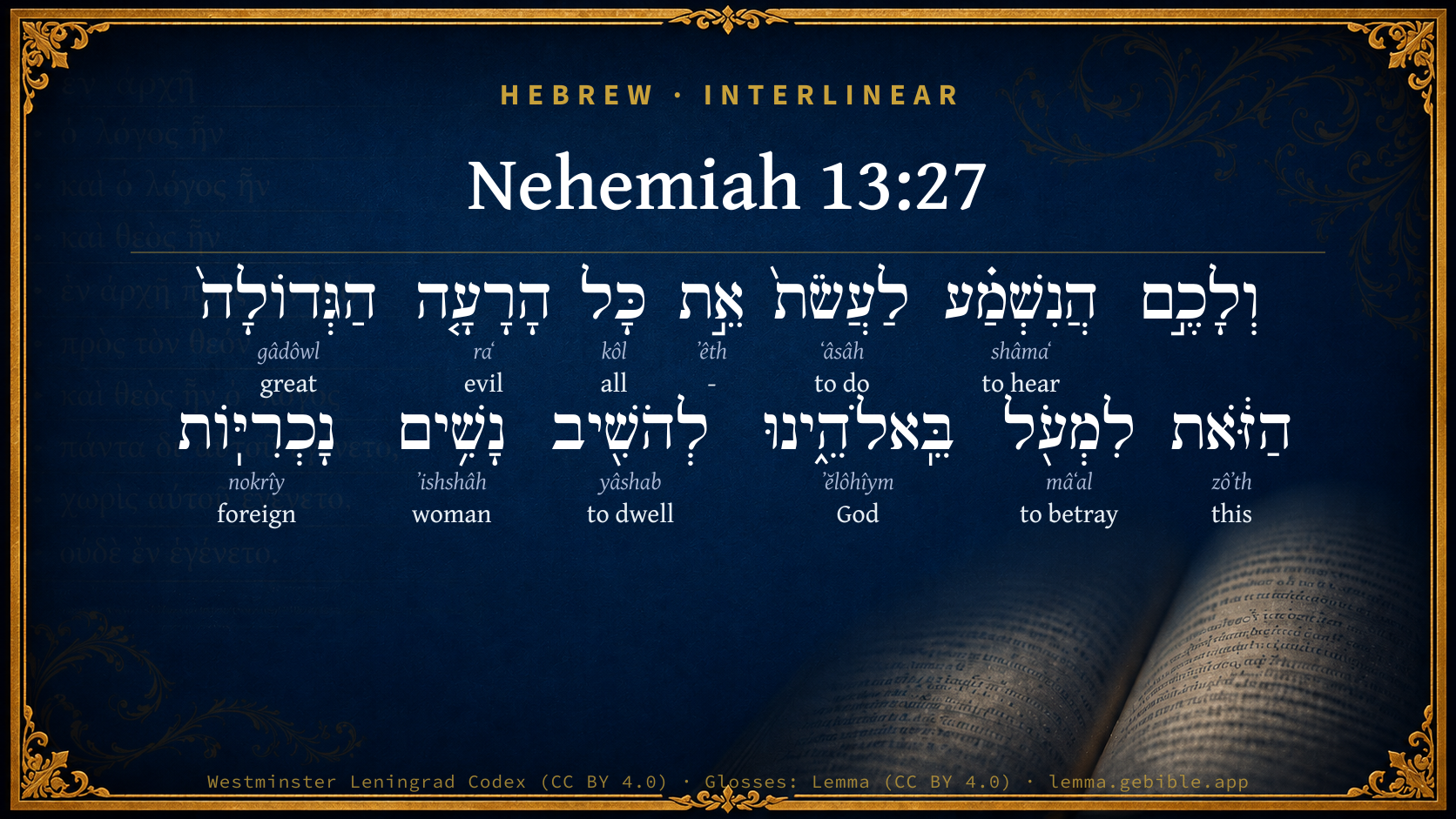
Hebrew (Westminster Leningrad Codex) Nehemiah 13:27 appears in the Hebrew Old Testament. The text above is from the Westminster Leningrad Codex. Each word links to its Strong’s number, a concise gloss, and parsing drawn from the Open Scriptures Hebrew Bible morphology. Click any word for its full Brown-Driver-Briggs (BDB) entry.
Download image
Cite this verse

Nehemiah 13:27 (World English Bible). Public Domain. Lemma interlinear Bible study tool, https://lemma.gebible.app/v/nehemiah/13/27.

Show BibTeX & RIS
BibTeX
RIS
English Translation
Shall we then listen to you to do all this great evil, to trespass against our God in marrying foreign women?
World English Bible · Public Domain
Download a study sheet

One document with this verse’s original text, its word-by-word gloss line, the meaning frame, cross-references with their text, attributed commentary, and full source and license credits — printable, and it pastes into notes with its structure intact.

This verse Autodidact and up

Study sheet (.html) Plain text (.txt)

A passage Seminary Student

Up to 50 verses in one chapter. A passage sheet keeps up to 6 commentary sources and 12 cross-references per verse, in the order this page ranks them, and says so on the sheet whenever that leaves anything out. Ask for a single verse and you get the Autodidact verse sheet above.

Everything on this page stays free to read, with no account — the sheet is a download of what is already on screen, not access to it.

Want to remove ads? Support Godless Engineer
Compare translations 3

The same verse in 3 English versions, stacked beneath the original-language interlinear above. Click any original word for its lexicon entry.

Each is an independent rendering of the whole verse — the interlinear is not word-aligned to these translations.

Highlighted words mark where these versions differ — a whole-verse word diff, not a word-by-word alignment.

  • World English Bible Public Domain
    Shall we then listen to you to do all this great evil, to trespass against our God in marrying foreign women?
  • King James Version Public Domain
    Shall we then hearken unto you to do all this great evil, to transgress against our God in marrying strange wives?
  • unfoldingWord Literal Text CC BY-SA 4.0
    Should we then listen to you, to do all this great evil, to act unfaithfully toward our God and give a dwelling to foreign women?”

unfoldingWord Literal Text — © unfoldingWord, licensed CC BY-SA 4.0. Word-aligned USFM3 via Door43 (git.door43.org/unfoldingWord/en_ult).

Versions to compare (up to 4)

3 of 4 selected

Show all 18 translations

Every available English version of this verse, each an independent rendering of the whole verse.

  • World English Bible Public Domain
    Shall we then listen to you to do all this great evil, to trespass against our God in marrying foreign women?
  • Berean Standard Bible Public Domain
    Must we now hear that you too are doing all this terrible evil and acting unfaithfully against our God by marrying foreign women?”
  • Majority Standard Bible Public Domain
    Must we now hear that you too are doing all this terrible evil and acting unfaithfully against our God by marrying foreign women?”
  • King James Version Public Domain
    Shall we then hearken unto you to do all this great evil, to transgress against our God in marrying strange wives?
  • American Standard Version (1901) Public Domain
    Shall we then hearken unto you to do all this great evil, to trespass against our God in marrying foreign women?
  • Revised Version (1885) Public Domain
    Shall we then hearken unto you to do all this great evil, to trespass against our God in marrying strange women?
  • Geneva Bible (1599) Public Domain
    Shall wee then obey vnto you, to doe all this great euil, and to transgresse against our God, euen to marry strange wiues?
  • Douay-Rheims (1899) Public Domain
    And shall we also be disobedient and do all this great evil to transgress against our God, and marry strange women?
  • Young's Literal Translation Public Domain
    And to you do we hearken to do all this great evil, to trespass against our God, to settle strange women?'
  • Literal Standard Version CC BY-SA 4.0
    And do we listen to you to do all this great evil, to trespass against our God, to settle strange women?”
  • Unlocked Literal Bible CC BY-SA 4.0
    Should we then listen to you and do all this great evil, and act treacherously against our God by marrying foreign women?”
  • unfoldingWord Literal Text CC BY-SA 4.0
    Should we then listen to you, to do all this great evil, to act unfaithfully toward our God and give a dwelling to foreign women?”
  • Darby Bible Public Domain
    And should we hearken to you to do all this great evil, to act unfaithfully to our God by marrying foreign wives?
  • World Messianic Bible Public Domain
    Shall we then listen to you to do all this great evil, to trespass against our God in marrying foreign women?”
  • Webster's Bible Public Domain
    Shall we then hearken to you to do all this great evil, to transgress against our God in marrying foreign wives?
  • Free Bible Version CC BY-SA 4.0
    So do we have to hear about you committing this dreadful sin, how you are being unfaithful to our God by marrying foreign women?”
  • Bible in Basic English Public Domain
    Are we then without protest to let you do all this great evil, sinning against our God by taking strange women for your wives?
  • JPS Tanakh (1917) Public Domain
    Shall we then hearken unto you to do all this great evil, to break faith with our God in marrying foreign women?'

Literal Standard Version (2020), Covenant Press — licensed CC BY-SA 4.0. Text via the HelloAO Bible API (eBible.org). Unlocked Literal Bible (unfoldingWord) — licensed CC BY-SA 4.0. Text via the HelloAO Bible API (eBible.org). unfoldingWord Literal Text — © unfoldingWord, licensed CC BY-SA 4.0. Word-aligned USFM3 via Door43 (git.door43.org/unfoldingWord/en_ult). Free Bible Version, Dr. Jonathan Gallagher — licensed CC BY-SA 4.0. Text via the HelloAO Bible API (eBible.org).

Word by word

More ways to search: Search by grammar → Find every occurrence → Compare this word →

Practice this passage: Drill this verse → Learn its vocabulary →

לִמְעֹ֖ל
mâʻal
H4603
“to betray”
Preposition + Verb, Qal, Infinitive Construct
Part of Speech
Preposition + Verb
Stem
Qal
Form
Infinitive Construct
Full BDB Definition

Origin: a primitive root

TWOT: 1230

to act unfaithfully, act treacherously, transgress, commit a trespass - (Qal) to act unfaithfully or treacherously - against man - against God - against devoted thing - against husband
  1. הֲנִשְׁמַ֗ע shâmaʻ H8085 “to hear” Particle, Interrogative + Verb, Niphal, Perfect, 3rd Person, Masculine, Singular
  2. לַעֲשֹׂת֙ ʻâsâh H6213 “to do” Preposition + Verb, Qal, Infinitive Construct
  3. אֵ֣ת ʼêth H853 “-” Particle, Direct Object
  4. כָּל kôl H3605 “all of” Noun, Common, Masculine, Singular, Construct
  5. הָרָעָ֤ה raʻ H7451 “the · evil” Particle, Definite Article + Noun, Common, Feminine, Singular, Absolute
  6. הַגְּדוֹלָה֙ gâdôwl H1419 “the · great” Particle, Definite Article + Adjective, Adjective, Feminine, Singular, Absolute
  7. הַזֹּ֔את zôʼth H2063 “the · this” Particle, Definite Article + Pronoun, Demonstrative, Feminine, Singular
  8. בֵּֽאלֹהֵ֑ינוּ ʼĕlôhîym H430 “in/at · God(s) · our” Preposition + Noun, Common, Masculine, Plural, Construct + Suffix, Personal, 1st Person, Common, Plural
  9. לְהֹשִׁ֖יב yâshab H3427 “to dwell” Preposition + Verb, Hiphil, Infinitive Construct
  10. נָשִׁ֥ים ʼishshâh H802 “women” Noun, Common, Feminine, Plural, Absolute
  11. נָכְרִיּֽוֹת nokrîy H5237 “foreign” Adjective, Adjective, Feminine, Plural, Absolute

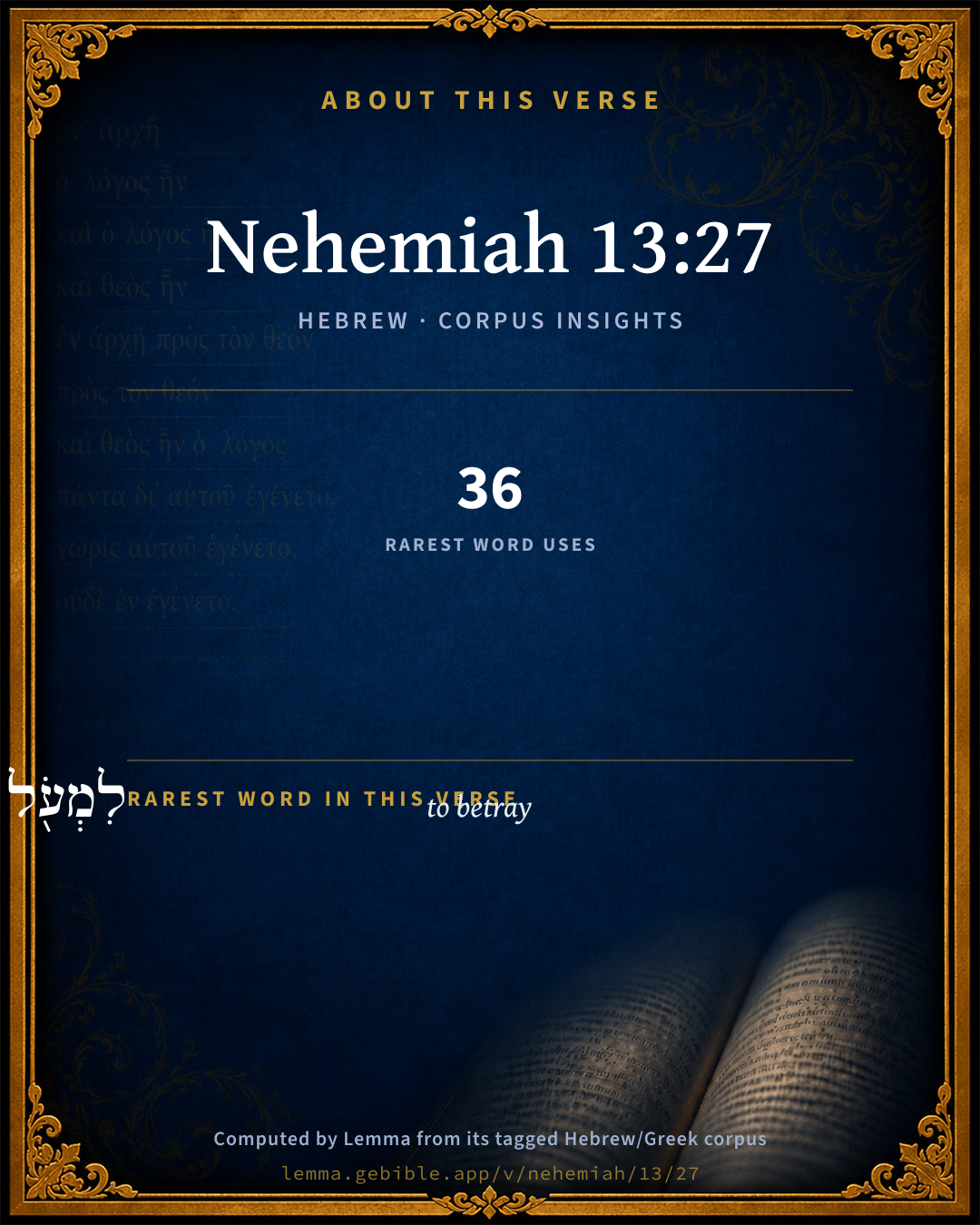
About this verse

These counts appear in no published source. They are computed here, from the morphology-tagged text and Lemma’s own curated glosses. What Lemma adds →

13
words
12
distinct lemmas
Historical
section

Shared distinctive vocabulary

לִמְעֹ֖ל to betray H4603 occurs in 35 verses of the Hebrew Bible. Also found in:

Grammatical profile

  • 4 verbs
  • 4 nouns
  • 2 adjectives
  • 1 pronoun
  • 1 preposition
  • 1 particle

Verb forms

  • הֲנִשְׁמַ֗ע Niphal · Perfect
  • לַעֲשֹׂת֙ Qal · Infinitive Construct
  • לִמְעֹ֖ל Qal · Infinitive Construct
  • לְהֹשִׁ֖יב Hiphil · Infinitive Construct

Cross-references

2

Topical passages linked to Nehemiah 13:27 in the Treasury of Scripture Knowledge — connected by theme and wording, ordered by reader-vote popularity; previews shown in the World English Bible.

  • Ezra 10:2 Shecaniah the son of Jehiel, one of the sons of Elam, answered Ezra, We have trespassed against our God, and have married foreign women of the peoples of the land: yet now there is hope for Israel concerning this thing.
  • 1 Samuel 30:24 Who will listen to you in this matter? for as his share is who goes down to the battle, so shall his share be who tarries by the baggage: they shall share alike.

Cross-references courtesy of OpenBible.info (CC BY 4.0).

Hebrew and Greek witnesses Masoretic Hebrew ↔ Greek Septuagint

The same verse in the two great witnesses to the Old Testament, shown verse-for-verse.

These are two independent witnesses, not word-aligned to each other, and the Septuagint is shown in lemma (dictionary) form.

Hebrew Nehemiah 13:27 Masoretic · Westminster Leningrad Codex

וְלָכֶ֣ם הֲנִשְׁמַ֗ע לַעֲשֹׂת֙ אֵ֣ת כָּל הָרָעָ֤ה הַגְּדוֹלָה֙ הַזֹּ֔את לִמְעֹ֖ל בֵּֽאלֹהֵ֑ינוּ לְהֹשִׁ֖יב נָשִׁ֥ים נָכְרִיּֽוֹת

Shall we then listen to you to do all this great evil, to trespass against our God in marrying foreign women?

World English Bible · Public Domain

Greek LXX Structure differs

The Septuagint has no separate book of Nehemiah. Its Greek text is the second half of Esdras B (2 Esdras), chapters 11–23; Ezra is the first half (1–10).

A verse-for-verse comparison isn’t shown here because the chapters and verses don’t line up. Switch to the LXX edition with the MT / LXX toggle above to read the Greek directly.

On this verse, The Cambridge Bible for Schools and Colleges discusses the Septuagint’s reading. Read the note in Commentary ↓

Hebrew: Westminster Leningrad Codex (CC BY 4.0). Greek: Septuagint (public domain); English from a public-domain English Septuagint. How the Septuagint differs from the Hebrew →

Commentary

Notes on Nehemiah 13:27 from classic Christian and Jewish commentators (each source and its license shown beneath its notes). The classic Christian expositions comment on the surrounding passage and are grouped to its opening verse, so a note may address several verses; the Jewish commentaries on the Tanakh (Rashi and others) are per-verse, so they appear only where the commentator wrote on this verse.

Lemma curates 59 commentaries, every one of them public domain or Creative Commons licensed, each selected and text-cleaned for this edition rather than reprinted as found. About our sources →

The Cambridge Bible for Schools and Colleges

gen. ed. J. J. S. Perowne

27. Shall we then hearken unto you] The rendering is disputed.

According to the English Version, the sense is, ‘are we to listen to your expostulations and entreaties, and permit this evil to go on unchecked, when even the saintly Solomon fell because of it?’ This is the rendering of the LXX. καὶ ὑμῶν μὴ ἀκουσώμεθα, and is reproduced by the Vulg. ‘Numquid et nos inobedientes faciemus.’ The alternative translation throws greater emphasis on the contrast between Solomon and the Jews. ‘And as for you, should it be heard of (i.e. surely if Solomon thus fell, it should be an unheard of thing), that ye should go on the same fatal course of conduct?’ In favour of this rendering is the prominent position of the 2nd plur. pron. at the head of Neh_13:27.

transgress] R.V. trespass.

wives] R.V. women. Nehemiah apparently renewed the policy of Ezra (Ezra 10) and urged the Jews to put away from them their Gentile wives.

The Cambridge Bible for Schools and Colleges (gen. ed. J. J. S. Perowne; Cambridge University Press, 1878–1918) — public domain. Text from a community e-Sword module.

Trapp's Complete Commentary

John Trapp

Neh 13:27 Shall we then hearken unto you to do all this great evil, to transgress against our God in marrying strange wives?

Ver. 27. To do all this great evil] Here are three articles in the Hebrew, importing the heinousness of this sin. See the like, Gen 39:9.

To transgress against our God] No sin can be little, because it is a disloyalty (so the word signifieth) against so great a God, and his most holy law; a sacrilegious trespass.

John Trapp, A Commentary or Exposition upon All the Books of the Old and New Testament (1647–1656) — public domain. Text from a community e-Sword module.

Joseph Benson's Commentary

Neh 13:27-28. Shall we then hearken unto you to do all this great evil? — That is, would you have me to connive at this wickedness, and so bring guilt upon myself, and ruin upon you? And one of the sons of Joiada, the son of Eliashib, &c. — It is supposed Eliashib died before Nehemiah returned from Persia, and that Joiada his son succeeded him as high-priest, one of whose sons had offended in this matter. Was son-in-law to Sanballat the Horaonite — He is said by Josephus to have been that Manasseh who, by Sanballat’s interest, procured liberty to build the Samaritan temple on mount Gerizim; to which those priests who had married strange wives, or been otherwise criminal, betook themselves: and, with or after them, others of the people in the same or like circumstances. Therefore I chased him from me — From my presence and court, from the city and temple, and from the congregation and church of Israel.

Joseph Benson's Commentary on the Old and New Testaments (1811–1818) — public domain. Text from a community e-Sword module.

Adam Clarke's Commentary

Verse 27. Shall we then hearken unto you] If God spared not Solomon, who was so much beloved of Him, shall we spare you, who by your conduct are bringing down God's judgments upon Israel?

Adam Clarke's Commentary on the Bible (1810–1826) — public domain. Text from a community e-Sword/MySword module.

John Gill's Exposition

Thus cleansed I them from all strangers,.... Both people and priests from strange wives, obliging them to put them away, or flee their country:

and appointing the wards of the priests and the Levites, everyone in his business: to do the work of their office in their courses and turns.

John Gill's Exposition of the Whole Bible (1746–1763) — public domain (CC PDM 1.0). Text via the HelloAO Bible API.

Haydock's Catholic Bible Commentary

Also be. Hebrew, "hearken unto you;" (Protestants; Haydock) or "Have ye not heard the evils which fell upon our fathers (Calmet) for doing all?" &c. (Haydock)

George Leo Haydock (1774–1849), Haydock's Catholic Family Bible and Commentary, 1859 edition — public domain. Excludes Psalms (Douay-Rheims chapter numbering differs from Protestant) and Deuterocanonical books (Catholic canon only).

Matthew Poole's English Annotations

Shall we then hearken unto you? shall we justify our action by permitting or not punishing it? God forbid.

Matthew Poole's English Annotations on the Holy Bible (1683–1685) — public domain. Text from a community e-Sword/MySword module.

Whedon's Commentary on the Bible

Daniel D. Whedon

27. Shall we then hearken unto you — Shall we hear to you, that is, in the sense of accepting your views, and consenting to your evil action in this matter? Less simple, we think, is the construction of Bertheau and Keil, who take נשׁמעas third person, Niphal: for you is it hard to do, etc.; that is, is it not unheard of for you to do so great an evil?

Daniel D. Whedon (gen. ed.), Commentary on the Old and New Testaments (1874–1909) — public domain. Text from a community e-Sword module.

The Pulpit Commentary

Shall we then hearken unto you? Shall we give way to you, and adopt the practice which you recommend, thus transgressing against God, and provoking him to destroy us? Surely not. Solomon"s example is enough to deter us.

The Pulpit Commentary (1880–1919), ed. H.D.M. Spence-Jones & Joseph S. Exell — public domain. Text from a community e-Sword module.

Lesson kit

Teaching starters — assembled from the data on this page, not authored interpretation. Every prompt links to the verse data it draws on. Edit before teaching.

Nehemiah, in the Historical, opens this verse with 13 words (12 distinct Hebrew lemmas). Its most distinctive word is mâʻal (“to betray”). A historical commentator’s framing appears above. Read the whole chapter for the surrounding context.

Discussion questions

  1. How does “to betray” (mâʻal) shape what this verse is saying?
  2. Leviticus 5:15 shares the word «to betray» with this verse. How do the two illuminate each other?
  3. These translations render this verse differently; the difference is in the English rendering, not the original. What questions does that raise?
  4. The verb «הֲנִשְׁמַ֗ע» is Niphal Perfect. How does its form color the action?
  5. Reading how The Cambridge Bible for Schools and Colleges and Trapp's Complete Commentary read this verse, where do the two commentators agree and where do they part?

Things to notice

Reading settings

Reading text

Shown beneath each verse's original-language words.

Old Testament
Old Testament edition

Read the OT as the Masoretic Hebrew (MT) or the Greek Septuagint (LXX).

English shown for the Greek Septuagint (in the Hebrew ↔ Greek comparison).

Comparing translations? Open the Compare panel on any verse page to stack up to four side by side.