
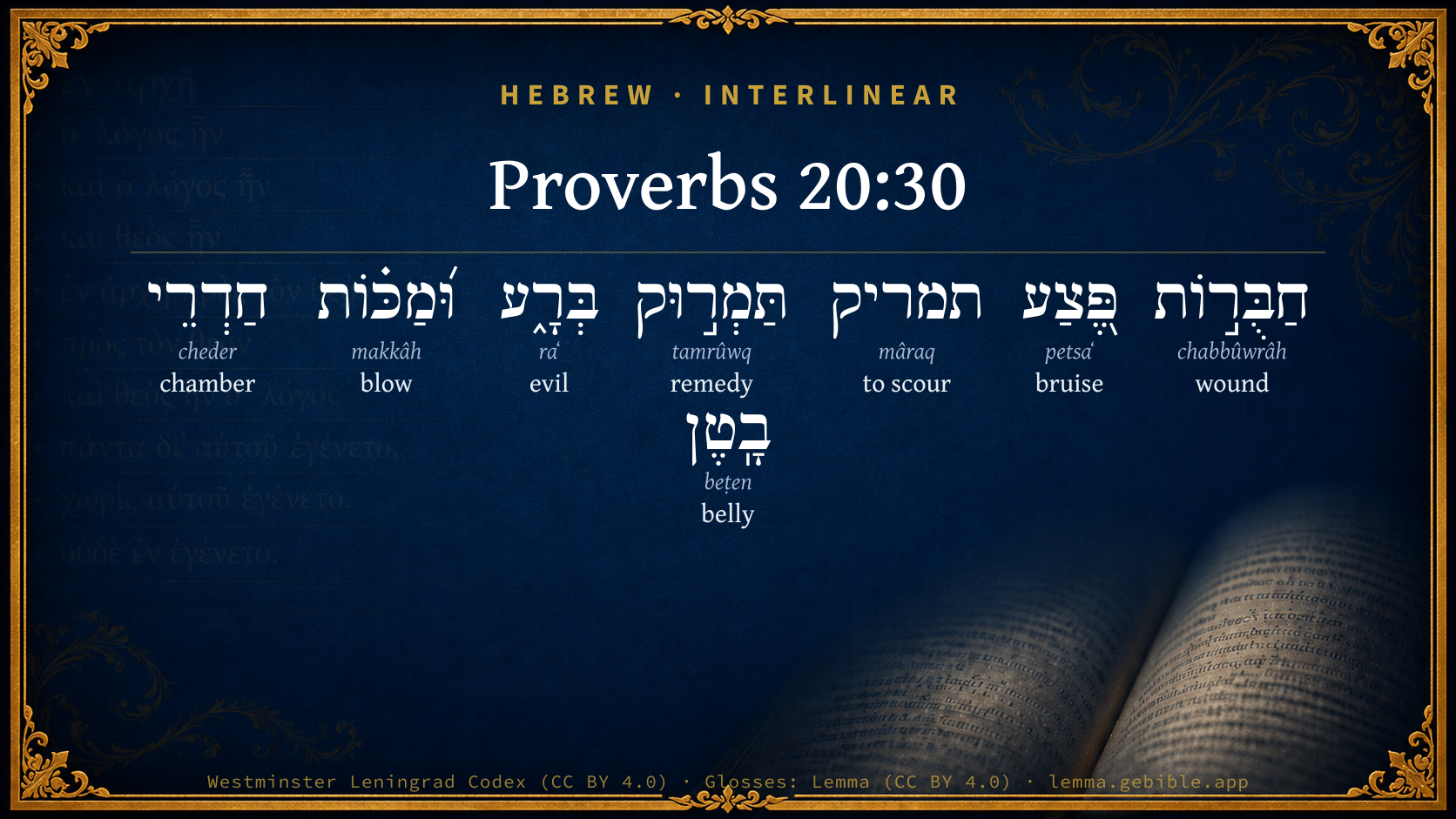
Proverbs 20:30

Hebrew (Westminster Leningrad Codex) Proverbs 20:30 appears in the Hebrew Old Testament. The text above is from the Westminster Leningrad Codex. Each word links to its Strong’s number, a concise gloss, and parsing drawn from the Open Scriptures Hebrew Bible morphology. Click any word for its full Brown-Driver-Briggs (BDB) entry.
Download image
Cite this verse

Proverbs 20:30 (World English Bible). Public Domain. Lemma interlinear Bible study tool, https://lemma.gebible.app/v/proverbs/20/30.

Show BibTeX & RIS
BibTeX
RIS
English Translation
Wounding blows cleanse away evil, And beatings purge the innermost parts.
World English Bible · Public Domain
Download a study sheet

One document with this verse’s original text, its word-by-word gloss line, the meaning frame, cross-references with their text, attributed commentary, and full source and license credits — printable, and it pastes into notes with its structure intact.

This verse Autodidact and up

Study sheet (.html) Plain text (.txt)

A passage Seminary Student

Up to 50 verses in one chapter. A passage sheet keeps up to 6 commentary sources and 12 cross-references per verse, in the order this page ranks them, and says so on the sheet whenever that leaves anything out. Ask for a single verse and you get the Autodidact verse sheet above.

Everything on this page stays free to read, with no account — the sheet is a download of what is already on screen, not access to it.

Want to remove ads? Support Godless Engineer
Compare translations 3

The same verse in 3 English versions, stacked beneath the original-language interlinear above. Click any original word for its lexicon entry.

Each is an independent rendering of the whole verse — the interlinear is not word-aligned to these translations.

Highlighted words mark where these versions differ — a whole-verse word diff, not a word-by-word alignment.

  • World English Bible Public Domain
    Wounding blows cleanse away evil, And beatings purge the innermost parts.
  • King James Version Public Domain
    The blueness of a wound cleanseth away evil: so do stripes the inward parts of the belly.
  • unfoldingWord Literal Text CC BY-SA 4.0
    Blows of a wound cleanse away evil and strikes, the rooms of the belly.

unfoldingWord Literal Text — © unfoldingWord, licensed CC BY-SA 4.0. Word-aligned USFM3 via Door43 (git.door43.org/unfoldingWord/en_ult).

Versions to compare (up to 4)

3 of 4 selected

Show all 18 translations

Every available English version of this verse, each an independent rendering of the whole verse.

  • World English Bible Public Domain
    Wounding blows cleanse away evil, And beatings purge the innermost parts.
  • Berean Standard Bible Public Domain
    Lashes and wounds scour evil, and beatings cleanse the inmost parts.
  • Majority Standard Bible Public Domain
    Lashes and wounds scour evil, and beatings cleanse the inmost parts.
  • King James Version Public Domain
    The blueness of a wound cleanseth away evil: so do stripes the inward parts of the belly.
  • American Standard Version (1901) Public Domain
    Stripes that wound cleanse away evil; And strokes `reach' the innermost parts.
  • Revised Version (1885) Public Domain
    Stripes that wound cleanse away evil: and strokes reach the innermost parts of the belly.
  • Geneva Bible (1599) Public Domain
    The blewnes of the wound serueth to purge the euill, and the stripes within the bowels of the belly.
  • Douay-Rheims (1899) Public Domain
    The blueness of a wound shall wipe away evils: and stripes in the more in- ward parts of the belly.
  • Young's Literal Translation Public Domain
    The bandages of a wound thou removest with the evil, Also the plagues of the inner parts of the heart!
  • Literal Standard Version CC BY-SA 4.0
    Blows that wound cleanse away evil, || Also the scourges of the inner parts of the heart!
  • Unlocked Literal Bible CC BY-SA 4.0
    Blows that make a wound cleanse away evil and beatings make the innermost parts clean.
  • unfoldingWord Literal Text CC BY-SA 4.0
    Blows of a wound cleanse away evil and strikes, the rooms of the belly.
  • Darby Bible Public Domain
    Wounding stripes purge away evil, and strokes [purge] the inner parts of the belly.
  • World Messianic Bible Public Domain
    Wounding blows cleanse away evil, and beatings purge the innermost parts.
  • Webster's Bible Public Domain
    The blueness of a wound cleanseth away evil: so do stripes the inward parts of the belly.
  • Free Bible Version CC BY-SA 4.0
    Wounds and blows clean away what's evil; beatings clean what's deep down inside.
  • Bible in Basic English Public Domain
    By the wounds of the rod evil is taken away, and blows make clean the deepest parts of the body.
  • JPS Tanakh (1917) Public Domain
    Sharp wounds cleanse away evil; so do stripes that reach the inward parts.

Literal Standard Version (2020), Covenant Press — licensed CC BY-SA 4.0. Text via the HelloAO Bible API (eBible.org). Unlocked Literal Bible (unfoldingWord) — licensed CC BY-SA 4.0. Text via the HelloAO Bible API (eBible.org). unfoldingWord Literal Text — © unfoldingWord, licensed CC BY-SA 4.0. Word-aligned USFM3 via Door43 (git.door43.org/unfoldingWord/en_ult). Free Bible Version, Dr. Jonathan Gallagher — licensed CC BY-SA 4.0. Text via the HelloAO Bible API (eBible.org).

Word by word

More ways to search: Search by grammar → Find every occurrence → Compare this word →

Practice this passage: Drill this verse → Learn its vocabulary →

About this verse

These counts appear in no published source. They are computed here, from the morphology-tagged text and Lemma’s own curated glosses. What Lemma adds →

8
words
8
distinct lemmas
Wisdom
section

Notable vocabulary

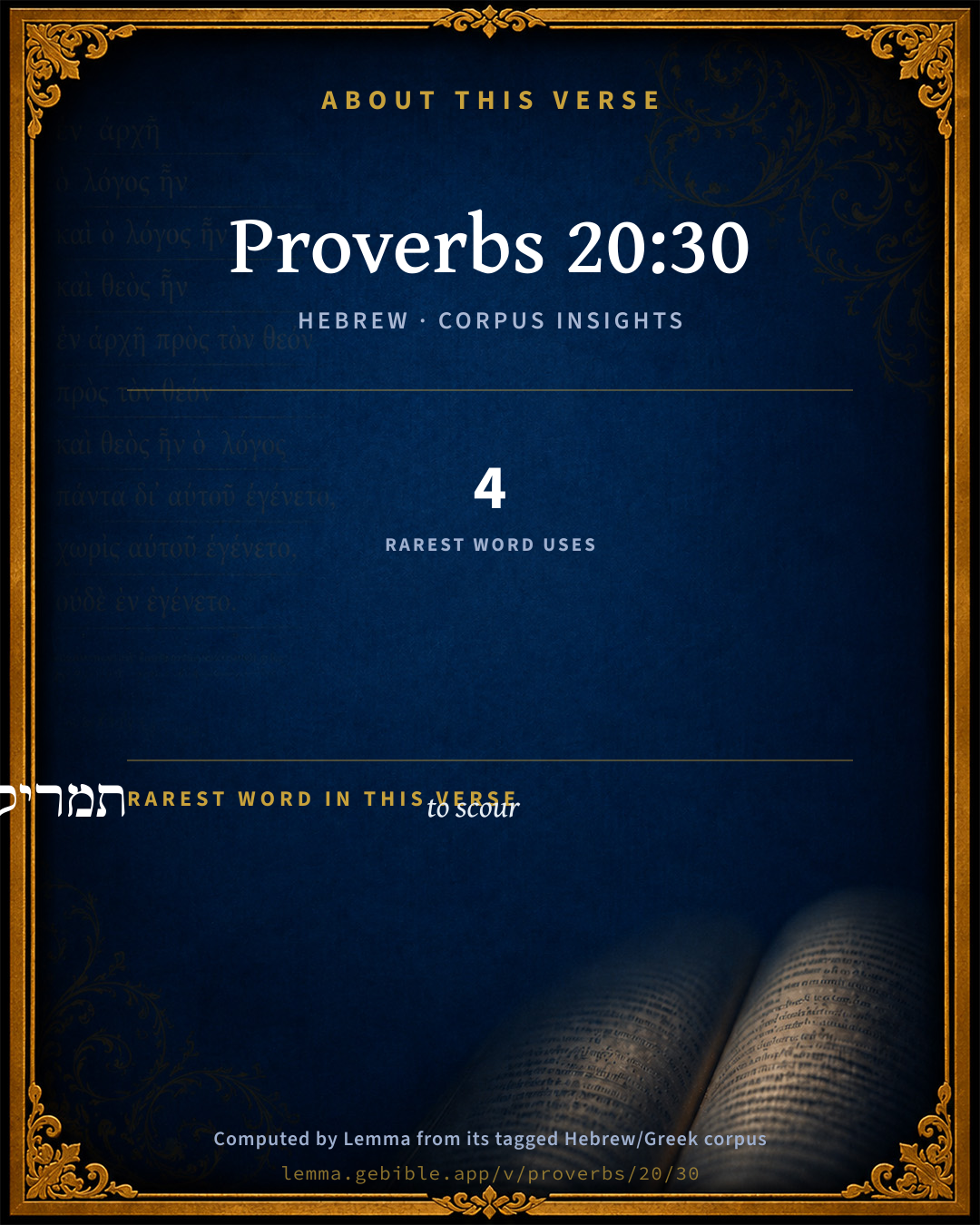
The rarest word here is תמריק to scour H4838 — appearing just 4 times in the whole Hebrew Bible.

Shared distinctive vocabulary

תמריק to scour H4838 occurs in 4 verses of the Hebrew Bible. Also found in:

Grammatical profile

  • 1 verb
  • 6 nouns
  • 1 adjective

Verb forms

  • תמריק Hiphil · Imperfect

Hebrew & Septuagint length

In English translation the verse runs 11 words from the Hebrew and 17 from the Septuagint (LXX English) — the Septuagint runs noticeably longer here. See the side-by-side →

A rough comparison of the two English renderings, which tokenize alike — not a word-level alignment.

Word counts can differ between the Hebrew and the Greek without any difference in meaning — e.g. the Hebrew direct-object marker אֵת has no separate Greek word, and Greek often adds the article ὁ.

Cross-references

5

Topical passages linked to Proverbs 20:30 in the Treasury of Scripture Knowledge — connected by theme and wording, ordered by reader-vote popularity; previews shown in the World English Bible.

  • Hebrews 12:10 For they indeed, for a few days, punished us as seemed good to them; but he for our profit, that we may be partakers of his holiness.
  • Proverbs 22:15 Folly is bound up in the heart of a child: The rod of discipline drives it far from him.
  • Proverbs 19:25 Flog a scoffer, and the simple will learn prudence; Rebuke one who has understanding, and he will gain knowledge.
  • Isaiah 53:5 But he was pierced for our transgressions, he was crushed for our iniquities; the punishment that brought our peace was on him; and by his wounds we are healed.
  • Isaiah 27:9 Therefore by this shall the iniquity of Jacob be forgiven, and this is all the fruit of taking away his sin: that he makes all the stones of the altar as chalk stones that are beaten in sunder, [so that] the Asherim and the sun-images shall rise no more.

Cross-references courtesy of OpenBible.info (CC BY 4.0).

Hebrew and Greek witnesses Masoretic Hebrew ↔ Greek Septuagint

The same verse in the two great witnesses to the Old Testament, shown verse-for-verse.

Here the Septuagint runs noticeably longer than the Hebrew — LXX2012 (modern English Septuagint) 17 words vs World English Bible 11. A rough length comparison of the two English translations, not a word-level alignment — read both below.

These are two independent witnesses, not word-aligned to each other, and the Septuagint is shown in lemma (dictionary) form.

Hebrew Proverbs 20:30 Masoretic · Westminster Leningrad Codex

חַבֻּר֣וֹת פֶּ֭צַע תמריק תַּמְר֣וּק בְּרָ֑ע וּ֝מַכּ֗וֹת חַדְרֵי בָֽטֶן

Wounding blows cleanse away evil, And beatings purge the innermost parts.

World English Bible · Public Domain

Greek LXX Proverbs 20:30 Septuagint · lemma form
Bruises and contusions befall bad men; and plagues shall come in the inward parts of their belly.

LXX2012 (modern English Septuagint) · Public Domain

On this verse, Adam Clarke's Commentary discusses the Septuagint’s reading. Read the note in Commentary ↓

Hebrew: Westminster Leningrad Codex (CC BY 4.0). Greek: Septuagint (public domain); English from LXX2012 (modern English Septuagint) (Public Domain). How the Septuagint differs from the Hebrew →

Commentary

Notes on Proverbs 20:30 from classic Christian and Jewish commentators (each source and its license shown beneath its notes). The classic Christian expositions comment on the surrounding passage and are grouped to its opening verse, so a note may address several verses; the Jewish commentaries on the Tanakh (Rashi and others) are per-verse, so they appear only where the commentator wrote on this verse.

Lemma curates 59 commentaries, every one of them public domain or Creative Commons licensed, each selected and text-cleaned for this edition rather than reprinted as found. About our sources →

Trapp's Complete Commentary

John Trapp

Pro 20:30 The blueness of a wound cleanseth away evil: so [do] stripes the inward parts of the belly.

Ver. 30. The blueness of the wound cleanseth.] Some must be beaten black and blue ere they will be better; neither is wit anything worth with them till they have paid well for it. - The Jews were ever best when in worst condition. The Athenians, Non nisi atrati, would never mend till they were in mourning. And,

“ Anglica gens est optima flens, et pessima ridens. ”

As a great statesman said of his nation, Physicians commonly cure a lethargy by a fever. Surgeons let their patients bleed sometimes, etiam ad deliquium animae. The scorpion heals his own wounds; and the viper being beaten and applied cures his own biting. Surely as the scourging of the garment with a stick beats out the moths and the dust, so do corrections corruptions from the heart; and as lancing lets out filth, so doth affliction sin.

John Trapp, A Commentary or Exposition upon All the Books of the Old and New Testament (1647–1656) — public domain. Text from a community e-Sword module.

Joseph Benson's Commentary

Pro 20:30. The blueness of a wound cleanseth away evil — Grievous wounds which make men black and blue, or severe punishments, are the means which are frequently most effectual to reclaim a wicked man, and to purge out his corruptions; so do stripes — Hebrew, ומכות, and stripes, which answer to wounds in the former clause; the inward parts of the belly — Hebrew, חדרי בשׂן, literally, the chambers of the belly, that is, the inward recesses of the mind. The sense of the whole is, Grievous wounds, or stripes, cleanse not only the outward man, by keeping it from evil actions, but even the inward man, by expelling or subduing vile affections; which is a great and blessed benefit of afflictions.

Joseph Benson's Commentary on the Old and New Testaments (1811–1818) — public domain. Text from a community e-Sword module.

The Preacher's Complete Homiletical Commentary

Joseph S. Exell (gen. ed.)

CRITICAL NOTES.—

Pro_20:30. The blueness of a wound. Cutting wounds (Delitzsch), Wounding stripes (Zöckler). Miller translates the “welts” (i.e., the tumid and purple confines of a wound), cleanse as though an evil, “that is, although painful and deformed, they have a clear office, viz., to purge away the sore.” Wardlaw suggests that the word, being etymologically derived from a verb denoting to join together, may be translated compressions, and says, “The compressions of a wound are necessary for cleansing out of it the prurient and peccant humour, which would prevent its healing; they are, at the same time, in many cases exceedingly painful, and would only be endured or inflicted from necessity. And as they thus clean the wound and promote its healing, so in a moral sense does the severity of discipline affect with salutary and cleansing influence the condition of the inner man.”

MAIN HOMILETICS OF Pro_20:30

PAIN AS A PREVENTIVE OF PAIN

For the different renderings of this verse, see the Critical Notes. However we translate it the thoughts suggested are the same, viz:—

I. That pain in the present may prevent greater pain in the future. When the surgeon is called in to examine a wounded man, the examination of the wound may give him more pain than he would have suffered if he had been let alone; it may bring far more present suffering to extract the ball, or to insert the probe, than it would have done simply to bandage the wound. But the pain of to-day is to ensure days of healthful rest by and by; if the present suffering was not inflicted, months and years of pain in the future might be the result. The pain of mind or body inflicted upon a child of five or ten years old, is intended by its parent to prevent greater moral or physical pain when he is fifty or seventy. There is no human creature who can afford to do without the pruning-knife at some period of its life; and if the pruning is not administered, the penalty will be paid either in this world or the next. The wise and loving parent gives pain in youth to prevent pain to his child in manhood, and the All-wise and Loving Father, God, subjects His children to pain in the present life to prevent a deeper and more lasting pain in the life to come. He pricks the conscience by His word to bring men to repentance, and so to salvation from the “wrath to come,” and He sees even in His own children so much “evil” remaining that He is compelled to visit “their transgressions with the rod, and their iniquity with stripes” (Psa_89:32), in order to “cleanse” their characters.

II. Pain of body may be beneficial to the human spirit. This is a subject to which our attention has been before directed. See on chap. Pro_13:24, page 334, and on chap. Pro_17:10, page 510.

The Preacher's Complete Homiletical Commentary (gen. ed. Joseph S. Exell; Funk & Wagnalls, c. 1892) — public domain (pre-1929). A full-Bible homiletical/sermon-outline anthology covering 65 of 66 books (2 John is absent from the source module). Text from a community e-Sword module.

Tyndale Open Study Notes

Tyndale Open Resources

20:30 Physical punishment cleanses away evil: See 13:24; 22:15; 23:13-14.

Tyndale Open Study Notes — © Tyndale Open Resources, licensed CC BY-SA 4.0. Text via the HelloAO Bible API.

Geneva Bible (1599)

Geneva Bible translators

Sharp punishment that pierceth even the inward parts, is profitable for the wicked, to bring them to amendment.

Geneva Bible (1599) marginal notes — public domain. Text via Bolls.life.

Matthew Henry's Commentary

Note, 1. Many need severe rebukes. Some children are so obstinate that their parents can do no good with them without sharp correction; some criminals must feel the rigour of the law and public justice; gentle methods will not work upon them; they must be beaten black and blue. And the wise God sees that his own children sometimes need very sharp afflictions. 2. Severe rebukes sometimes do a great deal of good, as corrosives contribute to the cure of a wound, eating out the proud flesh. The rod drives out even that foolishness which was bound up in the heart, and cleanses away the evil there. 3. Frequently those that most need severe rebukes can worse bear them. Such is the corruption of nature that men are as loth to be rebuked sharply for their sins as to be beaten till their bones ache. Correction is grievous to him that forsakes the way, and yet it is good for him, Heb 12:11.

Matthew Henry's Commentary on the Whole Bible (1708–1710) — public domain (CC PDM 1.0). Text via the HelloAO Bible API.

Jamieson, Fausset & Brown

Robert Jamieson, A. R. Fausset & David Brown

blueness--literally, "joining," the process of uniting the edges of a wound throws off purulent matter.

stripes . . . belly--So punishment provides healing of soul (Pro 18:8), by deterring from evil courses.

Next: Proverbs Chapter 21

Jamieson, Fausset & Brown — Commentary Critical and Explanatory on the Whole Bible (1871) — public domain (CC PDM 1.0). Text via the HelloAO Bible API.

Adam Clarke's Commentary

Verse 30. The blueness of a wound] חברות chabburoth, from חבר chabar, to unite, to join together. Does it not refer to the cicatrice of a wound when, in its healing, the two lips are brought together? By this union the wound is healed; and by the previous discharge the lace-rated ends of fibres and blood-vessels are purged away. So stripes, though they hurt for the time, become the means of correcting and discharging the moral evil of the inmost soul, the vice of the heart, the easily-besetting sin.

In this chapter, verses fourteen to nineteen, inclusive, are wanting in the Septuagint and Arabic; and the tenth, eleventh, twelfth, and thirteenth, come in after the twenty-second. It is difficult to account for these variations, unless they were occasioned by the change of leaves in MSS.

Adam Clarke's Commentary on the Bible (1810–1826) — public domain. Text from a community e-Sword/MySword module.

Ellicott's Commentary for English Readers

(30) The blueness of a wound.—Rather, the stripes of a wound, or wounds which cut into the flesh, cleanse away evil.

So do stripes the inward parts of the belly.—Better, and blows (which reach) the inward parts of the belly, i.e., which are felt in the inmost recesses of the heart (comp. Pro_20:27). Kindness is thrown away upon some people: they can only be touched by punishment.

A Bible Commentary for English Readers, edited by Charles John Ellicott (1878–1897) — public domain. Text from a community e-Sword module.

The Cambridge Bible for Schools and Colleges

gen. ed. J. J. S. Perowne

30. the blueness of a wound] Lit. stripes of (such as to cause) a wound. Render, with R.V.,

Stripes that wound cleanse away evil:

And strokes reach the innermost parts of the belly.

The expression, the blueness of a wound, is taken probably from the livor vulneris of the Vulgate, and indicates a blow so severe as to leave a blue, livid wound or weal behind it.

The Cambridge Bible for Schools and Colleges (gen. ed. J. J. S. Perowne; Cambridge University Press, 1878–1918) — public domain. Text from a community e-Sword module.

John Gill's Exposition

The blueness of a wound cleanseth away evil,.... Rubs it off and scours it away, as the word (m) signifies, or is a clearing and rubbing it off; some men must be beaten black and blue, or must have very sore correction, before they can be reclaimed and reformed from their evil ways; so some interpret it of the evil man (n): sanctified afflictions to God's people are the means of purging away their iniquities, their dross, and their sin; but there is nothing so effectually cleanses from sin as the blood of Jesus, or heals or cures of it as his blue wounds and stripes; see Isa 27:9;

so do stripes the inward part of the belly; or heart and conscience; by means of corrections and chastisement men are brought to an inward sense of sin; they are shown their transgressions wherein they have exceeded, and are commanded to return from iniquity, Job 36:9; they lament and mourn over sin, confess it and forsake it; and then may the inwards of the heart, the mind and conscience, defiled with them, be said to be cleansed from them; especially when led by these stripes and corrections to the stripes, wounds, and blood of Christ which, being applied, cleanse from all, sin inwardly and outwardly.

(m) "abstesio", Piscator, Mercerus, Cocceius; "detersio", Montanus, Michaelis; "effricatio", Schultens. (n) "in malo, sub, homine", Vatablus, Mercerus, Gejerus, Michaelis; "in malo (homine nequam)", Schultens, so Aben Ezra.

Next: Proverbs Chapter 21

John Gill's Exposition of the Whole Bible (1746–1763) — public domain (CC PDM 1.0). Text via the HelloAO Bible API.

Albert Barnes' Notes on the Bible

Better, The blueness of a wound is a cleansing of evil, so are the stripes that go down to the inward parts of the belly.

The open sores of wounds left by the scourge, unclean and foul as they seem, are yet a cleansing, purifying process for evil; so also are the stripes that reach the inward parts of the belly, i. e., the sharp reproofs, the stings of conscience, which penetrate where no scourge can reach, into the inner life of man. Chastisement, whatever be its nature, must be real; the scourge must leave its mark, the reproof must go deep.

Albert Barnes' Notes on the Bible (1834–1885) — public domain. Text from a community e-Sword/MySword module.

Haydock's Catholic Bible Commentary

Evils. The wicked shall derive benefit from correction. --- Belly. They shall feel the remorse of conscience, as Chaldean seems to indicate. (Calmet) --- A serious illness often causes people to repent. (Menochius)

George Leo Haydock (1774–1849), Haydock's Catholic Family Bible and Commentary, 1859 edition — public domain. Excludes Psalms (Douay-Rheims chapter numbering differs from Protestant) and Deuterocanonical books (Catholic canon only).

Matthew Poole's English Annotations

The blueness of a wound, grievous wounds, which make men black and blue, or severe punishments,

cleanseth away evil; are the most effectual means to reclaim a wicked man, and to purge out his corruption.

So do stripes, Heb. and stripes, which answer to the wounds in the former clause,

the inward parts of the belly; either,

1. Which pierce even to the inward parts of the belly; and so we are to understand out of the former branch, cleanse away evil. Or,

2. They cleanse the inward parts of the belly, i.e. of the heart. So this is an addition to the former clause, and the sense of the whole is, Grievous wounds or stripes do cleanse not only the outward man, by keeping it from evil actions, but even the inward man, by expelling or subduing vile affections; which is mentioned as a great and blessed benefit of afflictions.

Matthew Poole's English Annotations on the Holy Bible (1683–1685) — public domain. Text from a community e-Sword/MySword module.

Whedon's Commentary on the Bible

Daniel D. Whedon

30. The blueness of a wound — Meaning, that punishment or correction, even to such degree as to produce”blueness,” or marks, is likely to produce reformation. It is generally agreed that the first part of this verse refers to stripes caused by punishment. Some, as Stuart, interpret it of such strokes going down deep into the body. It is very evident that these old saints had no qualms of conscience about corporal punishment.

Stripes… inward parts — חדרי בשׂן, (hhadhre baten,) chambers of the body, is used in other places by metonymy for the “inner man,” the soul, the spirit, the mind. So, possibly, the term is used here; and if so, would imply that corporal punishment alone was not an effectual remedy, but inward smitings — those of the conscience and soul — penitence, heart-wounds, and aches, which, under the divine blessing and influence, would lead to a new and better life. For last clause, compare Pro_20:27. Miller insists on this rendering: “The welts of a wound cleanse, though as an evil; so do stripes the very chambers of the belly.” The welts — the tumid and purple confines of a wound — are an evil; that is, painful, etc.; but they purge away the sore: so stripes cleanse the inward parts, etc. The Septuagint reads this verse thus: “Bruises and contusions befall bad men; and plagues shall come into the inward parts of their belly.”

Daniel D. Whedon (gen. ed.), Commentary on the Old and New Testaments (1874–1909) — public domain. Text from a community e-Sword module.

The Pulpit Commentary

The blueness of a wound cleanseth away evil. So the Vulgate, Livor vulneris absterget mala. Chaburoth means "stripes," and the proverb says that deep-cutting stripes are the only effectual cure of evil; i.e. severe punishment is the best healing process in cases of moral delinquency. (Pro_19:29) Painful remedies, incisions, cauteries, amputations, are often necessary in the successful treatment of bodily ailments; spiritual sickness needs sterner, more piercing, remedies. So do stripes the inward parts of the belly; or better, and strokes that reach, etc. The stings of conscience, warnings and reproofs which penetrate to the inmost recesses of the heart, chastisement which affects the whole spiritual being. these are needful to the correction and purification of inveterate evil. Aben Ezra connects this verse with the preceding thus: as strength gives a glory to young men, and hoar hairs adorn an old man, so wounds and bruises, so to speak, ornament the sinner, mark him out, and at the same time heal and amend him. It may also be connected with ver. 27. If a man will not use the lamp which God has given him for illumination and correction, he must expect severe chastisement and sternest discipline.

Septuagint, "Bruises (upwpia ) and contusions befall bad men, and plagues that reach to the chambers of the belly." St. Gregory, "Moral.," 23:40, "By the blueness of a wound he implies the discipline of blows on the body. But blows in the secret parts of the belly are the wounds of the mind within, which are inflicted by compunction. For as the belly is distended when filled with food, so is the mind puffed up when swollen with wicked thoughts. The blueness, then, of a wound, and blows in the secret parts of the belly, cleanse away evil, because both outward discipline does away with faults, and compunction pierces the distended mind with the punishment of penance. But they differ from each other in this respect, that the wounds of blows give us pain, the sorrows of compunction have good savour. The one afflict and torture, the others restore when they afflict us. Through the one there is sorrow in affliction, through the other there is joy in grief" (Oxford transl.).

The Pulpit Commentary (1880–1919), ed. H.D.M. Spence-Jones & Joseph S. Exell — public domain. Text from a community e-Sword module.

John Wesley's Explanatory Notes

The blueness - Grievous wounds, which make men black and blue; or severe punishments. Cleanseth - Are the means to reclaim a wicked man, and to purge out his corruption. The belly - Of the heart. Grievous wounds or stripes cleanse not only the outward man by keeping it from evil actions, but even the inward man, by expelling or subduing vile affections: which is a great and blessed benefit of afflictions.

John Wesley, Explanatory Notes Upon the Whole Bible (1754–1765) — public domain. Text via the GEBible commentary corpus.

Keil & Delitzsch

C. F. Keil & F. Delitzsch

30 Cutting wounds cleanse away evil,

And reach the inner parts of the body.

The two words for wounds in line first stand in the st. constr.; חבּוּרה (from חבר, to be bound around with stripes, to be striped) is properly the streak, the stripe; but is here heightened by פּצע (from פּצע, to cleave, split, tear open), beyond the idea of the stripe-wound: tearing open the flesh, cuts tearing into the flesh. The pred. is after the Kerı̂ תּמרוּק; but this substantive, found in the Book of Esther, where it signifies the purification of the women for the harem (according to which, e.g., Ahron B. Joseph explains כמו תמרוק לנשׁים שׁהוא יפה להם), is syntactically hard, and scarcely original. For if we explain with Kimchi: wounds of deep incision find their cleansing (cure) by evil, i.e., by means which bring suffering (according to which, probably the Venet. μώλωπες τραύματος λάμψουσιν ἐν κακῷ), then תמרוקן, with the pronoun pointing back, one would have expected. But the interpretation of בּרע, of severe means of cure, is constrained; that which lies nearest, however, is to understand רע of evil. But if, with this understanding of the word, we translate: Vibices plagarum sunt lustratio quae adhibetur malo (Fleischer), one does not see why בּרע, and not rather gen. רע, is used. But if we read after the Chethı̂b תּמריק, then all is syntactically correct; for (1.) that the word ימריקוּ, or תּמרקנה, is not used, is in accordance with a well-known rule, Gesen. 146. 3; and (2.) that המריק is connected, not directly with an accus. obj., but with ב, has its analogy in התעה ב, Jer 42:2, השׁרישׁ בּ, Job 31:12, and the like, and besides has its special ground in the metaphorical character of the cleansing. Thus, e.g., one uses Syr. 't'aa' of external misleading; but with Syr. k of moral misleading (Ewald, 217, 2); and Arab. '_ of erecting a building; but with Arab. b of the intellectual erection of a memorial (monument). It is the so-called Bâ̇âlmojâz; vid., de Sacy's Chrest Arab. i. 397. The verb מרק means in Talm. also, "to take away" (a metaph. of abstergere; cf. Arab. marak, to wipe off)

(Note: Vid., Dozy's Lettre M. Fleischer (1871), p. 198.)

and that meaning is adopted, Schabbath 33a, for the interpretations of this proverb: stripes and wounds a preparedness for evil carries away, and sorrow in the innermost part of the body, which is explained by דרוקן (a disease appearing in diverse forms; cf. "Drachenschuss,"; as the name of an animal disease); but granting that the biblical מרק may bear this meaning, the ב remains unaccountable; for we say מרק עצמו לעברה, for to prepare oneself for a transgression (sin of excess), and not בעברה. We have thus to abide by the primary meaning, and to compare the proverb, Berachoth 5a: "afflictive providences wash away all the transgressions of a man." But the proverb before us means, first at least, not the wounds which God inflicts, but those which human educational energy inflicts: deep-cutting wounds, i.e., stern discipline, leads to the rubbing off of evil, i.e., rubs it, washes it, cleanses it away. It may now be possible that in 30b the subject idea is permutatively continued: et verbera penetralium corporis (thus the Venet.: πληγαὶ τῶν ταμιείων τοῦ γαρστρός), i.e., quorum vis ad intimos corporis et animi recessus penetrat (Fleischer). But that is encumbered, and חדרי־בטן (cf. Pro 20:27, Pro 18:8), as referring to the depths to which stern corporal discipline penetrates, has not its full force. וּמכּות is either a particip.: and that is touching (ferientes) the inner chambers of the body, or חדרי־בטן is with the ב, or immediately the second object of תמריק to be supplied: and strokes (rub off, cleanse, make pure) the innermost part. Jerome and the Targ. also supply ב, but erroneously, as designating place: in secretioribus ventris, relatively better the lxx and Syr.: εἰς ταμιεῖα κοιλίας. Luther hits the sense at least, for he translates:

One must restrain evil with severe punishment,

And with hard strokes which one feels.

Keil & Delitzsch — Biblical Commentary on the Old Testament (1861–1891) — public domain (CC PDM 1.0). Text via the HelloAO Bible API. (Old Testament only.)

Bridges on Proverbs

Charles Bridges

Chastisement is the LORD’s ordinance — the pain of the flesh for the subjugation of the spirit; sometimes even "the destruction of the flesh, that the spirit may be saved in the day of the Lord Jesus." (1Co 5:5 .) It describes not the gentle stroke, but the severity of parental discipline; not in pleasure or caprice, much less in anger, but for profit. (Heb 12:10 .) The diseased body needs medicine no less than food, and indeed to give nourishment. The diseased soul needs chastening no less than consolation, and as the main preparation for consolation. But if the blueness of the wound — the mark of severe chastisement — cleanseth away evil, is it not the lesser evil, as the means of subduing the greater? Do not the Lord’s stripes cleanse the inward parts? Misery beyond measure miserable is the untamed stubbornness of self-will. A gentle stroke is first tried. When this remedy is ineffectual, the blueness of the wound is needful. Manasseh’s Babylonish chains doubtless prevented the "everlasting chains of darkness."†1 Similar discipline was effectual with the holy nation, the prodigal son,†2 and the incestuous Corinthian.†3 Multitudes have borne witness to the love, wisdom, and power of their Father’s discipline — "chastened of the Lord, that they might not be condemned with the world."†4 The evil was cleansed away; and those, who groaned under the stripes, to all eternity will tune their harps to the song — "I know, O LORD, that thy judgments are right, and that thou in faithfulness hast afflicted me." (Psa 119:75 .)

Child of God! Think of your Father’s character. "He knoweth your frame. He doth not afflict willingly." (Pslam 103:14. Lam 3:33 .) Nothing will be given in weight or measure beyond the necessity of the case.†5 But truly blessed are the stripes, that humble and break the proud will.†6 Rich indeed are "fruits of righteousness" from the conflict and suffering of the flesh.†7

Footnotes:

†1 2Ch 33:12-13, with Jud 1:6 .

†2 Luk 15:16-20.

†3 2Co 2:6-8 .

†4 1Co 11:32 .

†5 Isa 27:8. Jer 10:24 .

†6 Jer 31:18-20.

†7 Job 34:31-32; Job 36:9-10 . Isa 27:9 . Heb 12:11 .

Charles Bridges, An Exposition of the Book of Proverbs (1846) — public domain. Text from a community e-Sword module.

Kretzmann's Popular Commentary

Paul E. Kretzmann

v. 30. The blueness of a wound cleanseth away evil, literally, "Wounding stripes purge away evil"; so do stripes the inward parts of the belly, for a proper measure of severe discipline penetrates to the depths of the heart and removes the desire for evil, all punishment, rightly administered, having this object.

Paul E. Kretzmann, Popular Commentary of the Bible (1921–1924) — public domain. Text from a community e-Sword module.

Rashi

Rabbi Shlomo Yitzchaki (Rashi)

Contusions and wounds come for outpouring in evil Our Sages expounded: Whoever “pours himself” out into sinful things, will ultimately come to wounds and contusions.

and plagues in the innermost parts This is dropsy.

Rashi on the Tanakh — English translations: “The Judaica Press complete Tanach with Rashi, translated by A. J. Rosenberg” (CC BY 4.0); “Pentateuch with Rashi's commentary by M. Rosenbaum and A.M. Silbermann, 1929-1934” (public domain); “The Metsudah Tanach series, Lakewood, N.J” (CC BY 4.0); and “The Book of Joshua, Metsudah Publications, 1997” (CC BY 4.0). Text via Sefaria.

Lesson kit

Teaching starters — assembled from the data on this page, not authored interpretation. Every prompt links to the verse data it draws on. Edit before teaching.

Proverbs, in the Wisdom, opens this verse with 8 words (8 distinct Hebrew lemmas). Its most distinctive word is mâraq (“to scour”). The Greek Septuagint runs longer here. A historical commentator’s framing appears above. Read the whole chapter for the surrounding context.

Discussion questions

  1. How does “to scour” (mâraq) shape what this verse is saying?
  2. Leviticus 6:28 shares the word «to scour» with this verse. How do the two illuminate each other?
  3. Compared with the Hebrew, the Septuagint runs longer here. What questions does that raise?
  4. These translations render this verse differently. What is at stake in choosing one wording over another?
  5. The verb «תמריק» is Hiphil Imperfect. How does its form color the action?
  6. Reading how Trapp's Complete Commentary and Joseph Benson's Commentary read this verse, where do the two commentators agree and where do they part?

Things to notice

Reading settings

Reading text

Shown beneath each verse's original-language words.

Old Testament
Old Testament edition

Read the OT as the Masoretic Hebrew (MT) or the Greek Septuagint (LXX).

English shown for the Greek Septuagint (in the Hebrew ↔ Greek comparison).

Comparing translations? Open the Compare panel on any verse page to stack up to four side by side.