
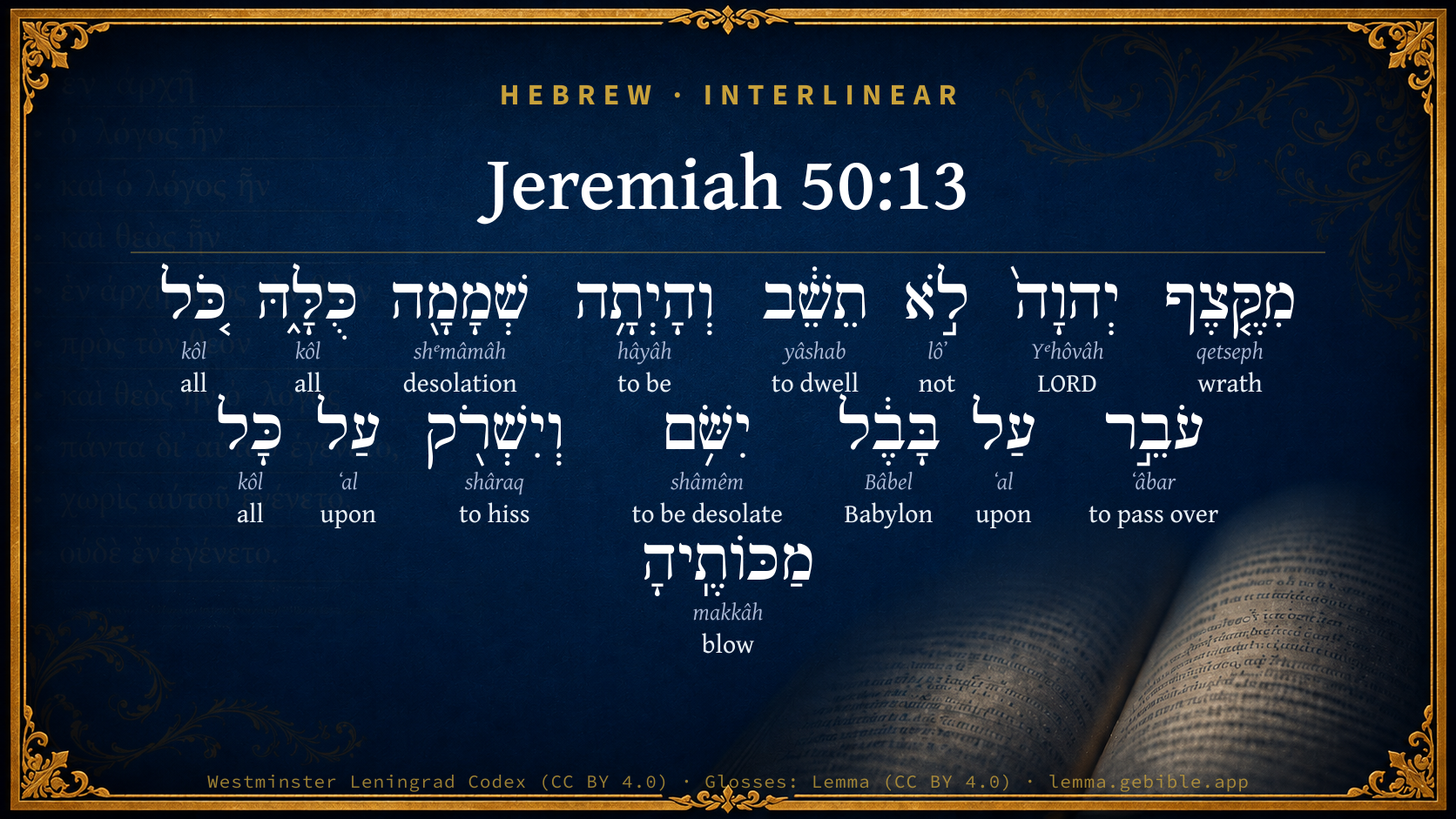
Jeremiah 50:13

Hebrew (Westminster Leningrad Codex) Jeremiah 50:13 appears in the Hebrew Old Testament. The text above is from the Westminster Leningrad Codex. Each word links to its Strong’s number, a concise gloss, and parsing drawn from the Open Scriptures Hebrew Bible morphology. Click any word for its full Brown-Driver-Briggs (BDB) entry.
Download image
Cite this verse

Jeremiah 50:13 (World English Bible). Public Domain. Lemma interlinear Bible study tool, https://lemma.gebible.app/v/jeremiah/50/13.

Show BibTeX & RIS
BibTeX
RIS
English Translation
Because of the wrath of Yahweh she shall not be inhabited, but she shall be wholly desolate: everyone who goes by Babylon shall be astonished, and hiss at all her plagues.
World English Bible · Public Domain
Download a study sheet

One document with this verse’s original text, its word-by-word gloss line, the meaning frame, cross-references with their text, attributed commentary, and full source and license credits — printable, and it pastes into notes with its structure intact.

This verse Autodidact and up

Study sheet (.html) Plain text (.txt)

A passage Seminary Student

Up to 50 verses in one chapter. A passage sheet keeps up to 6 commentary sources and 12 cross-references per verse, in the order this page ranks them, and says so on the sheet whenever that leaves anything out. Ask for a single verse and you get the Autodidact verse sheet above.

Everything on this page stays free to read, with no account — the sheet is a download of what is already on screen, not access to it.

Want to remove ads? Support Godless Engineer
Compare translations 3

The same verse in 3 English versions, stacked beneath the original-language interlinear above. Click any original word for its lexicon entry.

Each is an independent rendering of the whole verse — the interlinear is not word-aligned to these translations.

Highlighted words mark where these versions differ — a whole-verse word diff, not a word-by-word alignment.

  • World English Bible Public Domain
    Because of the wrath of Yahweh she shall not be inhabited, but she shall be wholly desolate: everyone who goes by Babylon shall be astonished, and hiss at all her plagues.
  • King James Version Public Domain
    Because of the wrath of the LORD it shall not be inhabited, but it shall be wholly desolate: every one that goeth by Babylon shall be astonished, and hiss at all her plagues.
  • unfoldingWord Literal Text CC BY-SA 4.0
    Because of Yahweh’s anger, Babylon will not be inhabited, but will be a complete devastation. Everyone who passes by will shudder because of Babylon and will hiss because all of its wounds.

unfoldingWord Literal Text — © unfoldingWord, licensed CC BY-SA 4.0. Word-aligned USFM3 via Door43 (git.door43.org/unfoldingWord/en_ult).

Versions to compare (up to 4)

3 of 4 selected

Show all 18 translations

Every available English version of this verse, each an independent rendering of the whole verse.

  • World English Bible Public Domain
    Because of the wrath of Yahweh she shall not be inhabited, but she shall be wholly desolate: everyone who goes by Babylon shall be astonished, and hiss at all her plagues.
  • Berean Standard Bible Public Domain
    Because of the wrath of the LORD, she will not be inhabited; she will become completely desolate. All who pass through Babylon will be horrified and will hiss at all her wounds.
  • Majority Standard Bible Public Domain
    Because of the wrath of the LORD, she will not be inhabited; she will become completely desolate. All who pass through Babylon will be horrified and will hiss at all her wounds.
  • King James Version Public Domain
    Because of the wrath of the LORD it shall not be inhabited, but it shall be wholly desolate: every one that goeth by Babylon shall be astonished, and hiss at all her plagues.
  • American Standard Version (1901) Public Domain
    Because of the wrath of Jehovah she shall not be inhabited, but she shall be wholly desolate: every one that goeth by Babylon shall be astonished, and hiss at all her plagues.
  • Revised Version (1885) Public Domain
    Because of the wrath of the LORD it shall not be inhabited, but it shall be wholly desolate: every one that goeth by Babylon shall be astonished, and hiss at all her plagues.
  • Geneva Bible (1599) Public Domain
    Because of the wrath of the Lord it shall not be inhabited, but shall be wholy desolate: euery one that goeth by Babel, shall be astonished, and hisse at all her plagues.
  • Douay-Rheims (1899) Public Domain
    Because of the wrath of the Lord it shall not be inhabited, but shall be wholly desolate: every one that shall pass by Babylon, shall be astonished, and hiss at all her plagues.
  • Young's Literal Translation Public Domain
    Because of the wrath of Jehovah it is not inhabited, And it hath been a desolation -- all of it. Every passer by at Babylon is astonished, And doth hiss because of all her plagues.
  • Literal Standard Version CC BY-SA 4.0
    Because of the wrath of YHWH it is not inhabited, || And it has been a desolation—all of it. Everyone passing by at Babylon is astonished, || And hisses because of all her plagues.
  • Unlocked Literal Bible CC BY-SA 4.0
    Because of Yahweh's anger, Babylon will not be inhabited, but will be a complete devastation. Everyone who passes by will shudder because of Babylon and will hiss because all of its wounds.
  • unfoldingWord Literal Text CC BY-SA 4.0
    Because of Yahweh’s anger, Babylon will not be inhabited, but will be a complete devastation. Everyone who passes by will shudder because of Babylon and will hiss because all of its wounds.
  • Darby Bible Public Domain
    Because of the wrath of Jehovah, it shall not be inhabited, but it shall be wholly desolate; every one that goeth by Babylon shall be astonished, and shall hiss, because of all her plagues.
  • World Messianic Bible Public Domain
    Because of the LORD’s wrath she won’t be inhabited, but she will be wholly desolate. Everyone who goes by Babylon will be astonished, and hiss at all her plagues.
  • Webster's Bible Public Domain
    Because of the wrath of the LORD it shall not be inhabited, but it shall be wholly desolate: every one that goeth by Babylon shall be astonished, and hiss at all her plagues.
  • Free Bible Version CC BY-SA 4.0
    Because of Lord's angry punishment, she will be deserted, completely desolate. Everyone who passes by will be horrified at what has happened to Babylon, and sneer at all her wounds.
  • Bible in Basic English Public Domain
    Because of the wrath of the Lord no one will be living in it, and it will be quite unpeopled: everyone who goes by Babylon will be overcome with wonder, and make sounds of fear at all her punishments.
  • JPS Tanakh (1917) Public Domain
    Because of the wrath of the LORD it shall not be inhabited, but it shall be wholly desolate; every one that goeth by Babylon shall be appalled and hiss at all her plagues.

Literal Standard Version (2020), Covenant Press — licensed CC BY-SA 4.0. Text via the HelloAO Bible API (eBible.org). Unlocked Literal Bible (unfoldingWord) — licensed CC BY-SA 4.0. Text via the HelloAO Bible API (eBible.org). unfoldingWord Literal Text — © unfoldingWord, licensed CC BY-SA 4.0. Word-aligned USFM3 via Door43 (git.door43.org/unfoldingWord/en_ult). Free Bible Version, Dr. Jonathan Gallagher — licensed CC BY-SA 4.0. Text via the HelloAO Bible API (eBible.org).

Word by word

More ways to search: Search by grammar → Find every occurrence → Compare this word →

Practice this passage: Drill this verse → Learn its vocabulary →

וְיִשְׁרֹ֖ק
shâraq
H8319
“and · to hiss”
Conjunction + Verb, Qal, Imperfect, 3rd Person, Masculine, Singular
Part of Speech
Conjunction + Verb
Stem
Qal
Form
Imperfect
Person
3rd Person
Gender
Masculine
Number
Singular
Full BDB Definition

Origin: a primitive root

TWOT: 2468

to hiss, whistle, pipe - (Qal) to hiss (as a signal)
  1. מִקֶּ֤צֶף qetseph H7110 “from · wrath of” Preposition + Noun, Common, Masculine, Singular, Construct
  2. יְהוָה֙ Yᵉhôvâh H3068 “LORD” Noun, Proper
  3. לֹ֣א lôʼ H3808 “not” Particle, Negative
  4. תֵשֵׁ֔ב yâshab H3427 “to dwell” Verb, Qal, Imperfect, 3rd Person, Feminine, Singular
  5. וְהָיְתָ֥ה hâyâh H1961 “and · to be” Conjunction + Verb, Qal, Sequential Perfect, 3rd Person, Feminine, Singular
  6. שְׁמָמָ֖ה shᵉmâmâh H8077 “desolation” Noun, Common, Feminine, Singular, Absolute
  7. כֻּלָּ֑הּ kôl H3605 “all · her” Noun, Common, Masculine, Singular, Construct + Suffix, Personal, 3rd Person, Feminine, Singular
  8. כֹּ֚ל kôl H3605 “all” Noun, Common, Masculine, Singular, Absolute
  9. עֹבֵ֣ר ʻâbar H5674 “passing over” Verb, Qal, Participle Active, Masculine, Singular, Absolute
  10. עַל ʻal H5921 “upon” Preposition
  11. בָּבֶ֔ל Bâbel H894 “Babylon” Noun, Proper
  12. יִשֹּׁ֥ם shâmêm H8074 “to be desolate” Verb, Qal, Imperfect, 3rd Person, Masculine, Singular
  13. עַל ʻal H5921 “upon” Preposition
  14. כָּל kôl H3605 “all of” Noun, Common, Masculine, Singular, Construct
  15. מַכּוֹתֶֽיהָ makkâh H4347 “blows · her” Noun, Common, Feminine, Plural, Construct + Suffix, Personal, 3rd Person, Feminine, Singular

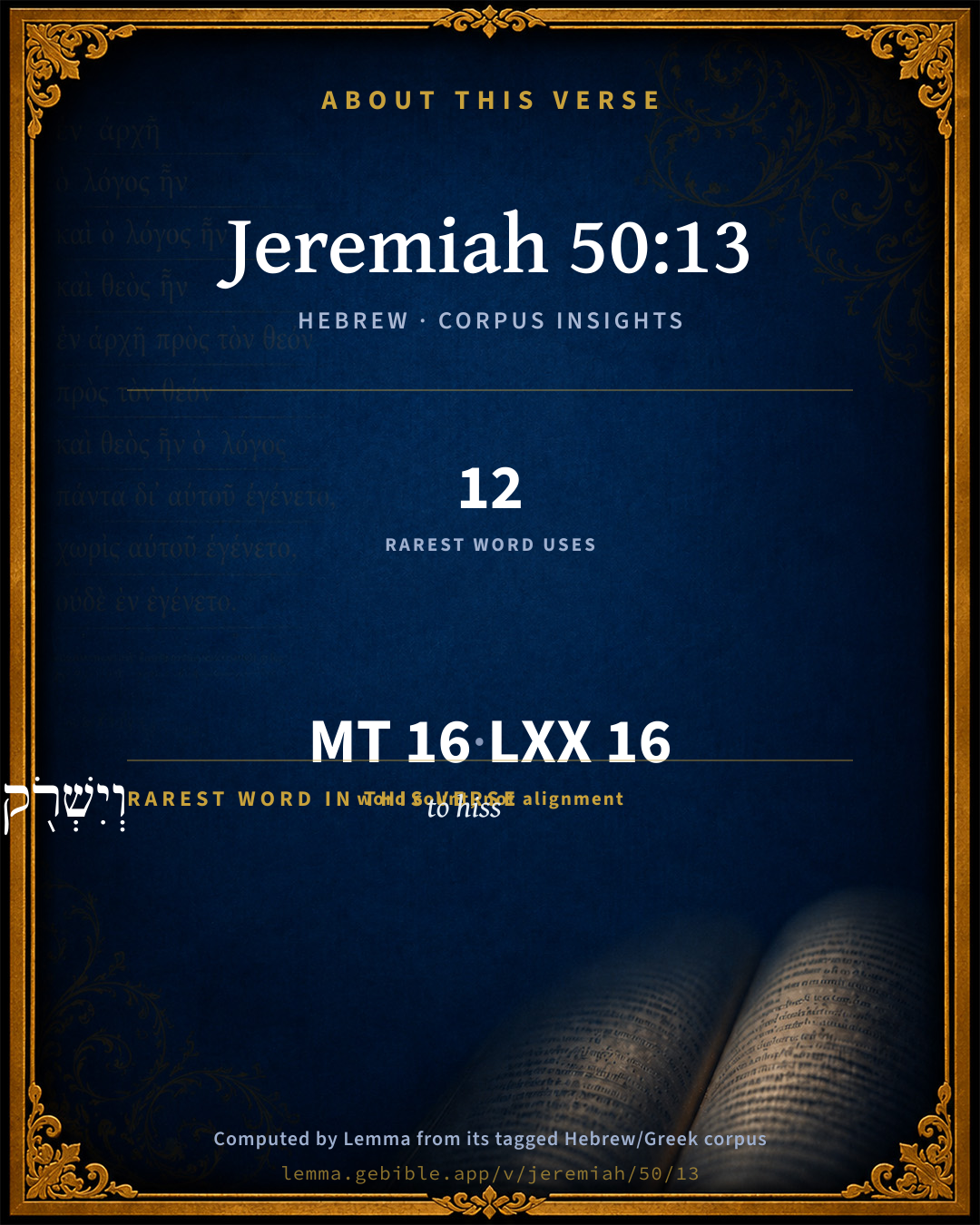
About this verse

These counts appear in no published source. They are computed here, from the morphology-tagged text and Lemma’s own curated glosses. What Lemma adds →

16
words
13
distinct lemmas
Prophets
section

Notable vocabulary

The rarest word here is וְיִשְׁרֹ֖ק to hiss H8319 — appearing just 12 times in the whole Hebrew Bible.

Shared distinctive vocabulary

וְיִשְׁרֹ֖ק to hiss H8319 occurs in 12 verses of the Hebrew Bible. Also found in:

Grammatical profile

  • 5 verbs
  • 8 nouns
  • 2 prepositions
  • 1 particle

Verb forms

  • תֵשֵׁ֔ב Qal · Imperfect
  • וְהָיְתָ֥ה Qal · Sequential Perfect
  • עֹבֵ֣ר Qal · Participle Active
  • יִשֹּׁ֥ם Qal · Imperfect
  • וְיִשְׁרֹ֖ק Qal · Imperfect

Repetition

Words recur within this verse — often emphatic in Hebrew:

  • כֻּלָּ֑הּ all H3605 ×3
  • עַל upon H5921 ×2

Hebrew & Septuagint length

In the original languages it is 16 Hebrew tokens and 16 Greek tokens — but the two are counted differently (Hebrew bundles its prefixes and suffixes into one token; the Greek is in lemma form), so that isn’t a like-for-like length.

Cross-references

11

Topical passages linked to Jeremiah 50:13 in the Treasury of Scripture Knowledge — connected by theme and wording, ordered by reader-vote popularity; previews shown in the World English Bible.

  • Jeremiah 18:16 to make their land an astonishment, and a perpetual hissing; everyone who passes thereby shall be astonished, and shake his head.
  • Jeremiah 49:17 Edom shall become an astonishment: everyone who passes by it shall be astonished, and shall hiss at all the plagues of it.
  • Job 27:23 Men shall clap their hands at him, And shall hiss him out of his place.
  • Isaiah 14:4–17 that you shall take up this parable against the king of Babylon, and say, How has the oppressor ceased! the golden city ceased!
  • Jeremiah 19:8 I will make this city an astonishment, and a hissing; everyone who passes thereby shall be astonished and hiss because of all the plagues of it.
  • Jeremiah 25:12 It shall happen, when seventy years are accomplished, that I will punish the king of Babylon, and that nation, says Yahweh, for their iniquity, and the land of the Chaldeans; and I will make it desolate forever.
  • Jeremiah 51:37 Babylon shall become heaps, a dwelling-place for jackals, an astonishment, and a hissing, without inhabitant.
  • Lamentations 2:15–16 All that pass by clap their hands at you; They hiss and wag their head at the daughter of Jerusalem, [saying], Is this the city that men called The perfection of beauty, The joy of the whole earth?
  • Habakkuk 2:6–18 Won't all these take up a parable against him, and a taunting proverb against him, and say, 'Woe to him who increases that which is not his, and who enriches himself by extortion! How long?'
  • Zephaniah 2:15 This is the joyous city that lived carelessly, that said in her heart, "I am, and there is none besides me." How she has become a desolation, a place for animals to lie down in! Everyone who passes by her will hiss, and shake their fists.
  • Zechariah 1:15 I am very angry with the nations that are at ease; for I was but a little displeased, but they added to the calamity."

Cross-references courtesy of OpenBible.info (CC BY 4.0).

Hebrew and Greek witnesses Masoretic Hebrew ↔ Greek Septuagint

The same verse in the two great witnesses to the Old Testament, shown verse-for-verse.

These are two independent witnesses, not word-aligned to each other, and the Septuagint is shown in lemma (dictionary) form.

Hebrew Jeremiah 50:13 Masoretic · Westminster Leningrad Codex

מִקֶּ֤צֶף יְהוָה֙ לֹ֣א תֵשֵׁ֔ב וְהָיְתָ֥ה שְׁמָמָ֖ה כֻּלָּ֑הּ כֹּ֚ל עֹבֵ֣ר עַל בָּבֶ֔ל יִשֹּׁ֥ם וְיִשְׁרֹ֖ק עַל כָּל מַכּוֹתֶֽיהָ

Because of the wrath of Yahweh she shall not be inhabited, but she shall be wholly desolate: everyone who goes by Babylon shall be astonished, and hiss at all her plagues.

World English Bible · Public Domain

Greek LXX Structure differs

In the Septuagint, Jeremiah is about an eighth shorter than the Hebrew and arranges its material differently — the Oracles Against the Nations (Hebrew chapters 46–51) appear in the middle of the Greek book, after 25:13. Because the chapter and verse boundaries do not line up, a verse-for-verse comparison with the Hebrew is not shown.

A verse-for-verse comparison isn’t shown here because the chapters and verses don’t line up. Switch to the LXX edition with the MT / LXX toggle above to read the Greek directly.

Hebrew: Westminster Leningrad Codex (CC BY 4.0). Greek: Septuagint (public domain); English from a public-domain English Septuagint. How the Septuagint differs from the Hebrew →

Targum (Aramaic paraphrase)

1

The Targum is the ancient Jewish Aramaic paraphrase of the Hebrew Scriptures — an interpretive translation, not the Hebrew text itself. Onkelos (literal) and Pseudo-Jonathan (expansive) render the Torah, and Jonathan the Prophets. Coverage is partial: where no permissively-licensed English translation exists for a verse, only the Aramaic is shown. This is verse-level text, not a word-by-word alignment to the Hebrew.

  1. Targum Jonathan Prophets (Joshua–Malachi)
    עַל דְאַרְגֵיזְתְּ בָּבֶל קֳדָם יְיָ לָא תִּתְיְתֵב וּתְהֵי לְצָדוּ כֻּלָהּ כֹּל דְיֶעְבַּר עַל בָּבֶל יִכְלֵי וִיגִיד עַל כָּל מְחָתָהָא:

    (no public-domain English translation for this verse)

    Targum Jonathan — Aramaic: “Mikraot Gedolot” (public domain). English: “Sefaria Community Translation” (CC0 1.0 (public-domain dedication)); “London "Chaldee Paraphrase," 1871” (public domain). Text via Sefaria.

Commentary

Notes on Jeremiah 50:13 from classic Christian and Jewish commentators (each source and its license shown beneath its notes). The classic Christian expositions comment on the surrounding passage and are grouped to its opening verse, so a note may address several verses; the Jewish commentaries on the Tanakh (Rashi and others) are per-verse, so they appear only where the commentator wrote on this verse.

Lemma curates 59 commentaries, every one of them public domain or Creative Commons licensed, each selected and text-cleaned for this edition rather than reprinted as found. About our sources →

Trapp's Complete Commentary

John Trapp

Jer 50:13 Because of the wrath of the LORD it shall not be inhabited, but it shall be wholly desolate: every one that goeth by Babylon shall be astonished, and hiss at all her plagues.

Ver. 13. It shall not be inhabited, but be wholly desolate.] Babylon standeth not now in the same place as of old, nor is there hardly any ruins of the old city remaining, as travellers tell us. Pausanias saith that in his time there was nought to be seen of it but the walls only; and Jerome saith {a} that in his it was turned into a park for deer. Omne in medio spatium solitude est. See on Jer 50:3.

{a} Lib. viii. in Isa. xiii.

John Trapp, A Commentary or Exposition upon All the Books of the Old and New Testament (1647–1656) — public domain. Text from a community e-Sword module.

Geneva Bible (1599)

Geneva Bible translators

In sign of contempt and disdain.

Geneva Bible (1599) marginal notes — public domain. Text via Bolls.life.

Jamieson, Fausset & Brown

Robert Jamieson, A. R. Fausset & David Brown

(Isa 13:20).

Jamieson, Fausset & Brown — Commentary Critical and Explanatory on the Whole Bible (1871) — public domain (CC PDM 1.0). Text via the HelloAO Bible API.

John Calvin's Commentaries

Jeremiah again repeats that the destruction of Babylon would be an evidence of God’s vengeance, because the Chaldeans had unjustly raged against the Church. But the name of God seems also to have been designedly mentioned, that the faithful might more readily receive this prophecy: for had they thought that what Jeremiah said came from man, they would have hardly believed his words, for what he said exceeded the comprehension of men. He then mentioned the indignation of God, that the faithful might know that it was absurd to form an opinion concerning the ruin of Babylon according to the present aspect of things, because God would do a work there beyond the common course of things.

He then says, that it would become a waste, so that every one passing through it would be astonished, and yet would not pity it. This way of speaking often occurs in the Prophets, when they wish to describe a waste exceeding what is common. In the meantime, what follows ought to be noticed, that this arrangement would excite no commiseration, but rather mockery, which the Prophet denotes by the word hissing. It then follows, —

John Calvin's Commentaries (1540-1563) — public domain. Text from the Calvin Translation Society English edition (1840s-50s) via the Christian Classics Ethereal Library (ccel.org). Calvin's coverage is partial (roughly two-thirds of the Bible); uncommented books and verses are honest gaps, never fabricated. The 19th-century editor's footnotes and remarks are omitted so the notes are faithfully Calvin's own voice.

Ellicott's Commentary for English Readers

(13) Every one that goeth . . .—We note the reproduction of the formula of Jer_19:8; Jer_49:17.

A Bible Commentary for English Readers, edited by Charles John Ellicott (1878–1897) — public domain. Text from a community e-Sword module.

The Cambridge Bible for Schools and Colleges

gen. ed. J. J. S. Perowne

13. Cp. chs. Jer_18:16, Jer_19:8, Jer_25:9; Jer_25:11, Jer_49:17, with notes.

be inhabited] See on Jer_17:25.

The Cambridge Bible for Schools and Colleges (gen. ed. J. J. S. Perowne; Cambridge University Press, 1878–1918) — public domain. Text from a community e-Sword module.

John Gill's Exposition

Because of the wrath of the Lord, it shall not be inhabited,.... That is, Babylon; which the Targum expresses,

"because thou, Babylon, hast provoked the Lord;''

by their idolatry, luxury, ill usage of his people, and profanation of the vessels of the sanctuary; therefore it should be destroyed, and left without an inhabitant in it:

but it shall be wholly desolate; as it now is. Pausanias says (o), in his time there was nothing but a wall remaining; and Jerom (p) says, he had it from a brother Elamite, or Persian, that Babylon was then a park or place for royal hunting, and that beasts of every kind were kept within its walls: of mystical Babylon, see Rev 16:19;

everyone that goeth by Babylon shall be astonished, and hiss at all her plagues; any traveller that had seen it in its glory would now be astonished to see the desolation of it; and, by way of scorn and derision, hiss at the judgments of God upon it, and rejoice at them, and shake their head, as the Targum.

(o) Arcadica, sive l. 8. p. 509. (p) Comment. in Isaiam, fol. 23. C.

John Gill's Exposition of the Whole Bible (1746–1763) — public domain (CC PDM 1.0). Text via the HelloAO Bible API.

Matthew Poole's English Annotations

It shall not be inhabited, but it shall be wholly desolate; the same thing was threatened against Babylon, Isa 13:20, It shall never be inhabited, neither shall it be dwelt in from generation to generation. Shall be astonished, and hiss at all her plagues: it seemeth to be a proverbial speech made use of to express the miserable state of a place; we had it before, Jer 49:17, applied to Edom. It is according to the threatening, Deu 28:37. See Jer 25:9,11; 29:18; 42:18; Eze 5:15.

Matthew Poole's English Annotations on the Holy Bible (1683–1685) — public domain. Text from a community e-Sword/MySword module.

The Pulpit Commentary

All but the first clause of this verse is taken from Jer_19:8 Jer_49:17.

The Pulpit Commentary (1880–1919), ed. H.D.M. Spence-Jones & Joseph S. Exell — public domain. Text from a community e-Sword module.

Lesson kit

Teaching starters — assembled from the data on this page, not authored interpretation. Every prompt links to the verse data it draws on. Edit before teaching.

Jeremiah, in the Prophets, opens this verse with 16 words (13 distinct Hebrew lemmas). Its most distinctive word is shâraq (“to hiss”). A historical commentator’s framing appears above. Read the whole chapter for the surrounding context.

Discussion questions

  1. The word shâraq carries the sense “to hiss.” How does it shape the verse?
  2. 1 Kings 9:8 shares the word «to hiss» with this verse. How do the two illuminate each other?
  3. “all” occurs 3× in this one verse. What is the effect of the repetition?
  4. These translations render this verse differently; the difference is in the English rendering, not the original. What questions does that raise?
  5. The verb «תֵשֵׁ֔ב» is Qal Imperfect. How does its form color the action?
  6. Reading how Trapp's Complete Commentary and Geneva Bible (1599) read this verse, where do the two commentators agree and where do they part?

Things to notice

Reading settings

Reading text

Shown beneath each verse's original-language words.

Old Testament
Old Testament edition

Read the OT as the Masoretic Hebrew (MT) or the Greek Septuagint (LXX).

English shown for the Greek Septuagint (in the Hebrew ↔ Greek comparison).

Comparing translations? Open the Compare panel on any verse page to stack up to four side by side.