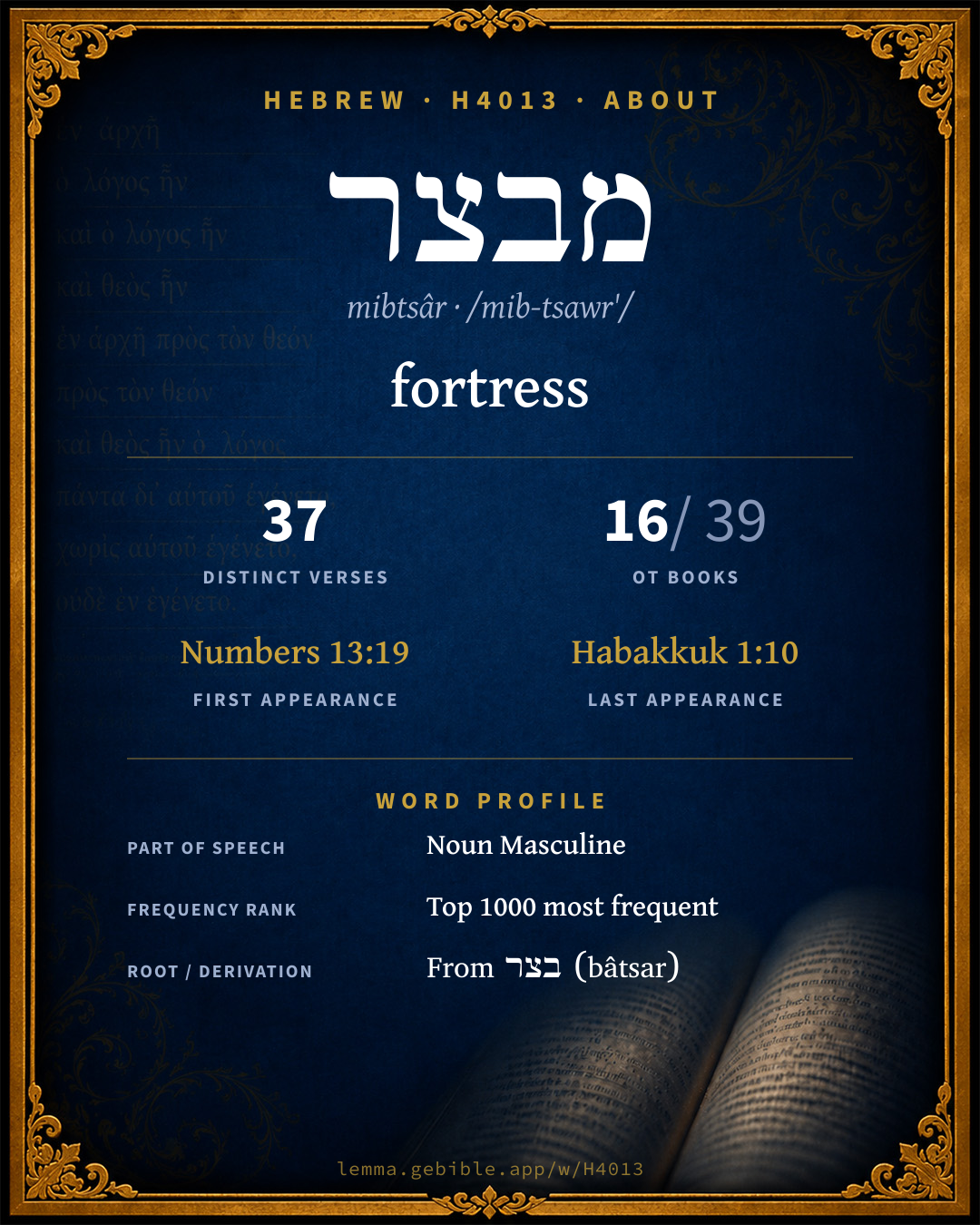
מִבְצָר
fortress
Full lexicon entry — Brown-Driver-Briggs (BDB)
From Brown-Driver-Briggs (BDB)
Where this word appears
See every Absolute-state word in the Hebrew Bible →
Grammar key — what these labels mean
Part of speech
- Noun
- A naming word — a person, place, thing, or idea.
Noun type
- Common
- A common noun — a general class of person, place, or thing (“king,” “city,” “water”), not a specific name.
State
- Absolute
- The independent form of a noun, not bound to a following word.
- Construct
- A noun bound to a following noun in a possessive / “of” relationship (the construct chain).
Gender
- Masculine
- Grammatically masculine.
Number
- Singular
- One.
- Plural
- More than one (in Hebrew, generally three or more).
Grammatical forms
- Noun, Common, Masculine, Singular, Absolute 19 times (51%)
- Noun, Common, Masculine, Plural, Construct 12 times (32%)
- Noun, Common, Masculine, Plural, Absolute 3 times (8%)
- Noun, Common, Masculine, Singular, Construct 3 times (8%)
Parsed forms decoded from the imported morphology (morphhb / Westminster Leningrad Codex — WLC text public domain, morphhb tagging CC BY 4.0), counted across 37 parsed occurrences — not distinct verses.
Every verse where H4013 appears — 37 distinct verses across 16 books. Click any verse to open its interlinear word-by-word view. Verse text shown in the World English Bible for context — . Each verse’s Hebrew form is shown with its reference; the English is not keyword-highlighted, since the data carries no word-level English alignment. Use “Compare translations” on any verse to read it across multiple English versions. This concordance covers the Hebrew Bible; Septuagint (Greek Old Testament) occurrences are not indexed here.
Numbers 3 verses
- Numbers 13:19 בְּ/מִבְצָרִֽים prep + n c mp and what the land is that they dwell in, whether it is good or bad; and what cities they are that they dwell in, whether in camps, or in strongholds;
- Numbers 32:17 הַ/מִּבְצָ֔ר ptcl def.art + n c ms but we ourselves will be ready armed to go before the children of Israel, until we have brought them to their place: and our little ones shall dwell in the fortified cities because of the inhabitants of the land.
- Numbers 32:36 מִבְצָ֖ר n c ms and Beth Nimrah, and Beth Haran: fortified cities, and folds for sheep.
Joshua 3 verses
- Joshua 10:20 הַ/מִּבְצָֽר ptcl def.art + n c ms It happened, when Joshua and the children of Israel had made an end of killing them with a very great slaughter, until they were consumed, and the remnant which remained of them had entered into the fortified cities,
- Joshua 19:29 מִבְצַר n c ms cs and the border turned to Ramah, and to the fortified city of Tyre; and the border turned to Hosah; and the goings out of it were at the sea by the region of Achzib;
- Joshua 19:35 מִבְצָ֑ר n c ms The fortified cities were Ziddim, Zer, and Hammath, Rakkath, and Chinnereth,
1 Samuel 1 verse
2 Samuel 1 verse
2 Kings 5 verses
- 2 Kings 3:19 מִבְצָר֙ n c ms You shall strike every fortified city, and every choice city, and shall fell every good tree, and stop all springs of water, and mar every good piece of land with stones.
- 2 Kings 8:12 מִבְצְרֵי/הֶ֞ם n c mp cs + sfx pers 3mp Hazael said, Why weeps my lord? He answered, Because I know the evil that you will do to the children of Israel: their strongholds will you set on fire, and their young men will you kill with the sword, and will dash in pieces their little ones, and rip up their women with child.
- 2 Kings 10:2 מִבְצָ֖ר n c ms Now as soon as this letter comes to you, seeing your master's sons are with you, and there are with you chariots and horses, a fortified city also, and armor;
- 2 Kings 17:9 מִבְצָֽר n c ms The children of Israel did secretly things that were not right against Yahweh their God: and they built them high places in all their cities, from the tower of the watchmen to the fortified city;
- 2 Kings 18:8 מִבְצָֽר n c ms He struck the Philistines to Gaza and the borders of it, from the tower of the watchmen to the fortified city.
2 Chronicles 1 verse
Psalms 2 verses
Isaiah 3 verses
- Isaiah 17:3 מִבְצָר֙ n c ms The fortress shall cease from Ephraim, and the kingdom from Damascus, and the remnant of Syria; they shall be as the glory of the children of Israel, says Yahweh of Hosts.
- Isaiah 25:12 וּ/מִבְצַ֞ר conj + n c ms cs The high fortress of your walls has he brought down, laid low, and brought to the ground, even to the dust.
- Isaiah 34:13 בְּ/מִבְצָרֶ֑י/הָ prep + n c mp cs + sfx pers 3fs Thorns shall come up in its palaces, nettles and thistles in the fortresses of it; and it shall be a habitation of jackals, a court for ostriches.
Jeremiah 7 verses
- Jeremiah 1:18 מִבְצָ֜ר n c ms For, behold, I have made you this day a fortified city, and an iron pillar, and brazen walls, against the whole land, against the kings of Judah, against the princes of it, against the priests of it, and against the people of the land.
- Jeremiah 4:5 הַ/מִּבְצָֽר ptcl def.art + n c ms Declare you in Judah, and publish in Jerusalem; and say, Blow you the trumpet in the land: cry aloud and say, Assemble yourselves, and let us go into the fortified cities.
- Jeremiah 5:17 מִבְצָרֶ֗י/ךָ n c mp cs + sfx pers 2ms They shall eat up your harvest, and your bread, [which] your sons and your daughters should eat; they shall eat up your flocks and your herds; they shall eat up your vines and your fig trees; they shall beat down your fortified cities, in which you trust, with the sword.
- Jeremiah 6:27 מִבְצָ֑ר n c ms I have made you a tester of metals [and] a fortress among my people; that you may know and try their way.
- Jeremiah 8:14 הַ/מִּבְצָ֖ר ptcl def.art + n c ms Why do we sit still? assemble yourselves, and let us enter into the fortified cities, and let us be silent there; for Yahweh our God has put us to silence, and given us water of gall to drink, because we have sinned against Yahweh.
- Jeremiah 34:7 מִבְצָֽר n c ms when the king of Babylon's army was fighting against Jerusalem, and against all the cities of Judah that were left, against Lachish and against Azekah; for these [alone] remained of the cities of Judah [as] fortified cities.
- Jeremiah 48:18 מִבְצָרָֽיִ/ךְ n c mp cs + sfx pers 2fs You daughter who dwells in Dibon, come down from your glory, and sit in thirst; for the destroyer of Moab is come up against you, he has destroyed your strongholds.
Lamentations 2 verses
- Lamentations 2:2 מִבְצְרֵ֥י n c mp cs The Lord has swallowed up all the habitations of Jacob, and has not pitied: He has thrown down in his wrath the strongholds of the daughter of Judah; He has brought them down to the ground; he has profaned the kingdom and the princes of it.
- Lamentations 2:5 מִבְצָרָ֑י/ו n c mp cs + sfx pers 3ms The Lord is become as an enemy, he has swallowed up Israel; He has swallowed up all her palaces, he has destroyed his strongholds; He has multiplied in the daughter of Judah mourning and lamentation.
Daniel 3 verses
- Daniel 11:15 מִבְצָר֑וֹת n c mp So the king of the north shall come, and cast up a mound, and take a well-fortified city: and the forces of the south shall not stand, neither his chosen people, neither shall there be any strength to stand.
- Daniel 11:24 מִבְצָרִ֛ים n c mp In time of security shall he come even on the fattest places of the province; and he shall do that which his fathers have not done, nor his fathers' fathers; he shall scatter among them prey, and spoil, and substance: yes, he shall devise his devices against the strongholds, even for a time.
- Daniel 11:39 לְ/מִבְצְרֵ֤י prep + n c mp cs He shall deal with the strongest fortresses by the help of a foreign god: whoever acknowledges [him] he will increase with glory; and he shall cause them to rule over many, and shall divide the land for a price.
Hosea 1 verse
Amos 1 verse
Micah 1 verse
Nahum 2 verses
- Nahum 3:12 מִבְצָרַ֔יִ/ךְ n c mp cs + sfx pers 2fs All your fortresses will be like fig trees with the first-ripe figs: if they are shaken, they fall into the mouth of the eater.
- Nahum 3:14 מִבְצָרָ֑יִ/ךְ n c mp cs + sfx pers 2fs Draw water for the siege. Strengthen your fortresses. Go into the clay, and tread the mortar. Make the brick kiln strong.
Habakkuk 1 verse
About this entry
At a glance — auto-summarized from this page’s data, not written by a person. Every figure links to its source below. This summary describes the numbers; it doesn’t interpret them.
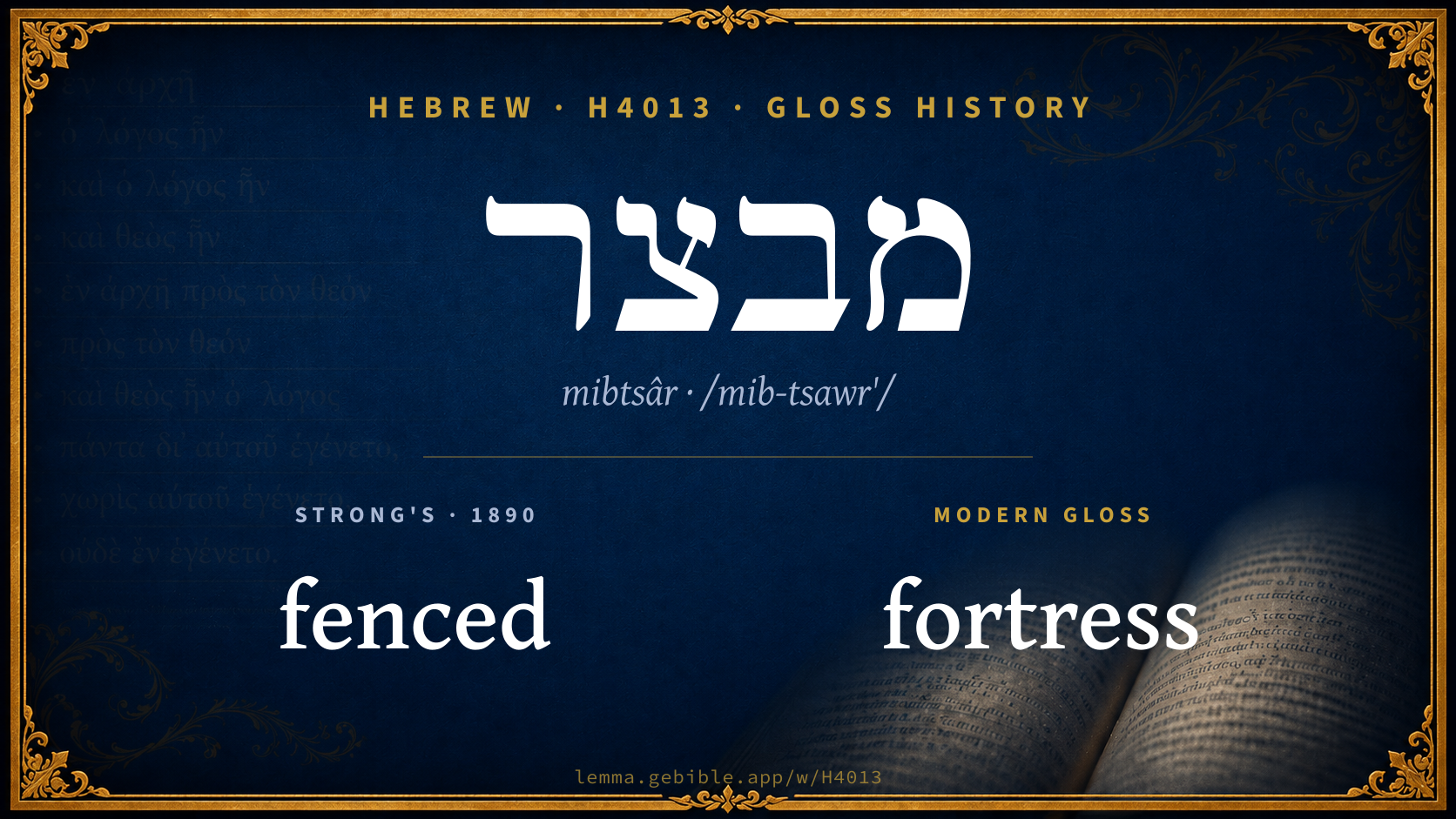
“fortress” is the headline sense of the Hebrew noun מבצר (mibtsâr). Older and newer Bibles part ways — “fenced” in the King James Version, “fortified” (Berean Standard Bible) and “fortification” (unfoldingWord Literal Text) in modern versions. See the renderings breakdown. It appears 37 verses across 16 books of the Hebrew Bible, among its moderately common vocabulary. Scripture first uses it in Numbers 13:19. It shares a root with בצר, בצור and בציר. See the sense tree, 37-verse concordance, and the renderings breakdown below.
Gloss history
Strong's 1890 vs modern scholarship
About this word
Strong's H4013 catalogs a Hebrew word from the Hebrew Old Testament.
These counts are not copied from any lexicon or concordance. They are computed here, from the morphology-tagged Hebrew Old Testament. What Lemma adds →
- 37
- distinct verses
- The word appears in 37 distinct verses.
- 16 / 39
- OT books
- The word appears in 16 of 39 Old Testament books.
- #967
- by frequency
- Top 1000 most frequent Hebrew words (rank 967 of 8,640 Hebrew words by occurrence).
View all 37 occurrences in the concordance →
By section of the Old Testament
By traditional corpus
Conventional, traditional groupings — biblical authorship is debated, so this is a traditional corpus grouping, not an authorship claim. Each share is this word’s portion of its verses in that division of the Hebrew canon. Each figure is a share of the word’s 37 distinct verses.
- Prophets (Nevi'im) 26 verses · 70%
- Writings (Ketuvim) 8 verses · 22%
- Torah (Pentateuch) 3 verses · 8%
How translations render this word
Counts come from each version’s own published word-to-Strong’s tagging or interlinear alignment — an approximate guide to how each version renders this word, not a word-level alignment the data otherwise carries. Because each total is that version’s own tagged count, the per-version totals vary from one another and need not match the appearance or distinct-verse counts above. These counts may also differ from a printed concordance because Lemma counts each distinctly tagged rendering and does not collapse phrase taggings into a single head-word total. This is a fixed set of word-tagged versions (KJV, ASV, BSB, ULT) and does not change with the reading translation you choose elsewhere. Each version’s license is shown beside its name below (and on Sources).
BDB lists this Strong’s number as 2 distinct words (homographs). Each count above pools all of them and is not split by sense — see the Senses section below. A low-frequency rendering may belong to a different one of those words, not the primary meaning.
- King James Version†: Fenced 9×, Strong holds 6×, Defenced 4×
- American Standard Version†: Fortified 13×, Fortress 4×, Strongholds 4×
- Berean Standard Bible†: Fortified 17×, Fortresses 6×, Strongholds 4×
- unfoldingWord Literal Text†: Fortification 12×, Fortresses 8×, Fortifications 5×
King James Version Public Domain
Renders H4013 across 37† tagged occurrences — most commonly:
Plus 11 renderings that appear only once — usually multi-word phrases or single function words the recovered tagging swept in, not distinct renderings.
American Standard Version Public Domain
Renders H4013 across 37† tagged occurrences — most commonly:
Plus 11 renderings that appear only once — usually multi-word phrases or single function words the recovered tagging swept in, not distinct renderings.
Berean Standard Bible Public Domain
Renders H4013 across 37† tagged occurrences — most commonly:
Plus 7 renderings that appear only once — usually multi-word phrases or single function words the recovered tagging swept in, not distinct renderings.
unfoldingWord Literal Text CC BY-SA 4.0
Renders H4013 across 37† tagged occurrences — most commonly:
Plus 7 renderings that appear only once — usually multi-word phrases or single function words the recovered tagging swept in, not distinct renderings.
Senses in BDB
The 1 sense BDB distinguishes for this word, in lexicon order (not ranked by frequency or importance). The full entry — with sub-senses — is in the Lexicon Entry tab.
- fortification, fortress, fortified city, stronghold
Word origin
I. n.m. Is 17:3 fortification—מִבְצָר Nu 32:17 + 18 times; cstr. מִבְצַר Jos 19:29 + 2 times; pl. מִבְצָרִים Nu 13:19 Dn 11:24; מִבְצָרוֹת Dn 11:15; מִבְצְרֵי La 2:2 Dn 11:39; sf. מִבְצָרֶיךָ Ho 10:14 + 2 times; מִבְצָרַיִךְ Na 3:12; מִבְצָרָ֑יִךְ v 14 Je 48:18; מִבְצָרָיו ψ 89:41 La 2:5; מִבְצָרֶיהָ Is 34:13; מִבְצְרֵיהֶם 2 K 8:12;—fortification, especially in phrase (המ׳) מ׳ (ערי) עיר = fortified city Nu 32:17, 36 Jos 10:20; 19:29, 35 1 S 6:18 2 K 3:19; 10:2; 17:9; 18:8 Je 4:5; 5:17; 8:14; 34:7 ψ 108:11 (עיר מ׳ = עיר מָצוֹר ψ 60:11), 2 Ch 17:19 Dn 11:15 (מ׳ in this connexion sing. except Je 5:17 & Dn 11:15 (מבצרות)); Je 1:18 fig. of prophet, so without עיר Je 6:27; fortress, stronghold, lit. without עיר etc. Nu 13:19 2 K 8:12 Je 48:18 Is 17:3; 25:12 (מ׳ משׁגב חומתיך) 34:13) (‖ארמנת), La 2:2, 5 (‖ id.) ψ 89:41 Ho 10:14 Am 5:9 Mi 5:10 Na 3:12, 14 Hb 1:10 Dn 11:24, 39; sq.n.pr. מ׳ צֹר 2 S 24:7 (cf. Jos 19:29 עיר מ׳ צֹר).
III. n.pr.m. Edomite chief Gn 36:42 = 1 Ch 1:53; A 𝔊 L Μαζαρ, A (in Ch) Μαβσαρ;—on n.pr.loc. Mabsar (Onom.277, 63; 137, 11) cf. BuhlEdom. 38).
— Brown-Driver-Briggs (Oxford 1906, public domain), digitized via Sefaria, supplemented by the OpenScriptures HebrewLexicon (CC BY 4.0). See Sources.
Derived from בצר (bâtsar) (H1219) — to fortify.
Forms in the corpus
The 28 distinct written forms H4013 takes in the Hebrew Bible, most frequent first — each parse links to that state’s occurrences in the concordance. Hebrew forms include their vowel points and cantillation, so a single lemma takes many written forms.
Same root — word family
Other BDB entries built from the same root as H4013, grouped by Strong’s listed origin. These share a root / origin per the lexicon — not necessarily a shared meaning. Each links to that word’s own entry.
Derives from
Shares the same root
- בצור bâtsôwr H1208 vintage
- בציר bâtsîyr H1210 vintage
- בצר betser H1220 gold
- בצרה botsrâh H1223 sheepfold
- בצרון bitstsârôwn H1225 stronghold
- בצרת batstsôreth H1226 drought
Proper names from this root
People and places named from this root — a name, not an additional meaning of the word.
Compare all same-root words → Showing 4 of 9 — not the complete family. 1 of the same-root words is a proper name (a person or place). They share a root, not necessarily a meaning.
Septuagint verse parallels
This word appears in 35 verses that also exist in the Greek Old Testament (Septuagint), out of the 37 Hebrew verses it occurs in. You can read those verses in Greek by switching the Old Testament edition to the Septuagint.
Read these verses in the Septuagint
- Numbers 13:19
- Joshua 10:20
- 1 Samuel 6:18
- 2 Samuel 24:7
- 2 Kings 3:19
- 2 Chronicles 17:19
- Psalms 108:10
- Isaiah 17:3
- Jeremiah 1:18
- Lamentations 2:2
- Daniel 11:15
- Hosea 10:14
This is a verse-level parallel only — the same verses exist in both the Hebrew and Greek Old Testaments. No word-level Hebrew↔Greek correspondence is claimed: the data carries no such alignment, so no Greek word is shown as this Hebrew word’s translation. Coverage is not total — the Septuagint omits the deuterocanon and renumbers the Psalms, so some Hebrew verses have no direct Greek parallel.