Isaiah 34:13

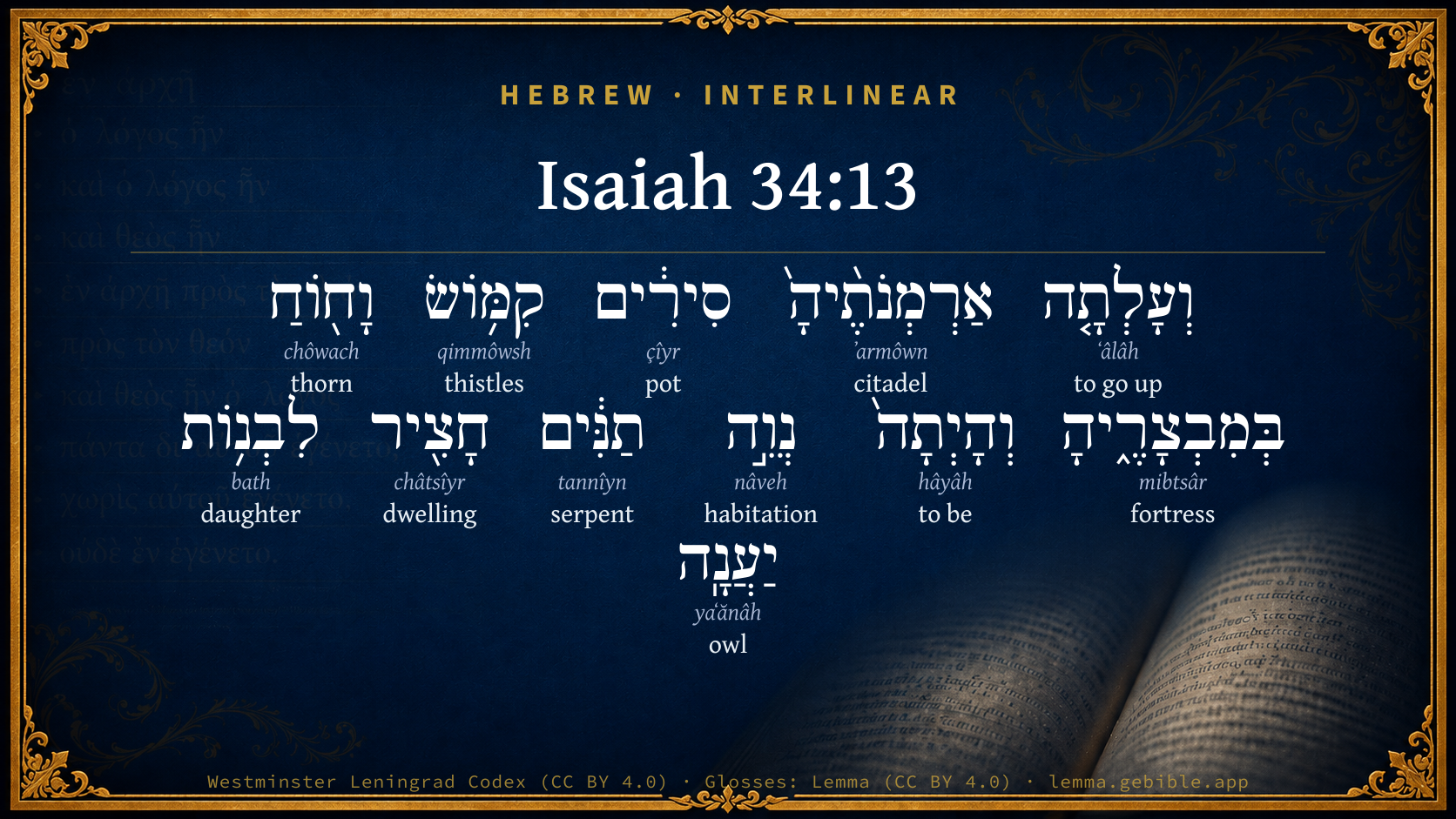
Hebrew (Westminster Leningrad Codex) Isaiah 34:13 appears in the Hebrew Old Testament. The text above is from the Westminster Leningrad Codex. Each word links to its Strong’s number, a concise gloss, and parsing drawn from the Open Scriptures Hebrew Bible morphology. Click any word for its full Brown-Driver-Briggs (BDB) entry.
Download image
Cite this verse

Isaiah 34:13 (World English Bible). Public Domain. Lemma interlinear Bible study tool, https://lemma.gebible.app/v/isaiah/34/13.

Show BibTeX & RIS
BibTeX
RIS
English Translation
Thorns shall come up in its palaces, nettles and thistles in the fortresses of it; and it shall be a habitation of jackals, a court for ostriches.
World English Bible · Public Domain
Highlights
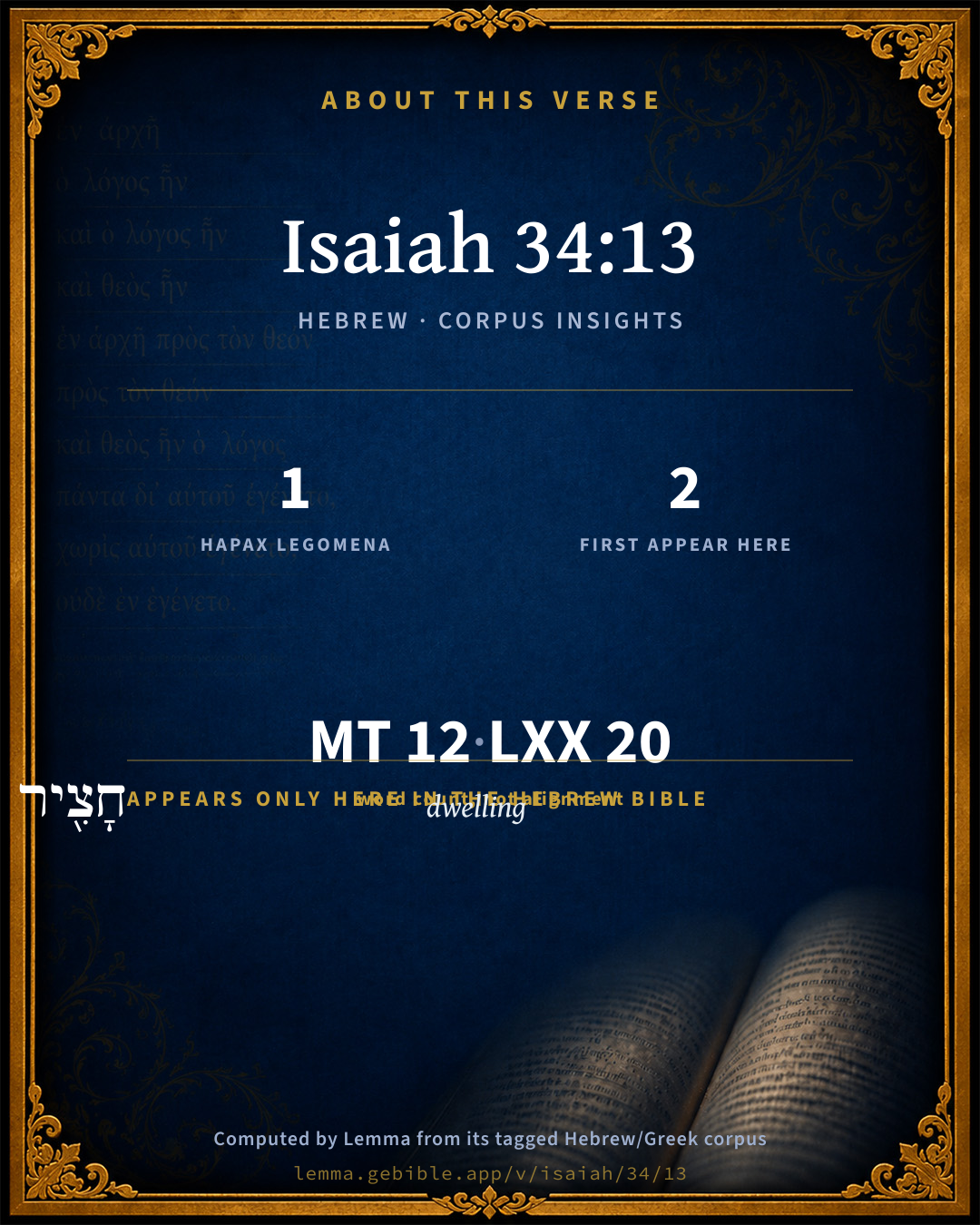
  • 1 hapax legomenon — only here in the Hebrew Bible
  • 2 first appearances in the Hebrew Bible
Full analysis ↓
Download a study sheet

One document with this verse’s original text, its word-by-word gloss line, the meaning frame, cross-references with their text, attributed commentary, and full source and license credits — printable, and it pastes into notes with its structure intact.

This verse Autodidact and up

Study sheet (.html) Plain text (.txt)

A passage Seminary Student

Up to 50 verses in one chapter. A passage sheet keeps up to 6 commentary sources and 12 cross-references per verse, in the order this page ranks them, and says so on the sheet whenever that leaves anything out. Ask for a single verse and you get the Autodidact verse sheet above.

Everything on this page stays free to read, with no account — the sheet is a download of what is already on screen, not access to it.

Want to remove ads? Support Godless Engineer
Compare translations 3

The same verse in 3 English versions, stacked beneath the original-language interlinear above. Click any original word for its lexicon entry.

Each is an independent rendering of the whole verse — the interlinear is not word-aligned to these translations.

Highlighted words mark where these versions differ — a whole-verse word diff, not a word-by-word alignment.

  • World English Bible Public Domain
    Thorns shall come up in its palaces, nettles and thistles in the fortresses of it; and it shall be a habitation of jackals, a court for ostriches.
  • King James Version Public Domain
    And thorns shall come up in her palaces, nettles and brambles in the fortresses thereof: and it shall be an habitation of dragons, and a court for owls.
  • unfoldingWord Literal Text CC BY-SA 4.0
    And thorns will come up her palaces, the nettle and the thornbush in her fortifications, and it will be a habitation of jackals, a court for the daughters of the ostrich.

unfoldingWord Literal Text — © unfoldingWord, licensed CC BY-SA 4.0. Word-aligned USFM3 via Door43 (git.door43.org/unfoldingWord/en_ult).

Versions to compare (up to 4)

3 of 4 selected

Show all 18 translations

Every available English version of this verse, each an independent rendering of the whole verse.

  • World English Bible Public Domain
    Thorns shall come up in its palaces, nettles and thistles in the fortresses of it; and it shall be a habitation of jackals, a court for ostriches.
  • Berean Standard Bible Public Domain
    Her towers will be overgrown with thorns, her fortresses with thistles and briers. She will become a haunt for jackals, an abode for ostriches.
  • Majority Standard Bible Public Domain
    Her towers will be overgrown with thorns, her fortresses with thistles and briers. She will become a haunt for jackals, an abode for ostriches.
  • King James Version Public Domain
    And thorns shall come up in her palaces, nettles and brambles in the fortresses thereof: and it shall be an habitation of dragons, and a court for owls.
  • American Standard Version (1901) Public Domain
    And thorns shall come up in its palaces, nettles and thistles in the fortresses thereof; and it shall be a habitation of jackals, a court for ostriches.
  • Revised Version (1885) Public Domain
    And thorns shall come up in her palaces, nettles and thistles in the fortresses thereof: and it shall be an habitation of jackals, a court for ostriches.
  • Geneva Bible (1599) Public Domain
    And it shall bring foorth thornes in the palaces thereof, nettles and thistles in the strong holdes thereof, and it shall be an habitation for dragons, and a court for ostriches.
  • Douay-Rheims (1899) Public Domain
    And thorns and nettles shall grow up in its houses, and the thistle in the fortresses thereof: and it shall be the habitation of dragons, and the pasture of ostriches.
  • Young's Literal Translation Public Domain
    And gone up her palaces have thorns, Nettle and bramble `are' in her fortresses, And it hath been a habitation of dragons, A court for daughters of an ostrich.
  • Literal Standard Version CC BY-SA 4.0
    And thorns have gone up her palaces, || Nettle and bramble [are] in her fortresses, || And it has been a habitation of dragons, || A court for daughters of an ostrich.
  • Unlocked Literal Bible CC BY-SA 4.0
    Thorns will overgrow her palaces, nettles and thistles her fortresses. It will be a habitation of jackals, a place for ostriches.
  • unfoldingWord Literal Text CC BY-SA 4.0
    And thorns will come up her palaces, the nettle and the thornbush in her fortifications, and it will be a habitation of jackals, a court for the daughters of the ostrich.
  • Darby Bible Public Domain
    And thorns shall come up in her palaces, nettles and brambles in her fortresses; and it shall be a dwelling-place of wild dogs, a court for ostriches.
  • World Messianic Bible Public Domain
    Thorns will come up in its palaces, nettles and thistles in its fortresses; and it will be a habitation of jackals, a court for ostriches.
  • Webster's Bible Public Domain
    And thorns shall come up in her palaces, nettles and brambles in her fortresses, and it shall be a habitation of dragons, and a court for owls.
  • Free Bible Version CC BY-SA 4.0
    Thorns will grow over its palaces; weeds and thistles will take over its fortresses. It will be a place where jackals live, a home for owls.
  • Bible in Basic English Public Domain
    And thorns will come up in her fair houses, and waste plants in her strong towers: and foxes will make their holes there, and it will be a meeting-place for ostriches.
  • JPS Tanakh (1917) Public Domain
    And thorns shall come up in her palaces, nettles and thistles in the fortresses thereof; and it shall be a habitation of wild-dogs, an enclosure for ostriches.

Literal Standard Version (2020), Covenant Press — licensed CC BY-SA 4.0. Text via the HelloAO Bible API (eBible.org). Unlocked Literal Bible (unfoldingWord) — licensed CC BY-SA 4.0. Text via the HelloAO Bible API (eBible.org). unfoldingWord Literal Text — © unfoldingWord, licensed CC BY-SA 4.0. Word-aligned USFM3 via Door43 (git.door43.org/unfoldingWord/en_ult). Free Bible Version, Dr. Jonathan Gallagher — licensed CC BY-SA 4.0. Text via the HelloAO Bible API (eBible.org).

Word by word

More ways to search: Search by grammar → Find every occurrence → Compare this word →

Practice this passage: Drill this verse → Learn its vocabulary →

חָצִ֖יר
châtsîyr
H2681
“dwelling”
Noun, Common, Masculine, Singular, Absolute
Part of Speech
Noun
Type
Common
Gender
Masculine
Number
Singular
State
Absolute
Full BDB Definition

Origin: a collateral form of H2691

TWOT: 723b

a dwelling, an abode, settled abode, haunt
  1. וְעָלְתָ֤ה ʻâlâh H5927 “and · to go up” Conjunction + Verb, Qal, Sequential Perfect, 3rd Person, Feminine, Singular
  2. אַרְמְנֹתֶ֨יהָ֙ ʼarmôwn H759 “citadels · her” Noun, Common, Masculine, Plural, Construct + Suffix, Personal, 3rd Person, Feminine, Singular
  3. סִירִ֔ים çîyr H5518 “pots” Noun, Common, Feminine, Plural, Absolute
  4. קִמּ֥וֹשׂ qimmôwsh H7057 “thistles” Noun, Common, Masculine, Singular, Absolute
  5. וָח֖וֹחַ chôwach H2336 “and · thorn” Conjunction + Noun, Common, Masculine, Singular, Absolute
  6. בְּמִבְצָרֶ֑יהָ mibtsâr H4013 “in/at · fortresses · her” Preposition + Noun, Common, Masculine, Plural, Construct + Suffix, Personal, 3rd Person, Feminine, Singular
  7. וְהָיְתָה֙ hâyâh H1961 “and · to be” Conjunction + Verb, Qal, Sequential Perfect, 3rd Person, Feminine, Singular
  8. נְוֵ֣ה nâveh H5116 “habitation of” Noun, Common, Both, Singular, Construct
  9. תַנִּ֔ים tannîyn H8577 “serpents” Noun, Common, Masculine, Plural, Absolute
  10. לִבְנ֥וֹת bath H1323 “to/for · daughters of” Preposition + Noun, Common, Feminine, Plural, Construct
  11. יַעֲנָֽה yaʻănâh H3284 “owl” Noun, Common, Feminine, Singular, Absolute

About this verse

These counts appear in no published source. They are computed here, from the morphology-tagged text and Lemma’s own curated glosses. What Lemma adds →

12
words
12
distinct lemmas
Prophets
section

Notable vocabulary

1 hapax legomenon — a word that appears only here in the entire Hebrew Bible:

  • חָצִ֖יר dwelling H2681

First appearance in Scripture

These words make their first canonical appearance in the Hebrew Bible here:

  • קִמּ֥וֹשׂ thistles H7057
  • חָצִ֖יר dwelling H2681

Shared distinctive vocabulary

קִמּ֥וֹשׂ thistles H7057 occurs in 2 verses of the Hebrew Bible. Also found in:

Grammatical profile

  • 2 verbs
  • 10 nouns

Verb forms

  • וְעָלְתָ֤ה Qal · Sequential Perfect
  • וְהָיְתָה֙ Qal · Sequential Perfect

Hebrew & Septuagint length

In English translation the verse runs 27 words from the Hebrew and 25 from the Septuagint (LXX English) — closely comparable.

A rough comparison of the two English renderings, which tokenize alike — not a word-level alignment.

Word counts can differ between the Hebrew and the Greek without any difference in meaning — e.g. the Hebrew direct-object marker אֵת has no separate Greek word, and Greek often adds the article ὁ.

In the original languages it is 12 Hebrew tokens and 20 Greek tokens — but the two are counted differently (Hebrew bundles its prefixes and suffixes into one token; the Greek is in lemma form), so that isn’t a like-for-like length.

Cross-references

14

Topical passages linked to Isaiah 34:13 in the Treasury of Scripture Knowledge — connected by theme and wording, ordered by reader-vote popularity; previews shown in the World English Bible.

  • Jeremiah 9:11 I will make Jerusalem heaps, a dwelling-place of jackals; and I will make the cities of Judah a desolation, without inhabitant.
  • Jeremiah 10:22 The voice of news, behold, it comes, and a great commotion out of the north country, to make the cities of Judah a desolation, a dwelling-place of jackals.
  • Psalms 44:19 Though you have crushed us in the haunt of jackals, And covered us with the shadow of death.
  • Malachi 1:3 but Esau I hated, and made his mountains a desolation, and gave his heritage to the jackals of the wilderness."
  • Isaiah 13:21–22 But wild animals of the desert shall lie there; and their houses shall be full of doleful creatures; and ostriches shall dwell there, and wild goats shall dance there.
  • Isaiah 32:13–14 On the land of my people shall come up thorns and briers; yes, on all the houses of joy in the joyous city.
  • Isaiah 35:7 The glowing sand shall become a pool, and the thirsty ground springs of water: in the habitation of jackals, where they lay, shall be grass with reeds and rushes.
  • Jeremiah 49:33 Hazor shall be a dwelling-place of jackals, a desolation forever: no man shall dwell there, neither shall any son of man sojourn therein.
  • Jeremiah 50:39–40 Therefore the wild animals of the desert with the wolves shall dwell there, and the ostriches shall dwell therein: and it shall be no more inhabited forever; neither shall it be lived in from generation to generation.
  • Jeremiah 51:37 Babylon shall become heaps, a dwelling-place for jackals, an astonishment, and a hissing, without inhabitant.
  • Hosea 9:6 For, behold, they have gone away from destruction. Egypt will gather them up. Memphis will bury them. Nettles will possess their pleasant things of silver. Thorns will be in their tents.
  • Zephaniah 2:9 Therefore as I live, says Yahweh of Hosts, the God of Israel, surely Moab will be as Sodom, and the children of Ammon as Gomorrah, a possession of nettles, and salt pits, and a perpetual desolation. The remnant of my people will plunder them, and the survivors of my nation will inherit them.
  • Revelation 18:2 He cried with a mighty voice, saying, "Fallen, fallen is Babylon the great, and she has become a habitation of demons, a prison of every unclean spirit, and a prison of every unclean and hateful bird!
  • Revelation 18:20–24 Rejoice over her, O heaven, you saints, apostles, and prophets; for God has judged your judgment on her."

Cross-references courtesy of OpenBible.info (CC BY 4.0).

Hebrew and Greek witnesses Masoretic Hebrew ↔ Greek Septuagint

The same verse in the two great witnesses to the Old Testament, shown verse-for-verse.

These are two independent witnesses, not word-aligned to each other, and the Septuagint is shown in lemma (dictionary) form.

Hebrew Isaiah 34:13 Masoretic · Westminster Leningrad Codex

וְעָלְתָ֤ה אַרְמְנֹתֶ֨יהָ֙ סִירִ֔ים קִמּ֥וֹשׂ וָח֖וֹחַ בְּמִבְצָרֶ֑יהָ וְהָיְתָה֙ נְוֵ֣ה תַנִּ֔ים חָצִ֖יר לִבְנ֥וֹת יַעֲנָֽה

Thorns shall come up in its palaces, nettles and thistles in the fortresses of it; and it shall be a habitation of jackals, a court for ostriches.

World English Bible · Public Domain

Greek LXX Isaiah 34:13 Septuagint · lemma form

καί ἀναφύω εἰς ὁ πόλις αὐτός ἀκάνθινος ξύλον καί εἰς ὁ ὀχύρωμα αὐτός καί εἰμί ἔπαυλις σειρήν καί αὐλή στρουθός

And thorns shall spring up in their cities, and in her strong holds: and they shall be habitations of monsters, and a court of ostriches.

LXX2012 (modern English Septuagint) · Public Domain

On this verse, Keil & Delitzsch discusses the Septuagint’s reading. Read the note in Commentary ↓

Hebrew: Westminster Leningrad Codex (CC BY 4.0). Greek: Septuagint (public domain); English from LXX2012 (modern English Septuagint) (Public Domain). How the Septuagint differs from the Hebrew →

Targum (Aramaic paraphrase)

1

The Targum is the ancient Jewish Aramaic paraphrase of the Hebrew Scriptures — an interpretive translation, not the Hebrew text itself. Onkelos (literal) and Pseudo-Jonathan (expansive) render the Torah, and Jonathan the Prophets. Coverage is partial: where no permissively-licensed English translation exists for a verse, only the Aramaic is shown. This is verse-level text, not a word-by-word alignment to the Hebrew.

  1. Targum Jonathan Prophets (Joshua–Malachi)
    וְיִסְקוֹן בִּרְנְיָתָהָא סִירִין קַרְסוּלִין וְחוֹחִין בִּתְקוֹף כְּרַכָּהָא וּתְהֵי מְדוֹר יְרוֹדִין אַתְרָא לְבַת נַעֲמָא:

    And in her palaces shall spring up thorns, and the nettles, and the brambles in their fortified city; and she shall become a habitation for dragons, a place for the daughter of the ostrich.

    Targum Jonathan — Aramaic: “Mikraot Gedolot” (public domain). English: “Sefaria Community Translation” (CC0 1.0 (public-domain dedication)); “London "Chaldee Paraphrase," 1871” (public domain). Text via Sefaria.

Commentary

Notes on Isaiah 34:13 from classic Christian and Jewish commentators (each source and its license shown beneath its notes). The classic Christian expositions comment on the surrounding passage and are grouped to its opening verse, so a note may address several verses; the Jewish commentaries on the Tanakh (Rashi and others) are per-verse, so they appear only where the commentator wrote on this verse.

Lemma curates 59 commentaries, every one of them public domain or Creative Commons licensed, each selected and text-cleaned for this edition rather than reprinted as found. About our sources →

Trapp's Complete Commentary

John Trapp

Isa 34:13 And thorns shall come up in her palaces, nettles and brambles in the fortresses thereof: and it shall be an habitation of dragons, [and] a court for owls.

Ver. 13. A court for owls.] Or, Ostriches. See on Isa 34:11.

John Trapp, A Commentary or Exposition upon All the Books of the Old and New Testament (1647–1656) — public domain. Text from a community e-Sword module.

Keil & Delitzsch

C. F. Keil & F. Delitzsch

The allusion to the monarchy and the lofty electoral dignity leads the prophet on to the palaces and castles of the land. Starting with these, he carries out the picture of the ruins in Isa 34:13-15. "And the palaces of Edom break out into thorns, nettles and thistles in its castles; and it becomes the abode of wild dogs, pasture for ostriches. And martens meet with jackals, and a wood-devil runs upon its fellow; yea, Liiliith dwells there, and finds rest for itself. There the arrow-snake makes its nest, and breeds and lays eggs, and broods in the shadow there; yea, there vultures gather together one to another." The feminine suffixes refer to Edom, as they did in the previous instance, as בּת־אדום or אדום ארץ. On the tannı̄m, tsiyyı̄m, and 'iyyı̄m, see at Isa 13:21-22. It is doubtful whether châtsı̄r here corresponds to the Arabic word for an enclosure (= חצר), as Gesenius, Hitzig, and others suppose, as elsewhere to the Arabic for green, a green field, or garden vegetable. We take it in the latter sense, viz., a grassy place, such as was frequented by ostriches, which live upon plants and fruits. The word tsiyyim (steppe animals) we have rendered "martens," as the context requires a particular species of animals to be named. This is the interpretation given by Rashi (in loc.) and Kimchi in Jer 50:39 to the Targum word tamvân. We do not render 'iyyı̄m "wild cats" (chattūilin), but "jackals," after the Arabic. קרא with על we take in the sense of קרה (as in Exo 5:3). Lı̄lı̄th (Syr. and Zab. lelitho), lit., the creature of the night, was a female demon (shēdâh) of the popular mythology; according to the legends, it was a malicious fairy that was especially hurtful to children, like some of the fairies of our own fairy tales. There is life in Edom still; but what a caricature of that which once was there! In the very spot where the princes of Edom used to proclaim the new king, satyrs now invite one another to dance (Isa 13:21); and there kings and princes once slept in their palaces and country houses, the lı̄lı̄th, which is most at home in horrible places, finds, as though after a prolonged search, the most convenient and most comfortable resting-place. Demons and serpents are not very far distant from one another. The prophet therefore proceeds in Isa 34:15 to the arrow-snake, or springing-snake (Arabic qiffâze, from qâphaz, related to qâphats, Sol 2:8, to prepare for springing, or to spring; a different word from qippōd, which has the same root). This builds its nest in the ruins; there it breeds (millēt, to let its eggs slide out) and lays eggs (bâqa‛, to split, i.e., to bring forth); and then it broods in the shade (dâgar is the Targum word in Job 39:14 for chimmēm (ithpael in Lam 1:20 for חמרמר), and is also used in the rabbinical writings for fovere, as Jerome renders it here). The literal sense of the word is probably to keep the eggs together (Targum, Jer 17:11, בּעין מכנּשׁ, lxx συνήγαγεν), since דּגר (syn. חמּר) signifies "to collect." Rashi has therefore explained it in both passages as meaning glousser, to cluck, the noise by which a fowl calls its brood together. The dayyâh is the vulture. These fowls and most gregarious birds of prey also collect together there.

Keil & Delitzsch — Biblical Commentary on the Old Testament (1861–1891) — public domain (CC PDM 1.0). Text via the HelloAO Bible API. (Old Testament only.)

Jamieson, Fausset & Brown

Robert Jamieson, A. R. Fausset & David Brown

dragons--(See on Isa 13:21; Isa 13:22).

court for owls--rather, "a dwelling for ostriches."

Jamieson, Fausset & Brown — Commentary Critical and Explanatory on the Whole Bible (1871) — public domain (CC PDM 1.0). Text via the HelloAO Bible API.

Adam Clarke's Commentary

Verse 13. And thorns shall come up in her palaces] ועלו בארמנותיה vealu bearmenotheyha; so read all the ancient versions.

A court for owls.] יענה yaanah, the ostrich, from ענה anah, to cry, because of the noise it makes. "They roar," says Dr. Shaw, "sometimes like a lion-sometimes like a bull. I have often heard them groan as if in the utmost distress."

Adam Clarke's Commentary on the Bible (1810–1826) — public domain. Text from a community e-Sword/MySword module.

Ellicott's Commentary for English Readers

(13) An habitation of dragons, and a court for owls . . .—The wild creatures named are identified, as elsewhere, with “jackals” (“wild dogs,” Delitzsch) and “ostriches.”

A Bible Commentary for English Readers, edited by Charles John Ellicott (1878–1897) — public domain. Text from a community e-Sword module.

The Cambridge Bible for Schools and Colleges

gen. ed. J. J. S. Perowne

13. The mention of nobles and princes naturally leads to the palaces and castles.

dragons … owls] jackals … ostriches (R.V.). See on ch. Isa_13:21 f.

The Cambridge Bible for Schools and Colleges (gen. ed. J. J. S. Perowne; Cambridge University Press, 1878–1918) — public domain. Text from a community e-Sword module.

John Gill's Exposition

And thorns shall come up in her palaces,.... Where their kings and princes dwelt, and kept their courts, popes and cardinals; here will be the tokens of God's curse, as thorns are, these being the people of his curse, as in Isa 34:5,

nettles and brambles in the fortresses thereof; alluding to "Bozrah" which signifies a fortress; referring to the towers and fortifications of the city of Rome, and all other fortified cities within its jurisdiction:

and it shall be a habitation of dragons; literally, as it figuratively had been the seat of the old dragon, the devil, and of the beast to whom the dragon gave his power, seat, and authority; and who, though he looked like a lamb, spoke like a dragon, Rev 12:3,

and a court for owls; or, "daughters of the owl"; or "ostriches", as some render it.

John Gill's Exposition of the Whole Bible (1746–1763) — public domain (CC PDM 1.0). Text via the HelloAO Bible API.

Albert Barnes' Notes on the Bible

And thorns ... - (see the note at Isa 5:6)

It shall be an habitation of dragons - On the meaning of the word ‘dragons,’ see the note at Isa 13:22.

Court for owls - A place of resort, a residence of owls. The word rendered ‘court’ (חציר châtsı̂yr) means a dwelling-place, a habitation, as well as an enclosure or court. The margin is, ‘Daughters of the owl,’ or ‘ostriches’ (see the note at Isa 13:21). ‘I would,’ says Stephens, when standing amidst the ruins of Petra, the capital of Idumea (see the note at Isa 16:1), and with this passage of Isaiah in his eye, ‘I would that the sceptic could stand as I did, among the ruins of this city among the rocks, and there open the sacred book, and read the words of the inspired penman, written when this desolate place was one of the greatest cities in the world. I see the scoff arrested, his cheek pale, his lip quivering, and his heart quaking with fear, as the ancient city cries out to him in a voice loud and powerful as one risen from the dead; though be would not believe Moses and the prophets, he believes the hand-writing of God himself, in the desolation and eternal ruin around him.’ (Incidents of Travel in Egypt, etc., vol. ii. p. 76.)

Albert Barnes' Notes on the Bible (1834–1885) — public domain. Text from a community e-Sword/MySword module.

Haydock's Catholic Bible Commentary

Dragons, Thannim, chap. xiii. 22. (Haydock) --- Ostriches, or swans.

George Leo Haydock (1774–1849), Haydock's Catholic Family Bible and Commentary, 1859 edition — public domain. Excludes Psalms (Douay-Rheims chapter numbering differs from Protestant) and Deuterocanonical books (Catholic canon only).

Matthew Poole's English Annotations

This is another mark and evidence of extreme desolation, as it is also, Hos 9:6.

Matthew Poole's English Annotations on the Holy Bible (1683–1685) — public domain. Text from a community e-Sword/MySword module.

Whedon's Commentary on the Bible

Daniel D. Whedon

13. The natural consequence of Edom’s depopulation follows. In her palaces, and over all her ruined walls of fortresses, there grow up thorns, nettles, and brambles. Thither also the wild beasts of the desert congregate. Wolves, or wild dogs, (not dragons,) have their homes there, and the court, or grassy plots among the ruins, are resorted to by ostriches, (not owls.)

Daniel D. Whedon (gen. ed.), Commentary on the Old and New Testaments (1874–1909) — public domain. Text from a community e-Sword module.

The Pulpit Commentary

Thorns shall come up in her palaces. The "palaces" of Bozrah are mentioned also by Amos, (Amo_1:12) and are threatened with destruction by fire. Amid their ruins should grow up thorns and briars. It shall be a habitation of dragons; or, of jackals (see the comment on Isa_13:22). Owls; literally, daughters of screaming a description better suited to the owl than to the ostrich, which some regard as the bird meant.

Vers. 13-15. The witness of desolate lands.

In every age there have been such. In the forefront of the world"s history there was desolated Sodom and Gomorrah, witnessing to Israelites, and witnessing to all the world. Our Lord, as a Teacher, called attention to its message. Attention may be directed to Babylon, Tyre, Palestine; and for modern times, to the decay of the commercial cities of Italy, to Holland, etc. countries which may be spoken of as "desolate" when compared with former prosperities. Edom, or Idumea, is the country alluded to by the prophet, and travelers describe very forcibly the completeness of its desolation. "Captains Irby and Mangles tell us that the Arabs about Akaba are a very bad people, notorious robbers, and at war with all others. The desolation of the land is utter and perpetual a terrible monument of the Divine displeasure against wickedness and idolatry. The whole land lies under a curse; the ruins of its cities of rock, and the remains of architectural skill and ingenuity, attest its former greatness, while they set forth the solemn fact that it is a fearful thing to fall into the hands of the living God." Dr. Robinson says, "A more frightful desert it had hardly been our lot to behold. Now and then a lone shrub of the Ghudah was almost the only trace of vegetation. The mountains beyond presented a most uninviting and hideous aspect; precipices and naked conical peaks of chalky and gravelly formation rising one above another without a sign of life or vegetation." Dr. Olin speaks of it as in "a state of desolation and ruin the most absolute and irretrievable, such as probably no portion of the globe once populous and fertile now exhibits." What, then, is the message which such a desolate land bears for all the world and for us? This may be worked out and illustrated under the following divisions.

I IT WITNESSES FOR GOD. He is known by the judgments which he executeth." There is evidently more than a mere operation of natural forces there is Divine direction of natural forces to effect Divine ends. This may get more familiar illustration from Palestine, which is a country with God"s curse on it.

II IT WITNESSES FOR RIGHTEOUSNESS. "Righteousness exalteth a nation." Righteousness is sure defense, security, stability. If a land is desolate, it calls to all other lands, saying, Hold fast by righteousness." Lands fall through the iniquity of the peoples.

III IT WITNESSES FOR JUDGMENT. "Though hand join in hand, the wicked shall not go unpunished." Sooner or later every kingdom, every nation, will find that God will arise and vindicate himself, and render a reward to the proud. R.T.

The Pulpit Commentary (1880–1919), ed. H.D.M. Spence-Jones & Joseph S. Exell — public domain. Text from a community e-Sword module.

J. A. Alexander on Isaiah

Joseph Addison Alexander

“And her palaces (or in her palaces) shall come up thorns, nettles and brambles in her fortresses.” The natural consequence of her depopulation. The situation here described would of course be the resort of wild and solitary animals. “And she shall be a home of wolves, a court (or grass-plot) for ostriches.” The general sense is that of an enclosed and appropriated spot, a play-ground or dwelling-place.

Joseph Addison Alexander, The Prophecies of Isaiah (1846–1847; New York: Scribner, 1870–1878) — public domain. Text from a community e-Sword module.

unfoldingWord translationNotes

Door43 World Missions Community

Thorns ... nettles ... thistles

These are all weeds with thorns. Nettles' thorns have poison that causes itching.

jackals ... ostriches ... wild animals ... hyenas ... Owls

Translate the names of these animals the same as you did in Isaiah 13:21-22.

Nocturnal animals

animals that are awake and active at night

hawks

birds that kill small animals for food

translationWords

goat

rest

unfoldingWord translationNotes — © Distant Shores Media and the Door43 World Missions Community, licensed CC BY-SA 4.0. Source: git.door43.org/Door43/en_tn.

Rashi

Rabbi Shlomo Yitzchaki (Rashi)

And its palaces shall grow thorns So is the nature of ruins to grow thorns and briers, and that is ‘kimosh’ and that is ‘choach’; they are all types of thorns, e.g., ortias, (nettles,) and the like.

the habitat of jackals (תַּנִּים) That is a desert, which is usually frequented by ‘tannim,’ which is a species of wild animal.

Rashi on the Tanakh — English translations: “The Judaica Press complete Tanach with Rashi, translated by A. J. Rosenberg” (CC BY 4.0); “Pentateuch with Rashi's commentary by M. Rosenbaum and A.M. Silbermann, 1929-1934” (public domain); “The Metsudah Tanach series, Lakewood, N.J” (CC BY 4.0); and “The Book of Joshua, Metsudah Publications, 1997” (CC BY 4.0). Text via Sefaria.

Ibn Ezra

Rabbi Abraham ibn Ezra

ארמנותיה Over her palaces. The preposition על is to be supplied. ועלתה סירים And thorns shall come up. Lit., And each of the thorns shall come up. סירים Thorns. Comp. Koh. 7:6. קמוש The same.

תנים Dragons. Comp. Job 30:29.

חצר ═ חציר A court. Comp. יָשֵׂשׂ (2 Chr. 36:17) ═ יָשִׂישׂ (Job 15:10), old. It can also be taken in its usual meaning: grass.

Ibn Ezra on the Tanakh — English translations: “Sefaria Community Translation” (CC0 1.0 (public-domain dedication)); “Yalkut, Sifsei Chachomim Chumash, Metsudah Publications, 2009” (CC BY 4.0); and “Commentary of Ibn Ezra on Isaiah - trans. by M. Friedlander, 1873” (public domain). Text via Sefaria.

Lesson kit

Teaching starters — assembled from the data on this page, not authored interpretation. Every prompt links to the verse data it draws on. Edit before teaching.

Isaiah, in the Prophets, opens this verse with 12 words (12 distinct Hebrew lemmas). Its most distinctive word is châtsîyr (“dwelling”). A historical commentator’s framing appears above. Read the whole chapter for the surrounding context.

Discussion questions

  1. What does “dwelling” (châtsîyr) contribute to the verse as a whole?
  2. This verse holds 1 word here found nowhere else in the Hebrew Bible. What might the rare word draw attention to?
  3. 2 words here appear for the first time in Scripture. What is being introduced at this debut?
  4. Hosea 9:6 shares the word «thistles» with this verse. How do the two illuminate each other?
  5. The translations on this page render this verse differently — a whole-verse word diff, not a word-by-word alignment. What might account for the different wordings?
  6. The verb «וְעָלְתָ֤ה» is Qal Sequential Perfect. How does its form color the action?
  7. Reading how Trapp's Complete Commentary and Keil & Delitzsch read this verse, where do the two commentators agree and where do they part?

Things to notice

Reading settings

Reading text

Shown beneath each verse's original-language words.

Old Testament
Old Testament edition

Read the OT as the Masoretic Hebrew (MT) or the Greek Septuagint (LXX).

English shown for the Greek Septuagint (in the Hebrew ↔ Greek comparison).

Comparing translations? Open the Compare panel on any verse page to stack up to four side by side.