Nahum 3:12

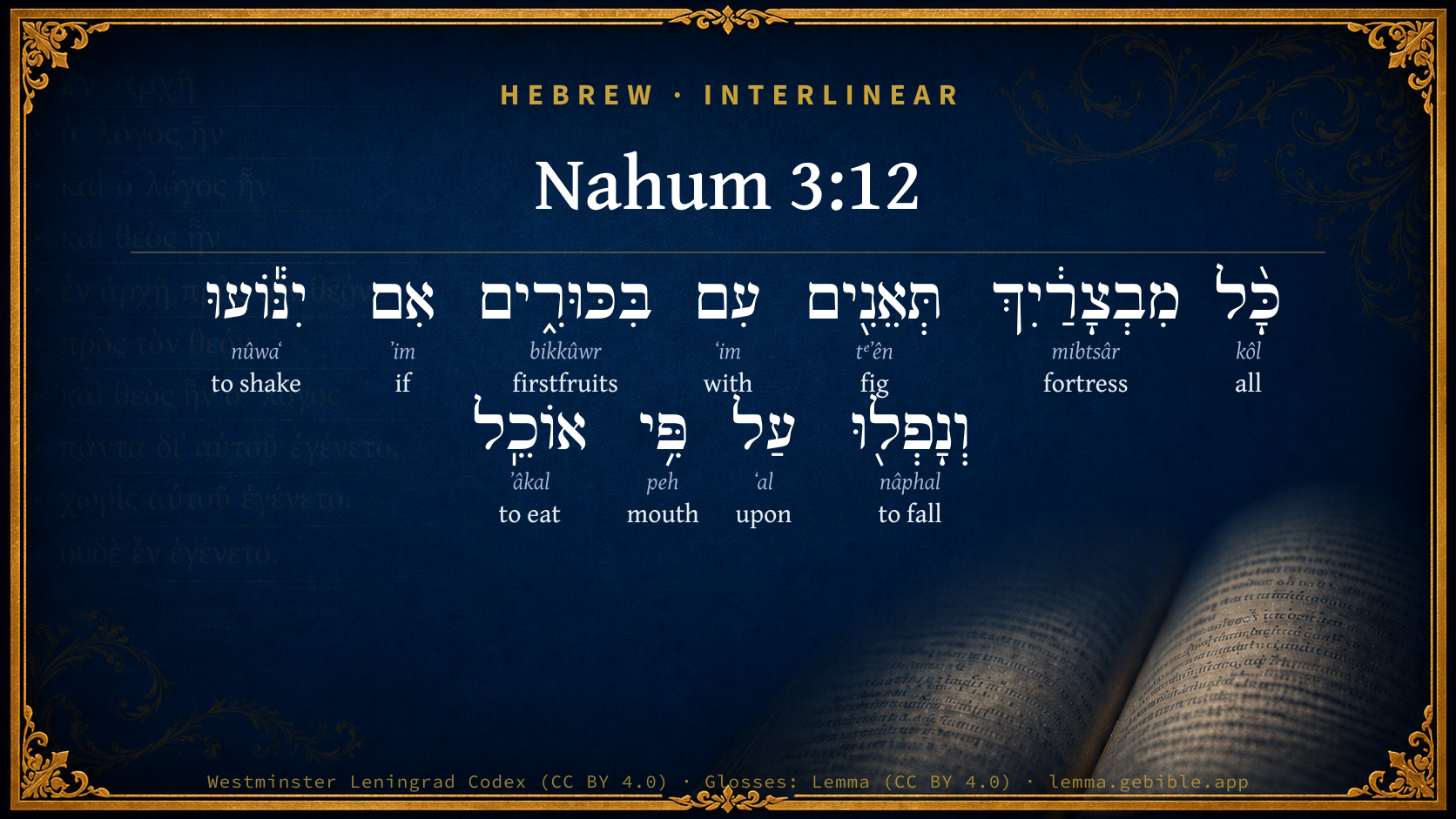
Hebrew (Westminster Leningrad Codex) Nahum 3:12 appears in the Hebrew Old Testament. The text above is from the Westminster Leningrad Codex. Each word links to its Strong’s number, a concise gloss, and parsing drawn from the Open Scriptures Hebrew Bible morphology. Click any word for its full Brown-Driver-Briggs (BDB) entry.
Download image
Cite this verse

Nahum 3:12 (World English Bible). Public Domain. Lemma interlinear Bible study tool, https://lemma.gebible.app/v/nahum/3/12.

Show BibTeX & RIS
BibTeX
RIS
English Translation
All your fortresses will be like fig trees with the first-ripe figs: if they are shaken, they fall into the mouth of the eater.
World English Bible · Public Domain
Download a study sheet

One document with this verse’s original text, its word-by-word gloss line, the meaning frame, cross-references with their text, attributed commentary, and full source and license credits — printable, and it pastes into notes with its structure intact.

This verse Autodidact and up

Study sheet (.html) Plain text (.txt)

A passage Seminary Student

Up to 50 verses in one chapter. A passage sheet keeps up to 6 commentary sources and 12 cross-references per verse, in the order this page ranks them, and says so on the sheet whenever that leaves anything out. Ask for a single verse and you get the Autodidact verse sheet above.

Everything on this page stays free to read, with no account — the sheet is a download of what is already on screen, not access to it.

Want to remove ads? Support Godless Engineer
Compare translations 3

The same verse in 3 English versions, stacked beneath the original-language interlinear above. Click any original word for its lexicon entry.

Each is an independent rendering of the whole verse — the interlinear is not word-aligned to these translations.

Highlighted words mark where these versions differ — a whole-verse word diff, not a word-by-word alignment.

  • World English Bible Public Domain
    All your fortresses will be like fig trees with the first-ripe figs: if they are shaken, they fall into the mouth of the eater.
  • King James Version Public Domain
    All thy strong holds shall be like fig trees with the firstripe figs: if they be shaken, they shall even fall into the mouth of the eater.
  • unfoldingWord Literal Text CC BY-SA 4.0
    All of your fortresses fig trees with first fruits: if they are shaken, they fall into the mouth of the eater.

unfoldingWord Literal Text — © unfoldingWord, licensed CC BY-SA 4.0. Word-aligned USFM3 via Door43 (git.door43.org/unfoldingWord/en_ult).

Versions to compare (up to 4)

3 of 4 selected

Show all 18 translations

Every available English version of this verse, each an independent rendering of the whole verse.

  • World English Bible Public Domain
    All your fortresses will be like fig trees with the first-ripe figs: if they are shaken, they fall into the mouth of the eater.
  • Berean Standard Bible Public Domain
    All your fortresses are fig trees with the first ripe figs; when shaken, they fall into the mouth of the eater!
  • Majority Standard Bible Public Domain
    All your fortresses are fig trees with the first ripe figs; when shaken, they fall into the mouth of the eater!
  • King James Version Public Domain
    All thy strong holds shall be like fig trees with the firstripe figs: if they be shaken, they shall even fall into the mouth of the eater.
  • American Standard Version (1901) Public Domain
    All thy fortresses shall be `like' fig-trees with the first-ripe figs: if they be shaken, they fall into the mouth of the eater.
  • Revised Version (1885) Public Domain
    All thy fortresses shall be like fig trees with the firstripe figs: if they be shaken, they fall into the mouth of the eater.
  • Geneva Bible (1599) Public Domain
    All thy strong cities shall be like figtrees with the first ripe figs: for if they be shaken, they fall into the mouth of the eater.
  • Douay-Rheims (1899) Public Domain
    All thy strong holds shall be like fig trees with their green figs: if they be shaken, they shall fall into the mouth of the eater.
  • Young's Literal Translation Public Domain
    All thy fortresses `are' fig-trees with first-fruits, If they are shaken, They have fallen into the mouth of the eater.
  • Literal Standard Version CC BY-SA 4.0
    All your fortresses [are] fig trees with first-fruits, || If they are shaken, || They have fallen into the mouth of the eater.
  • Unlocked Literal Bible CC BY-SA 4.0
    All your fortresses will be like fig trees with the earliest ripe figs: if they are shaken, they fall into the mouth of the eater.
  • unfoldingWord Literal Text CC BY-SA 4.0
    All of your fortresses fig trees with first fruits: if they are shaken, they fall into the mouth of the eater.
  • Darby Bible Public Domain
    All thy strongholds are [like] fig-trees with the first-ripe figs: if they be shaken, they even fall into the mouth of the eater.
  • World Messianic Bible Public Domain
    All your fortresses will be like fig trees with the first-ripe figs. If they are shaken, they fall into the mouth of the eater.
  • Webster's Bible Public Domain
    All thy strong holds shall be like fig-trees with the first ripe figs: if they be shaken, they shall even fall into the mouth of the eater.
  • Free Bible Version CC BY-SA 4.0
    All your fortresses are like fig trees ripe with fruit—they fall when they are shaken into the mouth of the one eating.
  • Bible in Basic English Public Domain
    All your walled places will be like fig-trees and your people like the first figs, falling at a shake into the mouth which is open for them.
  • JPS Tanakh (1917) Public Domain
    All thy fortresses shall be like fig-trees with the first-ripe figs: if they be shaken, they fall into the mouth of the eater.

Literal Standard Version (2020), Covenant Press — licensed CC BY-SA 4.0. Text via the HelloAO Bible API (eBible.org). Unlocked Literal Bible (unfoldingWord) — licensed CC BY-SA 4.0. Text via the HelloAO Bible API (eBible.org). unfoldingWord Literal Text — © unfoldingWord, licensed CC BY-SA 4.0. Word-aligned USFM3 via Door43 (git.door43.org/unfoldingWord/en_ult). Free Bible Version, Dr. Jonathan Gallagher — licensed CC BY-SA 4.0. Text via the HelloAO Bible API (eBible.org).

Word by word

More ways to search: Search by grammar → Find every occurrence → Compare this word →

Practice this passage: Drill this verse → Learn its vocabulary →

בִּכּוּרִ֑ים
bikkûwr
H1061
“firstfruits”
Noun, Common, Both, Plural, Absolute
Part of Speech
Noun
Type
Common
Gender
Both
Number
Plural
State
Absolute
Full BDB Definition

Origin: from H1069

TWOT: 244e

first-fruits - the first of the crops and fruit that ripened, was gathered, and offered to God according to the ritual of Pentecost - the bread made of the new grain offered at Pentecost - the day of the first-fruits (Pentecost)
  1. כָּ֨ל kôl H3605 “all of” Noun, Common, Masculine, Singular, Construct
  2. מִבְצָרַ֔יִךְ mibtsâr H4013 “fortresses · your” Noun, Common, Masculine, Plural, Construct + Suffix, Personal, 2nd Person, Feminine, Singular
  3. תְּאֵנִ֖ים tᵉʼên H8384 “figs” Noun, Common, Feminine, Plural, Absolute
  4. עִם ʻim H5973 “with” Preposition
  5. אִם ʼim H518 “if” Conjunction
  6. יִנּ֕וֹעוּ nûwaʻ H5128 “to shake” Verb, Niphal, Imperfect, 3rd Person, Masculine, Plural
  7. וְנָפְל֖וּ nâphal H5307 “and · to fall” Conjunction + Verb, Qal, Perfect, 3rd Person, Common, Plural
  8. עַל ʻal H5921 “upon” Preposition
  9. פִּ֥י peh H6310 “mouth of” Noun, Common, Masculine, Singular, Construct
  10. אוֹכֵֽל ʼâkal H398 “eating” Verb, Qal, Participle Active, Masculine, Singular, Absolute

About this verse

These counts appear in no published source. They are computed here, from the morphology-tagged text and Lemma’s own curated glosses. What Lemma adds →

11
words
11
distinct lemmas
Prophets
section

Notable vocabulary

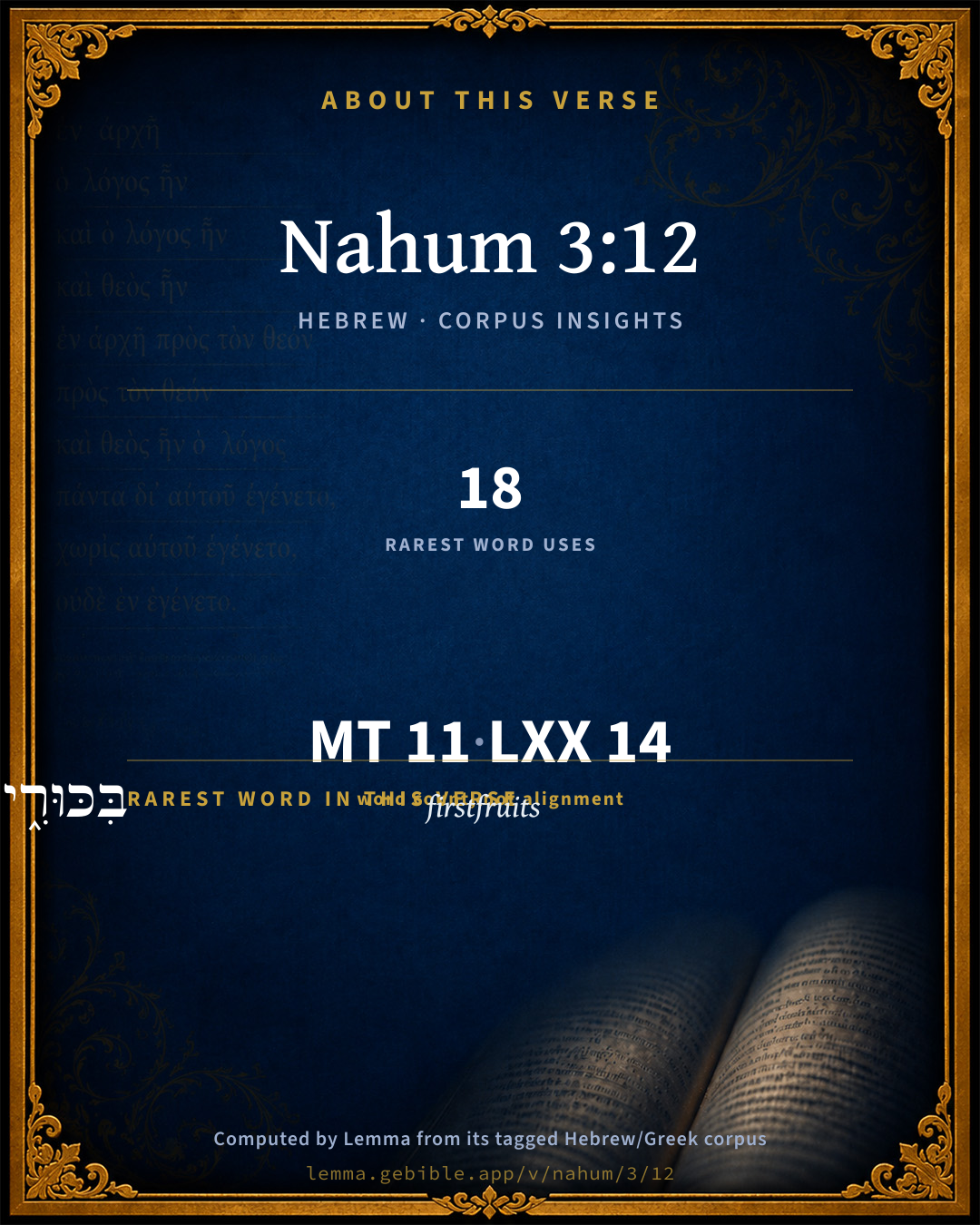
The rarest word here is בִּכּוּרִ֑ים firstfruits H1061 — appearing just 18 times in the whole Hebrew Bible.

Shared distinctive vocabulary

בִּכּוּרִ֑ים firstfruits H1061 occurs in 16 verses of the Hebrew Bible. Also found in:

Grammatical profile

  • 3 verbs
  • 5 nouns
  • 2 prepositions
  • 1 conjunction

Verb forms

  • יִנּ֕וֹעוּ Niphal · Imperfect
  • וְנָפְל֖וּ Qal · Perfect
  • אוֹכֵֽל Qal · Participle Active

Hebrew & Septuagint length

In English translation the verse runs 24 words from the Hebrew and 21 from the Septuagint (LXX English) — closely comparable.

A rough comparison of the two English renderings, which tokenize alike — not a word-level alignment.

Word counts can differ between the Hebrew and the Greek without any difference in meaning — e.g. the Hebrew direct-object marker אֵת has no separate Greek word, and Greek often adds the article ὁ.

In the original languages it is 11 Hebrew tokens and 14 Greek tokens — but the two are counted differently (Hebrew bundles its prefixes and suffixes into one token; the Greek is in lemma form), so that isn’t a like-for-like length.

Cross-references

3

Topical passages linked to Nahum 3:12 in the Treasury of Scripture Knowledge — connected by theme and wording, ordered by reader-vote popularity; previews shown in the World English Bible.

  • Revelation 6:13 The stars of the sky fell to the earth, like a fig tree dropping its unripe figs when it is shaken by a great wind.
  • Isaiah 28:4 and the fading flower of his glorious beauty, which is on the head of the fat valley, shall be as the first-ripe fig before the summer; which when he who looks on it sees, while it is yet in his hand he eats it up.
  • Habakkuk 1:10 Yes, he scoffs at kings, and princes are a derision to him. He laughs at every stronghold, for he builds up an earthen ramp, and takes it.

Cross-references courtesy of OpenBible.info (CC BY 4.0).

Hebrew and Greek witnesses Masoretic Hebrew ↔ Greek Septuagint

The same verse in the two great witnesses to the Old Testament, shown verse-for-verse.

These are two independent witnesses, not word-aligned to each other, and the Septuagint is shown in lemma (dictionary) form.

Hebrew Nahum 3:12 Masoretic · Westminster Leningrad Codex

כָּ֨ל מִבְצָרַ֔יִךְ תְּאֵנִ֖ים עִם בִּכּוּרִ֑ים אִם יִנּ֕וֹעוּ וְנָפְל֖וּ עַל פִּ֥י אוֹכֵֽל

All your fortresses will be like fig trees with the first-ripe figs: if they are shaken, they fall into the mouth of the eater.

World English Bible · Public Domain

Greek LXX Nahum 3:12 Septuagint · lemma form

πᾶς ὁ ὀχύρωμα σύ συκῆ σκοπός ἔχω ἐάν σαλεύω καί πίπτω εἰς στόμα ἐσθίω

All your strongholds are as fig-trees having watchers: if they be shaken, they shall fall into the mouth of the eater.

LXX2012 (modern English Septuagint) · Public Domain

Hebrew: Westminster Leningrad Codex (CC BY 4.0). Greek: Septuagint (public domain); English from LXX2012 (modern English Septuagint) (Public Domain). How the Septuagint differs from the Hebrew →

Targum (Aramaic paraphrase)

1

The Targum is the ancient Jewish Aramaic paraphrase of the Hebrew Scriptures — an interpretive translation, not the Hebrew text itself. Onkelos (literal) and Pseudo-Jonathan (expansive) render the Torah, and Jonathan the Prophets. Coverage is partial: where no permissively-licensed English translation exists for a verse, only the Aramaic is shown. This is verse-level text, not a word-by-word alignment to the Hebrew.

  1. Targum Jonathan Prophets (Joshua–Malachi)
    כָּל כְּרַכָּךְ דָמָן לְתֵינִין בַּכִּירָן דְאִם יְרַעֲדוּנוּנוּן יִתְּרוּן וְיִשְׁתָּאֲרוּן בְּהוֹן צְמוּקִין דְכָשְׁרִין לְמֵיכַל:

    (no public-domain English translation for this verse)

    Targum Jonathan — Aramaic: “Mikraot Gedolot” (public domain). English: “Sefaria Community Translation” (CC0 1.0 (public-domain dedication)); “London "Chaldee Paraphrase," 1871” (public domain). Text via Sefaria.

Commentary

Notes on Nahum 3:12 from classic Christian and Jewish commentators (each source and its license shown beneath its notes). The classic Christian expositions comment on the surrounding passage and are grouped to its opening verse, so a note may address several verses; the Jewish commentaries on the Tanakh (Rashi and others) are per-verse, so they appear only where the commentator wrote on this verse.

Lemma curates 59 commentaries, every one of them public domain or Creative Commons licensed, each selected and text-cleaned for this edition rather than reprinted as found. About our sources →

Trapp's Complete Commentary

John Trapp

Nah 3:12 All thy strong holds [shall be like] fig trees with the firstripe figs: if they be shaken, they shall even fall into the mouth of the eater.

Ver. 12. All thy strong holds shall be like fig trees] i.e. Tam infirma ac si ficulnea essent. Look how the fig tree casteth her untimely (or green) figs when she is shaken of a mighty wind, Rev 6:13; yea, though it be but of a gentle wind, if the figs be ripe, as here, they fall with little ado; so shall thy munitions, wherein thou trustest.

They shall even fall into the mouth of the eater] That is, of the Chaldean, who gape for thy destruction, and desires nothing more than to revel in thy ruins. They shall take thy fortresses as easily as Timotheus did towns, which were said to come into his toils while he slept, Aemuli ipsius dormientem pinxerant, &c. (Plut. in Sulla). Or, as Charles V, who in twenty-eight battles in America, waged by his Generals Cortez and Pizarro, won twenty-eight kingdoms.

John Trapp, A Commentary or Exposition upon All the Books of the Old and New Testament (1647–1656) — public domain. Text from a community e-Sword module.

Tyndale Open Study Notes

Tyndale Open Resources

3:12 ripe figs: Cp. Amos 8:1-2; Rev 6:13.

Tyndale Open Study Notes — © Tyndale Open Resources, licensed CC BY-SA 4.0. Text via the HelloAO Bible API.

Jamieson, Fausset & Brown

Robert Jamieson, A. R. Fausset & David Brown

thy strongholds--on the borders of Assyria, protecting the approaches to Nineveh: "the gates of thy land" (Nah 3:13).

fig trees with the first ripe figs--expressing the rapidity and ease of the capture of Nineveh (compare Isa 28:4; Rev 6:13).

Jamieson, Fausset & Brown — Commentary Critical and Explanatory on the Whole Bible (1871) — public domain (CC PDM 1.0). Text via the HelloAO Bible API.

Adam Clarke's Commentary

Verse 12. Thy strong holds] The effects of the consternation into which the Ninevites were cast by the assault on their city are here pointed out by a very expressive metaphor; the first-ripe figs, when at full maturity, fell from the tree with the least shake; and so, at the first shake or consternation, all the fortresses of Nineveh were abandoned; and the king, in despair, burnt himself and household in his own palace.

Adam Clarke's Commentary on the Bible (1810–1826) — public domain. Text from a community e-Sword/MySword module.

John Calvin's Commentaries

The Prophet here declares that the strongholds of the Assyrians would avail them nothing; whether they trusted in the number of their men, or in their walls, or in other defenses, they would be disappointed; for all things, he says, will of themselves fall, even without being much assailed. And he employs a very apposite similitude, “Thy fortifications,” he says, “which thou thinkest to be very strong, shall be like figs; for when the fruit is ripe, and any comes to the tree, as soon as he touches it or any of the branches, the figs will fall off themselves.” We indeed know that there is not much firmness in that fruit; when it is ripe, it immediately falls to the ground, or if it hangs on the branches, a very little shaking will bring it down. We now see the design of the Prophet.

And hence an useful doctrine may be deduced: whatever strength men may seek for themselves from different quarters, it will wholly vanish away; for neither forts, nor towers, nor ramparts, nor troops of men, nor any kind of contrivances, will avail any thing; and were there no one to rise against them, they would yet fall of themselves. It afterwards follows —

John Calvin's Commentaries (1540-1563) — public domain. Text from the Calvin Translation Society English edition (1840s-50s) via the Christian Classics Ethereal Library (ccel.org). Calvin's coverage is partial (roughly two-thirds of the Bible); uncommented books and verses are honest gaps, never fabricated. The 19th-century editor's footnotes and remarks are omitted so the notes are faithfully Calvin's own voice.

The Cambridge Bible for Schools and Colleges

gen. ed. J. J. S. Perowne

12–15. Her outer defences fallen, Nineveh must prepare for the siege

12. thy strong holds shall be] are. The strongholds here are the fortresses in the country, meant to guard the frontier or block the enemy’s progress towards the capital. They are like ripe figs, if the tree be shaken they fall into the mouth. Hab_1:10; 2Ki_3:25; Mic_5:5. On Nineveh’s preliminary defences, cf. Billerb.-Jer., pp. 127 seq.

The Cambridge Bible for Schools and Colleges (gen. ed. J. J. S. Perowne; Cambridge University Press, 1878–1918) — public domain. Text from a community e-Sword module.

John Gill's Exposition

All thy strong holds shall be like fig trees with the first ripe figs,.... Upon them, or like them: "and the first ripe figs"; which are easily shook and gathered; and so easily should the fortresses and towers of Nineveh, in which they trusted for safety, be taken by the enemy, not only one, but all of them:

if they be shaken, they shall even fall into the mouth of the eater; as such ripe fruit is very desirable, and the mouth of a man is open and ready for them; so if he gives the tree but the least shake, they will fall into his mouth, or about him in great plenty: in like manner, as the fortresses of Nineveh, being of importance, were desirable by the Chaldeans and Medes, and for which they were gaping; so upon the least assault they would fall into their hands; see Rev 6:13.

John Gill's Exposition of the Whole Bible (1746–1763) — public domain (CC PDM 1.0). Text via the HelloAO Bible API.

Albert Barnes' Notes on the Bible

All thy strong-holds shall be like fig trees, with the first ripe figs - Hanging from them; eagerly sought after , to be consumed. Being ripe, they are ready to fall at once; “if they be shaken;” it needs but the tremulous motion, as when trees wave in the wind, “they shall even fall into the mouth of the eater,” not costing even the slight pains of picking them from the ground . So easy is their destruction on the part of God, though it cost more pains to the Babylonians. At the end of the world it shall be yet more fulfilled Rev 6:13, for then God will use no human instrument, but put forth only His own Almightiness; and all strong-holds of man’s pride, moral or spiritual, shall, of themselves, melt away.

Albert Barnes' Notes on the Bible (1834–1885) — public domain. Text from a community e-Sword/MySword module.

Matthew Poole's English Annotations

All thy strong holds, castles and fortified places, not one or two, but all of them,

shall be like fig trees, easily shaken,

with the first-ripe figs, whose weight and ripeness will bring them quickly to the ground.

If they be shaken, if but very lightly touched. they shall even fall into the mouth of the eater; into the hand of devouring and hungry ones.

Matthew Poole's English Annotations on the Holy Bible (1683–1685) — public domain. Text from a community e-Sword/MySword module.

The Pulpit Commentary

Shall be like (are) fig trees with the first ripe figs. The Assyrians" fortresses are as ready for destruction and as easy to destroy as ripe figs are ready to fall from the tree at the least shake of the eater. (Isa_28:5)

The Pulpit Commentary (1880–1919), ed. H.D.M. Spence-Jones & Joseph S. Exell — public domain. Text from a community e-Sword module.

John Wesley's Explanatory Notes

Ripe figs - Whose weight and ripeness will bring them quickly to the ground. Shaken - If but lightly touched.

John Wesley, Explanatory Notes Upon the Whole Bible (1754–1765) — public domain. Text via the GEBible commentary corpus.

unfoldingWord translationNotes

Door43 World Missions Community

General Information:

Nahum continues to speak to the people of Nineveh as though they were the city itself. (See: Metonymy)

All your fortresses

Possible meanings for the word "fortresses" are 1) it refers to Nineveh's fortifications, such as the wall that surrounded the city AT: "All of your fortifications" or "All of your defenses" or 2) it refers to the fortified cities that were situated along Assyria's borders and prevented enemy armies from attacking Nineveh. AT: "All of your fortified cities" (See: Assumed Knowledge and Implicit Information)

All your fortresses will be like fig trees with the earliest ripe figs: if they are shaken, they fall into the mouth of the eater

Nahum compares the ease with which the attackers will conquer Nineveh with the ease with which a person can cause ripe figs to fall from a tree. AT: "Your enemies will destroy your fortresses as easily as a person can shake a fig tree and eat the first ripe figs that fall" (See: Simile)

the earliest ripe figs

This refers to the figs that would ripen first on the tree. These figs fell from the tree easily, so that a person only had to shake the tree to make them fall. Figs that ripened later would require a person to climb the tree and pick them by hand. (See: Assumed Knowledge and Implicit Information)

if they are shaken

"if the trees are shaken." This can be stated in active form. AT: "if a person shakes the trees" (See: Active or Passive)

they fall into the mouth of the eater

"the figs fall into the mouth of the eater." This is an exaggeration. By saying that the figs fall from the tree into the mouth of the one who eats it, Nahum emphasizes that the figs are ready to eat immediately. AT: "a person can eat the fig immediately" (See: Hyperbole and Generalization)

the people among you are women

In this ancient culture, women were not warriors for a number of reasons, including their being generally weaker physically than men. Here Nahum speaks of Nineveh's warriors losing their strength and courage to fight as if the people in the city were all women. AT: "your people are all like women who are weak and cannot defend themselves" (See: Metaphor)

the gates of your land have been opened wide to your enemies

This can be stated in active form. AT: "the gates of your land are wide open to your enemies" or "someone has opened wide to your enemies the gates of your land" (See: Active or Passive)

the gates of your land have been opened wide to your enemies

Possible meanings are 1) if "fortresses" in v. 12 refers to the Nineveh's defenses, then "the gates of your land" refers to the gates in the walls around Nineveh. AT: "the gates of your city are wide open for your enemies to attack" or 2) if "fortresses" in v. 12 refers to the fortified cities that were situated along Assyria's borders, then "the gates of your land" is a metaphor in which those cities are spoken of as if they were gates that prevented enemy armies from entering the land. AT: "your land is defenseless before your enemies because they have destroyed the cities that protected your borders" (See: Metaphor)

fire has devoured their bars

Possible meanings are 1) if "fortresses" in v. 12 refers to the Nineveh's defenses, then "their bars" refers to the bars that locked the gates in the walls around Nineveh. AT: "fire has destroyed the bars that lock your city gates" or 2) if "fortresses" in v. 12 refers to the fortified cities that were situated along Assyria's borders, then "their bars" is a metaphor in which those cities are spoken of as if they were locked gates that prevented enemy armies from entering the land. AT: "the cities on your borders can no longer protect you, just as gates can no longer protect a city when fire has destroyed their bars" (See: Metaphor)

fire has devoured

Nahum speaks of fire burning up and destroying as if fire were eating. AT: "fire has destroyed" or "fire has burned up" (See: Metaphor)

translationWords

fig

gate

unfoldingWord translationNotes — © Distant Shores Media and the Door43 World Missions Community, licensed CC BY-SA 4.0. Source: git.door43.org/Door43/en_tn.

Rashi

Rabbi Shlomo Yitzchaki (Rashi)

All your fortresses—It shall be easy to conquer all your fortified cities and to ravage all that is in their midst, like the fig trees when they are with their first ripe fruits; when the tree is shaken, the first ripe fruits fall into the mouth of the eaters.

fig trees Heb. תְּאֵנִים, fig trees.

they be shaken—which, if they be shaken hard by a man.

Rashi on the Tanakh — English translations: “The Judaica Press complete Tanach with Rashi, translated by A. J. Rosenberg” (CC BY 4.0); “Pentateuch with Rashi's commentary by M. Rosenbaum and A.M. Silbermann, 1929-1934” (public domain); “The Metsudah Tanach series, Lakewood, N.J” (CC BY 4.0); and “The Book of Joshua, Metsudah Publications, 1997” (CC BY 4.0). Text via Sefaria.

Lesson kit

Teaching starters — assembled from the data on this page, not authored interpretation. Every prompt links to the verse data it draws on. Edit before teaching.

Nahum, in the Prophets, opens this verse with 11 words (11 distinct Hebrew lemmas). Its most distinctive word is bikkûwr (“firstfruits”). A historical commentator’s framing appears above. Read the whole chapter for the surrounding context.

Discussion questions

  1. What does “firstfruits” (bikkûwr) contribute to the verse as a whole?
  2. How does Exodus 23:16, which shares the word «firstfruits», read alongside this verse?
  3. The translations on this page render this verse differently — a whole-verse word diff, not a word-by-word alignment. What might account for the different wordings?
  4. «יִנּ֕וֹעוּ» is a Niphal Imperfect verb. How does that grammatical form shape the action described?
  5. Compare how Trapp's Complete Commentary and Tyndale Open Study Notes read this verse. Where do they agree or differ?

Things to notice

Reading settings

Reading text

Shown beneath each verse's original-language words.

Old Testament
Old Testament edition

Read the OT as the Masoretic Hebrew (MT) or the Greek Septuagint (LXX).

English shown for the Greek Septuagint (in the Hebrew ↔ Greek comparison).

Comparing translations? Open the Compare panel on any verse page to stack up to four side by side.