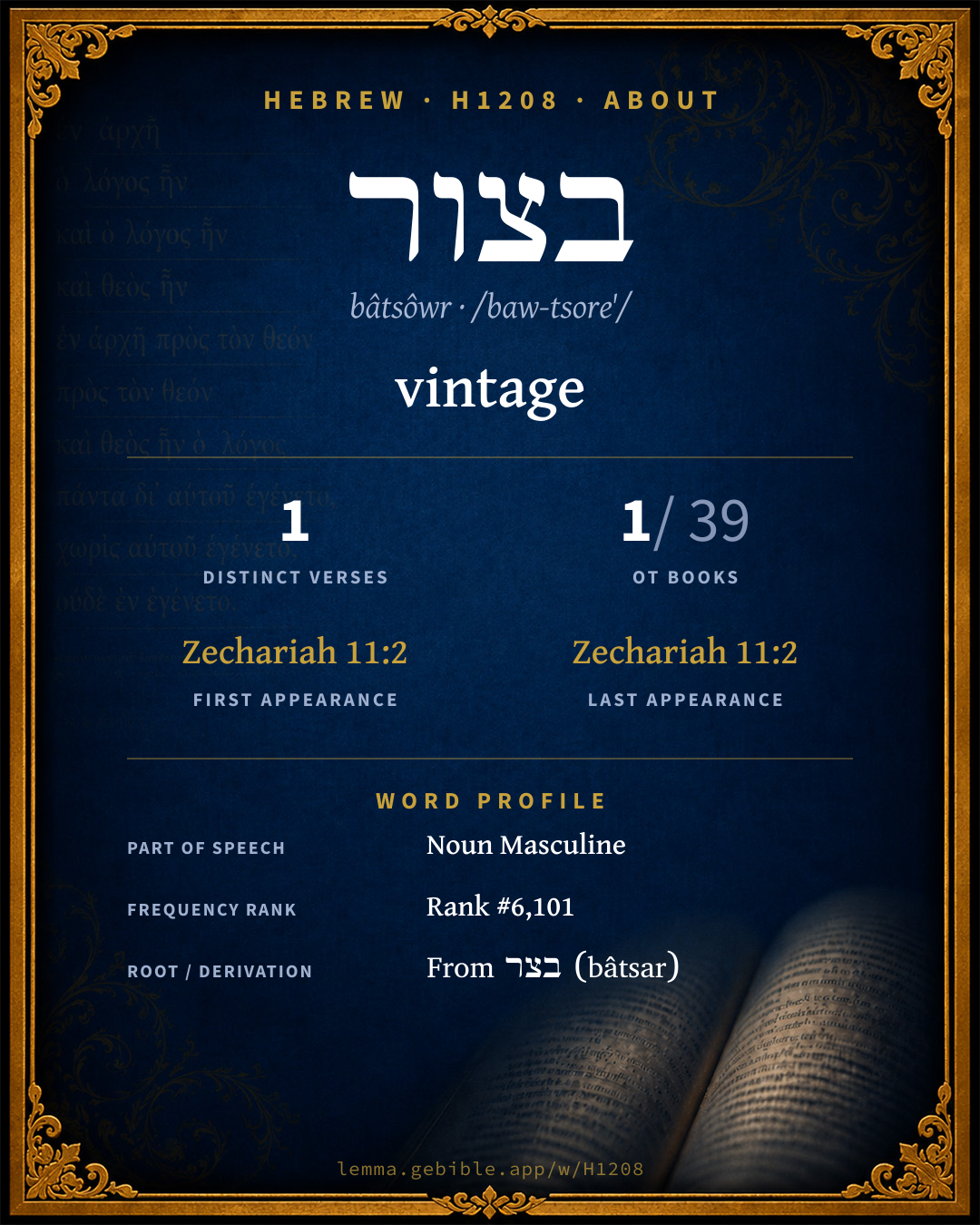
בָּצוֹר
vintage
‘vintage’ is one of 2 main senses fuller range ↓
Full lexicon entry — Brown-Driver-Briggs (BDB)
From Brown-Driver-Briggs (BDB)
Where this word appears
Grammar key — what these labels mean
Stem
- Qal
- The basic, simple active stem — the plain form of the verb (“he wrote”).
Form
- Participle Passive
- A verbal adjective expressing action received (“written”).
State
- Absolute
- The independent form of a noun, not bound to a following word.
Gender
- Masculine
- Grammatically masculine.
Number
- Singular
- One.
Every verse where H1208 appears — 1 distinct verse across 1 book. Click any verse to open its interlinear word-by-word view. Verse text shown in the World English Bible for context — . Each verse’s Hebrew form is shown with its reference; the English is not keyword-highlighted, since the data carries no word-level English alignment. Use “Compare translations” on any verse to read it across multiple English versions. This concordance covers the Hebrew Bible; Septuagint (Greek Old Testament) occurrences are not indexed here.
Zechariah 1 verse
About this entry
At a glance — auto-summarized from this page’s data, not written by a person. Every figure links to its source below. This summary describes the numbers; it doesn’t interpret them.
בצור (bâtsôwr) is a Hebrew noun most often rendered “vintage.” It occurs a mere 1 verse across Scripture. It clusters heavily in Zechariah, which alone accounts for 100% of its uses. Scripture uses it exactly once, at Zechariah 11:2. Its lexical range runs to 2 senses. The sections below give every sense, occurrence, and version rendering.
Gloss history
Strong's 1890 vs modern scholarship
About this word
Strong's H1208 catalogs a Hebrew word from the Hebrew Old Testament.
These counts are not copied from any lexicon or concordance. They are computed here, from the morphology-tagged Hebrew Old Testament. What Lemma adds →
- 1
- distinct verses
- The word appears in 1 distinct verse.
- 1 / 39
- OT books
- The word appears in 1 of 39 Old Testament books.
- #6,101
- by frequency
- Rank #6,101 (rank 6,101 of 8,640 Hebrew words by occurrence).
View all 1 occurrence in the concordance →
Most concentrated in
- Zechariah 1 verse 100%
By section of the Old Testament
By traditional corpus
Conventional, traditional groupings — biblical authorship is debated, so this is a traditional corpus grouping, not an authorship claim. Each share is this word’s portion of its verses in that division of the Hebrew canon. Each figure is a share of the word’s 1 distinct verse.
- Prophets (Nevi'im) 1 verse · 100%
How translations render this word
Counts come from each version’s own published word-to-Strong’s tagging or interlinear alignment — an approximate guide to how each version renders this word, not a word-level alignment the data otherwise carries. Because each total is that version’s own tagged count, the per-version totals vary from one another and need not match the appearance or distinct-verse counts above. These counts may also differ from a printed concordance because Lemma counts each distinctly tagged rendering and does not collapse phrase taggings into a single head-word total. This is a fixed set of word-tagged versions (KJV, ASV, BSB, ULT) and does not change with the reading translation you choose elsewhere. Each version’s license is shown beside its name below (and on Sources).
- King James Version: Vintage 1×
- American Standard Version: Strong 1×
- Berean Standard Bible: Dense 1×
- unfoldingWord Literal Text: Strong 1×
King James Version Public Domain
Renders H1208 across 1 tagged occurrence — most commonly:
American Standard Version Public Domain
Renders H1208 across 1 tagged occurrence — most commonly:
Berean Standard Bible Public Domain
Renders H1208 across 1 tagged occurrence — most commonly:
unfoldingWord Literal Text CC BY-SA 4.0
Renders H1208 across 1 tagged occurrence — most commonly:
Senses in BDB
The 2 senses BDB distinguishes for this word, in lexicon order (not ranked by frequency or importance). The full entry — with sub-senses — is in the Lexicon Entry tab.
- vintage
- (CLBL) inaccessible
Word origin
Derived from בצר (bâtsar) (H1219) — to fortify.
Jastrow Dictionary
A second Hebrew/Aramaic lexicon for comparison, covering Aramaic and post-biblical (Talmudic, Targumic, Midrashic) usage that the biblical-Hebrew BDB does not. Matched by lemma rather than by Strong’s number, so a lemma may carry more than one Jastrow headword (shown separately below), and the entries cover usage well beyond the Bible.
צוּר I
- rock. Ex. R. s. 15 ומצא שם צ׳ גדול and found there a large rock; a. e.—Pl. צוּרִים. Ib. כאן … על הצ׳ הללו here I will build the fortress, on these rocks.—[Tosef. Pes. VII, 13 שומרי צו׳ ed. Zuck., read: צִירִים, v. צִיר II).—Trnsf. [Protection,] the Lord; (in Agadah derived from יָצַר; v. next w.) the Creator. Ber. 5ᵇ (ref. to Job XVIII, 4) אין צ׳ אלא הקב"ה tsur means the Holy One &c. (with ref. to Deut. XXXII, 18). Lev. R. s. 23 (ref. to Deut. l. c.) התשתם … יוצר you have weakened the power of the Creator. Pirké d’R. El. ch. XLIII מרד בצ׳ עליון rebelled against the Rock on high; a. fr. e.g. Job 18:4
צוּר II
- [to turn,]
- 1. to tie around, wrap. B. Kam. 49ᵇ, a. e. וכי לָצוּר על פי וכ׳ does one want a document to tie around his flask?, i.e. does one care for a paper except for the value it represents? Koh. R. to VIII, 8 (ref. to Zech. XII, 1 ויצר) צָר רוח של אדם בגופו he tied up the spirit of man in his body, v. צָרַר; a. e. e.g. Zechariah 12:1
- 2. to form, shape. Sabb. 75ᵇ הצָר צורה בכלי he who draws a figure on a vessel. Ib. 103ᵇ עד שיָצוּר כולו until he has drawn the entire figure which he intended to draw. Gen. R. s. 7, beg.; Yalk. ib. 11 מדת בו"ד צר צורה … יכול לצור צורה במים (not מלך) a human being draws a design on land, can he draw a design in water?; Mekh. B’shall., Shir., s. 8. Lev. R. s. 14 לשני ציירין זה צר דמותו וכ׳ like two painters, one paints the likeness of one &c.; a. fr.—Zeb. 94ᵃ, v. infra.
- 3. (with על) to surround, besiege. Sifré Deut. 203 אין צָרִים על עיר וכ׳ we must not begin the siege of a town later than three days before the Sabbath; a. e.—[
- 4. (cmp. זוּר) to press, v. צִיר I.]
- to draw, paint; to embroider. Zeb. 94ᵃ בגד עליו לצַיְּירוֹ … Rashi (ed. עליה לצוּרָהּ; v. Rabb. D. S. a. l. note 1) a garment which one intends to embroider.—Part. pass. מְצוּיָּיר, מְצוּיָּר; f. מְצוּיֶּירֶת; pl. מְצוּיָּירִים, מְצוּיָּירִין; מְצוּיָּירוֹת, מְצוּיָּר׳. Num. R. s. 12; Cant. R. to VI, 4 (not צוויינות); Yalk. Num. 713 (not מצויינות), v. צָב I.
צוּר
- 1. to tie around. Snh. 48ᵃ; Ber. 23ᵇ דאזמניה למֵיצַר … צָר וכ׳ which he designated to wrap T’fillin in; if he did so &c. (v. צְרַר).—Part. צָאֵיר צָיֵיר. Y. Ber. IV, 7ᶜ top הוה צ׳ גולתיה וכ׳ tied Rab’s cloak up &c.; Y. Taan. IV, 67ᶜ.—Part. pass. צָיִיר, צָיִר, צָאִיר. Targ. Job XLI, 7.—Ḥull. 105ᵇ כל מילי דצייר וחתים whatever is tied up or sealed. B. Mets. 24ᵇ אשכח … דצָיְירֵי בסדינא found four Zuzin tied up in a sheet. Lev. R. s. 6; a. fr.
- 2. to draw, shape, design. Targ. Am. IV, 13 דצר ed. Lag. (ed. Wil. דִּיצַר, v. יְצַר). Targ. I Kings VII, 15; a. fr.—Part. pass. as ab. Targ. Esth. VIII, 15; a. e.
- 3. (with על) to besiege. Targ. Deut. II, 19. Targ. O. ib. 9 (Y. תעיק; h. text תצר). Targ. O. ib. XX, 12; 19. Targ. I Sam. XXIII, 8 (ed. Lag. לימצר, read למיצר); a. fr.—Gitt. 56ᵃ צר עלה וכ׳ he besieged it (Jerusalem) three years; a. e.
- 1. to form, shape, paint, engrave. Targ. Job X, 8. Targ. Jer. XXII, 14; a. e.—Part. pass. מְצַיַּיר, מְצַיַּר. Targ. O. Ex. XXV, 33, sq. (h. text משקד׳). Targ. Ez. XXIII, 14 (h. text מחקה). Targ. Y. I Lev. XXVI, 1 (h. text משכית).—Gitt. 36ᵃ; 87ᵇ, v. כַּוְורָא, חֲרוּתָא, מָכוּתָא.
- 2. to tie up, fold under. Men. 37ᵇ האי מאן דצַיְּירֵּיה לגלימיה Rashi (ed. דצרייה; Ar. דצארי) he who folds his cloak (and puts the show-fringes on the fold).
- to be embroidered, shaped. Targ. Ps. CXXXIX, 15 (ed. Wil. אצטיד׳, corr. acc.; h. text רקמ׳).—[Ithpe. אִתְצִיר, אִתְצַר, v. יְצַר.]
צוּר III
- (preced. wds.) [twist,] צ׳ דקל band made of palm-bark (cmp. נֵצֶר III).—Pl. constr. צוּרֵי. Sabb. 90ᵇ צ׳ דקל שתים (Ms. M. צַוָּארֵי; Ar. צָרֵי) he who carries palm-bands abroad (on the Sabbath), has transgressed the law by carrying two strips.
צוּר ²
- —Pl. צוּרֵי. Ab. Zar. 75ᵃ bot. חבלי דצ׳ (Ar. צרי) ropes made of palm-bands.
צוֹר
- (b. h.) pr. n. pl. Tyre in Phœnicia. Gen. R. s. 61 end כל צ׳ … מלא בצ׳ מדינה וכ׳ wherever in Scripture Tsor is written plene, the city of Tyre is meant, where it is defective (צר enemy), Rome is meant; Tanḥ. Bo 4; Pesik. R. s. 17. Y. B. Kam. IV, 4ᵇ סולמייא דצ׳; Y. Ab. Zar. I, 40ᵃ bot., v. סוּלָּם, סוּלָּמָא; a. fr.—Denom. צוֹרִי, צוֹרִיִּי. Bekh. VIII, 7, a. e. מנה צ׳, v. מָנֶה. Yalk. Deut. 821 סייף צוריי a Tyrian sword (Tanḥ. Vaëtḥ. 6 הנדיי). Maasr. III, 5, v. חָצֵר; a. fr.—Chald. צוֹרָאָה; pl. צוֹרָאֵי, צוֹרָיֵיא. Y. Sabb. II, 4ᶜ bot.; Y. Meg. II, 73ᵇ bot.
צַוַּר
- , v. צַיַּאר
A Dictionary of the Targumim, the Talmud Babli and Yerushalmi, and the Midrashic Literature (Marcus Jastrow; London, Luzac, 1903) — Public Domain. Digitized via Sefaria. Digitized via Sefaria. Full attribution on Sources.
Same root — word family
Other BDB entries built from the same root as H1208, grouped by Strong’s listed origin. These share a root / origin per the lexicon — not necessarily a shared meaning. Each links to that word’s own entry.
Derives from
Shares the same root
- בציר bâtsîyr H1210 vintage
- בצר betser H1220 gold
- בצרה botsrâh H1223 sheepfold
- בצרון bitstsârôwn H1225 stronghold
- בצרת batstsôreth H1226 drought
- מבצר mibtsâr H4013 fortress
Compare all same-root words → Showing 4 of 8 — not the complete family. They share a root, not necessarily a meaning.
Septuagint verse parallels
This word appears in 1 verse that also exists in the Greek Old Testament (Septuagint), out of the 1 Hebrew verse it occurs in. You can read those verses in Greek by switching the Old Testament edition to the Septuagint.
Read these verses in the Septuagint
This is a verse-level parallel only — the same verses exist in both the Hebrew and Greek Old Testaments. No word-level Hebrew↔Greek correspondence is claimed: the data carries no such alignment, so no Greek word is shown as this Hebrew word’s translation. Coverage is not total — the Septuagint omits the deuterocanon and renumbers the Psalms, so some Hebrew verses have no direct Greek parallel.