Nahum 3:14

Hebrew (Westminster Leningrad Codex) Nahum 3:14 appears in the Hebrew Old Testament. The text above is from the Westminster Leningrad Codex. Each word links to its Strong’s number, a concise gloss, and parsing drawn from the Open Scriptures Hebrew Bible morphology. Click any word for its full Brown-Driver-Briggs (BDB) entry.
Download image
Cite this verse

Nahum 3:14 (World English Bible). Public Domain. Lemma interlinear Bible study tool, https://lemma.gebible.app/v/nahum/3/14.

Show BibTeX & RIS
BibTeX
RIS
English Translation
Draw water for the siege. Strengthen your fortresses. Go into the clay, and tread the mortar. Make the brick kiln strong.
World English Bible · Public Domain
Download a study sheet

One document with this verse’s original text, its word-by-word gloss line, the meaning frame, cross-references with their text, attributed commentary, and full source and license credits — printable, and it pastes into notes with its structure intact.

This verse Autodidact and up

Study sheet (.html) Plain text (.txt)

A passage Seminary Student

Up to 50 verses in one chapter. A passage sheet keeps up to 6 commentary sources and 12 cross-references per verse, in the order this page ranks them, and says so on the sheet whenever that leaves anything out. Ask for a single verse and you get the Autodidact verse sheet above.

Everything on this page stays free to read, with no account — the sheet is a download of what is already on screen, not access to it.

Want to remove ads? Support Godless Engineer
Compare translations 3

The same verse in 3 English versions, stacked beneath the original-language interlinear above. Click any original word for its lexicon entry.

Each is an independent rendering of the whole verse — the interlinear is not word-aligned to these translations.

Highlighted words mark where these versions differ — a whole-verse word diff, not a word-by-word alignment.

  • World English Bible Public Domain
    Draw water for the siege. Strengthen your fortresses. Go into the clay, and tread the mortar. Make the brick kiln strong.
  • King James Version Public Domain
    Draw thee waters for the siege, fortify thy strong holds: go into clay, and tread the morter, make strong the brickkiln.
  • unfoldingWord Literal Text CC BY-SA 4.0
    Draw siege water for yourself; strengthen your fortresses; go into the clay and tread in the mortar; pick up the brick mold.

unfoldingWord Literal Text — © unfoldingWord, licensed CC BY-SA 4.0. Word-aligned USFM3 via Door43 (git.door43.org/unfoldingWord/en_ult).

Versions to compare (up to 4)

3 of 4 selected

Show all 18 translations

Every available English version of this verse, each an independent rendering of the whole verse.

  • World English Bible Public Domain
    Draw water for the siege. Strengthen your fortresses. Go into the clay, and tread the mortar. Make the brick kiln strong.
  • Berean Standard Bible Public Domain
    Draw your water for the siege; strengthen your fortresses. Work the clay and tread the mortar; repair the brick kiln!
  • Majority Standard Bible Public Domain
    Draw your water for the siege; strengthen your fortresses. Work the clay and tread the mortar; repair the brick kiln!
  • King James Version Public Domain
    Draw thee waters for the siege, fortify thy strong holds: go into clay, and tread the morter, make strong the brickkiln.
  • American Standard Version (1901) Public Domain
    Draw thee water for the siege; strengthen thy fortresses; go into the clay, and tread the mortar; make strong the brickkiln.
  • Revised Version (1885) Public Domain
    Draw thee water for the siege, strengthen thy fortresses: go into the clay, and tread the mortar, make strong the brickkiln.
  • Geneva Bible (1599) Public Domain
    Drawe thee waters for the siege: fortifie thy strong holdes: go into the clay, and temper the morter: make strong bricke.
  • Douay-Rheims (1899) Public Domain
    Draw thee water for the siege, build up thy bulwarks: go into the clay, and tread, work it and make brick.
  • Young's Literal Translation Public Domain
    Waters of a siege draw for thyself, Strengthen thy fortresses, Enter into mire, and tread on clay, Make strong a brick-kiln.
  • Literal Standard Version CC BY-SA 4.0
    Waters of a siege draw for yourself, || Strengthen your fortresses, || Enter into mire, and tread on clay, || Make strong a brick-kiln.
  • Unlocked Literal Bible CC BY-SA 4.0
    Go draw water for the siege; strengthen your fortresses; go into the clay and tread the mortar; pick up the molds for the bricks.
  • unfoldingWord Literal Text CC BY-SA 4.0
    Draw siege water for yourself; strengthen your fortresses; go into the clay and tread in the mortar; pick up the brick mold.
  • Darby Bible Public Domain
    Draw thee water for the siege, strengthen thy fortresses; go into the clay, and tread the mortar, make strong the brick-kiln.
  • World Messianic Bible Public Domain
    Draw water for the siege. Strengthen your fortresses. Go into the clay, and tread the mortar. Make the brick kiln strong.
  • Webster's Bible Public Domain
    Draw thee waters for the siege, fortify thy strong holds: go into clay, and tread the mortar, make strong the brick-kiln.
  • Free Bible Version CC BY-SA 4.0
    Store water to prepare for a siege! Strengthen your fortresses! Go to the clay pits to tread it well, mix the cement, get your brick molds ready!
  • Bible in Basic English Public Domain
    Get water for the time when you are shut in, make strong your towns: go into the potter's earth, stamping it down with your feet, make strong the brickworks.
  • JPS Tanakh (1917) Public Domain
    Draw thee water for the siege, strengthen thy fortresses; go into the clay, and tread the mortar, lay hold of the brickmould.

Literal Standard Version (2020), Covenant Press — licensed CC BY-SA 4.0. Text via the HelloAO Bible API (eBible.org). Unlocked Literal Bible (unfoldingWord) — licensed CC BY-SA 4.0. Text via the HelloAO Bible API (eBible.org). unfoldingWord Literal Text — © unfoldingWord, licensed CC BY-SA 4.0. Word-aligned USFM3 via Door43 (git.door43.org/unfoldingWord/en_ult). Free Bible Version, Dr. Jonathan Gallagher — licensed CC BY-SA 4.0. Text via the HelloAO Bible API (eBible.org).

Word by word

More ways to search: Search by grammar → Find every occurrence → Compare this word →

Practice this passage: Drill this verse → Learn its vocabulary →

מַלְבֵּֽן
malbên
H4404
“brick mold”
Noun, Common, Masculine, Singular, Absolute
Part of Speech
Noun
Type
Common
Gender
Masculine
Number
Singular
State
Absolute
Full BDB Definition

Origin: from H3835 (denominative)

TWOT: 1074i

brick mold, brick kiln, quadrangle - brick mould, brick kiln - quadrangle
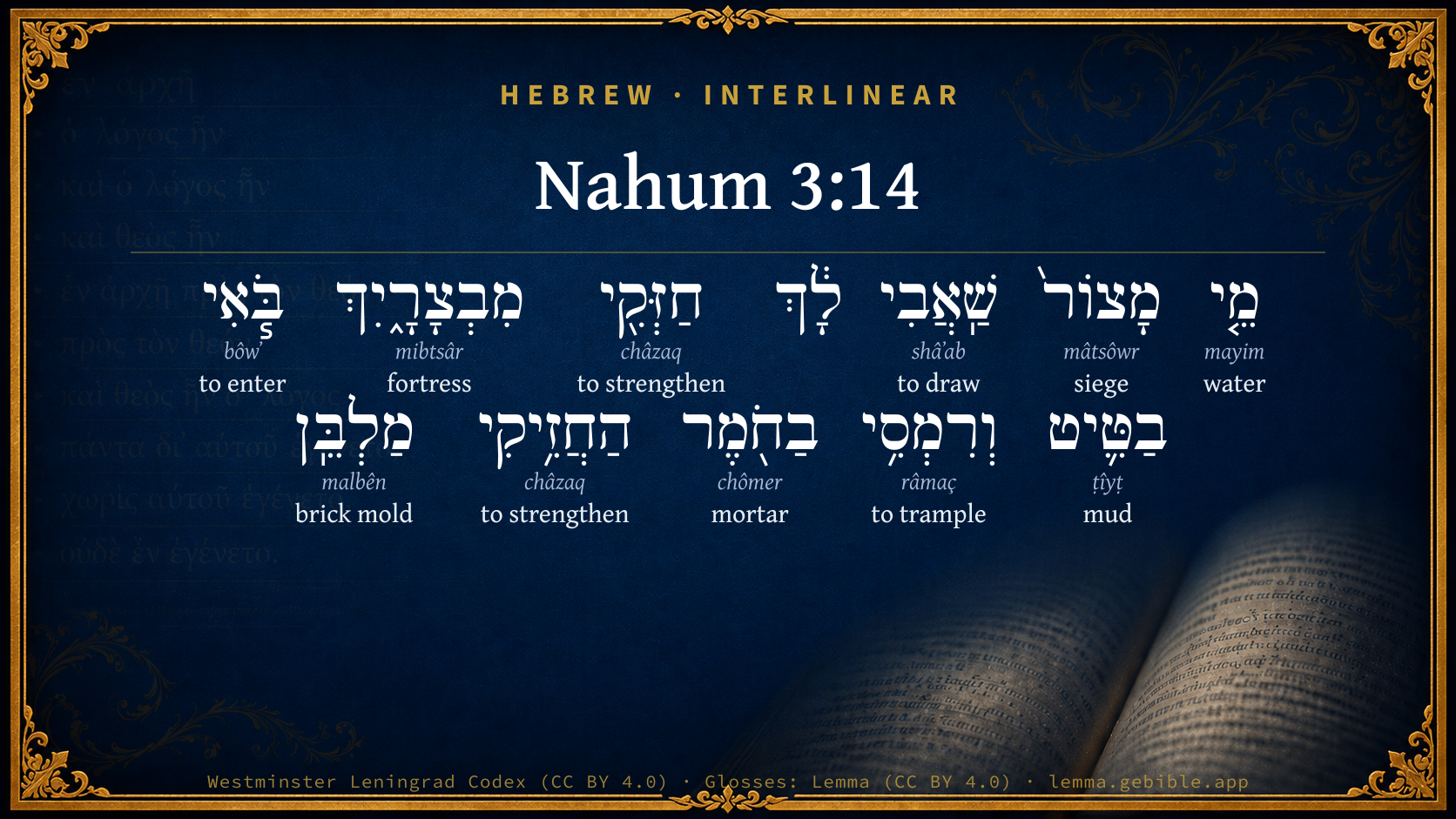
  1. מֵ֤י mayim H4325 “water(s) of” Noun, Common, Masculine, Plural, Construct
  2. מָצוֹר֙ mâtsôwr H4692 “siege” Noun, Common, Masculine, Singular, Absolute
  3. שַֽׁאֲבִי shâʼab H7579 “draw” Verb, Qal, Imperative, 2nd Person, Feminine, Singular
  4. חַזְּקִ֖י châzaq H2388 “strengthen” Verb, Piel, Imperative, 2nd Person, Feminine, Singular
  5. מִבְצָרָ֑יִךְ mibtsâr H4013 “fortresses · your” Noun, Common, Masculine, Plural, Construct + Suffix, Personal, 2nd Person, Feminine, Singular
  6. בֹּ֧אִי bôwʼ H935 “enter” Verb, Qal, Imperative, 2nd Person, Feminine, Singular
  7. בַטִּ֛יט ṭîyṭ H2916 “in/at the · mud” Preposition, Determined + Noun, Common, Masculine, Singular, Absolute
  8. וְרִמְסִ֥י râmaç H7429 “and · trample” Conjunction + Verb, Qal, Imperative, 2nd Person, Feminine, Singular
  9. בַחֹ֖מֶר chômer H2563 “in/at the · mortar” Preposition, Determined + Noun, Common, Masculine, Singular, Absolute
  10. הַחֲזִ֥יקִי châzaq H2388 “strengthen” Verb, Hiphil, Imperative, 2nd Person, Feminine, Singular

About this verse

These counts appear in no published source. They are computed here, from the morphology-tagged text and Lemma’s own curated glosses. What Lemma adds →

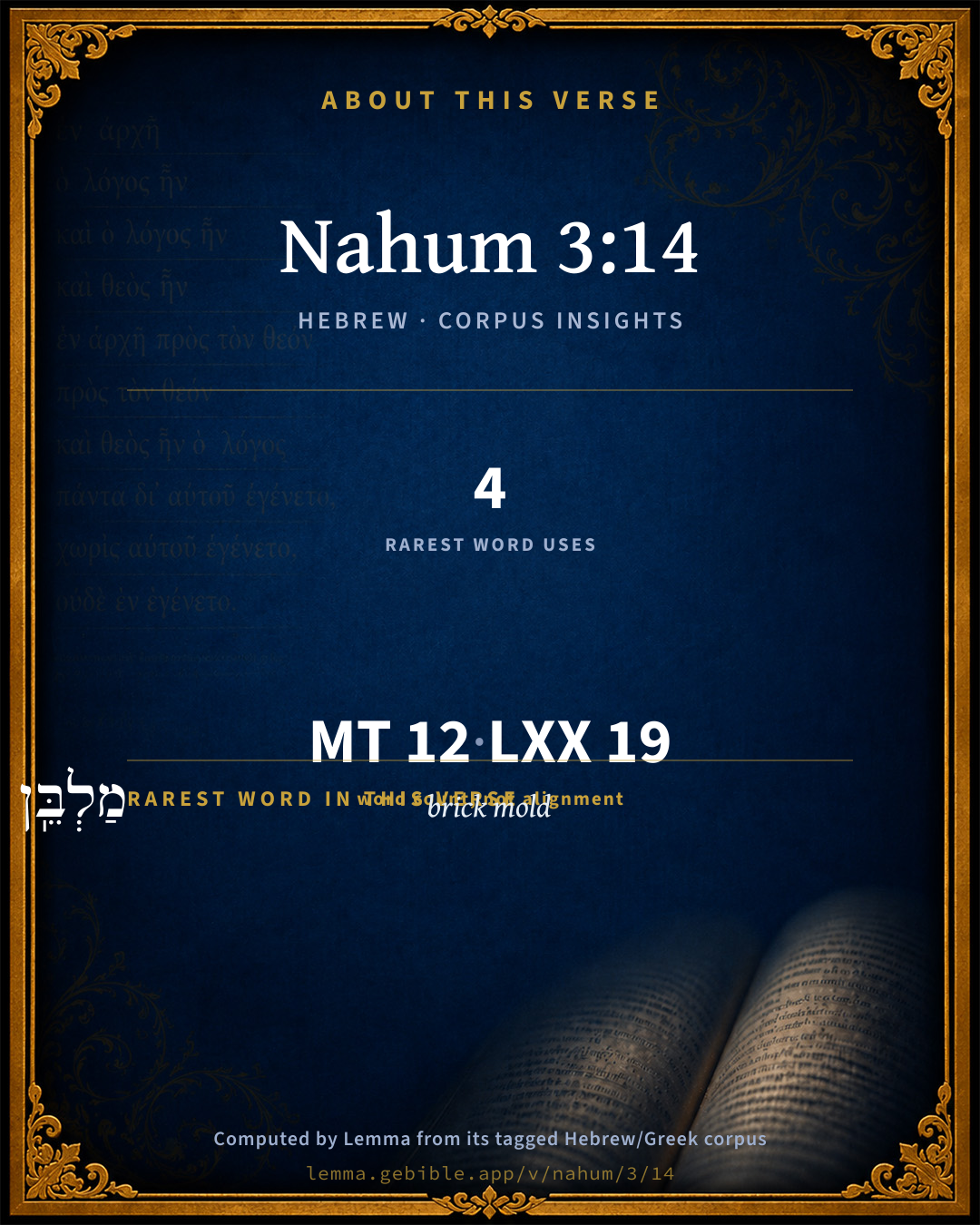
12
words
10
distinct lemmas
Prophets
section

Notable vocabulary

The rarest word here is מַלְבֵּֽן brick mold H4404 — appearing just 4 times in the whole Hebrew Bible.

Shared distinctive vocabulary

מַלְבֵּֽן brick mold H4404 occurs in 3 verses of the Hebrew Bible. Also found in:

Grammatical profile

  • 5 verbs
  • 6 nouns
  • 1 preposition

Verb forms

  • שַֽׁאֲבִי Qal · Imperative
  • חַזְּקִ֖י Piel · Imperative
  • בֹּ֧אִי Qal · Imperative
  • וְרִמְסִ֥י Qal · Imperative
  • הַחֲזִ֥יקִי Hiphil · Imperative

Repetition

A word recurs within this verse — often emphatic in Hebrew:

  • חַזְּקִ֖י to strengthen H2388 ×2

Hebrew & Septuagint length

In English translation the verse runs 21 words from the Hebrew and 28 from the Septuagint (LXX English) — closely comparable.

A rough comparison of the two English renderings, which tokenize alike — not a word-level alignment.

Word counts can differ between the Hebrew and the Greek without any difference in meaning — e.g. the Hebrew direct-object marker אֵת has no separate Greek word, and Greek often adds the article ὁ.

In the original languages it is 12 Hebrew tokens and 19 Greek tokens — but the two are counted differently (Hebrew bundles its prefixes and suffixes into one token; the Greek is in lemma form), so that isn’t a like-for-like length.

Cross-references

9

Topical passages linked to Nahum 3:14 in the Treasury of Scripture Knowledge — connected by theme and wording, ordered by reader-vote popularity; previews shown in the World English Bible.

  • 2 Chronicles 32:3–4 he took counsel with his princes and his mighty men to stop the waters of the springs which were outside of the city; and they helped him.
  • Nahum 2:1 He who dashes in pieces has come up against you. Keep the fortress! Watch the way! Strengthen your loins! Fortify your power mightily!
  • Jeremiah 46:3–4 Prepare you the buckler and shield, and draw near to battle.
  • 2 Chronicles 32:11 Does not Hezekiah persuade you, to give you over to die by famine and by thirst, saying, Yahweh our God will deliver us out of the hand of the king of Assyria?
  • Isaiah 8:9 Make an uproar, O you peoples, and be broken in pieces! And give ear, all you of far countries: gird yourselves, and be broken in pieces! Gird yourselves, and be broken in pieces!
  • Isaiah 22:9–11 You saw the breaches of the city of David, that they were many; and you gathered together the waters of the lower pool;
  • Isaiah 37:25 I have dug and drunk water, and with the sole of my feet will I dry up all the rivers of Egypt.
  • Jeremiah 46:9 Go up, you horses; and rage, you chariots; and let the mighty men go forth: Cush and Put, who handle the shield; and the Ludim, who handle and bend the bow.
  • Joel 3:9–11 Proclaim this among the nations: Prepare war. Stir up the mighty men. Let all the warriors draw near. Let them come up.

Cross-references courtesy of OpenBible.info (CC BY 4.0).

Hebrew and Greek witnesses Masoretic Hebrew ↔ Greek Septuagint

The same verse in the two great witnesses to the Old Testament, shown verse-for-verse.

These are two independent witnesses, not word-aligned to each other, and the Septuagint is shown in lemma (dictionary) form.

Hebrew Nahum 3:14 Masoretic · Westminster Leningrad Codex

מֵ֤י מָצוֹר֙ שַֽׁאֲבִי לָ֔ךְ חַזְּקִ֖י מִבְצָרָ֑יִךְ בֹּ֧אִי בַטִּ֛יט וְרִמְסִ֥י בַחֹ֖מֶר הַחֲזִ֥יקִי מַלְבֵּֽן

Draw water for the siege. Strengthen your fortresses. Go into the clay, and tread the mortar. Make the brick kiln strong.

World English Bible · Public Domain

Greek LXX Nahum 3:14 Septuagint · lemma form

ὕδωρ περιοχή ἐπισπάω σεαυτοῦ καί κατακρατέω ὁ ὀχύρωμα σύ ἐνβαίνω εἰς πηλός καί συνπάσχω ἐν ἄχυρον κατακρατέω ὑπέρ πλίνθος

Draw you water for a siege, and well secure your strongholds: enter into the clay, and be you trodden in the chaff, make the fortifications stronger than brick.

LXX2012 (modern English Septuagint) · Public Domain

On this verse, Keil & Delitzsch discusses the Septuagint’s reading. Read the note in Commentary ↓

Hebrew: Westminster Leningrad Codex (CC BY 4.0). Greek: Septuagint (public domain); English from LXX2012 (modern English Septuagint) (Public Domain). How the Septuagint differs from the Hebrew →

Targum (Aramaic paraphrase)

1

The Targum is the ancient Jewish Aramaic paraphrase of the Hebrew Scriptures — an interpretive translation, not the Hebrew text itself. Onkelos (literal) and Pseudo-Jonathan (expansive) render the Torah, and Jonathan the Prophets. Coverage is partial: where no permissively-licensed English translation exists for a verse, only the Aramaic is shown. This is verse-level text, not a word-by-word alignment to the Hebrew.

  1. Targum Jonathan Prophets (Joshua–Malachi)
    מַיָא בִצְיָרָא כְּנוּשִׁי לְגַוִיךְ תַּקְפִי כְּרַכֵּיךְ אַסְגָא מָרְוָא וְשַׁעְבִּידִי בְטִינָא אַתְקִיפִי בִנְיָנֵיךְ:

    (no public-domain English translation for this verse)

    Targum Jonathan — Aramaic: “Mikraot Gedolot” (public domain). English: “Sefaria Community Translation” (CC0 1.0 (public-domain dedication)); “London "Chaldee Paraphrase," 1871” (public domain). Text via Sefaria.

Commentary

Notes on Nahum 3:14 from classic Christian and Jewish commentators (each source and its license shown beneath its notes). The classic Christian expositions comment on the surrounding passage and are grouped to its opening verse, so a note may address several verses; the Jewish commentaries on the Tanakh (Rashi and others) are per-verse, so they appear only where the commentator wrote on this verse.

Lemma curates 59 commentaries, every one of them public domain or Creative Commons licensed, each selected and text-cleaned for this edition rather than reprinted as found. About our sources →

Trapp's Complete Commentary

John Trapp

Nah 3:14 Draw thee waters for the siege, fortify thy strong holds: go into clay, and tread the morter, make strong the brickkiln.

Ver. 14. Draw thee waters for the siege, &c.] A most bitter and biting taunt, or mock ( sarcasmus), whereby the prophet laugheth to scorn the fortifications of the Ninevites and their diligence and providence in defending themselves, which shall nothing avail them, because God will curse their enterprises, Psa 127:1-2 : see the like sarcasm Nah 2:1. In those eastern countries there was a great scarcity of water. Draw thee good store, for the better holding out the siege; for if water fail thee thou must needs yield.

Fortify thy strong holds] But they shall soon fail thee, Nah 3:12, as the tower of Shechem did those that fled to it, and as the strong hold of Zion did the braving Jebusites, 2Sa 5:7. If God be against us no other help can relieve us. Brass and iron can fence a man against a sword, but not against fire.

Go into clay, and tread the morter] viz. To make brick of. For in maritime and moorish places, where stones are not to be had, they used to wall their cities and make their munitions with brick. This proud Nineveh is commanded here to do, by an irony, as Theophylact noteth; but she shall but labour in the very fire, take pains to no purpose; for God will destroy the works of her hands, Ecc 5:6.

Make strong the brickkiln] Or repair it, that all may be ready. And these things they did, no doubt, very diligently; neither were they for that to be blamed. But this was their fault, as it was also the fault of the Jews in like case, Isa 22:8-11, that "they looked not to the Maker of all, neither had respect unto him that fashioned it long ago." This, if they had done seriously, though they had made less preparation, the enemy might have been daunted and dismayed as much as that Duke of Saxony was, who, having proclaimed war against the Bishop of Magdeburg, and understanding by his intelligencers that the bishop levied no army, made no preparation, but only gave out that he would commit his cause to God, who would not fail to take up arms for him. Insaniat alius, said the duke, It were a mad prank for me to make war upon such a one that trusteth in God to right and revenge him. Let who will meddle with such a man: I will not (Bucholcer, Chronol.).

John Trapp, A Commentary or Exposition upon All the Books of the Old and New Testament (1647–1656) — public domain. Text from a community e-Sword module.

Joseph Benson's Commentary

Nah 3:14-15. Draw thee waters for the siege — Fill all thy cisterns, and draw the waters into the ditches. Go into the clay, &c. — Set thy brickmakers on work to prepare store of materials for thy fortifications. There shall the fire devour thee — After all that thou canst do, the fire of the enemy shall reach even thy inmost works, and their darts shall drive off the defenders of them. The sword shall cut thee off — The Hebrew word, which we render here sword, properly signifies any kind of dart; and this seems to be spoken of the fire, and missile weapons which the enemy should throw, in order to burn their inner works, or drive them from off them. It shall eat thee up like the canker-worm — The sword of the enemy shall destroy thee, as the canker-worm eats up the fruits of the earth. Or, as some interpret the expression, Thou shalt be devoured as the cankerworm is eaten up; because the Assyrians were wont to eat these kinds of worms, which were a species of locusts, which are still eaten in the eastern countries. Make thyself many as the canker-worm — Though thou multiply thine armies like locusts, or caterpillars, yet the enemy shall destroy them.

Joseph Benson's Commentary on the Old and New Testaments (1811–1818) — public domain. Text from a community e-Sword module.

The Preacher's Complete Homiletical Commentary

Joseph S. Exell (gen. ed.)

CRITICAL NOTES.]

Nah_3:14. Draw] for a long-continued siege, improve fortifications, put the kiln in order for burning bricks.

Nah_3:15. Make] Multiply thyself, like the largest and most formidable locusts.

Nah_3:16.] Traders and merchants increased innumerable as the stars, but fire and sword would devour all.

Nah_3:17. Crowned] rulers or vassal princes which encamp in the cold and flee away in the sun. “The wings of locusts become stiffened in the cold; but as soon as the warm rays of the sun break through the clouds, they recover animation and fly away.”

Nah_3:18. Shepherds] Princes and great men, royal counsellors and deputies upon whom the government devolved. Sleep] in death. People] The flock scattered and perished (cf. Num_27:17; 1Ki_22:17).

THE LAST HOPE DESTROYED.—Nah_3:14-18

The city is laden with guilt, but relies still upon its fortifications and numerical strength of population. The last prop is cut down. There is no hope left. Though provisioned within and strongly defended without, Nineveh must fall, and great will be the fall.

I. Inward provisions will waste away. “Draw the waters for the siege, go into clay, and tread the mortar,” &c. Water, necessary for siege and the support of life, must be procured. She must furnish herself with all manner of provisions to keep her from surrender or starvation. Clay must be prepared, and the kilns made ready for repairing and building strongholds. The conquering nation were to toil and do the work of slaves. But all would be in vain. The fire would devour her bulwarks, and the sword her population. Swift will be the ruin of all who number houses and fortify walls, “but have not looked to the maker thereof, nor have not respected him that fashioned them” (Isa_22:10-11).

II. Outward defences will be destroyed. “There shall the fire devour thee.” There, in the very centre of their toil and vast preparations, where the greatest security was relied upon, was the devouring fire. What was considered strongest was destroyed with ease, like locusts eating up the tender grass. Singly, and as a whole, the judgments of God will find men out. “Evil shall hunt the violent man to overthrow him.”

III. Immense numbers will fall away. “Make thyself many as the cankerworm.” Make thyself numerous and oppressive as locusts, gather from all quarters men to help, and seek to become mighty in multitudes, yet the foe will consume like creatures which lick up all before them.

1. Wealthy merchants will not defend. Though multiplied above the stars of heaven, and trafficking in despotism, they cannot lay up in store against the wrath of God. Money is the sinews of war, but will not shelter from the consequences of sin. Prosperity suddenly changes into adversity. “The cankerworm spoileth and fleeth away.”

2. Warlike soldiers will not defend. The captains, confederates, and commanders of the army, will melt away, perish like dew before the rising sun. They are but grasshoppers, mighty as they are. “All flesh is grass.”

3. Ruling princes will not defend. “Thy crowned heads are as the locusts,” &c. They subside into quietness in the calamity of the night, and continue their flight in the morning. They are “torpid in the cold and fly in the heat.” Officers of state and subordinate chiefs will be completely annihilated. “Their place is not known where they are.”

4. Great counsellors will not defend. The shepherds slumber in listlessness and excess; sink into torpor and stupidity. The nobles and greatest politicians were benighted and bereft of wisdom. “At thy rebuke, O God of Jacob, both the chariot and horse are cast into a dead sleep.” Valiant men would dwell in the dust, and be buried in silence. God can soon strip a nation of its great ones, and lay its honour in the dust. Where are they when he deals with them? “Though his excellency mount up to the heavens, and his head reach unto the clouds, yet he shall perish for ever: they which have seen him shall say, Where is he? He shall fly away, as a dream, and shall not be found: neither shall his place any more behold him.”

HOMILETIC HINTS AND SUGGESTIONS

Nah_3:14. Clay. Mankind still, with mire and clay, build themselves Babels. They go into clay, and become themselves earthly like the mire they steep themselves in. They make themselves strong, as though they thought that their houses would continue for ever. God’s wrath descends, and eats up like a cankerworm [Pusey].

Nah_3:14-15.

1. Man by his endeavours cannot avert the judgments of God. Nineveh prepared and provisioned herself, but fell after all.

2. Man may presume upon carnal means until he is ruined. Lawful means are necessary, but we must not rely upon them for security. If God be against us no other help can relieve. “Running into God is the only best way to escape him. As to close and get in with him that would strike you doth avoid the blow” [Trapp].

Nah_3:15. The prophet gives in three words the whole history of Nineveh, its beginning and its end. He had before foretold its destruction, though it should be oppressive as the locust: he had spoken of its commercial wealth; he adds to this, that other source of its wealth, its despoiling warfares and their issue. The heathen conqueror rehearsed his victory, “I came, saw, conquered.” The prophet goes farther, as the issue of all human conquest, “I disappeared” [Pusey].

Nah_3:15-16.

1. The mightiest of earth are as locusts before him (cf. Isa_40:22).

2. The more obstinately they resist, the more irresistible is the judgment.

3. The larger and more numerous they are, the more utterly will they be destroyed [Lange].

Nah_3:17. Cowardly rulers.

1. Sheltering for advantage. In the cold day, camping in the hedges, but fleeing away in sunshine.

2. Living only to eat. They are wasters merely, like locusts devouring everything before them.

3. Deserting when they should help, an emblem this of the world’s friendship. Men get what they can out of others, and then bid them farewell in distress. Treacherous friendships abound everywhere.

Dust. All flesh perishes, but the word of God endures for ever [Lange].

HOMILETICS

SLUMBERING SHEPHERDS AND SCATTERED FLOCKS.—Nah_3:18

I. Shepherds unworthy in their character. They are destitute of counsel; base and idle; careful only for their own profit and safety, and not for the interests of the flock. Efficiency depends upon character in the ministry. Good shepherds care for the sheep, feed and defend them. “The hireling fleeth because he is an hireling, and careth not for the sheep.”

II. Shepherds negligent in their duty. They sleep and consult their own ease, instead of defending their city and country. Indolence, self-indulgence, and fickleness doth eat like a canker into the ministry of some. Our duties demand entire devotedness of mind and heart. Ministers desecrate their high calling, when they enter it for ease or commercial advantage. Diligence is required in study, visitation, and preaching. “Woe to the idol-shepherd (one wishing to be his own idol and the idol of his flock) that leaveth the flock! the sword shall be upon his arm, and upon his right eye.”

III. Shepherds cursed in their efforts. The flock is exposed and scattered, like sheep upon the mountains. They have none to care for them, consequently get lost. They are lost for ever. “No man gathereth them.” Terrible ruin! Fearful responsibility somewhere!

“I am shepherd to another man,

And do not sheer the fleece that I graze” [Shakspeare].

ILLUSTRATIONS TO CHAPTER 3

Nah_3:11-19. Nahum’s prophecy of the future destruction of Nineveh was fulfilled by the Medes and Babylonians (cf. ch. Nah_2:1); and according to his prediction, the vast power of Nineveh completely vanished, and its glory was utterly eclipsed, so that in the year B. C. 401, Xenophon passed by the site without learning its name (Xen. Anab. iii. 4–7). Four hundred years afterwards a small fortress was standing on the site, to guard the passsage of the river Tigris (Tacitus, Ann. xii. 13), and opposite to it, on the west bank of the Tigris, has arisen the city of Mosul. In the year 1776, Niebuhr visited the spot, and supposed that what were the heaps of ruins of Nineveh, were natural undulations in the soil (See Rawlinson, i. 326). In more modern times it has been explored by Botta, the French Consul (in 1842), and more recently by Layard and others, who have brought to light those gigantic remains of palaces, statues, and other monuments which testify to the ancient grandeur of Nineveh, and those annalistic inscriptions which confirm the veracity of the prophecies of Nahum and of Isaiah, and of the historical narrative of Holy Scripture: and bear witness to the Divine foreknowledge of the Holy Ghost who speaks in it; to whom with the Father and the Son, Three Persons and one God, be honour and glory now and for evermore. Amen [Wordsworth].

The Preacher's Complete Homiletical Commentary (gen. ed. Joseph S. Exell; Funk & Wagnalls, c. 1892) — public domain (pre-1929). A full-Bible homiletical/sermon-outline anthology covering 65 of 66 books (2 John is absent from the source module). Text from a community e-Sword module.

Keil & Delitzsch

C. F. Keil & F. Delitzsch

In conclusion, the prophet takes away from the city so heavily laden with guilt the last prop to its hope, - namely, reliance upon its fortifications, and the numerical strength of its population. - Nah 3:14. "Draw thyself water for the siege! Make thy castles strong! tread in the mire, and stamp in the clay! prepare the brick-kiln! Nah 3:15. There will the fire devour thee, the sword destroy thee, devour thee like the lickers. Be in great multitude like the lickers, be in great multitude like the locusts? Nah 3:16. Thou hast made thy merchants more than the star so heaven; the licker enters to plunder, and flies away. Nah 3:17. Thy levied ones are like the locusts, and thy men like an army of grasshoppers which encamp in the hedges in the day of frost; if the sun rises, they are off, and men know not their place: where are they?" Water of the siege is the drinking water necessary for a long-continued siege. Nineveh is to provide itself with this, because the siege will last a long while. It is also to improve the fortifications (chizzēq as in Kg2 12:8, Kg2 12:13). This is then depicted still more fully. Tı̄t and chōmer are used synonymously here, as in Isa 41:25. Tı̄t, lit., dirt, slime, then clay and potter's clay (Isaiah l.c.). Chōmer, clay or mortar (Gen 11:3), also dirt of the streets (Isa 10:6, compared with Mic 7:10). החזיק, to make firm, or strong, applied to the restoration of buildings in Neh 5:16 and Eze 27:9, Eze 27:27; here to restore, or to put in order, the brick-kiln (malbēn, a denom. from lebhēnâh, a brick), for the purpose of burning bricks. The Assyrians built with bricks sometimes burnt, sometimes unburnt, and merely dried in the sun. Both kinds are met with on the Assyrian monuments (see Layard, vol. ii. p. 36ff.). This appeal, however, is simply a rhetorical turn for the thought that a severe and tedious siege is awaiting Nineveh. This siege will end in the destruction of the great and populous city. שׁם, there, sc. in these fortifications of thine, will fire consume thee; fire will destroy the city with its buildings, and the sword destroy the inhabitants. The destruction of Nineveh by fire is related by ancient writers (Herod. 1:106, 185; Diod. Sic. 2:25-28; Athen. xii. p. 529), and also confirmed by the ruins (cf. Str. ad h. l.). It devours thee like the locust. The subject is not fire or sword, either one or the other, but rather both embraced in one. כּיּלק, like the licker; yeleq, a poetical epithet applied to the locust (see at Joe 1:4), is the nominative, no the accusative, as Calvin, Grotius, Ewald, and Hitzig suppose. For the locusts are not devoured by the fire or the sword, but it is they who devour the vegetables and green of the fields, so that they are everywhere used as a symbol of devastation and destruction. It is true that in the following sentences the locusts are used figuratively for the Assyrians, or the inhabitants of Nineveh; but it is also by no means a rare thing for prophets to give a new turn and application to a figure or simile. The thought is this: fire and sword will devour Nineveh and its inhabitants like the all-consuming locusts, even though the city itself, with its mass of houses and people, should resemble an enormous swarm of locusts. התכּבּד may be either an inf. abs. used instead of the imperative, or the imperative itself. The latter seems the more simple; and the use of the masculine may be explained on the assumption that the prophet had the people floating before his mind, whereas in התכּבּדי he was thinking of the city. Hithkahbbēd, to show itself heavy by virtue of the large multitude; similar to כּבד in Nah 2:10 (cf. כּבד in Gen 13:2; Exo 8:20, etc.).

The comparison to a swarm of locusts is carried still further in Nah 3:16 and Nah 3:17, and that so that Nah 3:16 explains the תּאכלך כּיּלק in Nah 3:15. Nineveh has multiplied its traders or merchants, even more than the stars of heaven, i.e., to an innumerable multitude. The yeleq, i.e., the army of the enemy, bursts in and plunders. That Nineveh was a very rich commercial city may be inferred from its position, - namely, just at the point where, according to oriental notions, the east and west meet together, and where the Tigris becomes navigable, so that it was very easy to sail from thence into the Persian Gulf; just as afterwards Mosul, which was situated opposite, became great and powerful through its widely-extended trade (see Tuch, l.c. p. 31ff., and Strauss, in loc.).

(Note: "The point," says O. Strauss (Nineveh and the Word of God, Berl 1855, p. 19), "at which Nineveh was situated was certainly the culminating point of the three quarters of the globe - Europe, Asia, and Africa; and from the very earliest times it was just at the crossing of the Tigris by Nineveh that the great military and commercial roads met, which led into the heart of all the leading known lands.")

The meaning of this verse has been differently interpreted, according to the explanation given to the verb pâshat. Many, following the ὥρμησε and expansus est of the lxx and Jerome, give it the meaning, to spread out the wing; whilst Credner (on Joel, p. 295), Maurer, Ewald, and Hitzig take it in the sense of undressing one's self, and understand it as relating to the shedding of the horny wing-sheaths of the young locusts. But neither the one nor the other of these explanations can be grammatically sustained. Pâshat never means anything else then to plunder, or to invade with plundering; not even in such passages as Hos 7:1; Ch1 14:9 and Ch1 14:13, which Gesenius and Dietrich quote in support of the meaning, to spread; and the meaning forced upon it by Credner, of the shedding of the wing-sheaths by locusts, is perfectly visionary, and has merely been invented by him for the purpose of establishing his false interpretation of the different names given to the locusts in Joe 1:4. In the passage before us we cannot understand by the yeleq, which "plunders and flies away" (pâshat vayyâ‛ōph), the innumerable multitude of the merchants of Nineveh, because they were not able to fly away in crowds out of the besieged city. Moreover, the flying away of the merchants would be quite contrary to the meaning of the whole description, which does not promise deliverance from danger by flight, but threatens destruction. The yeleq is rather the innumerable army of the enemy, which plunders everything, and hurries away with its booty. In Nah 3:17 the last two clauses of Nah 3:15 are explained, and the warriors of Nineveh compared to an army of locusts. There is some difficulty caused by the two words מנּזריך and טפסריך, the first of which only occurs here, and the second only once more, viz., in Jer 51:27, where we meet with it in the singular. That they both denote warlike companies appears to be tolerably certain; but the real meaning cannot be exactly determined. מנּזרים with dagesh dir., as for example in מקּדשׁ in Exo 15:17, is probably derived from nâzar, to separate, and not directly from nezer, a diadem, or nâzı̄r, the crowned person, from which the lexicons, following Kimchi's example, have derived the meaning princes, or persons ornamented with crowns; whereas the true meaning is those levied, selected (for war), analogous to bâchūr, the picked or selected one, applied to the soldiery. The meaning princes or captains is at variance with the comparison to 'arbeh, the multitude of locusts, since the number of the commanders in an army, or of the war-staff, is always a comparatively small one. And the same objection may be offered to the rendering war-chiefs or captains, which has been given to taphsar, and which derives only an extremely weak support from the Neo-Persian tâwsr, although the word might be applied to a commander-in-chief in Jer 51:27, and does signify an angel in the Targum-Jonathan on Deu 28:12. The different derivations are all untenable (see Ges. Thes. p. 554); and the attempt of Bttcher (N. Krit. Aehrenl. ii. pp. 209-10) to trace it to the Aramaean verb טפס, obedivit, with the inflection ־ר for ־ן, in the sense of clientes, vassals, is precluded by the fact that ar does not occur as a syllable of inflection. The word is probably Assyrian, and a technical term for soldiers of a special kind, though hitherto it has not been explained. גּוב גּובי, locusts upon locusts, i.e., an innumerable swarm of locusts. On גּובי, see at Amo 7:1; and on the repetition of the same word to express the idea of the superlative, see the comm. on Kg2 19:23 (and Ges. 108, 4). Yōm qârâh, day (or time) of cold, is either the night, which is generally very cold in the East, or the winter-time. To the latter explanation it may be objected, that locusts do not take refuge in walls or hedges during the winter; whilst the expression yōm, day, for night, may be pleaded against the former. We must therefore take the word as relating to certain cold days, on which the sky is covered with clouds, so that the sun cannot break through, and zârach as denoting not the rising of the sun, but its shining or breaking through. The wings of locusts become stiffened in the cold; but as soon as the warm rays of the sun break through the clouds, they recover their animation and fly away. Nōdad, (poal), has flown away, viz., the Assyrian army, which is compared to a swarm of locusts, so that its place is known no more (cf. Psa 103:16), i.e., has perished without leaving a trace behind. איּם contracted from איּה הם. These words depict in the most striking manner the complete annihilation of the army on which Nineveh relied.

Keil & Delitzsch — Biblical Commentary on the Old Testament (1861–1891) — public domain (CC PDM 1.0). Text via the HelloAO Bible API. (Old Testament only.)

Tyndale Open Study Notes

Tyndale Open Resources

3:14 Get ready . . . Strengthen: Nahum used sarcasm to stress that no amount of preparation would make the Assyrians able to withstand God’s wrath (note also the sarcastic tone of 2:11-13).

Tyndale Open Study Notes — © Tyndale Open Resources, licensed CC BY-SA 4.0. Text via the HelloAO Bible API.

Jamieson, Fausset & Brown

Robert Jamieson, A. R. Fausset & David Brown

Ironical exhortation to Nineveh to defend herself.

Draw . . . waters--so as not to be without water for drinking, in the event of being cut off by the besiegers from the fountains.

make strong the brick-kiln--or "repair" so as to have a supply of bricks formed of kiln-burnt clay, to repair breaches in the ramparts, or to build new fortifications inside when the outer ones are taken by the foe.

Jamieson, Fausset & Brown — Commentary Critical and Explanatory on the Whole Bible (1871) — public domain (CC PDM 1.0). Text via the HelloAO Bible API.

Adam Clarke's Commentary

Verse 14. Draw thee waters for the siege] The Tigris ran near to Nineveh, and here they are exhorted to lay in plenty of fresh water, lest the siege should last long, and lest the enemy should cut off this supply.

Go into clay, and tread the mortar] This refers to the manner of forming bricks anciently in those countries; they digged up the clay, kneaded it properly by treading, mixed it with straw or coarse grass, moulded the bricks, and dried them in the sun. I have now some of the identical bricks, that were brought from this country, lying before me, and they show all these appearances. They are compact and very hard, but wholly soluble in water. There were however others without straw, that seem to have been burnt in a kiln as ours are. I have also some fragments or bats of these from Babylon.

Adam Clarke's Commentary on the Bible (1810–1826) — public domain. Text from a community e-Sword/MySword module.

John Calvin's Commentaries

The Prophet goes on with the same subject, — that the Ninevites would labor in vain, while striving anxiously and with every effort to defend themselves against their enemies. The meaning then is, “That though thou remittest no diligence, yet thou shalt lose all thy labor; for thou wilt not be able to resist the vengeance of God; and thou deceives thyself if thou thinkest that by the usual means thou canst aid thyself; for it is God who attacks thee by the Babylonians. How much soever then thou mayest accumulate of those things which are usually employed to fortify cities, all this will be useless.” Draw for thyself, he says, waters for the siege; that is, lay up provisions for thyself, as it is usually done, and have water laid up in cisterns; strengthen thy fortresses, that is, renew them; enter into the clay for the sake of treading the mortar: fortify, or cement, or join together; the brick-kiln (for what some think that חזק, chezek, means, here is to hold, or to lay hold, is wholly foreign to the Prophet’s meaning:) to fortify then the brick- kiln, that is, the bricks which come forth from the kiln, nothing else than to construct and join them together, that there might be a solid building: for we know that buildings often fall, or are overturned, because they are not well joined together: and he refers to the mode of building which historians say was in use among the Assyrians. For as that country had no abundance of stones, they supplied the defect by bricks. We now then understand the intention of the Prophet.

John Calvin's Commentaries (1540-1563) — public domain. Text from the Calvin Translation Society English edition (1840s-50s) via the Christian Classics Ethereal Library (ccel.org). Calvin's coverage is partial (roughly two-thirds of the Bible); uncommented books and verses are honest gaps, never fabricated. The 19th-century editor's footnotes and remarks are omitted so the notes are faithfully Calvin's own voice.

Ellicott's Commentary for English Readers

(14) Draw thee waters.—In this desperate plight Nineveh is scoffingly advised to protract her resistance. The outer walls are broken down; let her hold out in the citadel. Nay, let her begin anew her preparations for defence. Let her lay in water and provision, and build new buttresses of brick. What shall it avail her? In the midst of her preparations, fire and sword shall again surprise her. The account of this last struggle for existence is minute. Nahum goes back to the repair of the brick-kiln, just as Isaiah, in his description of idol-worship, goes back to the smith working with the tongs, and the carpenter measuring with his rule (Isa_44:12, seq.). In both cases the irony gains force by a minute and elaborate description of operations destined to be futile.

A Bible Commentary for English Readers, edited by Charles John Ellicott (1878–1897) — public domain. Text from a community e-Sword module.

The Cambridge Bible for Schools and Colleges

gen. ed. J. J. S. Perowne

14. All the defences of the country up to the capital are fallen before the enemy. Nineveh must prepare for the siege.

fortify thy strong holds] i.e. make strong thy defence works. The “strongholds” here are the fortified places, whether outworks or wall towers, of the city itself.

make strong the brick-kiln] Rather: take hold of the brick mould. The words explain the previous phrases “go into the clay” &c. The exhortation is to prepare bricks to strengthen the walls, make new works, or repair the breaches. The great double outer rampart on the east of the city appears to have been partly of brick and partly of earth; the walls of the city itself were formed partly at least of blocks of limestone (mussel chalk). Comp. Layard, Nineveh, II. p. 275.

The Cambridge Bible for Schools and Colleges (gen. ed. J. J. S. Perowne; Cambridge University Press, 1878–1918) — public domain. Text from a community e-Sword module.

John Gill's Exposition

Draw thee waters for the siege,.... Before the siege is begun, fetch water from the river, wells, or fountains without the city, and fill cisterns, and such like receptacles of water, with them; that there may be sufficiency of it to hold out, which is often wanting in long sieges; the want of which gives great distress to the besieged: this is put for all necessary provisions, which should be made when a city is in danger of being blocked up: this, and what follows, are said ironically; signifying, let them do what they would or could for their support and security, it would be all in vain:

fortify thy strong holds; repair the old fortifications, and add new ones to them; fill them with soldiers, arms, and ammunition:

go into clay, and tread the mortar; make strong the brick kiln; repair the brick kilns, keep them in good order; employ men in digging clay, and treading it, and making it into bricks, and burning them in the kiln, that there be no want of bricks to repair the fortifications, or such breaches as might be made by the enemy. Bricks were much used instead of stone in those countries; but when they had done their utmost, they would not be able to secure themselves, and keep out the enemy.

John Gill's Exposition of the Whole Bible (1746–1763) — public domain (CC PDM 1.0). Text via the HelloAO Bible API.

Albert Barnes' Notes on the Bible

Draw thee waters for the siege, fortify thy strongholds - This is not mere mockery at man’s weakness, when he would resist God. It foretells that they shall toil, and that, heavily. Toil is added upon toil. Nineveh did undergo a two years’ siege. Water stands for all provisions within. He bids them, as before Nah 2:1, strengthen what was already strong; strongholds, which seemed to “cut off” all approach. These he bids them strengthen, not repairing decays only but making them exceeding strong 2Ch 11:12. Go into clay. We seem to see all the inhabitants, like ants on their nest, all poured out, every one busy, every one making preparation for the defense. Why had there been no need of it? What needed she of towers and fortifications, whose armies were carrying war into distant lands, before whom all which was near was hushed? Now, all had to be renewed. As Isaiah in his mockery of the idol-makers begins with the forging of the axe, the planting and rearing of the trees, which were at length to become the idol (Isa 44:12, following), Nahum goes back to the beginning. The neglected brick-kiln, useless in their prosperity, was to be repaired; the clay, which abounded in the valley of the Tigris , was to be collected, mixed and kneaded by treading, as still represented in the Egyptian monuments. The conquering nation was to do the work of slaves, as Asiatic captives are represented, under their taskmasters , on the monuments of Egypt, a prelude of their future. Xenophon still saw the massive brick wall, on the stone foundation .

Yet, though stored within and fenced without, it shall not stand (see Isa 27:10-11).

Albert Barnes' Notes on the Bible (1834–1885) — public domain. Text from a community e-Sword/MySword module.

Haydock's Catholic Bible Commentary

Water. This was a necessary precaution, 2 Paralipomenon xxxii. 3. --- Brick, to repair the breaches.

George Leo Haydock (1774–1849), Haydock's Catholic Family Bible and Commentary, 1859 edition — public domain. Excludes Psalms (Douay-Rheims chapter numbering differs from Protestant) and Deuterocanonical books (Catholic canon only).

Matthew Poole's English Annotations

Draw thee waters, fill all thy cisterns, and make more that thou want not for drink, yea, draw the waters into the ditches about every fort,

for the siege, which thine enemies will lay against thee.

Fortify; repair all decays, and strengthen all that is weak.

Go into clay, and tread the mortar; set thy brick-makers on work to prepare store of strongest bricks.

Make strong the brick-kiln, that the materials for thy fortifications may be firm and good. All this is spoken with an irony, or derision of their fruitless labour.

Matthew Poole's English Annotations on the Holy Bible (1683–1685) — public domain. Text from a community e-Sword/MySword module.

The Pulpit Commentary

Vers. 14-19. In spite of all its efforts and all its resources, Nineveh shall meet with a terrible end.

Nahum ironically bids the Ninevites prepare for the siege they were about to sustain. Draw thee waters for the siege. The drinking water necessary for a long siege is meant. This injunction is not particularly applicable to Nineveh, which from its situation was abundantly supplied with water, unless there was danger that the enemy would divert the courses of the rivers. But the warning would come home with peculiar force to the inhabitants of Jerusalem, among whom Nahum prophesied. (2Ki_20:20 Isa_22:11 Isa_30:20) Fortify thy strong holds; strengthen thy fortresses. Repair all defects in thy defences. (2Ch_11:11) The mode of doing this in the Assyrian fashion is then denoted. Go into clay, and tread the mortar. The soil round Nineveh was of a tenacious quality; and when moistened with water and kneaded either with feet or hands, with the addition usually of a little chopped straw, was easily formed into bricks. These, even without the aid of fire, became dry and hard in the course of a few days. But it is plain from the investigations of ruins that the Assyrians used both kiln-baked and sun-dried bricks, though the mass of the walls was usually composed of the latter, the more durable material being employed merely as an accessory (see Bouomi, "Nineveh and its Palaces," p. 9; Layard, "Nineveh," 2:252). Xenophon, "Anab.," 3:4. 11, speaks of the brick wall (plinyinon teicov ) of a town he calls Mespila. Make strong the brick kiln. There is an uncertainty about the meaning of the last word (malben), which occurs only in two other places. (2Sa_12:31 and Jer_43:9) In the latter passage it may possibly mean "a square" or "open quadrangle." Jerome has, tene laterem; the LXX, katakrathson uper plinyon "make them strong above (equivalent to "stronger than") brick," connecting it with the following verse. Some translate it, "brick mould." If the Anglican Version is correct, the prophet bids them repair their kilns, unused in the days of prosperity, when they had no need to look to the security of their walls. Virtually the same sense is elicited by rendering, "lay hold of the brick mould.

Vers. 14-19. The fall of Nineveh.

I PREPARATIONS FOR A SIEGE. (Ver. 14) In anticipation of the impending attack upon their capital, the inhabitants of Nineveh are exhorted by Nahum (ironically) to provide for their safety.

1. For their sustenance. This they should do by laying up within their city a plentiful supply of water for drinking, so as to enable them to withstand a prolonged siege. "Draw thee water for the siege." This, in a land like Assyria, would be likely to give way earlier than bread. It is only in seasons of exceptional scarcity arising from long continued drought, or from such calamities as occur in war, that men come to estimate correctly the value of water.

2. For their defence. This, on the other hand, they should do by strengthening their fortresses; for which again they would need an abundant store of bricks. Hence the prophet"s exhortation, still satirical in its tone, "Strengthen thy fortresses; go into the clay, and tread the mortar, make strong the brick kiln." The Assyrians, like the Egyptians, as the monuments attest, prepared their bricks with clay, which they mixed with straw, and sometimes burnt, at other times merely drying them in the sun (Layard, "Nineveh," 2:252); and quantities of these would be required, when the evil day arrived, to repair the breaches that might be made in the walls, or to construct an inner line of defence when the outer should be taken.

II RESULTS OF THE SIEGE. (Ver. 15)

1. The burning of the city. "There," in the midst of thy fortifications, "the fire shall devour thee." That Nineveh perished by fire is attested equally by ancient writers and by the state of the ruins.

2. The slaughter of its inhabitants. "The sword shall cut thee off, it shall devour thee like the cankerworm." The thought is that, even should the people of Nineveh be as numerous as a swarm of locusts, yet should they be swept away as completely as every green blade is swept away by the "cankerworm," or "licker," i.e. by the locust. (Joe_1:4 Joe_2:3)

3. The plundering of its treasures. "Thou hast multiplied thy merchants above the stars of heaven: the cankerworm or "licker," i.e. the army of the enemy spoileth, and fleeth away." "As soon as the soldiers entered a captured city they began to plunder, and then hurried away the spoil. They led off the horses, carried forth on their shoulders furniture, and vessels of gold, silver, and other metals; and made prisoners of the inhabitants, who probably became the property of those who seized them" (Layard"s "Nineveh," 2:377). That Nineveh was a rich city may be inferred from the spoils She had taken from surrounding nations during her career of conquest, as well as from her favourable position for commerce. The costly produce of India was conveyed through Nineveh and Babylon towards the West (Layard, "Nineveh," 2:414). That Nineveh, who had so often despoiled others, should be herself despoiled was an instance of just retribution.

4. The annihilation of its army. "Thy crowned are as the locusts, and thy marshals or, "scribes as the swarms of grasshoppers which camp in the hedges in the cold day," etc. (ver. 17). Whether the "crowned" ones should be understood as signifying the princes of Nineveh (Calvin, Gesenius, Fausset), or the warriors in general, whom it represents as "levied," "selected," "picked" (Keil); and whether the "marshals" here spoken of should be regarded as "military leaders," and thus as practically, synonymous with the "crowned" ones, or as common soldiers, though of a special excellence (Keil); it is probable that the destruction of the army of Assyria is that which the language is designed to set forth. Though the war force of Nineveh should be as numerous as the locusts, or as swarms of grasshoppers, which pitch their camps in the walls at nights and in cold weather, yet they would as completely vanish as do these insects when the sun ariseth.

5. The destruction of its nobility. "Thy shepherds slumber, O King of Assyria: thy worthies are at rest." Assyria"s princes and great men, her "royal counsellors, deputies, and generals" (Keil), should be slain and lie in still death. With grim satire the prophet represents them as having sunk into peaceful slumber after the labours of a long and busy day. Perhaps he intended to recall the scene which had once been witnessed before Jerusalem, when the stout-hearted (of Sennacherib"s army) were spoiled, when they "slept their sleep," and "none of the men of might found their hands," when at the rebuke of Jacob"s God" both the chariot and horse were cast into a deep sleep". (Psa_76:5, Psa_76:6)

6. The dispersion of its people; i.e. of such of them as had escaped the sword. "Thy people are scattered upon the mountains, and there is none to gather them" (ver. 18). Compare the language of Micaiah to Ahab with reference to the result of the battle of Ramoth-Gilead. (1Ki_22:17)

7. The exultation of the nations. "All that hear the bruit of thee clap the hands over thee" (ver. 19). Wherever the report of Nineveh"s overthrow should penetrate, it would awaken no compassion. As all nations had suffered from her wickedness, so would they rejoice in her humiliation. None would seek to help her or raise her up. Hence her downfall would be final; there would be no assuaging of her hurt; her wound would be grievous, would be dangerously bad, would be incurable.

Learn:

1. That the day of doom can be averted as little by ungodly men as by wicked nations.

2. That the resources of civilization commerce and gun powder are powerless defences against Heaven"s artillery.

3. That nothing and no one can upraise what God has overthrown.

4. That God"s righteousness in judging the wicked whether individuals or nations will ultimately vindicate itself in the eyes of all.

Vers. 14, 15. Human efforts as directed against the Divine purpose.

We have furnished us in these verses an illustration of human effort as directed against the accomplishment of the purpose of God. Sometimes this course is taken by men unconsciously, but it was scarcely so in this instance. We know that the Assyrian power in the time of Sennacherib boldly defied the God of heaven, and it seems with the lapse of time to have gone from bad to worse. It was the Divine will that at length the arm of Assyria should be broken, and that its haughty and oppressive rule should cease; and the prophet here set forth how that, in the day of trial, human strength should do its best in order to avert the destruction divinely intended to be wrought. Some regard ver. 14 as simply indicating the fact that the Assyrian power would maintain a prolonged defence; whilst others view the prophet as speaking ironically, and as mocking the vain endeavours of the defenders of Nineveh, just as Isaiah ridiculed the makers of idols. (Isa_44:9-20) Be this as it may, he certainly declared here prophetically that human effort should be enlisted, against the overthrow divinely purposed, and that this should utterly fail; the fire should devour, and the sword should cut them off; yea, as destructive as the locusts should the instruments of the Divine vengeance prove (ver. 15). We may find all this suggestive as applied to man"s hostile action in relation to the Divine working in the spiritual realm.

I IT IS AN UNDOUBTED FACT THAT HUMAN EFFORT IS DIRECTED AGAINST THE ACCOMPLISHMENT OF THE DIVINE PURPOSE IN GRACE. That purpose is the entire subjugation of evil the recovery of a lapsed world to allegiance to Heaven, and hence its restoration to holiness and happiness. This benevolent purpose of our God is repeatedly expressed in his Word. (Psa_2:6 Isa_52:10 Joh_12:32 Rev_11:15) The redemptive plan rests upon it, the unfailing consciousness that he was fulfilling the Divine counsels sustained the Christ as he pressed on with his glorious toil, (Heb_12:2) and the mighty hope supports his followers in all holy service. Yet such is the aversion of the hearts of men by nature, that against this glorious and loving will of our God human effort has from age to age been directed. The antagonism has taken various forms persecution, idolatry, scepticism, worldliness; all these forces have been employed in order to bring the counsel of God to nought. Note

II THE WEAKNESS OF HUMAN EFFORT AS THUS DIRECTED. So weak, indeed, are such endeavours, that in spite of them the Supreme Ruler sits on the throne of his majesty in perfect repose. He views with calm composure and without even a momentary apprehension and with scornful Contempt, this plotting and working of evil doers. (Psa_2:4, Psa_2:5)

III THE VANITY OF ALL SUCH ENDEAVOURS. They must inevitably prove ineffectual. So has it been, and so shall it be. Monumental pillars were raised to the memory of Diocletian, in that "he had everywhere abolished the superstition of Christ, and had extended the worship of the gods;" yet today this "superstition of Christ," as they called it, is everywhere spreading. The crescent shall wane before the cross; and despite the baneful influences of scepticism and worldliness, the Christ shall become enthroned in every heart. "The burial place of Christianity cannot be pointed out; it is not; for the living have no tomb." Its adversaries may "draw waters for the siege, fortify their strongholds," etc. (ver. 14), but they shall surely be defeated (ver. 15), for the Lord God omnipotent reigneth. S.D.H.

The Pulpit Commentary (1880–1919), ed. H.D.M. Spence-Jones & Joseph S. Exell — public domain. Text from a community e-Sword module.

John Wesley's Explanatory Notes

Draw thee waters - Fill all thy cisterns, and draw the waters into the ditches. Tread the mortar - Set thy brick-makers on work to prepare store of materials for thy fortifications.

John Wesley, Explanatory Notes Upon the Whole Bible (1754–1765) — public domain. Text via the GEBible commentary corpus.

unfoldingWord translationNotes

Door43 World Missions Community

General Information:

Nahum continues to speak to the people of Nineveh as though they were the city itself. (See: Metonymy)

Go draw water for the siege ... pick up the molds for the bricks

Nahum speaks to the people of Nineveh. He tells them to prepare for battle and to repair the walls, although he knows that the enemy will destroy the city. (See: Irony)

strengthen your fortresses

"repair the fortifications"

go into the clay and tread the mortar; pick up the molds for the bricks

These phrases refer to making mud bricks that they will use to repair the city's wall.

Fire will devour you there

Nahum speaks of fire burning and destroying as if it were eating. AT: "Fire will destroy you there" or "Your enemies will burn you with fire there" (See: Metaphor)

the sword will destroy you

Here the word "sword" is a metonym for the enemies who will attack with swords. AT: "your enemies will kill you with their swords" (See: Metonymy)

It will devour you as young locusts devour everything

The word "It" refers to the "sword," which is personified as eating those whom it kills. The soldiers using their swords to kill everyone in Nineveh is compared with the way that a swarm of locusts eats every plant in its path. AT: "Your enemies' swords will kill all of you, just as easily as a swarm of locusts devours everything in its path" (See: Personification and Simile)

Make yourselves as many as the young locusts, as many as the full-grown locusts

These words begin a new paragraph where Nahum compares the number of people in Nineveh with the large number of locusts in a swarm.

translationWords

siege

sword

unfoldingWord translationNotes — © Distant Shores Media and the Door43 World Missions Community, licensed CC BY-SA 4.0. Source: git.door43.org/Door43/en_tn.

Rashi

Rabbi Shlomo Yitzchaki (Rashi)

Draw siege water for yourself—When a city is about to be besieged, the people of the city gather much water into its midst in barrels, [so that they will have water] to drink during the days of the siege, when there are no cisterns within it [the city].

come into the clay and tread—it, to make bricks therefrom, in order to strengthen the cracks in the wall.

grasp the brickmold—Hold the brickmold, which is made for a mold of the bricks in your hand, to make bricks in it.

Rashi on the Tanakh — English translations: “The Judaica Press complete Tanach with Rashi, translated by A. J. Rosenberg” (CC BY 4.0); “Pentateuch with Rashi's commentary by M. Rosenbaum and A.M. Silbermann, 1929-1934” (public domain); “The Metsudah Tanach series, Lakewood, N.J” (CC BY 4.0); and “The Book of Joshua, Metsudah Publications, 1997” (CC BY 4.0). Text via Sefaria.

Lesson kit

Teaching starters — assembled from the data on this page, not authored interpretation. Every prompt links to the verse data it draws on. Edit before teaching.

Nahum, in the Prophets, opens this verse with 12 words (10 distinct Hebrew lemmas). Its most distinctive word is malbên (“brick mold”). A historical commentator’s framing appears above. Read the whole chapter for the surrounding context.

Discussion questions

  1. The word malbên carries the sense “brick mold.” How does it shape the verse?
  2. How does 2 Samuel 12:31, which shares the word «brick mold», read alongside this verse?
  3. What does the repetition of “to strengthen” (2× in this one verse) do in this verse?
  4. These translations render this verse differently. What is at stake in choosing one wording over another?
  5. «שַֽׁאֲבִי» is a Qal Imperative verb. How does that grammatical form shape the action described?
  6. Compare how Trapp's Complete Commentary and Joseph Benson's Commentary read this verse. Where do they agree or differ?

Things to notice

Reading settings

Reading text

Shown beneath each verse's original-language words.

Old Testament
Old Testament edition

Read the OT as the Masoretic Hebrew (MT) or the Greek Septuagint (LXX).

English shown for the Greek Septuagint (in the Hebrew ↔ Greek comparison).

Comparing translations? Open the Compare panel on any verse page to stack up to four side by side.