
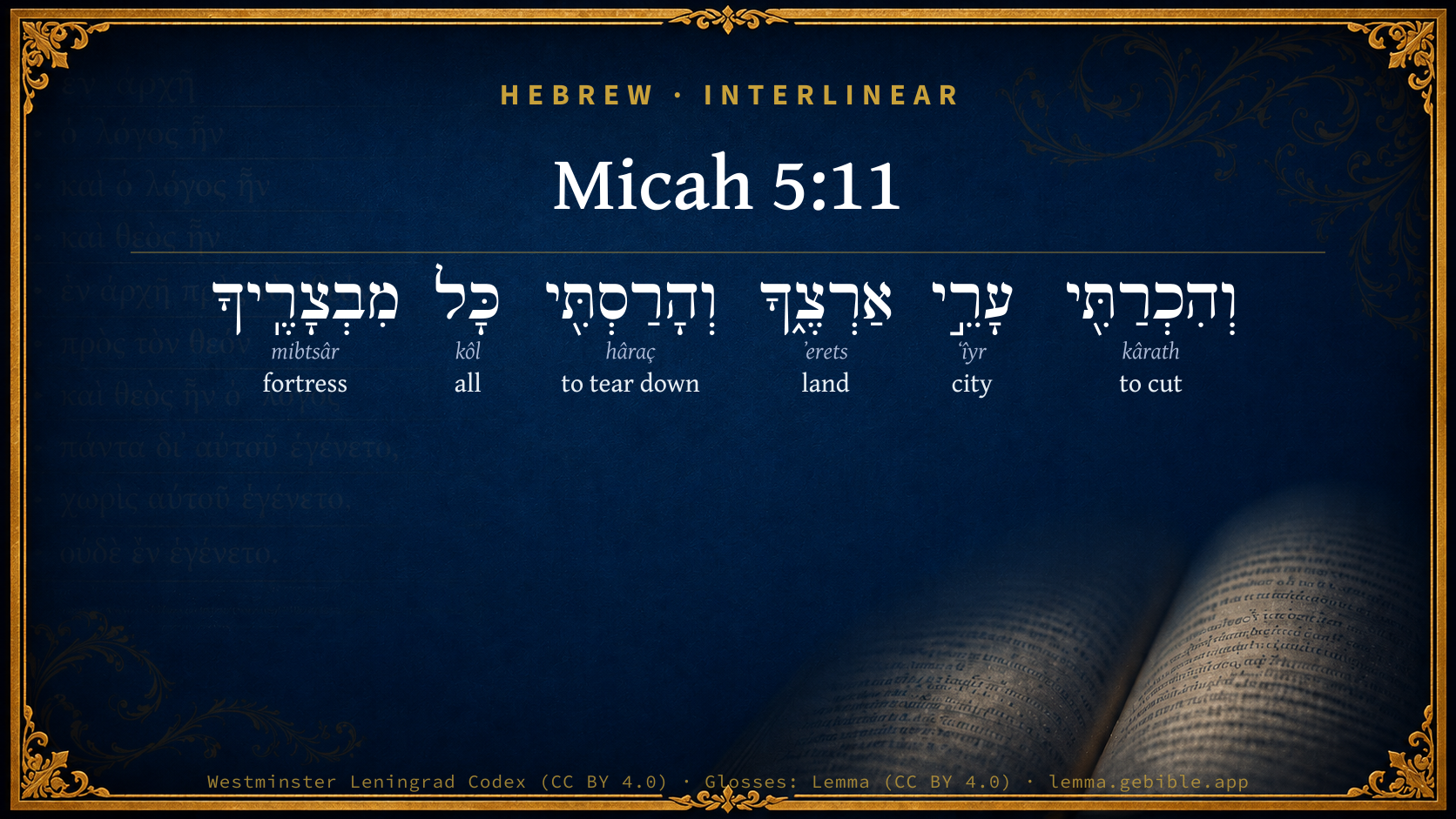
Micah 5:11

Hebrew (Westminster Leningrad Codex) Micah 5:11 appears in the Hebrew Old Testament. The text above is from the Westminster Leningrad Codex. Each word links to its Strong’s number, a concise gloss, and parsing drawn from the Open Scriptures Hebrew Bible morphology. Click any word for its full Brown-Driver-Briggs (BDB) entry.
Download image
Cite this verse

Micah 5:11 (World English Bible). Public Domain. Lemma interlinear Bible study tool, https://lemma.gebible.app/v/micah/5/11.

Show BibTeX & RIS
BibTeX
RIS
English Translation
I will cut off the cities of your land, And will tear down all your strongholds.
World English Bible · Public Domain
Download a study sheet

One document with this verse’s original text, its word-by-word gloss line, the meaning frame, cross-references with their text, attributed commentary, and full source and license credits — printable, and it pastes into notes with its structure intact.

This verse Autodidact and up

Study sheet (.html) Plain text (.txt)

A passage Seminary Student

Up to 50 verses in one chapter. A passage sheet keeps up to 6 commentary sources and 12 cross-references per verse, in the order this page ranks them, and says so on the sheet whenever that leaves anything out. Ask for a single verse and you get the Autodidact verse sheet above.

Everything on this page stays free to read, with no account — the sheet is a download of what is already on screen, not access to it.

Want to remove ads? Support Godless Engineer
Compare translations 3

The same verse in 3 English versions, stacked beneath the original-language interlinear above. Click any original word for its lexicon entry.

Each is an independent rendering of the whole verse — the interlinear is not word-aligned to these translations.

Highlighted words mark where these versions differ — a whole-verse word diff, not a word-by-word alignment.

  • World English Bible Public Domain
    I will cut off the cities of your land, And will tear down all your strongholds.
  • King James Version Public Domain
    And I will cut off the cities of thy land, and throw down all thy strong holds:
  • unfoldingWord Literal Text CC BY-SA 4.0
    And I will cut off the cities of your land, and I will tear down all your fortifications.

unfoldingWord Literal Text — © unfoldingWord, licensed CC BY-SA 4.0. Word-aligned USFM3 via Door43 (git.door43.org/unfoldingWord/en_ult).

Versions to compare (up to 4)

3 of 4 selected

Show all 18 translations

Every available English version of this verse, each an independent rendering of the whole verse.

  • World English Bible Public Domain
    I will cut off the cities of your land, And will tear down all your strongholds.
  • Berean Standard Bible Public Domain
    I will remove the cities of your land and tear down all your strongholds.
  • Majority Standard Bible Public Domain
    I will remove the cities of your land and tear down all your strongholds.
  • King James Version Public Domain
    And I will cut off the cities of thy land, and throw down all thy strong holds:
  • American Standard Version (1901) Public Domain
    and I will cut off the cities of thy land, and will throw down all thy strongholds.
  • Revised Version (1885) Public Domain
    and I will cut off the cities of thy land, and will throw down all thy strong holds:
  • Geneva Bible (1599) Public Domain
    And I will cut off the cities of thy land, and ouerthrowe all thy strong holdes.
  • Douay-Rheims (1899) Public Domain
    And I will destroy the cities of thy land, and will throw down all thy strong holds, and I will take away sorceries out of thy hand, and there shall be no divinations in thee.
  • Young's Literal Translation Public Domain
    And I have cut off the cities of thy land, And I have thrown down all thy fortresses,
  • Literal Standard Version CC BY-SA 4.0
    And I have cut off the cities of your land, || And I have thrown down all your fortresses,
  • Unlocked Literal Bible CC BY-SA 4.0
    I will destroy the cities in your land and throw down all your strongholds.
  • unfoldingWord Literal Text CC BY-SA 4.0
    And I will cut off the cities of your land, and I will tear down all your fortifications.
  • Darby Bible Public Domain
    And I will cut off the cities of thy land, and overthrow all thy strongholds.
  • World Messianic Bible Public Domain
    I will cut off the cities of your land and will tear down all your strongholds.
  • Webster's Bible Public Domain
    \\5:12\\And I will cut off witchcrafts out of thy hand; and thou shalt have no more sooth-sayers:
  • Free Bible Version CC BY-SA 4.0
    I will tear down your city walls and demolish your fortresses.
  • Bible in Basic English Public Domain
    I will put an end to your use of secret arts, and you will have no more readers of signs:
  • JPS Tanakh (1917) Public Domain
    (5-10) And I will cut off the cities of thy land, and will throw down all thy strongholds;

Literal Standard Version (2020), Covenant Press — licensed CC BY-SA 4.0. Text via the HelloAO Bible API (eBible.org). Unlocked Literal Bible (unfoldingWord) — licensed CC BY-SA 4.0. Text via the HelloAO Bible API (eBible.org). unfoldingWord Literal Text — © unfoldingWord, licensed CC BY-SA 4.0. Word-aligned USFM3 via Door43 (git.door43.org/unfoldingWord/en_ult). Free Bible Version, Dr. Jonathan Gallagher — licensed CC BY-SA 4.0. Text via the HelloAO Bible API (eBible.org).

Word by word

More ways to search: Search by grammar → Find every occurrence → Compare this word →

Practice this passage: Drill this verse → Learn its vocabulary →

About this verse

These counts appear in no published source. They are computed here, from the morphology-tagged text and Lemma’s own curated glosses. What Lemma adds →

6
words
6
distinct lemmas
Prophets
section

Shared distinctive vocabulary

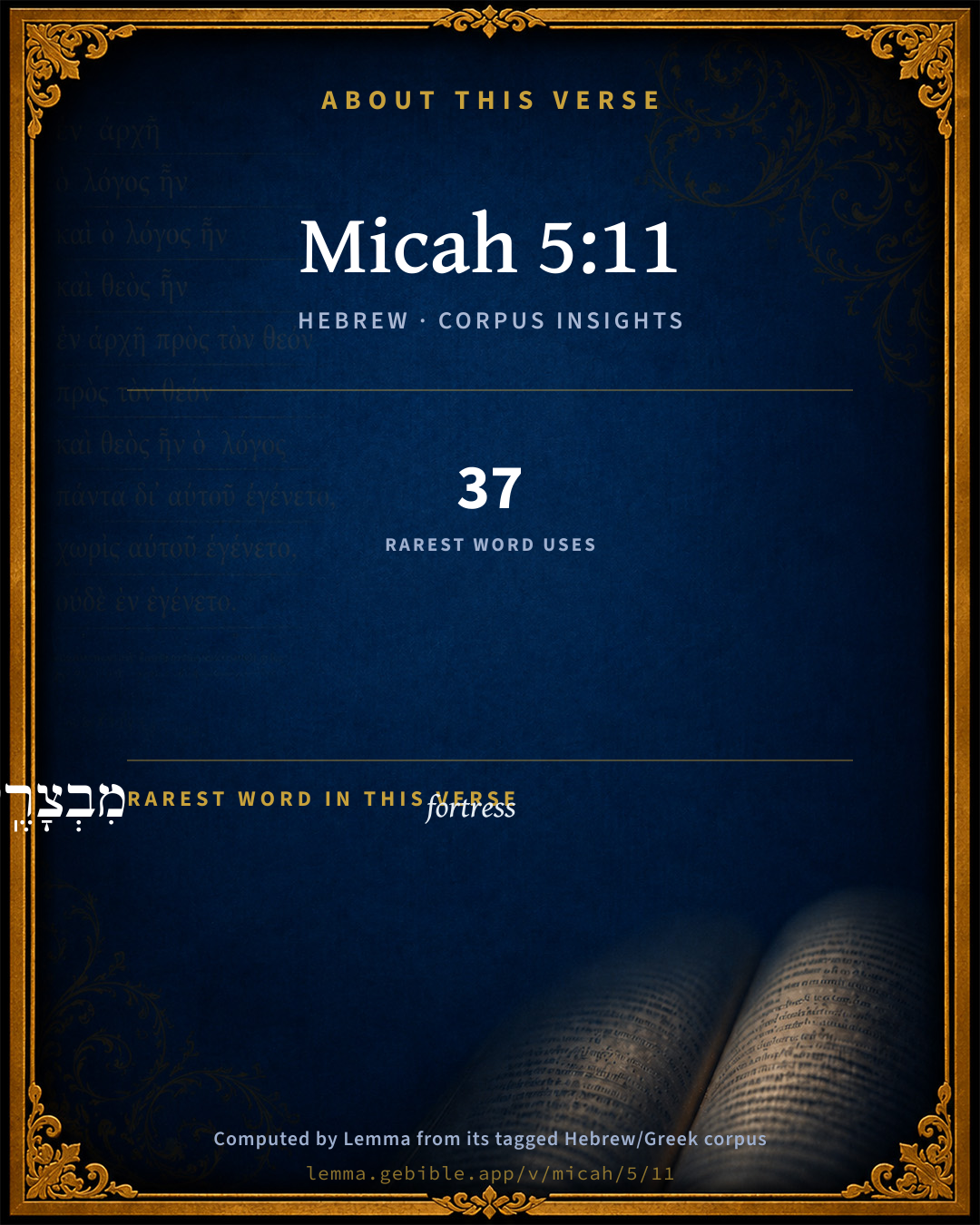
מִבְצָרֶֽיךָ fortress H4013 occurs in 37 verses of the Hebrew Bible. Also found in:

Grammatical profile

  • 2 verbs
  • 4 nouns

Verb forms

  • וְהִכְרַתִּ֖י Hiphil · Sequential Perfect
  • וְהָרַסְתִּ֖י Qal · Sequential Perfect

Hebrew & Septuagint length

In English translation the verse runs 16 words from the Hebrew and 15 from the Septuagint (LXX English) — closely comparable.

A rough comparison of the two English renderings, which tokenize alike — not a word-level alignment.

Word counts can differ between the Hebrew and the Greek without any difference in meaning — e.g. the Hebrew direct-object marker אֵת has no separate Greek word, and Greek often adds the article ὁ.

Cross-references

6

Topical passages linked to Micah 5:11 in the Treasury of Scripture Knowledge — connected by theme and wording, ordered by reader-vote popularity; previews shown in the World English Bible.

  • Isaiah 2:12–17 For there will be a day of Yahweh of Hosts for all that is proud and haughty, And for all that is lifted up; And it shall be brought low:
  • Isaiah 6:11 Then I said, "Lord, how long?" He answered, "Until cities are waste without inhabitant, And houses without man, And the land becomes utterly waste,
  • Ezekiel 38:11 and you shall say, I will go up to the land of unwalled villages; I will go to those who are at rest, who dwell securely, all of them dwelling without walls, and having neither bars nor gates;
  • Hosea 10:14 Therefore a battle roar will arise among your people, And all your fortresses will be destroyed, As Shalman destroyed Beth Arbel in the day of battle. The mother was dashed in pieces with her children.
  • Amos 5:9 Who brings sudden destruction on the strong, So that destruction comes on the fortress.
  • Zechariah 4:6 Then he answered and spoke to me, saying, "This is the word of Yahweh to Zerubbabel, saying, 'Not by might, nor by power, but by my Spirit,' says Yahweh of Hosts.

Cross-references courtesy of OpenBible.info (CC BY 4.0).

Hebrew and Greek witnesses Masoretic Hebrew ↔ Greek Septuagint

The same verse in the two great witnesses to the Old Testament, shown verse-for-verse.

These are two independent witnesses, not word-aligned to each other, and the Septuagint is shown in lemma (dictionary) form.

Hebrew Micah 5:11 Masoretic · Westminster Leningrad Codex

וְהִכְרַתִּ֖י עָרֵ֣י אַרְצֶ֑ךָ וְהָרַסְתִּ֖י כָּל מִבְצָרֶֽיךָ

I will cut off the cities of your land, And will tear down all your strongholds.

World English Bible · Public Domain

Greek LXX Micah 5:11 Septuagint · lemma form

καί ἐκαἴρω ὁ φάρμακον σύ ἐκ ὁ χείρ σύ καί ἀποφθέγγομαι οὐ εἰμί ἐν σύ

and I will utterly destroy the cities of your land, and demolish all your strongholds:

LXX2012 (modern English Septuagint) · Public Domain

Hebrew: Westminster Leningrad Codex (CC BY 4.0). Greek: Septuagint (public domain); English from LXX2012 (modern English Septuagint) (Public Domain). How the Septuagint differs from the Hebrew →

Targum (Aramaic paraphrase)

1

The Targum is the ancient Jewish Aramaic paraphrase of the Hebrew Scriptures — an interpretive translation, not the Hebrew text itself. Onkelos (literal) and Pseudo-Jonathan (expansive) render the Torah, and Jonathan the Prophets. Coverage is partial: where no permissively-licensed English translation exists for a verse, only the Aramaic is shown. This is verse-level text, not a word-by-word alignment to the Hebrew.

  1. Targum Jonathan Prophets (Joshua–Malachi)
    וֶאֱשֵׁיצֵי חֲרָשִׁין מִבֵּינָךְ וּמְעַנְנִין לָא יְהוֹן לָךְ:

    (no public-domain English translation for this verse)

    Targum Jonathan — Aramaic: “Mikraot Gedolot” (public domain). English: “Sefaria Community Translation” (CC0 1.0 (public-domain dedication)); “London "Chaldee Paraphrase," 1871” (public domain). Text via Sefaria.

Commentary

Notes on Micah 5:11 from classic Christian and Jewish commentators (each source and its license shown beneath its notes). The classic Christian expositions comment on the surrounding passage and are grouped to its opening verse, so a note may address several verses; the Jewish commentaries on the Tanakh (Rashi and others) are per-verse, so they appear only where the commentator wrote on this verse.

Lemma curates 59 commentaries, every one of them public domain or Creative Commons licensed, each selected and text-cleaned for this edition rather than reprinted as found. About our sources →

Trapp's Complete Commentary

John Trapp

Mic 5:11 And I will cut off the cities of thy land, and throw down all thy strong holds:

Ver. 11. And I will cut off the cities of thy land] Thy fenced cities and places of strength, for like reason as before, that thou mayest look upon my name alone as a strong tower, and thereto run and be safe, Pro 18:10, that thou mayest hover and cover under my wings, Psa 91:1-2, and there hold thee as secure as in a tower of brass or town of war. "Blessed be the Lord" (saith David, who could not be safe in Keilah, that had gates and bars), "for he hath showed me his marvellous lovingkindness as in a strong city," Psa 31:21. The tower of Shechem saved not those that ran into it, Jdg 9:49. The stronghold of Zion could not secure the Jebusites, that in the height of their pride scorned David and his host, that laid siege to it, 2Sa 5:6-7. Belshazzar and his Babylonians bare themselves so bold upon the strength of their city, and provision laid in for twenty years, if need were (as Xenophon testifieth), that they reproached the Persians that besieged them, and derided their attempts as to no purpose; yet were shortly after made a prey to the enemy. Arimazes, having garrisoned a very strong and steep rock in the Sogdian country with 80,000 men, sent to Alexander the Great, who demanded it, to know whether he could fly or not? But the next day he was taken together with his stronghold, and nailed to a cross (Plut. in Alex. Curt. lib. 7). God delights to confute men in their confidences; that those that are his may run to the Rock of ages, Isa 26:4, to that Arx roboris strong citadel of his holy name, which alone is impregnable, inexpugnable. The Spaniards called their navy in ‘88 the Invincible Armada, but it proved otherwise, and that upon St James’s day, whom they count their patron, their tutelary saint. It is not unlawful to have cities and strongholds, but to confide in them, by rising up to a corky, frothy hope when we have them; or to sit down in a faithless, sullen discontent and despondence when we want them; this is to make flesh our arm, and so to incur that heavy curse, Jer 17:5. God will cut off all occasions of so doing from those whom he loveth, as here he promiseth: and as accordingly he performed to this people, after their return from Babylon, and especially a little before the coming of Christ in the flesh, when they were reduced by Pompey into a province of the Roman empire.

John Trapp, A Commentary or Exposition upon All the Books of the Old and New Testament (1647–1656) — public domain. Text from a community e-Sword module.

Jamieson, Fausset & Brown

Robert Jamieson, A. R. Fausset & David Brown

cut off . . . cities . . . strongholds--such as are fortified for war. In that time of peace, men shall live in unwalled villages (Eze 38:11; compare Jer 23:6; Jer 49:31; Zac 2:8).

Jamieson, Fausset & Brown — Commentary Critical and Explanatory on the Whole Bible (1871) — public domain (CC PDM 1.0). Text via the HelloAO Bible API.

Adam Clarke's Commentary

Verse 11. I will - throw down all thy strongholds] Thou shalt have no need of fortified cities; I will be thy defense.

Adam Clarke's Commentary on the Bible (1810–1826) — public domain. Text from a community e-Sword/MySword module.

John Calvin's Commentaries

He afterwards subjoins, I will cut off the cities of thy land, and I will destroy all thy fortresses This verse is to be taken in the same sense. That the people dwelt in fortified cities, and had defenses and fortified places, was not of itself displeasing to God. But as the people habituated themselves to a false confidence, and as it were hardened themselves in it, so that this evil could not be remedied without taking away those things to which it is attached, the Prophet says here, I will cut off the cities of your land, and then, I will cut off your defenses and fortified places. Is it that they may be plundered with impunity by their enemies? By no means, but that the favor of God may be made glorious in their deliverance. For they could not ascribe it to their cities that they kept off enemies, but were constrained to acknowledge the hand of God, and to confess him to have been their only deliverer; for they were exposed to enemies, and there was no aid for them in the land. God then will thus render more evident his favor, when their cities and fortified places shall be cut off. We hence learn that the faithful at this day have no cause to murmur if they are without great riches, and if they are not formidable for the multitude of their horses, nor for the number and strength of their men. Why so? Because it is the Lord’s will that we should be like sheep, that we might depend wholly on his power, and know that we cannot be otherwise safe than under his protection. This reason then ought to comfort us, that it may not be grievous to us, when we find that we are in the midst of wolves, and that we have no equal strength to contend with them; for even this destitution hardly extorts from us a real confession that our safety is in the hand of God. We are always proud. How would it be, were the Church at this day in a flourishing state and all enemies subdued, were there no danger, no fear? Surely earth and heaven could not bear the foolish self-confidence of men. There is therefore no wonder that God thus holds us in, and that while he supports us by his grace, he deprives us of all earthly helps and aids, that we may learn that he alone is the author of our salvation.

This truth ought to be carefully contemplated by us. Whenever we see that the Church of God, though not possessing any great power, is yet diminished daily, yea, and becomes, so to speak, like a naked land, without any defenses, it so happens, in order that the protection of God may be alone sufficient for us, and that he may wholly tear away from our hearts all haughtiness and pride, and dissipate all those vain confidences by which we not only obscure the glory of God, but, as far as we can, entirely cover it over. In short, as there is nothing better for us than to be preserved by the hand of God, we ought to bear patiently the removal of all those impediments which close up the way against God, and, in a manner, keep off his hand from us, when he is ready to extend it for the purpose of delivering us. For when our minds are inflated with foolish self-confidence, we neglect God; and thus a wall intervenes, which prevents him to help us. Who would not wish, seeing himself in extreme danger and help not far distant, that an intercepting wall should immediately fall down? Thus God is near at hand, as he has promised; but there are many walls and many obstacles, from the ruin of which, if we would be safe, we must desire and seek, that God may find an open and free way, in order that he may be able to afford us aid.

The Prophet comes now to the second kind of impediments. We have already said that some things become impediments, as it were, accidentally, when, through our wickedness and misapplication, we turn God’s benefits to an end contrary to what he has designed. If, for instance, horses and chariots are given us, to possess them is not in itself an evil, but becomes so through our blindness, that is, when we, blinded by earthly possessions, think ourselves safe, and thus neglect God. But there are other impediments, which are, in their nature, and in themselves, vicious. To these the Prophet now leads us.

John Calvin's Commentaries (1540-1563) — public domain. Text from the Calvin Translation Society English edition (1840s-50s) via the Christian Classics Ethereal Library (ccel.org). Calvin's coverage is partial (roughly two-thirds of the Bible); uncommented books and verses are honest gaps, never fabricated. The 19th-century editor's footnotes and remarks are omitted so the notes are faithfully Calvin's own voice.

Ellicott's Commentary for English Readers

(11) I will cut off the cities.—Fenced cities and the other paraphernalia of war will be unnecessary in the Messiah’s kingdom: “they shall not learn war any more” (Mic_4:3).

A Bible Commentary for English Readers, edited by Charles John Ellicott (1878–1897) — public domain. Text from a community e-Sword module.

The Cambridge Bible for Schools and Colleges

gen. ed. J. J. S. Perowne

11. the cities of thy land] Large towns being centres of luxury and foreign fashions. The Book of Genesis traces the foundation of cities to the first murderer Cain, Gen_4:17.

all thy strong holds] Comp. Isa_2:15; Isa_30:25, Hos_8:14.

The Cambridge Bible for Schools and Colleges (gen. ed. J. J. S. Perowne; Cambridge University Press, 1878–1918) — public domain. Text from a community e-Sword module.

John Gill's Exposition

And I will cut off the cities of thy land, and throw down all thy strong holds. The meaning is, they should not dwell in fortified cities and walled towns; they should have none of these to trust to, nor should they stand in any need of them to defend them, their enemies being subdued; and besides, the Lord would be their strong hold and place of defence, a wall of fire round about them, but the glory in the midst of them, The phrases are expressive of the greatest tranquillity and safety, and of living in an open air, free and undisturbed; see Zac 2:4. The Targum is,

"I will cut off the cities of the people out of thy land, and destroy all their strong fortresses;''

these shall dwell no more there, and be no more offensive and troublesome.

John Gill's Exposition of the Whole Bible (1746–1763) — public domain (CC PDM 1.0). Text via the HelloAO Bible API.

Albert Barnes' Notes on the Bible

I will cut off the cities of thy land - So God promised by Zechariah, “Jerusalem shall be inhabited as towns without walls; for I will be unto her a wall of fire round about” Zec 2:4-5. The Church shall not need the temptation of human defense; for God shall fence her in on every side. Great cities too, as the abode of luxury and sin, of power and pride, and, mostly, of cruelty, are chiefly denounced as the objects of God’s anger. Babylon stands as the emblem of the whole city of the world or of the devil, as opposed to God. Rup.: “The first city was built by Cain; Abel and the other saints heed no continuing city” Heb 13:14 here. Cities then will include (Rup.) “all the tumults and evil passions and ambition and strife and bloodshed, which Cain brought in among men. Cities are collectively called and are Babylon, with whom, (as in the Revelations we hear a voice from heaven saying), “the kings of the earth committed fornication and the merchants of the earth are waxed rich through the abundance of her delicacies” Rev 18:3; and of which it is written, “And a mighty Angel took up a stone like a great millstone, and cast it into the sea, saying, Thus with violence shall that great city, Babylon, be thrown down, and shall be found no more at all.” Rev 18:21. “Great rest then is promised to holy Zion that is, the Church, when the cities or strongholds of the land (strongholds, as they are, of earthliness) shall be destroyed. For together with them are included all objects of desire in them, with the sight whereof the citizens of the kingdom of God, while pilgrims here, are tempted; whereof the wise man saith, Vanity of vanities, all is vanity.”

The fulfillment reaches on to the Day of Judgment, when the Church shall finally receive glory from the Lord, and be “without spot and wrinkle” Eph 5:27. All looks on to that Day. The very largeness of the promise, which speaks, in its fullest sense, of the destruction of things, without which we can hardly do in this life, (as cities or things very useful to the needs of man, (as horses,) carries us on yet more to that Day when there will be no more need of any outward things; Rup.: “when the heavy body shall be changed, and shall have the swiftness of angels, and shall be transported whither it willeth, without chariots and horses; and all things which tempt the eye shall cease; and no evil shall enter; and there shall be no need of divining, amid the presence and full knowledge of God, and where the ever-present Face of God, who is Truth, shall shine on all, and nothing be uncertain or unknown; nor shall they need to form in their souls images of Him whom His own shall see as He Is; nor shall they esteem anything of self, or the work of their own hands; but God shall be All in all.” In like way, the woe on those who obey not the truth, also looks on to the end. It too is final. There is nothing to soften it. Punishments in the course of life are medicinal. Here no mention is made of Mercy, but only of executing vengeance; and that, with wrath and fury; and that, such as they have not heard. For as eye hath not seen, nor heart conceived the good things laid up in store for those who love God, so neither the evil things prepared for those who, in act, shew that they hate Him.

Albert Barnes' Notes on the Bible (1834–1885) — public domain. Text from a community e-Sword/MySword module.

Haydock's Catholic Bible Commentary

Sorceries. The Jews after their return abstained more from such things; but not like the Church of Christ, in which idols and dealings with the devil have never been tolerated.

George Leo Haydock (1774–1849), Haydock's Catholic Family Bible and Commentary, 1859 edition — public domain. Excludes Psalms (Douay-Rheims chapter numbering differs from Protestant) and Deuterocanonical books (Catholic canon only).

Matthew Poole's English Annotations

And I, the Lord thy God, and thy Saviour, will cut off the cities; cut off the occasion of thy fortifying thy cities as heretofore thou hast done, thou shalt dwell in unwalled towns, and need no other defence than what I am to thee.

And throw down all thy strong holds; demolish all thy forts, and watch-towers, and frontier guards. These here mentioned are means of defence against enemies’ assaults, in which Israel had too much trusted; the others before mentioned, Mic 5:10, are offensive preparations for annoying the enemy; but in the day of that peace here spoken of, there should be no enemy should invade the people of God to put them on their defence; nor should they have any need to attempt upon their enemies; and though these means are lawful to be used, yet shall it be the happiness of God’s people not to need them, for their God, their Lord, is their Saviour in the midst of them, and he will cut off enemies round about them; so that virtually this is a promise to Israel that his adversaries should be destroyed, and so his fears disappear.

Matthew Poole's English Annotations on the Holy Bible (1683–1685) — public domain. Text from a community e-Sword/MySword module.

The Pulpit Commentary

Cities. Abodes of luxury and pride. From Messiah"s kingdom all pomp and vain glory shall be shut out. Strongholds. Such defences shall not be needed nor allowed. (comp. Isa_2:15 Zec_2:4, Zec_2:5)

The Pulpit Commentary (1880–1919), ed. H.D.M. Spence-Jones & Joseph S. Exell — public domain. Text from a community e-Sword module.

John Wesley's Explanatory Notes

The cities - Cut off the occasion of fortifying their cities, thou shalt need no other defense than what I am to thee.

John Wesley, Explanatory Notes Upon the Whole Bible (1754–1765) — public domain. Text via the GEBible commentary corpus.

Lesson kit

Teaching starters — assembled from the data on this page, not authored interpretation. Every prompt links to the verse data it draws on. Edit before teaching.

Micah, in the Prophets, opens this verse with 6 words (6 distinct Hebrew lemmas). Its most distinctive word is mibtsâr (“fortress”). A historical commentator’s framing appears above. Read the whole chapter for the surrounding context.

Discussion questions

  1. The word mibtsâr carries the sense “fortress.” How does it shape the verse?
  2. How does Numbers 13:19, which shares the word «fortress», read alongside this verse?
  3. These translations render this verse differently. What is at stake in choosing one wording over another?
  4. «וְהִכְרַתִּ֖י» is a Hiphil Sequential Perfect verb. How does that grammatical form shape the action described?
  5. Compare how Trapp's Complete Commentary and Jamieson, Fausset & Brown read this verse. Where do they agree or differ?

Things to notice

Reading settings

Reading text

Shown beneath each verse's original-language words.

Old Testament
Old Testament edition

Read the OT as the Masoretic Hebrew (MT) or the Greek Septuagint (LXX).

English shown for the Greek Septuagint (in the Hebrew ↔ Greek comparison).

Comparing translations? Open the Compare panel on any verse page to stack up to four side by side.