
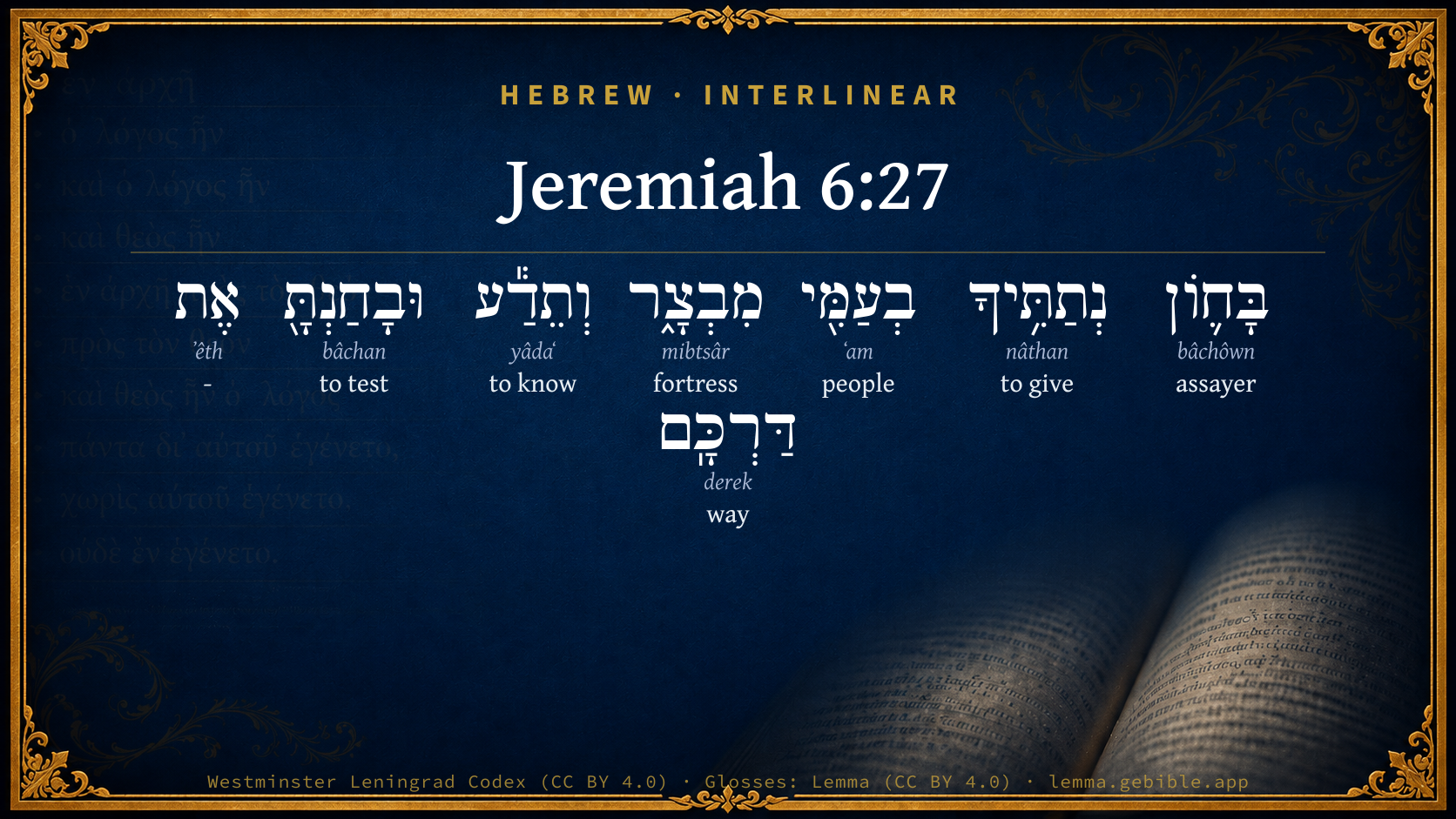
Jeremiah 6:27

Hebrew (Westminster Leningrad Codex) Jeremiah 6:27 appears in the Hebrew Old Testament. The text above is from the Westminster Leningrad Codex. Each word links to its Strong’s number, a concise gloss, and parsing drawn from the Open Scriptures Hebrew Bible morphology. Click any word for its full Brown-Driver-Briggs (BDB) entry.
Download image
Cite this verse

Jeremiah 6:27 (World English Bible). Public Domain. Lemma interlinear Bible study tool, https://lemma.gebible.app/v/jeremiah/6/27.

Show BibTeX & RIS
BibTeX
RIS
English Translation
I have made you a tester of metals [and] a fortress among my people; that you may know and try their way.
World English Bible · Public Domain
Highlights
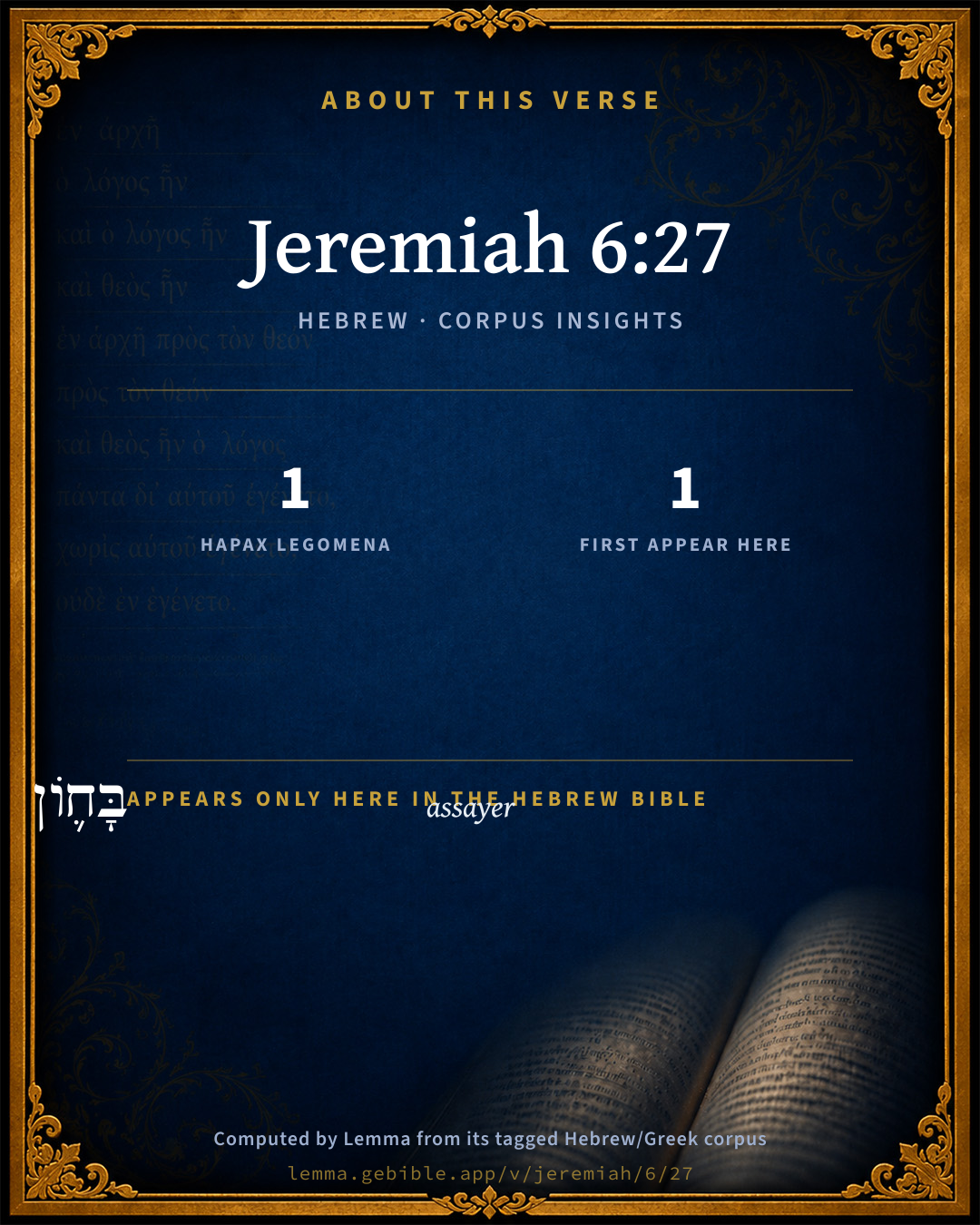
  • 1 hapax legomenon — only here in the Hebrew Bible
  • 1 first appearance in the Hebrew Bible
Full analysis ↓
Download a study sheet

One document with this verse’s original text, its word-by-word gloss line, the meaning frame, cross-references with their text, attributed commentary, and full source and license credits — printable, and it pastes into notes with its structure intact.

This verse Autodidact and up

Study sheet (.html) Plain text (.txt)

A passage Seminary Student

Up to 50 verses in one chapter. A passage sheet keeps up to 6 commentary sources and 12 cross-references per verse, in the order this page ranks them, and says so on the sheet whenever that leaves anything out. Ask for a single verse and you get the Autodidact verse sheet above.

Everything on this page stays free to read, with no account — the sheet is a download of what is already on screen, not access to it.

Want to remove ads? Support Godless Engineer
Compare translations 3

The same verse in 3 English versions, stacked beneath the original-language interlinear above. Click any original word for its lexicon entry.

Each is an independent rendering of the whole verse — the interlinear is not word-aligned to these translations.

Highlighted words mark where these versions differ — a whole-verse word diff, not a word-by-word alignment.

  • World English Bible Public Domain
    I have made you a tester of metals [and] a fortress among my people; that you may know and try their way.
  • King James Version Public Domain
    I have set thee for a tower and a fortress among my people, that thou mayest know and try their way.
  • unfoldingWord Literal Text CC BY-SA 4.0
    “I have given you a tester among my people, an appraiser, so you can know and test their way.

unfoldingWord Literal Text — © unfoldingWord, licensed CC BY-SA 4.0. Word-aligned USFM3 via Door43 (git.door43.org/unfoldingWord/en_ult).

Versions to compare (up to 4)

3 of 4 selected

Show all 18 translations

Every available English version of this verse, each an independent rendering of the whole verse.

  • World English Bible Public Domain
    I have made you a tester of metals [and] a fortress among my people; that you may know and try their way.
  • Berean Standard Bible Public Domain
    “I have appointed you to examine My people like ore, so you may know and try their ways.
  • Majority Standard Bible Public Domain
    “I have appointed you to examine My people like ore, so you may know and try their ways.
  • King James Version Public Domain
    I have set thee for a tower and a fortress among my people, that thou mayest know and try their way.
  • American Standard Version (1901) Public Domain
    I have made thee a trier `and' a fortress among my people; that thou mayest know and try their way.
  • Revised Version (1885) Public Domain
    I have made thee a tower and a fortress among my people; that thou mayest know and try their way.
  • Geneva Bible (1599) Public Domain
    I haue set thee for a defence and fortresse among my people, that thou maiest knowe and trie their waies.
  • Douay-Rheims (1899) Public Domain
    I have set thee for a strong trier among my people: and thou shalt know and prove their way.
  • Young's Literal Translation Public Domain
    A watch-tower I have given thee, Among My people a fortress, And thou knowest, and hast tried their way.
  • Literal Standard Version CC BY-SA 4.0
    “I have given you a watchtower, || A fortress among My people, || And you know, and have tried their way.
  • Unlocked Literal Bible CC BY-SA 4.0
    “I have made you, Jeremiah, one who tests my people like one would test metal, so you will inspect and test their ways.
  • unfoldingWord Literal Text CC BY-SA 4.0
    “I have given you a tester among my people, an appraiser, so you can know and test their way.
  • Darby Bible Public Domain
    I have set thee among my people as an assayer, a fortress, that thou mayest know and try their way.
  • World Messianic Bible Public Domain
    “I have made you a tester of metals and a fortress among my people, that you may know and try their way.
  • Webster's Bible Public Domain
    I have set thee for a tower and a fortress among my people, that thou mayest know and try their way.
  • Free Bible Version CC BY-SA 4.0
    Jeremiah, I have made you a tester of metals so you can test my people as if they were metal, so you can know what they're made of and how they act.
  • Bible in Basic English Public Domain
    I have made you a tester among my people, so that you may have knowledge of their way and put it to the test.
  • JPS Tanakh (1917) Public Domain
    I have made thee a tower and a fortress among My people; that thou mayest know and try their way.

Literal Standard Version (2020), Covenant Press — licensed CC BY-SA 4.0. Text via the HelloAO Bible API (eBible.org). Unlocked Literal Bible (unfoldingWord) — licensed CC BY-SA 4.0. Text via the HelloAO Bible API (eBible.org). unfoldingWord Literal Text — © unfoldingWord, licensed CC BY-SA 4.0. Word-aligned USFM3 via Door43 (git.door43.org/unfoldingWord/en_ult). Free Bible Version, Dr. Jonathan Gallagher — licensed CC BY-SA 4.0. Text via the HelloAO Bible API (eBible.org).

Word by word

More ways to search: Search by grammar → Find every occurrence → Compare this word →

Practice this passage: Drill this verse → Learn its vocabulary →

About this verse

These counts appear in no published source. They are computed here, from the morphology-tagged text and Lemma’s own curated glosses. What Lemma adds →

8
words
8
distinct lemmas
Prophets
section

Notable vocabulary

1 hapax legomenon — a word that appears only here in the entire Hebrew Bible:

  • בָּח֛וֹן assayer H969

First appearance in Scripture

This word makes its first canonical appearance in the Hebrew Bible here:

  • בָּח֛וֹן assayer H969

Shared distinctive vocabulary

וּבָחַנְתָּ֖ to test H974 occurs in 28 verses of the Hebrew Bible. Also found in:

Grammatical profile

  • 3 verbs
  • 4 nouns
  • 1 particle

Verb forms

  • נְתַתִּ֥יךָ Qal · Perfect
  • וְתֵדַ֕ע Qal · Imperfect
  • וּבָחַנְתָּ֖ Qal · Sequential Perfect

Cross-references

6

Topical passages linked to Jeremiah 6:27 in the Treasury of Scripture Knowledge — connected by theme and wording, ordered by reader-vote popularity; previews shown in the World English Bible.

  • Jeremiah 1:18 For, behold, I have made you this day a fortified city, and an iron pillar, and brazen walls, against the whole land, against the kings of Judah, against the princes of it, against the priests of it, and against the people of the land.
  • Jeremiah 15:20 I will make you to this people a fortified brazen wall; and they shall fight against you, but they shall not prevail against you; for I am with you to save you and to deliver you, says Yahweh.
  • Jeremiah 9:7 Therefore thus says Yahweh of Hosts, Behold, I will melt them, and try them; for how [else] should I do, because of the daughter of my people?
  • Ezekiel 3:8–10 Behold, I have made your face hard against their faces, and your forehead hard against their foreheads.
  • Ezekiel 20:4 Will you judge them, son of man, will you judge them? Cause them to know the abominations of their fathers;
  • Ezekiel 22:2 You, son of man, will you judge, will you judge the bloody city? then cause her to know all her abominations.

Cross-references courtesy of OpenBible.info (CC BY 4.0).

Hebrew and Greek witnesses Masoretic Hebrew ↔ Greek Septuagint

The same verse in the two great witnesses to the Old Testament, shown verse-for-verse.

These are two independent witnesses, not word-aligned to each other, and the Septuagint is shown in lemma (dictionary) form.

Hebrew Jeremiah 6:27 Masoretic · Westminster Leningrad Codex

בָּח֛וֹן נְתַתִּ֥יךָ בְעַמִּ֖י מִבְצָ֑ר וְתֵדַ֕ע וּבָחַנְתָּ֖ אֶת דַּרְכָּֽם

I have made you a tester of metals [and] a fortress among my people; that you may know and try their way.

World English Bible · Public Domain

Greek LXX Structure differs

In the Septuagint, Jeremiah is about an eighth shorter than the Hebrew and arranges its material differently — the Oracles Against the Nations (Hebrew chapters 46–51) appear in the middle of the Greek book, after 25:13. Because the chapter and verse boundaries do not line up, a verse-for-verse comparison with the Hebrew is not shown.

A verse-for-verse comparison isn’t shown here because the chapters and verses don’t line up. Switch to the LXX edition with the MT / LXX toggle above to read the Greek directly.

On this verse, Joseph Benson's Commentary discusses the Septuagint’s reading. Read the note in Commentary ↓

Hebrew: Westminster Leningrad Codex (CC BY 4.0). Greek: Septuagint (public domain); English from a public-domain English Septuagint. How the Septuagint differs from the Hebrew →

Targum (Aramaic paraphrase)

1

The Targum is the ancient Jewish Aramaic paraphrase of the Hebrew Scriptures — an interpretive translation, not the Hebrew text itself. Onkelos (literal) and Pseudo-Jonathan (expansive) render the Torah, and Jonathan the Prophets. Coverage is partial: where no permissively-licensed English translation exists for a verse, only the Aramaic is shown. This is verse-level text, not a word-by-word alignment to the Hebrew.

  1. Targum Jonathan Prophets (Joshua–Malachi)
    בְּחִיר יְהַבְתָּךְ בְּעַמִי כִּכְרַךְ תַּקִיף וּתְהוֹדַע וּתְחַוֵי לְהוֹן יַת אוֹרְחַתְהוֹן:

    (no public-domain English translation for this verse)

    Targum Jonathan — Aramaic: “Mikraot Gedolot” (public domain). English: “Sefaria Community Translation” (CC0 1.0 (public-domain dedication)); “London "Chaldee Paraphrase," 1871” (public domain). Text via Sefaria.

Commentary

Notes on Jeremiah 6:27 from classic Christian and Jewish commentators (each source and its license shown beneath its notes). The classic Christian expositions comment on the surrounding passage and are grouped to its opening verse, so a note may address several verses; the Jewish commentaries on the Tanakh (Rashi and others) are per-verse, so they appear only where the commentator wrote on this verse.

Lemma curates 59 commentaries, every one of them public domain or Creative Commons licensed, each selected and text-cleaned for this edition rather than reprinted as found. About our sources →

Jamieson, Fausset & Brown

Robert Jamieson, A. R. Fausset & David Brown

tower . . . fortress-- (Jer 1:18), rather, "an assayer (and) explorer." By a metaphor from metallurgy in Jer 6:27-30, Jehovah, in conclusion, confirms the prophet in his office, and the latter sums up the description of the reprobate people on whom he had to work. The Hebrew for "assayer" (English Version, "tower") is from a root "to try" metals. "Explorer" (English Version, "fortress") is from an Arabic root, "keen-sighted"; or a Hebrew root, "cutting," that is, separating the metal from the dross [EWALD]. GESENIUS translates as English Version, "fortress," which does not accord with the previous "assayer."

Jamieson, Fausset & Brown — Commentary Critical and Explanatory on the Whole Bible (1871) — public domain (CC PDM 1.0). Text via the HelloAO Bible API.

Trapp's Complete Commentary

John Trapp

Jer 6:27 I have set thee [for] a tower [and] a fortress among my people, that thou mayest know and try their way.

Ver. 27. I have set thee for a tower and a fortress.] Or, A fortified watch tower have I made thee among my people - i.e., to spy out and discover their dispositions and affections.

John Trapp, A Commentary or Exposition upon All the Books of the Old and New Testament (1647–1656) — public domain. Text from a community e-Sword module.

Joseph Benson's Commentary

Jer 6:27. I have set thee for a tower, &c. — According to this reading, God speaks here by way of encouragement to the prophet, and tells him he had made him a fortified tower, that he might be safe, notwithstanding all the attempts of the wicked against him. But Lowth, with some others, thinks that “the sense would be plainer if the words were translated thus: I have set thee (in) a watch-tower, and (in) a fortress;” that is, God tells the prophet that he hath placed him as a watchman in a high tower, or fortress, to take an account of the people’s behaviour, and to warn them accordingly. That thou mayest know and try their way — That is, their actions and manners, and how they stand affected toward God and his word; that thou mayest bring their whole conduct under thy strict observation and scrutiny, as refiners do metals. Hereby the prophet is encouraged to reprove them more freely, and with authority, because God promises to defend him from injury, and would give him prudence to see what was amiss, and undauntedness to oppose it. It may be proper to observe here, that this latter clause of the verse favours the sense in which the LXX. and the Vulgate have taken the preceding clause. They render the word בחון, which we translate a tower, δοκιμαστην, probatorem, a prover, or trier, which Blaney interprets thus: “I have appointed thee the office of an assay-master among my people, as to the gold thereof; that is, to try what is in them of genuine worth and excellence, which, like pure gold, will stand the utmost test.” Dr. Dodd considers the passage in the same light, observing, “The prophet in these verses evidently takes his ideas from metals, and the trial of them; and the verbs in the latter clause of this verse, referring to such trial, manifestly require something corresponding in the preceding part. But what has a tower and fortress to do with the trying of metals? In this view the reader will agree with me, that the passage is rendered much more properly in some of the versions, and indeed more agreeably to the Hebrew, I have given, or established, thee as a strong prover, or trier of metals among my people that thou mightest know, &c.”

Joseph Benson's Commentary on the Old and New Testaments (1811–1818) — public domain. Text from a community e-Sword module.

Tyndale Open Study Notes

Tyndale Open Resources

6:27-30 The Lord interrupted Jeremiah’s lamentation and brought him back to his commissioned task. God depicted the prophet as a silversmith working with raw ore. The refining process was going to reveal that the silver content of the ore was so small as to be worthless.

6:27 Jeremiah’s prophetic task was at odds with the empathy that he felt for his people. Like a metalworker, he was to direct the fire of criticism on the people to determine their quality in the light of God’s standards.

Tyndale Open Study Notes — © Tyndale Open Resources, licensed CC BY-SA 4.0. Text via the HelloAO Bible API.

Geneva Bible (1599)

Geneva Bible translators

Meaning, Jeremiah, whom God had appointed to try out the godly from the wicked, as a founder doth the pure metal from the dross.

Geneva Bible (1599) marginal notes — public domain. Text via Bolls.life.

Adam Clarke's Commentary

Verse 27. I have set thee for a tower and a fortress] Dr. Blayney translates, I have appointed thee to make an assay among my people. The words refer to the office of an assayer of silver and gold; and the manner of assaying here intended is by the cupel, a flat broad iron ring filled with the ashes of burnt bones. To separate the alloy from the silver they add a portion of lead; and when all is fused together, and brought into a state of ebullition, the cupel absorbs the lead, and with it the dross or alloy, and the silver is left pure and motionless on the top of the cupel. The people are here represented under the notion of alloyed silver. They are full of impurities; and they are put into the hands of the prophet, the assayer, to be purified. The bellows are placed, the fire is lighted up, but all to no purpose: so intensely commixed is the alloy with the silver, that it cannot be separated. The nozzle of the bellows is even melted with the intensity of the fire used to effect the refinement; and the lead is carried off by the action of the heat; and the assayer melteth in vain, for the alloy still continues in union with the metal. The assayer gives up the process, - will not institute one more expensive or tedious - pronounces the mass unfit to be coined, and denominates it reprobate silver, Jer 6:30. Thus, the evil habits and dispositions of the Israelites were so ingrained that they would not yield to either the ordinary or extraordinary means of salvation. God pronounces them reprobate silver, - not sterling, - full of alloy; - having neither the image nor the superscription of the Great King either on their hearts or on their conduct. Thus he gave them up as incorrigible, and their adversaries prevailed against them. This should be a warning to other nations, and indeed to the Christian Church; for if God did not spare the natural branches, neither will he spare these.

Adam Clarke's Commentary on the Bible (1810–1826) — public domain. Text from a community e-Sword/MySword module.

John Calvin's Commentaries

The Prophet says, that he was set by God as a watchtower, which was also fortified, that he might observe the wickedness of the people. In order to gain more authority for his prophecy, he introduces God as the speaker. He had spoken hitherto in his own person; but now God himself comes forth, and says, I have made thee a citadel. Jerome renders the last word “probation.” The verb בחן, becken, means to prove; and Jeremiah uses the verb in this verse, “that thou mayest prove their way.” But as the word מבצר, mebezar, “fortress, “follows, we cannot take the word here otherwise than as meaning a citadel or rampart. I therefore have no doubt but that a citadel for watching is what is meant; as though God had said, that his Prophet was like a watchtower, from which might be seen at one glance whatever was done far and wide: for we cannot see far from a plain, but they who are located high can see to a great distance.

But the word fortress is also added: for it behooved Jeremiah to watch without fear, and not to be exposed to the threats, calumnies, or clamors of the people. Jeremiah intimates that two things are required in God’s servants, even knowledge and undaunted courage; for it was not enough for the prophets to see clearly what was needful, except they were firmly prepared to discharge their office. Both these things seem to be included, when he says, that he was set as a watchtower, and also as a fortress

Why was he thus set? That thou mayest know, he says, and prove their way Let us now see what was the intention of this. The Prophet no doubt here claims power and credit to himself, that he might not only freely but authoritatively reprove the people: for objections, we know, were ever in their mouths, that they might be at liberty to despise the Prophet’s teaching, as though it did not proceed from God. This then was the reason why God here declares that Jeremiah was like a citadel, and that a fortified one; he was made so, that he might observe and know the way of the people. Hence it followed, that however obstinately they might defend themselves, it availed them nothing; for Jeremiah was endued with the highest authority, even that which was divine, in order to perform his office of a judge in condemning them: for it immediately follows —

John Calvin's Commentaries (1540-1563) — public domain. Text from the Calvin Translation Society English edition (1840s-50s) via the Christian Classics Ethereal Library (ccel.org). Calvin's coverage is partial (roughly two-thirds of the Bible); uncommented books and verses are honest gaps, never fabricated. The 19th-century editor's footnotes and remarks are omitted so the notes are faithfully Calvin's own voice.

Ellicott's Commentary for English Readers

(27) I have set thee . . .—The verse is difficult, as containing words in the Hebrew which are not found elsewhere, and have therefore to be guessed at. The following rendering is given on the authority of the most recent commentators, and has the merit of being in harmony with the metallurgic imagery of the following verses. As a prover of ore I have set thee among my people, and thou shalt know and try their way. The words are spoken by Jehovah to the prophet, and describe his work. By others, the first part of the sentence is rendered as follows: As a prover of ore I have set thee like a fortress, as if with a reference to Jer_1:18, where the same word is used.

A Bible Commentary for English Readers, edited by Charles John Ellicott (1878–1897) — public domain. Text from a community e-Sword module.

The Cambridge Bible for Schools and Colleges

gen. ed. J. J. S. Perowne

27. a tower] rather, as mg., a trier. It was owing to a difficulty presented by the following substantives that this was rendered tower.

a fortress] The same word (with slight difference in vocalisation) has the sense of “tower” in Isa_23:13. Hence probably, and with a reference to Jer_1:18, the word “fortress” got into the MT. It is quite foreign to the context. If retained, it must be pointed otherwise, but the meaning which must then be given it, viz. gold-washer, or gold-extractor, has no valid support.

27–30. In these vv. the Lord reassures Jeremiah of his divine commission, and he appears under the figure of one testing metal. The result of the testing process is that no precious metal is found. All is dross.

The Cambridge Bible for Schools and Colleges (gen. ed. J. J. S. Perowne; Cambridge University Press, 1878–1918) — public domain. Text from a community e-Sword module.

John Gill's Exposition

I have set thee for a tower,.... Or "in" one (d); in a watch tower, to look about and observe the actions of the people, their sins and transgressions, and reprove them for them; as well as to descry the enemy, and give notice of danger; see Hab 2:1 or, "for a trier"; since the word used comes from one which signifies to "try" metals, as gold and silver; and the rather this may be thought to be the meaning here, since the verb is made use of in this sense in the text; and the metaphor is carried on in the following words; though the word is used for towers in Isa 23:13 and may well enough be understood of a watchtower, agreeably with the office of the prophet; who is here addressed as a watchman, and was one to the house of Israel: and as the faithful discharge of his work required courage, as well as diligence and faithfulness, it follows, and

for a fortress among my people; not to defend them, but himself against them; or he was to consider himself as so under the divine protection, that he was as a fortress or strong tower, impregnable, and not to be dismayed and terrified with their calumnies and threatenings; see Jer 1:18,

that thou mayest know and try their way; their course and manner of life, whether good or bad; which he would be able to do, being in his watch tower, and in the discharge of his duty; for the ministry of a good man is as a touchstone, by which the principles and practices of men are tried and known; for if it is heard and attended to with pleasure, it shows that the principles and practices of men are good; but if despised and rejected, the contrary is evident, see Jo1 4:5.

(d) "in exploratoria specula", Junius & Tremellius.

John Gill's Exposition of the Whole Bible (1746–1763) — public domain (CC PDM 1.0). Text via the HelloAO Bible API.

Albert Barnes' Notes on the Bible

Render it:

I have set thee among My people as a prover of ore,

And thou shalt know and try their way.

They are all of them rebels of rebels (i. e., utter rebels):

Slander-walkers, were copper and iron,

Corrupters all of them.

The bellows glow: from their fire lead only!

In vain hath the smelter smelted,

And the wicked are not separated.

Refuse-silver have men called them:

For Yahweh hath refused them.

The intermixture throughout of moral words and metallurgical terms is remarkable.

Albert Barnes' Notes on the Bible (1834–1885) — public domain. Text from a community e-Sword/MySword module.

Haydock's Catholic Bible Commentary

Trier of my people, as of gold in the furnace, Job xxii. 25.

George Leo Haydock (1774–1849), Haydock's Catholic Family Bible and Commentary, 1859 edition — public domain. Excludes Psalms (Douay-Rheims chapter numbering differs from Protestant) and Deuterocanonical books (Catholic canon only).

Matthew Poole's English Annotations

Here God speaks by way of encouragement to the prophet, and tells him he had made him a fortified tower, that he might both discover the carriages of his people, which is one use of a high tower, Isa 21:5,8; Hab 2:1; and also to assure him, though they shall make several attempts against him, yet he shall be kept safe, os in a castle or fortress, Jer 15:20.

That thou mayest know and try their way; their courses, actions, and manners, and which way they stand affected; thou mayest bring all to thy strict observation and scrutiny, as goldsmiths or refiners do metals; for so is the word try used, Psa 66:10, and elsewhere. Hereby he shall be encouraged to reprove them more freely, and with authority, because God doth promise to defend him, that they shall not hurt him; God will give him prudence to see what is amiss, and undauntedness to oppose it.

Matthew Poole's English Annotations on the Holy Bible (1683–1685) — public domain. Text from a community e-Sword/MySword module.

Whedon's Commentary on the Bible

Daniel D. Whedon

27. A tower and a fortress — The rendering here is clearly indefensible. The word rendered “tower” is an active verbal noun from a root which means “to inspect closely,” and may perhaps be best rendered as tester or trier — that is, of metals. The word rendered “fortress” is more doubtful.

Some (Gesenius, Keil, Noyes) accept this sense, and translate, “For a trier have I set thee among my people as a strong tower. Others (as Furst and Nagelsbach) take the word in the sense of ore. There is no other example of this sense for this word in the Old Testament, but it comes legitimately from the root-meaning, namely, to cut off, hence that which is cut off — the ore. The rendering then would be, “I have set thee among my people as a tester of ore,” or, more expressly, after Nagelsbach, “I have set thee as a trier among my people — the ore.”

Daniel D. Whedon (gen. ed.), Commentary on the Old and New Testaments (1874–1909) — public domain. Text from a community e-Sword module.

The Pulpit Commentary

I have set thee, etc.; literally, as an assayer have I set thee among my people, a fortress. Various attempts have been made to avoid giving the last word its natural rendering, "a fortress." Ewald, for instance, would alter the points, and render "a separator of metals," thus making the word synonymous with that translated "an assayer;" but this is against Hebrew usage. Hitzig, assuming a doubtful interpretation of Job_22:24, renders "... among my people without gold," i.e. "without there being any gold there for thee to essay" (a very awkward form of expression). These are the two most plausible views, and yet neither of them is satisfactory. Nothing remains but the very simple conjecture, supported by not a few similar phenomena, that mibhcar, a fortress, has been inserted by mistake from the margin, where an early glossator had written the word, to remind of the parallel passage. (Jer_1:18, "I have made thee this day a fortress-city," "it mibhcar) In this and the following verses metallurgic phraseology is employed with a moral application. (comp. Isa_1:22, Isa_1:25)

Vers. 27-30. Testing fires.

Under the image of an assayer and his fire, Jeremiah is led to regard his mission, and the troubles of Israel, with which this is so much concerned, as means for testing the character of the Jews.

I THE STANDARD OF MEASUREMENT IS DIVINE TRUTH. The prophet is to be an assayer. Men are to be judged by the truths of righteousness which he is inspired to see and to declare. God has revealed standards of judgment. We are not free to shape our lives according to fancy, taste, or unaided private judgment. The truths of Scripture constitute the standard by which we shall be measured. This will be applied according as it is known. Jeremiah was the watchman before he was the assayer. He blew the trumpet, preached the truth he saw. They who have not received the fuller revelation will be judged by what light they possess. (Rom_1:18-20 Rom_2:12)

II THE TEST IS APPLIED IN THE FIRES OF AFFLICTION. Trouble is not only sent for discipline and chastisement; it is a test, a revealer of character. It reveals a man to himself and to others. If he has any true spiritual life, any precious metal, it must come out when, one after another, the worthless ideas and feelings fail before the searching flames of the baptism of fire. Trouble shows:

1. Whether religion is real and heartfelt, or formal and superficial.

2. How far faith is a practical trust, and how far it is a barren conviction.

3. Whether love and devotion to God are deep enough to stand against the temptation to rebel or despair.

III THEY ARE UTTERLY WORTHLESS WHO DISPLAY NO GOOD QUALITIES AFTER THE SEARCHING TRIAL OF AFFLICTION. This follows from the preceding statements. It was terribly applicable to Israel. We should ask how far it applies to ourselves, and beware of two delusions, viz.:

1. The delusion that merit may be still, hidden after God has applied his most thorough test. A religion which is completely secret, never discoverable, must be a poor and worthless thing. The heart cannot be right if it never gives proof of good qualities when tested in all ways.

2. The delusion that trial can destroy spiritual worth. The silver is not burnt if it is not forthcoming. True religion will survive the hardest test that may be applied to it. It is only the superficial, unreal sentiment of religion that is scorched up by persecution and affliction; the growth on the barren rock, not that in the good soil. (Mat_13:5, Mat_13:20, Mat_13:21)

IV GOD WILL REJECT NONE WITHOUT FULL TRIAL. Character is to be assayed. God judges before he condemns. The reprobate silver has been well tried. No soul is reprobated by God till every means has been used to search for some good in it. See, then, the merciful intention of trial. The fires are fierce because the intention is to discover some small good thing hidden from every milder test, if only this exists. God is not anxious to find the evil, but to find the good, in men, as the assayer is searching for silver. He will gladly welcome the faintest indication of the least good. No genuine silver can miss the Assayer after his most searching tests. God will abandon no soul till he has sought for all that can be brought in its favor. He is loath to give his children up. (Hos_11:8)

Vers. 27-30. The prophet a spiritual assayer.

Of interest as a description of process of refining precious metals among ancient peoples. The grinding and washing of the ore to discover and separate the precious metals, the fusing of the silver with lead in order to its further purification, and the repetition of this under severer heat, are processes which are used to illustrate the influence of the words of revelation upon the human heart. These words

I REVEAL CHARACTER. Some believed, and some believed not," is the consequence always following upon the faithful preaching of the truth. It is a hard saying; who can hear it?" How instantaneous were the results in this way attendant on the proclamations of Biblical prophets and preachers! They addressed the conscience, the affection, and the will, and pressed for a verdict and practical following up of opinion in action. Much more is this the case with the gospel, because of its deeper and more spiritual force. It is by hearing the Word, and looking into the mirror it affords, that a man is discovered to himself.

II DETERMINE DESTINY. Sometimes in a good, sometimes in a bad sense. In the case before us it is wholly the latter, As there was no reality or earnestness in Israel, so there was no point at which a commencement could be made towards reformation. They are all concluded guilty and worthless. It was a severe judgment, but was meant in mercy to the people themselves. They were thereby warned of the need of radical change, and the supernatural, saving grace of God. It is by the determinations and effects produced by the hearing of the Word that the future is influenced. There is a distinct moral responsibility incurred each time the truth is proclaimed in our hearing. Nothing else so searches into and potently affects the moral nature, because the conscience is most vividly aroused and reality in all its naked force bursts upon the soul. The furthest developments of personal character, interest, and occupation may be thus conditioned: "See, then, how ye hear!

III ARE CAREFULLY ADAPTED, BY INCREASINGLY SEVERE PROCESSES, TO EFFECT THEM. They result in rejection, and this is rendered inevitable by the utter worthlessness of character and work exhibited. If there is any good in a man, the truth will discover it, and sympathetically develop and reinforce it; if not, it will only the more utterly and unquestionably condemn him. The ear does not try words more delicately or decisively than words of God try the heart. According to their spiritual state will men be condemned, approved; received or rejected by the hearing of the gospel. Some men have been tried and condemned by it already; to others it opens more and more widely the door of hope. M.

The Pulpit Commentary (1880–1919), ed. H.D.M. Spence-Jones & Joseph S. Exell — public domain. Text from a community e-Sword module.

John Wesley's Explanatory Notes

I have set thee - Here God speaks by way of encouragement to the prophet, and tells him, he had made him a fortified tower, that he might be safe, notwithstanding all the attempts against him. And try - As refiners do metals; hereby be is encouraged to reprove them more freely, God will give him prudence to see what is amiss, and undauntedness to oppose it.

John Wesley, Explanatory Notes Upon the Whole Bible (1754–1765) — public domain. Text via the GEBible commentary corpus.

unfoldingWord translationNotes

Door43 World Missions Community

General Information:

Yahweh is speaking to Jeremiah. God speaks of the people of Israel being very sinful as if they were silver that was full of impurities. God speaks of punishing Israel to make them stop sinning as if he were boiling silver and lead in a hot fire in order to remove the impurities from the silver. (See: Metaphor)

one who tests my people like one would test metal

Yahweh compares Jeremiah testing his people to a person who tests metal to see how good it is. (See: Simile)

their ways

"their behavior" or "how they live"

who go about slandering others

"and constantly slander other people"

All of them are bronze and iron

Bronze and iron are hard metals. Yahweh speaks of the people being stubborn as if they were hard like bronze and iron. AT: "All of them are hard like bronze and iron" or "All of them are stubborn, as hard as bronze and iron" (See: Metaphor)

The bellows are scorched by the fire that is burning them; the lead is consumed in the flames

God speaks of punishing his people as if they were silver and he was boiling the silver in a very hot fire. These phrases emphasize that the one boiling the metal was working very hard. (See: Assumed Knowledge and Implicit Information)

The bellows are scorched by the fire that is burning them

The fire is so hot that it burns the bellows. This can be stated in active form. This very hot fire represents God's judgment. AT: "The fire is so hot that it scorches the bellows" or "The punishment is so severe that it is like a fire that even burns the bellows" (See: Metaphor and Active or Passive)

The bellows are scorched

Bellows are a tool used to blow large amounts of air into a burning fire to make the fire hotter. (See: Translate Unknowns)

the lead is consumed in the flames

The silver has so many impurities in it that the lead is used up before it can remove them all. This represents the people of Israel being so full of sin, that they continue to sin even after God punishes them. AT: "the silver is so full of impurities, that the lead that is used to remove them is used up" or "they are like silver that is so full of impurities that the lead cannot remove them all" (See: Assumed Knowledge and Implicit Information and Metaphor)

The refining continues among them

This can be stated in active form. AT: "You will continue to refine them" or "You will continue to try to purify them" (See: Active or Passive)

because the evil is not removed

God speaks of Israel continuing to be evil as if they were silver and the impurities remained in the silver. This can be stated in active form. AT: "because the evil remains" or "the impurities remain" (See: Active or Passive)

They will be called rejected silver, for

This can be stated in active form. AT: "People will say about the people of Israel, 'They are rejected silver,' for" (See: Active or Passive)

translationWords

Jeremiah

people of God

test

stiff-necked

slander

bronze

corrupt

fire

consume

evil

call

reject

silver

Yahweh

unfoldingWord translationNotes — © Distant Shores Media and the Door43 World Missions Community, licensed CC BY-SA 4.0. Source: git.door43.org/Door43/en_tn.

Rashi

Rabbi Shlomo Yitzchaki (Rashi)

I have made you the strong one This was said to Jeremiah. I have made you the strong one in their midst, and you shall know and test their way, that he tested them and they will not heed. בחון is an expression of strength. Comp. (Isa. 32:14) “rampart and tower (בחן),” also (ibid. 23:13) “they erected its towers (בחוניו).”

Rashi on the Tanakh — English translations: “The Judaica Press complete Tanach with Rashi, translated by A. J. Rosenberg” (CC BY 4.0); “Pentateuch with Rashi's commentary by M. Rosenbaum and A.M. Silbermann, 1929-1934” (public domain); “The Metsudah Tanach series, Lakewood, N.J” (CC BY 4.0); and “The Book of Joshua, Metsudah Publications, 1997” (CC BY 4.0). Text via Sefaria.

Lesson kit

Teaching starters — assembled from the data on this page, not authored interpretation. Every prompt links to the verse data it draws on. Edit before teaching.

Jeremiah, in the Prophets, opens this verse with 8 words (8 distinct Hebrew lemmas). Its most distinctive word is bâchôwn (“assayer”). A historical commentator’s framing appears above. Read the whole chapter for the surrounding context.

Discussion questions

  1. The word bâchôwn carries the sense “assayer.” How does it shape the verse?
  2. This verse holds 1 word here found nowhere else in the Hebrew Bible. What might the rare word draw attention to?
  3. The word “assayer” first appears here in Scripture. What is being introduced at this debut?
  4. Genesis 42:15 shares the word «to test» with this verse. How do the two illuminate each other?
  5. The translations on this page render this verse differently — a whole-verse word diff, not a word-by-word alignment. What might account for the different wordings?
  6. The verb «נְתַתִּ֥יךָ» is Qal Perfect. How does its form color the action?
  7. Reading how Jamieson, Fausset & Brown and Trapp's Complete Commentary read this verse, where do the two commentators agree and where do they part?

Things to notice

  • 1 word in this verse appears nowhere else in the Hebrew Bible.
  • 1 word makes its first canonical appearance in Scripture here.
  • These translations choose different wording for 14 words in this verse.
  • 8 distinct Hebrew lemmas span 8 words in this verse.

Reading settings

Reading text

Shown beneath each verse's original-language words.

Old Testament
Old Testament edition

Read the OT as the Masoretic Hebrew (MT) or the Greek Septuagint (LXX).

English shown for the Greek Septuagint (in the Hebrew ↔ Greek comparison).

Comparing translations? Open the Compare panel on any verse page to stack up to four side by side.