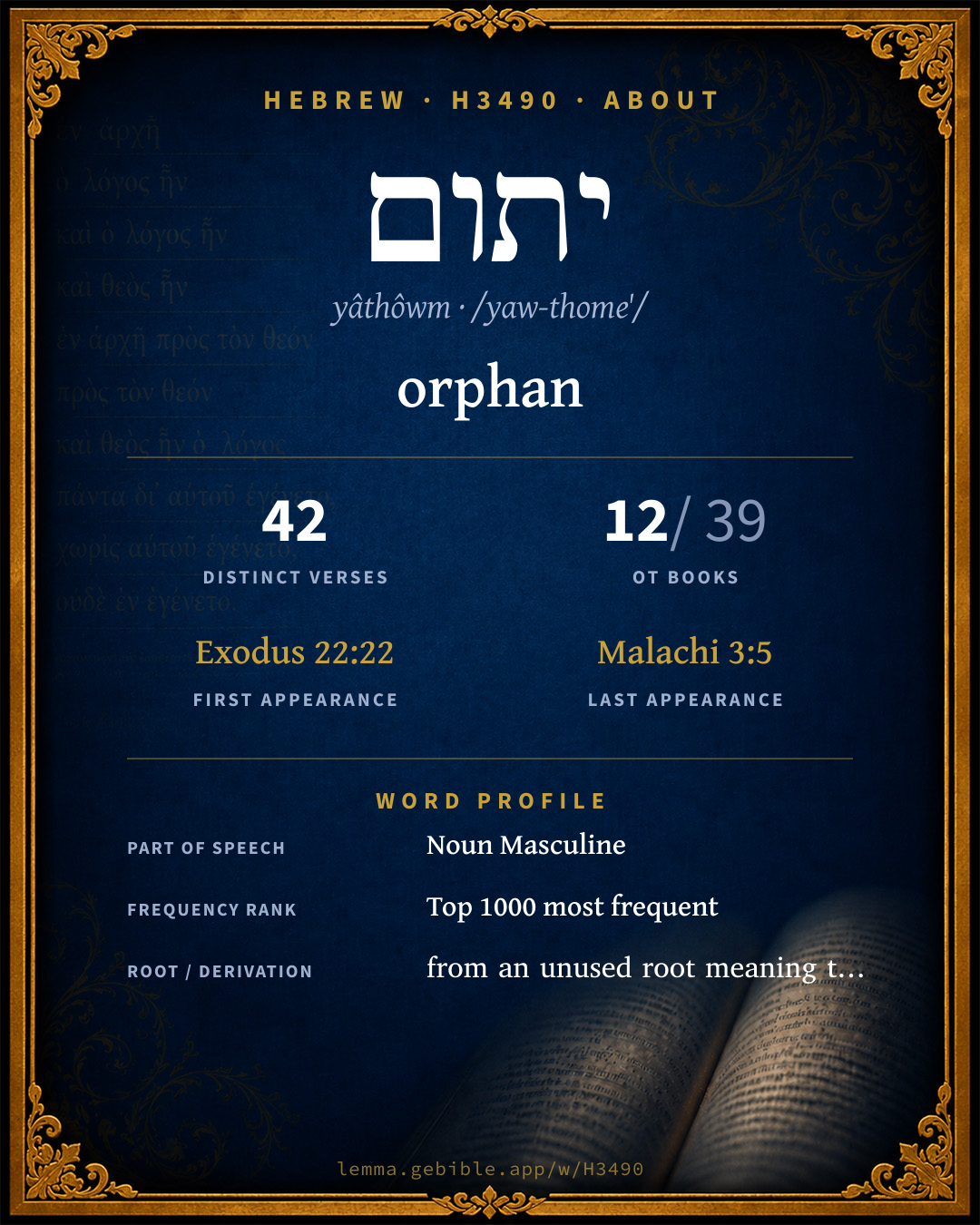
יָתוֹם
orphan
Full lexicon entry — Brown-Driver-Briggs (BDB)
From Brown-Driver-Briggs (BDB)
Where this word appears
See every Absolute-state word in the Hebrew Bible →
Grammar key — what these labels mean
Part of speech
- Noun
- A naming word — a person, place, thing, or idea.
Noun type
- Common
- A common noun — a general class of person, place, or thing (“king,” “city,” “water”), not a specific name.
State
- Absolute
- The independent form of a noun, not bound to a following word.
- Construct
- A noun bound to a following noun in a possessive / “of” relationship (the construct chain).
Gender
- Masculine
- Grammatically masculine.
Number
- Singular
- One.
- Plural
- More than one (in Hebrew, generally three or more).
Grammatical forms
- Noun, Common, Masculine, Singular, Absolute 30 times (71%)
- Noun, Common, Masculine, Plural, Absolute 9 times (21%)
- Noun, Common, Masculine, Plural, Construct 3 times (7%)
Parsed forms decoded from the imported morphology (morphhb / Westminster Leningrad Codex — WLC text public domain, morphhb tagging CC BY 4.0), counted across 42 parsed occurrences — not distinct verses.
Every verse where H3490 appears — 42 distinct verses across 12 books. Click any verse to open its interlinear word-by-word view. Verse text shown in the World English Bible for context — . Each verse’s Hebrew form is shown with its reference; the English is not keyword-highlighted, since the data carries no word-level English alignment. Use “Compare translations” on any verse to read it across multiple English versions. This concordance covers the Hebrew Bible; Septuagint (Greek Old Testament) occurrences are not indexed here.
Exodus 2 verses
Deuteronomy 11 verses
- Deuteronomy 10:18 יָת֖וֹם n c ms He does execute justice for the fatherless and widow, and loves the foreigner, in giving him food and clothing.
- Deuteronomy 14:29 וְ/הַ/יָּת֤וֹם conj + ptcl def.art + n c ms and the Levite, because he has no portion nor inheritance with you, and the foreigner living among you, and the fatherless, and the widow, who are within your gates, shall come, and shall eat and be satisfied; that Yahweh your God may bless you in all the work of your hand which you do.
- Deuteronomy 16:11 וְ/הַ/יָּת֥וֹם conj + ptcl def.art + n c ms and you shall rejoice before Yahweh your God, you, and your son, and your daughter, and your man-servant, and your maid-servant, and the Levite who is within your gates, and the foreigner, and the fatherless, and the widow, who are in the midst of you, in the place which Yahweh your God shall choose, to cause his name to dwell there.
- Deuteronomy 16:14 וְ/הַ/יָּת֥וֹם conj + ptcl def.art + n c ms and you shall rejoice in your feast, you, and your son, and your daughter, and your man-servant, and your maid-servant, and the Levite, and the foreigner, and the fatherless, and the widow, who are within your gates.
- Deuteronomy 24:17 יָת֑וֹם n c ms You shall not wrest the justice [due] to the foreigner, [or] to the fatherless, nor take the widow's clothing to pledge;
- Deuteronomy 24:19 לַ/יָּת֥וֹם prep det + n c ms When you reap your harvest in your field, and have forgot a sheaf in the field, you shall not go again to get it: it shall be for the foreigner, for the fatherless, and for the widow; that Yahweh your God may bless you in all the work of your hands.
- Deuteronomy 24:20 לַ/יָּת֥וֹם prep det + n c ms When you beat your olive tree, you shall not go over the boughs again: it shall be for the foreigner, for the fatherless, and for the widow.
- Deuteronomy 24:21 לַ/יָּת֥וֹם prep det + n c ms When you gather [the grapes of] your vineyard, you shall not glean it after you: it shall be for the foreigner, for the fatherless, and for the widow.
- Deuteronomy 26:12 לַ/יָּת֣וֹם prep det + n c ms When you have made an end of tithing all the tithe of your increase in the third year, which is the year of tithing, then you shall give it to the Levite, to the foreigner, to the fatherless, and to the widow, that they may eat within your gates, and be filled.
- Deuteronomy 26:13 לַ/יָּת֣וֹם prep det + n c ms You shall say before Yahweh your God, I have put away the holy things out of my house, and also have given them to the Levite, and to the foreigner, to the fatherless, and to the widow, according to all your commandment which you have commanded me: I have not transgressed any of your commandments, neither have I forgotten them:
- Deuteronomy 27:19 יָת֖וֹם n c ms Cursed be he who wrests the justice [due] to the foreigner, fatherless, and widow. All the people shall say, Amen.
Job 7 verses
- Job 6:27 יָת֥וֹם n c ms Yes, you would even cast lots for the fatherless, And make merchandise of your friend.
- Job 22:9 יְתֹמִ֣ים n c mp You have sent widows away empty, And the arms of the fatherless have been broken.
- Job 24:3 יְתוֹמִ֣ים n c mp They drive away the donkey of the fatherless, And they take the widow's ox for a pledge.
- Job 24:9 יָת֑וֹם n c ms There are those who pluck the fatherless from the breast, And take a pledge of the poor,
- Job 29:12 וְ֝/יָת֗וֹם conj + n c ms Because I delivered the poor who cried, And the fatherless also, who had none to help him.
- Job 31:17 יָת֣וֹם n c ms Or have eaten my morsel alone, And the fatherless has not eaten of it
- Job 31:21 יָת֣וֹם n c ms If I have lifted up my hand against the fatherless, Because I saw my help in the gate:
Psalms 8 verses
- Psalms 10:14 יָ֝ת֗וֹם n c ms But you do see trouble and grief; You consider it to take it into your hand. You help the victim and the fatherless.
- Psalms 10:18 יָת֗וֹם n c ms To judge the fatherless and the oppressed, That man who is of the earth may terrify no more.
- Psalms 68:5 יְ֭תוֹמִים n c mp A father of the fatherless, and a defender of the widows, Is God in his holy habitation.
- Psalms 82:3 וְ/יָת֑וֹם conj + n c ms "Defend the weak, the poor, and the fatherless. Maintain the rights of the poor and oppressed.
- Psalms 94:6 וִֽ/יתוֹמִ֣ים conj + n c mp They kill the widow and the alien, And murder the fatherless.
- Psalms 109:9 יְתוֹמִ֑ים n c mp Let his children be fatherless, And his wife a widow.
- Psalms 109:12 לִ/יתוֹמָֽי/ו prep + n c mp cs + sfx pers 3ms Let there be none to extend kindness to him, Neither let there be any to have pity on his fatherless children.
- Psalms 146:9 יָת֣וֹם n c ms Yahweh preserves the foreigners. He upholds the fatherless and widow, But the way of the wicked he turns upside down.
Proverbs 1 verse
Isaiah 4 verses
- Isaiah 1:17 יָת֔וֹם n c ms Learn to do well. Seek justice, Relieve the oppressed, Judge the fatherless, Plead for the widow."
- Isaiah 1:23 יָתוֹם֙ n c ms Your princes are rebellious, and companions of thieves. Everyone loves bribes, and follows after rewards. They don't judge the fatherless, Neither does the cause of the widow come to them.
- Isaiah 9:17 יְתֹמָ֤י/ו n c mp cs + sfx pers 3ms Therefore the Lord will not rejoice over their young men, neither will he have compassion on their fatherless and widows; for everyone is profane and an evil-doer, and every mouth speaks folly. For all this his anger is not turned away, but his hand is stretched out still.
- Isaiah 10:2 יְתוֹמִ֖ים n c mp to turn aside the needy from justice, and to rob the poor of my people of their right, that widows may be their spoil, and that they may make the fatherless their prey!
Jeremiah 4 verses
- Jeremiah 5:28 יָת֖וֹם n c ms They are grew fat, they shine: yes, they overpass in deeds of wickedness; they don't plead the cause, the cause of the fatherless, that they may prosper; and the right of the needy they don't judge.
- Jeremiah 7:6 יָת֤וֹם n c ms if you don't oppress the foreigner, the fatherless, and the widow, and don't shed innocent blood in this place, neither walk after other gods to your own hurt:
- Jeremiah 22:3 יָת֨וֹם n c ms Thus says Yahweh: Execute you justice and righteousness, and deliver him who is robbed out of the hand of the oppressor: and do no wrong, do no violence, to the foreigner, the fatherless, nor the widow; neither shed innocent blood in this place.
- Jeremiah 49:11 יְתֹמֶ֖י/ךָ n c mp cs + sfx pers 2ms Leave your fatherless children, I will preserve them alive; and let your widows trust in me.
Lamentations 1 verse
Ezekiel 1 verse
Hosea 1 verse
Zechariah 1 verse
Malachi 1 verse
About this entry
At a glance — auto-summarized from this page’s data, not written by a person. Every figure links to its source below. This summary describes the numbers; it doesn’t interpret them.
יתום — transliterated yâthôwm — is a Hebrew noun carrying the sense “orphan.” Debuting at Exodus 22:22, it then recurs through the corpus. It appears 42 verses across 12 books of the Hebrew Bible, among its moderately common vocabulary. More than a quarter of its appearances fall in Deuteronomy. Related forms include יתמה. See the sense tree, 42-verse concordance, and the renderings breakdown below.
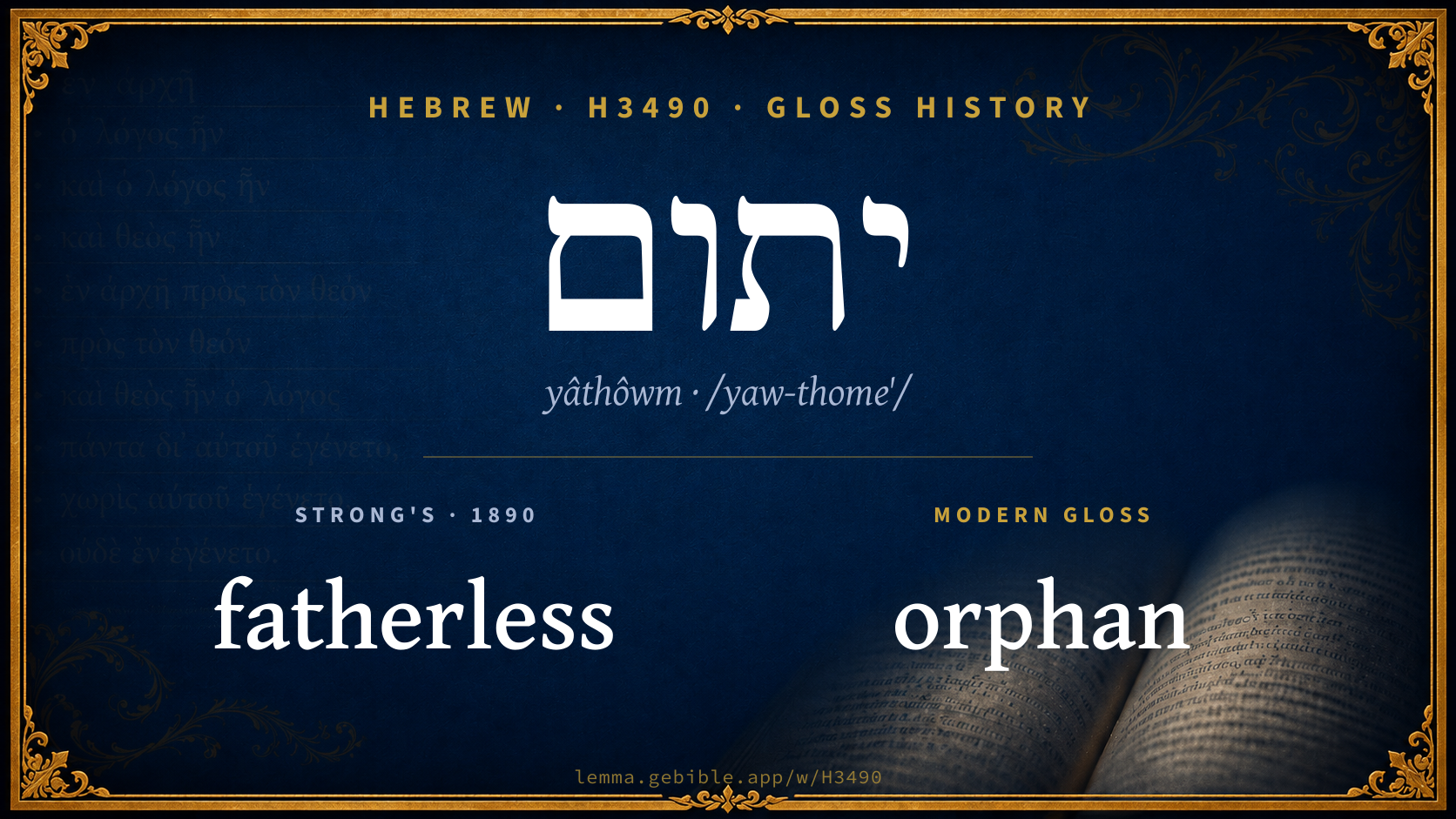
Gloss history
Strong's 1890 vs modern scholarship
About this word
Strong's H3490 catalogs a Hebrew word from the Hebrew Old Testament.
These counts are not copied from any lexicon or concordance. They are computed here, from the morphology-tagged Hebrew Old Testament. What Lemma adds →
- 42
- distinct verses
- The word appears in 42 distinct verses.
- 12 / 39
- OT books
- The word appears in 12 of 39 Old Testament books.
- #864
- by frequency
- Top 1000 most frequent Hebrew words (rank 864 of 8,640 Hebrew words by occurrence).
View all 42 occurrences in the concordance →
Most concentrated in
- Deuteronomy 11 verses 26%
- Psalms 8 verses 19%
- Job 7 verses 17%
By section of the Old Testament
By traditional corpus
Conventional, traditional groupings — biblical authorship is debated, so this is a traditional corpus grouping, not an authorship claim. Each share is this word’s portion of its verses in that division of the Hebrew canon. Each figure is a share of the word’s 42 distinct verses.
- Writings (Ketuvim) 17 verses · 40%
- Torah (Pentateuch) 13 verses · 31%
- Prophets (Nevi'im) 12 verses · 29%
How translations render this word
Counts come from each version’s own published word-to-Strong’s tagging or interlinear alignment — an approximate guide to how each version renders this word, not a word-level alignment the data otherwise carries. Because each total is that version’s own tagged count, the per-version totals vary from one another and need not match the appearance or distinct-verse counts above. These counts may also differ from a printed concordance because Lemma counts each distinctly tagged rendering and does not collapse phrase taggings into a single head-word total. This is a fixed set of word-tagged versions (KJV, ASV, BSB, ULT) and does not change with the reading translation you choose elsewhere. Each version’s license is shown beside its name below (and on Sources).
- King James Version: Fatherless 33×, Fatherless children 2×
- American Standard Version: Fatherless 26×, Shall be for the sojourner for the fatherless 2×
- Berean Standard Bible: Fatherless 33×, Orphans 3×, Or the fatherless 2×
- unfoldingWord Literal Text: Fatherless 22×, Orphan 8×, Orphans 6×
King James Version Public Domain
Renders H3490 across 42 tagged occurrences — most commonly:
Plus 7 renderings that appear only once — usually multi-word phrases or single function words the recovered tagging swept in, not distinct renderings.
American Standard Version Public Domain
Renders H3490 across 42 tagged occurrences — most commonly:
Plus 14 renderings that appear only once — usually multi-word phrases or single function words the recovered tagging swept in, not distinct renderings.
Berean Standard Bible Public Domain
Renders H3490 across 42 tagged occurrences — most commonly:
Plus 4 renderings that appear only once — usually multi-word phrases or single function words the recovered tagging swept in, not distinct renderings.
unfoldingWord Literal Text CC BY-SA 4.0
Renders H3490 across 42 tagged occurrences — most commonly:
Plus 4 renderings that appear only once — usually multi-word phrases or single function words the recovered tagging swept in, not distinct renderings.
Senses in BDB
The 1 sense BDB distinguishes for this word, in lexicon order (not ranked by frequency or importance). The full entry — with sub-senses — is in the Lexicon Entry tab.
- an orphan, fatherless
Word origin
n.[m.] orphan (NH id.; Aramaic יַתְמָא, ܝܰܬܡܳܐ; Ph. יתם; Arabic يَتِيمٌ pupil, orphan)—יָתוֹם Ex 22:21 + 29 times; pl. יְתוֹמִים v 23 + 8 times; sf. יְתֹמֶיךָ Je 49:11; יְתֹמָיו Is 9:16; לִיתוֹמָיו ψ 109:12;—orphan, i.e. fatherless (‖ אַלְמָנָה) Ex 22:23 ψ 109:9 La 5:3 (‖ אֵין אָב); Jb 24:9 ψ 109:12; prob. also Ex 22:21 Dt 10:18; 14:29; 16:11, 14; 24:17, 19, 20, 21; 26:12, 13; 27:19 ψ 94:6; 146:9 Je 7:6; 22:3 Zc 7:10 Mal 3:5 (in all these, mentioned as helpless, exposed to injury, ‖ אַלְמָנָה and גֵּר); similarly, ‖ אַלְמָנָה Jb 22:9; 24:3; 29:12; 31:17 ψ 68:6 Is 1:17, 23; 9:16; 10:2 Je 49:11 Ez 22:7; without אלמנה Ho 14:4 Jb 6:27; 31:21 ψ 10:14, 18 Pr 23:10 Je 5:28 (in no case clear that both parents are dead).
— Brown-Driver-Briggs (Oxford 1906, public domain), digitized via Sefaria, supplemented by the OpenScriptures HebrewLexicon (CC BY 4.0). See Sources.
Origin: from an unused root meaning to be lonely
Jastrow Dictionary
A second Hebrew/Aramaic lexicon for comparison, covering Aramaic and post-biblical (Talmudic, Targumic, Midrashic) usage that the biblical-Hebrew BDB does not. Matched by lemma rather than by Strong’s number, so a lemma may carry more than one Jastrow headword (shown separately below), and the entries cover usage well beyond the Bible.
יָתוֹם
- (b. h.) [by one’s self, cmp. גּוּף, גַּף I,] single, alone, forsaken. Ḥag. 3ᵇ; Mekh. Bo s. 16, a. e. אין הדור י׳ וכ׳ that generation is not forsaken in which &c.—אמן י׳, v. אָמֵן.—Esp.
- 1. fatherless, orphan, public charge. Meg. 13ᵃ המגדל י׳ וי׳ בתוך ביתו וכ׳ he who rears a male or female orphan in his house, is regarded as the parent. Tosef. Keth. VI, 8 י׳ וי׳ צריכין פרנסה מפרנסין את היתומה וכ׳ if an orphan boy and an orphan girl need public support, we must support the girl first &c.; Keth. 67ᵃ. Taan. 24ᵃ בי׳ וי׳ we were engaged in collecting for an orphaned couple to be married; a. v. fr.—יתומה בחיי האב self-depending in her father’s life-time, i.e. a minor over whom her father has no control, e.g. when he has given her away in marriage, and she being divorced or widowed returns to her paternal home. Yeb. XIII, 6. Keth. 73ᵇ; a. fr.
- 2. an animal whose mother died during or soon after childbirth. Bekh. IX, 4. Ḥull. 38ᵇ
- 3. (Law) a minor heir whom the authorities must protect by appointing a guardian to plead his cause &c.; in gen. heir (mostly in the plural).—Pl. יְתוֹמִים, יְתוֹמִין; f. יְתוֹמוֹת. B. Mets. 70ᵃ מעות של י׳ minor heirs’ funds. B. Bath. 124ᵃ שבח שהשביחו י׳ לאחר וכ׳ improvements which the heirs made after their father’s death (before division). Arakh. VI, 1 (21ᵇ) שום הי׳ the assessment for public sale of minors’ (heirs’) property which the court sells to satisfy the decedent’s creditors. Gitt. V, 1; a. fr.—Yeb. XIII, 7 שתי אחיות י׳ two orphan sisters; a. fr.
יָתוֹם ²
- Targ. Y. Ex. XXII, 21 (O. יִתַּם).—Pl. יְתוֹמֵי. Targ. Job XXII, 9.—Fem. יְתוֹמְתָּא. Lev. R. s. 37 (some ed. יְתִימְתָּא).—V. יִתַּם.
A Dictionary of the Targumim, the Talmud Babli and Yerushalmi, and the Midrashic Literature (Marcus Jastrow; London, Luzac, 1903) — Public Domain. Digitized via Sefaria. Digitized via Sefaria. Full attribution on Sources.
Forms in the corpus
The 32 distinct written forms H3490 takes in the Hebrew Bible, most frequent first — each parse links to that state’s occurrences in the concordance. Hebrew forms include their vowel points and cantillation, so a single lemma takes many written forms.
Same root — word family
Other BDB entries built from the same root as H3490, grouped by Strong’s listed origin. These share a root / origin per the lexicon — not necessarily a shared meaning. Each links to that word’s own entry.
Proper names from this root
People and places named from this root — a name, not an additional meaning of the word.
Compare all same-root words → 1 of the same-root words is a proper name (a person or place). They share a root, not necessarily a meaning.
Septuagint verse parallels
This word appears in 38 verses that also exist in the Greek Old Testament (Septuagint), out of the 42 Hebrew verses it occurs in. You can read those verses in Greek by switching the Old Testament edition to the Septuagint.
Read these verses in the Septuagint
- Exodus 22:22
- Deuteronomy 10:18
- Job 6:27
- Psalms 68:5
- Proverbs 23:10
- Isaiah 1:17
- Jeremiah 5:28
- Lamentations 5:3
- Ezekiel 22:7
- Hosea 14:3
- Zechariah 7:10
- Malachi 3:5
This is a verse-level parallel only — the same verses exist in both the Hebrew and Greek Old Testaments. No word-level Hebrew↔Greek correspondence is claimed: the data carries no such alignment, so no Greek word is shown as this Hebrew word’s translation. Coverage is not total — the Septuagint omits the deuterocanon and renumbers the Psalms, so some Hebrew verses have no direct Greek parallel.