
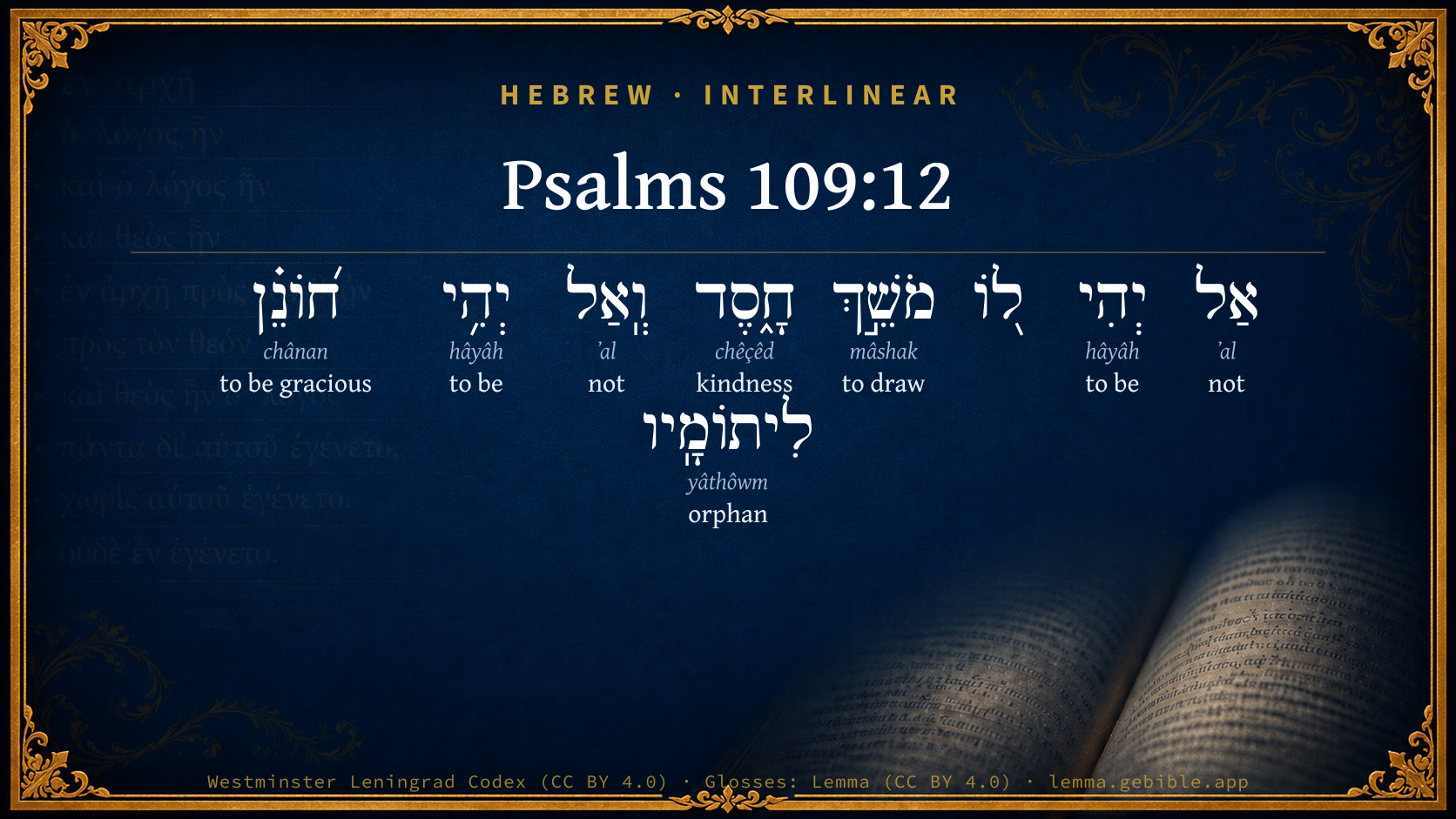
Psalms 109:12

Hebrew (Westminster Leningrad Codex) Psalms 109:12 appears in the Hebrew Old Testament. The text above is from the Westminster Leningrad Codex. Each word links to its Strong’s number, a concise gloss, and parsing drawn from the Open Scriptures Hebrew Bible morphology. Click any word for its full Brown-Driver-Briggs (BDB) entry.
Download image
Cite this verse

Psalms 109:12 (World English Bible). Public Domain. Lemma interlinear Bible study tool, https://lemma.gebible.app/v/psalms/109/12.

Show BibTeX & RIS
BibTeX
RIS
English Translation
Let there be none to extend kindness to him, Neither let there be any to have pity on his fatherless children.
World English Bible · Public Domain
Download a study sheet

One document with this verse’s original text, its word-by-word gloss line, the meaning frame, cross-references with their text, attributed commentary, and full source and license credits — printable, and it pastes into notes with its structure intact.

This verse Autodidact and up

Study sheet (.html) Plain text (.txt)

A passage Seminary Student

Up to 50 verses in one chapter. A passage sheet keeps up to 6 commentary sources and 12 cross-references per verse, in the order this page ranks them, and says so on the sheet whenever that leaves anything out. Ask for a single verse and you get the Autodidact verse sheet above.

Everything on this page stays free to read, with no account — the sheet is a download of what is already on screen, not access to it.

Want to remove ads? Support Godless Engineer
Compare translations 3

The same verse in 3 English versions, stacked beneath the original-language interlinear above. Click any original word for its lexicon entry.

Each is an independent rendering of the whole verse — the interlinear is not word-aligned to these translations.

Highlighted words mark where these versions differ — a whole-verse word diff, not a word-by-word alignment.

  • World English Bible Public Domain
    Let there be none to extend kindness to him, Neither let there be any to have pity on his fatherless children.
  • King James Version Public Domain
    Let there be none to extend mercy unto him: neither let there be any to favour his fatherless children.
  • unfoldingWord Literal Text CC BY-SA 4.0
    May there not be to him extending covenant faithfulness; and may there not be pitying his orphans.

unfoldingWord Literal Text — © unfoldingWord, licensed CC BY-SA 4.0. Word-aligned USFM3 via Door43 (git.door43.org/unfoldingWord/en_ult).

Versions to compare (up to 4)

3 of 4 selected

Show all 18 translations

Every available English version of this verse, each an independent rendering of the whole verse.

  • World English Bible Public Domain
    Let there be none to extend kindness to him, Neither let there be any to have pity on his fatherless children.
  • Berean Standard Bible Public Domain
    May there be no one to extend kindness to him, and no one to favor his fatherless children.
  • Majority Standard Bible Public Domain
    May there be no one to extend kindness to him, and no one to favor his fatherless children.
  • King James Version Public Domain
    Let there be none to extend mercy unto him: neither let there be any to favour his fatherless children.
  • American Standard Version (1901) Public Domain
    Let there be none to extend kindness unto him; Neither let there be any to have pity on his fatherless children.
  • Revised Version (1885) Public Domain
    Let there be none to extend mercy unto him; neither let there be any to have pity on his fatherless children.
  • Geneva Bible (1599) Public Domain
    Let there be none to extend mercie vnto him: neither let there be any to shewe mercie vpon his fatherlesse children.
  • Douay-Rheims (1899) Public Domain
    May there be none to help him: nor none to pity his fatherless offspring.
  • Young's Literal Translation Public Domain
    He hath none to extend kindness, Nor is there one showing favour to his orphans.
  • Literal Standard Version CC BY-SA 4.0
    He has none to extend kindness, || Nor is there one showing favor to his orphans.
  • Unlocked Literal Bible CC BY-SA 4.0
    May no one extend any kindness to him; may no one have pity on his fatherless children.
  • unfoldingWord Literal Text CC BY-SA 4.0
    May there not be to him extending covenant faithfulness; and may there not be pitying his orphans.
  • Darby Bible Public Domain
    Let there be none to extend kindness unto him, neither let there be any to favour his fatherless children;
  • World Messianic Bible Public Domain
    Let there be no one to extend kindness to him, neither let there be anyone to have pity on his fatherless children.
  • Webster's Bible Public Domain
    Let there be none to extend mercy to him: neither let there be any to favor his fatherless children.
  • Free Bible Version CC BY-SA 4.0
    May no one be kind to him; may no one take pity on his fatherless children.
  • Bible in Basic English Public Domain
    Let no man have pity on him, or give help to his children when he is dead.
  • JPS Tanakh (1917) Public Domain
    Let there be none to extend kindness unto him; neither let there be any to be gracious unto his fatherless children.

Literal Standard Version (2020), Covenant Press — licensed CC BY-SA 4.0. Text via the HelloAO Bible API (eBible.org). Unlocked Literal Bible (unfoldingWord) — licensed CC BY-SA 4.0. Text via the HelloAO Bible API (eBible.org). unfoldingWord Literal Text — © unfoldingWord, licensed CC BY-SA 4.0. Word-aligned USFM3 via Door43 (git.door43.org/unfoldingWord/en_ult). Free Bible Version, Dr. Jonathan Gallagher — licensed CC BY-SA 4.0. Text via the HelloAO Bible API (eBible.org).

Word by word

More ways to search: Search by grammar → Find every occurrence → Compare this word →

Practice this passage: Drill this verse → Learn its vocabulary →

מֹשֵׁ֣ךְ
mâshak
H4900
“drawing”
Verb, Qal, Participle Active, Masculine, Singular, Absolute
Part of Speech
Verb
Stem
Qal
Form
Participle Active
Gender
Masculine
Number
Singular
State
Absolute
Full BDB Definition

Origin: a primitive root

TWOT: 1257

to draw, drag, seize - (Qal) - to draw (and lift out), drag along, lead along, drag or lead off, draw down - to draw (the bow) - to proceed, march - to draw out or give (a sound) - to draw out, prolong, continue - to trail (seed in sowing) - to cheer, draw, attract, gratify - (Niphal) to be drawn out - (Pual) - to be drawn out, be postponed, be deferred - to be tall
  1. אַל ʼal H408 “not” Particle, Negative
  2. יְהִי hâyâh H1961 “to be” Verb, Qal, Jussive, 3rd Person, Masculine, Singular
  3. חָ֑סֶד chêçêd H2617 “kindness” Noun, Common, Masculine, Singular, Absolute
  4. וְֽאַל ʼal H408 “and · not” Conjunction + Particle, Negative
  5. יְהִ֥י hâyâh H1961 “to be” Verb, Qal, Jussive, 3rd Person, Masculine, Singular
  6. ח֝וֹנֵ֗ן chânan H2603 “being gracious” Verb, Qal, Participle Active, Masculine, Singular, Absolute
  7. לִיתוֹמָֽיו yâthôwm H3490 “to/for · orphans · his” Preposition + Noun, Common, Masculine, Plural, Construct + Suffix, Personal, 3rd Person, Masculine, Singular

About this verse

These counts appear in no published source. They are computed here, from the morphology-tagged text and Lemma’s own curated glosses. What Lemma adds →

9
words
6
distinct lemmas
Wisdom
section

Shared distinctive vocabulary

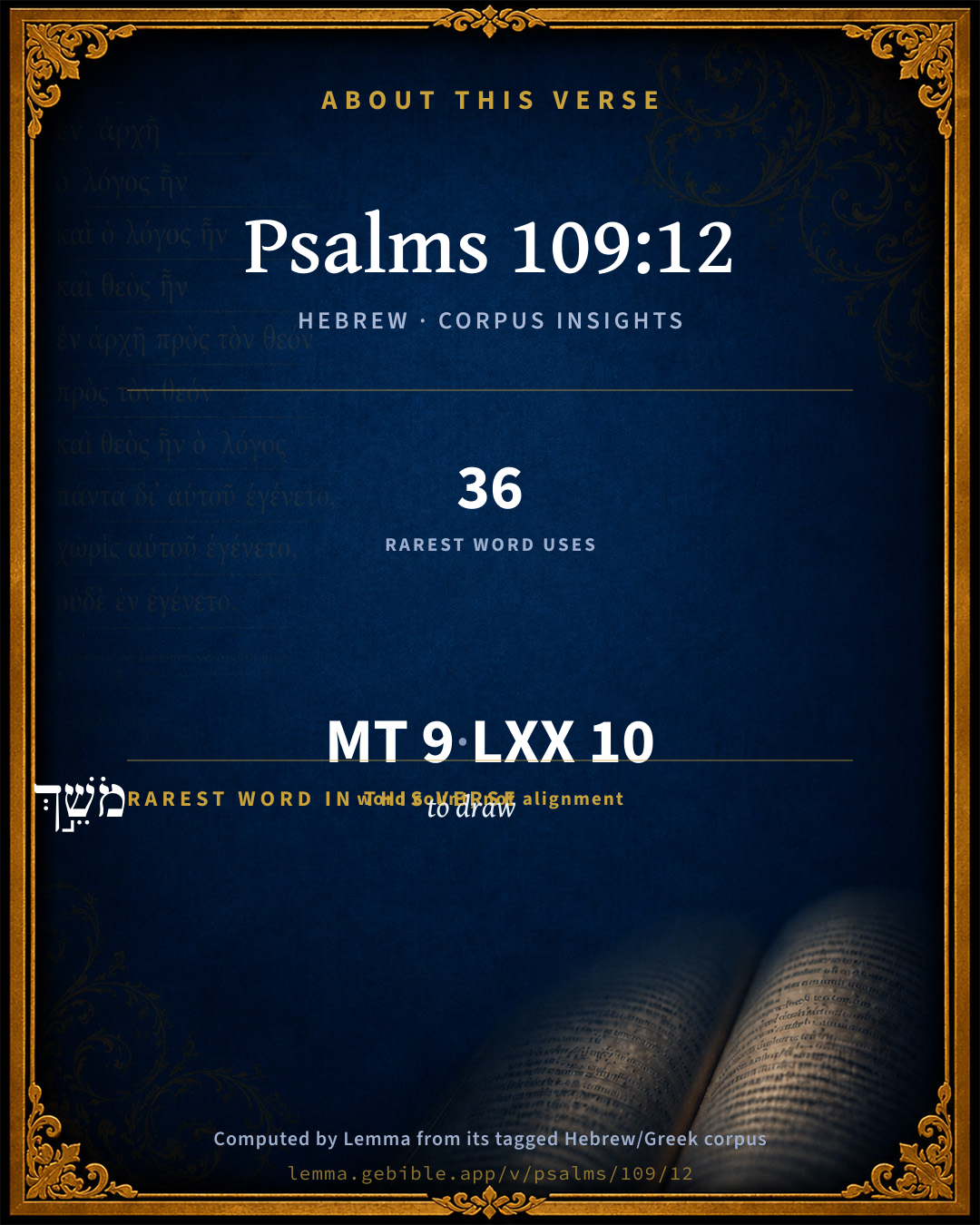
מֹשֵׁ֣ךְ to draw H4900 occurs in 36 verses of the Hebrew Bible. Also found in:

Grammatical profile

  • 4 verbs
  • 2 nouns
  • 1 preposition
  • 2 particles

Verb forms

  • יְהִי Qal · Jussive
  • מֹשֵׁ֣ךְ Qal · Participle Active
  • יְהִ֥י Qal · Jussive
  • ח֝וֹנֵ֗ן Qal · Participle Active

Repetition

Words recur within this verse — often emphatic in Hebrew:

  • יְהִי to be H1961 ×2
  • אַל not H408 ×2

Hebrew & Septuagint length

In English translation the verse runs 21 words from the Hebrew and 18 from the Septuagint (LXX English) — closely comparable.

A rough comparison of the two English renderings, which tokenize alike — not a word-level alignment.

Word counts can differ between the Hebrew and the Greek without any difference in meaning — e.g. the Hebrew direct-object marker אֵת has no separate Greek word, and Greek often adds the article ὁ.

In the original languages it is 9 Hebrew tokens and 10 Greek tokens — but the two are counted differently (Hebrew bundles its prefixes and suffixes into one token; the Greek is in lemma form), so that isn’t a like-for-like length.

Cross-references

9

Topical passages linked to Psalms 109:12 in the Treasury of Scripture Knowledge — connected by theme and wording, ordered by reader-vote popularity; previews shown in the World English Bible.

  • Psalms 137:8–9 Daughter of Babylon, doomed to destruction, He will be happy who rewards you, As you have served us.
  • Matthew 27:25 All the people answered, "May his blood be on us, and on our children!"
  • Luke 6:38 "Give, and it will be given to you: good measure, pressed down, shaken together, and running over, will be given to you. For with the same measure you measure it will be measured back to you."
  • James 2:13 For judgment is without mercy to him who has shown no mercy. Mercy triumphs over judgment.
  • Job 5:4 His children are far from safety, They are crushed in the gate. Neither is there any to deliver them,
  • Isaiah 9:17 Therefore the Lord will not rejoice over their young men, neither will he have compassion on their fatherless and widows; for everyone is profane and an evil-doer, and every mouth speaks folly. For all this his anger is not turned away, but his hand is stretched out still.
  • Isaiah 13:18 [Their] bows shall dash the young men in pieces; and they shall have no pity on the fruit of the womb; their eye shall not spare children.
  • Isaiah 27:11 When the boughs of it are withered, they shall be broken off; the women shall come, and set them on fire; for it is a people of no understanding: therefore he who made them will not have compassion on them, and he who formed them will show them no favor.
  • Luke 11:50–51 that the blood of all the prophets, which was shed from the foundation of the world, may be required of this generation;

Cross-references courtesy of OpenBible.info (CC BY 4.0).

Hebrew and Greek witnesses Masoretic Hebrew ↔ Greek Septuagint

The same verse in the two great witnesses to the Old Testament, shown verse-for-verse.

You’re reading Greek Psalm 108 (Hebrew Psalm 109). The Septuagint counts the superscription, so verse numbers can differ from the Hebrew — chapter-level alignment, not verse-by-verse. Numbering follows Rahlfs.

These are two independent witnesses, not word-aligned to each other, and the Septuagint is shown in lemma (dictionary) form.

Hebrew Psalms 109:12 Masoretic · Westminster Leningrad Codex

אַל יְהִי ל֭וֹ מֹשֵׁ֣ךְ חָ֑סֶד וְֽאַל יְהִ֥י ח֝וֹנֵ֗ן לִיתוֹמָֽיו

Let there be none to extend kindness to him, Neither let there be any to have pity on his fatherless children.

World English Bible · Public Domain

Greek LXX Greek Psalm 108:12 Septuagint · lemma form

μή ὑποἄρχω αὐτός ἀντιλήμπτωρ μηδέ γίγνομαι οἰκτίρμων ὁ ὀρφανός αὐτός

Let him have no helper; neither let there be any one to have compassion on his fatherless children.

LXX2012 (modern English Septuagint) · Public Domain

Hebrew: Westminster Leningrad Codex (CC BY 4.0). Greek: Septuagint (public domain); English from LXX2012 (modern English Septuagint) (Public Domain). How the Septuagint differs from the Hebrew →

Commentary

Notes on Psalms 109:12 from classic Christian and Jewish commentators (each source and its license shown beneath its notes). The classic Christian expositions comment on the surrounding passage and are grouped to its opening verse, so a note may address several verses; the Jewish commentaries on the Tanakh (Rashi and others) are per-verse, so they appear only where the commentator wrote on this verse.

Lemma curates 59 commentaries, every one of them public domain or Creative Commons licensed, each selected and text-cleaned for this edition rather than reprinted as found. About our sources →

Trapp's Complete Commentary

John Trapp

Psa 109:12 Let there be none to extend mercy unto him: neither let there be any to favour his fatherless children.

Ver. 12. Let there be none to extend mercy to him] Let God in his justice set off all hearts from him that had been so unreasonably merciless. Thus no man opened his mouth to intercede for Haman; Judas was shaken off by the priests, and bid see to himself, &c.

Neither let there be any to favour his fatherless] Pupillis pusillis. Let there be none to plead their pupil’s cause against the griping extortioner, or the stranger that violently invadeth their right.

John Trapp, A Commentary or Exposition upon All the Books of the Old and New Testament (1647–1656) — public domain. Text from a community e-Sword module.

J. A. Alexander on Psalms

Joseph Addison Alexander

12. (Psa 109:12) Let there be no one to him, extending mercy, and let there be no one shewing favour to his orphans. The verb translated extend literally means draw out, prolong, and is applied to the continued indulgence both of hostile and amicable feelings. See above, on Psa 28:3; Psa 36:10; Psa 85:5. Shewing favour, exercising mercy, as in Psa 37:21.

Joseph Addison Alexander, The Psalms Translated and Explained (1850) — public domain. Text from a community e-Sword module.

John Calvin's Commentaries

12 Let there be none prolonging mercy to him. To continue to show humanity and mercy is, according to the Hebrew idiom, equivalent to constant and successive acts of kindness; and it also sometimes denotes pity, or the being moved to sympathy, when, through the lapse of years, anger is appeased, and even one’s calamity melts the heart of the man who bore hatred towards him. Accordingly, there are some who understand this clause to mean, that there will be none to show kindness to his offspring; which interpretation is in conformity with the next clause of the verse. David, however, includes also the wicked man himself along with his children; as if he should say, Though he visibly pine away under such calamities, and these descend to his children, yet let no one show pity towards them. We are aware it not unfrequently happens, that the long-continued misfortune of an enemy either excites the sympathy of men of savage dispositions, or else makes them forget all their hatred and malevolence. But in this part of the psalm, David expresses a desire that his enemy and all his posterity may be so hated and detested, that the people may never be wearied with beholding the calamities which they endure, but may become so familiarised with the spectacle, as if their hearts were of iron. At the same time, let it be remarked, that David is not rashly excited by any personal anguish to speak in this manner, but that it is as God’s messenger he declares the punishment which was impending over the ungodly. And verily the law accounts it as one of the judgments of God, his hardening men’s hearts, so that they who have been passionately and unmercifully cruel, should find no sympathy, Deuteronomy 2:30. It is just that the same measure which they have used towards others, should also be meted out to themselves.

John Calvin's Commentaries (1540-1563) — public domain. Text from the Calvin Translation Society English edition (1840s-50s) via the Christian Classics Ethereal Library (ccel.org). Calvin's coverage is partial (roughly two-thirds of the Bible); uncommented books and verses are honest gaps, never fabricated. The 19th-century editor's footnotes and remarks are omitted so the notes are faithfully Calvin's own voice.

The Cambridge Bible for Schools and Colleges

gen. ed. J. J. S. Perowne

12. Let him have none to continue lovingkindness to him as represented in his children; nor any one to have pity on his orphans.

The Cambridge Bible for Schools and Colleges (gen. ed. J. J. S. Perowne; Cambridge University Press, 1878–1918) — public domain. Text from a community e-Sword module.

John Gill's Exposition

Let his posterity be cut off,.... As the seed of the wicked are said to be, Psa 37:28, or cut down, as a tree to the very root; as the Jewish nation was by the axe of God's judgment, which, John says, was laid to the root of the tree, and the blow just going to be given, as it was in a few years after, Mat 3:10 or, as the Targum,

"let his end be for destruction;''

and so the Syriac version, "let their end be for destruction"; their last end, which it is said shall be cut off, and issue in death, eternal death; when the end of a good man is peace and eternal life, see Psa 37:37.

And in the generation following let their name be blotted out: or, in another age (d); the next age, the third generation; meaning the name of the posterity of Judas, and the name of the people of the Jews, so as to be spoken of with honour and reputation; but, instead of that, they are for a taunt, a proverb, and a curse, in all places.

(d) "in generatione altera", Pagninus, Montanus, &c.

John Gill's Exposition of the Whole Bible (1746–1763) — public domain (CC PDM 1.0). Text via the HelloAO Bible API.

Albert Barnes' Notes on the Bible

Let there be none to extend mercy unto him - Let him find compassion and sympathy in no one. When he suffers, let him be left to bear it alone. Let there be none found to shed a tear of compassion over him, or to relieve him. Literally, “Let there be no one to draw out kindness to him.”

Neither let there be any to favor his fatherless children - To show them mercy or kindness. See the notes at Psa 109:10.

Albert Barnes' Notes on the Bible (1834–1885) — public domain. Text from a community e-Sword/MySword module.

Matthew Poole's English Annotations

Let him and his be unpitied and hated as the public enemies of mankind.

Matthew Poole's English Annotations on the Holy Bible (1683–1685) — public domain. Text from a community e-Sword/MySword module.

The Treasury of David

Charles H. Spurgeon

Ver. 12. Let there be none to extend mercy unto him. He had no mercy, but on the contrary, he crushed down all who appealed to him. Loath to smite him with his own weapon, stern justice can do no otherwise, she lifts her scales and sees that this, too, must be in the sentence.

Neither let there be any to favour his fatherless children. We are staggered to find the children included in the father's sentence, and yet as a matter of fact children do suffer for their father's sins, and, as long as the affairs of this life are ordered as they are, it must be so. So involved are the interests of the race, that it is quite impossible in all respects to view the father and the child apart. No man among us could desire to see the fatherless suffer for their deceased father's fault, yet so it happens, and there is no injustice in the fact. They share the parent's ill gotten gain or rank, and their aggrandizement is a part of the object at which he aimed in the perpetration of his crimes; to allow them to prosper would be an encouragement and reward of his iniquity; therefore, for these and other reasons, a man perishes not alone in his iniquity. The ban is on his race. If the man were innocent this would be a crime; if he were but commonly guilty it would be excessive retribution; but when the offence reeks before high heaven in unutterable abomination, it is little marvel that men devote the man's whole house to perpetual infamy, and that so it happeneth.

Ver. 12. Let there be none to extend mercy to him. He does not say, None who shall shew, but none who shall "extend" kindness to him. The extending of kindness is, when after a friend's death it is shown to his children, and true friendship is of this sort, that the kindness which friends shewed to each other while alive is maintained, not extinguished with the death of the friend. Wolfgang Musculus.

Ver. 12. Let there be none to extend mercy to him. Let God in his justice set off all hearts from him that had been so unreasonably merciless. Thus no man opened his mouth to intercede for Haman; Judas was shaken off by the priests, and bid see to himself, etc. John Trapp.

Psalms 109:13*

Charles H. Spurgeon's The Treasury of David (1869–1885) — public domain. Psalms only. Text from a community e-Sword/MySword module.

Whedon's Commentary on the Bible

Daniel D. Whedon

12. Let there be none to extend mercy—There shall be none. The word “extend” takes the sense of lengthened time, as Psa_36:10, “O continue,” etc. Psa_85:5, “Wilt thou draw out,” etc. Pro_13:12, “Hope deferred,” etc. And the quality of mercy here denoted is that of requital—remitting the claim of a creditor—as in 2Sa_9:1; 2Sa_9:3; 2Sa_9:7; 2Sa_10:2; 1Ki_2:7. The idea is, that the life and character of the father had been such as awakened no regrets at his downfall, and none felt obligated to requite his acts with favour, or to prolong kindness to his family for the father’s sake. In the divine constitution this is a penal consequence of accumulating wealth by a merciless and unprincipled life. Pro_21:13; Pro_28:8; Jas_2:13

Daniel D. Whedon (gen. ed.), Commentary on the Old and New Testaments (1874–1909) — public domain. Text from a community e-Sword module.

The Pulpit Commentary

Let there be none to extend (literally, continue) mercy unto him. In his need, let none of his neighbors continue to show him mercy and loving-kindness. Let them stand aloof, and remain passive, while punishment overtakes him. Neither let there be any to favor his fatherless children. Let them too be suffered to endure the woes which come naturally upon them (see ver. 10) through their father"s fault, without any one thinking it necessary, because they arc fatherless, to show them favor.

The Pulpit Commentary (1880–1919), ed. H.D.M. Spence-Jones & Joseph S. Exell — public domain. Text from a community e-Sword module.

Lesson kit

Teaching starters — assembled from the data on this page, not authored interpretation. Every prompt links to the verse data it draws on. Edit before teaching.

Psalms, in the Wisdom, opens this verse with 9 words (6 distinct Hebrew lemmas). Its most distinctive word is mâshak (“to draw”). A historical commentator’s framing appears above. Read the whole chapter for the surrounding context.

Discussion questions

  1. The word mâshak carries the sense “to draw.” How does it shape the verse?
  2. How does Genesis 37:28, which shares the word «to draw», read alongside this verse?
  3. What does the repetition of “to be” (2× in this one verse) do in this verse?
  4. These translations render this verse differently. What is at stake in choosing one wording over another?
  5. «יְהִי» is a Qal Jussive verb. How does that grammatical form shape the action described?
  6. Compare how Trapp's Complete Commentary and J. A. Alexander on Psalms read this verse. Where do they agree or differ?

Things to notice

Reading settings

Reading text

Shown beneath each verse's original-language words.

Old Testament
Old Testament edition

Read the OT as the Masoretic Hebrew (MT) or the Greek Septuagint (LXX).

English shown for the Greek Septuagint (in the Hebrew ↔ Greek comparison).

Comparing translations? Open the Compare panel on any verse page to stack up to four side by side.