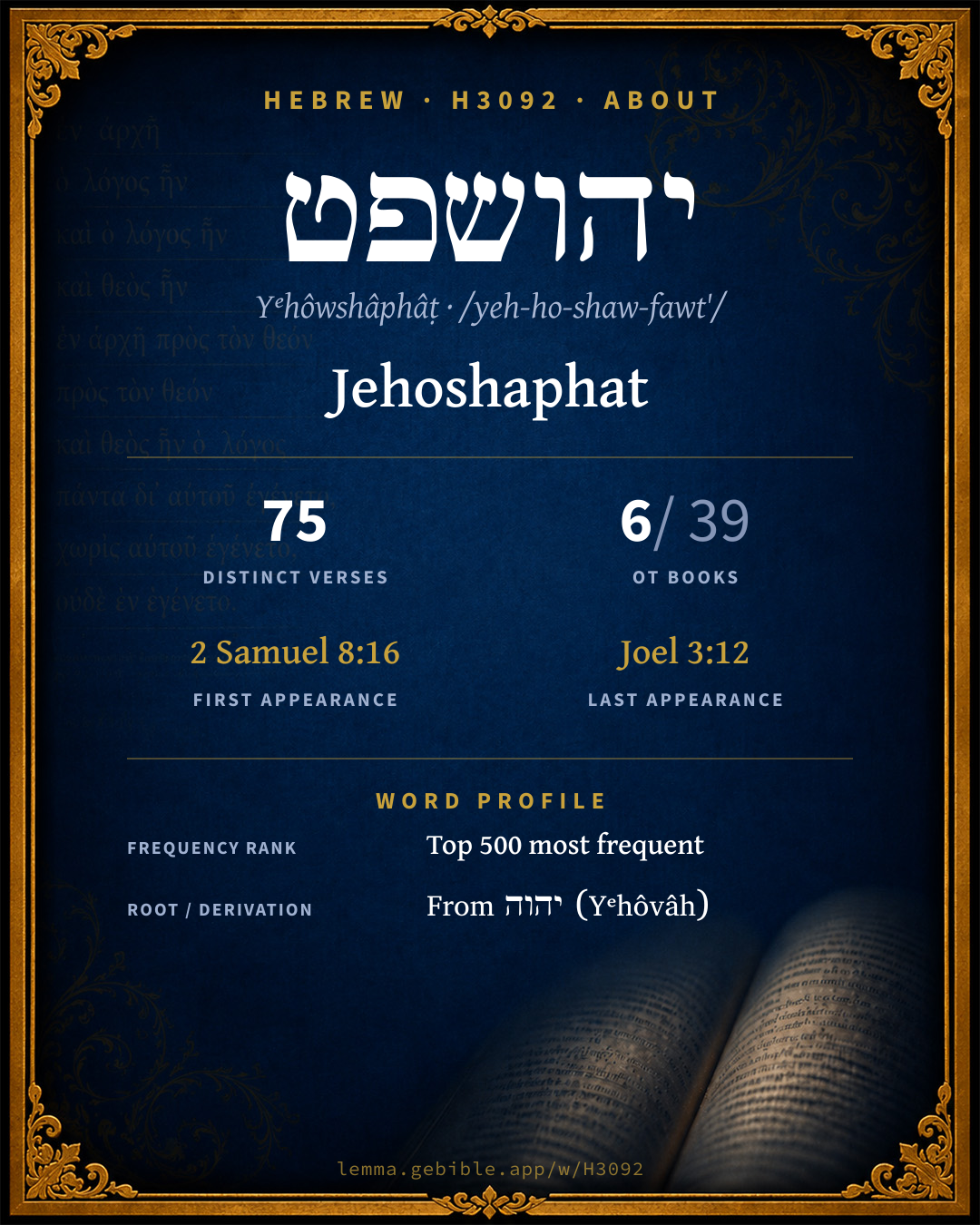
יְהוֹשָׁפָט
Jehoshaphat
BDB lists 7 entries for ‘Jehoshaphat’ fuller range ↓
Full lexicon entry — Brown-Driver-Briggs (BDB)
From Brown-Driver-Briggs (BDB)
Where this word appears
Grammar key — what these labels mean
Part of speech
- Noun
- A naming word — a person, place, thing, or idea.
Noun type
- Proper
- A name of a specific person, place, or people (e.g. Abraham, Zion, Israel).
Every verse where H3092 appears in the Book of 1 Kings — 21 distinct verses. Click any verse to open its interlinear word-by-word view. Verse text shown in the World English Bible for context — . Each verse’s Hebrew form is shown with its reference; the English is not keyword-highlighted, since the data carries no word-level English alignment. Use “Compare translations” on any verse to read it across multiple English versions. This concordance covers the Hebrew Bible; Septuagint (Greek Old Testament) occurrences are not indexed here.
1 Kings
- 1 Kings 4:3 יְהוֹשָׁפָ֥ט n Proper Elihoreph and Ahijah, the sons of Shisha, scribes; Jehoshaphat the son of Ahilud, the recorder;
- 1 Kings 4:17 יְהוֹשָׁפָ֥ט n Proper Jehoshaphat the son of Paruah, in Issachar;
- 1 Kings 15:24 יְהוֹשָׁפָ֥ט n Proper Asa slept with his fathers, and was buried with his fathers in the city of David his father; and Jehoshaphat his son reigned in his place.
- 1 Kings 22:2 יְהוֹשָׁפָ֥ט n Proper It happened in the third year, that Jehoshaphat the king of Judah came down to the king of Israel.
- 1 Kings 22:4 יְה֣וֹשָׁפָ֔ט יְהֽוֹשָׁפָט֙ n Proper n Proper He said to Jehoshaphat, Will you go with me to battle to Ramoth-gilead? Jehoshaphat said to the king of Israel, I am as you are, my people as your people, my horses as your horses.
- 1 Kings 22:5 יְהוֹשָׁפָ֖ט n Proper Jehoshaphat said to the king of Israel, Please inquire first for the word of Yahweh.
- 1 Kings 22:7 יְה֣וֹשָׁפָ֔ט n Proper But Jehoshaphat said, Isn't there here a prophet of Yahweh besides, that we may inquire of him?
- 1 Kings 22:8 יְהוֹשָׁפָ֡ט יְה֣וֹשָׁפָ֔ט n Proper n Proper The king of Israel said to Jehoshaphat, there is yet one man by whom we may inquire of Yahweh, Micaiah the son of Imlah: but I hate him; for he does not prophesy good concerning me, but evil. Jehoshaphat said, "Don't let the king say so."
- 1 Kings 22:10 וִֽ/יהוֹשָׁפָ֣ט conj + n Proper Now the king of Israel and Jehoshaphat the king of Judah were sitting each on his throne, arrayed in their robes, in an open place at the entrance of the gate of Samaria; and all the prophets were prophesying before them.
- 1 Kings 22:18 יְהוֹשָׁפָ֑ט n Proper The king of Israel said to Jehoshaphat, Didn't I tell you that he would not prophesy good concerning me, but evil?
- 1 Kings 22:29 וְ/יהוֹשָׁפָ֥ט conj + n Proper So the king of Israel and Jehoshaphat the king of Judah went up to Ramoth-gilead.
- 1 Kings 22:30 יְהוֹשָׁפָ֗ט n Proper The king of Israel said to Jehoshaphat, I will disguise myself, and go into the battle; but put you on your robes. The king of Israel disguised himself, and went into the battle.
- 1 Kings 22:32 יְהוֹשָׁפָ֗ט יְהוֹשָׁפָֽט n Proper n Proper It happened, when the captains of the chariots saw Jehoshaphat, that they said, Surely it is the king of Israel; and they turned aside to fight against him: and Jehoshaphat cried out.
- 1 Kings 22:41 וִ/יהֽוֹשָׁפָט֙ conj + n Proper Jehoshaphat the son of Asa began to reign over Judah in the fourth year of Ahab king of Israel.
- 1 Kings 22:42 יְהוֹשָׁפָ֗ט n Proper Jehoshaphat was thirty-five years old when he began to reign; and he reigned twenty-five years in Jerusalem. His mother's name was Azubah the daughter of Shilhi.
- 1 Kings 22:44 יְהוֹשָׁפָ֖ט n Proper Jehoshaphat made peace with the king of Israel.
- 1 Kings 22:45 יְהוֹשָׁפָ֛ט n Proper Now the rest of the acts of Jehoshaphat, and his might that he shown, and how he warred, aren't they written in the book of the chronicles of the kings of Judah?
- 1 Kings 22:48 יְהוֹשָׁפָ֡ט n Proper Jehoshaphat made ships of Tarshish to go to Ophir for gold: but they didn't go; for the ships were broken at Ezion Geber.
- 1 Kings 22:49 יְה֣וֹשָׁפָ֔ט יְהוֹשָׁפָֽט n Proper n Proper Then said Ahaziah the son of Ahab to Jehoshaphat, Let my servants go with your servants in the ships. But Jehoshaphat would not.
- 1 Kings 22:50 יְהֽוֹשָׁפָט֙ n Proper Jehoshaphat slept with his fathers, and was buried with his fathers in the city of David his father; Jehoram his son reigned in his place.
- 1 Kings 22:51 לִ/יהוֹשָׁפָ֖ט prep + n Proper Ahaziah the son of Ahab began to reign over Israel in Samaria in the seventeenth year of Jehoshaphat king of Judah, and he reigned two years over Israel.
About this entry
At a glance — auto-summarized from this page’s data, not written by a person. Every figure links to its source below. This summary describes the numbers; it doesn’t interpret them.
יהושפט (Yᵉhôwshâphâṭ) is a Hebrew name most often rendered “Jehoshaphat.” It clusters heavily in 2 Chronicles, which alone accounts for 51% of its uses. With 75 verses in 6 books, it is a moderately common word in the Hebrew Bible. Debuting at 2 Samuel 8:16, it then recurs through the corpus. For the data behind this summary, explore 75-verse concordance and the renderings breakdown below.
Gloss history
Strong's 1890 vs modern scholarship
About this word
Strong's H3092 catalogs a Hebrew word from the Hebrew Old Testament.
These counts are not copied from any lexicon or concordance. They are computed here, from the morphology-tagged Hebrew Old Testament. What Lemma adds →
- 75
- distinct verses
- The word appears in 75 distinct verses.
- 6 / 39
- OT books
- The word appears in 6 of 39 Old Testament books.
- #483
- by frequency
- Top 500 most frequent Hebrew words (rank 483 of 8,640 Hebrew words by occurrence).
View all 75 occurrences in the concordance →
Most concentrated in
- 2 Chronicles 38 verses 51%
- 1 Kings 21 verses 28%
- 2 Kings 10 verses 13%
By section of the Old Testament
By traditional corpus
Conventional, traditional groupings — biblical authorship is debated, so this is a traditional corpus grouping, not an authorship claim. Each share is this word’s portion of its verses in that division of the Hebrew canon. Each figure is a share of the word’s 75 distinct verses.
- Writings (Ketuvim) 40 verses · 53%
- Prophets (Nevi'im) 35 verses · 47%
How translations render this word
Counts come from each version’s own published word-to-Strong’s tagging or interlinear alignment — an approximate guide to how each version renders this word, not a word-level alignment the data otherwise carries. Because each total is that version’s own tagged count, the per-version totals vary from one another and need not match the appearance or distinct-verse counts above. These counts may also differ from a printed concordance because Lemma counts each distinctly tagged rendering and does not collapse phrase taggings into a single head-word total. This is a fixed set of word-tagged versions (KJV, ASV, BSB, ULT) and does not change with the reading translation you choose elsewhere. Each version’s license is shown beside its name below (and on Sources).
- King James Version: Jehoshaphat 75×, Against jehoshaphat 3×, Did jehoshaphat 2×
- American Standard Version: Jehoshaphat 74×, Against jehoshaphat 3×, Against him 2×
- Berean Standard Bible: Jehoshaphat 76×, Jehoshaphat’s 3×
- unfoldingWord Literal Text: Jehoshaphat 84×
King James Version Public Domain
Renders H3092 across 84 tagged occurrences — most commonly:
Plus 2 renderings that appear only once — usually multi-word phrases or single function words the recovered tagging swept in, not distinct renderings.
American Standard Version Public Domain
Renders H3092 across 84 tagged occurrences — most commonly:
Plus 3 renderings that appear only once — usually multi-word phrases or single function words the recovered tagging swept in, not distinct renderings.
Berean Standard Bible Public Domain
Renders H3092 across 81 tagged occurrences — most commonly:
Plus 2 renderings that appear only once — usually multi-word phrases or single function words the recovered tagging swept in, not distinct renderings. Not rendered by a distinct English word in 3 further occurrences.
unfoldingWord Literal Text CC BY-SA 4.0
Renders H3092 across 84 tagged occurrences — most commonly:
7 senses and sub-senses in the full BDB
What do BDB’s symbols mean?
BDB uses these scholarly abbreviations:
| Symbol | Meaning |
|---|---|
| 𝔊 | the Septuagint (the ancient Greek translation, LXX) |
| 𝔙 | the Vulgate (the Latin translation) |
| 𝔖 | the Syriac version (the Peshitta) |
| 𝔗 | the Targum (the Aramaic translation) |
| ψ | the Psalms |
| √ | root (the underlying root or stem) |
| ‖ | parallel passage (a synonymous or contrasted parallel) |
| † | the dagger: every passage where the word occurs is cited |
The 7 senses and sub-senses the full Brown-Driver-Briggs lexicon distinguishes for this word, in lexicon order (not ranked by frequency), with BDB’s own verbatim wording and sub-sense lettering. Shown in Hebrew script with BDB’s own scholarly abbreviations. The condensed entry is in the Lexicon Entry tab. See also the Forms in the corpus table below.
- 1. יְהוֹ׳ (so all except 5. & 6) king of Judah, son of Asa 1 K 15:24; 22:2 + 21 times 1 K; 2 K 1:17; 3:1, 7, 11, 12(×2), 14; 8:16(×2), 12:19; 1 Ch 3:10; 2 Ch 17:1 + 40 times 2 Ch. e.g. 1 Kings 15:24
- 2. father of Jehu king of Israel 2 K 9:2, 14. e.g. 2 Kings 9:2
- 3. chronicler under David & Solomon, son of Ahilud 2 S 8:16; 1 K 4:3; 1 Ch 18:15; also 2 S 20:24 (𝔊L Σαφαν). e.g. 2 Samuel 8:16
- 4. one of Sol.’s 12 officers who provided victuals for the royal household 1 K 4:17 (𝔊L Ἰωασαφατ). e.g. 1 Kings 4:17
- 5. יוֹ׳ one of David’s heroes 1 Ch 11:43. e.g. 1 Chronicles 11:43
- 6. יוֹ׳ a priest & trumpeter in David’s time 1 Ch 15:24. e.g. 1 Chronicles 15:24
- 7. in n.pr.loc. עֵמֶק יְהוֹשָׁפָט Jo 4:2, 12, symbolical name of a valley near Jerusalem, place of ultimate judgment. e.g. Joel 4:2
Senses from the full Brown-Driver-Briggs lexicon (Brown, Driver, Briggs; Oxford 1906 — public domain), digitized via Sefaria, supplemented by the OpenScriptures HebrewLexicon (CC BY 4.0). Full attribution on Sources.
Word origin
n.pr.m. 𝔊 Ἰωσαφαω, Ἰωσαφατ (י׳ hath judged, cf. אֱלִישָׁפָט, שְׁפַטְיָהוּ & reff.)—
— Brown-Driver-Briggs (Oxford 1906, public domain), digitized via Sefaria, supplemented by the OpenScriptures HebrewLexicon (CC BY 4.0). See Sources.
Derived from יהוה (Yᵉhôvâh) (H3068) — LORD.
Jastrow Dictionary
A second Hebrew/Aramaic lexicon for comparison, covering Aramaic and post-biblical (Talmudic, Targumic, Midrashic) usage that the biblical-Hebrew BDB does not. Matched by lemma rather than by Strong’s number, so a lemma may carry more than one Jastrow headword (shown separately below), and the entries cover usage well beyond the Bible.
יְהוֹשָׁפָט
- (b. h.) pr. n. m. Joshafat, king of Judah. Sabb. 56ᵇ. Gen. R. s. 33; a. fr.
A Dictionary of the Targumim, the Talmud Babli and Yerushalmi, and the Midrashic Literature (Marcus Jastrow; London, Luzac, 1903) — Public Domain. Digitized via Sefaria. Digitized via Sefaria. Full attribution on Sources.
Forms in the corpus
The 24 distinct written forms H3092 takes in the Hebrew Bible, most frequent first — each parse links to that state’s occurrences in the concordance. Hebrew forms include their vowel points and cantillation, so a single lemma takes many written forms.
| Form | Parsing | Example | Uses |
|---|---|---|---|
| יְהוֹשָׁפָ֖ט | Noun, Proper | 1 Kings 22:5 | 10 |
| יְהוֹשָׁפָ֗ט | Noun, Proper | 1 Kings 22:30 | 9 |
| יְהוֹשָׁפָ֥ט | Noun, Proper | 1 Chronicles 3:10 | 8 |
| יְה֣וֹשָׁפָ֔ט | Noun, Proper | 1 Kings 22:4 | 7 |
| יְהֽוֹשָׁפָט֙ | Noun, Proper | 1 Kings 22:4 | 5 |
| יְהוֹשָׁפָ֑ט | Noun, Proper | 1 Kings 22:18 | 5 |
| יְהוֹשָׁפָ֣ט | Noun, Proper | 2 Chronicles 20:25 | 5 |
| יְהוֹשָׁפָ֛ט | Noun, Proper | 1 Kings 22:45 | 4 |
| וִ/יהוֹשָׁפָ֥ט | Noun, Proper | 1 Chronicles 18:15 | 3 |
| וִֽ/יהוֹשָׁפָ֣ט | Noun, Proper | 1 Kings 22:10 | 3 |
| יְהוֹשָׁפָ֡ט | Noun, Proper | 1 Kings 22:8 | 3 |
| יְהוֹשָׁפָֽט | Noun, Proper | 1 Kings 22:32 | 3 |
| וִ/יהוֹשָׁפָ֖ט | Noun, Proper | 2 Kings 3:12 | 2 |
| יְהֽוֹשָׁפָ֑ט | Noun, Proper | Joel 3:2 | 2 |
| יְהוֹשָׁפָ֔ט | Noun, Proper | 2 Chronicles 19:2 | 2 |
| יְהוֹשָׁפָ֜ט | Noun, Proper | 2 Chronicles 19:8 | 2 |
| יְהוֹשָׁפָ֨ט | Noun, Proper | 2 Chronicles 19:1 | 2 |
| לִ/יהוֹשָׁפָ֖ט | Noun, Proper | 1 Kings 22:51 | 2 |
| לִֽ/יהוֹשָׁפָ֛ט | Noun, Proper | 2 Chronicles 17:11 | 2 |
| וְ/יהוֹשָׁפָ֥ט | Noun, Proper | 1 Kings 22:29 | 1 |
| וִ/יהֽוֹשָׁפָט֙ | Noun, Proper | 1 Kings 22:41 | 1 |
| וִֽ/יהוֹשָׁפָ֥ט | Noun, Proper | 2 Chronicles 18:28 | 1 |
| לִ/יהוֹשָׁפָ֑ט | Noun, Proper | 2 Chronicles 17:5 | 1 |
| לִֽ/יהוֹשָׁפָט֙ | Noun, Proper | 2 Chronicles 20:2 | 1 |
Same root — word family
Other BDB entries built from the same root as H3092, grouped by Strong’s listed origin. These share a root / origin per the lexicon — not necessarily a shared meaning. Each links to that word’s own entry.
Derives from
Proper names from this root
People and places named from this root — a name, not an additional meaning of the word.
- הושמע Hôwshâmâʻ H1953 Hoshama
- יה Yâhh H3050 Jah
- יהוא Yêhûwʼ H3058 Jehu
- יהואחז Yᵉhôwʼâchâz H3059 Jehoahaz
- יהואש Yᵉhôwʼâsh H3060 Jehoash
- יהוה Yᵉhôvih H3069 LORD
- יהוה יראה Yᵉhôvâh yirʼeh H3070 Jehovah-jireh
- יהוה נסי Yᵉhôvâh niççîy H3071 Jehovah-nissi
- יהוה צדקנו Yᵉhôvâh tsidqênûw H3072 a sacred name symbolically applied to
- יהוה שלום Yᵉhôvâh shâlôwm H3073 Jehovah-shalom
- יהוה שמה Yᵉhôvâh shâmmâh H3074 Jehovahshammah
- יהוזבד Yᵉhôwzâbâd H3075 Jehozabad
- יהוחנן Yᵉhôwchânân H3076 Jehohanan
- יהוידע Yᵉhôwyâdâʻ H3077 Jehoiada
- יהויכין Yᵉhôwyâkîyn H3078 Jehoiachin
- יהויקים Yᵉhôwyâqîym H3079 Jehoiakim
- יהויריב Yᵉhôwyârîyb H3080 Jehoiarib
- יהונדב Yᵉhôwnâdâb H3082 Jehonadab
- יהונתן Yᵉhôwnâthân H3083 Jonathan
- יהועדה Yᵉhôwʻaddâh H3085 Jehoadah
- יהועדין Yᵉhôwʻaddîyn H3086 Jehoaddan
- יהוצדק Yᵉhôwtsâdâq H3087 Jehozadak
- יהורם Yᵉhôwrâm H3088 Jehoram
- יהושבע Yᵉhôwshebaʻ H3089 Jehosheba
- Ιωσαφατ Iōsaphát G2498 Jehoshaphat
- יושפט Yôwshâphâṭ H3146 Joshaphat
+11 more proper names from this root (not shown).
Compare all same-root words → Showing 4 of 39 — not the complete family. 38 of the same-root words are proper names (people or places). They share a root, not necessarily a meaning.
Bible dictionary
Public-domain dictionary articles matched to this entry by name (Jehoshaphat). A biblical name can be shared by more than one person or place, so an article may treat several.
Easton's Bible Dictionary · M. G. Easton, 1897
Jehovah-judged. (1.) One of David's body-guard (1 Chr. 11:43).
(2.) One of the priests who accompanied the removal of the ark to Jerusalem (1 Chr. 15:24).
(3.) Son of Ahilud, "recorder" or annalist under David and Solomon (2 Sam. 8:16), a state officer of high rank, chancellor or vizier of the kingdom.
(4.) Solomon's purveyor in Issachar (1 Kings 4:17).
(5.) The son and successor of Asa, king of Judah. After fortifying his kingdom against Israel (2 Chr. 17:1, 2), he set himself to cleanse the land of idolatry (1 Kings 22:43). In the third year of his reign he sent out priests and Levites over the land to instruct the people in the law (2 Chr. 17:7-9). He enjoyed a great measure of peace and prosperity, the blessing of God resting on the people "in their basket and their store."
The great mistake of his reign was his entering into an alliance with Ahab, the king of Israel, which involved him in much disgrace, and brought disaster on his kingdom (1 Kings 22:1-33). Escaping from the bloody battle of Ramoth-gilead, the prophet Jehu (2 Chr. 19:1-3) reproached him for the course he had been pursuing, whereupon he entered with rigour on his former course of opposition to all idolatry, and of deepening interest in the worship of God and in the righteous government of the people (2 Chr. 19:4-11).
Again he entered into an alliance with Ahaziah, the king of Israel, for the purpose of carrying on maritime commerce with Ophir. But the fleet that was then equipped at Ezion-gaber was speedily wrecked. A new fleet was fitted out without the co-operation of the king of Israel, and although it was successful, the trade was not prosecuted (2 Chr. 20:35-37; 1 Kings 22:48-49).
He subsequently joined Jehoram, king of Israel, in a war against the Moabites, who were under tribute to Israel. This war was successful. The Moabites were subdued; but the dreadful act of Mesha in offering his own son a sacrifice on the walls of Kir-haresheth in the sight of the armies of Israel filled him with horror, and he withdrew and returned to his own land (2 Kings 3:4-27).
The last most notable event of his reign was that recorded in 2 Chr. 20. The Moabites formed a great and powerful confederacy with the surrounding nations, and came against Jehoshaphat. The allied forces were encamped at Engedi. The king and his people were filled with alarm, and betook themselves to God in prayer. The king prayed in the court of the temple, "O our God, wilt thou not judge them? for we have no might against this great company that cometh against us." Amid the silence that followed, the voice of Jahaziel the Levite was heard announcing that on the morrow all this great host would be overthrown. So it was, for they quarrelled among themselves, and slew one another, leaving to the people of Judah only to gather the rich spoils of the slain. This was recognized as a great deliverance wrought for them by God (B.C. 890). Soon after this Jehoshaphat died, after a reign of twenty-five years, being sixty years of age, and was succeeded by his son Jehoram (1 Kings 22:50). He had this testimony, that "he sought the Lord with all his heart" (2 Chr. 22:9). The kingdom of Judah was never more prosperous than under his reign.
(6.) The son of Nimshi, and father of Jehu, king of Israel (2 Kings 9:2, 14).
Smith's Bible Dictionary · William Smith, 1863
(whom Jehovah judges.)
+ King of Judah, son of Asa, succeeded to the throne B.C. 914, when he was 35 years old, and reigned 25 years. His history is to be found among the events recorded in (1 Kings 15:24; 2 Kings 8:16) or in a continuous narrative in (2 Chronicles 17:1; 2 Chronicles 21:3) He was contemporary with Ahab, Ahaziah and Jehoram. He was one of the best, most pious and prosperous kings of Judah, the greatest since Solomon. At first he strengthened himself against Israel; but soon afterward the two Hebrew kings formed an alliance. In his own kingdom Jehoshaphat ever showed himself a zealous follower of the commandments of God: he tried to put down the high places and groves in which the people of Judah burnt incense, and sent the wisest Levites through the cities and towns to instruct the people in true morality and religion. Riches and honors increased around him. He received tribute from the Philistines and Arabians, and kept up a large standing army in Jerusalem. It was probably about the 16th year of his reign, B.C. 898, when he became Ahab's ally in the great battle of Ramoth-gilead, for which he was severely reproved by Jehu. (2 Chronicles 19:2) He built at Ezion-geber, with the help of Ahaziah, a navy designed to go to Tarshish; but it was wrecked at Ezion-geber. Before the close of his reign he was engaged in two additional wars. He was miraculously delivered from a threatened attack of the people of Ammon, Moab and Seir. After this, perhaps, must be dated the war which Jehoshaphat, in conjunction with Jehoram king of Israel and the king of Edom, carried on against the rebellious king of Moab. (2 Kings 3:1) ... In his declining years the administration of affairs was placed, probably B.C. 891, in the hands of his son Jehoram. + Son of Ahilud, who filled the office of recorder of annalist in the courts of David, (2 Samuel 8:16) etc., and Solomon. (1 Kings 4:3) + One of the priests in David's time. (1 Chronicles 15:24) + Son of Paruah; one of the twelve purveyors of King Solomon. (1 Kings 4:17) + Son of Nimshi and father of King Jehu. (2 Kings 9:2,14)
Hitchcock's Bible Names Dictionary · Roswell D. Hitchcock, 1869
the Lord is judge
Classic public-domain reference works; full attribution on Sources.
Septuagint verse parallels
This word appears in 71 verses that also exist in the Greek Old Testament (Septuagint), out of the 75 Hebrew verses it occurs in. You can read those verses in Greek by switching the Old Testament edition to the Septuagint.
Read these verses in the Septuagint
This is a verse-level parallel only — the same verses exist in both the Hebrew and Greek Old Testaments. No word-level Hebrew↔Greek correspondence is claimed: the data carries no such alignment, so no Greek word is shown as this Hebrew word’s translation. Coverage is not total — the Septuagint omits the deuterocanon and renumbers the Psalms, so some Hebrew verses have no direct Greek parallel.