
2 Chronicles 18:28

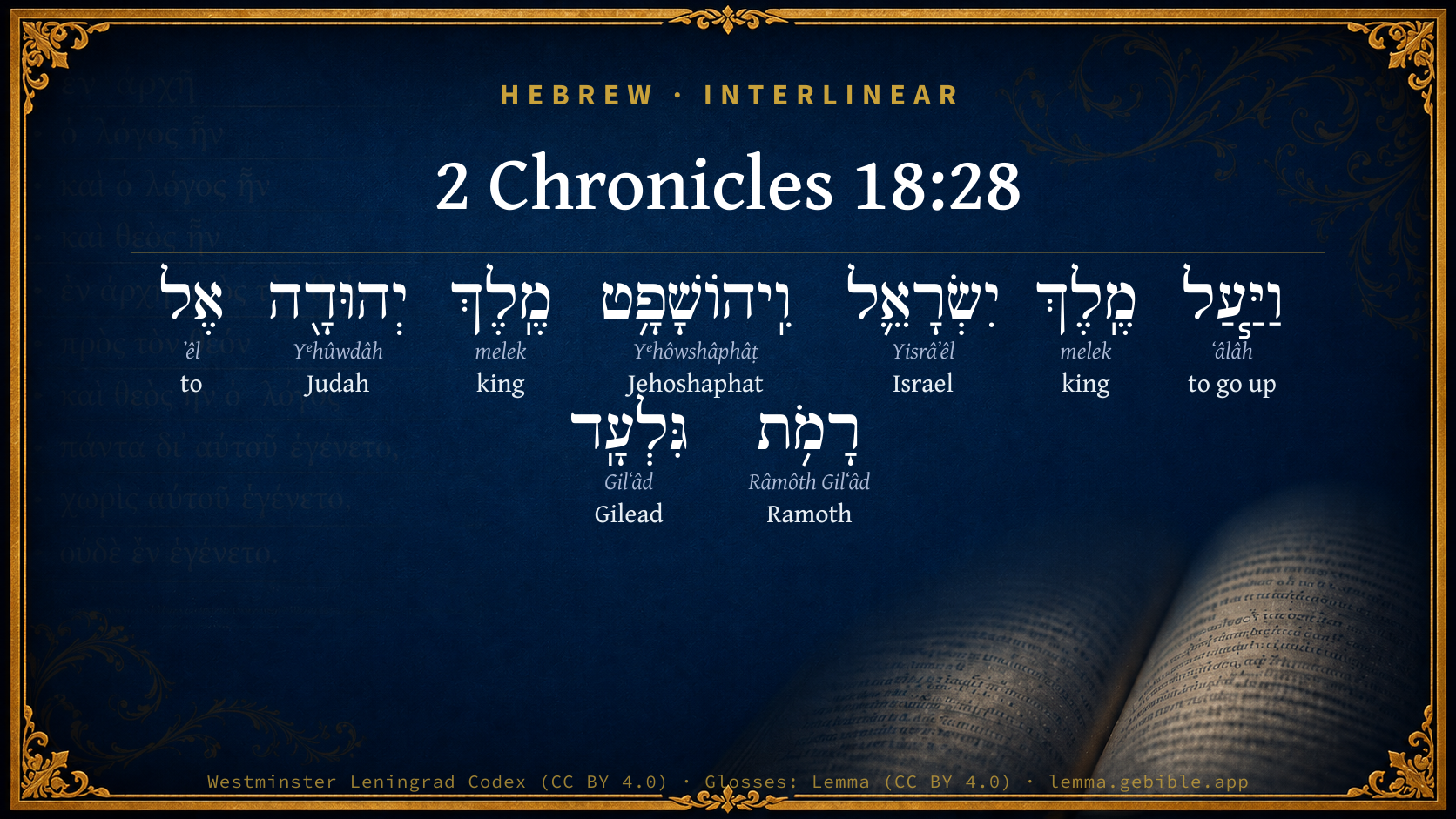
Hebrew (Westminster Leningrad Codex) 2 Chronicles 18:28 appears in the Hebrew Old Testament. The text above is from the Westminster Leningrad Codex. Each word links to its Strong’s number, a concise gloss, and parsing drawn from the Open Scriptures Hebrew Bible morphology. Click any word for its full Brown-Driver-Briggs (BDB) entry.
Download image
Cite this verse

2 Chronicles 18:28 (World English Bible). Public Domain. Lemma interlinear Bible study tool, https://lemma.gebible.app/v/2-chronicles/18/28.

Show BibTeX & RIS
BibTeX
RIS
English Translation
So the king of Israel and Jehoshaphat the king of Judah went up to Ramoth-gilead.
World English Bible · Public Domain
Download a study sheet

One document with this verse’s original text, its word-by-word gloss line, the meaning frame, cross-references with their text, attributed commentary, and full source and license credits — printable, and it pastes into notes with its structure intact.

This verse Autodidact and up

Study sheet (.html) Plain text (.txt)

A passage Seminary Student

Up to 50 verses in one chapter. A passage sheet keeps up to 6 commentary sources and 12 cross-references per verse, in the order this page ranks them, and says so on the sheet whenever that leaves anything out. Ask for a single verse and you get the Autodidact verse sheet above.

Everything on this page stays free to read, with no account — the sheet is a download of what is already on screen, not access to it.

Want to remove ads? Support Godless Engineer
Compare translations 3

The same verse in 3 English versions, stacked beneath the original-language interlinear above. Click any original word for its lexicon entry.

Each is an independent rendering of the whole verse — the interlinear is not word-aligned to these translations.

Highlighted words mark where these versions differ — a whole-verse word diff, not a word-by-word alignment.

  • World English Bible Public Domain
    So the king of Israel and Jehoshaphat the king of Judah went up to Ramoth-gilead.
  • King James Version Public Domain
    So the king of Israel and Jehoshaphat the king of Judah went up to Ramothgilead.
  • unfoldingWord Literal Text CC BY-SA 4.0
    And the king of Israel went up, and Jehoshaphat, the king of Judah, against Ramoth Gilead.

unfoldingWord Literal Text — © unfoldingWord, licensed CC BY-SA 4.0. Word-aligned USFM3 via Door43 (git.door43.org/unfoldingWord/en_ult).

Versions to compare (up to 4)

3 of 4 selected

Show all 18 translations

Every available English version of this verse, each an independent rendering of the whole verse.

  • World English Bible Public Domain
    So the king of Israel and Jehoshaphat the king of Judah went up to Ramoth-gilead.
  • Berean Standard Bible Public Domain
    So the king of Israel and Jehoshaphat king of Judah went up to Ramoth-gilead.
  • Majority Standard Bible Public Domain
    So the king of Israel and Jehoshaphat king of Judah went up to Ramoth-gilead.
  • King James Version Public Domain
    So the king of Israel and Jehoshaphat the king of Judah went up to Ramothgilead.
  • American Standard Version (1901) Public Domain
    So the king of Israel and Jehoshaphat the king of Judah went up to Ramoth-gilead.
  • Revised Version (1885) Public Domain
    So the king of Israel and Jehoshaphat the king of Judah went up to Ramoth-gilead.
  • Geneva Bible (1599) Public Domain
    So the King of Israel and Iehoshaphat the King of Iudah went vp to Ramoth Gilead.
  • Douay-Rheims (1899) Public Domain
    So the king of Israel and Josaphat king of Juda went up to Ramoth Galaad.
  • Young's Literal Translation Public Domain
    And the king of Israel goeth up, and Jehoshaphat king of Judah, unto Ramoth-Gilead;
  • Literal Standard Version CC BY-SA 4.0
    And the king of Israel goes up—and Jehoshaphat king of Judah—to Ramoth-Gilead;
  • Unlocked Literal Bible CC BY-SA 4.0
    So Ahab, the king of Israel, and Jehoshaphat, the king of Judah, went up against Ramoth Gilead.
  • unfoldingWord Literal Text CC BY-SA 4.0
    And the king of Israel went up, and Jehoshaphat, the king of Judah, against Ramoth Gilead.
  • Darby Bible Public Domain
    And the king of Israel and Jehoshaphat the king of Judah went up to Ramoth-Gilead.
  • World Messianic Bible Public Domain
    So the king of Israel and Jehoshaphat the king of Judah went up to Ramoth Gilead.
  • Webster's Bible Public Domain
    So the king of Israel and Jehoshaphat the king of Judah went up to Ramoth-gilead.
  • Free Bible Version CC BY-SA 4.0
    The king of Israel and Jehoshaphat, king of Judah, went to attack Ramoth-gilead.
  • Bible in Basic English Public Domain
    So the king of Israel and Jehoshaphat, the king of Judah, went up to Ramoth-gilead.
  • JPS Tanakh (1917) Public Domain
    So the king of Israel and Jehoshaphat the kind of Judah went up to Ramoth-gilead.

Literal Standard Version (2020), Covenant Press — licensed CC BY-SA 4.0. Text via the HelloAO Bible API (eBible.org). Unlocked Literal Bible (unfoldingWord) — licensed CC BY-SA 4.0. Text via the HelloAO Bible API (eBible.org). unfoldingWord Literal Text — © unfoldingWord, licensed CC BY-SA 4.0. Word-aligned USFM3 via Door43 (git.door43.org/unfoldingWord/en_ult). Free Bible Version, Dr. Jonathan Gallagher — licensed CC BY-SA 4.0. Text via the HelloAO Bible API (eBible.org).

Word by word

More ways to search: Search by grammar → Find every occurrence → Compare this word →

Practice this passage: Drill this verse → Learn its vocabulary →

About this verse

These counts appear in no published source. They are computed here, from the morphology-tagged text and Lemma’s own curated glosses. What Lemma adds →

9
words
8
distinct lemmas
Historical
section

Notable vocabulary

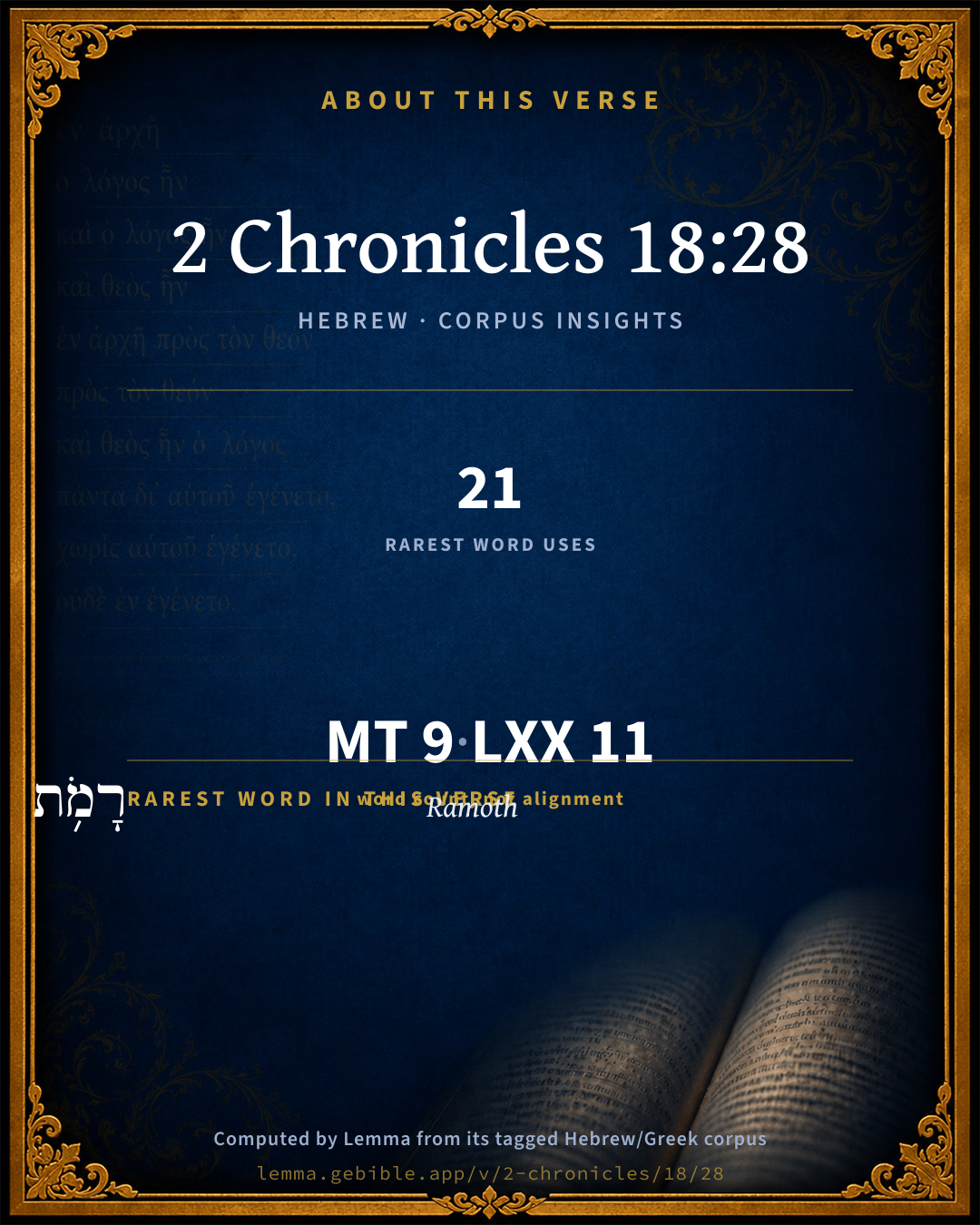
The rarest word here is רָמֹ֥ת Ramoth H7433 — appearing just 21 times in the whole Hebrew Bible.

Shared distinctive vocabulary

רָמֹ֥ת Ramoth H7433 occurs in 21 verses of the Hebrew Bible. Also found in:

Grammatical profile

  • 1 verb
  • 7 nouns
  • 1 preposition

Verb forms

  • וַיַּ֧עַל Qal · Sequential Imperfect

Repetition

A word recurs within this verse — often emphatic in Hebrew:

  • מֶֽלֶךְ king H4428 ×2

Hebrew & Septuagint length

In English translation the verse runs 15 words from the Hebrew and 15 from the Septuagint (LXX English) — the same length.

A rough comparison of the two English renderings, which tokenize alike — not a word-level alignment.

Word counts can differ between the Hebrew and the Greek without any difference in meaning — e.g. the Hebrew direct-object marker אֵת has no separate Greek word, and Greek often adds the article ὁ.

In the original languages it is 9 Hebrew tokens and 11 Greek tokens — but the two are counted differently (Hebrew bundles its prefixes and suffixes into one token; the Greek is in lemma form), so that isn’t a like-for-like length.

Cross-references

1

Topical passages linked to 2 Chronicles 18:28 in the Treasury of Scripture Knowledge — connected by theme and wording, ordered by reader-vote popularity; previews shown in the World English Bible.

  • 1 Kings 22:29–33 So the king of Israel and Jehoshaphat the king of Judah went up to Ramoth-gilead.

Cross-references courtesy of OpenBible.info (CC BY 4.0).

Hebrew and Greek witnesses Masoretic Hebrew ↔ Greek Septuagint

The same verse in the two great witnesses to the Old Testament, shown verse-for-verse.

These are two independent witnesses, not word-aligned to each other, and the Septuagint is shown in lemma (dictionary) form.

Hebrew 2 Chronicles 18:28 Masoretic · Westminster Leningrad Codex

וַיַּ֧עַל מֶֽלֶךְ יִשְׂרָאֵ֛ל וִֽיהוֹשָׁפָ֥ט מֶֽלֶךְ יְהוּדָ֖ה אֶל רָמֹ֥ת גִּלְעָֽד

So the king of Israel and Jehoshaphat the king of Judah went up to Ramoth-gilead.

World English Bible · Public Domain

Greek LXX 2 Chronicles 18:28 Septuagint · lemma form

καί ἀναβαίνω βασιλεύς ἰσραήλ καί ιωσαφατ βασιλεύς ἰουδά εἰς ραμωθ γαλαάδ

So the king of Israel, and Josaphat king of Juda, went up to Ramoth Galaad.

LXX2012 (modern English Septuagint) · Public Domain

Hebrew: Westminster Leningrad Codex (CC BY 4.0). Greek: Septuagint (public domain); English from LXX2012 (modern English Septuagint) (Public Domain). How the Septuagint differs from the Hebrew →

Commentary

Notes on 2 Chronicles 18:28 from classic Christian and Jewish commentators (each source and its license shown beneath its notes). The classic Christian expositions comment on the surrounding passage and are grouped to its opening verse, so a note may address several verses; the Jewish commentaries on the Tanakh (Rashi and others) are per-verse, so they appear only where the commentator wrote on this verse.

Lemma curates 59 commentaries, every one of them public domain or Creative Commons licensed, each selected and text-cleaned for this edition rather than reprinted as found. About our sources →

Tyndale Open Study Notes

Tyndale Open Resources

18:28-34 Although Ahab knew he had gone against God’s will and was therefore liable for the consequences, his immediate concern was the Aramean army. His belief that he could defy God’s judgment against him indicates his disregard for the Lord; his error was fatal.

Tyndale Open Study Notes — © Tyndale Open Resources, licensed CC BY-SA 4.0. Text via the HelloAO Bible API.

Matthew Henry's Commentary

We have here, 1. Good Jehoshaphat exposing himself in his robes, thereby endangered, and yet delivered. We have reason to think that Ahab, while he pretended friendship, really aimed at Jehoshaphat's life, to take him off, that he might have the management of his successor, who was his son-in-law, else he would never have advised him to enter into the battle with his robes on, which was but to make himself an easy mark to the enemy: and, if really he intended that, it was as unprincipled a piece of treachery as ever man was guilty of, and justly was he himself taken in the pit he digged for his friend. The enemy had soon an eye upon the robes, and vigorously attacked the unwary prince who now, when it was too late, wished himself in the habit of the poorest soldier, rather than in his princely raiment. he cried out, either to his friends to relieve him (but Ahab took no care of that), or to his enemies, to rectify their mistake, and let them know that he was not the king of Israel. Or perhaps he cried to God for succour and deliverance (to whom else should he cry?) and he found it was not in vain: The Lord helped him out of his distress, by moving the captains to depart from him, Ch2 18:31. God has all men's hearts in his hand, and turns them as he pleases, contrary to their own first intentions, to serve his purposes. Many are moved unaccountably both to themselves and others, but an invisible power moves them. 2. Wicked Ahab disguising himself, arming himself thereby as he thought securing himself, and yet slain, Ch2 18:33. No art, no arms, can save those whom God has appointed to ruin. What can hurt those whom God will protect? And what can shelter those whom God will destroy? Jehoshaphat is safe in his robes, Ahab killed in his armour; for the race is not to the swift nor the battle to the strong.

Matthew Henry's Commentary on the Whole Bible (1708–1710) — public domain (CC PDM 1.0). Text via the HelloAO Bible API.

The Pulpit Commentary

It must remain doubtful which of the kings carried with him the uneasier heart. What Jehoshaphat might have gained in less element of personal and physical fear, he by rights should have lost in sensitiveness of conscience.

Vers. 28-34.

The true lesson of human ignorance.

What are the true lessons that we gather from this interesting episode? There may be suggested

I TWO THOUGHTS WHICH ARE SPECIOUS BUT FALSE. Some men would probably infer from similar facts happening in the range of their own observation:

1. That the issue of events is in the hands of an irreversible fate. Ahab (they would argue) was bound to fall that day; do what he might, disguise himself as he pleased, take whatever precaution he could, his death was decreed and was simply unavoidable. But this is not the wise, nor is it the right, way of regarding it. Had he been as brave as Jehoshaphat (see ver. 29), he certainly would not have fallen in the way he did; had he been as true to Jehovah as the King of Judah was, and as he might and should have been, he would not have "gone up to Ramoth-Gilead" at all, for he would have been dissuaded by the prophet of the Lord, and he would not have fallen at all. His death that day, as well as that way, was due to his own course and to his own choice. Our destiny is not in the hands of some inexorable necessity; it resides in our own character; it is the work of our own will.

2. That many things, if not most things, are decided not by choice, but bychance. The death of Ahab (they would say) was the result of "a bow drawn at a venture." And it is this chance-work that has a very large share in the determination of our whole earthly history. But chance, in the sense of positive lawlessness, does not exist. Everything happened here according to law. The soldier drew his bow according to his instruction, aiming at the enemy, though not at any one whom he recognized in particular; the arrow went on its career according to the laws of motion, and did its work on Ahab"s person in accordance with all the laws of physics. There was no violation of law in the smallest degree, though something happened which no man could have calculated and predicted. If we succeed, it will be by using the laws of health, of prosperity, etc.; if we fail, it will be in consequence of our disregarding these laws, which are laws of God. Chance will neither make nor mar us.

II TWO THOUGHTS WHICH ARE BOTH TRUE AND SERVICEABLE.

1. That we do not know what harm we do by our most casual strokes. We "draw a bow at a venture," we "send an arrow through the air;" it is only a sentence, it is a very simple deed, we think; but it hits and wounds a sensitive human heart; it may even slay a Soul. It may cause such grief as we would on no account hays inflicted if we could have foreseen it; it may lead to the first declension of a valuable human life, and may end in such spiritual disaster as it would grieve us indeed to originate.

2. That we cannot tell what good we do by our simplest efforts. Little did the Syrian soldier suppose that by that shot of his arrow he was to serve his royal master as he did. It is a most cheering and inspiring thought that we cannot tell what kind or measure of good we are effecting by our everyday service of our Lord. A kindly smile, a gracious recognition, an encouraging word, a neighbourly kindness, a warning utterance, the taking of "a class," the giving of "an address," the conduct of "a service," perhaps under the humblest roof, or to the most unpromising audience, may prove to be a most valuable contribution to the cause of Jesus Christ, to the service of mankind. C.

Vers. 28-34.

The battle of Ramoth. an ill-fated expedition.

I AHAB"S DISGUISE. (Ver. 29.)

1. Artfully contrived. Apprehensive of the truth of Micaiah"s prediction, Ahab agreed with Jehoshaphat to lay aside his royal robes and go into battle in the garb of a common soldier, perhaps (though not so said) concealing his well-known features behind a vizor, while he (Jehoshaphat), who had no occasion to dread an evil issue from the campaign, should array himself as usual in regal apparel not in Ahab"s robes (Josephus), but in his own. In this way Ahab may have reckoned on a double chance of

2. safety. On the one hand, his disguise would assist him to elude the notion of the enemy; on the other hand, Jehoshaphat"s kingly clothing would probably cause him to be mistaken for Ahab.

3. Wickedly designed. In so far as Ahab"s contrivance was prompted by a desire of self-preservation it was legitimate, though scarcely valorous, and palpably selfish, considering that he did not suggest the like expedient to Jehoshaphat, but rather recommended the contrary. The King of Israel"s artifice, however, had not its origin in any praiseworthy motive. Whether he hoped that Jehoshaphat might fall, while he escaped and seized upon the southern kingdom (Schulz), cannot be known, and is probably "too low and unworthy" a scheme "even for a character so bad as Ahab" (Keil); it is certain he aimed at falsifying Micaiah"s prediction by evading his threatened doom. This, indeed, he might have done by foregoing the Ramoth campaign, to which he was not called by Jehovah; but to attempt by such a flimsy or even any device to elude Divine vengeance while defying the Divine will, was a fearful aggravation of his original offence.

4. Completely ineffectual. "Ahab"s fate found him without his robes" (Josephus), while Jehoshaphat, who seemed to be in the greater peril of the two, escaped unhurt. So God commonly confounds the counsels of the crafty, and defeats the designs of deceitful workers.

II BENHADAD"S ORDER. (Ver. 30.)

1. The meaning of it. In commanding the captains of his chariots, thirty-two in number, (1Ki_22:31) to fight neither with small nor great, but only with the King of Israel, the King of Syria meant that against Ahab they should direct their principal and, as far as practicable, exclusive attack. This they would be able to do, seeing that Ahab, according to custom, would appear upon the field in his royal robes. That ancient monarchs followed this practice appears from the monuments of Egypt the heroic poem of Pentaur representing Ramses II as fighting in person at the head of his warriors and charioteers against the Khita and saying, "The diadem of the royal snake adorned my head. It spat fire and glowing flame in the face of my enemies" (Brugsch, "Egypt under the Pharaohs," 2:63).

2. The motive of it.

(1) Perhaps clemency, as knowing that the shortest way to end the war was to secure the capture or destruction of Ahab, armies commonly being disheartened when they lose their leaders.

(2) More probably revenge, as never having been able to forget, and far less forgive, the disgrace of his own capture by Ahab in a previous campaign of his against Ahab. If it was so, it was a poor return for the merciful consideration and mild treatment then shown to him by Ahab. (1Ki_20:30-34) But in ordinary life least kindness is often received from those from whom one might expect the most.

III JEHOSHAPHAT"S DELIVERANCE. (Ver. 31.)

1. His imminent peril. Mistaking him for the King of Israel, the Syrian charioteers surrounded him. This natural, and had Jehoshaphat been smitten the blame would have been his own. He who runs into danger unbidden need hardly expect to come out of it in safety. Moreover, just as certainly as he who walketh with wise men shall be wise, the companion of fools shall be destroyed; (Pro_13:20) if he is not, the praise is due not to himself but to God. (Psa_115:1)

2. His sudden outcry. That this "cry" was a prayer, the Chronicler is thought by some to indicate; this, however, is not absolutely certain. The Chronicler says not Jehovah helped Jehoshaphat because (cf. 19:3), but only when he cried, and Jehovah might have helped him without being appealed to by a formal supplication. Considering where Jehoshaphat was, it is as likely as not that he did not address Jehovah in prayer; but remembering who and what Jehoshaphat was, a descendant of David and a follower of Jehovah, it is certain his "outcry" would sound in Jehovah"s ears as an appeal for help.

3. His mysterious rescue. Scarcely had he "cried" when the Syrian charioteers turned aside and left him unmolested. If the "cry" was a "prayer" Jehoshaphat must have looked upon his unexpected escape as an answer to his supplication; if only a "shout" or signal of distress, he must still have regarded the extraordinary behaviour of the Syrians as little short of a providential miracle as a merciful interposition of Jehovah on his behalf, as indeed it was. Jehovah helped Jehoshaphat; moved the charioteers and, warriors to turn aside, not by any supernatural influence upon them, but by so ordering the succession of events, that they understood Jehoshaphat"s cry and recognized his features in time to let them see he was not the object of their pursuit.

IV JEHOVAH"S ARROW. (Ver. 33.)

1. Whence it flew. From the bow of an unknown warrior, most likely an obscure common soldier, who shot either aimlessly into the ranks of the Israelitish army, or with deliberate aim, but at no one he knew, at the first man that came into his field of vision. Either explanation satisfies the phraseology certain man drew a bow at a venture." That the man"s name was Naaman (Josephus) is a groundless tradition.

2. Whither it sped. To the person of Ahab. All events are under God"s control. He directeth the flights of arrows as of fowls, the careers of javelins as the courses of stars, according to the counsel of his will. Nothing happens by accident. In a world governed by infinite wisdom and power chance is impossible. The Syrian archer drew his bow at a venture; not so did Jehovah draw his. The Syrian sharpshooter knew not at whom he aimed; Jehovah understood well who was his target. "Every bullet has its billet," not because the gunner but because God directs its path through the air. Not a sparrow can fall to the ground without our heavenly Father"s permission, (Mat_10:29) nor shaft can hit till he pleases.

3. To what it led. To the death of Ahab. It smote him "between the jointsof the harness;" rather between the lower armour and the breastplate (Revised Version), between the corselet and the tunic (Luther), between the joints and the harness (Keil). It found the spot where the parts of Ahab"s armour fitted least closely, and there it entered the lower region of his body. Had it penetrated as far as did the arrow with which Jehu shot Jehoram, (1Ki_9:24) it must have proved instantaneously fatal. That it did not seems a natural inference from the fact that he was able to remain upon the field.

Learn:

1. The folly of attempting to outwit God.

2. The certainty that no disguise can hide a wicked man from God.

3. The impossibility of evading death when the appointed hour has come.

4. The clemency of God to his erring people.

5. The reality of God"s interference with the affairs of time. W.

The Pulpit Commentary (1880–1919), ed. H.D.M. Spence-Jones & Joseph S. Exell — public domain. Text from a community e-Sword module.

Kretzmann's Popular Commentary

Paul E. Kretzmann

The Syrians Defeat Israel

v. 28. So the king of Israel and Jehoshaphat, the king of Judah, went up to Ramoth-gilead, in order to take it from the hands of the Syrians by force.

v. 29. And the king of Israel, desiring to shield himself and thus to escape the fate predicted to him by Micaiah, said unto Jehoshaphat, I will disguise myself, by putting on the dress and the armor of an ordinary soldier or officer, and will go to the battle; but put thou on thy robes. So the king of Israel disguised himself; and they went to the battle.

v. 30. Now, the king of Syria, in order to put an early and satisfactory end to the war by removing Ahab at once, had commanded the captains of the chariots that were with him, saying, Fight ye not with small or great, save only with the king of Israel. They were to single him out for their attacks, concentrate all their efforts upon him in order to slay him.

v. 31. And it came to pass, when the captains of the chariots saw Jehoshaphat, who was clothed in his royal attire, that they said, It is the king of Israel. Therefore they compassed about him to fight, directing all their assaults against his person; but Jehoshaphat cried out, either in prayer or in making himself known, and the Lord helped him; and God moved them to depart from him. God saved the life of His servant.

v. 32. For it came to pass that, when the captains of the chariots perceived that it was not the king of Israel, when they became aware of their mistake, they turned back again from pursuing him, they no longer massed their attacks against his person.

v. 33. And a certain man drew a bow at a venture, without taking specific aim at anyone person in the army of Israel, and smote the king of Israel between the joints of the harness, there being small slits or openings where the several parts of the armor fitted together; therefore he said to his chariot man, Turn thine hand that thou mayest carry me out of the host, away from the battle-line; for I am wounded, he felt that he had received a mortal wound.

v. 34. And the battle increased that day; howbeit, the king of Israel stayed himself up in his chariot against the Syrians until the even, holding himself upright by a strong effort of his will; and about the time of the sun going down he died. That was the end of Ahab, the enemy of the Lord. Like him, all the enemies of Jehovah will be destroyed, while He Himself holds His hand over those who trust in Him.

Paul E. Kretzmann, Popular Commentary of the Bible (1921–1924) — public domain. Text from a community e-Sword module.

unfoldingWord translationNotes

Door43 World Missions Community

Ahab, the king of Israel, and Jehoshaphat, the king of Judah, went up against

Here the kings represent themselves accompanied by their armies. AT: "Ahab, the king of Israel, and Jehoshaphat, the king of Judah led their armies up against" (See: Synecdoche)

went up against

"fought against"

Ramoth Gilead

Translate the name of this place as you did in 2 Chronicles 18:2 (See: How to Translate Names)

disguise

This means to change the usual appearance so as not to be identified.

Do not attack the unimportant or the important soldiers

By mentioning both "the unimportant" and "the important soldiers," the king meant all soldiers. AT: "Do not attack any of the soldiers" (See: Merism)

translationWords

Israel

Judah

royal

Aram

command

chariot

unfoldingWord translationNotes — © Distant Shores Media and the Door43 World Missions Community, licensed CC BY-SA 4.0. Source: git.door43.org/Door43/en_tn.

Lesson kit

Teaching starters — assembled from the data on this page, not authored interpretation. Every prompt links to the verse data it draws on. Edit before teaching.

2 Chronicles, in the Historical, opens this verse with 9 words (8 distinct Hebrew lemmas). Its most distinctive word is Râmôth Gilʻâd (“Ramoth”). A historical commentator’s framing appears above. Read the whole chapter for the surrounding context.

Discussion questions

  1. What does “Ramoth” (Râmôth Gilʻâd) contribute to the verse as a whole?
  2. How does Joshua 21:38, which shares the word «Ramoth», read alongside this verse?
  3. What does the repetition of “king” (2× in this one verse) do in this verse?
  4. These translations render this verse differently; the difference is in the English rendering, not the original. What questions does that raise?
  5. «וַיַּ֧עַל» is a Qal Sequential Imperfect verb. How does that grammatical form shape the action described?
  6. Compare how Tyndale Open Study Notes and Matthew Henry's Commentary read this verse. Where do they agree or differ?

Things to notice

Reading settings

Reading text

Shown beneath each verse's original-language words.

Old Testament
Old Testament edition

Read the OT as the Masoretic Hebrew (MT) or the Greek Septuagint (LXX).

English shown for the Greek Septuagint (in the Hebrew ↔ Greek comparison).

Comparing translations? Open the Compare panel on any verse page to stack up to four side by side.