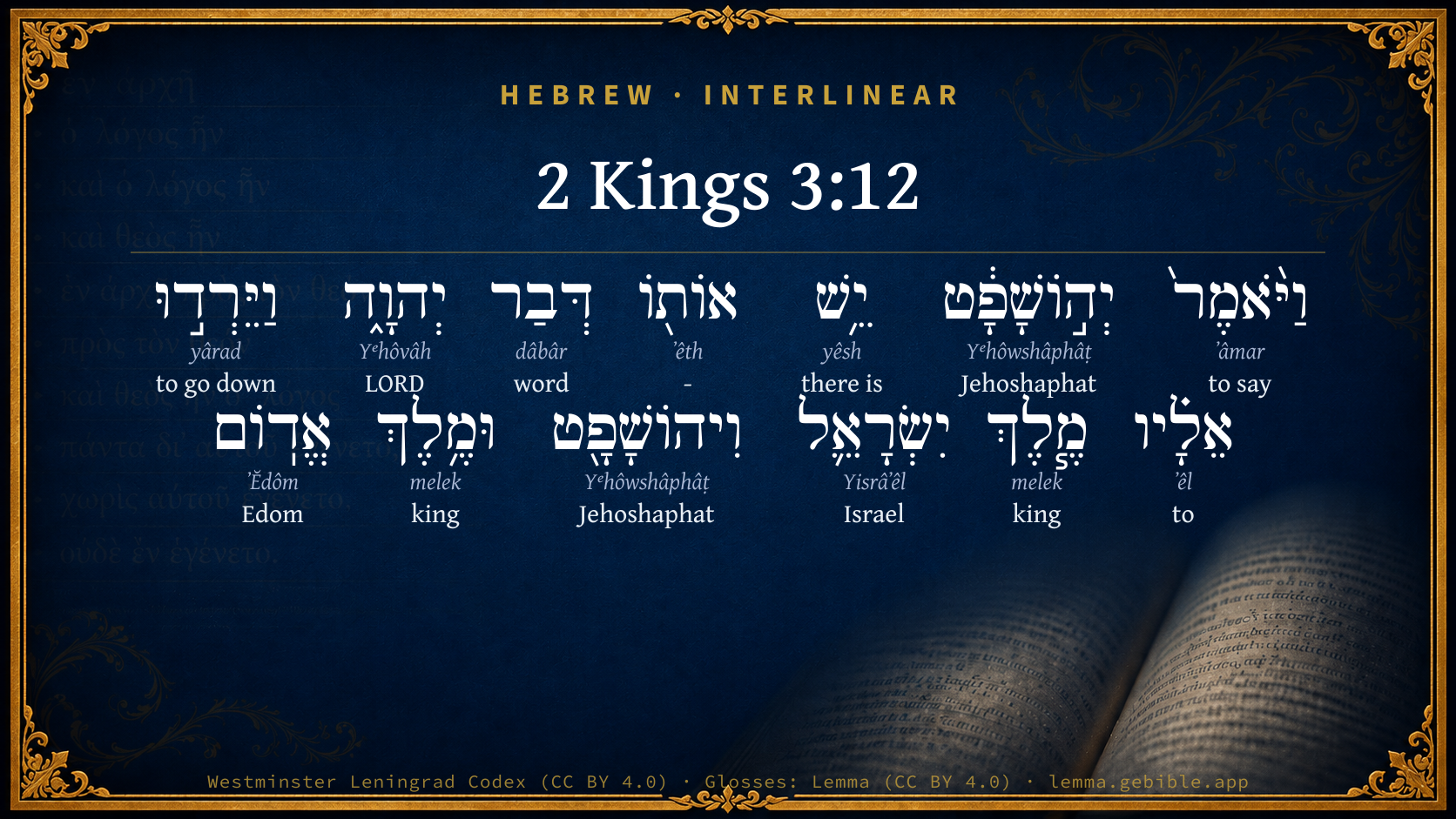
2 Kings 3:12

Hebrew (Westminster Leningrad Codex) 2 Kings 3:12 appears in the Hebrew Old Testament. The text above is from the Westminster Leningrad Codex. Each word links to its Strong’s number, a concise gloss, and parsing drawn from the Open Scriptures Hebrew Bible morphology. Click any word for its full Brown-Driver-Briggs (BDB) entry.
Download image
Cite this verse

2 Kings 3:12 (World English Bible). Public Domain. Lemma interlinear Bible study tool, https://lemma.gebible.app/v/2-kings/3/12.

Show BibTeX & RIS
BibTeX
RIS
English Translation
Jehoshaphat said, The word of Yahweh is with him. So the king of Israel and Jehoshaphat and the king of Edom went down to him.
World English Bible · Public Domain
Download a study sheet

One document with this verse’s original text, its word-by-word gloss line, the meaning frame, cross-references with their text, attributed commentary, and full source and license credits — printable, and it pastes into notes with its structure intact.

This verse Autodidact and up

Study sheet (.html) Plain text (.txt)

A passage Seminary Student

Up to 50 verses in one chapter. A passage sheet keeps up to 6 commentary sources and 12 cross-references per verse, in the order this page ranks them, and says so on the sheet whenever that leaves anything out. Ask for a single verse and you get the Autodidact verse sheet above.

Everything on this page stays free to read, with no account — the sheet is a download of what is already on screen, not access to it.

Want to remove ads? Support Godless Engineer
Compare translations 3

The same verse in 3 English versions, stacked beneath the original-language interlinear above. Click any original word for its lexicon entry.

Each is an independent rendering of the whole verse — the interlinear is not word-aligned to these translations.

Highlighted words mark where these versions differ — a whole-verse word diff, not a word-by-word alignment.

  • World English Bible Public Domain
    Jehoshaphat said, The word of Yahweh is with him. So the king of Israel and Jehoshaphat and the king of Edom went down to him.
  • King James Version Public Domain
    And Jehoshaphat said, The word of the LORD is with him. So the king of Israel and Jehoshaphat and the king of Edom went down to him.
  • unfoldingWord Literal Text CC BY-SA 4.0
    And Jehoshaphat said, “The word of Yahweh is with him.” And, the king of Israel, and Jehoshaphat and the king of Edom went down to him.

unfoldingWord Literal Text — © unfoldingWord, licensed CC BY-SA 4.0. Word-aligned USFM3 via Door43 (git.door43.org/unfoldingWord/en_ult).

Versions to compare (up to 4)

3 of 4 selected

Show all 18 translations

Every available English version of this verse, each an independent rendering of the whole verse.

  • World English Bible Public Domain
    Jehoshaphat said, The word of Yahweh is with him. So the king of Israel and Jehoshaphat and the king of Edom went down to him.
  • Berean Standard Bible Public Domain
    Jehoshaphat affirmed, “The word of the LORD is with him.” So the king of Israel and Jehoshaphat and the king of Edom went down to him.
  • Majority Standard Bible Public Domain
    Jehoshaphat affirmed, “The word of the LORD is with him.” So the king of Israel and Jehoshaphat and the king of Edom went down to him.
  • King James Version Public Domain
    And Jehoshaphat said, The word of the LORD is with him. So the king of Israel and Jehoshaphat and the king of Edom went down to him.
  • American Standard Version (1901) Public Domain
    And Jehoshaphat said, The word of Jehovah is with him. So the king of Israel and Jehoshaphat and the king of Edom went down to him.
  • Revised Version (1885) Public Domain
    And Jehoshaphat said, The word of the LORD is with him. So the king of Israel and Jehoshaphat and the king of Edom went down to him.
  • Geneva Bible (1599) Public Domain
    Then Iehoshaphat saide, The worde of the Lord is with him. Therefore the King of Israel, and Iehoshaphat, and the King of Edom went downe to him.
  • Douay-Rheims (1899) Public Domain
    And Josaphat said: The word of the Lord is with him. And the king of Israel, and Josaphat king of Juda, and the king of Edom went down to him.
  • Young's Literal Translation Public Domain
    And Jehoshaphat saith, `The word of Jehovah is with him;' and go down unto him do the king of Israel, and Jehoshaphat, and the king of Edom.
  • Literal Standard Version CC BY-SA 4.0
    And Jehoshaphat says, “The word of YHWH is with him”; and the king of Israel goes down to him, and Jehoshaphat, and the king of Edom.
  • Unlocked Literal Bible CC BY-SA 4.0
    Jehoshaphat said, “The word of Yahweh is with him.” So the king of Israel, Jehoshaphat, and the king of Edom went down to him.
  • unfoldingWord Literal Text CC BY-SA 4.0
    And Jehoshaphat said, “The word of Yahweh is with him.” And, the king of Israel, and Jehoshaphat and the king of Edom went down to him.
  • Darby Bible Public Domain
    And Jehoshaphat said, The word of Jehovah is with him. And the king of Israel and Jehoshaphat and the king of Edom went down to him.
  • World Messianic Bible Public Domain
    Jehoshaphat said, “The LORD’s word is with him.” So the king of Israel and Jehoshaphat and the king of Edom went down to him.
  • Webster's Bible Public Domain
    And Jehoshaphat said, The word of the LORD is with him. So the king of Israel and Jehoshaphat and the king of Edom went down to him.
  • Free Bible Version CC BY-SA 4.0
    Jehoshaphat agreed, “The Lord communicates by him.” So the king of Israel, Jehoshaphat, and the king of Edom went to see him.
  • Bible in Basic English Public Domain
    And Jehoshaphat said, The word of the Lord is with him. So the king of Israel and Jehoshaphat and the king of Edom went down to him.
  • JPS Tanakh (1917) Public Domain
    And Jehoshaphat said: 'The word of the LORD is with him.' So the king of Israel and Jehoshaphat and the king of Edom went down to him.

Literal Standard Version (2020), Covenant Press — licensed CC BY-SA 4.0. Text via the HelloAO Bible API (eBible.org). Unlocked Literal Bible (unfoldingWord) — licensed CC BY-SA 4.0. Text via the HelloAO Bible API (eBible.org). unfoldingWord Literal Text — © unfoldingWord, licensed CC BY-SA 4.0. Word-aligned USFM3 via Door43 (git.door43.org/unfoldingWord/en_ult). Free Bible Version, Dr. Jonathan Gallagher — licensed CC BY-SA 4.0. Text via the HelloAO Bible API (eBible.org).

Word by word

More ways to search: Search by grammar → Find every occurrence → Compare this word →

Practice this passage: Drill this verse → Learn its vocabulary →

יְה֣וֹשָׁפָ֔ט
Yᵉhôwshâphâṭ
H3092
“Jehoshaphat”
Noun, Proper
Part of Speech
Noun
Type
Proper
Full BDB Definition

Origin: from H3068 and H8199

TWOT: None

Jehoshaphat = "Jehovah has judged" - son of king Asa and himself king of Judah for 25 years; one of the best, most pious, and prosperous kings of Judah (noun proper masculine) - son of Nimshi and father of king Jehu of the northern kingdom of Israel (noun proper masculine) - son of Ahilud and chronicler under David and Solomon (noun proper masculine) - son of Paruah and one of the 12 commissary officers under Solomon (noun proper masculine) - a priest and trumpeter in the time of David (noun proper masculine) - symbolical name of a valley near Jerusalem which is the place of ultimate judgment; maybe the deep ravine which separates Jerusalem from the Mount of Olives through which the Kidron flowed (noun proper locative)
  1. וַיֹּ֨אמֶר֙ ʼâmar H559 “and · to say” Conjunction + Verb, Qal, Sequential Imperfect, 3rd Person, Masculine, Singular
  2. יֵ֥שׁ yêsh H3426 “there is” Particle, Demonstrative
  3. אוֹת֖וֹ ʼêth H853 “- · him” Particle, Direct Object + Suffix, Personal, 3rd Person, Masculine, Singular
  4. דְּבַר dâbâr H1697 “word of” Noun, Common, Masculine, Singular, Construct
  5. יְהוָ֑ה Yᵉhôvâh H3068 “LORD” Noun, Proper
  6. וַיֵּרְד֣וּ yârad H3381 “and · to go down” Conjunction + Verb, Qal, Sequential Imperfect, 3rd Person, Masculine, Plural
  7. אֵלָ֗יו ʼêl H413 “to · him” Preposition + Suffix, Personal, 3rd Person, Masculine, Singular
  8. מֶ֧לֶךְ melek H4428 “king of” Noun, Common, Masculine, Singular, Construct
  9. יִשְׂרָאֵ֛ל Yisrâʼêl H3478 “Israel” Noun, Proper
  10. וִיהוֹשָׁפָ֖ט Yᵉhôwshâphâṭ H3092 “and · Jehoshaphat” Conjunction + Noun, Proper
  11. וּמֶ֥לֶךְ melek H4428 “and · king of” Conjunction + Noun, Common, Masculine, Singular, Construct
  12. אֱדֽוֹם ʼĔdôm H123 “Edom” Noun, Proper

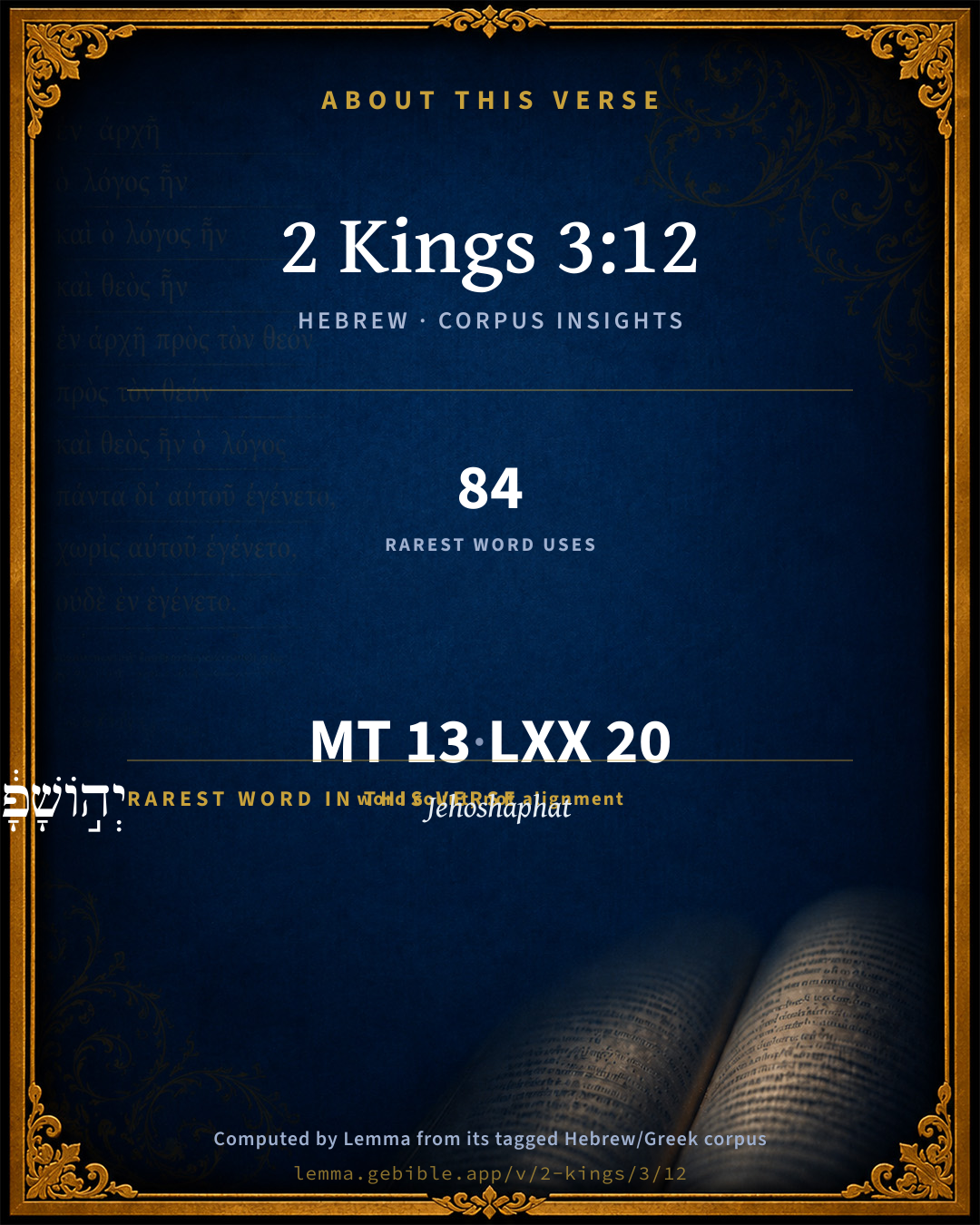
About this verse

These counts appear in no published source. They are computed here, from the morphology-tagged text and Lemma’s own curated glosses. What Lemma adds →

13
words
11
distinct lemmas
Historical
section

Grammatical profile

  • 2 verbs
  • 8 nouns
  • 1 preposition
  • 2 particles

Verb forms

  • וַיֹּ֨אמֶר֙ Qal · Sequential Imperfect
  • וַיֵּרְד֣וּ Qal · Sequential Imperfect

Repetition

Words recur within this verse — often emphatic in Hebrew:

  • יְה֣וֹשָׁפָ֔ט Jehoshaphat H3092 ×2
  • מֶ֧לֶךְ king H4428 ×2

Hebrew & Septuagint length

In English translation the verse runs 25 words from the Hebrew and 29 from the Septuagint (LXX English) — closely comparable.

A rough comparison of the two English renderings, which tokenize alike — not a word-level alignment.

Word counts can differ between the Hebrew and the Greek without any difference in meaning — e.g. the Hebrew direct-object marker אֵת has no separate Greek word, and Greek often adds the article ὁ.

In the original languages it is 13 Hebrew tokens and 20 Greek tokens — but the two are counted differently (Hebrew bundles its prefixes and suffixes into one token; the Greek is in lemma form), so that isn’t a like-for-like length.

Cross-references

9

Topical passages linked to 2 Kings 3:12 in the Treasury of Scripture Knowledge — connected by theme and wording, ordered by reader-vote popularity; previews shown in the World English Bible.

  • 1 Samuel 3:19–21 Samuel grew, and Yahweh was with him, and did let none of his words fall to the ground.
  • 2 Kings 2:14–15 He took the mantle of Elijah that fell from him, and struck the waters, and said, Where is Yahweh, the God of Elijah? and when he also had struck the waters, they were divided here and there; and Elisha went over.
  • 2 Kings 2:21 He went forth to the spring of the waters, and cast salt therein, and said, Thus says Yahweh, I have healed these waters; there shall not be from there any more death or miscarrying.
  • 2 Kings 2:24–25 He looked behind him and saw them, and cursed them in the name of Yahweh. There came forth two she-bears out of the wood, and mauled forty-two lads of them.
  • 2 Kings 5:8–9 It was so, when Elisha the man of God heard that the king of Israel had torn his clothes, that he sent to the king, saying, Why have you torn your clothes? let him come now to me, and he shall know that there is a prophet in Israel.
  • 2 Kings 5:15 He returned to the man of God, he and all his company, and came, and stood before him; and he said, See now, I know that there is no God in all the earth, but in Israel: now therefore, please take a present from your servant.
  • Isaiah 49:23 Kings shall be your nursing fathers, and their queens your nursing mothers: they shall bow down to you with their faces to the earth, and lick the dust of your feet; and you shall know that I am Yahweh; and those who wait for me shall not be disappointed.
  • Isaiah 60:14 The sons of those who afflicted you shall come bending to you; and all those who despised you shall bow themselves down at the soles of your feet; and they shall call you The city of Yahweh, The Zion of the Holy One of Israel.
  • Revelation 3:9 Behold, I give of the synagogue of Satan, of those who say they are Jews, and they are not, but lie. Behold, I will make them to come and worship before your feet, and to know that I have loved you.

Cross-references courtesy of OpenBible.info (CC BY 4.0).

Hebrew and Greek witnesses Masoretic Hebrew ↔ Greek Septuagint

The same verse in the two great witnesses to the Old Testament, shown verse-for-verse.

These are two independent witnesses, not word-aligned to each other, and the Septuagint is shown in lemma (dictionary) form.

Hebrew 2 Kings 3:12 Masoretic · Westminster Leningrad Codex

וַיֹּ֨אמֶר֙ יְה֣וֹשָׁפָ֔ט יֵ֥שׁ אוֹת֖וֹ דְּבַר יְהוָ֑ה וַיֵּרְד֣וּ אֵלָ֗יו מֶ֧לֶךְ יִשְׂרָאֵ֛ל וִיהוֹשָׁפָ֖ט וּמֶ֥לֶךְ אֱדֽוֹם

Jehoshaphat said, The word of Yahweh is with him. So the king of Israel and Jehoshaphat and the king of Edom went down to him.

World English Bible · Public Domain

Greek LXX 2 Kings 3:12 Septuagint · lemma form

καί εἶπον ιωσαφατ εἰμί αὐτός ῥῆμα κύριος καί καταβαίνω πρός αὐτός βασιλεύς ἰσραήλ καί ιωσαφατ βασιλεύς ιουδα καί βασιλεύς εδωμ

And Josaphat said, He has the word of the Lord. And the king of Israel, and Josaphat king of Juda, and the king of Edom, went down to him.

LXX2012 (modern English Septuagint) · Public Domain

Hebrew: Westminster Leningrad Codex (CC BY 4.0). Greek: Septuagint (public domain); English from LXX2012 (modern English Septuagint) (Public Domain). How the Septuagint differs from the Hebrew →

Targum (Aramaic paraphrase)

1

The Targum is the ancient Jewish Aramaic paraphrase of the Hebrew Scriptures — an interpretive translation, not the Hebrew text itself. Onkelos (literal) and Pseudo-Jonathan (expansive) render the Torah, and Jonathan the Prophets. Coverage is partial: where no permissively-licensed English translation exists for a verse, only the Aramaic is shown. This is verse-level text, not a word-by-word alignment to the Hebrew.

  1. Targum Jonathan Prophets (Joshua–Malachi)
    וַאֲמַר יְהוֹשָׁפָט אִית עִמֵיהּ פִּתְגָמָא דַייָ וּנְחָתוּ לְוָתֵיהּ מַלְכָּא דְיִשְׂרָאֵל וִיהוֹשָׁפָט וּמַלְכָּא דֶאֱדוֹם:

    (no public-domain English translation for this verse)

    Targum Jonathan — Aramaic: “Mikraot Gedolot” (public domain). English: “Sefaria Community Translation” (CC0 1.0 (public-domain dedication)); “London "Chaldee Paraphrase," 1871” (public domain). Text via Sefaria.

Commentary

Notes on 2 Kings 3:12 from classic Christian and Jewish commentators (each source and its license shown beneath its notes). The classic Christian expositions comment on the surrounding passage and are grouped to its opening verse, so a note may address several verses; the Jewish commentaries on the Tanakh (Rashi and others) are per-verse, so they appear only where the commentator wrote on this verse.

Lemma curates 59 commentaries, every one of them public domain or Creative Commons licensed, each selected and text-cleaned for this edition rather than reprinted as found. About our sources →

Trapp's Complete Commentary

John Trapp

2Ki 3:12 And Jehoshaphat said, The word of the LORD is with him. So the king of Israel and Jehoshaphat and the king of Edom went down to him.

Ver. 12. So the king of Israel.] By Jehoshaphat’s persuasion likely, and the present necessity. Either zeal or need will make a prophet honoured. These three kings sent not for Elisha, but went unto him.

John Trapp, A Commentary or Exposition upon All the Books of the Old and New Testament (1647–1656) — public domain. Text from a community e-Sword module.

Joseph Benson's Commentary

2Ki 3:12. The word of the Lord is with him — He is a true prophet, and the Lord declares his will by him. Undoubtedly he had been informed how Elijah had chosen him his successor; how he had attended him till he was taken up into heaven, and what wonders he had already done. So the king of Israel and Jehoshaphat, &c., went down to him — To his tent, which was either in the camp or not far from it. They did not send for him, but went to him, that by paying him this respect, and thus honouring him, they might engage him to give them his utmost assistance.

Joseph Benson's Commentary on the Old and New Testaments (1811–1818) — public domain. Text from a community e-Sword module.

Geneva Bible (1599)

Geneva Bible translators

He is able to instruct us what is God’s will in this point.

Geneva Bible (1599) marginal notes — public domain. Text via Bolls.life.

Adam Clarke's Commentary

Verse 12. The word of the Lord is with him.] He has the gift of prophecy.

Adam Clarke's Commentary on the Bible (1810–1826) — public domain. Text from a community e-Sword/MySword module.

Ellicott's Commentary for English Readers

(12) The king of Israel and Jehoshaphat.—All the versions except the Targum add, “the king of Judah.” Jehoshaphat said what follows either on the ground of Elijah’s reputation, or because the news of Elisha’s succession had already reached Judah.

The proper names, Shaphat and Jehoshaphat, are identical (He judgeth, i.e., Jah judgeth). (Comp. Ahaz and Jehoahaz.)

Went down to him.—From the royal tents, which were probably pitched on an eminence, so as to overlook the camp. The three kings go to consult the prophet as persons of ordinary station might do. This shows the estimation in which he was held. Keil says they were humbled by misfortune.

A Bible Commentary for English Readers, edited by Charles John Ellicott (1878–1897) — public domain. Text from a community e-Sword module.

The Cambridge Bible for Schools and Colleges

gen. ed. J. J. S. Perowne

12. is with him] This expression seems to imply a more than ordinary participation of the divine Spirit. The more usual phrase is ‘The word of the Lord came to’ (cf. Gen_15:1; 1Sa_15:10 &c.). And even the ‘sons of the prophets’ recognized that Elijah and after him Elisha were preeminently endowed with gifts from God.

went down to him] Such a man was not to be lightly summoned, and at such a crisis all reverence would be shewn to one on whose words it seemed that the chance of relief greatly depended. It may be that the phrase ‘go down’ is used here also because the tents of the kings would stand above the host. Josephus tells us that the tent of Elisha was outside the camp, which is very improbable. Bp Hall remarks here: ‘It was news, to see three kings going down to the servant of him who ran before the chariot of Ahab. Religion and necessity have both of them much power of humiliation. I know not whether more. Either zeal or need will make a prophet honoured’.

The Cambridge Bible for Schools and Colleges (gen. ed. J. J. S. Perowne; Cambridge University Press, 1878–1918) — public domain. Text from a community e-Sword module.

John Gill's Exposition

Elisha said, as the Lord of hosts liveth, before whom I stand,.... Whose minster and prophet he was, to whom he prayed, and whose service he was ready to perform:

surely, were it not that I regard the presence of Jehoshaphat the king of Judah; revere him not only as a king, but as a pious prince, and a worshipper of the true God:

I would not look toward thee, nor see thee; give him no countenance at all, pay no regard to his request, not so much as to look at him in a civil way; but turn away his face from him with contempt and disdain, as unworthy to be conversed with by a prophet of the Lord.

John Gill's Exposition of the Whole Bible (1746–1763) — public domain (CC PDM 1.0). Text via the HelloAO Bible API.

Haydock's Catholic Bible Commentary

With him. I am content. (Haydock) --- Others read with an interrogation, as if the reputation of Eliseus was not yet established. (Menochius) --- Him; they go to his tent. No one ever supported the character of God’s envoy, or shewed his authority over the most haughty, better than Eliseus. (Calmet)

George Leo Haydock (1774–1849), Haydock's Catholic Family Bible and Commentary, 1859 edition — public domain. Excludes Psalms (Douay-Rheims chapter numbering differs from Protestant) and Deuterocanonical books (Catholic canon only).

Matthew Poole's English Annotations

The word of the Lord is with him; we may inquire the mind of God by him, for he is a true prophet; which Jehoshaphat might easily understand, because being a good man, and a great favourer of the Lord’s prophets, he would diligently inquire, and many persons would be ready to inform him, of all things of that nature, and, amongst others, of Elijah’s calling of Elisha by casting his prophetical mantle over him, 1Ki 19:19, and of Elijah’s translation and Elisha’s substitution in his place, and of the proof of it, 2Ki 2:8,14.

Down to him; to his tent; which was either in the camp, or not far from it; for he went along with the army by the impulse of God’s Spirit for this very occasion. They did not send for him, but went to him, that by giving him this honour they might more effectually engage him to give them his utmost assistance; and because they had heard that he was a man of a rugged temper and carriage, who therefore was to be sweetened, and so disposed to pity and relieve them.

Matthew Poole's English Annotations on the Holy Bible (1683–1685) — public domain. Text from a community e-Sword/MySword module.

Whedon's Commentary on the Bible

Daniel D. Whedon

12. Went down to him — They do not presume to summon Elisha into their presence, but, humbled in spirit, all three of the kings go down to him, thereby showing their respect and reverence for him, and their confidence in his gift of prophecy. He probably sat waiting for them in some neighbouring valley.

Daniel D. Whedon (gen. ed.), Commentary on the Old and New Testaments (1874–1909) — public domain. Text from a community e-Sword module.

The Pulpit Commentary

And Jehoshaphat said, The word of the Lord is with him; that is, "he is a true prophet; he can tell us the will of God." It is impossible to say how Jehoshaphat had acquired this conviction. Elijah"s selection of Elisha to be his special attendant (1Ki_19:19-21) was no doubt generally known, and may have raised expectations that Elisha would be the next great prophet. Jehoshaphat may have heard of the miracles recorded in 2Ki 2. At any rate, he appears to have been firmly convinced of Elisha"s prophetic mission, and to have accepted him as the authorized exponent of God"s will at the time. So the King of Israel and Jehoshaphat and the King of Edom went down to him. Prophets were commonly summoned into the king"s presence, or, if they had a message to him, contrived a meeting in some place where they knew he would be. That the kings should seek Elisha out and visit him was a great sign both of the honor in which he was held, and also of the extent to which they were humbled by the danger which threatened them.

The Pulpit Commentary (1880–1919), ed. H.D.M. Spence-Jones & Joseph S. Exell — public domain. Text from a community e-Sword module.

John Wesley's Explanatory Notes

The word, &c. - He is a true prophet. Which Jehoshaphat might easily understand, because being a good man, many would be ready to inform him of. Went - To his tent; which was either in the camp, or not far from it: they did not send for him, but went to him, that by giving him this honour, they might engage him to give them his utmost assistance.

John Wesley, Explanatory Notes Upon the Whole Bible (1754–1765) — public domain. Text via the GEBible commentary corpus.

Lesson kit

Teaching starters — assembled from the data on this page, not authored interpretation. Every prompt links to the verse data it draws on. Edit before teaching.

2 Kings, in the Historical, opens this verse with 13 words (11 distinct Hebrew lemmas). Its most distinctive word is Yᵉhôwshâphâṭ (“Jehoshaphat”). A historical commentator’s framing appears above. Read the whole chapter for the surrounding context.

Discussion questions

  1. How does “Jehoshaphat” (Yᵉhôwshâphâṭ) shape what this verse is saying?
  2. 1 Samuel 3:19–21 shares this passage’s theme. How do the two illuminate each other?
  3. “Jehoshaphat” occurs 2× in this one verse. What is the effect of the repetition?
  4. These translations render this verse differently. What is at stake in choosing one wording over another?
  5. The verb «וַיֹּ֨אמֶר֙» is Qal Sequential Imperfect. How does its form color the action?
  6. Reading how Trapp's Complete Commentary and Joseph Benson's Commentary read this verse, where do the two commentators agree and where do they part?

Things to notice

Reading settings

Reading text

Shown beneath each verse's original-language words.

Old Testament
Old Testament edition

Read the OT as the Masoretic Hebrew (MT) or the Greek Septuagint (LXX).

English shown for the Greek Septuagint (in the Hebrew ↔ Greek comparison).

Comparing translations? Open the Compare panel on any verse page to stack up to four side by side.